




Abstract
The study tried to explore the adopted branding strategy in trading essential goods in lockdown during the COVID-19 pandemic. The lead researcher observed the buying behaviour of 600 rural customers as a participant–observer in grocery shops. Additionally, he interviewed five grocery shopkeepers in that village to cross-check the customers’ observations. The study categorised these observations into similar themes using content analysis. The sorting of the study data resulted in six main categories. Out of six categories, two are the most important, which reveal that customers don’t want to compromise with their choice of products/brands even in this adverse situation and they ask their preferred products/brands in code word very often to their nearby shopkeepers. Actually, these code words are the impact of silent branding of a product in their mind. The current study reveals that silent branding works long-lasting for customers and could be beneficial for firms. The study imperatively adds the concept of silent branding in the existing literature on branding.
Introduction
As the world has witnessed an outbreak of novel coronavirus disease 2019 (COVID-19), India is also not untouched by it (Dev and Sengupta 2020). As of 7 July 2020, more than 690,000 cases have been confirmed in India, including more than 19,600 deaths (Covid19india 2020). However, in order to curb the situation, the government of India (GOI) had taken the initiative to impose 21 days complete lockdown across the nation from 24 March 2020, which further extended (Rangarajan 2020). The decision undertaken by GOI has been proven as the most appreciated measure in response to the COVID-19 pandemic than other developed and developing countries (Tomar and Gupta 2020). In this period, all sorts of businesses and services, including wholesale and retail shops, industries, educational institutions, government and private offices and transportation, were decided to be staying closed (Saha, Barman and Chouhan 2020). Even religious places of worship had been shut down. The essential products and services such as grocery, milk, vegetable, fruits, medicine and hospitals were allowed to open with certain restrictions. The GOI allowed operating these shops in the morning hours with following social distancing norms compulsorily among people. This decision forced customers to buy basic products of daily usage in a short time. Additionally, customers didn’t get sufficient time to opt for their preferred brands in this situation. They used to buy whatever was available in nearby stores. However, it also observed that some customers were still able to buy products of their choice even in lockdown. They used to ask for their preferred brands in code words to a shopkeeper and all the things get done. Therefore, it would be interesting to know which branding strategy helped them to do so. Hence, the primary aim of the present study is to explore the adopted branding strategy in trading essential goods in lockdown due to the COVID-19 pandemic.
Literature Review
Branding
In general, the concept of branding, brand building, brand positioning and brand management are similar in nature (Kapferer 1992). Usually, branding is regarded as a strategy of designing and managing the companies’ products eye-catching and differently in the market (Salzer-Mörling and Strannegård 2004; Kushi et al. 2021;). It is an activity to build a strong relationship between a brand and consumers (Aperia 2001). Thus, the brand takes a central position in the heart of marketing activities (Dugar and Chamola 2021). Eventually, branding helps to increase the market value of a brand not only from the firms’ perspective but also for buyers (Aaker 1996). Therefore, brands are considered as assets that need to be effectively managed (Efrat and Asseraf 2019). Marketers generally express attractive stories about a firm/product which is supposed to convey the core values of that firm/product as a brand (Laurence and Valentina 2019; Christensen and Cheney 2000). They talk about its name, image, striking logo and punch line in the market (Olins 2000). Yet, storytelling is one of the best ways of brand communication to customers (Lundqvist et al. 2013). Importantly, a consumer has been considered as a passive receiver of pre-defined stories of a brand in the existing branding literature (Salzer-Mörling and Strannegård 2004). It states that marketers are considered as sense-givers whilst consumers are as regarded as sense-takers in the production of branding.
Branding During COVID-19 Pandemic
While trying to curb the COVID-19 pandemic most of the nations have imposed partial or full lockdown in their respective cities and villages, which has changed the buying pattern of customers drastically. Even buying essential products for day-to-day life has become more challenging for them due to heavy restrictions (Dave 2021). Though, the concerned government of each nation has laid down the trading time of essential products between 2 and 3 hours with following social distancing norms necessarily. Notably, all big shopping complexes and malls had been decided to shut down in this period (Narayanan and Saha 2021). This situation has created a strange problem between sellers and buyers. Neither sellers could promote any brand in this period nor could customers buy a product of their choice. Interestingly, major fast-moving consumer goods (FMCG) giants have also cut down their promotional budget during this period due to low sales volume. Print and electronic media channels have been witnessed of it with a lack of advertisements. On the other hand, the retail market of FMCG in India is still dominated by an unorganised sector, where customers can’t see, touch and feel products most of the time before buying because of the traditional counter trade system (Sengupta 2008; Sutradhar and Das 2020). Thus, customers are forced to buy essential products from their nearby unorganised shops due to lockdown (Galanakis et al. 2021). Hence, it is interesting to know that how customers bought their preferred brands in such a situation. The extant existing literature on branding indicates that firms use branding techniques as a tool to attract and build a sustainable relationship with customers so they don’t accept substitute products and firms take economical advantage of it later (Gregory 1993; Rooney 1995; Jevons 2005). If a few customers could manage to buy their preferred brands during the lockdown, there may be a hidden branding strategy behind it that needs to be disclosed.
Silent Branding
Branding can be communicated by different modes (Carroll 2009; Hjelmgren 2016). Generally, it is an expensive marketing strategy that depends more on visual signs, images and stories (Simeon 2006; Ryu et al. 2019). As far as the visual signs and images are concerned, brands are silent but highly visible in the ways of aesthetic expressions (Salzer-Mörling and Strannegård 2004). Here, branding aims to create a long-lasting impression on customers’ minds instead of conveying meaning. When it comes to storytelling, branding primarily focuses on the sense and the lived experience of the brand to convey a message (Lundqvist et al. 2013). However, branding is mostly characterised as an attempt of producing visual effects rather than conveying meaning in the marketplace (Hjelmgren 2016). Therefore, branding appears as a marketing activity for the production and distribution of visual images that need to be consumed meaningfully (Laurence and Valentina 2019). In this sense, branding is regarded as a silent corporate activity in the existing literature. Importantly, this activity may help customers to buy their preferred brands/products amid the COVID-19 pandemic. It might be possible that customers keep a brand in their mind due to strong brand positioning and get connected to that while purchasing. They may also recall the core feature or benefit of a product while purchasing. Thus, they may directly ask about that particular brand to a seller and manage their purchasing in a short time. The process of memorising a particular brand in customers’ minds can happen in two ways. Either customer recalls the brand positioning of a product done by a firm earlier or he recalls his experience with that product. In both cases, it seems promising that silent branding works effectively. Additionally, whenever customers are in a panic situation or hurry, silent branding helps them more while purchasing. It appears to happen in a recent situation of the COVID-19 pandemic. There could be many aspects to understand the concept of silent branding, thus, the present study tries to establish it in the existing literature.
Methodology
Participant Observation
Participant observation is regarded as a broad research technique that allows a researcher to experience the combinations of observations, sampling, written material and interviews (Jackson 1983; Park 1999; Slack and Rowley 2000). Yin (2003) claimed it as more than a data collection method. This method facilitates a researcher to explore the behaviour of a group by observing conversations of the group members for a considerable time (Pålsson 2007). Participant observation offers a better opportunity to uncover the unexpected behaviour and tacit knowledge in changed situations (Foote Whyte 1991). It helps to collect first-hand data set in contemporary occurrence. Hence, the present study employed this technique to collect the data during the COVID-19 pandemic. Due to the lockdown with many restrictions across the country, this method could be own easily and effectively.
Sample Size and Data Collection
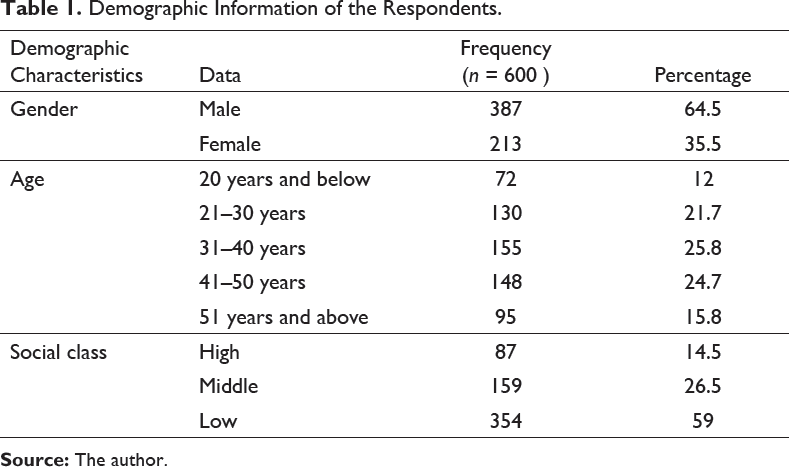
Demographic Information of the Respondents.
Data Analysis and Findings
Reliability and Validity
Although checking the reliability and validity of an observation method is a key concern in the existing literature, the current paper appointed an independent judge to classify the data (Maxwell 1992). The researcher explained the background of the present study to him. The independent judge who was an expert on qualitative research methods coded the data based on the lead researcher’s grouping and coding and agreed with 96% of it. Thus, the inter-coder reliability was found higher than the acceptable limit in qualitative studies (Perreault and Leigh 1989). On the other hand, the present paper strictly followed the Slack and Rowley (2000) study during the observation and categorisation process to check the validity of data. Additionally, the initial formed groups and codes were shown to the five grocery shopkeepers during their interviews to cross-check the categorisation of data (Maxwell 1992). This course of action found satisfactory feedback and confirmed the validity of the data.
Classification of the Observations
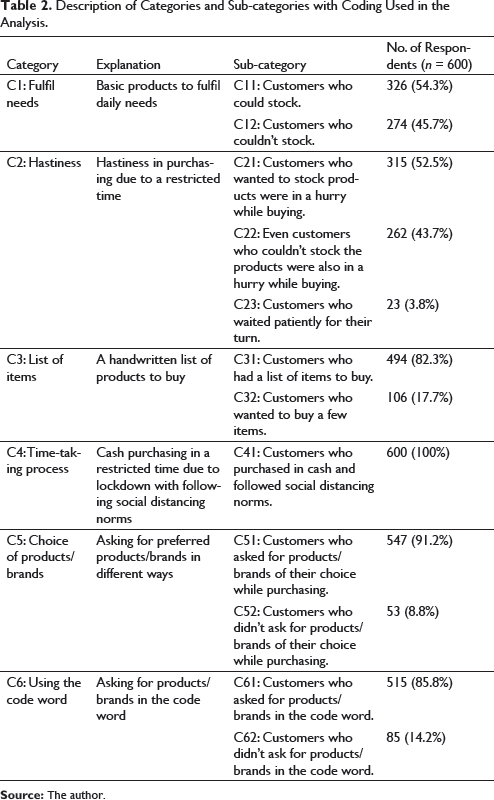
The noted observations of the 600 participants were categorised into similar themes using content analysis (Mayring 2000). However, these observations were carefully and repetitively examined to be familiar with the data before analysis. The sorting of the study data resulted in six main categories as follows:
Category 1: Fulfil Needs
The participants wanted to buy basic products to fulfil their daily needs. These basic products included wheat, flour, rice, pulse, sugar, salt, edible oil, butter, soap, detergent powder, etc. It observed that those who could afford tried to stock these products to fulfil their daily needs due to uncertainty in lockdown.
Category 2: Hastiness
Importantly, most of the customers were in a hurry while buying products. Besides, shopkeepers were also in a hurry to attain the maximum number of customers to increase the sales in a restricted time.
Category 3: List of Items
The majority of the rural customers had a list of items to buy products from grocery shops. However, shopkeepers were reluctant to touch their lists and belongings due to the COVID-19 pandemic threat. Thus, customers read it themselves to ask for the products from shopkeepers. It was easy for them to read their handwriting to save time. However, some customers struggled to explain to shopkeepers what specific product/brand they want. It happened due to a lack of clarity in the description of products/brands. Additionally, some customers didn’t come up with a list because they wanted to buy a few items.
Category 4: Time-taking Process
The customers were well aware that purchasing in lockdown due to the COVID-19 pandemic would be a time-taking process. Firstly, it was mandatory to follow the social distancing norms and then they had to buy in a restricted time. Thus, there was always a queue while opening a shop which extended customers’ waiting time. In addition, neither shopkeepers nor customers emphasised on using digital payment modes. Undoubtedly, it extended the buying and selling process adversely. All the transactions were in cash. Eventually, it forced customers to manage their buying process in a short time.
Category 5: Choice of Products/Brands
Most interestingly, the majority of customers continuously asked for products/brands of their choice even in such situation. They were reluctant to compromise with their choice of products/brands. Although shopkeepers excused them for the unavailability of products due to limited production, manpower and transportation facilities, it was difficult to convince them. Actually, the supply chain of essential products was being disrupted due to the lockdown in the pandemic. However, they still asked about a product/brand of their choice in different ways.
Category 6: Using the Code Word
Most of the customers asked for a product/brand in a code word to shopkeepers. Surprisingly, the shopkeepers also understood that code word and instantly responded in the same manner. Usually, unorganised retail shopkeepers familiar with nearby customers and their buying habits. The customers asked for a product/brand based on as follows:
Strong positioning of a product/brand in their mind Long-term satisfactory experience with a product/brand Highlighting a specific feature/benefit/quality of a product/brand Specifying a price tag of a product/brand Based on the colour of a product/brand Based on the offered quantity of a product Based on the packaging of a product My favourite product/brand
It represents their collective affection and emotions towards a product/brand then only they consider it as their favourite brand. Here, the present study expresses some remarkable code words of products/brands as were mentioned by customers in their words while purchasing. These were as follows:
White washing powder (Surf Excel quick wash by Unilever) Blue washing powder (Surf Excel easy wash by Unilever) Fairness cream (Fair & Lovely face cream by Unilever) Colgate (Colgate toothpaste by Colgate-Palmolive) Body lotion (Vaseline intensive care deep restore body lotion by Unilever) Deo (Fogg Deodorant by Vini Cosmetics) Number one sanitizer (Dettol instant hand sanitiser by Reckitt Benckiser) Number one hand-wash (Dettol liquid hand-wash by Reckitt Benckiser) Butter biscuits (Good Day butter biscuits by Britannia) Cashew biscuits (Good Day Cashew biscuits by Britannia) Gillette (Gillette Presto razor by Procter & Gamble) Coconut oil (Parachute Coconut hair oil by Marico)
Description of Categories and Sub-categories with Coding Used in the Analysis.
Reporting of Interview Data
The semi-structured interviews of five grocery shopkeepers were conducted after observing the buying behaviour of 600 customers. It guided the lead researcher to focus more on two observation categories than six. These interviews were emphasised more to explore the choice of products/brands and using code word by customers while purchasing. Additionally, their responses were same for the remaining four observation categories of customers. They admitted that during the panic situation as we had faced in lockdown due to the COVID-19 pandemic customers want to stock the products of necessities for their daily needs. Certainly, shopkeepers were also in a hurry to attain maximum customers due to time restrictions. Also, they were reluctant to touch their list of items because of the coronavirus threat. Further, they mentioned that doing business in cash with following social distancing norms is a time-taking process. They were also asked about digital payment modes. They disclosed that there is a lack of awareness of digital payment modes in the rural market. Moreover, the study presents their remarkable opinion about two main customers’ observation categories as follows:
Opinion on Customers’ Choice of Products/Brands
All the shopkeepers had the same consent that the choice of rural customers has changed now. They are more aware of products and brands than before because of excessive usage of electronic media channels. Especially, the usage of smartphones with cheaper internet connectivity has played a key role in this regard. Most of the respondents were seen with a smartphone. Besides that, their purchasing power has also increased. The government of India has tried to uplift their standard of living by various schemes. Therefore, it is not easy to offer them products them now. They don’t accept it and ask for their preferred products/brands very often. It doesn’t mean that most of them buy costly products/brands. Of course, some customers who can afford to buy premium class products/brands. Overall, the majority of rural customers don’t want to change their old tastes and preferences. Thus, they want to buy similar products/brands which they have been buying and consuming for many years.
Opinion on Using a Code Word for Products/Brands by Customers
The shopkeepers stated that the majority of customers prefer to call a popular product/brand by a unique identity. Sometimes, a product/brand is recognised based on its strong market positioning by its firm. However, very often customers recognise a product/brand based on their personal experience with that product/brand. During the usage of a product/brand customers get associated with it and always prefer to recognise it by its core characteristics. It may work long-lasting for them and companies’ branding strategies as well. They highlight the core feature of that product/brand as a code word while purchasing. Mostly, unorganised retail store owners get to know these code words when nearby customers come for purchasing. One of the grocery shopkeepers submitted an example of it. He told that due to the COVID-19 pandemic many customers asked for ‘Dettol hand-wash’ or ‘Number one hand-wash’. Actually, they asked for ‘Dettol liquid hand-wash’ made by Reckitt Benckiser in a code word. Here, it is interesting to know how they decided that only ‘Dettol liquid hand-wash’ is the number one brand. He enquired about it from many customers and found that they assume it based on their experience. A few customers revealed that when we go to visit a mall or a good restaurant in a city we find a bottle of ‘Dettol liquid hand-wash’ to use in washrooms. Similarly, we get it in the toilets of good schools, colleges, universities and private offices. Even many times we find a ‘Dettol liquid hand-wash’ bottle with low-cost liquid hand-wash inside that bottle. Due to cost-cutting sometimes these enterprises and institutes pour the cheaper liquid hand-wash in that bottle. Thus, it appears that only ‘Dettol liquid hand-wash’ is a premium quality brand among its product category. In this way, sometimes customers make their opinion about a product/brand. Here, it is also important to mention that Dettol is the pioneer brand to introduce liquid hand-wash and alcohol-based sanitiser in India with 99.9% germs protection. The shopkeepers were also asked whether customers ask for a product/brand based on its price tag. They unanimously said that it happens when a small-size packaging of a product gets popularised among them. Then they ask for a product/brand based on its price tag. The shopkeepers mentioned a few examples of it as follows:
Two rupees’ shampoo (shampoo in sachet) Ten rupees’ dish wash (small-size dish wash bar) Ten rupees’ washing powder (small-size washing powder) Ten rupees’ toothpaste (small-size Colgate toothpaste) Five rupees’ bathing soap (small-size bathing soap)
Additionally, the shopkeepers stated that when customers have a long-term satisfactory experience with a product/brand then they accept it as their favourite product/brand. Interestingly, they ask for it as ‘my favourite product/brand’ while purchasing. These are a few examples:
Give my favourite rice. Give my favourite edible oil. Give my favourite face cream. Give my favourite butter. Give my favourite biscuits.
Thus, the five shopkeepers collectively admitted that all these code words help a lot while trading in a restricted time due to the COVID-19 pandemic. Simply, they just ask for a product in a code word and we respond in the same manner, which saves our time and energy.
Importantly, the study identified 67 words based on the classification of participants’ observation and interview data. These words have been used extensively in the study data. The study employed Python to create a word cloud analysis based on their frequency to highlight the important words in Figure 1. The words that are in bold and large font size have been used repeatedly in the study data.
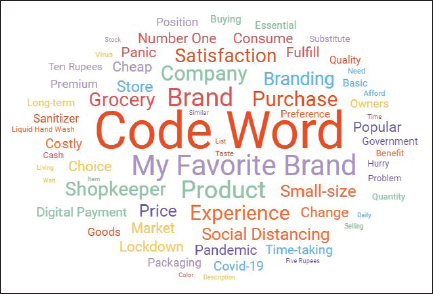
Thus, Figure 1 also supports the study findings that there are some connections between the terms such as code word, my favourite brand, branding, product, number one brand, satisfaction, experience, etc.
Discussion
The lead researcher observed the buying behaviour of 600 customers as a participant-observer during the lockdown in the COVID-19 pandemic. These observations resulted in six categories. The study found that all of the customers wanted to buy basic products to fulfil their daily needs. Most of them were in a hurry while purchasing due to a restricted period of sales of essential goods. Importantly, they had a handwritten list of products to buy for their convenience to save time. Though, some customers struggled while purchasing due to a lack of clarity in the description of products/brands between sellers and them. Moreover, cash purchasing in a restricted time with following social distancing norms was a time-taking process. Most importantly, shopkeepers, as well as customers, didn’t emphasise on using online payment modes. Yet, the majority of customers managed to buy products/brands of their choice. The shopkeepers also admitted that now rural customers are more aware of products and brands. They don’t want to change their old taste and preferences. Interestingly, they asked about their preferred products/brands in different ways and shopkeepers excused them for the unavailability of products/brands because of lockdown. One of the most important ways was they used a code word to ask about their preferred products/brands. The shopkeepers also understood that code word and responded in the same manner. Further, the study mentioned some remarkable examples of these code words. The shopkeepers shared that very often customers recognise a product/brand in two ways. Either strong brand positioning gives a unique identity to a product/brand or customers recognise it based on their personal experience during the usage. When customers get associated with the core characteristics of a product/brand it works long-lasting for them and differs from the firm’s branding strategies. Thus, customers highlight this core feature as a code word while purchasing. Additionally, customers recognise and ask for their preferred products/brands based on price tags and packaging. Moreover, sometimes customers accept a product/brand as ‘my favourite product/brand’ when they have a long-term satisfactory experience with that product/brand. These code words have been profusely used by customers while purchasing essential goods in restricted time due to lockdown in the COVID-19 pandemic. These code words facilitated a lot to customers as well as shopkeepers to manage their buying and selling activities.
Managerial Implications
The present study offers various considerable implications for firms and their managers. The first and foremost important aspect of a product is branding. It is crucial when customers and shopkeepers are in a hurry or panic situation. Currently, this situation has been observed in lockdown where customers are forced to purchase even essential goods of daily use in a restricted time due to the COVID-19 pandemic. Despite that, customers are not ready to accept substitute products/brands. Even rural customers don’t want to change their old tastes and preferences and now more aware of products/brands because of electronic media channels. Thus, they asked about products/brands in code word while purchasing to their nearby retail storekeepers. Surprisingly, it was found that these shopkeepers also understand these code words because they are familiar with the buying behaviour of their nearby customers. These code words of products/brands help both customers as well as shopkeepers to manage their buying and selling activities in a restricted time. Interestingly, these code words are nothing but an impact of silent branding on customers’ minds. The present study indicates that the concept of silent branding works in two ways. Either it helps customers to recall the strong brand positioning of a product/brand marketed by a firm earlier or to recognise a core feature/characteristic of a product/brand based on their long-term personal experience with that product/brand. The study mentioned various examples of these code words used by customers while purchasing. Undoubtedly, this could be a significant branding strategy for firms and their managers. Here, it is important to point out that when a firm works on brand positioning of a product, it may be accepted by customers but there is no assurance of its success. However, if a firm highlights a core characteristic of a product in its brand positioning that is recognised by customers based on their personal experience, it could be a successful branding strategy because it is already recognised and accepted by customers. It is possible that as a firm or marketer you might have not realised it while brand positioning. As it is disclosed in interviews by one of the shopkeepers when he asked the customers how they considered that only ‘Dettol liquid hand-wash’ is the number one brand, he got very surprising responses. Thus, the current study reveals that silent branding works long-lasting for customers and could be beneficial for firms. In the Indian market, customers still could remember the jingle and punch line of ‘Hamara Bajaj’ (Our Bajaj scooter positioned by Bajaj Auto Ltd.) even though the company had stopped the manufacturing of the ‘Chetak scooters’ long back. Companies and their managers can survey to know the preferred core characteristics of a product by customers.
Moreover, there are some other suggested key areas where firms and managers can work. The present study revealed that some customers faced problems while purchasing due to a lack of clarity in the description of products/brands. Either they were not able to explain the description of products/brands to shopkeepers or shopkeepers were not able to understand that description. Silent branding can also assist in this regard if firms strongly position a brand of a product in customers’ minds, it will go long-lasting. Most importantly, firms and managers could play a key role to promote online transactions in the rural market. They have a direct network with these unorganised retail storekeepers. Therefore, they can spread awareness by telling them the various benefits of digital payment.
Conclusion and Future Research Directions
The study tried to explore the adopted branding strategy in trading essential goods in lockdown due to the COVID-19 pandemic. The lead researcher observed the buying behaviour of 600 customers as a participant–observer in grocery shops. He also interviewed five grocery shopkeepers to cross-check the customers’ observations. The noted observations of the 600 participants were categorised into similar themes using content analysis which resulted in six main categories. Out of six categories, two are the most important which reveal that customers don’t want to compromise with their choice of products/brands even in this adverse situation. They ask their preferred products/brands in code word very often to their nearby shopkeepers. These code words help customers as well as unorganised retail shopkeepers to manage their buying and selling activities in a restricted time. Actually, these code words are the impact of silent branding of a product in their mind. It happens in two ways. Either firm strongly positions a product/brand or a product’s core characteristic itself creates a positive image in customers’ minds long-lasting. Importantly, customers recognise the core features of a product/brand based on their personal experience during the usage. It could be the quality, price, quantity and packaging of a product/brand. The study found that these code words help customers and shopkeepers both to manage their buying and selling activities in a short time. Moreover, the study highlights the key findings as follow:
Mostly, customers are a creator of a brand. They create brand name in code words based on their personal experience while using a product. Importantly, these code words are happened to be the impact of silent branding of a product in their mind. Sometimes, firms’ promotional strategies able to create a positive image in customers’ mind. Sometimes, a product’s core feature itself creates a strong brand image in customers’ mind long-lasting. When customers recognise a core feature of a product, they use it as a code word while purchasing to their nearby shops.
Nevertheless, the present study offers many significant contributions; some limitations need to be considered while generalising the results. The concept of silent branding is exploratory; hence, there is a need to work more on it in the future. Further, the study is based on qualitative techniques. To confirm the applicability of the study findings, conclusive methods could be employed in the future. Most importantly, the study data was collected from the rural market; thus, the current study should be replicated in urban markets to know their customers’ opinions. However, the study imperatively adds the concept of silent branding in the existing literature on branding.
Footnotes
Declaration of Conflicting Interests
The author declared no potential conflicts of interest with respect to the research, authorship, and/or publication of this article.
Funding
The author received no financial support for the research, authorship, and/or publication of this article.
