




Abstract
Economic policies tend to downplay social and community considerations in favour of market-led and business-focussed support. The COVID-19 pandemic underscored the need for greater and deeper social cohesion and local social support networks while highlighting that an overreliance on market forces can create social problems at times of need. Community businesses (CBs) are not for profit organisations that provide services and produce goods where the profit (or surplus) is reinvested back into that community. This article explores why CBs in England responded in a variety of ways to the COVID-19 pandemic, assesses what government policy did to help and hinder their place-based operations, and explores the observed socioeconomics of their age-related volunteer staff churn. Some CBs were ravaged by the consequences of the pandemic and associated government policies with many becoming unsustainable, while others evolved and augmented their support for and services to their communities, thereby enhancing their community’s resilience. We highlight how adjustments to government policies could enhance the sustainability of CBs, making them and the communities they serve more resilient.
Introduction
As the COVID-19 pandemic developed, national governments imposed policies requiring social distancing, limiting numbers of people congregating, and restricting travel, all consistent with World Health Organisation’s recommendations (WHO, 2020). These policies were grounded on the view that the measures would reduce the spread of the virus (Anderson et al., 2020). Social distancing measures (2 m gaps between individuals) made working and leisure activities challenging if not impossible. Travel restrictions were inconvenient as UK inhabitants were used to travelling frequently out of their immediate communities to meet friends, see family members and commute to work. In the UK, the travel restrictions limited geographical mobility to 5 miles (8 kms), which is smaller than the average UK commute of 8.8 miles (14.2 kms) (DfT, 2017). As the likelihood of interacting with another person is strongly affected by the geographical size of a community and the presence of facilities in their residential area (Van Den Berg et al., 2015), this travel restriction was particularly problematic for sparsely populated communities. Impositions of travel restrictions and social distancing measures were incongruous with the existing fabric of communities that often had a limited intra-neighbourhood interaction.
Economic policies tend to downplay social and community considerations in favour of market-led and business-focussed support, and this occurs at both the national and local levels (Nel, 2015), and an overreliance on market forces can create social problems at times of need. COVID-19 restrictions exposed significant gaps in community cohesion, reduced residents’ mental health (Banks and Xu, 2020), drove a seismic wedge into the heart of local economies (Relihan et al., 2020), affected community resilience in the UK, and stopped people meeting members of their own family. Businesses went bust, millions of workers became unemployed or furloughed (ONS, 2020), and the reliance on public sector organisations grew significantly at a time when they had previously experienced a decade of austerity. Gaps in local socioeconomic provisions emerged, from the cessation of meals-on-wheels services, to the shutting of local crèches (thereby reducing the ability of parents to go to work), to the closure of spaces where communities congregate (such as pubs and sports centres).
There is a group of businesses with knowledge of their local communities that tends to be superior to that of public and private organisations, and who have been able to fill some of the gaps in service provision during this time of need: community businesses. Community businesses (CBs) are not for profit organisations that provide services and produce goods where the profit (or surplus) is reinvested back into that community. They are place-based (Diamond et al., 2018; Somerville and McElwee, 2011), formed when community members collaborate around an opportunity or a need, and self-organise a response (Van Ham et al., 2017), thereby creating businesses that are directly accountable to their community (Aiken, Taylor and Moran, 2016). Many CBs emphasise their role in reducing social isolation (85%), increasing community cohesion (82%) and improving the health and wellbeing (81%) of their communities (Higton et al., 2019). Unfortunately not all CBs were able to respond to their community’s sharply amplified needs during the COVID-19 pandemic. By focusing on the roles of CBs and their variegated responses to the COVID-19 pandemic, this article exposes the experiences and highlights the effects of government policies on CBs’ ability to respond to the needs of their local communities during this critical time. We draw on semi-structured interviews with 31 CBs across England before and during the pandemic to identify forced and unforced change to the structures that affected their ability to meet community needs.
This article begins by reviewing the literature on the roles of community businesses and their ability to fulfil local needs. The following section outlines the methodology used to collect data and undertake the analysis. A discussion of findings follows which emphasises how CBs responded to the pandemic and how government policies assisted or inhibited CBs’ ability to fulfil their community’s heightened needs. Finally, conclusions are drawn that underscore how policymakers could adjust their stance and enable CBs to fulfil their communities’ demands and reduce pandemic-related hardships.
Heightened roles for community businesses during COVID-19
There are currently estimated to be 11,300 CBs in England, employing 37,800 people and 148,700 volunteers (Higton et al., 2021), and each has a focus on their community (Frey et al., 2012; Johnstone and Lionais, 2004). Community businesses share a common purpose: to produce positive economic, social and/or political impacts for their communities (Bailey, 2012; Pearce, 2003; Peredo and Chrisman, 2006). CBs operate under a variety of legal and governance structures depending on the purpose of the business and the needs they seek to fulfil, ranging from cooperatives and community benefit societies, to community interest companies (Pearce, 2003). Community businesses have a diversity of business structures, vary hugely in their levels of turnover, and have different propensities for growth (Swersky and Plunkett, 2015). The majority of CBs are small scale (Healey, 2015), such as volunteer-run community shops or bus services, and seek revenues to cover their costs in order to provide a service to communities. However, some CBs are much larger with turnovers in excess of a million pounds, acting as complex community anchors or regeneration organisations, and offering a wide range of services such as housing, business and health. Some CBs were formed in response to UK government austerity following the 2008 financial crisis, with 13% of CBs delivering services previously provided by local councils and health services and 59% operating a community hub (Higton et al., 2019).
While the term CB is used within the UK, the concept of a community-based business or enterprise is not unique to the UK, with several studies exploring the features and sustainability of similar community enterprises across Europe (Dentoni et al., 2018; Hertel et al., 2019; Igalla et al., 2020; Lumpkin et al., 2018). A comparative study between CBs in the UK and Community Development Corporations in the US (Varady et al., 2015) highlights differences between approaches to urban regeneration, with UK CBs adopting a wider approach to regeneration than in the US where the predominant focus is on housing.
Common to all studies across the world is the recognition that CBs operate within their own geographical ecosystem and it is this ‘placial embeddedness’ (De Beer, 2018) that makes CBs uniquely positioned to understand and meet the needs of their community. It is this strength – the combination of place and purpose – which authenticates their idiosyncratic nature and makes inter-CB comparisons problematic. The geographical embeddedness and the direct accountability to their community (Ebrahim et al., 2014; Kleinhans et al., 2019; Molecke and Pinkse, 2017) places CBs in a unique, almost monopolistic position within their local economies.
The global outbreak of the COVID-19 pandemic left many citizens feeling isolated within their own local communities. In the UK, shielding measures removed support structures that enabled people, many vulnerable, to meet and socialise. Mass furloughing and redundancies drove families to foodbanks and children were expected to be home-schooled irrespective of the ability and availability of parents or access to computers and the internet (DfE, 2020). Support structures and mechanisms, such as taking a bus, meeting family and friends, and taking part in sporting activities, were removed leaving people, especially the elderly, feeling cut off and lonely. As CBs are intricately woven into their communities (Ratten and Welpe, 2011) and accountable to that community (Finlayson and Roy, 2019), they have unique insights into the capacity and resilience of local individuals to cope with additional pandemic-related stressors. They can ensure the efficient and effective allocation of resources by garnering the support of volunteers (Van Meerkerk et al., 2018). Their knowledge of individuals’ needs gives CBs the ability to utilise resources in a manner that would not be possible for statutory organisations (Johnstone and Lionais, 2004).
CBs are agile and can respond quickly to the needs of their communities to produce the maximum social benefit (Dentoni et al., 2018). With the elderly being particularly vulnerable to the virus, the propensity to venture out for essential goods and social interaction varied significantly across the population and accentuated social inequalities. The pandemic created extra needs; for instance, 46% of adults who were advised to shield by the government did not leave their house at all between the lockdown in March 2020 and the end of June the same year (ONS, 2020). The ONS (2020) also report that video / telephone calls with family and friends, prescription deliveries and food deliveries were the most common things that helped people who needed to shield during this period. At the same time, more than one-third (37%) of the shielding population reported a worsening of their mental health and those receiving treatment for mental health problems were more likely to report a deterioration in their condition since receiving shielding advice (ONS, 2020).
The extent of the personal impacts of the lockdown can only be observable from a very close proximity. Word-of-mouth and participant observation are perhaps the only effective way to gain an understanding of need, especially at a time when people’s usual social and familial networks were significantly affected by travel restrictions and social distancing requirements. In many cases, only a family member, friend or local CB is intimately connected enough to understand needs. Managers of private sector firms are most often geared towards objectives that further the sustainability, market share or growth of their firms and may prioritise profitability. The early part of the pandemic coincided with a cut in consumer spending, with household savings ratios increasing from 6.6 to 8.6% (ONS, 2020). This cut in demand may be due to reductions in the purchasing of entertainment and luxuries rather than a reduction in purchasing essentials. What is particularly concerning is whether the most vulnerable in society were able to purchase essentials and benefit from social support due to social distancing restrictions. There were therefore critical gaps for CBs to fill during the COVID-19 pandemic.
Food and medicine deliveries, trips to local chemists, running errands, and sometimes simply putting the rubbish out for refuse collection were all duties undertaken by members of CBs in order to assist and enhance the resilience of their fellow community members. What remains unclear is whether CBs were universally able to fulfil the needs of their communities, provide unconditional support to those who needed it, and support those members of society most in need. Were CBs the right organisations to step into this critical provision gap? Could they step in even if they wanted to, and were they agile enough to respond to the needs of their communities? Furthermore, it remains unclear how government policies affected the abilities of CBs to provide support, whether such policies helped or hindered, and whether other confounding effects, such as the furloughing scheme, had unintended effects on community resilience. This article summarises an investigation that sought to answer these questions through the collection of primary data. The remainder of this article catalogues the content of semi-structured interviews with CB managers and provides an assessment of their ability to respond to the needs of their communities during the lockdown and of the barriers to and enablers of CBs during the COVID-19 pandemic.
Methodology and data
We adopted a qualitative research strategy using semi-structured interviews with community businesses leaders to examine the breadth of responses of CBs to the COVID-19 lockdown and the reasons why they responded in different ways. Semi-structured interviews enabled the assessment of a core set of factors while permitting the exploration of other factors deemed important by the interviewee. The sample began with contacts made through Power to Change, a charitable trust that supports and develops community businesses in England, and expanded via snowball sampling that prioritised sourcing rich data from suitable respondents (Gilbert, 2005). All businesses were contacted directly, initially through an email and then with the participants via email and telephone. The viability of CBs, experiences of respondents, and the position of the CBs within their own market were unknown in advance and hence not used for sample selection.
A final sample of 30 CBs was selected to represent the broad range of CBs at different stages of their development, ranging from nascent businesses (trading for less than a year) to established businesses employing more than 80 people. The sample reflects CBs within the categorisation of CBs put forward by Swersky and Plunkett (2015): business savers, asset transfers, cross-funders, and community start-ups. Higton et al. (2019) segmentation of the CB business market produced seven broader categories: venue, public facing support services, economic/business services, arts/culture, retail, manufacturing/production, and other. The sample of CBs in our study represents CBs from across these primary business categories and also from across the English regions. 1 The participants in our study reflect the make-up of people supporting CBs, with the sample of interviewees split about equally between paid and volunteer roles. Interviewees aged under 40 were the smallest age group represented in the study with six participants, of which only two were volunteers. The rest of the interviewees were split equally, with 24 people in each of the 40–65 and over 65 age groups. Only three interviewees of the 40–65 age group were volunteers and the rest were employed by the CB. Six members of this age group lived in the area served by the CB while three other members had previously lived in the area and developed strong emotional ties with the community. Even though this group were employed predominantly by the CB, many expressed a strong emotional attachment to the locality.
Most of the over 65 year old group were volunteers, with only one member of this group in a paid role, and the vast majority lived within the area served by the CB. For many, their motivation was helping their local community. About two-thirds (one-third) of the CBs were located in urban (rural) areas; community shops were all located in rural areas, which reflects the national picture. 2
In order to understand the full range of issues in appropriate depth, semi-structured interviews were considered to be more appropriate than questionnaires. Brown (2010) finds significant contradictions between perceptions and reality using a mixed-methods approach. She finds that the positive views received via surveys sometimes contrast strongly with answers in interviews. Moreover, surveys are less able to capture nuances such as the inter-relationships between factors, the relative weighting of factors in decisions, and their potential cumulative influence (Lightbody, 2009).
The semi-structured interview format enabled exploration of a stated range of issues in a depth acceptable to the interviewee. The method permitted comparisons of core-topic data, and allowed for emergent reflective accounts of participants’ perspectives. Developing a rapport with the participants enabled deeper examination of underlying social factors that exist within complex communities. This article reports on the third round of interviews conducted over a 2-year period with individuals working within 30 CBs, and draw on our only set of interviews conducted during the COVID-19 pandemic. Earlier interviews were conducted face-to-face, but due to social distancing and travel restrictions all of these interviews were conducted online or over the phone.
Interviews lasted for an hour on average. Semi-structured interview questions covered the effect that the lockdown and the pandemic had on their CB and what support mechanisms could be used to support them during this period. All of the CBs were from English regions, so were governed by the same national level regulations and all had access to the same potential external grant funding, whether they accessed it or not.
Data were initially subjected to thematic analysis based on the interview schedule, and subsequently, the data were coded into emergent themes. The analysis focused on identifying experiences and changes that resulted from the onset of the COVID-19 lockdown. The results are divided into themes that developed from the thematic analysis and relate to CB experiences immediately before and during lockdown.
Findings
This section reports the prevalent experiences from an extensive list of issues that interviewees perceived affected the ability of their CB to respond with dexterity to the needs of their communities during the COVID-19 pandemic. Research highlights reasons why some CBs had to close, how they had to adapt, and what barriers restricted their ability to respond at this critically important time. Four key themes emerged from an analysis of the interview data: achieving purpose at a time of financial turbulence; the ability to be agile; the dynamics of volunteers; and new partnerships and the future of CBs.
Achieving purpose during government imposed lockdown
The COVID-19 lockdown fundamentally altered the ability of CBs to achieve their defined purpose of serving their community. In some cases, the lockdown heightened CB leaders’ sense of purpose and the need for the CB within the community, but social distancing and lockdown rules precluded the achievement of that purpose, leading to feelings of frustration and disempowerment. In other cases, the role of the CBs was decimated and leaders had a difficult choice to make concerning whether the CB should continue to operate or close. Fortunately for the respective communities, the majority of CBs that participated in this study chose to continue to support their communities even though some were operating at a loss. The pull of the social mission was greater than the need to balance the books: “Our charitable objectives are to support our community, their wellbeing, health and happiness. So we were in this incredibly difficult dilemma that I needed to or we needed to reduce our costs as much as possible. We needed to up our income, what was left of it, as much as possible, and yet we had to continue to operate” (Male, employed, 40–65)
Like many businesses during the lockdown, CBs made use of the financial support mechanisms that were available to them from central and local government. Apart from the community shops, all of the CBs in our sample who were employing staff used the UK government furlough scheme to retain their employed staff. Other CBs accessed small business grants from their Local Authority to help to pay their fixed costs. These funds were not always easy to access, and there were areas where CBs struggled to get funding, as they did not fit the restrictive criteria. Some CB development trusts helped their small business tenants to access funding, which benefited both the business tenant and the CB. But the financial position of CBs depended on the type of business that they operated and the percentage breakdown of income from different sources and activities. CBs funded from grants were actually better off in the lockdown, as many funders continued to sponsor community activities; this runs counter to the narrative that CBs pride themselves on their independence and ability to respond to the needs of the community who provide their income.
Many CBs tried to avoid embracing the government’s loan scheme, as they saw this as storing up problems for the future, with one interviewee stating that “87 percent of our income was generated by trading, so when the command came to lockdown … we lost practically all of it, and we’ve now got a cash flow which we update weekly” (Male, employed, 40–65). Funding shortfalls were made more problematic when their trading incomes collapsed. This significantly reduced their ability to achieve their charitable objectives of providing services to vulnerable people in their community. One CB leader expressed their concern for the vulnerable people who remained in the community, but were no longer able to visit the community centre. Other CBs highlighted the growing level of food poverty and the increased local demand on foodbanks. The CBs’ current financial deficit may have long lasting negative effects on their ability to meet their aims and operate their charitable activities: “We think we’ll lose at least 25 percent of income on the trading company this year, which predominantly will mean that the trading company won’t be able to donate to charity” (Female, employed, 40–65).
But while some CBs incurred significant reductions in their income, others saw their incomes stop completely. With debts rising, some CBs face closure, with one interviewee stating that “we’ve got no trading income coming in at all because virtually everything had to be frozen … This three-month closure has cost us 150 grand” (Male, employed, 65+).
While many CBs are used to combining income sources (Hull et al., 2016), there is an important funding gap that could be filled by central and local government to support the CBs continued contribution to the operation and life of communities. CBs adopt roles and responsibilities that enhance their communities’ level of resilience. Supporting CBs in this way may reduce the need for public bodies to fund expansions in their mental health and other support services and to create substitute community anchors. Although the government’s furloughing scheme enabled the retention of employed staff, which ensured local knowledge of local needs were not lost, other CBs needed extra funding to meet increased demand for their services. There was an under-supply of essential time-intensive personal support and community services at a critical time. Such funding shortfalls for socially beneficial CBs may have diminished the services provided and worsened the social effects of the pandemic. In line with the findings of Wallace (2005), if government wishes to ensure that communities are resilient during times of crisis, then they need to focus financial support on those CBs that provide lifeline services to communities.
Ability to adapt to new circumstance
The effects of the pandemic on revenue streams differed dramatically, with some CBs benefiting and others having to reassess their resources and ability to achieve their purpose. Some CBs increased their trading incomes significantly during the pandemic; for instance, community shops reported takings were significantly up on what they would normally be, partly because of consumers’ desires to avoid potentially densely populated supermarkets (Rybaczewska and Sparks, 2020), and because of the ability and agility of workers in and leaders of CBs. Despite greater demand, all the community shops reduced and changed their opening hours to compensate for the reduction in volunteers and to give them time and space to put together or strengthen their online ordering system. One community shop set up a backroom ordering system and customer accounts with 30–40 people regularly placing orders. Some shops went from barely breaking even to making a profit in a few weeks, as exemplified by one interviewee who stated that “… we have more than doubled our turnover in the last four weeks, in fact some days it’s been three times as much as normal” (Male, volunteer, 65+).
But the majority of CBs had to reflect on their business model and figure out what would enable them to continue to provide services to their communities. They had to be agile while at the same time noticing and responding to the needs of their communities and to new vulnerabilities: “I think in the last few weeks we’ve really kept an eye out. There’s one or two very vulnerable people who are sort of slightly under the radar and we’ve been able to keep an eye on them and possibly signpost … it’s not signposting them to the help, its signposting the help to them. Sometimes people won’t ask. They don’t even realise they are entitled to ask” (Female, employed, 40–65).
Main business activity and the status of CBs during the pandemic.
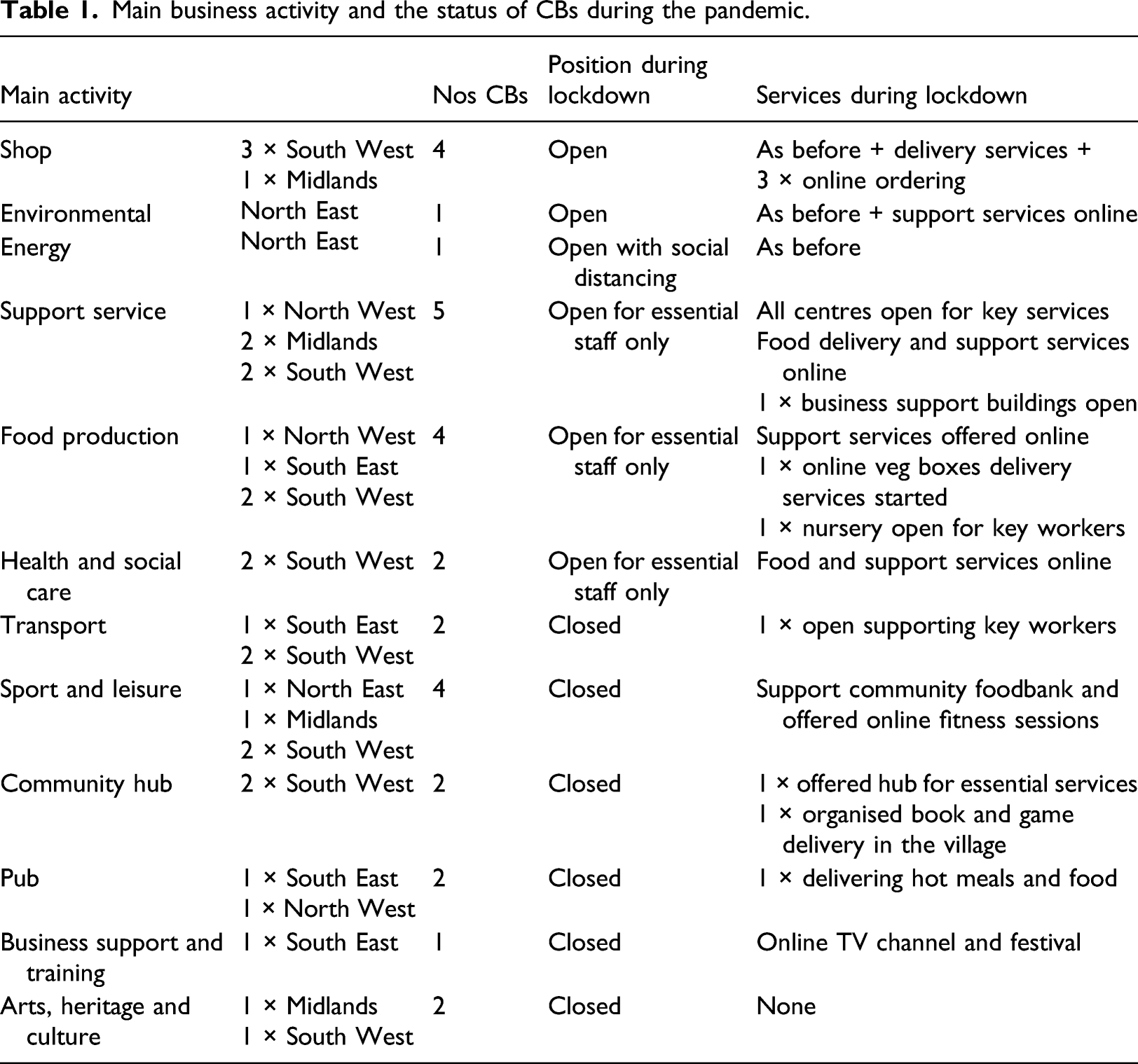
Whether a CB kept their premises open to the public depended on the type of service offered, their infrastructure, and the effect of social distancing restrictions. Some shops selling essential items for regular consumption, such as food and medicine and fuel for heating, remained open, as was permitted under government policies. Many of those CBs were able to expand their service provisions through other means, such as increasing the proportion of online services, or providing delivery services instead of depending on collection. Switching this part of the business model incurred additional costs in terms of money and time, but these costs were surmountable due to their priority to serve their communities. This agility required tenacity to self-train, agility to transfer understandings from one platform to another, and information, which was not necessarily freely available nor was it obvious where this information could be sourced.
A second group of CBs had to close their doors to the public, but remained operational in order to meet the needs of essential workers. These CBs included online food ordering, vegetable box deliveries, and essential transport services, but otherwise their business models precluded continuance. Production to meet much lower levels of effective demand meant that these CBs generated very little revenue, but their desire to support essential workers and continue to meet part of their stated purpose resulted in their continuation. It is unclear what will be the long-term effects of this immediate choice. There is a clear need here for public funds to support these services for essential workers.
A third group of CBs closed their face-to-face provision and switched to online services to maintain a response to the needs of their communities, which in some cases was unrelated to their previous offerings. Sports and leisure clubs switched to support community foodbanks; community hubs switched to delivering books and games; pubs started delivering cooked food to the most vulnerable. One pub and some support services in our sample set up services delivering free food to those most in need that was partly subsidised by a paid service to those who could afford it: “We have repurposed what we did because X is always in crisis, so we can handle a crisis” (Male, volunteer, 40–65).
A fourth group of CBs, covering most transport providers (to non-essential workers) as well as those focused on arts, heritage and cultural provisions, closed completely and their revenue reduced to zero. This group of CBs with ongoing overheads to cover, such as vehicle or building rental contracts, could be forced into bankruptcy at a cost to their entire community: “As a community business, it is really at degree zero. Those of us in management, the trustees and other employees were continuing our regular meetings but doing it remotely on zoom or whatever as best we can... We have no indication at the moment when we might resume. I hope we get a fair amount of notice. We won’t be able to resume the next day. So that’s where we are, we are in stasis” (Male, Volunteer, 65+).
CB closure results in the loss of local knowledge and understanding of the needs of their community, but it is also precisely that knowledge and understanding that gives CBs the ability and agility to respond quickly and appropriately to the changing needs of communities (Dentoni et al., 2018). One anchor organisation used its community development team to organise the community response in their area, allocating roles to the 1100 volunteers that stepped up to help, while a community shop utilised a group of local volunteers through Facebook: “You put (out) a message to say you’ve got five deliveries around the village at about 3:30 in the afternoon, and in the first couple of weeks we were getting Angels fighting over it because they want to get out. … They want to do something. So … our deliveries are all done now by them and we don’t have to manage that at all and we do it by Facebook; without it I don’t know how we would do it” (Male, volunteer, 65+).
This change in business model from collection to delivery and from in-person to online purchase and payment required an underlying ability and drive to adapt. CBs tend to be based around face-to-face interaction and personal engagement, but social distancing stopped this and forced people to actively consider the enhanced use of technology. As a result, some CBs began holding staff meetings online or on the phone. Many CBs began to utilise digital platforms to maintain direct contact with their communities, ranging from Facebook to Zoom, and have updated their websites and set up separate email addresses to enable online ordering. Some CBs set up online services for those with mental health issues and learning disabilities, and included a telephone option for those without computer access or skills. Zoom-based gym classes were developed by providers to keep communities fit and active. Farmers’ livestreamed the feeding of their animals directly into the homes of children with learning disabilities. Instead of cancelling a booked community festival, one CB took the festival online and created a Facebook TV station broadcasting for 10-hours a day and bringing a range of arts, cultural and wellbeing activities direct to their online community. Although CBs were by no means unique in this technological switch, they have needed to be creative to implement low-cost technological solutions that are accessible and enable them to remain in touch with their communities: “…we’ve redesigned all of our services so it’s all online. It’s telephone support, it’s video support, and other things. And we have got hugely involved in the local COVID response” (Male, employed, 40–65).
Underpinning these changes are the individual motivations and the capabilities of those who worked within CBs. Their experiences, tenacity, and belief in the mission of the CB ultimately enabled them to break through barriers and continue to provide a service to their communities. All of the shops in this study remained open by imposing new social distancing measures, and they all felt that their communities had been grateful for this commitment: “We have had to change the way the whole organise is run, you know. Really massive accelerated change process really. And I think you know, there are negatives and positives” (Female, employed 40–65).
The continuance of CBs should not be taken for granted (Wallace, 2005). Financial support, such as central government funds to subsidise the provision of services for essential workers, is required, but there is also a need for local authorities to reimburse CBs for their costs in providing food and other services in support of vulnerable members of their communities. The ability of CBs to adapt was reliant on both financial support and support from local residents and councils (Avdoulos, et al., 2020). Governments could also increase the guidance and support offered for the adoption of technologies through heavily subsidised training and refresher courses. Debts specifically incurred by CBs during the lockdown could be written off as a reward for their continued support of vulnerable people and to enhance community cohesion, whilst reducing the likelihood of their closure post-lockdown.
Changing human resources
The literature recognises that CBs are able to garner support of volunteers (Valchovska and Watts, 2016; Van Meerkerk et al., 2018) to ensure an efficient and effective allocation of resources. Many CBs in our sample were heavily or totally reliant on volunteers. In earlier rounds of interviews before the pandemic, many CBs reported concerns about their sustainability as volunteer recruitment was becoming more difficult. Relying on the skills of an older volunteer workforce was often discussed pre-COVID-19. During the pandemic the conversation changed as interviewees discussed the need for older colleagues and those with underlying health conditions to self-isolate. One CB found their volunteer numbers reduced from 40 to 15 at the start of the pandemic: “We’re sending a weekly blog to volunteers to try and keep them interested for when they return, and a lot of them have emailed and said how sad they are not to be driving but they quite understand and want to get back” (Male, volunteer, 65+).
The interviewees revealed a universally accepted belief in the value of CBs in service to their communities (Bailey, 2012). However, there was also strong concern voiced by some who felt that it was not morally right to keep a CB open and risk the health of the older volunteers: “There was some opposition; some of the committee wanted us to shut. Some of them said, the younger ones, thought that us oldies should just back off and leave it. We didn’t like that idea at all, so three of us just worked out what to do” (Male, Volunteer, 65+).
While many volunteers wanted to return, many CBs put in extra protection to ensure their colleagues’ safety, while being realistic that some volunteers would not be able to return: “I know that a lot of them are missing it because I’ve been keeping in touch with a lot of them and they’re all saying it would be great to come back … depending on what the situation is at the time, whether they feel that they can safely come back” (Female, Volunteer, 65+).
An encouraging finding is that the pandemic led younger people to take a more active role in their communities. This was partly due to the government scheme allowing furloughing of staff in mainstream work, which enabled furloughed workers to volunteer and to help CBs. New and less experienced volunteers were looking to fill their time and appeared to have a genuine desire to become more involved with their communities by working in shops, foodbanks and delivering shopping to vulnerable, self-isolating community members. Some new volunteers then utilised their IT and business skills to create or strengthen the CB’s online presence. It is hoped that some of these younger volunteers will continue to stay involved with the CB in some capacity and inject new ways of working and experiences into the CB: “We’ve probably got less than half the number of volunteers that we had before … but probably a quarter of these are brand new (volunteers) who are all at work normally, so you know they couldn’t have done it (before)” (Male, volunteer, 65+).
An unintended consequence of the UK government response to the pandemic was that more volunteers were available to assist community initiatives and to bring together neighbourhoods. Before the pandemic a perceived lack of social incentive to contribute to CBs and to enhance community cohesion, coupled with the need for paid work, precluded greater engagement with CBs. A major contributor to the increase in the number of volunteers was a bi-product of the government furloughing scheme. The furloughing scheme paid 80% of workers’ wages whilst explicitly barring them from contributing to their usual place of work. This provided people with paid free time, enabling them to contribute to activities that they valued. Government could consider different ways to enable this to continue after the pandemic crisis (Valchovska and Watts, 2016).
New partnerships and the future of CBs
Many volunteers chose to play a part in responding to the pandemic by contributing time and effort to their communities. The interwoven network of CBs and other instigators of socially benevolent activities is burgeoning and many CBs have become part of a much bigger web of initiatives to support communities. Statutory and other organisations are beginning to understand the scope and scale of the work undertaken by CBs in their communities, evidenced by the positive, though unintended effect of government policies: “So we’re one of many X Council hubs where community organisations have stepped forward to volunteer to become a hub for X Council and the NHS and … (help) residents that are shielding that can’t go out for 12 weeks because of underlying health issues. We support them with shopping, prescriptions, paying their bills, just that type of thing really” (Male, employed, 40–65).
Optimistic members within CBs expected that the pandemic would lead to more people engaging with them in the future, as partners and clients. CBs are often the main anchor organisation within a community and they collaborate with a range of partners (Vestrum et al., 2017) enabling them to help to direct charity and statutory agencies to where the support is needed most. Many CBs utilised their premises and mobilised their staff for food distribution and online and telephone support for those most isolated. The pandemic has emphasised to a larger range of people the key roles that CBs play in providing goods and services in their communities, with one interviewee stating that “There is an awareness now of how important your … local businesses are, and that’s really, really nice” (Female, employed, under 40) and another commenting that “…organisations across the whole country … have got stuck in and done stuff, and hopefully people will remember them and support them” (Male, volunteer, 40–65).
Alongside this optimism is the sobering knowledge that many members of the CBs in this study took time to reflect on what their CBs will look like in the future and ask questions about what life post-COVID-19 will look like in their communities. This could mean taking some difficult decisions around staffing levels and limiting or changing the services that they are able to offer. Many online and delivery services will continue, but uncertainties are anticipated as customer behaviours have changed, with one interviewee commenting that “The complicated thing is working out what’s going to happen to people’s behaviour. Are they going to come back? What do we have to change in the longer term?” (Female, employed, 40–65).
CBs may have to change their income generation model again and seek more grant funding, which proved to be more secure during the pandemic. The future might require different ways of providing services, such as continued online support, that might not be the most effective approach for the recipients of the support services, and may affect (positively or negatively) the ability to CBs to identify the more vulnerable in our communities. CBs will need to continue to be agile and adaptable and look for new opportunities to meet the needs of their communities: “… it’s given us a chance and will give us a chance to relook at what we do … and also the weird thing is (that) it might be better for our business, because we are reaching lots of people who would never have used us for whatever. Maybe the Meals-on-Wheels will carry on for a long time” (Male, volunteer, 40–65).
There was a significant impact on the individuals who were running and supporting CBs, and the ways they worked altered dramatically. The level of stress and worry that people faced trying to keep their businesses open and furloughing other staff caused many sleepless nights. This was an energising experience for some, while for others, it was a very challenging time to manage operations: “I don’t think we slept, we hardly ate. X and I lost over half a stone each … We are living on adrenaline and we’re just beginning to calm down now to be honest. So it’s, I hate to say, it’s been a very exciting period of time and only now does the horror of it hit you, you know, when you come down from actually just organising and managing stuff which has been great” (Male, volunteer, 65+). “The fear that seven years of graft and hard work in building up X, to what we’ve built it up to, and being on the verge of something really great, and to the fear of having all that snatched from you because of the fear from the unknown as to where we are going to be in six months’ time … I’ve no idea of whether I am going to have any customers coming back and how long it will take or how long we’ll survive this, and whether or not we will survive. The despair that that will bring to so many people if we go under” (Male, employed, 65+).
Many CB leaders were not used to working from home and the changes in working practices led some to question their role within the organisation. This reflection coincided with some stepping back from the day-to-day running of the organisation to take a strategic approach. Some CB leaders report feeling guilty at leaving other family members to look after children while they worked in another room. Their sense of guilt also extended to other members of their CB team in the front-line delivering services. One interviewee who worked in a CB centred on sustainable food production described the pandemic as a “shape of things to come … it has to be a wake-up call to say this is what our future could look like” (Female, employed, under 40). While other CB leaders found that remote working had improved the way that they communicate with their teams, with another interviewee stating that “we are having … staff meetings really regularly on zoom and it feels like … although everyone has had to totally disperse and go to their homes … the teamwork has ... improved. It’s really odd” (Female, employed 40–65).
Economic policies tend to downplay social and community considerations in favour of market-led and business-focussed support (Nell, 2015), but if society and the government wish to maintain community businesses then they must support their initiatives, make positive change easier, and enable CBs to continue to provide an invaluable service to communities. Simply relying on the goodwill and motivation of CB leaders to provide support to vulnerable members of our community may be short-sighted and detrimental to the lives of our communities in the long-run.
Conclusions
Community businesses form when community members collaborate around an opportunity or a need and self-organise (Van Ham et al., 2017), and they are directly accountable to their community (Aiken, Taylor and Moran, 2016). CBs are by their nature embedded within (Ratten and Welpe, 2011) and accountable to the communities they support, providing them with unique insights and capabilities to provide services at the individual level of need (Finlayson and Roy, 2019). During the COVID-19 pandemic, CBs revealed themselves to be well placed to respond to emergent crises. While the lockdown during the pandemic strengthened the CB’s sense of purpose, not all of them were able to respond as rules halted their activities. Individuals’ sense of mission exceeded economic concerns, and many CBs innovated to adapt and meet their community’s needs.
The idiosyncratic nature of CBs, their rootedness to place (Somerville and McElwee, 2011) and their purpose in creating positive outcomes for their communities (Swersky and Plunkett, 2015), makes it very difficult to make comparisons between CBs which are situated within a similar geographical area. Whilst community enterprises, with similar aims and business models exist in other countries (Hertel et al., 2019) the context within which these businesses operate will be very different making it difficult to make direct comparisons between them and CBs in England. Future international research into how CBs or community enterprises responded to the pandemic may highlight similar adaptations and challenges to those found in this research, but the context and levels of both community and financial support are likely to be different.
Human resources changed during the pandemic. Due to their nature, CBs are often staffed and led by volunteers (Van Meerkerk et al., 2018), with many CBs totally dependent on a voluntary workforce. Some CBs initially struggled for volunteers, as the predominantly older workers they had relied on self-isolated during the pandemic. The government furlough scheme inadvertently gave younger people the opportunity to offer their skills to these organisations. The pandemic was a stressful time for some organisers and it took them away from their families, so some will step back when things settle, and a question remains over whether new workers will then continue to contribute or even increase their contribution to the activities of CBs. CBs may see a reversion to fewer habitually contributing socially benevolent older workers. Government policymakers could examine enhanced individual support to enable and encourage ongoing engagement in locally focused activities for the benefit of communities. The furloughing scheme paid 80% of workers’ wages whilst explicitly barring them from contributing to their usual place of work, and this provided those workers with paid free time, enabling them to select and contribute to activities that they value most. The government should consider different ways to enable this to continue after the pandemic.
The resilience of CBs was linked to the nature of their service. We identified four response categories: those able to keep premises open to all, which in our sample included shops and utility providers; those only open to essential staff, which in our sample included transport and mental health services; those who had to close premises but could innovate and offer alternative services, which in our sample included those community hubs who could switch to different support services such as food or books and games delivery; and those who closed altogether, which were predominantly the meeting places for arts, sports and pubs who were unable to find alternative roles due to social distancing restrictions. Agility in reconfiguring resource to meet different responses requires retraining and guidance. It appears cost effective for government to make provision for knowledge and training services in support of businesses to enable continued value creation with current resource.
Financial resource strategies to assist CBs will require some consideration going forwards. In the UK, one-third of charitable income is from government funding (Keen, 2015) and such resource dependency can shift a charity from its core mission (Bingham and Walters, 2013). Most CBs act as businesses and hold dear their financial independence as it forms part of their mission; money comes from their community and goes back to support their community. Many CBs avoided government loans during the pandemic, as these were seen as a source of future problems. However, a counter narrative emerged as some CBs’ incomes dropped during the pandemic. Those CBs with grant funding continued to receive support and could provide services and retain staff, while those without funding support had to adapt or potentially face closure. Government has an opportunity to provide support for these community-focused businesses, which in the near term could be through the creation of a fund to support CBs that are struggling to survive. In the medium term, the government could establish a grant (not a loan scheme) for community businesses that would provide resilience during times of crisis, so that services to communities can survive with resilience and quickly become independent again.
The pandemic highlighted the agility and capability of CBs and the passion people have for their mission. There is hope that the pandemic heightened the recognition of the importance of the positive contributions of CBs to their communities, and that this recognition will remain high. Many statutory organisations began to understand the scope and scale of the offerings of CBs as an integral part of supporting communities in need. But this hope is tinged with scepticism. Leaders realised that they may have to adapt again if support recedes, and they may need to seek grant funding in a financially constrained environment. In other areas, the future might require a permanent change to provide continued cost-effective digital support, but this may not be optimal for meeting local need as some community members’, including those who are most vulnerable, have limited or no access to the internet. Society can choose to sustain, support and buttress community businesses that assist the most vulnerable and enhance a community’s resilience, or it can choose to take a chance and hope that community businesses will remain in existence when the next pandemic arrives.
