




Abstract
Background
Self-efficacy, the belief in one’s ability to succeed, plays a crucial role in learning, consistent practice and performance in skill-intensive fields. Bharatanatyam, a classical Indian dance form, requires high levels of technical precision, artistic expression and physical endurance. While research in sports and Western dance has shown that self-efficacy enhances performance, there is limited evidence in Indian classical dance, and no validated self-efficacy tool specific to Bharatanatyam exists. Standard scales do not capture the cultural, physical and expressive dimensions of Bharatanatyam. This gap in measurement limits researchers’ understanding of dancers’ confidence levels in specific performance domains.
Purpose
This study aimed to develop and validate a self-efficacy scale tailored to Bharatanatyam dancers.
Methods
A 20-item scale was developed and validated, categorised into four domains: technical skills, expressive abilities, performance readiness and overall confidence. Items were rated on a five-point Likert scale. Content validation involved expert review (n = 6), focusing on item relevance and clarity. Experts evaluated each item, and feedback was used to refine the tool. As a part of initial validation, Cronbach’s alpha was calculated to assess the internal consistency reliability of the 20-item scale.
Results
Experts unanimously agreed on the relevance and clarity of all items. The scale demonstrated strong content validity, with a content validity ratio of 1.00 and Item Content Validity Index values ranging from 0.83 to 1.00, indicating accurate reflection of key performance areas in Bharatanatyam.
Conclusion
The Self-Efficacy Scale for Bharatanatyam Dancers developed is a contextually relevant and valid tool for assessing dancers’ confidence across performance domains. It has potential applications in the design of psychological support in classical dance education.
Keywords
Introduction
Self-efficacy refers to an individual’s belief in his or her ability to perform a specific task, 1 achieve goals, face threats, regulate emotions, reach out for support, utilise the tough environment and invest in their growth.2, 3 High self-efficacy leads to persistence and resilience, while low self-efficacy frequently causes avoidance and lowers performance expectations.
In traditional performing arts, especially Bharatanatyam, self-efficacy is important in maintaining technicality, expressiveness and physical fitness for successive taxing performances on stage. Self-efficacy is commonly assessed with standardised questionnaires like the Self-Efficacy Scale by Sherer et al., 4 which measure general and social self-efficacy. In dance, the Self-Efficacy Scale for Dancers (SESD) has been designed and validated for the measurement of the physical and psychological self-efficacy in ballet dancers aged 10–19 years 5 and demonstrated good psychometric properties. There is an evident gap in the literature: no instruments have been designed to measure the self-efficacy of Bharatanatyam dancers. Addressing this gap, the current research presents a rigorously developed and validated self-efficacy scale specifically tailored for Bharatanatyam dancers, thus providing an organised way of examining and interpreting self-efficacy amongst Bharatanatyam dancers.
Assessing self-efficacy in this domain may allow for an understanding of the performers’ self-confidence concerning performance constituents and personalised training methodologies. But as beneficial as self-efficacy is, it is also worth a reminder of how overconfidence can lead to complacency, and ultimately the suppression of performance quality and artistic evolution. Thus, for Bharatanatyam dancers, it is important to have an equal and healthy mix of self-belief and a realistic assessment of themselves in order to sustain growth and achieve excellence in the realm of performance.
Methods
Instrument Development
The Self-Efficacy Scale for Bharatanatyam Dancers (SESBD) is a carefully constructed index to measure dancers’ confidence across various dimensions of Bharatanatyam. The theoretical framework combined existing self-efficacy theory and domain-specific knowledge in Bharatanatyam training, sports science, performance psychology and behavioural sciences.
The SESBD consists of 20 items grouped under four theoretically based domains, with the aim of capturing different dimensions of Bharatanatyam performance (Annexure 1):
Section A: Technical skills (nine items)—Measures the level of confidence in executing fundamental movement patterns (adavus) and complex choreographic sequences, such as Jathiswarams and Tillanas that have intricate footwork, hand gestures and rhythmic coordination.
Section B: Expressive abilities (two items)—Measures confidence in Abhinaya (expressive and interpretive narration), specifically in narrative genres like the Javali that require intricate expressive facial expressions and hand movements.
Section C: Performance readiness (four items)—Measures the extent to which the performer is ready and resilient under performance demands, especially in sustaining energy and focus through difficult items such as a Varnam, which is often the centrepiece of a classical recital.
Section D: Overall performance confidence (five items)—Measures general self-belief about stage presence, physical endurance and audience engagement within a variety of performance situations.
All scales were rated on a five-point Likert scale (1 = Strongly Disagree to 5 = Strongly Agree) to reflect varying levels of self-efficacy confidence.
Content Validity Assessment
Content validity was rigorously evaluated using Lawshe’s (1975) quantitative method. A purposively selected expert panel of six professionals provided independent ratings of item relevance and clarity. The panel composition ensured both artistic and scientific expertise: Two senior Bharatanatyam practitioners with a minimum of 15 years of teaching experience One dance researcher with published work in Indian classical dance One English language professor specialising in survey methodology One sports medicine physician with expertise in dancer health One behavioural scientist with measurement development experience
Experts evaluated each item on a four-point ordinal scale: 1 = Not Relevant, 2 = Somewhat Relevant, 3 = Quite Relevant and 4 = Highly Relevant. Items receiving ratings of 3 or 4 were considered content-valid.
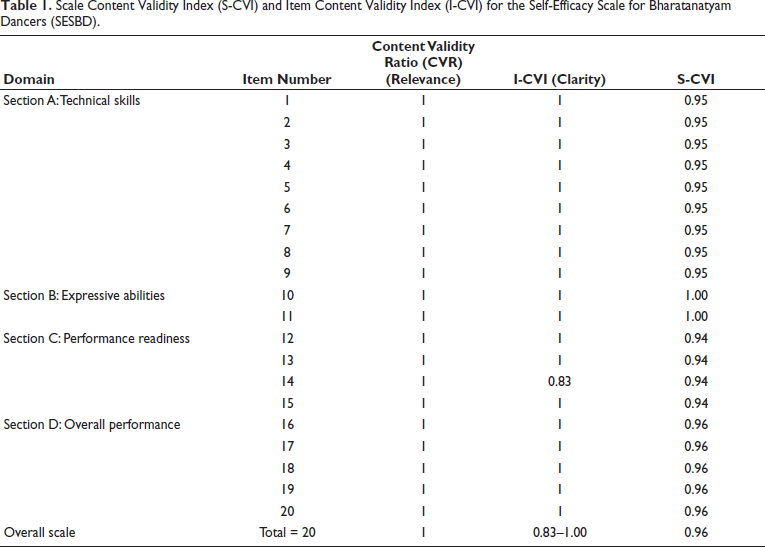
The Item Content Validity Index (I-CVI) was calculated as the proportion of experts rating each item as relevant (scores 3–4). The Scale Content Validity Index (S-CVI) was computed using the averaging method (S-CVI/Ave) for each section and the overall instrument (Table 1). Following established criteria, items with I-CVI ≥0.78 were retained for psychometric testing.
Scale Content Validity Index (S-CVI) and Item Content Validity Index (I-CVI) for the Self-Efficacy Scale for Bharatanatyam Dancers (SESBD).
Reliability Assessment
Internal consistency reliability was evaluated using Cronbach’s alpha coefficient for the total scale and each subscale separately. The minimum acceptable reliability threshold was set at α = 0.70, consistent with established psychometric standards for newly developed instruments. As a part of the initial validation process, internal consistency reliability was assessed using Cronbach’s alpha coefficient, but it served as an early indicator of item coherence.
Results
Content Validity Outcomes
The SESBD demonstrated excellent content validity across all measured dimensions. Expert consensus was remarkably high, with individual item validity indices ranging from 0.83 to 1.00, well exceeding the minimum threshold of 0.78.
Section-specific Content Validity Results
Technical skills (Section A): All nine items achieved strong expert consensus (I-CVI range: 0.83–1.00; S-CVI = 0.95), confirming the relevance of included technical competencies from basic adavu execution to complex choreographic sequences.
Expressive abilities (Section B): Perfect expert agreement was achieved for both items (I-CVI = 1.00; S-CVI = 1.00), indicating unanimous recognition of the critical role of abhinaya in Bharatanatyam performance assessment.
Performance readiness (Section C): High validity was found for all four items (I-CVI range: 0.83–1.00; S-CVI = 0.94), adding support for performance preparation and resilience constructs.
Overall performance confidence (Section D): Strong expert consensus was established (I-CVI range: 0.83–1.00; S-CVI = 0.96) that supported the measurement of overall performance self-efficacy.
Overall scale validity: The 20-item SESBD had an S-CVI of 0.96, showing excellent content validity and expert consensus on the inclusiveness of the SESBD as a means of evaluating Bharatanatyam performance.
These validity coefficients are well above published standards (Polit et al., 2007), supporting the proposition that the SESBD yields substantial evidence for the major domains of self-efficacy for Bharatanatyam dancers and the clarity and cultural relevance of item construction.
Reliability Analysis
Internal consistency reliability of the SESBD was tested as part of the initial validation, with Cronbach’s alpha. The internal consistency of the estimated 20 items was found to be very high for the entire scale (α = 0.972).
Discussion
The SESBD was constructed with initial evidence of content-related validity and internal consistency. The I-CVI of each item ranged from 0.83 to 1.00, with the S-CVI at more than 0.94, indicating excellent expert agreement. After expert review, a few items were changed, and some of these items were restated per the goal of clarity and relevancy for comprehensiveness, anchored to the purpose so that the eventual edition would adequately capture important aspects of Bharatanatyam self-efficacy.
This iterative refinement further increased the potential of the scale to detect confidence-related issues in dancers, which could assist in identifying focused interventions to optimise performance.
Findings of this study reveal that the SESBD has strong content validity, adequate internal consistency and follows good models that are imperative for any self-efficacy scale development. The SESBD yielded I-CVI scores between 0.83 and 1.00, and an S-CVI above 0.94, demonstrating robust expert agreement, comparable to existing validated self-efficacy scales.
For example, the SESD was created to measure self-efficacy in young dancers (10 and 19 years of age). The SESD is a 15-item scale that is based on two components: physical self-efficacy (seven items, α = 0.82) and psychological self-efficacy (eight items, α = 0.81). 5 Items were chosen according to the literature as well as to the practical experience of the dance and were submitted to the judgment of six judges with training, obtaining an 88.87% degree of agreement (Kappa). Factor analysis indicated good psychometric properties, where short administration time was also considered to suit the context of dance. 5
A task-based Dance Self-Efficacy measure (t-bDSE) was created for older adults taking part in dance-based programmes. The instrument comprises six items 6 with a high internal consistency (Cronbach’s alpha = 0.88). The t-bDSE was confirmed for different age groups, sex, physical capacities, cognitive functions, psychosocial well-being, dance experiences and physical exercise. It demonstrated satisfactory criterion-related and construct validity, and the responsiveness was supported by better changes observed in dance programme groups than in the control groups. 6
Strengths
One of the main advantages of this work is the rigorous validation process conducted in the exploratory phase. Specialists’ feedback was elaborately considered, and items were revised and reworded to represent practical, technical/technical and expressive difficulties experienced by dancers.
Limitations
Although the SESBD reveals robust face validity, internal consistency and content validity, assessment of its other psychometric properties was restricted to assessment of content validity and internal reliability. Additionally, psychometric assessments, including construct validity, factor analysis and test–retest reliability, are required to confirm the stability of the scale in wider samples.
Conclusion
This article presents the new and carefully refined SESBD, a tool to measure self-efficacy among Bharatanatyam dancers. The addition of expert advice with regard to the scale revision and optimisation for greater content validity and relevance has made it an acceptable tool. The SESBD shows potential for researchers and practitioners to explore and develop dancer confidence. Nevertheless, further psychometric testing is suggested for the complete validation of the instrument.
Footnotes
Acknowledgement
The expert panel is greatly acknowledged for their critical comments that substantially helped in the further optimisation of the questions.
Authors’ Contributions
All authors participated in the study design, data analysis and critical revision of the manuscript. The preliminary draft was prepared by Swarnamalya under the guidance of D. C. M., P. and M. K., who provided valuable insights and guidance throughout the study. All authors read and approved the final manuscript.
Declaration of Conflicting Interests
The authors declared no potential conflicts of interest with respect to the research, authorship and/or publication of this article.
Ethical Approval
Not applicable.
Funding
The authors received no financial support for the research, authorship and/or publication of this article.
Informed Consent
Informed consent was obtained from all expert panel members prior to their participation in the content validation process.
