




Abstract
Background
Adolescence represents a critical developmental phase characterised by rapid biological, psychological and social changes. During this period, vulnerabilities such as aggression, delinquency and rule-breaking behaviours often emerge. Personality traits, particularly those described in Eysenck’s Psychoticism-Extraversion-Neuroticism (PEN) model, psychoticism, extraversion and neuroticism, have long been associated with antisocial tendencies. However, empirical evidence from non-Western contexts, including India, remains limited.
Purpose
The present study examined how psychoticism, extraversion and neuroticism are related to one another when considered together as a combined measure of criminal propensity among Indian adolescents. It further explored gender and regional differences in this composite disposition across Gujarat and Maharashtra.
Methods
Using an ex post facto, cross-sectional design, data were collected from 814 adolescents aged 15–19 years from schools in Gujarat and Maharashtra. The Criminal Propensity Scale (Sanyal, 2018) was administered to assess psychoticism, extraversion, neuroticism and response tendencies measured through the Lie scale. Criminal propensity was treated as a composite dispositional index derived from the PEN dimensions. Analyses included Pearson’s correlations among personality traits and independent-samples t tests to examine gender and regional differences.
Results
Significant intercorrelations were observed among psychoticism, extraversion and neuroticism, indicating coherent personality configurations reflected in composite criminal propensity scores. Gender differences in the composite criminal propensity index were negligible and statistically nonsignificant. In contrast, adolescents from Maharashtra demonstrated significantly higher composite criminal propensity scores than those from Gujarat, although the effect size was small. Lie scale correlations suggested the presence of socially desirable responding, highlighting a potential methodological influence rather than substantive psychological traits.
Conclusion
The findings highlight the relevance of personality configuration patterns, rather than predictive effects, in understanding self-reported criminal propensity during adolescence. The absence of gender differences suggests comparable dispositional profiles across male and female adolescents within the present sample, while modest regional variations indicate the possible influence of contextual factors. The study contributes culturally grounded evidence from India and emphasizes the need for cautious interpretation of composite personality indices in criminological research.
Introduction
Background and Context
Adolescence represents a critical developmental phase characterised by rapid biological, psychological and social changes. Heightened emotional reactivity, identity exploration and the pursuit of autonomy during this stage increase vulnerability to maladaptive behaviours such as impulsivity, aggression and risk-taking, which may escalate into antisocial patterns and compromise individual well-being as well as community safety.1–3
Personality traits are central to these outcomes. Eysenck’s PEN model, psychoticism, extraversion and neuroticism, provides a well-established framework for understanding individual differences in deviant behaviour. 4 Psychoticism reflects deficits in impulse control and empathy, often manifesting as aggression or rule-breaking 4 ; extraversion is linked to heightened reward sensitivity and thrill-seeking 5 ; and neuroticism reflects emotional vulnerability, with high stress reactivity predisposing adolescents to maladaptive coping and externalising behaviour. 6 Collectively, these traits are commonly discussed in relation to delinquent and antisocial tendencies. Criminal propensity has been widely used in psychological and criminological research to understand tendencies toward delinquent and antisocial behaviour. In the present study, criminal propensity is conceptualised as a self-reported dispositional tendency reflecting personality-based orientations linked to rule-breaking and antisocial tendencies, rather than as an indicator of actual criminal or delinquent behaviour. Several studies have examined its association with personality traits, emotional regulation and social factors during adolescence.
Personality Traits and Criminal Propensity
Personality traits are linked not only to behavioural tendencies but also to their neurobiological substrates. High psychoticism is associated with deficits in empathy and impulse control, linked to prefrontal and amygdala alterations. 7 Extraversion and neuroticism correspond to neural patterns that predispose to impulsivity and emotion-driven behaviours. 8 Examining these links in adolescence is critical, as this stage represents both heightened vulnerability and an opportunity for timely intervention. 9
Youth delinquency, manifesting in aggression, substance use, theft and antisocial conduct, has become a global concern. While environmental and socioeconomic influences play a role, personality traits remain central dispositional correlates; interventions that overlook these risk being superficial.10, 11
Empirical evidence shows that high neuroticism, high psychoticism, low agreeableness and low Conscientiousness are linked to high criminal propensity.12, 13 Although extraversion fosters sociability, it also predicts impulsivity and risk-taking in delinquent contexts.14, 15 A key difference exists between adolescence-limited and life-course-persistent antisocial behaviour, the latter linked to early neuropsychological deficits and weak family support.15, 16
Gender further moderates delinquency: Males more often exhibit externalising behaviours such as aggression and violence, whereas females, typically higher in empathy, display internalising symptoms such as anxiety, depression and trauma, often rooted in adverse family environments.17–22 These findings underscore the need for personality- and gender-sensitive approaches to understanding and addressing adolescent delinquency.23, 24
Research Gap
Extensive research from Western contexts has established strong associations between personality traits and delinquent behaviours. However, little is known about these dynamics in non-Western populations, where cultural, social and environmental contexts shape both personality expression and behavioural outcomes. This limits the direct applicability of Western findings to Indian adolescents. Despite growing concerns about juvenile delinquency in India, systematic investigations into the role of psychoticism, extraversion and neuroticism in shaping criminal propensity remain scarce.
The present study addresses this gap by examining the relationship of these traits, as outlined in Eysenck’s PEN model, with criminal propensity among adolescents in Gujarat and Maharashtra. It further explores gender and regional differences to provide culturally relevant insights. In doing so, the study contributes to both theoretical understanding and the development of evidence-based interventions for reducing adolescent delinquency.
Objectives
The present study aims to achieve the following objectives:
To examine the interrelationship among psychoticism, extraversion and neuroticism as components of a composite criminal propensity index among adolescents.
To assess whether significant gender differences exist in overall criminal propensity scores among adolescents.
To examine regional differences in overall criminal propensity scores between adolescents from Gujarat and Maharashtra.
Hypotheses
The study’s hypotheses, derived from the research objectives, are as follows. Analytical hypotheses examining relationships between individual PEN traits and the composite criminal propensity score were not specified, as criminal propensity is operationalised as a composite index derived from these traits:
Psychoticism, extraversion and neuroticism will show significant intercorrelations, reflecting coherent personality configurations within the composite criminal propensity index. There will be no significant difference in overall criminal propensity scores between male and female adolescents. There will be a significant difference in overall criminal propensity scores between adolescents from Gujarat and Maharashtra.
Methods
Research Design
The present study employed an ex post facto, cross-sectional research design to examine personality configurations associated with criminal propensity among adolescents in a naturalistic context without experimental manipulation. This design was considered appropriate as the study focused on existing variations in psychoticism, extraversion and neuroticism and their pattern of interrelationships within a composite criminal propensity index. In the present study, criminal propensity was operationalised as a composite dispositional index derived from psychoticism, extraversion and neuroticism, rather than as an independent outcome variable. The design also facilitated the examination of gender and regional differences (Gujarat and Maharashtra) in the composite criminal propensity index, allowing for the exploration of dispositional patterns alongside broader sociocultural influences shaping adolescent behaviour.
Data Collection
Data was collected from adolescents in Gujarat and Maharashtra, utilising established measures for the Criminal Propensity Scale.
Sample
The study population includes adolescents aged 15–19 years residing in the Indian states of Gujarat and Maharashtra. The age range of 15–19 years was selected to capture mid-to-late adolescence, a developmental period characterised by heightened emotional reactivity, identity formation and increased salience of personality traits. This stage is also commonly examined in personality and delinquency research, as dispositional tendencies become more stable while social and behavioural regulation remains in transition. A stratified random sampling technique was employed to ensure proportional representation of both gender and regional groups, yielding a total sample of 814 participants. Of these, 431 were male (52.9%) and 383 were female (47.0%). Region-wise, 414 participants (50.9%) were from Gujarat and 400 participants (49.1%) were from Maharashtra.
Procedure
A systematic approach was followed to ensure methodological rigour. The Criminal Propensity Scale (Sanyal, 2018) was employed to assess psychoticism, extraversion, neuroticism and the Lie scale, selected for their reliability and suitability with adolescents. 25
Before data collection, permissions were obtained from school authorities in Gujarat and Maharashtra. Participants were informed about the study’s objectives, assured of confidentiality and voluntary participation and written consent was obtained from both adolescents and their parents or guardians. Ethical guidelines were strictly observed at all stages.
Data were collected in classroom settings under the researcher’s supervision, with standardised instructions provided. Each session lasted approximately 30–35 minutes and the environment was structured to minimise distractions and ensure independent responding. Questionnaires were reviewed for completeness before participants were dismissed.
Responses were coded and analysed using SPSS version 26. Descriptive statistics were computed, Pearson’s correlation assessed associations between personality traits and criminal propensity and independent-samples t tests examined gender and regional differences. Effect sizes (Cohen’s d) were calculated to estimate the magnitude of group differences.
Tools Used
A demographic data sheet was prepared to collect basic information such as age, gender, state and qualification.
Criminal Propensity Scale: Criminal Propensity Scale (2018) by Dr (Mrs.) Shubra Sanyal. Criminal Propensity Scale consists of 39 ‘yes–no’ questions. The scoring is done using a scoring stencil. The stencil consists of four domains: Psychoticism, neuroticism, extraversion and the Lie scale. The Lie scale was included to assess response style and impression management rather than as an indicator of substantive personality traits. The total of these scores constitutes a composite criminal propensity index, reflecting the combined configuration of psychoticism, extraversion and neuroticism. The item scores are reliable at a .01 significance level. The scale was assumed to be valid since it is based on Eysenck’s Personality Questionnaire. Internal consistency estimates for the Criminal Propensity Scale in the present sample were not separately computed; however, prior studies using this instrument have reported satisfactory reliability across adolescent populations. This is acknowledged as a limitation of the present study.
Results
The following section presents the statistical findings examining the pattern of associations among personality traits and group differences in the composite criminal propensity index among adolescents from Gujarat and Maharashtra. Pearson’s correlation analyses were conducted to examine interrelationships among psychoticism, extraversion and neuroticism, along with age and response tendencies measured through the Lie scale. Independent-samples t tests were used to examine gender and regional differences in the composite criminal propensity index.
As presented in Table 1, significant intercorrelations were observed among the three personality dimensions constituting the composite criminal propensity index. Psychoticism showed significant positive associations with extraversion (r = 0.147, p < .01) and neuroticism (r = 0.249, p < .01). Extraversion was also positively correlated with neuroticism (r = 0.171, p < .01). These findings indicate a coherent pattern of personality configurations characterised by impulsivity, emotional reactivity and sensation-seeking tendencies among adolescents.
Pearson Correlation Matrix for Age, Personality Traits and Lie Scale (N = 814).
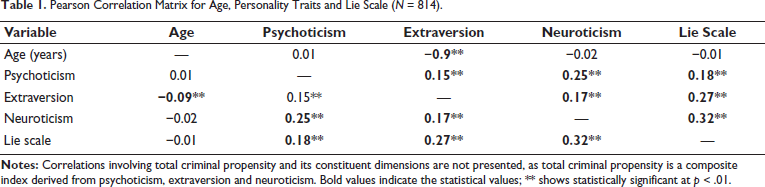
Because total criminal propensity is a composite index mathematically derived from psychoticism, extraversion and neuroticism, correlations between the composite score and its constituent traits are not interpreted, even descriptively. Accordingly, the results focus on the interrelationships among the PEN dimensions themselves and on group differences in the composite index, which represent the meaningful statistical findings of the study.
Age showed no significant association with the composite criminal propensity index (r = −0.053, p > .05), indicating relative stability of the dispositional configuration across the sampled adolescent age range. A small but significant negative association was observed between age and extraversion (r = −0.092, p < .01), suggesting slightly lower extraversion levels among older adolescents.
The Lie scale demonstrated small-to-moderate positive associations with psychoticism (r = 0.178, p < .01), extraversion (r = 0.269, p < .01) and neuroticism (r = 0.316, p < .01). These findings indicate the presence of response tendencies related to socially desirable responding and impression management, highlighting a methodological influence on self-reported personality scores rather than substantive psychological characteristics.
Gender differences in the composite criminal propensity index are summarised in Tables 2, 3 and 4. Mean scores for male (M = 15.48, SD = 3.63) and female adolescents (M = 15.73, SD = 3.81) were comparable. The independent-samples t test revealed no statistically significant gender difference, t(812) = −0.95, p = .34, with negligible effect sizes (Cohen’s d = −0.07; Hedges’ g = −0.07), indicating minimal practical significance.
Group Statistics for Gender Differences in Criminal Propensity (N = 814).

Independent Samples t Test for Gender Differences in Criminal Propensity.

Note: Negative values indicate that males scored slightly lower than females on total criminal propensity.
Effect Sizes for Gender Differences in Criminal Propensity.

Note: Negative values indicate that males scored slightly lower than females on total criminal propensity.
Regional comparisons, presented in Tables 5, 6 and 7, revealed a statistically significant difference in composite criminal propensity scores between adolescents from Gujarat (M = 15.12, SD = 3.33) and Maharashtra (M = 16.10, SD = 4.01). Welch’s t test indicated a significant difference, t(775.57) = −3.80, p < .001, with a small effect size (Cohen’s d = −0.27). These findings suggest modest regional variation in the composite criminal propensity index, with the small effect size indicating limited practical significance despite statistical reliability.
Group Statistics for Total Criminal Propensity by State.
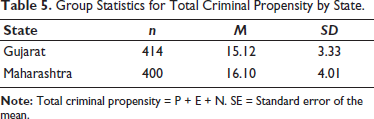
Note: Total criminal propensity = P + E + N. SE = Standard error of the mean.
Independent Samples t Test for Total Criminal Propensity by State.
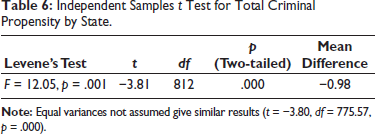
Note: Equal variances not assumed give similar results (t = −3.80, df = 775.57, p = .000).
Effect Sizes for State Differences in Total Criminal Propensity.
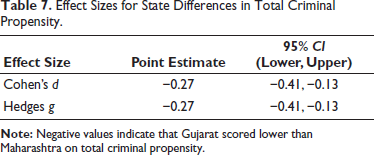
Note: Negative values indicate that Gujarat scored lower than Maharashtra on total criminal propensity.
Taken together, the results demonstrate meaningful interrelationships among psychoticism, extraversion and neuroticism within a composite dispositional index of criminal propensity, alongside negligible gender differences and small but statistically reliable regional differences.
Discussions
The pattern of associations observed in the present study aligns with personality-based models of delinquency when criminal propensity is conceptualised as a composite dispositional configuration rather than an independent outcome.26, 27 Significant intercorrelations among psychoticism, extraversion and neuroticism indicate that impulsivity, emotional reactivity and sensation-seeking tendencies tend to cluster together during adolescence, consistent with Eysenck’s PEN framework, which posits that high psychoticism and neuroticism and, in some contexts, extraversion are associated with dispositional orientations commonly linked to delinquent behaviour via impulsivity, sensation-seeking and emotional lability.28, 29 At the same time, two methodological cautions temper the magnitude of these links. First, total criminal propensity is constructed as the sum of P, E and N. Part–whole contamination will mechanically inflate correlations between the composite (total criminal propensity) and its components, especially when internal reliabilities are high. Interpreting the absolute sizes of r therefore requires caution and the more informative take-away is the relative ranking (neuroticism > extraversion > psychoticism) rather than their raw magnitudes. Second, the Lie scale shows small-to-moderate positive associations with neuroticism and extraversion, indicating shared variance attributable to impression management or socially desirable responding. This suggests the possibility of upward bias in self-reported scores due to response style effects inherent in self-report measures, rather than reflecting substantive dispositional differences, an issue repeatedly emphasised in adolescent personality assessment. 30
Despite these caveats, the pattern itself is theoretically coherent. Meta-analytic and narrative reviews consistently identify psychoticism and negative emotionality as dispositional patterns discussed in the delinquency literature for externalising behaviour. 31 Neuroticism’s leading correlation here (r = 0.742 with the composite; r = 0.249 with psychoticism; r = 0.171 with extraversion) fits models where emotional dysregulation fuels reactive aggression and rule-breaking, particularly under stress. 32 Extraversion’s positive association is more mixed in the literature, sometimes protective through social bonds, sometimes risky through sensation-seeking and peer deviance, but becomes reliably risk-conducive when coupled with high psychoticism and neuroticism. 32 The present intercorrelations among P, E and N capture a dispositional clustering of impulsivity, emotional reactivity and sensation-seeking profiles often overrepresented among youth with conduct problems. 33
Age showed no meaningful association with the composite index is unsurprising given the likely narrow age band in school-based samples. Developmental research shows that maturational timing and pubertal hormones, rather than chronological age per se, better explain shifts in sensation-seeking and affective reactivity during adolescence. 34 If pubertal status varies within a grade for the same chronological age, age–propensity links can wash out. Future work could add pubertal stage or hormonal proxies to disentangle developmental timing from calendar age.
Gender comparisons add a nuanced counterpoint to expectations drawn from delinquency prevalence data. Although broad criminological trends often show higher male involvement in detected delinquency, the present findings indicate no statistically or practically significant gender difference in composite criminal propensity scores (means 15.48 vs. 15.73; p > .34; Cohen’s d ≈ −0.07). This finding should be interpreted in light of the construct assessed in the present study. Criminal propensity, as operationalised here, reflects a self-reported dispositional tendency rather than actual engagement in delinquent or criminal behaviour. As such, the absence of gender differences in propensity does not imply equivalence in behavioural offending but rather similarity in underlying personality-based orientations.
Several factors may help contextualise this pattern within the Indian sociocultural setting. Gender-differentiated norms, parental monitoring practices and social control mechanisms may shape behavioural expression differently for boys and girls, while not necessarily producing large differences in dispositional self-reports. Prior research suggests that empathy and socialisation processes may partially mediate observed gender gaps in delinquent behaviour and school environments, emphasising that prosocial norms may further attenuate dispositional differences. In addition, method effects are relevant, as self-report measures tend to yield smaller gender disparities than official records or informant reports. Taken together, these findings caution against assuming inherently gendered differences in dispositional criminal propensity and support the relevance of universal, rather than exclusively male-targeted, preventive approaches.
A statistically significant difference in composite criminal propensity scores was observed between adolescents from Maharashtra and Gujarat; however, the magnitude of this difference was small (Cohen’s d ≈ 0.27), indicating limited practical significance. While regional variation may reflect broader sociocultural or environmental influences, such interpretations remain speculative, as the present study did not directly assess contextual variables. Accordingly, these findings should be interpreted with caution and viewed as preliminary. Future research incorporating explicit measures of cultural, environmental and contextual factors is required to clarify the nature and significance of regional variation in dispositional personality configurations among adolescents.
The Lie scale findings merit methodological attention. Positivity biases correlated with extraversion and neuroticism may reflect impression management among sociable youth and defensive responding among emotionally reactive youth. From a methodological perspective, these findings are consistent with prior work demonstrating that socially desirable responding can covary with personality dimensions in self-report research. This underscores the importance of interpreting personality–propensity associations cautiously when impression management concerns are salient. Methodologically, including the Lie scale as a covariate in sensitivity analyses or using multi-informant data would help gauge the robustness of self-reported trait–propensity associations.
Taken together, the present results support three practical implications. First, universal, personality-informed preventive frameworks are warranted given the sizable role of dispositional risk across genders. Programmes that enhance emotion regulation and stress management may be particularly relevant for adolescents exhibiting high emotional reactivity. Second, trait-informed but context-responsive interventions are advisable. Even when conduct problems improve with treatment, more trait-like callous–unemotional features can be stubborn, implying benefits from earlier, sustained and multimodal approaches. Third, regional tailoring makes sense: Small-to-moderate differences across states suggest that school climate initiatives, family stress supports or peer-focused components should be calibrated to local risk ecologies.
Final, these findings are consistent with contemporary views of adolescent personality as measurable, meaningful and developmentally plastic. Personality dispositions confer probabilistic, not deterministic risk that unfolds through gene–environment interplay and developmental transitions. The present data echo systematic reviews linking individual traits to criminality while underscoring two caveats for interpretation: Part–whole inflation from the criminal propensity composite and potential social desirability bias. Addressing these in future work by modelling criminal propensity as a latent factor separate from P, E and N; incorporating pubertal status and multi-informant measures; and testing trait × context interactions will sharpen estimates of true effect sizes and illuminate how, when and for whom personality risk is most likely to translate into delinquent outcomes.
Because personality traits and criminal propensity were assessed using self-report measures, response style effects reflected by the Lie scale may have influenced observed associations, underscoring the need for multi-method assessment in future research.
Conclusion and Future Scope
The present study examined patterns of association among personality traits within a composite dispositional index of criminal propensity among adolescents from two Indian states. Rather than supporting predictive or causal claims, the findings highlight coherent configurations of psychoticism, extraversion and neuroticism that tend to co-occur within adolescent personality profiles associated with higher scores on a self-reported criminal propensity index.
Significant interrelationships among the PEN dimensions suggest that impulsivity, emotional reactivity and sensation-seeking tendencies cluster together in meaningful ways during adolescence. These configurations reflect dispositional patterns rather than actual delinquent behaviour and should be interpreted as dispositional orientations rather than determinants of criminal outcomes.
Gender comparisons revealed no statistically or practically meaningful differences in the composite criminal propensity index, indicating that dispositional personality configurations reflected in the composite criminal propensity index may be similarly distributed across male and female adolescents within the sampled contexts. This finding underscores the importance of avoiding assumptions about gendered dispositional risk based solely on crime prevalence statistics.
Regional differences between Gujarat and Maharashtra were statistically significant but small in magnitude, suggesting limited practical significance. These differences likely reflect contextual or sociocultural influences rather than substantive divergence in personality structure, though such interpretations remain speculative in the absence of direct contextual measures.
Methodological considerations are central to interpreting the findings. The use of a composite index derived from its constituent traits limits inferential conclusions due to part–whole overlap and reliance on self-report measures introduces potential response biases, as indicated by associations with the Lie scale. Accordingly, the results are best understood as descriptive mappings of personality configurations rather than evidence of developmental risk pathways or behavioural prediction. Also, associations involving the Lie scale underscore the influence of response style in self-report measures and should be considered a methodological limitation rather than a substantive psychological finding.
Future Scope
Future research would benefit from disentangling dispositional personality patterns from behavioural outcomes by incorporating longitudinal designs that track how personality configurations interact with environmental contexts over time. Modelling criminal propensity as a latent construct independent of its constituent traits would reduce part–whole contamination and allow more precise estimation of trait effects.
The inclusion of multi-informant data (e.g., parent, teacher or official records) and behavioural indicators of delinquency would help address response style biases inherent in self-report methods and clarify the relationship between dispositional personality configurations and actual conduct. Incorporating measures of pubertal status, peer context, family environment and cultural norms would further illuminate how personality configurations translate into behaviour under specific social conditions.
Final, examining trait × context interactions across diverse regional and sociocultural settings within India would strengthen ecological validity and help distinguish universal dispositional patterns from context-specific expressions of adolescent risk.
Footnotes
Authors’ Contribution
All authors contributed to the study conception and design. Research conceptualisation, data collection, analysis and plagiarism checks were performed by Dr Divya Dubey, Dr Sulbha Rai, Dr Aasim Ur Rehman Ganie and Dr Soni Kewalramani. The first manuscript draft was prepared by Dr Divya Dubey. All authors reviewed the results and approved the final version of the manuscript.
Statement of Ethics
Due permission was obtained from the concerned authorities of the institutes where the study was conducted. Confidentiality was maintained by assigning a code to each participating student. The data were stored with a security code. Participants were informed of the confidentiality of their responses and all doubts of the students were clarified before they filled out the questionnaire.
Declaration of Conflicting Interests
The authors declared no potential conflicts of interest with respect to the research, authorship and/or publication of this article.
Funding
The authors received no financial support for the research, authorship and/or publication of this article.
