




Abstract
Background
North Indian classical music ragas evoke distinct emotional responses, shaped by their tonal structures. Prior studies on Western music have shown that minor and major intervals influence affective valence and neural activity, but similar research in the Indian context is limited.
Purpose
This study aimed to investigate how increasing minor-to-major intervals (m/M tonal ratios) in North Indian classical music affect cortical sources and emotional responses.
Methods
Thirty healthy participants listened to four ragas—Bilawal (M1), Yaman (M2), Puriya Kalyan (M3), and Todi (M4)—while undergoing EEG recording. Emotional responses were assessed using the GEMS-25 and self-assessment manikin (SAM) scales. The ragas were selected to represent ascending m/M tonal ratios.
Results
Ragas with higher proportions of major intervals (e.g., Bilawal) elicited positive emotions such as joy and calmness, accompanied by widespread cortical activation, particularly in areas associated with emotional processing and musical familiarity. In contrast, ragas with increasing minor intervals (e.g., Todi) induced negative affect such as sadness and tension, with reduced cortical engagement. Raga Todi showed minimal deviation from resting-state EEG, correlating with low arousal and negative valence. EEG analysis revealed heightened activation in areas involved in acoustic processing and the Default Mode Network during Bilawal, which progressively declined across Yaman, Puriya Kalyan, and Todi as the m/M ratio increased.
Conclusion
The minor-to-major tonal ratio significantly modulates emotional and cortical responses in Indian classical music. Increasing minor intervals reduces cortical engagement and evokes negative affective states. These findings not only mirror trends observed in Western music but also highlight the cultural and therapeutic potential of ragas in emotional regulation and mental well-being.
Introduction
Music influences us, consciously and unconsciously, by evoking emotions and shaping mood. 1 This ability makes it a key tool for studying emotions and their neural bases. While music’s emotional impact is well-known, the mechanisms remain unclear. Current theories suggest that unique acoustic elements in music interact with the environment, cognitive processes, and auditory system to trigger emotional responses.2, 3 Features such as intensity, tempo, and mode evoke emotions, while associations with memories or settings further shape reactions. For example, fast tempos are associated with heightened arousal and positive affect, while slow tempos correlate with reduced arousal and melancholic states. Minor tonalities are linked to negative emotional valence, whereas major tonalities are associated with positive affective responses. 4
Studies have often focused on Western Classical music, leaving North Indian Classical Music (NICM) underexplored despite its rich link between musical tones and emotion. NICM is built on thaats, systematic heptatonic scales combining major (shuddh) and minor (komal) intervals. 5 The Circle of Thaats organises these scales to vary emotional valence, linking tonal ratios to moods. Ragas, derived from thaats, use ascending (aarohan) and descending (avrohan) sequences and characteristic phrases (pakar) to evoke distinct emotions. 6 Major intervals convey joy and calmness, while minor intervals, like the minor second (komal re), express sadness or tension. The dual-phase raga presentation—alaap (slow introduction) and gat (rhythmic composition)—enables controlled exploration of tonality and rhythm in shaping emotions. 6 Ragas like Hamsadhvani evoke happiness, Brindavani Sarang romance, and Bhoopali reduce anxiety, highlighting NICM’s therapeutic and empirical research potential. 7
No study has explored the link between increasing minor intervals in music and cortical source activity of emotional state. We hypothesise that increasing the proportion of minor intervals relative to major intervals (i.e., a higher minor-to-major tonal ratio) in North Indian classical ragas will produce a shift in emotional experience from positive to negative affect, accompanied by corresponding changes in cortical activity, particularly in brain regions implicated in emotional and acoustic processing. To test this hypothesis, the present study investigates EEG-derived cortical source activity and self-reported emotional responses elicited by a set of ragas with systematically increasing minor-to-major interval ratios. The study was conducted among undergraduate and postgraduate students of AIIMS, who served as participants in the research.
Methods
Music Stimulus
Four instrumental renditions of 5 minutes each were performed on the bansuri (Indian bamboo flute), in a sound-treated music studio, to ensure high acoustic fidelity and eliminate ambient noise interference. A professional bansuri player with years of classical training performed the renditions. Each performance was digitally recorded.
The final recordings were then presented to participants using high-quality speakers in a quiet, controlled environment to ensure uniform audio delivery across all subjects. The sound levels were calibrated to comfortable listening volumes for all participants.
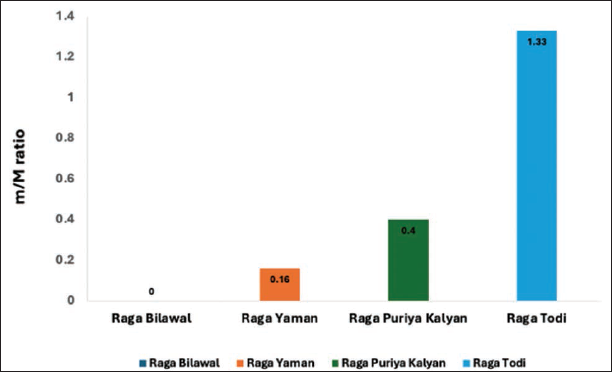
Each rendition included a 2-minute alaap (slow, non-rhythmic improvisation of the raga) and a 3-minute gat (faster, rhythmic section with tabla accompaniment in teen taal, a 16-beat cycle). The renditions featured in these ragas, along with their tonal ratio (m/M), are mentioned below (Figure 1):
M1: Raga Bilawal (Bilawal Thaat) – S, R, G, M, P, D, N (all major) [m/M = 0] M2: Raga Yaman (Kalyan Thaat) – S, R, G, m, P, D, N (one minor, six major) [m/M = 0.16] M3: Raga Puriya Kalyan (Marwa Thaat) – S, r, G, m, P, D, N (two minor, five major) [m/M = 0.4] M4: Raga Todi (Todi Thaat) – S, r, g, m, P, D, n (four minor, three major) [m/M = 1.33]
Uppercase notes indicate major intervals; lowercase notes represent minor intervals.
Participants
Thirty healthy, right-handed participants (mean age: 27.2 ± 3.7 years) were included in the study. Individuals with psychiatric, neurological, or auditory disorders, or prior training in Indian classical music, were excluded. Participants were recruited from undergraduate and postgraduate students at AIIMS, New Delhi. The study was conducted at the Stress and Cognitive Electro-Imaging Laboratory (SCEL), AIIMS, New Delhi, following ethical approval from the Institutional Ethics Committee (IECPG-303/28.04.2021).
Study Design
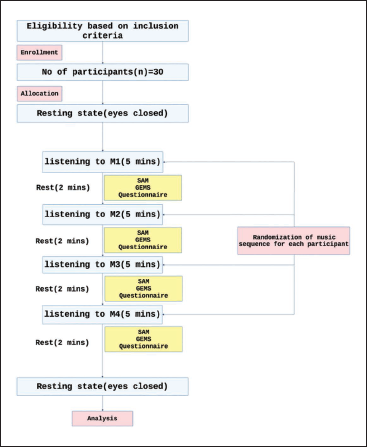
Resting-state EEG was recorded with eyes closed condition for 5 minutes, followed by EEG recordings as the participants listened to the pre-recorded four ragas. A 2-minute inter-music interval was given to allow the music’s effects to wane, during which participants rated emotions using the Geneva Emotional Music Scale (GEMS-25) and the Self-Assessment Manikin (SAM) scale. GEMS-25 is a music-specific categorical emotional model, 8 while SAM is a non-verbal tool assessing emotions on valence and arousal dimensions. 9 Afterwards, a 5-minute eyes-closed resting EEG was recorded again. To minimise the order effects, the sequence of four music excerpts was randomised independently for each participant using a computer-generated randomisation done on E-Prime software. The complete study protocol is illustrated in Figure 2. The participants were instructed to minimise movements, facial activity, and keep their eyes closed during recordings.
Study Design.
EEG Data Acquisition
EEG was acquired with a 128-channel Hydrocel Geodesic Sensor Net (Electrical Geodesics, Inc., USA), sampled at 1,000 Hz with 24-bit precision and a 0.05–100 Hz bandwidth. Cz served as the reference, with impedances kept below 50 kΩ. Recordings were conducted in a quiet, dimly lit, interference-free room.
Geodesic Photogrammetry System (GPS) for Sensor Localisation
This study aimed to identify the brain regions responsible for generating scalp-recorded signals. Although data collection was conducted using subject-specific electrode nets, variations in electrode placement within a single net could occur due to individual differences in scalp structure and symmetry. Such discrepancies may affect EEG analysis, as electrode positioning is a key factor in ensuring accuracy. To address this, a GPS device was employed immediately after recording to capture subject-specific sensor positions, enhancing precision. 10 The resulting 3D electrode coordinates were then utilised to estimate the neural sources underlying the recorded signals.
Preprocessing
The EEG data were pre-processed offline using Net Station and EEGLAB software. Raw EEG signals were bandpass filtered between 1 and 70 Hz. EEG epochs corresponding to the 30-second listening window between 1:30 and 2:00 minutes of each 5-minute music rendition were analysed. Artefacts, such as eye blinks and muscle activity, were detected and removed. Poor-quality channels were replaced with interpolated data from neighbouring electrodes. The cleaned data were subjected to independent component analysis (ICA) to isolate and remove artefacts like eye movements and cardiac activity. Finally, ICA-processed data were used for source localisation analysis via sLORETA to identify intracerebral EEG signal sources.
Source Imaging
Standardised low-resolution electromagnetic tomography (sLORETA) was utilised to estimate intracortical sources from scalp activity across frequency bands, calculating standardised current density (nAm/m²) via an inverse-problem algorithm. 11 The forward problem was resolved using the finite difference head model, with source localisation mapped to 6239 voxels of 5 mm in the grey matter and the hippocampus using the Montreal Neurological Institute MRI atlas. 12 Three orthogonal dipole moments (x, y, z) per voxel were assigned to 66 gyri using craniocerebral correlations.
Statistical Analysis
Cortical activity during music listening was analysed in comparison to the resting state (eyes closed) using sLORETA. Activated gyri were mapped onto six-dimensional cortical views, and log F-ratio tests were used to assess differences between pre- and post-assessments for both the resting state and the music-listening state. Statistical nonparametric mapping (SnPM), combined with randomisation tests (5,000 permutations), was applied to determine significance while correcting for multiple voxel comparisons. 13 Significant clusters of voxel activity were identified using exceedance proportion tests, based on both height threshold and spatial extent.
Administration and Scoring of GEMS-25 and SAM Scales
For the Geneva Emotional Music Scale (GEMS-25), participants were instructed to rate how the music made them feel, rather than describing the music itself. Each of the 25 discrete emotional terms in GEMS was rated on a 5-point Likert scale, ranging from 1 (not at all) to 5 (very much). This approach acknowledges the multidimensional nature of music-evoked emotions, as a single musical excerpt can evoke multiple emotional states simultaneously. The 25 individual emotion ratings were then grouped into nine higher-order emotion categories as per the GEMS framework. For each of the four music excerpts, average ratings were computed for each of the nine emotional dimensions across all participants. To compare emotional responses across the excerpts, Repeated Measures ANOVA was applied.
For the SAM scale, participants used five pictorial manikins representing different levels of emotional intensity to rate two core dimensions of affect: valence and arousal. Ratings were provided on a 5-point scale in whole-number steps, ranging from 1 (‘unpleasant’) to 5 (‘pleasant’) for valence, and 1 (‘calm’) to 5 (‘aroused’) for arousal. For each musical excerpt, mean scores for valence and arousal were calculated across all participants to assess the affective impact of each musical piece. Repeated Measures ANOVA was applied to compare the responses across the excerpts.
Results
Emotional Responses Induced by Each Raga According to the GEMS-25 Scale (p < .05)
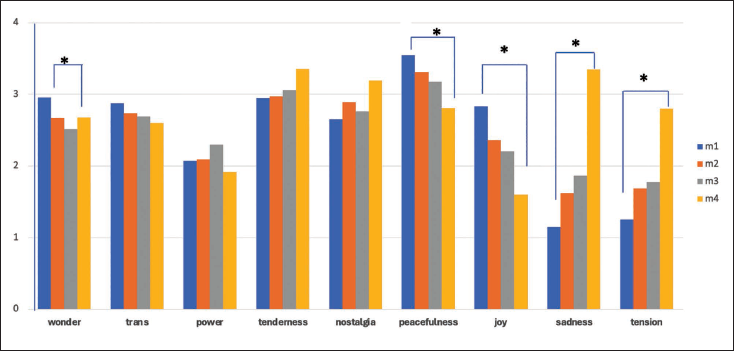
The emotional responses to the four ragas, measured using the GEMS-25 scale, are summarised in Figure 3. Raga Bilawal (M1) elicited significantly higher levels of joy compared to the other three ragas, while Raga Todi (M4) was associated with significantly greater feelings of sadness and tension. No significant differences were observed among the ragas in terms of transcendence, power, tenderness, and nostalgia. However, Raga Bilawal (M1) significantly evoked more wonder than Raga Puriya Kalyan (M3), and both Raga Bilawal (M1) and Raga Yaman (M2) were rated as significantly more peaceful than M4.
Emotional Responses Induced by Each Raga According to the GEMS-25 Scale. *p < .05.
Emotional Responses Induced by Each Raga in the Arousal and Valence Domains (SAM Scale) (p < .05)
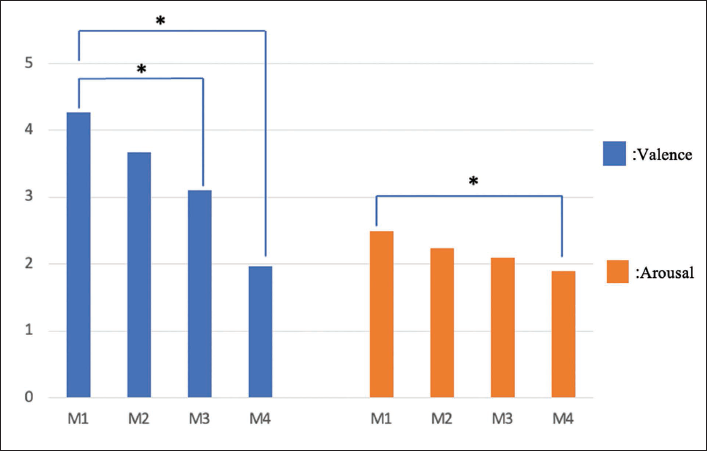
The valence ratings of the four ragas, measured using the SAM scale, are summarised in Figure 4. Valence ratings were significantly lower for Raga Puriya Kalyan (M3) and Raga Todi (M4) compared to Raga Bilawal (M1), indicating that Raga Bilawal (M1) was perceived as pleasant, while Raga Puriya Kalyan (M3) and Raga Todi (M4) were considered unpleasant. On the arousal scale, the overall arousal generated by all ragas was relatively low, although Raga Bilawal (M1) induced significantly more arousal than Raga Todi (M4).
Emotional Responses Induced by Each Raga in the Valence and Arousal Domains (SAM Scale). *p < .05.
Cortical Sources as Assessed by EEG
Effect of Listening to M1 (Raga Bilawal, m/M = 0) on Cortical Sources Compared to the Eyes-closed Resting State
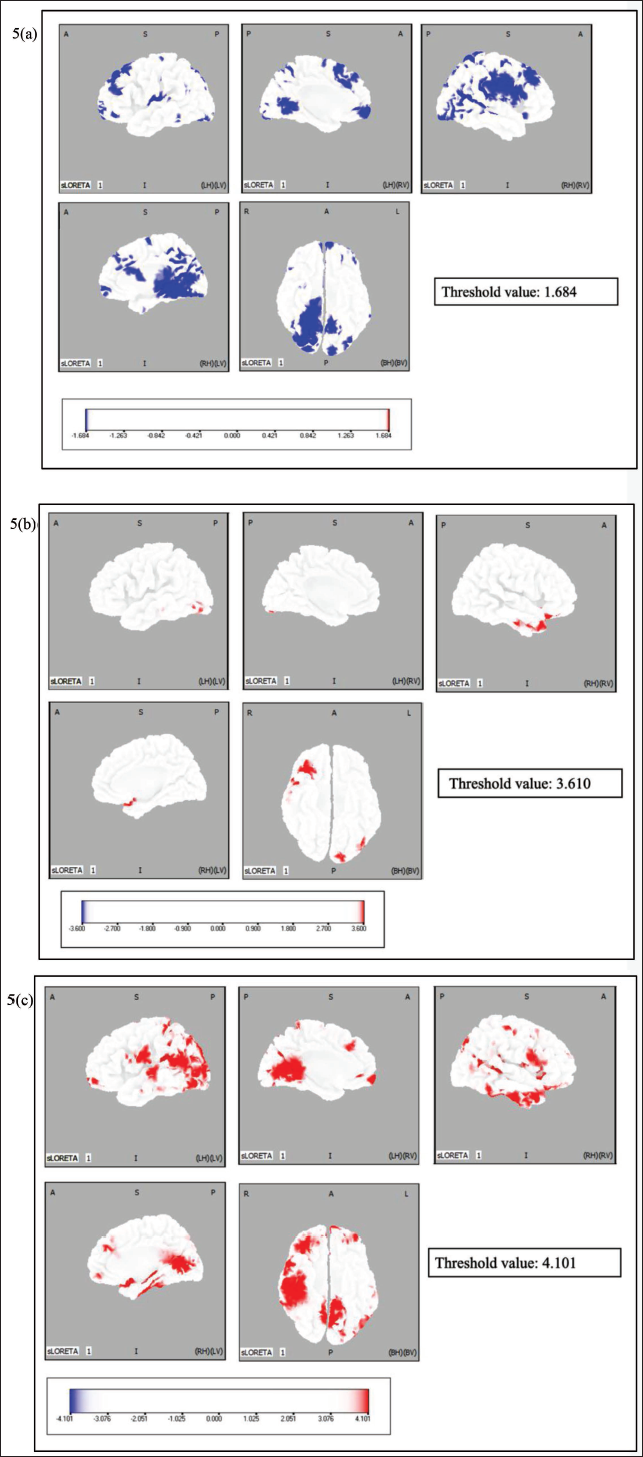
When comparing the resting state with eyes closed to listening to M1 (Raga Bilawal), lower activation was observed in several brain regions at a significance level of p < .05 with a threshold of 1.684 (Figure 5a). The gyri showing reduced activity during the resting state include the Anterior Cingulate, Inferior Parietal Lobule, Middle Occipital Gyrus, Cuneus, Insula, Paracentral Lobule, Precentral Gyrus, Sub-Gyral, Superior Temporal Gyrus, Cingulate Gyrus, Inferior Temporal Gyrus, Middle Temporal Gyrus, Precuneus, Supramarginal Gyrus, Transverse Temporal Gyrus, Fusiform Gyrus, Lingual Gyrus, Parahippocampal Gyrus, Superior Frontal Gyrus, Inferior Frontal Gyrus, Medial Frontal Gyrus, Postcentral Gyrus, Superior Occipital Gyrus, Inferior Occipital Gyrus, Middle Frontal Gyrus, Posterior Cingulate, and Superior Parietal Lobule.
sLORETA Orthogonal Views Showing Activated Brain Regions with Colour-coded t-values. (a) Resting-State vs M1, (b) Resting-State vs M2, (c) Resting-State vs M3. A = Anterior, P = Posterior, S = Superior, I = Inferior, LH = Left Hemisphere, RH = Right Hemisphere, LV = Left View, RV = Right View. The scale presented represents the t-statistic values.
Effect of Listening to M2 (Raga Yaman, m/M = 0.16) on Cortical Sources Compared to the Eyes-closed Resting State
When comparing the resting state with eyes closed to listening to M2 (Raga Yaman), higher activation was observed in several brain regions at a significance level of p < .05 with a threshold of 3.610 (Figure 5b). The gyri showing higher activity during the resting state include the Extra-Nuclear, Inferior Frontal Gyrus, Inferior Occipital Gyrus, Inferior Temporal Gyrus, Lingual Gyrus, Middle Frontal Gyrus, Middle Occipital Gyrus, Middle Temporal Gyrus, and Superior Temporal Gyrus.
Effect of Listening to Music M3 (Raga Puriya Kalyan, m/M = 0.5) on Cortical Sources Compared to the Eyes-closed Resting State
When comparing the resting state with eyes closed to listening to M3 (Raga Puriya Kalyan), higher activation was observed in several brain regions at a significance level of p < .05 with a threshold of 4.101 (Figure 5c). The gyri showing higher activity during resting state incluse Angular Gyrus; Inferior Occipital Gyrus; Middle Frontal Gyrus; Posterior Cingulate; Superior Parietal Lobule; Anterior Cingulate; Inferior Parietal Lobule; Middle Occipital Gyrus; Precentral Gyrus; Superior Temporal Gyrus; Cuneus; Inferior Temporal Gyrus; Middle Temporal Gyrus; Precuneus; Supramarginal Gyrus; Extra-Nuclear regions; Insula; Orbital Gyrus; Sub-Gyral; Transverse Temporal Gyrus; Fusiform Gyrus; Lingual Gyrus; Parahippocampal Gyrus; Superior Frontal Gyrus; Uncus; Inferior Frontal Gyrus; Medial Frontal Gyrus; Postcentral Gyrus; and Superior Occipital Gyrus.
Effect of Listening to Music M4 (Raga Todi, m/M = 1.33) on Cortical Sources Compared to the Eyes-closed Resting State
When comparing the resting state with eyes closed to listening to M4 (Raga Todi), no significant difference was observed in the cortical source activity between both conditions.
Discussion
This study investigated the emotional and neural correlates of listening to four North Indian Classical Music ragas differing in their tonal structures, specifically in the proportion of major (shuddh) and minor (komal) notes. By integrating behavioural measures (GEMS-25 and SAM scales) with EEG-based cortical source analysis, we aimed to elucidate how tonal variation influences emotional valence, arousal, and neural engagement in terms of cortical sources. Our findings indicate that ragas rich in major notes, such as Raga Bilawal, elicited positive emotions like joy, wonder, and peace, alongside heightened cortical activation in regions associated with acoustic processing, emotion, and reward. In contrast, ragas with a higher proportion of minor notes, such as Raga Todi and Raga Puriya Kalyan, were associated with negative valence and reduced arousal, mirrored by attenuated activation across key cortical and subcortical regions.
Comparative Analysis and Implications of Emotional Responses Across Ragas
Based on the GEMS-25 questionnaire, Raga Bilawal (M1), with only major notes, evoked the most joy, while Raga Todi (M4), with more minor notes, elicited greater sadness and tension.
Raga Bilawal (M1) elicited significantly greater wonder compared to Raga Puriya Kalyan (M3). Additionally, both Raga Bilawal (M1) and Raga Yaman (M2) were perceived as significantly more peaceful than M4. All four ragas were comparable in eliciting feelings of transcendence, power, tenderness, and nostalgia. As the proportion of minor notes increased (i.e., higher m/M ratio), listeners reported a corresponding increase in sadness and tension, while emotions related to wonder, transcendence, power, and nostalgia were preserved. Previous studies have shown a strong association between the minor second interval (komal re) and ‘tension’ in Indian classical music, an effect corroborated in this study, particularly for Raga Puriya Kalyan (M3) and Raga Todi (M4). 14 This is consistent with findings in Western music, where minor intervals, especially the minor third, are similarly linked to the induction of sadness in listeners. 15
Using the SAM scale, we observed a distinct shift in the emotional valence of the music as minor notes were introduced. Specifically, in Raga Puriya Kalyan (M3) and Raga Todi (M4), the valence shifted towards negative, with Raga Todi (M4) being rated the most unpleasant (most negative valence), in contrast to the more positive response elicited by Raga Bilawal. In terms of arousal, all four ragas induced relatively low levels of arousal, with Raga Todi showing the lowest arousal when compared to Raga Bilawal (M1). Consistent with previous studies, major intervals (shuddh swaras) were predictive of positive valence, while minor intervals (komal swaras) were predictive of negative valence.16, 17
Cortical Sources Linked to Acoustic Features of Music
Effect of Increasing Minor Notes (m/M Ratio)
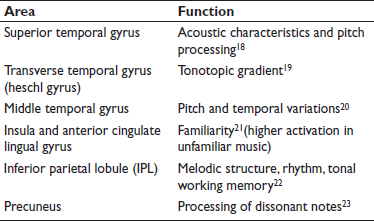
Incremental increases in the minor interval ratio, exemplified by the addition of komal re, elicited a marked decrease in neural activation across key cortical and subcortical regions. Specifically, the inferior frontal gyrus, occipital and temporal gyri, lingual gyrus, and precuneus—regions integral to acoustic feature extraction, emotional processing, 24 and autonomic regulation—exhibited attenuated activity. This suggests that the incorporation of minor notes, known for their association with negative emotional valence, 25 suppresses neural engagement within these domains.
Further augmentation of the minor interval ratio was accompanied by diminished activation in additional areas, including the angular gyrus, anterior cingulate cortex, cuneus, fusiform gyrus, and parahippocampal gyrus. This extended suppression is supportive of a progressive reduction in the brain’s capacity for acoustic processing and emotional engagement, potentially driven by the amplified negative emotional tone conveyed by minor notes. Similarly, an fMRI study on the emotional processing of major and minor chords observed a reduced capacity for emotional engagement when processing minor chords. 26
In Raga Bilawal, areas involved in acoustic processing (e.g., superior, middle, and inferior temporal gyri) were significantly activated, reflecting the brain’s role in analysing the music’s auditory structure. Regions like the superior frontal gyrus, insula, and anterior cingulate cortex, which are crucial for familiarity recognition, 27 were also highly activated during Raga Bilawal but showed reduced activation in Raga Yaman (M2) and Raga Puriya Kalyan (M3).
Cortical Sources of Emotion, Reward, and Autonomic Processing in Response to Music

Effect of Increasing Minor Notes (m/M Ratio)
Increased cortical sources activation in Raga Bilawal (M1), featuring only major notes, correlated with increased emotional valence and engagement. In contrast, Raga Puriya Kalyan (M3), with increased minor notes, associated with lower valence and arousal, showed reduced cortical source activation compared to the baseline. Regions implicated in reward processing and autonomic regulation, such as the anterior cingulate cortex and insula, 30 displayed elevated activation in Raga Bilawal (M1). However, as the minor-to-major note ratio (m/M) increased, activation within these regions progressively declined, signifying a transition toward less positive emotional states and attenuated autonomic responses.
Cortical Sources of DMN
The Default Mode Network (DMN), active during rest and mind-wandering, engages when attention shifts away from the external environment. 31 It is typically active during rest and is associated with mind-wandering. Its key areas include posterior cingulate cortex, precuneus, cuneus, temporo-parietal junction, prefrontal cortex, and anterior cingulate cortex. 32 Mood is known to impact the DMN. 33 The posterior cingulate cortex, precuneus, cuneus and anterior cingulate cortex were highly activated while listening to Raga Bilawal (M1), which has a positive emotional tone. In contrast, Raga Puriya Kalyan (M3), characterised by more minor notes and negative valence, showed lower DMN activation. This suggests that music with positive valence promotes more DMN activity and mind-wandering than music with negative emotional content. However, some studies suggest that sad music can also activate DMN areas, the listeners exhibit increased inward attention and self-related emotional thoughts, whereas happy music is associated with greater external focus on the music itself and reduced mind-wandering. 34 This indicates complex interactions between emotional valence and DMN activity.
Raga Todi (M4)
No significant differences in cortical activation were observed between Raga Todi (M4) and the resting state. The negative valence and low arousal associated with this raga likely contributed to diminished emotional engagement as the piece progressed. Evaluations using the GEMS-25 and SAM scales indicated that Raga Todi was perceived as unpleasant and emotionally aversive, probably due to participants’ reduced attention during the latter segments of the music. Contrary to this finding that emotionally aversive music reduces neural activation, several studies—including Vuoskoski and Eerola (2017)—have shown that such music can enhance activity in brain regions associated with empathy, memory, introspection (e.g., medial prefrontal cortex, precuneus), and even reward processing, particularly in individuals high in absorption or musical openness. 35 However, the music used in the study consisted of different genres, whereas in the present study, we have standardised it to NICM.
Conclusion
This study explores the neuro-emotional dynamics of North Indian classical ragas, showing how tonal ratio (m/M) evokes distinct emotions and influences cortical activity. Raga Bilawal, with major intervals, elicited joy and positive valence, linked to widespread cortical activation in regions involved in emotion, familiarity, and auditory processing. In contrast, Raga Todi, dominated by minor notes, evoked sadness and tension, with reduced activation in emotional engagement areas and the DMN.
A higher minor-to-major interval ratio (m/M) shifted emotional valence negatively and reduced cortical engagement, aligning with Western music research on minor intervals while highlighting the unique emotional depth of Indian music.
This study highlights Indian ragas as a framework for exploring neural mechanisms of emotion, with potential applications in music-based therapies. The modulation of autonomic and emotional networks by specific tonal qualities suggests possible promising avenues for therapeutic interventions in emotional regulation and mental well-being. It lays a foundation for further research into the neural and physiological impact of Indian classical music, emphasising its cross-cultural and clinical relevance.
Footnotes
Abbreviations
Acknowledgement
We acknowledge the cooperation of all participants involved in this study. We also thank Mr. Chandan Rastogi, a professional flautist, for composing the musical track employed in the experimental protocol.
Authors Contribution
CRediT: Abhisek Sahoo: Conceptualization, Data curation, Formal Analysis, Investigation, Methodology, Software, Visualization, Writing – original draft; Prashant Tayade: Conceptualization, Formal Analysis, Methodology, Software, Supervision, Validation, Visualization, Writing – review & editing; Suriya Prakash Muthukrishnan: Formal Analysis, Methodology; Simran Kaur: Supervision, Validation; Ratna Sharma: Supervision, Validation
Statement of Ethics
The study was approved by the ethical committee for human subjects (Ref. No. IECPG-303/28.04.2021, RT-07/28.05.2021) of All India Institute of Medical Sciences (AIIMS), New Delhi w.e.f. 28.05.2021.
Declaration of Conflicting Interests
The authors declared no potential conflicts of interest with respect to the research, authorship and/or publication of this article.
Funding
The authors received no financial support for the research, authorship and/or publication of this article.
Informed Consent
Informed consent was obtained from all participants prior to their inclusion in the study.
