



Abstract
Background
Olfactory pathway and limbic system demonstrate a close nexus, which paves common ground for investigating the effects of smell on emotions, cognitive load and autonomic functions. Notably, olfactory stimulation during the administration of cognitive load may interfere with the performance.
Purpose
The study is planned to investigate the effect of citrus inhalation on cognitive performance, through psychophysiological assessments.
Methods
Thirty male participants were subjected to the cognitive load with the 2-back task in control and experimental sessions. Olfactory stimulation was administered with a pure citrus odour through an aroma diffuser. Electrocardiogram (ECG) for heart rate variability (HRV); photoplethysmography (PPG), and electrodermal activity (EDA) were recorded in experimental and control sessions.
Results
Citrus odour significantly improved the performance in 2-back task. A paired t-test revealed that the target correct response numbers and target accuracy were significantly increased with the citrus odour inhalation. The EDA showed a rise in the skin conductance level with the 2-back task that was suppressed with the citrus odour administration. The HRV measures, pNN50, RMSSD, and HF power demonstrated a significant increase in the citrus smell.
Conclusion
Importantly, citrus odour produced resilience to cognitive stress due to the cognitive task and it was reflected in the EDA. Olfactory stimulation with citrus improved the scores in the 2-back task performance. Though there was no alteration in the overall variability of cardiac oscillation but there was a conspicuous shift of autonomic balance towards the parasympathetic system with the citrus inhalation. The observed finding advocates the use of citrus odour as a cognitive stress-suppressing measure for cognitive enhancement.
Introduction
Odors have been found to play a substantial role in daily life as modulators of our emotions. A growing body of investigations has studied the relaxing effects of odours on human physiology. 1 Olfaction demonstrates close association with the limbic system. It initiates a reaction in the hippocampus, amygdala, and hypothalamus that plays a role in the body’s affective, motivational, and responsive functions. 2 Therefore, owing to the limbic and hypothalamic connections, it is likely that odours can be potential modulators of one’s perception of psychological or physical challenges. Among the common odours from our daily life, Citrus fruits emanate the familiar citrus odour known to all. They are a rich source of bioactive flavanones which have been found to have a neuroprotective role. Evidence suggests that repeated exposure to a familiar odour in a natural setting affects the emotional state and stress perception in humans. 3 Both these factors have also been found to affect the cognitive performance of an individual. 4 The unobtrusive effects of exposure to citrus odour on people’s behaviour and cognition have revealed that olfactory cues may affect thinking and actions in a positive way. 5 In addition, the results from studies on human subjects, though limited in number, reveal an encouraging outcome of the effects of citrus polyphenols on the improvement in cognitive performance and risk for neurological diseases. 6 Interestingly, olfactory function has been correlated with cognitive speed and executive functions. 7 It is shown that there is a common anatomical nexus for the olfactory and cognitive functions that are found to operate through the orbitofrontal cortex. 8 It is also suggested that the structural changes in the entorhinal cortex and hippocampus are linked to poor olfactory function and cognitive decline. 9 It seems likely that these connections offer potential grounds to study the effects of olfactory stimulation during presentation of cognitive stress and the associated autonomic responses. 10
Cognitive tasks can be easily administered to impart cognitive stress. The published literature shows that n-back tasks are popular measures of working memory for cognitive assessment. They can be administered with increasing working memory load (1-back, 2-back, 3-back…so on). In the 1-back task, the participant has to recognise and match the target shown just before the current stimulus. In the 2-back task, the target shown prior to the last one has to be recalled and matched. 11 Thus 2-back and above that, new contents are added to the working memory for subsequent recall increasing the cognitive load. It can be thought of that two-back tasks are appropriate for imparting slightly complex cognitive load compared to 1-back task and may be used to study the autonomic responses ensuing from cognitive load. Of note, the autonomic nervous system accounts for adaptive behaviour in diverse environmental conditions and is essential for the performance of cognitively demanding and time-consuming tasks.12, 13 According to the neurovisceral integration model, cognitive functions, as well as the central autonomic network that controls heart activity, have a mutual action and reaction affecting each other.14, 15 This suggests that psychophysiological measures such as electrodermal activity, heart rate variability, and photoplethysmography may provide additional and valuable insight into studying the autonomic modulations during the cognitive task performance in the presence of olfaction.
Taken together, olfactory stimulation may affect the perception of cognitive load and autonomic balance, and may thus affect cognitive performance. It may be hypothesised that olfactory stimulation with a familiar odour like citrus may improve performance in a cognitive task that will correlate with the autonomic changes during the task. As the data on human participants reporting such association remains scarce, we planned to investigate the effect of citrus odour inhalation on the cognitive load with the performance of 2-back task with a simultaneous recording of psychophysiological parameters.
Methods
The present study was conducted after obtaining approval from the Institutional Ethics Committee. Adult males in the age group 20–45 years having more than five years of education, and who provided written consent were recruited for the study. Individuals with known cardiac disorders were excluded. All participants were screened for perceived stress through the Perceived Stress Scale (PSS). Mini Mental State Examination (MMSE) was used to screen the cognitive function.
MMSE
MMSE, having 30-point questionnaire, was used to assess visual-spatial skills, language, memory, orientation and attention skills. 17 License for the use of MMSE was obtained from Psychological Assessment Resourcing (PAR).
Individuals with chronic medical conditions, neuropsychiatric disorders, gross motor abnormality, and substance abuse were excluded from the study.
Experiment Protocol
The participants were instructed to avoid physical exercises on the day of recording and abstain from having tea, coffee, or smoking, four hours before the test. They were seated comfortably in the laboratory and the study procedure was explained. The room setup was constant; air flow rate and ambient room temperature were maintained. All recordings were done in the morning hours in two sessions, control and an experimental session with an interval of 60 minutes. Each session began with a baseline recording of psychophysiological parameters for five minutes, followed by the presentation of the cognitive task. The recordings continued during the task performance. The citrus odour was administered as an intervention during the experimental session. Participants were instructed to breathe normally through the nose throughout the experiment.
Olfactory Intervention by the Citrus Essential Oil
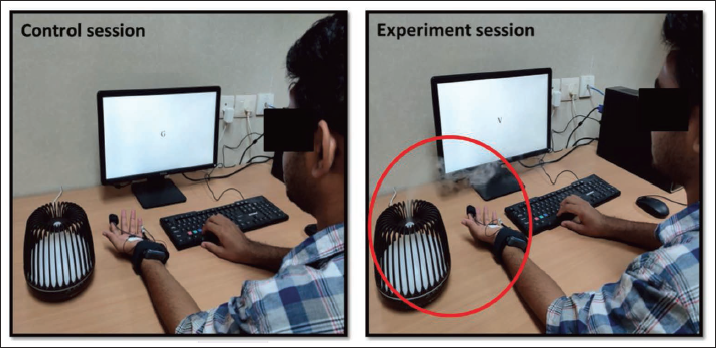
The olfactory stimulation was administered through an aroma diffuser (DT-506H) with a tank capacity of 500 ml that diffused water vapour/mist into the air. Hundred-millilitre water and 1 µl citrus essential oil (100% natural and pure cold-pressed essential oil) were added into the diffuser tank based on a previous study. 18 The setup was kept at a fixed distance during the cognitive task performance (Figure 1).
Assessment via 2-back Task (Cognitive Test)
Two-back task was used to assess attention and working memory. It was designed using Superlab5.0 (Cedrus Corporation) software. It had three blocks with a rest period of 10 seconds in between each block. Eliminating the five vowels, 21 consonants were divided into a group of three (seven each) to make one block. Each block consisted of 40 events, the five consonants were repeated six times and the rest two consonants were repeated five times in each block. The first block had consonants F, K, P, B, G, L, Q, the second block had consonants V, C, H, M, R, W, Z, and the third block had consonants D, N, S, X, J, T, Y. A total of 120 events (30 targets and 90 non-target events) with a response time of 1000ms and inter-stimulus interval of 500ms were incorporated in the task. The participants were required to press the response button when the presented stimulus on screen matched with letter seen one before last. The total number of correct responses, percentage accuracy of the task, percentage error of task, total target response time, total response time were calculated for the control and experimental sessions.
Autonomic Nervous System Parameters
Electrocardiogram was recorded by Lead II ECG (Biopac MP150TM BiopacSystem, Inc. (C)) system) which was used to derive the HRV parameters. The participant was asked to rest for five minutes before the recording. For analysis, the artefacts were manually removed from the ECG signal and frequency and time domain parameters were derived.
Root mean square of successive differences in milliseconds (RMSSD) and the fraction of pairs of adjacent RR intervals with a difference higher than 50 ms (pNN50) were used as time-domain measurements. Both of them were measures of parasympathetic activity. Standard Deviation of Normal-to-Normal Intervals (SDNN), that is, all intervals between consecutive QRS complexes caused by sinus node depolarisation) was used as a measure of sympathetic and parasympathetic activity as well as total HRV variance. 19 Four frequency domain parameters, total power of five minutes during baseline and during the cognitive task, power in the low (LF) and high frequency (HF) range, and the ratio of LF and HF, were derived.
EDA and PPG
PPGED-R and ERS 100CTM modules along with BioNomadix™ Wireless EDA and PPG recording modules of Biopac MP150TM system were used. BioNomadix™ Wireless EDA and PPG recording module were tied on the wrist of the non-dominant hand and connected with the electrode. For EDA recording, disposable silver/silver chloride disc electrodes (EL507, 3M, India Ltd) were applied to hypothenar and thenar eminences, and the PPG sensor was placed on the index finger. A skin conductance module PPGED-RTM amplified electrical signals and these systems were already connected to a preamplifier UIM100CTM, which is a universal interface module. This preamplifier was further connected to a computer equipped with Biopac MP150TM via Ethernet. EDA analysis was done using Acqknowledge™ software and EDA parameters skin conductance level (SCL), latency, skin conductance response (SCR), SCR size, and SCR rise time were derived. SCL often known as the tonic component of EDA, was used as a measure of the sympathetic stimulation at baseline.
PPG analysis was done using the LabChart 8 version of the software. The PPG amplitude and pulse transit time were derived. PPG amplitude represented a change in the width of the vasculature, while the pulse transit time represented arterial stiffness or vascular structural change.
Statistical Analysis
Data were checked for normal distribution and extreme outliers. Statistical package for social sciences (version 23.0) was used for data analysis. The change in the value (Delta) from baseline was calculated for comparison of the psychophysiological parameters. Paired sample t-test was used for comparison of the n-back performance. Wilcoxon signed-rank test was applied to find out the statistical significance for the EDA, PPG and HRV parameters as the data was not normally distributed. The p value <.05 was considered significant.
Results
Thirty healthy males were enrolled in the study with an age mean (SD) of 28.3(5.2) years. All the participants were right-handed. The mean (SD) PSS score was 15.9 (6.4) and the mean (SD) MMSE score was 28.7 (.44). A paired sample t-test revealed that with citrus odour stimulation there was a statistically significant improvement in the performance in the n-back task (Table 1).
Performance in the 2-back Task in the Control and Experimental Session (in the Presence of Citrus Odour).

The Wilcoxon signed-rank test showed that the time domain measures of HRV pNN50 (p = .001), and RMSSD (p = .002) were increased by the odour. In addition, HF power (p = .007), the frequency domain parameter was also increased. Whereas changes in SDNN (p = .212), Total power (p = .719), LF power (p = .171), and LF/HF ratio (p = .220) were not statistically significant though there was a decreasing trend in heart rate and LF/HF ratio in the presence of the odour (Figure 2).
Comparison of Changes in (a) RMSSD, (b) pNN50, (c) HF Power, (d) R-R Interval and (e) LF/HF Ratio in the Control and Experiment Sessions.
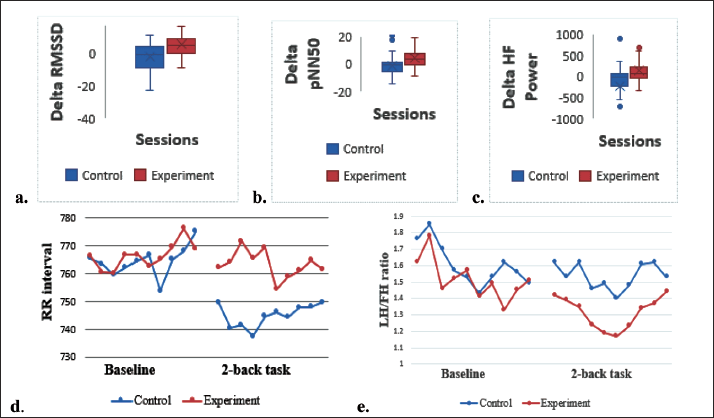
Delta is the change of HRV parameters from the task to the baseline. Root mean square of successive RR interval differences (RMSSD), percentage of successive RR intervals that differ by more than 50ms (pNN50), standard deviation of NN intervals (SDNN), power in low frequency range (LF power), power in high frequency range (HF power) and ratio of low frequency and high-frequency power (LH/HF).
Among the EDA and PPG parameters, the change in skin conductance level (SCL) between baseline and task was statistically significant in the two sessions (p = .032) (Figure 3).
Change in Skin Conductance Level (SCL) in the Control and Experiment Session.
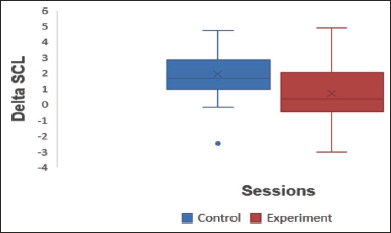
The SCL increased from baseline to that during the 2-back task but in the presence of the citrus odour, during the experimental session, the increase was comparatively low.
The difference in the Skin conductance response (SCR) (p = .131), Skin conductance response time (SCR Time) (p = .464), Skin conductance response size (SCR Size) (p = .100), Pulse transit time (PTT) (p = .985), and PPG amplitude (p = .509) were not statistically significant.
Discussion
We investigated the effect of citrus odour on the cognitive load through the 2-back task, its effect on the performance outcome of the task and the associated autonomic correlates. Cognitive tasks impart cognitive load that evokes changes in the autonomic parameters and the compensatory responses to this cognitive stress can be affected in the presence of citrus odour.
Stress, whether physical or cognitive, affects the functioning of the brain and constitutes an important risk factor for the development of mental disorders. Looking for measures that lead to stress resilience forms an essential domain of research in curbing the occurrence of mental disorders. Goodman and Freeman in their review on stress and working memory found that early life stress is associated with poor cognitive performance. 20 In this context, citrus odour can be an easy intervention that is found to affect the perception of cognitive stress and in turn, affect the outcome of the task. 21 Fragrance has been known to have an effect on emotion, higher functions, and the ANS since centuries. Because of the peculiarity of the neuronal network, the sense of olfaction is frequently associated with stress-related mechanisms. 22 Unlike other senses that are relayed through the thalamus to the cortex, and stress-mediating regions, the olfactory receptors are only two synapses apart from the amygdala and hypothalamus. These two regions are imperative for the stress response. 23 Furthermore, because of the thalamic bypass, the olfactory signals have privileged access to the stress-processing regions of the brain. 24 The connections mentioned before, offer a striking anatomical association between odour and stress.
To investigate this relationship, the ANS possesses a significant place. In humans, the ANS is responsible for dynamically managing the body’s response to a variety of environmental stimuli as well as modulating biological homeostasis. It is important to know, to what extent the autonomic parameters are affected by the presented cognitive stress and fragrance. Our results reveal that the presentation of cognitive load by 2-back task increased the tonic EDA (SCL). This could possibly result from substantial arousal of the sympathetic cholinergic system that manifested as an increase in the SCL from baseline. The alterations in reticular formation centres in the brainstem and thalamus, which are also impacted by cortical networks directing orientation to the relevant target, appear to have a psychological impact on EDA.25, 26 In this context, the citrus odour seems to have a counter effect on the sympathetic cholinergic discharge as compared to the control session, and the finding corroborates with a similar study by Joussain et al. They found that regular exposure to olfactory stimulation with the odour had a positive effect in relieving stress. 4 We demonstrated an acute effect of odour in showing resilience to stress with cognitive load, although the effect of citrus on long-term stress reduction cannot be commented on.
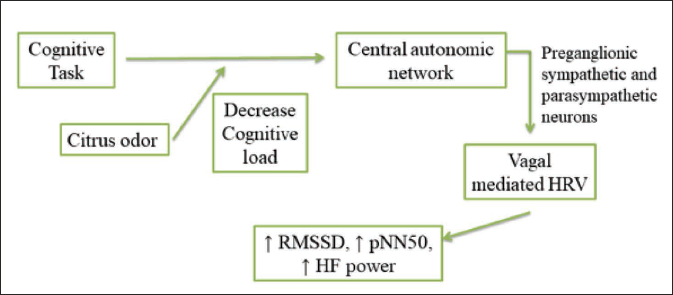
We also found the parasympathetic system activation by the citrus odour though it did not affect the overall variability of the cardiac oscillations. Of note, the neurovisceral model proposes that parasympathetic nervous system activities or resting vagal tone indicate the working of the psychological and physiological network that is involved in self-regulatory response management and consequent cognitive control. 14 The RMSSD is an important time-domain metric used to assess the vagally mediated changes seen in HRV. The pNN50 and RMSSD time-domain measurements are substantially linked with high-frequency power. 27 The proposed mechanism for the observation is presented in Figure 4. Our study has shown a significant change in the HF, RMSSD, and pNN50 that strongly drives parasympathetic activation with the citrus odour, and a significant improvement in the 2-back task was observed. Similar to our results, Matsumoto and colleagues demonstrated that there was a considerable increase in HF power following the citrus smell (odour) inhalation in comparison to inhaling water. 28
Demonstrates the Probable Pathway for the Effects of Citrus Odour on Cognitive Performance and Observed Changes in Psychophysiological Parameters.
We investigated the ANS changes evoked by the 2-back task presentation, the effect of citrus odour on this cognitive load, and on the performance in the task by objectively quantifying them with the help of EDA, PPG, and HRV. However, we have not investigated these findings in female participants which may be a potential limitation of the present study.
Conclusion
The 2-back task imparts cognitive load and evokes changes in the EDA. Exposure to Citrus odour produces resilient response to cognitive load and has potential to improve performance in cognitive tasks. Though there is no alteration in the overall variability of cardiac oscillation but there is a conspicuous shift of autonomic balance towards the parasympathetic system with the citrus inhalation. It implies that citrus odour may be used for modulation of cognitive stress-related response and for its potential effects on cognitive performance.
Footnotes
Acknowledgement
Authors would like to thank the participants for their contribution.
Authors’ Contribution
Declaration of Conflicting Interests
The authors declared no potential conflicts of interest with respect to the research, authorship and/or publication of this article.
Funding
The authors received no financial support for the research, authorship and/or publication of this article.
Statement of Ethics
Approval from the Institutional Ethics Committee was obtained prior to commencement of the work. All participants provided written informed consent before their enrolment.
