



Abstract
Background:
Scientific evidence suggests that yoga is beneficial for treating mental health disorders. To the best of our knowledge, minimal studies have been done on the development of a yoga module for the specific clinical aspects of depression and there is no particular study on yoga protocol development for mild depression and moderate depression.
Purpose:
The primary aim of this study is to develop specific yoga protocol modules for treating patients affected with mild and moderate depression.
Methods:
Yoga protocols for treating mild and moderate depression were developed using classical yoga texts, previous literature, and with the help of yoga experts. 26 practices for mild depression and 35 practices for moderate depression were identified, each of which was scored as (a) not essential, (b) useful but not essential, and (c) essential, and content validity ratio (CVR) determined using Lawshe’s formula for the validation.
Results:
Expert’s opinion revealed that 13 out of 28 practices and 12 out of 35 practices showed significant CVR (>0.60) for mild and moderate depression.
Conclusions:
The yoga practices developed based on experts’ opinion is the first step toward the development of a validated protocol for mild and moderate depression. This will be assessed for its effectiveness through a randomized controlled study to confirm the module’s efficiency.
Introduction
Mental health disorders are the leading cause of noncommunicable diseases (NCDs) such as cardiovascular diseases, diabetes, cancer, and respiratory diseases which are also responsible for 7.4% of global disability-adjusted life years (DALYs). 1 World health organization stated that the prevalence of depression is 15% to 40% 2 and the Global Burden of Disease reported the global prevalence of depression is 264 million individuals of all ages, including 57 million people in India (15.1%). 3 Depression can lead to suicide in the worst-case scenario and every year almost 800,000 people die by suicide. It is the second highest cause of death among those aged between 15 and 29 years. 4 Mixed Anxiety and Depression (MAD), a common and devastating mental health disorder that is the biggest cause of disability in adults under the age of 45, affects most people. 5 The conventional treatment for depression, which affects their everyday functioning, only results in a 50% reduction in symptoms for depressive people. 6 Around 60% of people who are depressed have a significant impairment in their daily life. Despite employing traditional therapies for depression, nonresponse rates have been reported to be as high as 45% to 50%, and about 27% to 31% of them stop taking antidepressants because they do not get any benefit from them. 7
Yoga for Depression—Need of the Hour
Mental health problems are becoming more common in the global population because of the present COVID-19 pandemic, notably among COVID-19 patients, health-care workers, quarantined individuals, and noninfectious chronic disease patients. 8 Psychological morbidity was highly common among COVID-19 patients. 9 They discovered that over half of the population was affected by psychological issues such as psychological distress (34%), poor sleep quality (40%), and stress (34%). During the COVID-19 shutdown, an Indian study found that 74% of people were stressed and 40% suffered anxiety or depression symptoms. 10
By 2030, unipolar depression is expected to be the second major cause of the global burden of disease. 11 Yoga is effective in the treatment of mental health illnesses because of its role in stress, inflammation, and autonomic dysfunction. 12 There are only a few studies that have been done on the development of yoga modules for various diseases. Hence, if a validated yoga protocol is made available for depression, it can be used by medical health professionals to manage the patients effectively in an orderly/systematic manner.13, 14 So, we aimed this present study for developing a valid yoga protocol for patients with mild depression.
Methods
Yoga Protocol Module Development
Yoga practices have been selected from classical yoga texts (Gheranda Samhita, Hatha Yoga Pradeepika, and Patanjali yoga sutras with contemporary yoga-related books Yoga therapy series-yogic management of diseases, Suryanamaskar, Yoga Darsana and light on yoga, etc) and scientific literature for treating the clinical features of depression which have been used as the sources of information for framing the yoga protocol. The selected yoga practices for mild and moderate depression include simple breathing techniques, relaxation techniques, asanas (postures), mudra (hand gestures), Om meditation, and yogic counseling.
Validation of the Protocol
A questionnaire with selected yoga practices has been sent to 32 experts electronically by email with Google form for obtaining their opinion on a three-point Likert scale ([1] = not necessary, [2] = useful but not essential, [3] = essential) for validation. Additional questions have been added to have their opinion on the same practices. Experts were the experienced (> 10 years) medical professionals in yoga, physiology, and psychology, who either practiced or treated patients with yoga. After incorporating the comments of the expert, final yoga protocols for mild depression and moderate depression were developed. Content validity ratio (CVR) for each practice was calculated using Lawshe’s law for the validation, and those with CVR ≥ 0.6 have been included in the final protocol (i.e., marked ≥ 80% Essential by experts).
15

where
ne = number of experts indicating “essential”
N = total number of experts.
Results
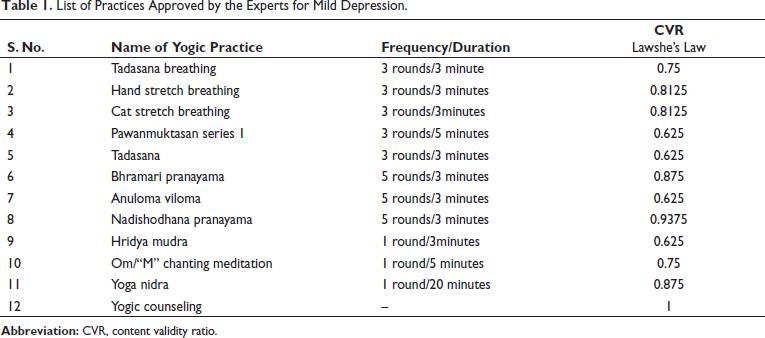
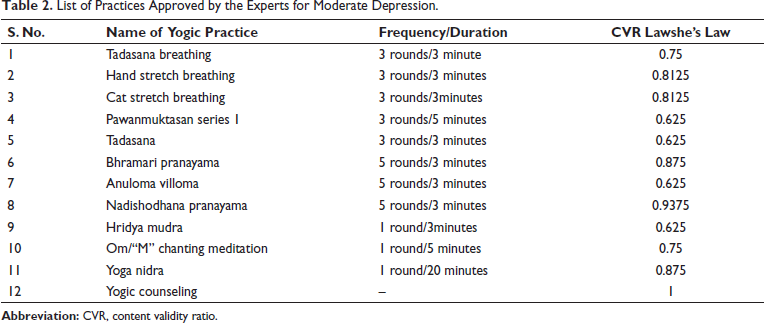
All experts (n = 32) provided their opinion on the selected yoga practices to be followed for mild depression and moderate depression. Tables 1 and 2 show the validation of the identified yogic practices for mild and moderate depression. For mild depression, out of 26 practices, the majority of them accepted 13 practices as ≥ 80% essential (CVR ≥ 0.6), whereas 13 practices were considered to be less essential or not necessary (CVR ≤ 0.6) (see supplementary Table S1). for moderate depression, out of 35 practices, the majority of them accepted 12 practices as ≥ 80% essential (CVR ≥ 0.6), whereas 23 practices were considered to be less essential or not necessary (CVR ≤ 0.6) (see supplementary Table S2). This yoga protocol was recommended by the experts for at least 12 weeks of intervention for patients with depression. Based on the recommendations of experts, 45 min/session for weekly 7 days for 12 weeks was fixed for the intervention.
List of Practices Approved by the Experts for Mild Depression.
List of Practices Approved by the Experts for Moderate Depression.
Discussion
In this study, yoga protocols for mild and moderate depression were framed with pre-existing textbooks and scientific literature to target specific depression symptoms with proper statistical validation. Similar to that of many other yoga protocols, our protocol also contains posture (asana), breathing techniques (pranayama), hand gestures (mudra), meditation, and relaxation techniques. The recommended duration for the mild and moderate depression protocol is 45 minutes and experts insisted on daily practice for 12 weeks. The selected yoga practice for mild and moderate depression includes 3 breathing techniques, 3 asanas (Pawanmuktasana part 1, Tadasana, Vajrasana), 3 pranayamas (Bhramari pranayama, Anuloma villoma, Nadishodhana pranayama), 1 mudra (Hridaya Mudra), yoga nidra, OM meditation, and yogic counseling. Yoga practices included in the final protocols are easy to practice and need to be customized based on individual preference and safety. Most of the experts recommended individual-based supervised yoga sessions, whereas considering the COVID pandemic, it can be done online. Recently, many studies recommended tele/online yoga mode for safety and effective patients care to adopt the current situation.16, 17 We also incorporated multiple strategies to enhance the patient’s active participation and adherence to the protocol, as per the expert’s recommendation. We are planning to create an app-based mobile application for the patients to use the recommended yoga protocols. Along with that, the app has the functionality to capture the live recording of the patient’s practice and give us timely alerts for effective follow-up. The app has multiple options, like how many times they have logged in and viewed the yoga practices and their moments are also captured for documentation. These details will be useful for us to design the study and follow a systematic, iterative process.
Conclusion
The yoga practices developed based on experts’ opinion is the first step towards the development of a validated protocol for mild depression. This will be assessed for its effectiveness through a randomized controlled study to confirm the module’s efficiency, and if the module is beneficial in clinical research, it may become a therapeutic option for people with mild and moderate depression.
Supplemental Material
Supplemental material for this article is available online.
Supplemental Material for Development and Validation of Yoga Protocol for Patients with Depression by Dhamodhini K.S., Maheshkumar K., Santhi Silambanan, Suvarna Jyothi Kantipudi, R. Sathianathan and Padmavathi R., in Annals of Neurosciences
Footnotes
Authors’ Contribution
Conceptualization, methodology, and study design - RP, RS and SS;
Acquiring Data and data curation- DKS and MK;
Writing original draft - DKS, MK and RP;
Data analysis and interpretation - DKS and MK;
Reviewing and editing - SJK, RS, SS and RP.
Revising the manuscript critically for important intellectual content - SJK, RS, SS and RP.
Statement of Ethics
Ethical clearance for the study was obtained from the institutional ethics committee of Sri Ramachandra Institute for Higher Education and Research (Ref no: IEC-N1/20/OCT/76/112). Inform consent also obtained from the study participants.
Declaration of Conflicting Interests
The authors declared no potential conflicts of interest with respect to the research, authorship, and/or publication of this article.
Funding
The authors disclosed receipt of the following financial support for the research, authorship, and/or publication of this article: This project was financially supported by the Department of Science and Technology (DST) under the SATYAM category. (Reference project title: DST/SATYAM/COVID-19/2020/25, Reference project number: 28262.)

References
Supplementary Material
Please find the following supplemental material available below.
For Open Access articles published under a Creative Commons License, all supplemental material carries the same license as the article it is associated with.
For non-Open Access articles published, all supplemental material carries a non-exclusive license, and permission requests for re-use of supplemental material or any part of supplemental material shall be sent directly to the copyright owner as specified in the copyright notice associated with the article.
