




Abstract
Background
Criminal behaviour is influenced by various factors, including social, environmental and individual personality traits. Research has indicated that individuals with psychopathic traits, challenging temperaments and low self-control are more likely to engage in criminal activities. While Yoga has been associated with reducing psychological distress among prison inmates, the application of traditional Vedic philosophy-based personality measures, particularly Triguna (Sattva, Rajas and Tamas), has not been explored within this context.
Purpose
This study aimed to explore the effect of the common Yoga protocol (CYP) on Vedic personality traits among prisoners and examine their association with socio-demographic factors.
Methods
This exploratory analysis involved a randomised controlled trial with 191 prisoners diagnosed with mild to moderate cognitive impairment, focusing on perceived stress and cognitive improvement. Participants were randomly assigned to either a Yoga group (n = 96) or a control group (n = 95). The Yoga group practiced CYP for two months, while the control group maintained their usual routines. Vedic personality traits were assessed at baseline and post-intervention. A per-protocol analysis was conducted on 88 participants from the Yoga group and 66 from the control group who completed the study.
Results
The Yoga group exhibited a significant increase in Sattva (P ≤ .001) and significant decreases in both Rajas (P ≤ .001) and Tamas (P ≤ .001) compared to the control group. Within the Yoga group, Sattva was negatively correlated with age (r = −0.237, P ≤ .05) and BMI (r = −0.220, P ≤ .05), while Tamas was positively correlated with age (r = 0.265, P ≤ .05) and BMI (r = 0.252, P ≤ .05).
Conclusion
The CYP effectively enhances the positive attribute, that is, Sattva, while reducing negative attributes, that is, Rajas and Tamas of personality among prisoners. Incorporating Yoga into daily prison routines may serve as an effective rehabilitation tool and improve our understanding of the criminal psychology of inmates.
Introduction
An individual’s personality is characterised by stability in a distinctive pattern of thoughts, emotions and behaviours.1, 2 Allport (1937) defined personality as ‘the dynamic organisation within the individual of those psychophysical systems that determine his unique adjustments to the environment’. 3 According to Roberts (2009), ‘Personality traits are the relatively enduring patterns of thoughts, feelings and behaviours that reflect the tendency to respond in certain ways under certain circumstances’. 4 Besides genetics, the development of various personality traits is significantly influenced by social and environmental factors, which also directly influence unlawful behaviour.2, 5 Personality traits are typically categorised into four distinct combinations ‘high control–high affiliation, low control–low affiliation, high control–low affiliation, and low control–high affiliation’. Individuals with high interpersonal control and low interpersonal affiliation are strongly associated with antisocial behaviour. 1 Recent studies have indicated that individuals exhibiting psychopathic personality traits, difficult temperament and low self-control are susceptible to being involved in criminal behaviour. 2 Similarly, the Indian traditional Vedic personality may also be associated with criminal behaviour. 6 The behaviour exhibited by an individual is a manifestation of their personality traits; consequently, the characteristics and qualities of an individual’s personality may impact unlawful behaviour. 2 Ancient literature links personality to three mental attributes that shape personality traits and subsequently influence an individual’s diverse behaviours. These mental attributes define the Vedic personality of an individual and denote mental tendencies associated with a person’s psychological and spiritual profile.7, 8 According to the Vedic literature, three personality traits called Triguna are Sattva (illumination), Rajas (activity) and Tamas (inactivity/inertia). Each individual is a combination of all three personalities. However, every person has a dominant particular personality and acts according to that. The Sattva-dominated personality is associated with immaculate, illuminating happiness and non-attachment. 6 The Rajas-dominated personality is associated with a craving for desire, attachment and egoism. 6 The Tamas-dominated personality is associated with ignorance, laziness, sleepiness, delusion and disregarding consequences, loss or violence to others. 6
Since Sattva personality has positive attributes, it negatively correlates with Rajas, and Tamas, as well as perceived stress, and positively correlates with life satisfaction. Evidently, Rajas and Tamas positively correlate with perceived stress and negatively correlate with life satisfaction. 9 A study has reported that healthy individuals have significantly higher Sattva compared to most psychiatric disorders patients such as schizophrenia, depression, anxiety and bipolar disorders. 10 Further, Ravindra and Babu have demonstrated that Sattva has a positive, and Rajas and Tamas have a negative correlation with attention, self-awareness, outlook, social intuition and sensitivity to context. Additionally, they found that individuals with Sattva-dominated personalities exhibit greater resilience. 11 Thus, Rajas and Tamas-dominated personalities may be associated with unlawful behaviour, and enhancing Sattva may control unlawful behaviour and an individual’s outlook on life and society.
Various studies have documented the impact of Yoga on prisoners, focusing mainly on stress, anxiety and depression. However, there is a need for research aimed at personality traits among this population. A six-week Yoga intervention, specifically Sudarshan kriya Yoga practice among prisoners, has led to significant improvement in anxiety, depression, functioning, self-control, positive well-being, vitality and general well-being. 12 Ten weeks of Yoga intervention were reported to improve positive performance in cognitive tasks and reduce psychological distress among prisoners. 13 Besides, Yoga practice and transcendental meditation may help to reduce stress, anxiety, depression, dissociation and sleep disturbances among prisoners. 14 Qualitative analysis suggests that Pranavidya, a Yoga-based intervention, may also contribute to changing criminal behaviour, improving psychological well-being and developing positive attitudes toward intervention. 15
While the impact of Yoga interventions on the personality traits of prisoners remains unclear, it has its influence on Vedic personality traits is well-documented. Deshpande et al. demonstrated that eight weeks of integrated Yoga practice led to improvement in Sattva Guna among healthy participants. 16 Another study has shown the improvement of Sattva and reduction of Rajas and Tamas after eight weeks of integrated Yoga practice among home guards, 17 and a similar result has been documented after one month of sleep special technique among healthy Yoga practitioners. 18 A comparative study has shown higher Sattva scores among Yoga practitioners compared to the physical activity and the sedentary lifestyle group. 19 Another study has shown significant improvement in Sattva and a reduction of Rajas and Tamas after 10 days of Yoga and a naturopathy intervention program among non-communicable disease patients. 20 Studies on the mental health of prisoners are limited in India in comparison to other countries and need attention on predisposing factors and treatment options related to mental health problems. 21
Even though various personality-based studies have been conducted in prison populations to evaluate the association of personality traits with criminal activity, as far as we are aware, no research has been done on Vedic personality among prisoners.1, 2, 22 We hypothesised that Yoga may enhance positive attributes of Vedic personality among prisoners, and Vedic personality may be associated with socio-demographic factors.
Common Yoga protocol (CYP), being an easy-to-practice module, can be applied to various age groups and individuals. The present sub-study is an exploratory study that aims to investigate the role of CYP on Vedic personality among prisoners and its association with various socio-demographic factors.
Methods
Design
The present exploratory sub-study is an offshoot of a larger randomised controlled trial with Yoga and control groups.
Study Participants and Sampling
The participants were recruited from Model Jail Chandigarh based on the enrolment criteria. Participants of both genders (male and female) aged between 20 and 60 years with no previous experience of Yoga and ready to participate as per the rules and regulations of jail authorities were recruited for the study. Participants who were non-cooperative, had aggressive behaviour, did not provide consent, had a history of addiction, or of a severe psychiatric or neurological illness were excluded from the study. Further, the participants underwent the mini-mental state examination (MMSE) test, and the participants with mild (MMSE score 19–23) and moderate cognitive impairment (MMSE score 10–18) were enrolled in the study. 23 The participants with severe cognitive impairment (MMSE score <10) were excluded from the study.
Randomisation and Blinding
One hundred ninety-one participants were randomly allocated into the control group (n = 95) and the Yoga group (n = 96) through lottery-based randomisation. 24 Randomisation was done by a technician who was not involved in the recruitment, assessments, experimentation and analysis procedure. The participants were blinded until baseline assessments.
Intervention
Control Group
The control group followed their daily routine as per the prison authority.
Yoga Group
The Yoga group participants attended the 45-minute CYP sessions daily, five days a week, for eight weeks. An orientation program was held to orient them about Yoga and its benefits and limitations before the commencement of the intervention. CYP was developed and authored by experts throughout the globe under the leadership of the Ministry of Ayurveda, Yoga and Naturopathy, Unani, Siddha, Sowa Rigpa and Homoeopathy (AYUSH), Government of India, is especially used for International Day of Yoga (IDY) that includes loosening practices, Yoga postures, cleansing techniques, pranayama, meditation, etc. 25 The detailed intervention protocol is mentioned in our previous study. 26 Results have shown improvement in stress, anxiety, executive function, general health status, neurogenesis markers and CD34+ cells after CYP practice in healthy adults. 26 Another study has shown the improvement of stress, anxiety, depression, resting autonomic modulation, parasympathetic dominance, oxidative stress and inflammatory markers after CYP in nurses. 27
Assessments
Socio-demographic and Anthropometric Assessments
Socio-demographic and anthropometric assessments such as age, gender, marital status, education, smoking status, alcohol consumption, diet pattern and criminal history were documented at the baseline. Assessments were also done for height, weight, BMI and waist-hip ratio at baseline and after eight-week follow-up.
Vedic Personality Inventory
Vedic personality inventory (VPI) was used to evaluate the mental tendencies associated with a person’s psychological and spiritual profile (Gunas) at baseline and after eight weeks of follow-up. Participants were made to sit quietly, and the test procedure was explained to each participant. After that, the VPI questionnaire, consisting of 56 questions, was given to them, and asked to choose any single option that first came to their mind on a seven-point Likert scale from 1 (very strongly disagree) to 7 (very strongly agree) for each question. VPI is divided into three subscales with Cronbach’s alpha of 0.93, 0.94 and 0.94 for Sattva, Rajas and Tamas, respectively. The sum score of questions related to each Guna was divided by the possible highest score to get the percentage of each Guna, and the percentage of each Guna was divided by the sum of the three Guna percentages. Standardised Guna scores were used for the analysis. 7 VPI has also been studied in the Indian healthy adults with Cronbach’s alpha 0.85, 0.92 and 0.90 for Sattva, Rajas and Tamas, respectively. 11
Statistical Analysis
The SPSS statistical software (version 21.0.) was used to analysed the data. Kolmogorov–Smirnov test was performed to check the normality of the data. P value ≥.05 was considered as normally distributed data. All the continuous variables of Yoga and the control group data were normally distributed, thus, parametric tests were applied. Independent sample t-test was used for between-group comparison of baseline data such as age, height, weight, BMI, waist-hip ratio and standardised score of Sattva, Rajas and Tamas. Chi-square test and Fisher’s Exact test (when n ≤ 5, e.g., diet pattern) were performed for between-group comparison of baseline socio-demographic data. Analysis of covariance (ANCOVA) was performed on outcome variables (Sattva, Rajas and Tamas). The outcome variables were adjusted for covariates, age, gender, marital status, education, smoking status, alcohol consumption status, diet pattern, type of crime and baseline value of the outcome variables. Pearson correlation analysis was performed to analyse the correlation between outcome variables with age and BMI. ANCOVA was performed to evaluate the association of socio-demographic factors with Gunas by using remaining socio-demographic factors and baseline values as covariates. The significance level was fixed at ≤0.05 for all the tests except normality tests.
Results
In this exploratory sub-study, we have presented only a subset of the main study and the manuscript related to the primary study is under process. A total of 597 participants were assessed for eligibility, and 79 participants were excluded after testing of study inclusion and exclusion criteria. Further, 518 participants were screened through the MMSE test; among them, seven participants had severe cognitive impairment, 244 participants did not have any cognitive impairment, and only 267 participants showed mild to moderate cognitive impairments.
Further 76 participants were either released or declined to participate or provide data and finally 191 (control n = 95, Yoga n = 96) participants with mild to moderate cognitive impairment were included in the study. During the intervention period, 1 participants discontinued the intervention in the Yoga group and 19 participants discontinued participation in the control group. Also, 7 and 10 participants went on bail in the Yoga and control groups, respectively. Finally, 88 and 66 participants in the Yoga and control groups were included in the analysis, respectively. Figure 1 shows the CONSORT of the study.
CONSORT Flow Chart.
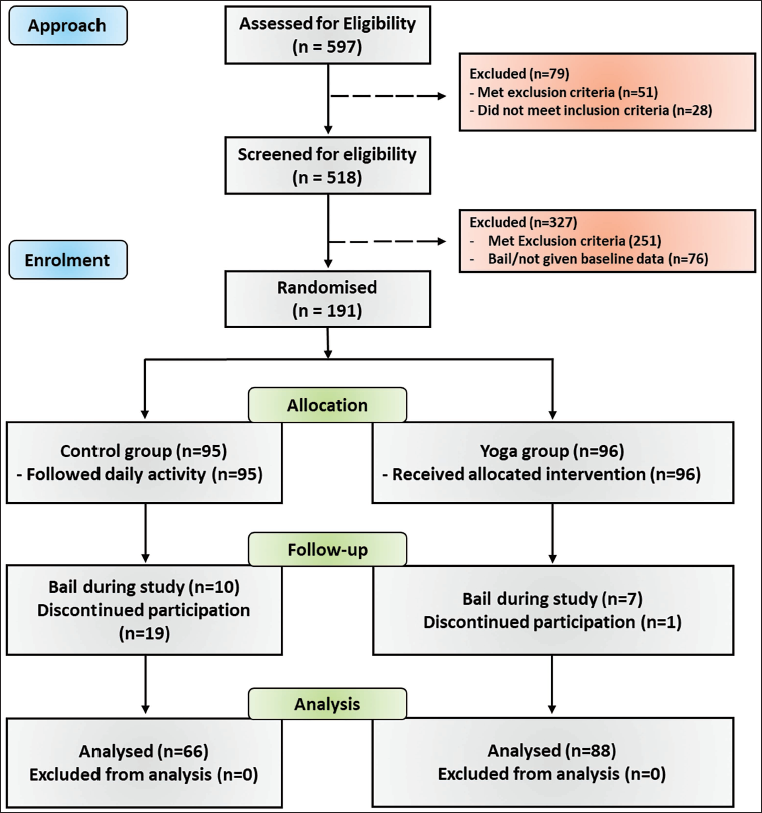
Table 1 shows the baseline characteristics of the study participants. No significant difference was seen among the groups except for BMI at baseline.
Baseline Characteristics of Participants.
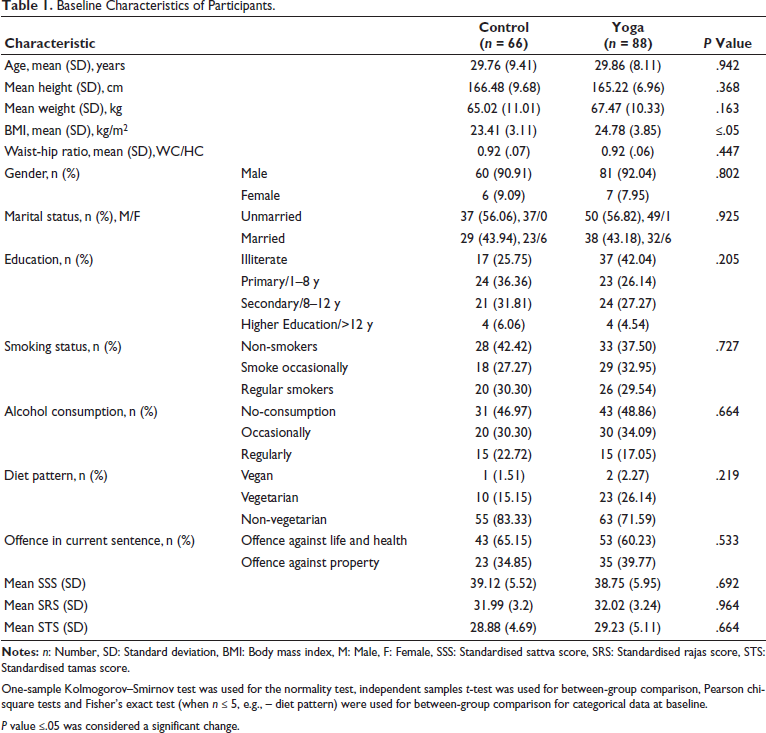
One-sample Kolmogorov–Smirnov test was used for the normality test, independent samples t-test was used for between-group comparison, Pearson chi-square tests and Fisher’s exact test (when n ≤ 5, e.g., – diet pattern) were used for between-group comparison for categorical data at baseline.
P value ≤.05 was considered a significant change.
The VPI showed good reliability with Cronbach’s Alpha 0.83, 0.72 and 0.91 for Sattva, Rajas and Tamas, respectively, in our study. Table 2 and Figure 2 show the significant improvement in the Sattva Guna (P ≤ .001) after eight weeks of Yoga practice compared to the control group. Also, significant reductions in Rajas (P ≤ .001) and Tamas Guna (P ≤ .001) were found after intervention in the Yoga group compared to the control group.
Outcome Measures After Eight Weeks of Follow-up.
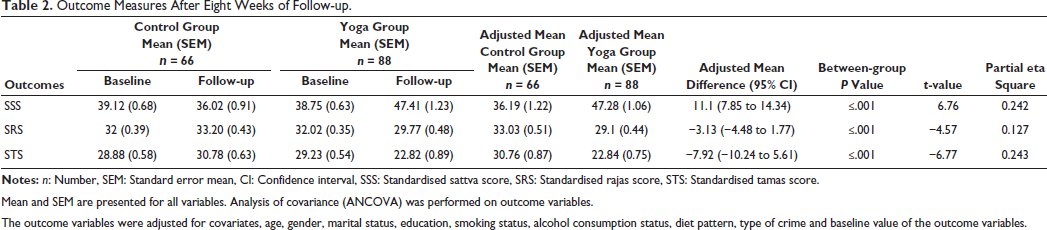
Mean and SEM are presented for all variables. Analysis of covariance (ANCOVA) was performed on outcome variables.
The outcome variables were adjusted for covariates, age, gender, marital status, education, smoking status, alcohol consumption status, diet pattern, type of crime and baseline value of the outcome variables.
P value ≤.05 was considered a significant change.
Changes in Gunas on Follow-up in the Control and Yoga Group: The Follow-up Values Were Adjusted with the Covariates, Age, Gender, Marital Status, Education, Smoking Status, Alcohol Consumption Status, Diet Pattern, Type of Crime and Baseline Value of the Outcome Variables. ***P ≤ .001.
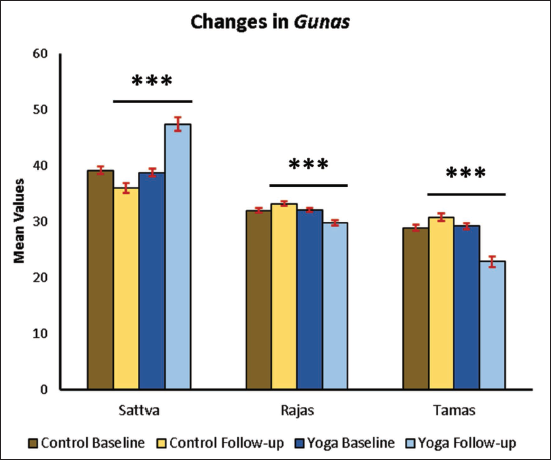
Table 3 shows that Sattva is negatively correlated with age (r = −0.237, P ≤ .05), and BMI (r = −0.220, P ≤ .05), whereas Tamas is positively correlated with age (r = 0.265, P ≤ .05) and BMI (r = 0.252, P ≤ .05) at follow-up in the Yoga group. The correlational analysis also revealed that Sattva is negatively correlated with Rajas (baseline: r = −0.514, P ≤ .001; follow-up: r = −0.796, P ≤ .001) and Tamas (baseline: r = −0.840, P ≤ .001; follow-up: r = −0.946, P ≤ .001) at baseline as well as at follow-up in the Yoga group.
Correlation of Gunas with Age and BMI.
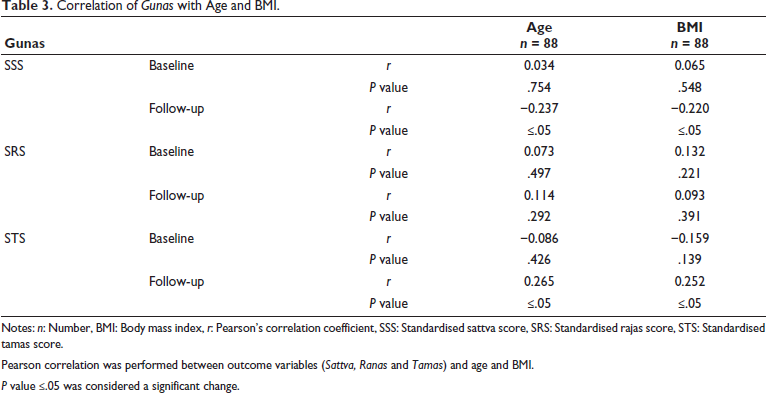
Pearson correlation was performed between outcome variables (Sattva, Ranas and Tamas) and age and BMI.
P value ≤.05 was considered a significant change.
Table 4 shows no significant association between socio-demographic variables and Gunas after Yoga practice. However, we noticed different trends such as unmarried prisoners having higher levels of Sattva and lower Rajas and Tamas in post-intervention, illiterate prisoners having a higher percentage of Sattva and a lower percentage of Rajas and Tamas, non-smokers having higher Sattva, prisoners with vegan diet are having higher Sattva and lower Rajas and Tamas, prisoners with offense against life and health are having lower Sattva and higher Rajas and Tamas.
Association of Socio-demographic Factors with Gunas After Yoga Intervention.
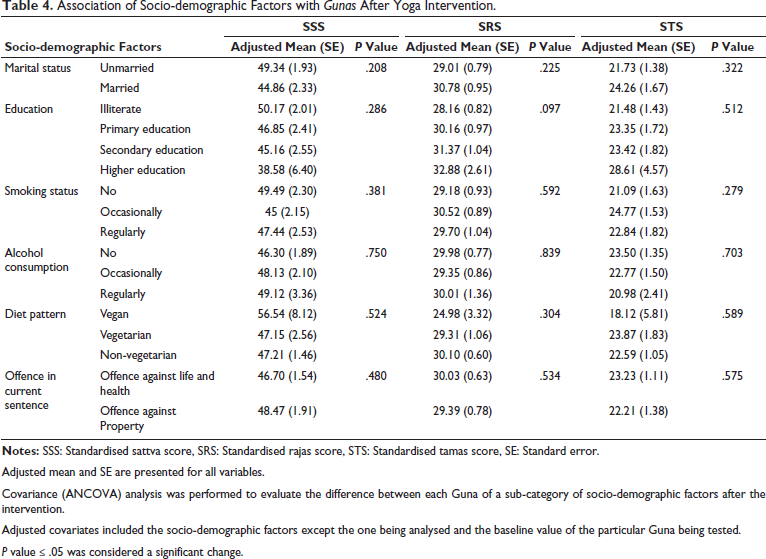
Adjusted mean and SE are presented for all variables.
Covariance (ANCOVA) analysis was performed to evaluate the difference between each Guna of a sub-category of socio-demographic factors after the intervention.
Adjusted covariates included the socio-demographic factors except the one being analysed and the baseline value of the particular Guna being tested.
P value ≤ .05 was considered a significant change.
Discussion
This is the first study to assess the effects of the CYP on prisoners, specifically assessing Vedic personality traits. We observed the significant impact of Yoga practice on the personality traits of prisoners after 8 weeks of intervention. Results reported significant improvement of Sattva and the reduction of Rajas and Tamas after eight weeks of CYP practice compared to the control group. The previous study by Deshpande et al. reported a significant improvement in Sattva and a non-significant reduction in Rajas and Tamas after eight weeks of Yoga intervention in the non-prisoner cohort. 16 Another study by Amaranath et al. has shown similar results after Yoga practice in home guards. The study has shown that one hour of an integrated Yoga module, practiced six days per week for eight weeks, significantly improved Sattva and decreased Rajas and Tamas in the Yoga group, and reverse results were found in the control group. 17 A similar trend was found in our results. However, the present study is unique due to its prison population. Prisoners represent a unique population for conducting randomised controlled trials due to their homogeneity in lifestyle variables such as food, sleep and environment. Given that food habits significantly influence Trigunas, the prison setting provides an ideal cohort for investigating the impact of interventions on personality traits, minimising confounding factors. While parameters such as prior life experiences, genetics and emotional intelligence also affect personality, key potential confounders, including diet and environmental conditions, remain consistent within this population. Also, in the present study, we have statistically adjusted different influencing factors or covariates such as age, gender, marital status, education, smoking status, alcohol consumption status, diet pattern, type of crime and baseline value of the particular outcome variables. These findings implicate social relevance given the known philosophical association of Sattva with attributes of self-awareness, self-control, stress resilience and freedom from maladjustment tendencies. In particular, psychological constructs like self-control have a high predictability of criminal behaviour. As per Gottfredson and Hirschi’s social control theory, 28 low self-control may lead to the adoption of deviance and thereby engagement in antisocial behaviour.
Yoga protocol plays an important role in Yoga-based studies. A comparative study has shown that the participants who have practiced Ashtanga Yoga (ethics-based Yoga) with a special orientation on the teaching of eightfold limbs have shown significant improvement of Sattva Guna and quality of life and significant reduction of BMI, waist circumference, Rajas, and Tamas compared to those who practice general Yoga for the same duration of time. 29 The Yoga intervention of the present study, that is, CYP incorporates most of the limbs of Ashtanga Yoga and includes one hour of orientation about Yoga principles before the intervention starts. This Yoga protocol is also unique due to its simplicity. The protocol includes simple Yoga practices and can be practiced by the general public, as it is a validated protocol developed for the IDY.
The present study shows that increased Sattva score after eight weeks of Yoga practice was negatively correlated with BMI, and a similar result was also documented by Mewada et al. in the previous study. 29 This is consistent with our study in which we report Sattva to be negatively correlated with age, and Tamas to be positively correlated with age and BMI in the present study. Hence, a negative correlation of Sattva with age is obvious and observed. Sattva-dominated personalities are more inclined towards consuming a Sattvic diet, which is a balanced and nutritious diet that may help in the reduction of weight and BMI. 30 This explains the inverse correlation of Sattva with BMI. Generally, as a person ages, he/she is burdened with social responsibilities and professional stress, which increases with age. In our study, the participants included criminals with ongoing conviction proceedings, causing stress. We did not find any significant difference in the association analysis; this needs further evaluation in a larger sample size.
The Strength of This Study
The present study is the first randomised exploratory study in the prison population that demonstrates the improvement in positive attributes of personality, that is, Sattva, after Yoga intervention. The major strength of the study is the confined and imposed lifestyle in the prison that mitigated many of the confounding biases, in particular, diet, sleep and environment.
Limitations of This Study
The study was designed for a short period without any long-term follow-up due to the limited scope of the permission of security agencies. Also, we could not sample mood and behavioural assessments. We were unable to perform gender-based subgroup analysis due to the limited number of female prisoners, and unable to analyse the correlation of personality with cognition and behavioural assessments. Excessive dropout and prisoner bail have reduced the number of samples. BMI was significantly different among groups at baseline is also considered another limitation of our study. Prisoners may lie while responding to self-reported questionnaires, we have not taken any lie scale measure, which is a limitation of the study.
Conclusion
Eight weeks of CYP improve positive attributes of Vedic personality, that is, Sattva, and reduce negative attributes of Vedic personality, that is, Rajas and Tamas, among prisoners with mild to moderate cognitive impairment. Including Yoga in prison as a daily routine may act as a rehabilitation tool for prisoners. Understanding the Vedic personality of prisoners may also help in understanding criminal psychology, which is also influenced by socio-demographic factors. Hence, the policy of implementing Yoga practice in every Indian prison may provide an opportunity to transform prisoners into good citizens for society, reduce the recidivism rate and justify the true meaning of rehabilitation. Further studies with a larger sample size are needed to understand the role of socio-demographic factors on Vedic personality in the context of criminal psychology, as our study does not report any association of socio-demographic factors with Vedic personality.
Abbreviations
ANCOVA, Analysis of Covariance; AYUSH, Ayurveda, Yoga and Naturopathy, Unani, Siddha, Sowa Rigpa and Homeopathy; BMI, Body Mass Index; CM, Centimeter; CONSORT, Consolidated Standards of Reporting Trials; CYP, Common Yoga Protocol; F, Female; GCYEH, Government College of Yoga Education & Health; IDY, International Day of Yoga; kg, Kilogram; kg/m2, Kilograms per square meter; M, Male; MMSE, Mini-mental State Examination; N, Number; PGIMER, Postgraduate Institute of Medical Education and Research; SD, Standard Deviation; SEM, Standard Error Mean; SRS, Standardised Rajas Score; SSS, Standardised Sattva Score; STS, Standardised Tamas score; S-VYASA, Swami Vivekananda Yoga Anusandhana Samsthana; VPI, Vedic Personality Inventory; Y, Year.
Footnotes
Acknowledgements
The authors thank the Chandigarh Prison authority and the Chandigarh administration for allowing us to conduct this study at Chandigarh Prison. Also, the authors are thankful to all members of the Neuroscience Research Laboratory, Department of Neurology, PGIMER, Chandigarh; S-VYASA University, Bengaluru, and GCYEH, Sector-23, Chandigarh, for helping in this study. The authors would like to thank Dr. Judu Ilavarasu, Assistant Professor, Department of Humanities and Liberal Arts in Management, Indian Institute of Management, Kozhikode, for validating the data and reviewing the manuscript.
Authors’ Contributions
KM has collected data, given intervention, analysed data, interpreted data, and written the manuscript; MR has helped in data analysis, writing, and reviewing the manuscript; ND, SK, MD, PV, SWC, MG, KS helped in intervention and data collection; AS edited the manuscript; RN helped in Statistical analysis; SP reviewed and edited the manuscript; PN edited the manuscript; KK validated the data and edited the manuscript; VM helped in data analysis, reviewing and writing the manuscript; AA conceptualization.
Data Availability Statement
The datasets generated during and/or analysed during the current study and the full study protocol are/will be available upon request from the corresponding author.
Declaration of Conflicting Interests
The authors declared no potential conflicts of interest with respect to the research, authorship and/or publication of this article.
Funding
The authors disclosed receipt of the following financial support for the research, authorship and/or publication of this article: Financial support was provided by Science and Technology of Yoga and Meditation (SATYAM), Department of Science and Technology (DST), Govt of India.
Patient Consent
The study was explained to each participant and signed consent forms were collected at the beginning of the study.
Statement of Ethics
Ethical approval was taken from the Institutional Ethical Committee of S-VYASA University, Bengaluru (RES/IEC-SVYASA/167/2020) and PGIMER, Chandigarh (PGI/IEC/2020/001007).
