




Abstract
Background
Immediate assent to high altitude affects the cognitive performance and mood of an individual, which is followed by depression and anxiety. It also affects the sleep quality, general health, and happiness quotient of an individual. Sudarshan Kriya Yoga (SKY) is a cyclical breathing technique, which has been proven successful in managing stress, depression, anxiety, and helps in the improvement of sleep quality.
Purpose
The current study was to understand the role of SKY meditation on psychological parameters, happiness quotient of low landers at high altitude (Leh).
Methods
It is a two-armed pre–post study with experimental and control group both are lowlanders, and their psychological parameters are being assessed when they immediately assent to high altitude (Leh). There are two groups experimental group (SKY) was from AOL SKY–AMP and has prior SKY meditation experience. The control group does not have any yoga or meditation experience. SKY–AMP is a 4 days protocol done at high altitude by the SKY group. Both groups reach Leh through air mode transportation.
Results
Oxford Happiness Questionnaire (OHQ) showed a significant result in the SKY group with P ≤ .001, whereas it is nonsignificant in the control group. We also observed anthropometric and physiological changes in the participants showing significant effects on weight, BMI, waist circumference, hip circumference, and blood pressure; with no significant effect in the control group. It is one of the first studies done with both two groups, where yoga and meditation are done at high altitude and then seen the changes in the groups at physical and psychological level.
Conclusion
Yogic practices can be helpful in having positive psychological change in the lowlanders at high altitude.
Introduction
Immediate assent to high altitude affects the cognitive performance of an individual, which is followed by depression, anxiety, increase in pulse rate, lower blood oxygen saturation (SpO2), fall in heart rate (HR), and cardiac output.1–3 This also leads to acute altitude illness (AAI), acute mountain sickness (AMS), high-altitude cerebral edema (HACE), high-altitude pulmonary edema (HAPE), and pulmonary artery pressure (PAP).4, 5 Low oxygen availability and bad sleep quality at high altitudes are two main causes of poor cognitive performance, which affects the general health and happiness quotient of an individual. 6 Studies also imply decrease in cognitive performance after ascending to altitude above 3,000 m.7, 8 The most common treatment given is supplementary oxygen, which helps improve sleep and better daytime saturation.5–12 It is important to find the nonpharmacological intervention to work on these cognitive conditions at high altitude.
Many earlier studies have proven that yogic practices, like Sudarshan Kriya Yoga (SKY) cyclical breathing technique, have been proven successful in managing stress, depression, anxiety, and helps in improvement of sleep quality. As SKY has been used for cardiorespiratory physiology therefore it can be used as a therapy to manage lifestyle diseases, such as diabetes, hypertension, and psychiatric disorders.13–15, 9–11
Therefore, in the current analysis, we investigated the role of SKY to assess the psychological parameters happiness quotient and the general health of low landers at high altitude.
Methods
The study participants (experimental n = 37; controls n = 16) were enrolled according to the defined inclusion and exclusion criteria. The experimental group (SKY) enrolled in SKY meditation were enrolled by the Art of Living (AOL) Advanced Meditation Program (AMP) carried out in Leh, India at two different time points who had completed basic SKY meditation program were enrolled for the study. SKY–AMP is a technique taught by AOL the protocol is for 4 days. The control group did not have any prior experience in yogic practice or SKY meditation and no intervention was given to them. They were general travelers to Leh. Convenience sampling was considered due to the limitation at high altitude in getting the controls. For pre-assessment, the data were collected on day one when the participant reached Leh and post-assessment data were collected at the end of day four. They all were recruited at a high altitude of <20,000 ft above sea level. This study was approved by the Ethics Committee of Swami Vivekananda Yoga Anusandhana Samsthana (SVYASA) University, Bangaluru, India RES/IEC-SVYASA/165/2020 and Sri Sri Institute for Advanced Research (SSIAR), Bangaluru, India (vide SSIAR/IEC/05).
Inclusion and Exclusion
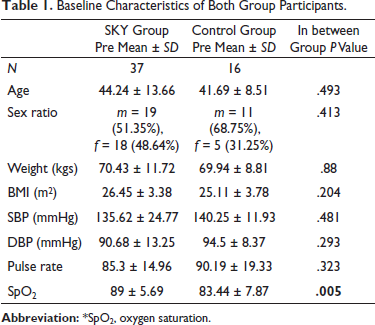
In both groups, healthy participants (male and female) in the age group of 20–65 years were enrolled in the study (Table 1). The SKY group enrolled those participants who had completed SKY basic meditation program whereas those enrolled in the control group had no prior experience in SKY. The written informed consent and air mode of transportation were considered mandatory for inclusion. However, subjects with co-morbidities, including major surgery, diabetes, hypertension, cardiovascular disease, chronic liver, kidney disease, etc., who traveled by road to high altitude, were excluded from the study.
Baseline Characteristics of Both Group Participants.
Intervention
The protocol was followed under the strict supervision of authorized teachers Rishi Nityapragya (Nitin Limaye) and Dr Disha Bhanushali by AOL. The 4-day protocol had asanas (Suryanamaskar along with a set of other supine, sitting, and standing asanas called padmasadhana), Pranayama (Nadi Shodhan/Anulom-Vilom, Kapalbhaati, Brahmari Pranayama followed by Ujjayi, Bhastrika, and SKY) and guided meditations. All participants in the SKY group had prior SKY experience and knowledge about Kriya. All participants maintained silence, had gone for a nature walk, and were served simple vegetarian food (Satvik diet), they also participated in selfless service and spiritual music sessions.16–18 The course started at 5.00
Assessment
Anthropometric: Included participant’s height (H), weight (W), body mass index (BMI), waist circumference (WC), and hip circumference (HC) (Table 1).
Psychological
The Oxford Happiness Questionnaire (OHQ) comprises 29 questions with 6 options 1 being “strongly disagree” to 6 being “strongly agree”; out of which 12 questions score to be reversed then a total of 29 questions need to be divided with 29 to get the final happiness score. The higher score indicates a better happiness quotient. 15
Physiological Assessment
Acute mountain sickness (AMS): It used the Lake Louise AMS scoring scale to measure mountain sickness. It consists of five short self-assessment statement, which helps in measuring the severity of the disease; it includes headache, gastrointestinal symptoms, fatigue/weakness, dizziness/light-headedness, and difficulty in sleeping.
SpO2 assessment: The oxygen saturation of the participants was measured through pulse oximeter (RoHS, India) to measure the oxygen-carrying hemoglobin percentage in the blood (Table 1).
Blood pressure assessment: Systolic blood pressure (SPB) and diastolic blood pressure (DPB) of the participants were measured on the day of arrival at high altitude and on the last day. The instrument used was a digital blood pressure monitor (Dr. Morepen, Morepen Laboratories, India). The unit of measurement was millimeters of mercury (mmHg).
Biochemical assessment: For biochemical assessment 4 ml of blood was collected in EDTA vacutainer by a trained phlebotomist. The same was given to a certified diagnostic laboratory using standard diagnostic to measure cholesterol, triglycerides, high-density lipoproteins (HDL), low-density lipoproteins (LDL), and very low-density lipoproteins (VLDL) were measured in milligrams per deciliter (mg/dl) of blood.
All the assessments for all participants were done at two-time points on the day when they arrived at high altitude and the last day before they left high altitude.
Analysis
Data were analyzed using SPSS 21. Data were divided into the SKY group and control group and were compared by Student’s t-test, which was summarized as mean ± SD (standard deviation).
Result
There were a total of 53 participants in the study, divided into two groups SKY (n = 37) and control (n = 16) with average age 44.24 ± 13.65 and 41.6 ± 8.5, respectively.
OHQ showed a significant result in the SKY group with P ≤ .039, whereas it is nonsignificant in the control group. OHQ has increased significant in SKY group as which shown the better general health. There are no significant changes in lipid profile parameters for both the groups except LDL and LDL/HDL ratio, there is a significant decrease in the SKY group. LDL score 99.64 ± 22.83 to 90.74 ± 18.44 with P = .029 and LDL/HDL ration score 3.16 ± 1.16 to 2.69 ± 0.78 with P = .022. In the SKY group in all four anthropometric parameters, there is a significant reduction with P ≤ .001 in all cases, whereas in the control group there is a significant reduction in weight and BMI of participants with P = .022 and P = .023, respectively. There is a reduction in the waist circumference and hip circumference as well, but it is nonsignificant (Table 2).
Means and Standard Deviations at Two Time Point before and after the Intervention.
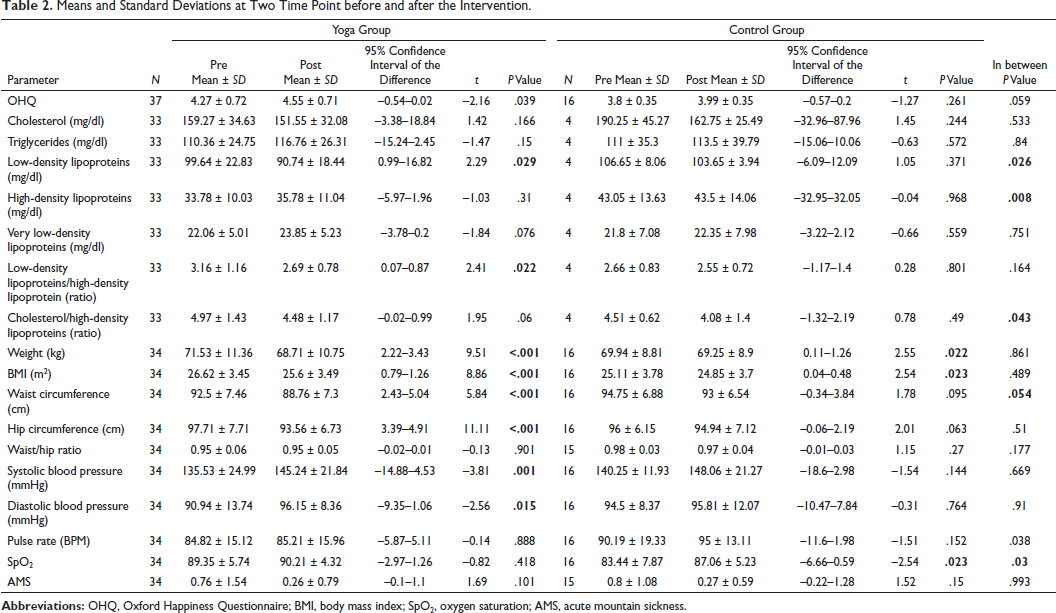
In physiological assessment both high blood pressure and low blood pressure have increased significantly in the SKY group from 135.53 ± 24.99 to 145.24 ± 21.84 with P ≤ .001 and 90.94 ± 13.74 to 96.15 ± 8.36 with P = .015, respectively. There is no significant change in the control group. To our surprise, oxygen saturation in the control group has increased significantly from 83.44 ± 7.87 to 87.06 ± 5.23 with P = .023, whereas in the SKY group there is an increase but nonsignificant. AMS score has reduced in the SKY group and increased in the control group but both are nonsignificant.
Discussion
In the earlier studies, it has been observed that when low landers ascend to high altitude it affects their cognitive performance and mood negatively.1, 19 Due to low O2 level at high altitude respiratory patterns are disturbed resulting in periodic breathing, which affects the sleeping pattern of an individual.2, 20 Although in our present study we have observed individuals who have been SKY practitioners and have performed advance meditation program at high altitude their cognitive performance, their mood, sleeping pattern, health, and happiness quotient, is not effective and has positive effects. The control group in our study shows a similar effect as in earlier studies. Initial studies have shown that when lowlanders ascend to high altitude individuals lose weight and BMI decrease in hypoxia conditions21, 22 and similar results have been seen in our study with significant effect in both the groups. Activation of the sympathetic nervous system further causes an increase in cardiac output, HR, resulting in an increase in blood pressure and AMS, which has been discussed in older studies.23, 24, 25 In our study as well blood pressure increased in both the groups, pulse rate was higher in both groups but in the control group, it was significantly higher compared to the experimental group. Our study’s AMS score was lower in the SKY group as compared with the control group. Strength of our pilot study we collected blood samples and questionnaires at high altitude. As it is a pilot study sample size is small in both groups, which is the limitation of this study. The sample size of the control group for general health questionnaire is lower than the SKY group, which is a weak point in our study, so more comprehensive studies with a greater sample size need to be conducted. To develop a deeper understanding a standardized yoga protocol with a larger sample size needs to be studied, which can be useful not only for mountaineers but also for the general health of individuals who go to high altitude as tourists.
Conclusion
We can conclude that yogic practices can be helpful in having positive psychological change in the lowlanders at high altitude as through our study we can conclude that cognitive performance, their mood, sleeping pattern, health, and happiness quotient, is not effective and has a positive effect.
Footnotes
Acknowledgements
We express our sincere thanks to AOL and PGIMER, Chandigarh, for supporting the conduction of this study and all the volunteers of AOL and PGIMER, Chandigarh, who helped us at various stages of the project.
Authors’ Contribution
SJG drafted the complete manuscript; BP supervised and conceptualized; DB contributed through conceptualization and given intervention RN (NL) contributed through conceptualization and given intervention
Statement of Ethics
All the ethical approval have been taken from the institutional ethical committee. This study was approved by the Ethics Committee of Swami Vivekananda Yoga Anusandhana Samsthana (SVYASA) University, Bangaluru, India RES/IECSVYASA/165/2020 and Sri Institute for Advanced Research (SSIAR), Bangaluru, India (vide SSIAR/IEC/05).
Declaration of Conflicting Interests
The authors declared no potential conflicts of interest with respect to the research, authorship, and/or publication of this article.
Funding
The authors received no financial support for the research, authorship, and/or publication of this article.
