




Abstract

By the courtesy of the Asia Pacific Regional Committee of International Brain Research Organization (IBRO-APRC), a three-day Brain Awareness Week (BAW) was celebrated with gaiety and enthusiasm to raise the awareness and understanding about the intricacies of brain and neuroscience from June 7 to June 9, 2021, at Ibn Sina Academy, Aligarh, India.
IBRO with partner members like Dana Foundation supports BAW projects across the regions of Africa, Asia, Latin America, and the Middle East. IBRO-APRC also offers additional BAW grants to projects in the Asia Pacific Region. In the year 2021, through the Global Engagement Initiative, established with 12 founding partners such as Federation of European Neuroscience Societies (FENS), Society for Neuroscience (SfN), the Japan Neuroscience Society, the Australasian Neuroscience Society, and the Dana Foundation, another 20 public outreach, advocacy, and engagement activities also took place around the world. This was all done to make people aware about the brain and neuroscience in general and about its complications in particular.
To our knowledge, BAW activities were also previously organized in other parts of the Indian subcontinent. This illustrates the progression of BAW among the scientific community and the engagement of the general public within India. Following three events are worth to be mentioned:
The Regional Centre for Biotechnology, Faridabad, arranged a series of webinars on different aspects of brain and neurosciences from March 15 to March 21, 2021. 1
DBT-inStem, Government of India, hosted a series of podcasts with neuroscientists and psychiatrists after engaging the National Institute of Mental Health and Neuro Sciences (NIMHANS), National Centre for Biological Sciences (NCBS), Institute for Stem Cell Science and Regenerative Medicine (inStem), and National Brain Research Centre (NBRC) from March 15 to March 21, 2021. 2
The Centre for Cognitive and Brain Sciences at the Indian Institute of Technology, Gandhinagar (IITGN), Gujarat, hosted a panel discussion on “Neuroethics and AI in the Global Context” on March 17, 2021. 3
IBRO-APRC selected Ibn Sina Academy with a grant award of 1250 Euros to organize BAW. The theme of the Academy’s celebration was “Neuroscience through the Ages to Modern Times.” Because of the pandemic and lockdown, the education system in particular has become dependent on online mode. Learning and other educational activities are being organized through online platforms such as Microsoft teams, Google classroom, and WebEx. This mode allowed virtual training and skill development. However, challenges with e-learning such as affordability, accessibility, flexibility, internet connection, and access to digital devices may be there in remote areas. 4 Student assessment is another challenge as it is carried out with uncertainty and confusion among students as well as teachers. Many students lack accessibility to digital devices and many of their parents are also not well trained with these new online modes of learning. 4 Besides, it leads the way for creative initiatives that can be explored and used even after offline teaching resumes. 5 We believe such an online event would be more beneficial to students and the general public. To organize BAW in a pandemic situation was another challenge for us. The program could have been organized in a better way with more participants if there was no lockdown. Even then, we organized the BAW as per the government guidelines and according to the lockdown protocol, and participants of every age group participated beyond our expectation. School children particularly of all standards participated and completed projects assigned to them.
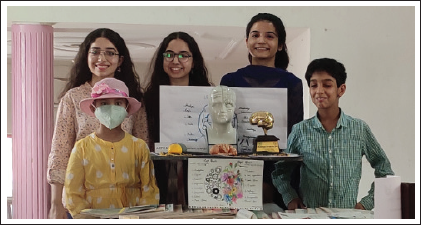
The three-day celebration was kick-started with an impressive inaugural program. This was followed by presentations from children in front of the audience which comprised of students from elementary school (classes 1–5), middle school (classes 6–8), high school (classes 9–12), university students, professionals, and general public. Earlier, various painting, essay writing, and poetry competition were organized on brain and neuroscience in which students from several schools participated. Some children submitted their creative works through email. Handsome cash awards were given to the winning students. Master Syed Faiz Rahman (Student of VI Standard, Our Lady of Fatima School, Aligarh) prepared a collage of original postcards and postal stamps on neuroscience extant at Ibn Sina Academy. It was well appreciated by all and played a significant role in popularizing the concept of BAW.6, 7
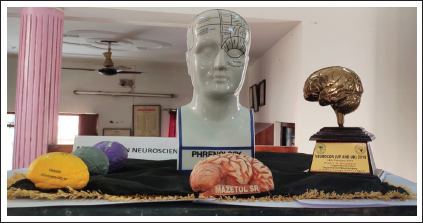
On the next day, i.e., on June 8, 2021, an exhibition of all publications on neuroscience that are extant at Ibn Sina Academy was arranged for the general public. This exhibition of publications on neuroscience, 3D artifacts on brain, bust of phrenology, and exercise-related aids for patients of Parkinsonism to reduce tremor and rigidity, was inaugurated by the Chief Guest, Professor M. Fakhrul Huda (Chairman, Department of Neurosurgery, Jawaharlal Nehru Medical College, Aligarh Muslim University, Aligarh) in presence of Guests of Honor, Dr Raman M. Sharma (Department of Neurosurgery, Jawaharlal Nehru Medical College, A.M.U., Aligarh) and Dr Sanjeev Sharma (Consultant, SASMIT Neuro-Care and Trauma Centre, Vikram Colony, Aligarh).6, 7
Dr Ahmar Hasan (Resident, Department of Pharmacology, Jawaharlal Nehru Medical College, A.M.U., Aligarh), prepared the list of all publications and presented the same through Power Point presentation. To cite an example, the academy displayed a few copies of journals and books on brain and neuroscience such as the Newsletters and Annals of Neuroscience (Indian Academy of Neuroscience), Cerebral Palsy (Indian Family of Cerebral Palsy), Neurochemistry News and Journal of Neurochemistry (International Society of Neurochemistry), European Journal of Neurosciences (ESN), Neuromodulation (International Neuromodulation Society), IBRO News, Nature Neuroscience, Epilepsia, Epilepsy Currents, Brain Behavior and Evolution, Psychiatry and Clinical Neurosciences, Headache, Journal of Head and Face Pain, Indian Journal of Pain, Pain Practice, Psychological Science, Journal of the American Psychological Society, Current Directions in Psychological Science (American Psychological Society), Neuropsychopharmacology, Neurotoxicology Updates, Current Neuropharmacology, Drug and Alcohol Dependence, Psychophysiology (Society for Psychophysiological Research), Journal of Clinical Neurophysiology (American Clinical Neurophysiology Society), Neurodegenerative Diseases, Neurotransmissions (Newsletter for the Neuroscientists), The Mind Healer, Neuro-Signals, Developmental Neuroscience, etc. In addition, lots of abstract books of different symposiums, seminars, and conferences on brain and neuroscience, WHO World Health Day Kit (2017 Theme: Ageing and Health) were also displayed.6, 7
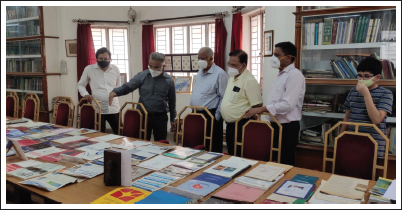
These publications were displayed to highlight that neuroscience journals are being issued from almost all countries and they are covering good research and exploring the science of the brain. The staff present at the site of the exhibition explained the significance of these publications and international journals. Special reference needs to be mentioned here that Ibn Sina Academy displayed two of its own publications on neuroscience and ageing significantly. Ain al-Hayat (An Arabic Manuscript on Geriatrics written in 1532 AD) by Mohammad bin Yousuf Al-Harwi (d. 1542 AD). There are four copies of this old manuscript reported in various libraries of the world. It is stated that this is the first text on ageing in the world. After collation of these four copies of the manuscript, Hakim Syed Zillur Rahman (President, Ibn Sina Academy) edited and translated the manuscript in Urdu language in 2007. In the edited book, one can find how the author 500 years back discussed all types of behavioral and lifestyle factors including diet, environment, and housing conditions related to the well-being of ageing. He also discussed what drugs could increase or decrease the ageing. This book in Urdu has now been translated into English and Bahasa and the same were also displayed. Another book of Ibn Sina Academy which was displayed was “Self-rated memory of individuals associated with demographic profiles, lifestyle parameters, health status and medication use” by Syed Ziaur Rahman (2017).6, 7
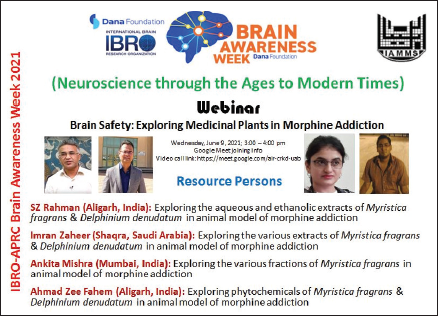
On the third day, i.e., on June 9, 2021, a webinar through Google Meet was arranged on the subject “Brain Safety: Exploring Medicinal Plants in Morphine Addiction.” Drug addiction is a common problem which affects the brain and neuroscience. The research presented on morphine addiction was actually done by researchers working at Aligarh and hence the need was felt to be shared by the local public. The resource persons and topics of presentation were as follows: Dr Syed Ziaur Rahman (Aligarh, India): Exploring the aqueous and ethanolic extracts of Myristica fragrans & Delphinium denudatum in animal model of morphine addiction; Dr Imran Zaheer (Shaqra, Saudi Arabia): Exploring the various extracts of Myristica fragrans & Delphinium denudatum in animal model of morphine addiction; Dr Ankita Mishra (Mumbai, India): Exploring the various fractions of Myristica fragrans in animal model of morphine addiction; Dr Ahmad Zee Fahem (Aligarh, India): Exploring phytochemicals of Myristica fragrans & Delphinium denudatum in animal model of morphine addiction.6, 7
Footnotes
Acknowledgments
The academy is thankful to the IBRO-APRC for selecting Ibn Sina Academy with a grant award of 1250 Euros to organize BAW. The grant was released to Professor Syed Ziaur Rahman (Hony. Treasurer, Ibn Sina Academy) who is a member of IBRO and other neuroscience societies.
Statement of Ethics
Written informed consent was obtained from the Organising committee for publication of this report and any accompanying images.
Declaration of Conflicting Interests
The authors declared no potential conflicts of interest with respect to the research, authorship, and/or publication of this article.
Funding
The author disclosed receipt of the following financial support for the research, authorship, and/or publication of this article: The academy is thankful to the IBRO-APRC for selecting Ibn Sina Academy with a grant award of 1250 Euros to organize BAW. The grant was released to Professor Syed Ziaur Rahman (Hony. Treasurer, Ibn Sina Academy) who is a member of IBRO and other neuroscience societies.
