



Abstract
Knowing when crimes occur most predominantly in a specific area, such as which hour/s of the day, which day/s of the week, or which month/s of the year, is fundamental for the formulation of crime prevention strategies. This information facilitates operational as well as tactical resource deployment in areas at times when they are needed the most. This article aimed to contribute to this knowledge by exploring when most residential burglaries occurred in the Newlands East policing precinct in the Durban area. This was deemed necessary as residential burglary had been reported as the highest property-related crime in the study area for the 5-year period (2015–2019) preceding the study. To ensure that the aim of this study was achieved, a qualitative research design was utilized which assisted the researcher to focus on the temporal assessment of burglary at residential premises in the Newlands East policing precinct. Data collection was achieved by means of Focus Group Discussions and semi-structured interviews that involved a total of 37 participants comprising of South African Police Service members, Community Policing Forum representatives, local Ward councillors, and ordinary community members. The overall results suggest that the Newlands area experiences fluctuations in the frequency of residential burglaries throughout the year by hour, day, week, month, and season. This information can inform policymakers and law enforcement agents on when to implement crime prevention strategies.
Keywords
Introduction
Time is an important risk factor that enhances opportunities for habitual and opportunistic burglars to commit their crime (Ozkan, 2013). Coupe and Blake (2006) argue that opportunities to commit burglaries differ between day and night as affluent but less guarded properties are targeted during the day and well-guarded properties are targeted at night. Correlations between climate and weather and residential burglaries have also been found (Hird & Ruparel, 2007; Linning, 2015; Ranson, 2014). For example, in hot climates a lack of air conditioning may facilitate night-time burglaries as windows may be left open (Hamilton-Smith & Kent, 2005). Obtaining data from interviews with active burglars, Coupe and Blake (2006) found that burglars monitored the daily activities of people in neighborhoods before targeting a residence at a certain opportune time. For instance, when mothers take their children to school or leave to pick them up again, they leave the premises unattended for a set period each weekday. Other research studies have discovered that the average burglary rate decreases on weekends compared to workdays (Breetzke, 2016; Peng et al., 2011), indicating that weekend burglaries were more likely to be suppressed by people’s routine activities.
Ozkan (2013) further emphasizes that temporal patterns can explain a lot of circumstances leading to incidences of burglary. The mode of entry, for example, can be determined by the time of day. Breaking doors and smashing door locks or windows generally occur during the day and are avoided by burglars operating at night. Night-time burglary operation thus tends to be stealthier. Moreover, in the summer months burglars may use the opportunity provided by open windows to enter a home (David, 2003; Hamilton-Smith & Kent, 2005). This means that the time of day and the season can be pivotal in a burglar’s decision to “hit” a target. Closed and locked windows and doors means that the availability of potential targets shrinks dramatically. Burglars also avoid tall buildings and upper floors in tall buildings, visible first floors, and well-lit areas were gaining access through open windows on a summer’s night will be difficult. Neighborhoods where households with air conditioning systems are prevalent are thus often avoided. Consequently, several studies on residential burglary have proposed that the rate of this crime varies between areas and may be higher at specific times of the day, on specific days of the week, and during certain seasons of the year (Breetzke, 2015; Henry & Bryan, 2000; Linning, 2015).
Moreover, criminal victimization is highly concentrated among prior crime victims. According to research, prior housebreaking victimization best predicts future housebreaking victimization risk (Clark, 2018; Sidebottom, 2012; Yang, 2006). Huigen (2020) asserts that, while most burglaries are a one-time occurrence, many residences are repeatedly targeted. In most cases of repeat housebreaking, the same criminals commit both the first and the follow-up burglary, especially if the time between the two incidents is short (Everson & Pease, 2001; Huigen, 2020). Following a housebreaking, the danger of becoming a victim is temporarily increased not only for the household that was burglarized first, but for surrounding properties as well. This risk diminishes in time and space, spreads up to a few hundred metres, and lasts a month or two (Johnson et al., 2007).
The Current Study
This article aims to offer new insights into the temporal distribution of burglary at residential premises in the Newlands East Policing Precinct. Based on the South African Police Services (SAPS) Statistics, residential burglary in the Newlands East Policing Precinct has remained consistently high since 2015 as indicated in Table 1.
Property-related Crime (Burglary at Residential Premises) in Newlands East Policing Precinct, Durban.
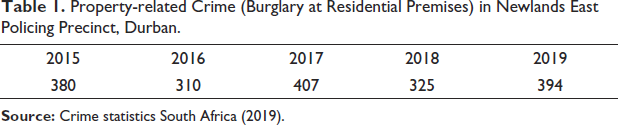
The available statistics on property-related crimes in the Newlands East policing precinct indicate that burglary at residential premises remained high over a five-year period (2015– 2019), with high peaks in 2017 and 2019 and a slight decline in 2016 and 2018. Although the reasons for this decline were beyond the scope of the study, it is undeniable that the many residential burglaries in the Newlands East policing precinct have impacted this community negatively as burglary at residential premises does not only have financial implications for innocent and often poor residents, but victims may be harmed psychologically.
Furthermore, when the nature and extent of burglary at residential premises are considered, it has become an escalating problem nationally and has been categorized as the most feared crime in South Africa by the South African Victims of Crime Survey (Statistics South Africa, 2017/18). This is not surprising as this crime has continued to be the dominant in South Africa as it accounts for 54% of all household crimes in the VOCS (Statistics South Africa, 2019). Africacheck (2019) reports that as many as 220,865 house burglaries were recorded in 2019 with an average of 605 houses burgled per day.
Against this backdrop, it is imperative to understand when these burglaries are occurring in order to implement effective crime prevention strategies. Furthermore, knowing when most residential burglaries are likely to occur is vital in the policing and crime prevention sphere as this knowledge will allow law enforcement to allocate resources strategically. Andresen and Malleson (2013, p. 32) emphasis that “it is in the best interest of policymakers to understand not only which crime prevention methods are most effective, but [also] where and
Theoretical Framework
Burglary at residential premises phenomenon is best understood within the theoretical tenets of the Routine Activities Theory (RAT). The RAT was developed by Cohen and Felson (1979) in the late twentieth century and is one the most influential perspectives for explaining crime patterns. The authors developed this theory to clarify the rise in property crimes in the United States which occurred in conjunction with a rise in economic prosperity post World War II. Their seminal research, titled Social change and crime rate trends: A routines activity approach, explains how the dispersion of activities away from home and family may result in a rise in opportunities to commit a crime (Cohen & Felson, 1979). After World War II, socioeconomic changes were introduced, particularly as women began working away from home. Many had to travel far from their residential areas, leaving their homes and possessions unguarded while their children were at school.
Furthermore, Cohen and Felson (1979, p. 593) argue that the tenets of the RAT are embedded in “the recurrent and prevalent vocational and leisure activities individuals undertake on a regular day-to-day basis.” This theory puts emphasis on where and when people are, what they are doing, and what happens to those individuals because of their situation in time and place (Clarke & Felson, 1993). This theory refers to direct-contact predatory crimes that are “predatory violations involving direct physical contact between at least one offender and at least one item or object which that offender attempts to take or damage” (Cohen & Felson, 1979, p. 589). This theory stipulates that “crime is the result of the convergence in time and in space of motivated offenders, suitable targets, and the absence of capable guardians.”
The likelihood of the three components coming together changes in time because of the presence of routine activities. These activities could be daily and obligatory (periods within a day when an individual is working or in school), weekly (weekday versus weekend schedules, for example going to church on Sundays), or even yearly (annual school schedules that determine when the youth attend school and when they do not) (Brunsdon et al., 2009). These activities are usually quite stable in time and place and do not alter much. Additional activities (such as social events) are, on the other hand, optional and less time bound. People choose whether to participate in such activities as well as when they will do so (Lebeau & Corcoran, 1990). According to this theory, the possibility of the convergence of the three major components increases during periods when people are engaged in regular routine activities, which may impact the decision by a burglar to commit a crime at a particular location at a specific time.
Methodology
To explore the temporal distribution of burglary at residential premises in the Newlands East policing precinct, the researcher adopted a qualitative research design. Qualitative research seeks to explore, describe, and analyse the meaning of individual lived experiences pertaining to a particular phenomenon in order to determine “how [the participants] perceive it, describe it, feel about it, judge it, remember it, make sense of it, and talk about it with others” (Patton, 2002, p. 104, cited in Marshall & Rossman, 2014). This distinctive feature rendered the qualitative approach imminently suitable for this research study as it enabled the researcher to explore the perceptions and views of SAPS officials, local Ward councillors, Community Police Forum (CPF) members, as well as community members on the temporal distribution of burglary at residential premises in the Newlands East policing precinct. The qualitative design was also suitable to elicit the participants’ views and perceptions regarding the topic under investigation as it facilitated a setting in which the selected participants could frankly and comprehensively explain and describe their feelings and experiences. Some of the selected participants were usually the first people to respond to a crime scene and they were also the first to receive reports of crime incidences, while others had been victims or were familiar with victims of residential burglary and had therefore often witnessed the temporal distribution of residential burglary in the study area.
Study Population
The target population is the population to which the researcher would ideally like to generalise his or her results (Welman et al., 2005). The target population of the current study comprised all the SAPS officials at the Newlands East police station, executive members of the Community Police Forum (CPF) associated with this police station, all the community members in the study area, as well as all the Ward councillors of the area. As this population was far too large to include in the study, sampling was conducted to select appropriate participants. The categories of participants as set out above were selected to gain the most accurate responses regarding the research challenge at hand. This was predicated on the belief that conducting interviews with all the officials and stakeholders would be difficult in practice due to time, cost, and geographic constraints. As a result, the study’s population was limited to a carefully selected sample.
Sample Selection and Sample Size
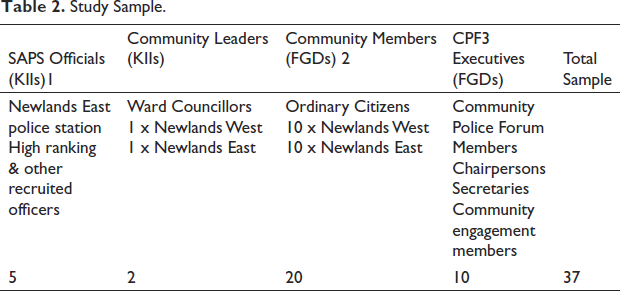
A sample is a subset of a population’s constituents that is used to generate generalizations about the entire population. The ideal sample is one that provides a perfect representation of a population with all the relevant features of the population (Blaikie, 2003). The study population (Table 2) consisted of members of the SAPS, members of CPFs, Ward councillors, and ordinary community members. The study sample that was selected from these groups finally comprised of 37 participants in total. The total number of community participants from the two study areas was 30 comprising of 10 CPF executive members and 20 general community members. These participants were engaged in three focus group discussions (FGDs). Five SAPS officers and two councillors, one from each area, were also involved in the study, totalling seven participants who were individually involved in key informant interviews (KIIs).
Study Sample.
Sampling Procedure
To select the actual participants for this study, two sampling methods were used, namely purposive and snowball sampling. Purposive sampling was used primarily to select the key informants, namely the Ward councillors, the SAPS officials as well as the CPF members known to the researcher, while snowball sampling was used to recruit the community members. The researcher asked the initially identified respondents (Ward councillors, SAPS and CPF members) who had been selected by means of convenience sampling if they knew anyone from the community with similar ideas or circumstances who would be interested in participating in the study. Gatekeeper’s permission was obtained from the Ward councillors to involve these selected community members in the study.
Data Collection Techniques
Individual or group interviews and the observation of people and study surroundings are the two most common methods of gathering qualitative data in the social sciences. The two main methods of gathering data used in the present study were interviews (KIIs) and FGDs. Individual face-to-face and in-depth interviews were conducted with five SAPS officials and two Ward councillors (seven in total) as key informants, while FGD were conducted with 30 CPF and community members in groups of 10 CPF members and 10 and 10 community members. (It is noteworthy as stated in footnote 6 that some CPF members were regarded as key informants due to their wide knowledge and understanding of issues in the study area.)
Data Analysis
To analyse the data, the thematic analysis method was used. Thematic analysis is a method for identifying, analysing, and reporting patterns (or themes) within data and thus the researcher can organize and describe an extensive data set in detail (Braun & Clarke, 2006). This method comprised six stages as proposed by Braun and Clarke (2006): (a) becoming familiar with the data, (b) generating initial codes, (c) searching for themes, (d) reviewing themes, (e) defining and naming themes, and (f) producing the report. In the first stage, the researcher read and listened to the audio-recorded interviews multiple times to become acquainted with their content and to ensure reliability in decoding the information from the audio recordings of the in-depth interviews and FGDs in the transcripts. Familiarization with the data also enabled the researcher to acquire an initial comprehension of the information. By doing so, it enabled the researcher in the second stage to be able to distinguish vital components and topics that were applicable to the problem, questions, and objectives of this study. The vital components and topics of information that emerged from the participants’ data were examined, and this included both similar and contradictory elements that were examined according to their relevance to the objectives of the study. During the third stage, the researcher looked for common denominators and differences within and across the material and these common denominators and differences were formulated as themes. The researcher divided the key information into themes and those that were not applicable were discarded. Relevant themes were compared with those revealed by the literature review. The researcher could then, in stage four, review the themes to be certain that each was logical and that it would fit among the coded information and the other themes. In the fifth stage, the researcher defined all the themes, which enabled the final stage, which was the draughting of the report.
Findings and Discussion
Season of the Year
To ascertain the seasonal periodicity of burglary, a particular question in this regard was posed to the participants.
In which season are most burglaries committed? .... Is there a specific reason for more burglaries during a particular season of the year?
It was noted that the responses provided answers that were very similar to the responses for time of the year. The responses revealed that the hot summer holiday period in December/January was the time that residents chose to travel and be away from home, and for most this was a key factor that contributed to residential burglary in the study area. The participants explained that during the hot summer holidays, people were more likely to spend time away from their properties and this was therefore a perfect season for burglaries. This season was also commonly deemed to increase the number of vacated homes and thus decreased the presence of a “capable guardian.” Below are responses that highlight this point:
“I would think residential burglaries tend to increase during the warm seasons. I say this because residents are often away for holiday purposes and properties are often empty and unguarded” (FGD-A: 03:01). “Generally, during the summer holidays in Newlands people are usually away from their homes as they go to beaches and other places of entertainment and this absence from their houses increases the likelihood of their property being burglarized” (KII-A: 01:01). “I believe during the summer holidays Newland’s people mostly visit the beaches during those times, attend parties. There’s just a lot going on at that time as others leave their houses vacant” (FGD-A: 03:03).
Months of the Year
The question was posed:
In which month/months is burglary at residential premises most likely to occur...? Is there a specific reason for this?
It has been argued that burglary at residential premises, just like any other crime, is periodic (David, 2003). This is to say that similar fluctuations in victimization rates occur year after year during the same months and seasons (Lauritsen & White, 2014). This notion was also evident in the responses of most of the participants who argued that burglaries reached their peak in the month of December. This majority group reasoned that this was due to an increase in people’s activities away from their homes during this time. Below are excerpts that exemplify this view:
“December. I believe that during these times most residents are in holiday mode, and families are often away from their homes. This creates an opportunity for the perpetrators” (FGD-A: 03:01). “December, so towards and during the festive season as there is so much activity going on during that time, especially away from people’s homes” (KII-A: 01:03). “Burglaries occur more in December, so during the December holidays until the 2nd of January. People living in Westrich are targeted more during these times as they leave their houses unoccupied and go to the farm and when they come back, they find that the house has been broken into. That is one of the patterns, especially in Westrich, and mostly it is community people who are involved because they know that those people are not at home” . (KII-A: 06:06)
The RAT posits that there are three plausible reasons why residential burglaries are high in the month of December. First, the pleasant weather during the December holiday season causes more individuals to be outside and away from their homes, which raises the risk of burglary at residential premises. Second, the number of people in Newlands who stay at home in December diminishes during the vacation as many visit their families on farms and in the rural areas while many others go to the numerous beaches in Durban. This results in an increase in the number of vacated properties which makes residential burglary easier as there are no efficient guardians who will deter crime. Moreover, researchers have indicated that property crimes are often caused by a perceived need for cash immediately and houses that are likely to be targeted are those with cash and valuables (Cohn & Rotton, 2003). These elements are predominated in the hot summer months of December in South Africa, when people get bonuses, buy asserts like jewellery, televisions, smart phones, and computers and are less likely to stay at home. Mbonambi (2018) indicates at times homeowners advertise their belongings by leaving empty boxes outside their house for trash collection, which makes criminals aware. Moreover, the South African Victims of Crime surveys revealed that the most stolen items during residential burglaries are television sets, clothing or linen, computer equipment, mobile phones and accessories, tools, small electrical appliances (e.g., toasters, kettles, and microwave ovens), jewellery, and money, among others. The considerable many second-hand merchandise traders in South Africa create opportunities for offenders to commit property-related crimes as they know they will have a market to trade their assets with impunity (Statistics South Africa, 2016). These findings also support Fitzgerald and Poynton’s (2011) theory that housebreakers focus on possessions that are of high value and that can be easily disposed of for cash.
Days of the Week
The question was posed:
On which days of the week are most burglaries committed...weekdays, at weekends? Is there a specific reason for this?
Individuals and families have different lifestyles on weekends than they have during the week, therefore it is possible that weekend crime patterns will differ from those during the week. Responses to the above question revealed that the participants shared a similar understanding of burglary patterns associated with weekday-weekend frequency. The participants seemed knowledgeable and experienced as they all perceived those residential burglaries occurred most during the week. They also demonstrated a clear understanding of why this pattern was prevalent. Some responses that exemplify this view are the following:
“It is during the week, from Monday to Friday. In most cases you would find that people are home during the weekend and no housebreaker wants to confront home dwellers, so they use the chance when nobody is home” (KII-A: 01:03). “It occurs more during the week, as people are mostly away from home during the week with children at school, parents at work. Therefore, there is no one at home to prevent the crime from occurring” (FGD-A: 03:10). “Mostly from Monday to Friday” (KII-A: 01:01).
The above comments enlighten the point that the obligatory activities of people during the week provide opportunities for residential burglary. Individuals leave their homes unattended when they go to work and the children attend school, while on the weekend individuals are more likely to be at home. It is thus less likely to that opportunities for burglary are presented during weekends. In general, all the above responses suggest that weekend burglaries are likely to be suppressed by people’s routine activities. This finding is corroborated by Breetzke (2016), who conducted a similar study in the City of Tshwane, and Peng et al. (2011), who conducted their study in China. All these authors agree that burglaries are more likely to occur during the week than on the weekend.
Time of the Day
The question was posed:
At what time of the day do most burglaries occur...during the day, during the night? Is there a specific reason for this?
According to Ozkan (2013), the time of day can be a risk factor for residential burglary. Coupe and Blake (2006) argue that burglary opportunities differ during daylight and night hours while Mpofu (2019) explains that the logic behind this is that housebreakers are rational in their approach toward targeting their potential victim/s and they will therefore cautiously predetermine a target associated with minimal risk rather than behave impulsively. Thus, because residential burglary is a passive crime, the offender will always choose a time and place that will limit the possibility of encountering targeted victims.
When the study participants were asked what time of day burglaries were most likely to occur, they all shared the view that burglaries occurred predominantly during the day. The reason they shared for this observation was that families were engaged in daily activities during daylight hours such as going to work and attending school. This view is supported by both the RAT and the rational choice theory (RCT). For instance, RAT proposes that the absence of a capable guardian such as a homeowner or housewife during the day is an enabling factor for residential burglary, while RCT posits that criminals rationalize that they will not get caught during the day as they will be unobserved when no one is home. The following are examples of the comments that expressed the participants’ view regarding this question:
“During the day, I think the perpetrators maximize more on the time when residents are away for work or school purposes” (FGD-A: 03:01). “During the day, because nobody is at home during the day” (FGD-A: 06:03). “It happens mostly during the day. I think the perpetrators know that individuals are at work, and they target those houses” (KII-A: 01:03). “In my Ward, I have noticed that these criminals prefer to break into people’s homes during the day because they know that many of the residences here are empty. They are so deliberate in their movements because they do not want to encounter the people” (KII-A: 06:06). “Mostly it’s during the day when people are out going to work; that’s when they get the opportunity to get into people’s houses because in the afternoon or at night people are back from work so that deters them” (KII-A: 01:05).
The above responses revealed that housebreakers in the study area avoided interaction with residents, which is a view that is corroborated by David (2003). Therefore, before targeting a property to commit a burglary, the perpetrator/s clearly weigh their options. In this case, they become acquainted with the residents’ daily routines and pounce when the victims leave their property, probably knowing when they will return. As a result, knowing victims’ movements makes it simple for them to commit a burglary (and even multiple burglaries) during the day. Clearly, the participants confirmed earlier findings that burglary at residential premises occurs at times that are most convenient for perpetrators and that housebreakers consider their options carefully before “hitting” a target.
When all the above data are evaluated, a clear finding is that homes in the study area are more likely to be targeted during the day by burglars than during the evening or night, although burglaries in the latter hours are also likely to occur. This finding is in line with the definition of burglary at residential premises that states that such events generally happen “with no contact between the victim/s and the perpetrator/s” (Africacheck, 2017). It should be noted, however, that this finding conforms with international studies that argue that residential burglaries occur mostly during the day. Conversely, most South African studies have found that residential burglaries occur during the afternoon and early hours of the morning (Breetzke, 2015; Zinn, 2008). Furthermore, most Victims of Crime surveys (Statistics South Africa, 2011, 2014, 2016) reveal that residential burglaries tend to be committed at night. These contradictory findings confirm the importance of studying residential burglary temporal patterns in a particular setting on a regular basis to ensure vigilance and control. As it is almost certain that studies in other South African cities will produce different results as each city and community is unique and is impacted by different environmental factors that affect the magnitude and nature of crime, continued surveys and studies on burglary rates are essential as both the frequencies and nature of burglaries need to be monitored to ensure effective response to this crime.
Conclusion and Recommendations
This article has explored the temporal aspects of burglary at residential premises in the Newlands East policing precinct in the Durban area. The overall results suggest that the Newlands area experiences fluctuations in the frequency of residential burglaries throughout the year by hour, day, week, month, and season. Underpinning the data and findings using the RAT has proven to be quite useful in better understanding these temporal patterns. One pivotal finding is that seasonal variations in crime differ among cities and/or nations simply because people’s routine activities differ. These differences may be attributed to many factors that include, but are not limited to major holidays, weather trends as well as schooling schedules (Breetzke & Cohn, 2012; Carbone-Lopez & Lauritsen, 2013; McDowall et al., 2012). The literature suggests that there are no general temporal variations for residential burglaries but that every city is unique and has different attributes that can shape as well as influence the movement and behavior of individuals. As the findings of this study corroborate this notion, it is important that research continues in this field of study by utilizing different methodologies and data from new and unstudied areas so that a better comprehension of these temporal trends can be illuminated.
Recommendations
Recommendation One
Community members must be educated on the times, and the season when most burglaries can be expected to occur, particularly in their respective areas. This could render targeted communities more vigilant, and they may take extra precautions during times when this crime is most likely to occur.
Recommendation Two
The local SAPS, private security companies, and community members should work collaboratively to increase visibility during the times that are mostly targeted by burglars. This will minimise opportunities for residential burglary and reduce the vulnerability of specific targets.
Recommendation Three
Taking into consideration the understudied nature of the temporal patterns of burglary at residential premises in South Africa, more research is required to explore this phenomenon. Such studies should elicit both quantitative and qualitative data for comparative purposes and to make accurate projections of crime trends over a longitudinal period. Such studies and the recommendations they offer will be highly beneficial in the Criminology field.
Footnotes
Declaration of Conflicting Interests
The author declared no potential conflicts of interest with respect to the research, authorship and/or publication of this article.
Funding
The author received no financial support for the research, authorship and/or publication of this article.
