




Abstract
Since the virus was first identified in the city of Wuhan, China, in November 2019, the novel Coronavirus Disease or COVID-19, has spread all over the world and the World Health Organization (WHO) declared it as a pandemic. Everywhere, it has spread damage to life, the economy, organizations, employees and employment, including in India, forcing organizations to move to a Work from Home (WFH) business model to ensure continuity of operations. We reviewed a volume of literature on work, organizations, productivity and WFH and their impact both from a historical perspective and the ongoing research in the context of the pandemic. The lockdowns are a recent phenomenon and research studies on consequent WFH are limited. This study is one of the first major studies on WFH during the pandemic. Our research focussed on a sample of 526 professionals from the IT sector working across the globe. The research showed that about two thirds of IT employees reported an increased productivity while at WFH, making effective use of the time saved from commuting, as well as to meet increased expectations. The article examines the impact of WFH during the lockdown on the productivity of the IT employee, with particular reference to organizational factors. The research makes use of quantitative analysis as well as qualitative answers from respondents to our questionnaire in arriving at our final findings. The findings indicate that organizational factors, such as autonomy and empowerment, independence to employees, and a supportive environment were necessary for ensuring the productivity of employees, even during a WFH situation. We also find that continued WFH over several months had induced a sense of fatigue.
Executive Summary
Businesses in India and around the world responded to the global lockdowns resulting from the COVID-19 pandemic by adapting their operations to continue serving customers—and one alternate utilized was to move work from offices to the homes of the employees, particularly in the IT industry. While Work from Home (WFH) has a long history since the 1970s, this was the first time when the entire workforce shifted to this mode of working, for a sustained period of time. This has drawn understandable interest amongst researchers, such as the authors.
The focus of our research was the productivity of the individual IT professionals during WFH. What were the factors which resulted in higher or continued productivity and what factors did or did not impact the productivity negatively? We examined several variables, including demographic, organizational and personality variables. In this article we discuss the findings related to the relationship between the organizational variables and the productivity of the IT employees during WFH. Other findings are proposed to be published in a separate paper.
The research was conducted among a sample of 526 respondents from the IT industry, across companies, geography and size and type of organizations. The analysis was conducted using various statistical tools. The research also benefitted from an extensive set of qualitative comments and information provided by the participants.
We studied the organizational factors, like: the autonomy and empowerment given to the employees, availability of access to meet and understand the customer requirements, the employees’ perception that they had a fair chance of growth in the company, personal values of the employee being aligned to the values of the company, being well equipped (necessary hardware, a home environment), the comfort of making genuine mistakes, taking risks and lastly, a feeling of pride in the organization.
Our findings establish a positive correlation between all the above factors, barring one (of making genuine mistakes and taking risks) and the productivity of the employee. These findings are largely in line with a large volume of available literature where organizational factors and the link to productivity has been studied extensively.
The practical implications for the business leaders and the HR professionals in the IT industry are that the organizational factors and the HR practices need to be consistent and flexible enough to consider differing work environments of the employee, whether at Work from Office (WFO) or while at WFH.
Introduction
In November 2019 a strange new virus was first noticed in Wuhan, China. It rapidly spread to various countries around the world and within a few months the World Health Organization declared it a pandemic, with the nomenclature, ‘Coronavirus Disease 2019’ or ‘COVID-19’. (WHO, 2020) Within weeks several countries including India declared travel bans and mandated the wearing of face masks and social distancing (De, 2020). About a third of the world was under some form of lockdown by orders of their respective governments (Koh, 2020). Organizations resorted to WFH which was seen as a partial solution to the business problems created by the pandemic-induced lockdown, kicking off a new WFH paradigm wherever this was possible.
In India the government initially declared a one day lockdown on 22 March 2020 and after that a 21 day lockdown on 24 March 2020 allowing only emergency services to operate (De, 2020). The lockdown continued for several months at varying degrees of intensity in different parts of the country. Like their global counterparts organizations in India shifted work to the homes of employees, with several companies providing facilities like hardware and Wi-Fi infrastructure (Gartner, 2020). An interesting comparison could be drawn on how the first industrial revolution moved work from homes (as say, weavers) to factories, and now because of WFH, some work has shifted back to homes (Mas & Pallais, 2020).
We reviewed the available literature on WFH and its impact on the employees, as well as what factors impacted the performance or productivity of the employees while at WFH. The pandemic was still of relatively recent origin when the data for the study was collected and till the writing of this article the number of research articles were limited; and research on these topics was also nascent. The recency of the pandemic itself created the opportunity of a research gap, and our study attempts to bridge this gap to a limited extent.
The objective of this study therefore was to understand the effect of the WFH during the pandemic induced lockdowns on the productivity of the IT employee, particularly from the point of view of the organizational factors. While the study covered several other factors apart from organizational variables, those factors do not form a part of this research article.
The culture of WFH is here to stay even beyond the lockdowns, as major IT companies have announced that about 70% of their workforce would continue to work from home into the foreseeable future (PTI, 2020a, 2020b).
This present research is one of the first major studies to focus on the effects of the lockdown on the productivity of individual IT employees, and what actions could work for organizations to ensure that the employees continue to be productive at WFH as much as at WFO. To that extent, this research adds to the body of literature on this novel paradigm.
Review of Literature
Work from Home Before the Pandemic
In 1976 a US scientist, Jack Nilles, had posed the option of using telephone lines and computers to move some work out of traditional offices and thereafter came to be acknowledged as the ‘father of telecommuting’ (Mears, 2007), which evolved into WFH. A similar suggestion of WFH came as a response to another business problem, that of high gasoline prices with an article in a leading American newspaper suggesting that gasoline (petrol) costs could be saved by people working from their homes (Schiff, 1979).
A study of US employees working from home in all industries found that by 2000 the number of employees working from home almost doubled. This was especially true amongst jobs that relied on information technology (Oettinger, 2011). The author also found that this increase was largely driven by the fall in costs of working from home. In a 1989 article in the Wall Street Journal, management guru Peter Drucker stated that all the basic infrastructure was available for knowledge work to move from offices to the residences of employees. (Waters-Lynch, 2020)
A UK study (Bailyn, 1988) of IT and non-IT employees indicated that working from home made employees independent and increased their motivation. A US study (Linos, 2020) found that while teleworkers, working at home, showed a reduction in productivity, their peers who worked in the offices showed an increase in productivity. A pioneering experimental study (Bloom et al., 2015) in a travel agency in China by researchers from the University of Stanford was conducted to understand the effect of WFH among the call centre employees. They found that when employees started working from home the productivity of call centre employees increased by 9%, with a 50% drop in turnover (attrition). However, they also found that employees were worried about their chances of promotion because they may not be visible to the management. A study in Germany (Kira & Beckmann, 2016) showed that employees worked harder when working from home. Another study found that knowledge workers chose WFH to avoid the daily commutes and reduce disturbances they faced in offices, and to fulfil family commitments (OWL Labs, 2017). A global study reported in the Harvard Business Review (Schawbel, 2018) indicated that around two-thirds of employees working from home did not feel engaged in their work; most of these were knowledge workers. The author shared his own experiences of working from home over several years where he felt very positive about a lot of things, like independence, and yet felt isolated and disengaged.
Work from Home During the Pandemic—Global Perspective
As the pandemic forced societies to lockdown, a study by (Dingel & Neiman 2020) estimated that over one third of the total jobs in the US ‘can be performed entirely at home’, including the typical knowledge work of the IT industry.
Research among white collar employees (Berstein et al., 2020) found that immediately after the lockdowns were implemented a fall in productivity was seen. This (fall in productivity) may be expected whenever there is a large scale change, such as the lockdown. The fall in productivity was reversed after a couple of months, and the employees found themselves with 10 to 20% longer working hours on average. An Italian study (Angelici & Profeta, 2020) found that even an arrangement of working one day in a week from home (which they call ‘smart-working’), increased the productivity and well-being of workmen in a traditional Italian company of blue and white collar employees. Another US study of knowledge workers (Birkinshaw et al., 2020) found that productivity was up mainly because employees were spending less time in meetings and more time with customers and partners, and non-essential activities were down by 25%.
However, a study by Purdue University (Wu & Chen, 2020) amongst a cross-section of US employees showed that while workload increased by about three hours per week after the lockdowns, there was a 38% fall in productivity largely due to technology and connectivity reasons. The Economist (2020) magazine reported that employees were experiencing longer working hours and the reality of working from home was less ideal than what employees had expected. The article quoted other research to say that Israelis on average were working 47 minutes longer, South Koreans, seven minutes longer and Japanese workmen, 16 minutes longer than before the pandemic, while they were at their regular work places. This was also the conclusion of a survey (PWC, 2020), which found managers and employees differing in how they viewed productivity, with 44% of the managers expressing that the employee productivity had increased although only 28% of the employees reported an increase in their productivity. An interesting study (Quito, 2020) found that employees working from home while under lockdown, were conveying feelings and emotions by using about 80% more emojis, including some newly developed emojis (for example, to convey Wi-Fi problems at home). As long back as 1980’s (De Sanctis, 1984) it was suggested that working from home (or telecommuting, as it was called then), would be a problem if issues of communications and provisions of adequate physical resources were not addressed.
In a qualitative study of WFH among Indian call centre employees (pre-COVID-19), the authors (D’Cruz & Noronha, 2008) pointed out the very important role played by the supervisors in encouraging interpersonal relations, communications and increasing job satisfaction during WFH, when the employee may be feeling isolated. Berstein et al. (2020) suggested that managers of employees who were working from home should vastly increase their communications with employees to clarify expectations and instructions, and avoid misunderstandings. They suggested that there be a ‘chief repetition officer’ to make sure communications go out regularly.
Giurge and Bohns (2020) advised employees to build boundaries while working from home with simple activities like going for a walk during normal commute time and wearing more formal clothes even while working at home. An article (Deighton, 2020) quotes Microsoft as developing tools to help employees who miss out on, say, the commute time from home to office, by building a virtual commute into their calendars.
A Brookings study (Guyot & Sawhill, 2020) predicts that WFH would continue in the foreseeable future. Even as the pandemic is ongoing business leaders like Microsoft founder Bill Gates predicted that WFH will continue with some newer ways of doing work (PTI, 2020c).
In a study among Baidu’s employees working from home during COVID-19, the researchers (Bao et al., 2020) found that the increase in productivity was not consistent and that WFH was not positive for all employees. The employees working on larger projects were most negatively affected. In a qualitative study of Indonesian employees at WFH during the pandemic, the researchers (Mustajab et al., 2020) found that WFH negatively affected women employees who had to pick up the entire burden of the housework in the absence of domestic help due to the lockdowns and the high expectations of society and family.
In a ‘unique’ study (the authors used this word to acknowledge the coincidence of studying similar employees before and during the pandemic) the authors (Beno & Hvorecky, 2021) noticed a drop in productivity of employees while working from home and this was because of the difficulties of balancing the many domestic activities.
After a detailed study on the impact of the WFH paradigm, Alon et al. (2020) conclude that in the long run WFH may have some positives for women employees, since organizations will start investing more in child care, flexible working and other options in order to ensure that women employees continue to maintain productivity. At the same time, men would learn the additional responsibilities of child care and relieve the burden on the women employees to that extent.
Work from Home During the Pandemic in India
There are a few Indian studies that have been published on the impact of the COVID-19 on employees in India, including on the employees of the IT industry.
A survey among IT employees in Bengalore (Singh et al., 2020) showed that two out of three employees spent longer working hours during WFH, with increase in productivity as well as improved work life balance. Another study amongst Indian employees of multinational companies (Seema et al., 2020) found that 50% of participants reported higher productivity, and about 27% reported a lowering in their productivity. A study across a large industrial house (Jaiswal & Arun, 2020) discovered that creativity increased to some extent among employees during the lockdown. However, there was an increase in insecurity amongst the employees owing to communication gaps with their colleagues and managers. A significant number (about 23%) expected that their appraisals would be negatively affected because of their working from home.
A study (Haridas et al., 2021) of IT employees working from home during the pandemic revealed that regular communication and extensive collaboration among employees were correlated most with productivity. Another study (Galanti et al., 2021) during COVID-19 found that autonomy was positively correlated to the performance of the employees, while a poor work life balance and related stress could negatively affect the output of the employees. Farooq and Sultana (2021) concluded from their study that women employees were negatively impacted by WFH due to their need to balance the domestic activities unlike the men who could spend more time on office activities, free of distractions, while working from home.
A study of women doctors in India (Aggarwal et al., 2021), found that the ‘me’ time of women doctors was reduced due to domestic compulsions and they go on to suggest a series of recommendations to mitigate the problems of women employees while at WFH, including, ‘psychological counselling’.
Yet another study (Haridasan et al., 2021) among women employees while at WFH during the pandemic, found that the women employees had higher productivity while working from home due to lesser interference, and the quality of the work was also higher.
India’s Nasscom president Debjanj Ghosh was being hopeful when he said that the mindset that women have to work (outside of home) and single-handedly manage the home ‘has to change’ (Rai, 2020).
Mr Rishab Premji, Chairman of Wipro thinks it is important for a company’s culture that employees be in their offices. (Chandra, 2020) Mr N. R. Narayana Murthy, the founder of Infosys, also believes that WFH could not be a long term solution (Ghosh, 2020). At the same time reports indicate that all the major companies such as TCS, Infosys, Wipro, and so on, are preparing for a future where a major proportion of the employees would continue to WFH even after the lockdowns had ended (PTI, 2020a, 2020b).
Organizational Practices and Employee Outcomes
The link between the concepts of organizational culture and climate and commitment and employee outcomes like job satisfaction and performance and productivity of the employee has been extensively researched in psychology and organizational behaviour.
For the purposes of this article, we frame organizational culture as the set of shared ideas, values, practices and artefacts commonly understood by employees of an organization (Huff, 2014) and which guides the employees everyday, as well as the management. This can be put in common language as the way things are done in an organization (Deal & Kennedy, 2000). Organizational commitment is commonly understood as the psychological attachment (Yousef, 2017) that an employee feels towards the organization and determines if an employee will continue to remain voluntarily employed and contribute towards the organization’s success.
Research by Porter and Smith (1970) and Mowday et al. (1979) establishes a linkage between the commitment of an employee towards an organization if they believes in its values and goals and where the employee is willing to put in extra efforts towards the success of the organization. Luthans et al. (2008) found that the psychological contract is a mediator between the organizational climate and the performance of the employee, apart from the link to job satisfaction and an increased commitment towards the organization. In their book Mowday et al. (2013) stressed the psychological contract created between an employee and the organization where such membership could lead to both financial (compensation, benefits) and non-financial rewards (psychological satisfaction, continued membership of the organization) for the employee. A study of Indian IT employees (Mathew et al., 2012) showed that a company’s profitability was positively impacted where the employees’ job satisfaction and productivity were high.
Several authors have brought out the importance of autonomy (and empowerment) for an employee. This includes the seminal work of Hackman and Oldham (1976) where autonomy or the ‘freedom, independence and discretion’ an individual has was one of the major factors impacting the Motivating Potential Score (MPS). Other studies also showcase the importance of autonomy (Akin & Hopelain, 1986; Haas, 2010), especially among knowledge workers (Langfred & Rockmann, 2016), where the importance of autonomy has been emphasised over time (Langfred & Moye, 2004). Empowerment, the availability of power to the employee, is also found to be important (Mills & Ungson, 2003; Spreitzer, 1995). In fact, Knowledge Workers are well qualified, technically trained and also have the ability to work with autonomy (Drucker, 1992; Langfred & Rockmann, 2016)
Shared values are a basis of the psychological contract between employee and employer, and one of the three pillars of employee commitment (Mowday et al., 1982) and of organizational culture (Schein, 1996). Rousseau et al. (2006) stressed the need for values that are widely shared in an organization, and which the employees could own. Even when a value is espoused in an organization and an opposite value, or a counter culture exists in a sub-part of the organization, the respective shared values may be important to the employee (Martin & Siehl, 1983).
Providing growth to the knowledge worker is considered a duty of management (Aydogmus, 2019). In addition, resources in terms of equipment and funds, apart from the managerial time are essential for productivity, in essence saying that management should do what it needs to and the employees will follow (Akin & Hopelain, 1986; Rousseau et al., 2006). A research study of Sheffield Hallam University (UK) among knowledge workers showed the importance of being well equipped—both in areas of personal environment as well as the availability of equipment (‘ergonomic equipment’), to be more productive (De Been et al., 2016).
In their HBR paper, Anthony et al. (2015) emphasise the importance of risk taking in innovation, quoting Thomas Edison that a mistake was but a way forward. Quality of work is positively associated with organizational innovation, which is linked to employee outcomes and helps improve the organization’s ability to further attract the best candidates (Mathew et al., 2012).
Levering (1996) highlights the requirements of an organization to be considered a ‘good workplace’ where the Human Resource practices and the culture of the organization are positive, which results in a better quality of employee output and in turn leads to the organization attracting better quality talent. Correspondingly, such organizations also have better quality products and thereby better profits.
Well known HR thought leader Peter Cappelli (2020) warns that the increases in productivity of employees while at WFH during the pandemic, would tempt some CEOs to continue with this system to increase profits. He reminds managers that a better way for businesses to increase the performance of the employees would be the more traditional approach—of involving the employees in their work and work related decision making.
Research Gap
WFH as an alternative to WFO took off due to the impact of COVID-19 from March 2020. Research studies on how the lockdowns have impacted productivity and WFH are relatively nascent. Much has been written on the impact of the pandemic, but the writings have been in general purpose newspapers and magazines, or in specialized medical journals as details of the new variants of the virus emerged. Publication on the impact of WFH on employees in established research journals, has been limited. In fact the authors reviewed almost all available literature more than one year into the pandemic and had not found any significant research article that studied the productivity of the knowledge workers with any depth. While there exists a significant documentation on the importance of organizational factors in the productivity of IT employees, very little literature could be found on the productivity of employees of the knowledge industry and the IT sector while at WFH and, understandably even less, during the lockdowns, both in the global as well as in the Indian context.
There is, therefore, a need for a detailed research into the impact of organizational factors on the productivity of the employees of the Indian IT industry, while at WFH.
Motivation
Both the authors of this Research article have had a long experience in the IT industry, one as a senior business head and delivery leader and the other as a Human Resource professional. Their common observation that WFH was often ‘granted’ to employees on a special request, and had to be approved at senior levels, for very special reasons such as an extended maternity leave or an injury or illness of the employee or a family member.
With the onset of the pandemic, lockdowns were declared and organizations had to respond quickly to the new environment and WFH became the default necessity. Many large IT companies have planned to continue WFH on a permanent basis for a majority of their workforce. The authors took up this study to understand how this new WFH compulsion impacted the IT industry, particularly the productivity of IT professionals. What factors would make the WFH more successful for both the employees and the organizations? What could organizations and managers do to make the IT employee more productive? The study draws from this motivation.
Research Question
The scope of the research, and the research gap, being very broad, the authors have decided to study the impact of WFH in phases, and in this phase the impact of organisational factors on productivity while at WFH has been selected for research. Therefore, the Research Question which emerges for the present article is:
This research article aims to examine the impact of the WFH model on the performance and productivity of the employees of the IT industry, and determine what organizational factors impact the productivity of employees even through a continued period of WFH.
Hypotheses
Following the review of literature, research gap and research question, the following null hypotheses were formulated for the study:
The Dependent Variable was the Productivity of the IT Professional while at WFH, during the Pandemic, or the short form, “while at WFH”.
Methodology
To understand the effect the WFH had on the productivity of knowledge workers of the IT sector, we conducted a study during the pandemic. We sought to examine the impact of organizational factors on the performance or productivity during WFH. We designed a questionnaire and requested IT employees across India and abroad to respond to the questionnaire from a variety of organizations. We used a well-known independent platform,
We received a total 745 responses from various locations across the globe. After cleaning up and validating the data, a total of 526 responses were available for analysis. We also encouraged the respondents to elaborate on their responses in a ‘comments’ response box at several places in the questionnaire. These qualitative comments are also analysed and the results of that analysis are also discussed in a subsequent section.
Reliability and Validity of the Scales Used
The questionnaire was designed to cover basic demographic information along with the questions on the various constructs and concepts hypothesised for the study, which were mostly the organizational factors responsible for the performance or productivity of the employee. For this article the following scales were used from the sources indicated. Questions asked in the Survey were drawn from well-known questionnaires and instruments freely available in the public domain.
Some of the questions were drawn from the instruments, Job Satisfaction Survey (Spector, 1994), Utrecht Work Engagement Scale (Schaufeli, 2002), English version, and the Organizational Commitment Questionnaire (Mowday, 1979).
The authors drafted other questions. These questions were validated with extensive comments and feedback on the language and contents, from about 15 industry and academic experts, each of whom had over 20 years of experience. Subsequent to this exercise, the questions were included in the questionnaire.
The Likert scale was used where applicable with 1 for Strongly Agree or Excellent and 5 for Strongly Disagree or Very Poor. Other questions used other scales as appropriate.
The statistical analysis was carried out using SPSS version 23.
Results
Quantitative and Statistical Analysis
Of the 526 responses, the demographics were as follows:
Gender: 442 (84.03%) were men and 84 (15.97%) were women. Age: All age groups, divided into five year intervals, from below 25 years to above 60 years were well represented in the total responses. The average age of the respondents was 37.63 years. Qualifications: 53.80% had a bachelor’s degree, mostly in Engineering, 42.40% had a master’s degree and 05 (0.95%) had a doctoral degree. Location: Respondents to the Survey were spread all over the world. The largest location was Bengalore, with 48.10% of the respondents, followed by Pune, India with 30.80% of respondents and the National Capital Region of India (i.e., Delhi, Gurugram and Noida), other cities in India contributing 18.90% and 2.30% of respondents being in places outside of India.
The Dependent Variable for the study was the Productivity of the employee during the WFH. The Independent Variables were the Organizational Variables.
Factor Analysis
KMO and Bartlett’s tests were used to test the suitability of data for factor analysis. KMO value was 0.881 exceeding the recommended value of 0.70. Bartlett’s Test of sphericity reached statistical significance (approx. chi-square 5,545.525, df 276 and Sig .000) which signifies that the data was good for conducting factor analysis.
Principal Component Analysis with Varimax Rotation Method Kaiser Normalization was further used and the statistical tables indicated that the data set is adequate with Elgin values exceeding 01 and rotation converged in 06 iterations. PCA revealed the groupings, and the ones used are used for this research study.
Cronbach Alpha
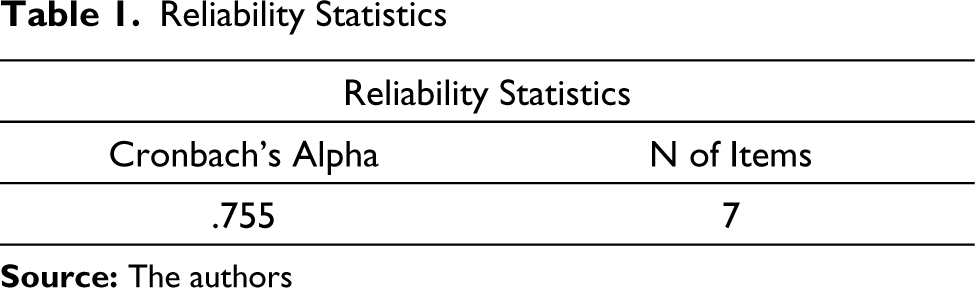
For the seven organizational variables Cronbach alpha was 0.755 which showed a good reliability of the variables for our study (see Table 1).
Reliability Statistics
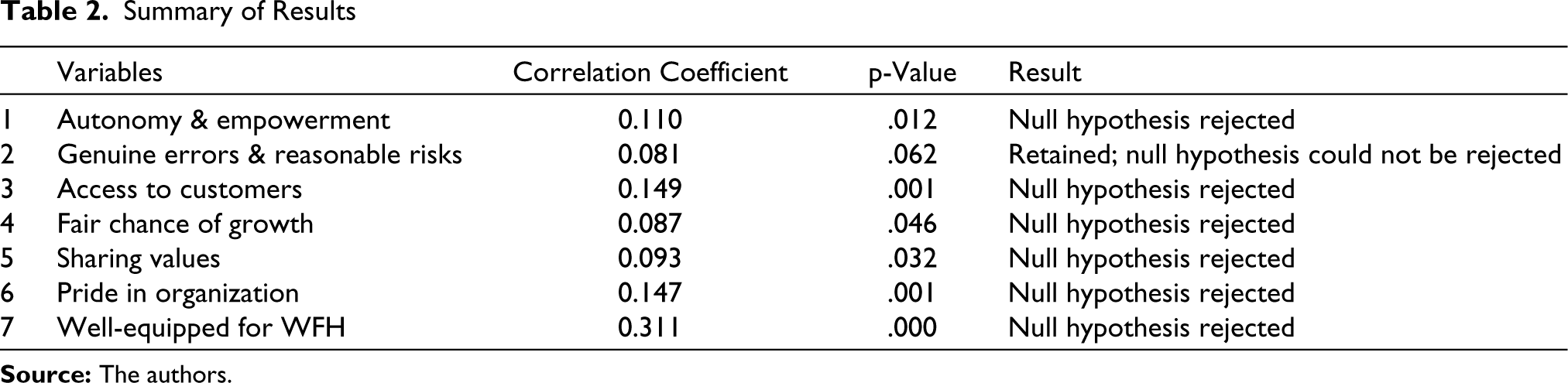
Summary of Results (see Table 2)
Summary of Results
Autonomy and Empowerment:
There is a relationship between the autonomy and empowerment [H0 (1)] given by the organization and the productivity of the respondent during WFH. With a Sig. value of 0.012 which is less than 0.05, we reject the null hypothesis and conclude that the Autonomy and Empowerment of the respondent and productivity are correlated.
Genuine Errors and Reasonable Risks:
There is no relationship between the respondent feeling that they could make genuine errors [H0 (2)] or take reasonable risks and productivity of the respondent during WFH.
Access to Customers:
There is a relationship between the respondent having Access to the Customers [H0 (3)] and the productivity during the WFH. With a Sig. value of 0.01 which is less than 0.05, we reject the null hypothesis and conclude that productivity of the respondent during the WFH and having access to the end customer are correlated.
Fair Chance of Growth:
There is a relationship between the respondents feeling they had a fair chance of growth [H0 (4)] in the organization and productivity of the respondent during WFH. With a Sig. value of 0.046 which is less than 0.05, we reject the null hypothesis and conclude that productivity of the respondent during WFH and the feeling that the respondent stood a fair chance of growth in the organization are correlated.
Sharing Values:
There is a relationship between the respondents feeling they have shared values with the organization [H0 (5)] and productivity during the WFH. With a Sig. value of 0.032 which is less than 0.05, we reject the null hypothesis and conclude that the productivity of the respondent during the WFH and having shared values with the organization are correlated.
Pride in the Organization:
There is a relationship between the respondents feeling Proud of the organization [H0 (6)] and the productivity during the WFH. With a Sig. value of 0.01 which is less than 0.05, we reject the null hypothesis and conclude that productivity of the respondent during the WFH and feeling proud of working in the organization are correlated.
Well Equipped for WFH:
There is a relationship between the respondents feeling they are Well Equipped to WFH [H0 (7)] and productivity during the WFH. With a Sig. value of 0.000 which is less than 0.05, we reject the null hypothesis and conclude that the productivity of the respondent during the WFH and being well equipped to WFH are correlated.
Analysis of Qualitative Responses
A total of 204 qualitative comments were received from 186 of the 526 respondents (35.36%), a rich source of information which is a unique feature of this research. The commentary below summarizes the qualitative comments and the feeling and emotions of respondents. Comments have been collated and edited for ease of reading, but are true to the spirit of the responses.
Please note that totalling all qualitative responses would not add up to 100%, since there were multiple responses and very generic comments, to several questions.
Of the total qualitative responses, 39.22% were positive towards WFH and indicated that productivity had increased during WFH. The reasons behind increased productivity included the elimination of commute times (up to 2.5 hours daily for some), and the resultant reduction in stress.
There were respondents (20.59%) who felt their productivity had gone down, that is, they were negatively affected by the WFH. The reasons included, that WFH had added to the stress levels because of increased working hours (up to 14 hours a day), the lack of formal lunch, tea/snack breaks, and even dinner time, lead the respondents to believe that working 24×7 was a new expectation by bosses who did not respect personal time, and there were distractions on the home front.
On increased productivity, male and female responses were similar, with 68.10% of men saying they experienced an increase in productivity during WFH compared to 69.05% of the women experiencing an increase in productivity. However, 10.71% of women experienced a drop in productivity, as against 6.56% of the men. The remaining numbers claimed not to have experienced a change in their productivity. One of these respondents explained, ‘(activities are) already process driven and decentralized; no change in productivity’.
Respondents who had moved to new jobs during the Pandemic with WFH and had a virtual on-boarding process, ended up working with colleagues whom they had never met.
In several parts of India, infrastructure was an issue. Respondents (6.86%) felt that their organization should have provided equipment and office set up. These respondents expressed that the homes were not geared for working from home, with a lack of space for more than one member working in privacy, low bandwidth issues and even ergonomic issues with tables and chairs at home.
Other respondents (12.75%) however said their organizations had provided facilities, and in a few company’s workstation and widescreen monitors were shipped to the residences from the offices.
Some respondents offered a view that their family environment was supportive, and helped to increase productivity. It was also true of those respondents who were already experienced with WFH, although those had been for shorter periods.
Some employees who were new to their jobs had not had a one to one meeting with their team mates or supervisors due to the WFH. The lack of personal contact meant an increase in communication problems and a lack of understanding of requirements, either of the manager or the customer. This ‘failure’ of communications, or a ‘lack of precise, clear communication’, due to lack of physical infrastructure problems or absence of a personal touch, has a lesson for the success of a WFH environment—supervisors must increase communication, and even over-communicate, and be specific and precise in their communications, and encourage their team members to do so. Some teams have even created a ‘time off’ during the online calls and meetings, where employees, new or existing, could simply catch up, and this was not seen as ‘wasting’ time.
A few employees did express that not meeting the supervisors/managers and HR colleagues would have a negative effect on their careers, as they were ‘out of the sight, out of mind’ of the managers during WFH.
A recurring theme was of ‘missing office environment…chitchats, tea/lunch breaks with colleagues’.
For women respondents, WFH brought additional challenges, sometimes overwhelming them with multiple roles. Some respondents expressed that as the lockdowns continued, ‘the maids have returned, so things are better’; and ‘as the pandemic continues, they (husband, children) have started lazing off on house work. However, I cannot’.
Other responses from women included, ‘I have become totally numb, due to this COVID and WFH’; ‘I have multiple roles, being a wife, mother, parents-in-law at home, and not just a team leader at work’; ‘sometimes overwhelmed, as there is no time limit for women (WFH) means juggling work and home stuff’.
To some extent, the above experiences of women employees who were at WFH during this pandemic were similar to experiences of women in earlier voluntary WFH situations, indicating a mixed response to WFH—some flexibility was available and mostly, more work due to family pressures.
Several respondents also said that, ‘Initially WFH looked good, but now…’ implying a certain fatigue and wish to return to the offices.
Discussion
The COVID-19 pandemic was a severe disruptor, forcing governments into mandating curfews and lockdowns. While essential services were exempted from the lockdowns, businesses suffered as economic activities came to an abrupt stand-still. The knowledge industries, particularly the IT sector responded by shifting the work to a WFH model, to ensure business continuity. While WFH was already an option in most IT companies, the difference was that from a limited number of employees being on voluntary WFH to almost all the employees shifted to mandatory WFH.
We note that over two thirds of the respondents reported either some or a major improvement in productivity. About a quarter of respondents reported no change, and the remaining (7.20%), a decrease in their productivity. Some of the increases or changes may be because of a Hawthorne effect, with WFH initially receiving very close scrutiny from all angles. From the qualitative responses, this increase in productivity appears to be on account of increase in work hours with respondents re-utilizing the time saved from commuting. In addition, several reported a better working environment due to lesser meetings, more flexible working hours, and a better work life balance, as reasons for their improved performance.
The working environment or culture is seen to play a major role in ensuring higher performance and productivity of the IT sector professionals. The results show that factors, like autonomy or empowerment experienced by the employee, interacting directly with the end customers or stakeholders, the organization being fair in providing growth opportunities—were directly correlated to the employee’s performance and productivity while at WFH. The findings support that performance or productivity of respondents was higher among those who shared the values of the organization and felt enough pride in the organization to tell others about this feeling. These findings strengthen our conclusion that a positive organizational working environment was important to the success of the WFH format.
Collaborating, communicating, and several other challenges, were more easily resolved or mandated in a situation where a smaller set of professionals worked from home, occasionally. With the whole office moving, there was a wholly different challenge for productivity and effectiveness. Employees felt that communication was a key factor during WFH. Casual communications and gestures were more easily misunderstood, forcing more formal communications.
The importance of delegating, autonomy, empowerment and not being ‘destructively critical’ when an employee makes a mistake, thus killing initiative, were articulated decades ago by William L. McKnight (former chairman of 3M) (3M, n.a.).
One significant observation is that the role of the supervisor or immediate manager of the employees is a critical factor for the success of WFH. Several of the above challenges are those which can be channelled with the support of the supervisors of the employees. Whether it is regular and positive communications with the employees, giving them a feeling of ‘belonging’, or improving inter-personal working or collaboration, the supervisor is the best placed person within the management and leadership of the organization. Similarly, a good supervisor will delegate and allow autonomy and empowerment, thereby ensuring that the best employees grow in the organization.
Most professional organizations show consideration towards their women employees who have to balance their domestic responsibilities when they are working from the office. This special consideration needs to be continued when employees are working from home. When children are attending schools online, assessing what would be the most appropriate time to hold a meeting that could be comfortably attended by the women employees of the team, would be positively reciprocated by the women. So would other steps, customized to the needs of the particular team.
These findings are in line with some previous literature on the subject. The results of our research also seem to contradict the findings of some earlier research, for example, Gajendran and Harrison (2007), Schawbel (2018) or Abrams (2019) or Linos (2020), whose studies could not conclusively affirm an increase in productivity during and because of WFH.
Conclusions
It is seen from the analysis that organizational factors and working culture were important for productivity in general and for success during working from home.
Giving freedom, autonomy and empowerment to employees plays a vital role in the performance of employees. Ensuring that they experience a link between their performance and growth opportunities is a matter of a well-administered HR process. Ensuring the values of the organization and the employees are respected is a matter of communication of the organization’s vision, mission and values and managers and organizations holding on to these values in the severest of testing times. Similarly, building pride in the organization also positively impacts productivity.
The role of the immediate supervisor or manager is important in this context. Most of the above cultural and organizational process steps are implemented in organizations through the supervisor of the employees. Even if the HR department, for example, initiates a process centrally, the supervisor or the manager takes the initiative, or are given the task, to ensure completion of the process by the employees. For the employee, the supervisor is the face of the management.
Women employees need to be given increased consideration, taking into account the known additional workload they face, with more flexibility built in according to their (individual, in some cases) requirements.
We could take the example of the pandemic itself, where, very quickly after lockdowns/WFH were announced, supervisors, managers and organizations communicated adequately, and adapted quickly to ensure a democratic spread of capital, and ensured adequate infrastructure to employees, so that the organization would arguably be seen as a more friendly employer, and also to ensure higher productivity.
Contribution
This article adds to the limited literature available on WFH as a model of employment adopted by an organization in India’s IT industry, after the pandemic. The data for our research was collected from July 2020, at least four months after the WFH model has commenced, and continued till December 2020. We believe that this ensured sufficient time had elapsed, and avoided any knee-jerking reactions about the WFH to the questionnaire. This time period was essential for organizations and employees to settle WFH into a routine, with systems and processes in place.
The major contribution of this article is in establishing that supervision and the working culture or environment in an organization is always important for performance or productivity, irrespective of WFO or WFH. Secondly, organizations need to work harder to ensure women employees are afforded a more customized and accommodating work environment.
Most of the earlier research focused on situations where WFH was typically a short term option for some employees under special conditions, now, WFH may be a long term option for a majority of the employees. This research article’s findings emphasise that focussing on supervision and organization and cultural factors was a critical success factor.
In addition to the quantitative and statistical analysis expected in a research paper, the research also benefitted from the numerous qualitative comments contributed by the respondents to the survey.
Practical Implications
WFH is likely to be a new normal in the immediate future. This research study gives pointers on some of the factors which organizations can focus on and improve, to make WFH more successful.
Most important is to closely examine the working culture of the organization. Some of the working cultural elements examined in our article, and shown are essential for ensuring the productivity of the employees include: (a) encouraging autonomy; (b) empowering employees in general and facilitating direct interaction where necessary with customers and stakeholders; (c) establishing through precedents that good performance and potential can result in growth in the organization; (d) all these elements going on to prove that the organization’s value systems match those of the employee; and (e) finally, all leading to the employee to feel a sense of pride in belonging to the particular organization. We believe that if all these factors are present, then the probability is that the performance and productivity will remain high during WFH as during WFO.
We also establish that during WFH the organization and its supervisors, managers and leaders need to invest more in ensuring constant and effective communication. Without a personal touch, employees are likely to be not just alienated, both also misunderstand or to not fully understand a message, a task or a deliverable.
Prior research shows that these findings are also true for any organization. By taking care of these factors, organizations can ensure employees remain as productive in WFH as they were in WFO, since it is likely that WFH will be here for a long time.
These are important messages for organizations, employees, managers and leaders of the IT industry.
Limitations
This research was conducted after the COVID-19 induced WFH pattern started. Like all research in India and globally, it does not have the benefit of either prior data or post-COVID data for comparison of responses of WFH.
This research focussed on the organizational aspects of WFH and the link to productivity. Several other factors which are linked to the productivity of employees, including demographic and individual employee personality factors, which have not been examined in this article.
The research was limited to employees of the IT industry. It would be useful to contrast the effects of the study between employees and organizations of different industries.
Scope for Further Research
Researchers may do well to capture data of productivity and other parameters of the employees at WFH during this pandemic. This can be then compared with data obtained subsequently, when WFO is re-established, or, as some organizations are planning, where WFH continues without the compulsions of a pandemic.
Further, this research was focused on the IT sector, and research which could compare with other industries would be useful, paving the way for good learning.
A large proportion of respondents for this study were from India, and it would be useful to measure the impacts of WFH on productivity with more respondents from across the world.
The authors themselves are in the process of studying the impact of other factors, such as demographic and individual personality factors, and their link to the productivity of employees during WFH.
Footnotes
Declaration of Conflicting Interests
The authors declared no potential conflicts of interest with respect to the research, authorship and/or publication of this article.
Funding
The authors received no financial support for the research, authorship and/or publication of this article.