




Abstract
This article aims to check whether the quality audit assessment could positively improve human resource management (HRM) practices and processes of the private higher education institutions. A quantitative analytical approach was performed in order to enhance our understandings of the impact of quality audit in terms of HRM. Twenty-six reports of 26 Omani private higher education institutions (HEIs) who already completed the first stage of national accreditation process has been analysed through this research. Researchers were able to notify a certain positive impact in certain areas related to the staff and staff support. The progress observed is partial, as certain sub-areas of assessment were severely criticized and several recommendations of improvement were issued in such regard. Through this research, we were able to conclude that the Omani private HEIs performed very well in the sub-areas of staff profile, severance, promotion, incentives and Omanization. Contrarily, an important number of recommendations was issued regarding the sub-areas of staff organizational climate and retention, human resource (HR) planning and management, professional development and finally recruitment and selection processes.
Introduction
The reality of the higher education institutions (HEIs) was completely transformed during the last two decades of the twentieth century. In fact, policy makers highlighted the necessity of measuring the quality of education through assessing the performance of universities. The HEIs progressively adopted new calculative practices including quality assurance protocols, teaching quality reviews and benchmarking (Craig et al., 2014; Shore, 2008). The process of the institutional accreditation was progressively adopted by policy makers in different countries. The main objective of this transformation aims to acknowledge or to certify the HEIs and their academic programs (Graffigna et al., 2014). These accreditation processes could also serve as tools that guide Educative Institutions in order to determine their strengths, weaknesses, opportunities and threats. By adopting a quality accreditation framework institutions seek to evaluate their performance in term of strategic management. Like at the international level, a first philosophy of education based on 16 fundamental principles (Kooli, 2017) was developed by the Omani Education Council. One of these basic objectives seeks to create educative ‘supervisory, accreditation and quality assurance bodies’. Doing so, the Oman Academic Accreditation Authority (OAAA) was created. The mission of this institution consists of conducting quality audits for the HEIs. The mission of quality assessment, consists of evaluating the performance of the Omani educative institutions in regard of nine standards. Among them, a full standard evaluates the quality of Staff and Staff Support Services that are related to the human resources management (HRM). By doing so, policy makers in Oman recognize the sensitive role played by human resources (HRs) and HEIs in offering and maintaining of a good level of education. The research subject focussing on measuring the impact of quality audit and its impact on the performance of HEIs is considered as new and innovative. Therefore, the central research question of the study consists of measuring the impact of the quality assessment on the strategic management of HRs in a comparative environment. Thus, the specific research objectives consist to (a) explore the level of adherence of the Omani private HEIs to the maintain of quality accreditation standards established by the OAAA in term of HRM, (b) check the degree of success of the quality assessment programmes in promoting and developing HRM processes of the audited private HEIs.
Review of Literature
Human beings are both the tool and the goal of human development, where management and quality improvement are used to ensure this development. The concept of mobilization and resource allocation means that any real development depends on the human being in its own right and that the issue of HR development is the ultimate investment. The development of HR is based on many dimensions, including the economic and socio-cultural dimension of education. In order to achieve this objective organizational measures have emerged, among them the ISO quality measures. Since the launch of the ISO 2000 version, the quality certification has given better results in the different activities, the keys to this success lie in the three fundamental principles: the process, the orientation, the management of the HRs and the continuous improvement (Prashar, 2020; Prashar & Antony, 2018). This new measure is part of a new dimension, the simplification of previous procedures considered very complex, as well as the establishment of new procedure to cover previously neglected services. This change is not a coincidence, indeed several researches have contributed directly or indirectly to the enrichment of old standards. In this logic, Zarifian (1996) concluded that
[W]orking consists of entering a pre-established order; it is to be in conformity, if possible in a ‘qualified’ way. But working is also dealing with events that arise in excess of the established situation. It is to face the unexpected, the surprising and the singular.
From his side, Bernoux (1995) explains that the management or control mode can evolve through the exchange of experiences and knowledge that lead to the emergence of new solutions. In 1991, Reynaud in his theory of social regulation considers that the various disciplines of the social sciences collaborate to address, with more relevance, the collective action and the coordination. He calls for the development of a joint regulation linked to a greater autonomy of the actors. These interactions and exchanges lead to solutions that are adapted and accepted by everyone. This will be translated to process that facilitate the understanding and treatment of problems. The interconnection between the various actors and the mode of communication used, as well as the sharing of knowledge, are at the centre of the change in today’s management mode (Detchessahar, 2003). Developed countries have realized the importance of quality in higher education. According to Delausnay et al. (2005), in higher education, the feasibility of quality depends on management and the quality manager focusses on this parameter in order to achieve its mission. The quality approach in higher education is an internal mode of self-management control including processes or techniques of control and evaluation of the quality and the institution at the same time. Control is not an end in itself but the beginning, its goal is the use of results in order to establish a strategy covering the entire institution. This mode of approach to quality also seems to correspond to the recent work of the leaders of the Conferences of Rectors and Presidents of the Universities of the Latin countries of Europe, gathered in the framework of the ELU group, who decided to work on the development of a shared repository of indicators and assessment procedures (Tavenas, 2003). The impact of total quality management on the construction of the individual and its development and preparation for competition and quality characterizing the needs of the market and demand. The concept of quality and its application to universities has a significant impact on HR development. Which qualifies, forms, and becomes the concept of quality being part of his life for creativity and problem solving and the use of modern technologies of all kinds and the outside world, especially the West with all the important developments. Finally, the quality approach determines the competitiveness of higher education institutions and gives them a competitive advantage over others (Lewis, 1989; Moore, 1987). Since students are the first to be concerned, the quality approach must ensure that they are satisfied. This objective is essentially a function of the quality of education offered by the university (Cronin & Taylor, 1992). In the Sultanate of Oman, the policy makers focussed their efforts on developing the human capital of the country through the development of the educative system (Kooli, 2017). In 2018, a philosophy of education was introduced by the high council of education (Kooli et al., 2019a). As system of quality assessment at the level of HEIs was also introduced in 2010. Thus, the OAAA took in charge the mission of regulating the quality of higher education in Oman. Some researches were conducted in order to evaluate the effectiveness of the quality assurance programmes at the Omani private HEIs. In fact, Kooli et al. (2019b), observed that Community Engagement has become an important part of the quality accreditation framework in Omani HEIs. Nevertheless, the study found that organizational participation in CE initiatives tends to become a more strategically-imposed resource created under the limitations of the performance certification requirements instead of the HEIs’ self-awareness and self-engagement. Kooli (2019) conducted a research aimed at evaluating the function and effect of institutional accrediting processes in strengthening and expanding the governance and management of the Omani private HEI. The study showed that Omani HEIs view performance measurement programs as a politically placed resource rendered under accountability constraint rather than as an active development mechanism. The research has also shown that private HEIs are running their operations without a straightforward corporate strategy, performance governance system and management processes (Kooli, 2019). The literature review reveals that the quality evaluation is involved in improving the HEIs management processes. The review of certain researches that were applied to the Omani environment observed mitigated results at the Omani private HEIs at the level of community engagement, governance and management. The first hypothesis of this research presupposes that Omani private HEIs are aware of the implications of their mission and therefore perfectly manage their human capital.
Several researches and field surveys show that, at university, student satisfaction is a reflection of the quality of higher education services and the environment in which students live (Mahipalan et al., 2018; Prashar, 2015). It is considered as the source of efficiency in the organization’s communication strategy. This leads to the improvement of the university’s reputation and maximizes the satisfaction rate of its students by the service provided (Clemes et al., 2008; Omar et al., 2009). Tyson (1995), explained that, HEIs need to enable their HRM systems to achieve a strong competitive advantage by creating HRs policies and strategies and also by playing a major strategic role. In the same regard, Popescu and Băltăreţu (2012) admitted that the maintenance and further development of the HEIs existence is directly linked to their practices in term of HR development. Doing so, it becomes necessary for HEIs to effectively develop HR policies and strategies higher education institutions by adopting best practices of the field (Gordon & Whitchurch, 2007). Also, Barney and Wright (1998) explained that in the new knowledge-based economies, to attain a competitive advantage, organizations need to focus their managerial efforts on the strategic human resource management (SHRM). Teir and Zhang (2016), admitted that the majority of researches (Chisholm & Vally, 1996; Govender, 1997; Smylie & Wenzel, 2006) analysing the different components of HR in education were guided by the attributes and aspects of the professional life of the employees and omitted the highlight of application. From their side, Allui and Sahni (2016) studied the system of higher education and admitted that we need to do more research on the practices of SHRM in HEIs. They also observed a significant lack of research studying the impact of quality assessment and assurance on HRM practices in the field of higher education. Some parts of researches indirectly highlighted the previously mentioned aspect. As example, Obwogi (2011) in his work ‘Factors that affect Quality of teaching staff in universities in Kenya’ notified that Kenyan universities adopted excellent quality assessment methods by the impact of these strategic tools on the deployment of administration grounded on achievement, pay and incentives are nominal. Contrarily, the research established by Clark and Balázs (2015) has find that the quality of the HRM and its attributes directly impacts the quality of the managerial and academic attributes of HEIs. The assessment of the quality of the HRM by the HEIs became a major component of the accreditation process. The Researches focussing on studying the importance of the SHRM at the higher education environments are abundant, but those measuring the HRM are rare. The majority of the quality assessment researches focussed on measuring the organizational or educative impact, however, few of them studied the sources of this impact and almost none of them studied the impact of the quality assessment on the SHRM in a comparative environment. This work measures the effect of the quality management programmes on improving the performance of the Omani Private Higher Education Institutions in terms of HRM. The second hypothesis of this study suggests that the process of quality assessment helps the HEIs profit from the errors of the other assessed institutions.
Research Methods
An analytical approach is used in this research. A documentary collection, review and analysis was performed with respect to the field work. Thumiki and Al Bulushi (2017) addressed and explained that in the accreditation process ‘both quantitative and qualitative analyses are conducted so as to generate reports and documents which become vital evidence of the systems implemented and processes carried out in an institution’. This research, performs a qualitative data collection method based on documental revision and analysis. The research method followed in the above research consists of the analysis of the quality audit reports of 26 Omani HEIs evaluated by the OAAA. Thus, we covered all private institutions’ published reports that performed the first step of process of national certification.
This research, analysed the effect of the quality management system and audit on Omani private HEIs results in terms of Staff and Staff Support Services. The research problem therefore consists of examining whether or not the private Omani HEIs have benefited from the system of quality assurance and increased their results in terms of personnel and Staff Support Services. By October 2019, 48 Quality Audit Reports relating to the first phase of the quality evaluation were released by the OAAA. Twenty-two reports have been given to Omani public HEIs and some have been made available. The remaining documents (26) were given to Omani private HEIs and made available through the website of the OAAA. Between October 2009 and October 2019, the audited reports were released. Researchers focussed analysis on the private HEIs for the intent of this research article. Thus, 100% of the reports issued by the OAAA were retrieved for private institutions and their metadata was analysed using the worksheet Word and Excel. This study, in particular, attempts to determine the correlation between the various HEIs and the various variables of the HRM scope.
Analysis and Interpretations
Degree of Respect of the Quality Accreditation Standards
This research measures the impact of the quality assessment on the strategic management of HR in a comparative environment. The first objective of the research consists of exploring whether the private Omani HEIs, as academic institutions, are aware of the implications of their mission and therefore accept the quality accreditation requirements set by the OAAA in terms of HRM. Table 1 shows that 74 recommendations have been made regarding the standards of Staff and Staff Support Services. Therefore, we conclude that 13% of the total of the recommendations related to the 9 standards of assessment were oriented to this area of review. The normal average of recommendations per area is 65. The ratio of 13% registered in this area of evaluation is considered lower than what was observed in the area of governance and management (31%). It is also considered as very high comparing with the ratio of the standard industry and community engagement (3.7%). This finding is quite alarming because the average of recommendations is perceived as high (13%). At the same time, out of 26, only 6 Omani HEIs were commanded for the efforts deployed in term of only one area of the 10 areas of Staff and Staff Support Services. That represents only 5% of the total of commendations issued in the nine areas of quality accreditation. If we compare with the other areas, we observe that 34% of the commendations went to the area of governance and management and 5% of the standard industry and community engagement. The ratio of 5% registered in the area of staff support is considered as too far from the supposed average of 12%. So, we conclude that the average of recommendations and commendations observed in the area of evaluation are respectively very weak. The audited institutions did not perform well in term of HRM. We also recognize that the progress that has been made in HRM is so far from what the OAAA needs, and it is hoped that far more changes will be made throughout the coming years.
General View About the Quality Audit Findings

In addition, the self-assessment by the HEIs before the performance audit against the requirements indicates troubling results (Table 1). Only 24 claims of failure to reach the standard have been raised with an average of 10% of claims per organization. The number of affirmations made by these HEI institutions constitutes three times less the number of recommendations issued by the audit panel members. Unfortunately, just 32% of the number of suggestions make up the number of affirmations. In other words, the panel made roughly 3 suggestions in conjunction for each statement made by the HEI. These finding shows that the Omani HEIs are very far from conscious of the need to take care of their employees to provide them with the appropriate support services. As can be seen in the Table 2, in the area of staff and staff support services the recommendations issued varies from one sub-area to another one. For example, the audited institutions were blamed regarding the standard of staff organizational climate and retention, as 23% of recommendations were oriented through this parameter. The ratio registered indicated that Omani HEIs does not offer a good climate of working and consequently this could influence the possibilities of retention of the staff engaged. Also, it seems that the audit panel members were not satisfied by the HR planning and management (14 recommendations), the professional development (13 recommendations), and the recruitment and selection processes (10 recommendations). At the same time, only 2 recommendations were, respectively, issued to the sub-areas of staff profile, severance, promotion and incentives and finally Omanization. Thus, we understand that the Omani HEIs made considerable efforts in term of offering equal employment opportunities for males and females. They also hire people from varied citizenships and with different academic profiles. Also, we understand that by making only 2 recommendations in the sub-area of Omanization, the members of the assessment committee are very pleased with the actions of the Omani HEIs to promote and inspire Omani people to work in the educational sector. Also, it seems that the Omani HEIs offer good opportunities of promotion and good incentives. Audited HEIs are also aware of the benefits of the system of termination and know how to deal with these situations. The data summarized in Table 2 clearly shows that the audited institution performed very well in four sub-areas (only two recommendations) and at the same time need to put more emphasis on four strategic and critical sub areas (10 recommendations and more).
Repartition of the Panel Findings Regarding the Sub-areas of Staff and Staff Support Services
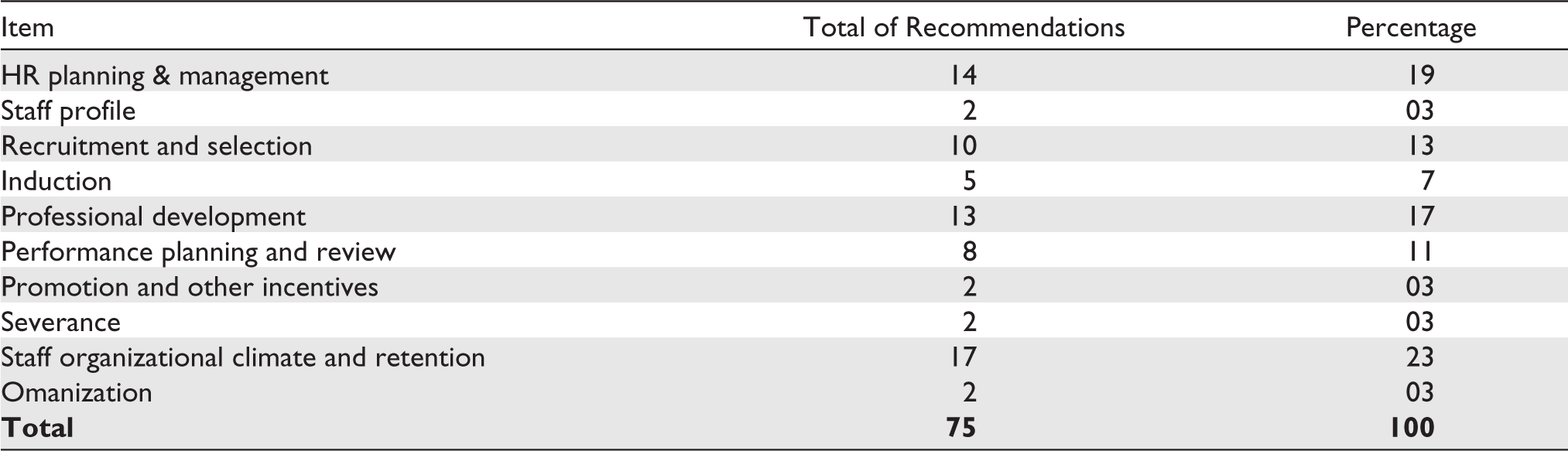
Generally speaking, we may assume that the Omani HEIs are mitigating their efforts in terms of personnel and employee support services. The field of community engagement was criticized heavily and, at almost the same point, scarcely praised relative to the other fields of performance evaluation. It is possible to summarize three main findings in this regard. Firstly, a large number of suggestions are provided by the separate and independent audit committee. Secondly, a limited number of commendations are issued by the audit committees. Eventually, a relatively small number of proclamations are made by the HEIs. Such specific results clearly indicate that the HEIs in terms of employees and staff support services really are not conscious of their limitations. Subsequently, the results demonstrate that the Omani HEIs partially comply with the OAAA’s quality accreditation standards in a few subcategories such as staff profile, induction, promotion and incentives, severance and ultimately Omanization. Simultaneously, these institutions have been asked to focus more and improve on four quality assessment sub-areas. Results endorse partly the first hypothesis.
The Quality Assessment and the Improvement of HR Processes
The second hypothesis of this study suggests that the process of quality assessment helps HEIs profit from the errors of the other assessed institutions. To check the validity of this assumption, we reviewed the key results extracted from the study of the 26 quality audit reports. The review would concentrate on the 10 employees and work support services common sub-areas.
Human Resources Planning and Management
Walker (1992) defined SHRM as ‘the means of aligning the management of HR with the strategic content of the business and HR strategy so that the latter supports the accomplishment of the former and, indeed, helps to define it’. The Michigan model (Fombrun et al., 1982) is the most prevailing model in SHRM. This model views the HRM strategies and the HRM policies as essential components of any performance organization. In this way, the HEI needs to turn its strategic objectives into HR policies and strategies in order to create a competitive advantage. (Tyson, 1995). Considering the strategic importance of the substandard of HR planning and management, the different quality audit panels gave a special attention to this area of assessment. An important number of recommendations (14) was issued to some of the 26 Omani HEIs. In general, reviewed quality audit reports a severe lack of HR planning and management policies and procedures among several HEIs and in several related areas. To enable these institutions to deliver on their longer term strategic intent, the quality audit panels recommended to these institutions to develop and implement a HR plan that is aligned with their mission and strategic goals and that includes all elements of HR planning and management. These plans need to cover sections like recruitment, succession planning, induction, handling of staff grievances, performance management, professional development, promotion and severance. The quality audit instances also suggested that the HR strategic plans shall include measurable targets, be transparently and consistently implemented through operational plans and need to include mechanisms to monitor their effectiveness. The quality audit panels, also suggested to some HEIs to develop Bylaws that include a set of transparent and fair HR policies and procedures and ensure that these are consistently implemented and regularly reviewed. In the operational side, certain recommendations highlighted the urgency of reducing the teaching workload of academics and rationalize the ratio of students to academic advisors. By doing so, the Omani HEIs will provide time for faculty members to engage in research, perform other relevant professional activities and consequently improve the overall quality of instruction.
Staff Profile
For Mushemeza (2016), in order to attract more students; generate incomes; improve the image and the overall growth and stability of the institution, HEIs need to vary the profile of their staff. Simultaneously, Rowley (1996) considers that diversity of staff experience and roles impinge on the management of motivation inside the HEIs. For this researcher, the variation of factors like length of service in higher education, other work experiences, age and aspirations greatly contribute to motivate HEIs staff. In Oman, the OAAA urges HEIs to diversify their staff profile and recruit HR with the relevant skills to meet students’ teaching and learning needs, as well as the ability to perform research in accordance with either the strategic plan as well as the requirements of the Oman Quality Assurance System regulations. In general, we can say that the Omani HEIs succeeded to satisfy this substandard as only 2 recommendations were issued in this area of assessment. The Omani HEIs made considerable efforts in order to show gender equality, to hire people from different citizenships and with varied experience profiles. Despite that, certain institutions were invited to attract more Omani staff in academic departments and hire more PhD holders. The quality audit panels highlighted the necessity to consider the qualifications needed in relation to the curriculum offered.
Recruitment and Selection
Valenzuela and Cruz (2016) admitted in order to achieve its mission goals; an educational institution needs an efficient, effective and qualified faculty. Also, Diokno (2012) sees that HEI derives its power from the staff whose mental ability, technical expertise and skills form the culture and credibility of the organizations. So in order to attract highly qualified faculty members, HEIs need to maintain a highly sophisticated process of recruitment and selection. Out of 26 audited institutions, 10 HEIs were recommended to improve their system in the evaluated area. The quality audit panels notified that the recruitment and selection process in these institutions is implemented on an opportunistic basis, rather than following a clear, consistent and transparent approach. Thus, the main recommendations went through the development and implementation of recruitment system which is supported by policies that are consistently implemented, smoothly monitored, clearly communicated and regularly reviewed. The audited HEIs were also recommended to implement staff recruitment and selection processes that support strategic staffing needs and that are clearly documented and subject to regular effective evaluation.
Induction
By introducing new employees to their job and organization, the process of induction helps to provide the required information and the main tools necessary to understand and start the job. Dessler (2013) considers induction as the process by which organizations minimize staff turnover and maximize employees’ performance and engagement. The sub-area of induction was highly appreciated by quality audit panels as it received 66% of commendations in the Staff and Staff Support Services quality standard. So, the OAAA commended 4 Omani HEIs for having established a comprehensive staff induction program which is systematically delivered and well-received. These institutions made induction programs that provided new employees with information including the mission, vision, policy and procedures related to teaching, learning and research. These institutions also provided mentors to support new staff and explained staffing matters including, induction, mentoring, professional development and appraisal. At the same time, five HEIs were recommended to enhance their induction system. Thus, the OAAA recommended them to develop a systematic approach for an appropriate induction programs through formalized processes that are part of a fully comprehensive HR strategy. They were also invited to monitor the effectiveness of the induction process through relevant and documented procedures.
Professional Development
El Hares (1994) admitted that technology and societal systems changes faster so that professions must respond more rapidly. People working in science and technology fields should therefore actively work hard to keep up. For this reason, El Hares (1994) considers that there is a need for some professors to catch up, others to keep up, and some to get ahead through professional development. This sub-area of quality assessment was highly criticized and 13 recommendations were issued in such regard. In many situations, neither a training schedule for staff development activities related to their professional development nor a formal training policy was found by the performance audit committee. The OAAA therefore, suggests that the Omani HEIs develop and implement a systematic approach to staff training strategies and detailed plans, which are aligned to their performance appraisal systems, reviewed and evaluated on a regular basis. Thus the objective is to promote the professional development of staff and support the HEIs HRM strategic goals. As part of professional development, The OAAA strongly recommended that educators have chances via conferences and seminars to stay in contact with their fellow professionals and latest results in discipline research. Likewise, it was emphasized that members of support staff need to have the opportunity to meet colleagues from other organizations in order to expand their knowledge. All these programmes of professional development shall be linked to an institutional needs analysis and regular review of performance.
Performance Planning and Review
Kashoki (1994) admitted that HEIs are accountable to the society, they serve and consequently good performance evaluation programs must be designed and implemented at all levels of management. The regular evaluation of the performance of schools and HEIs becomes important in order to guarantee efficiency and accountability (Dasgupta & Prashar, 2020; Maamouri, 1994). This sub-area of assessment was less criticized as 8 recommendations were issued. HEIs were invited to reflect on their achievements, challenges and professional development needs and consequently develop and implement formal, systematic and transparent systems for performance planning and management that are clearly communicated to both academic and non-academic staff. The OAAA also insisted in the recommendations issued, that these systems need to be linked to the HEI strategic and operational goals and staff profile, and used to improve staff performance. Other keys success of the HR review policies and performance planning relays on their coverage of all staff at all levels, transparency, consistent implementation, regular monitoring of effectiveness and review on regular basis.
Promotion and Other Incentives
The Omani HEIs performed very well in the sub-area of promotion and incentives. The data analysis of 26 documents on the performance review revealed that there were only two suggestions in this area. The OAAA recommends that Omani HEIs design and implement a comprehensive and consistent policy and remuneration promotion process that is clearly expressed and reasonably applied to all employees. Main objective consists to guarantee a career progression along with a formalized scheme for rewarding excellence, including research output. HEIs were also encouraged to conduct staff satisfaction surveys. The feedback generated shall serve to inform staff retention planning. It could also help in designing and providing career advancement incentives schemes.
Severance
The majority of dictionaries explained that severance is linked to the dismissal or discharge from employment and is associated with the payment of financial compensation. This sub-area of quality assessment also registered a minimal number of recommendations (just two). For this standard, the OAAA does not focus only on the financial aspects, but also encouraged the analysis and understanding of the causes of departure of employees. In general, in the formal side, the OAAA recommends the development of formal procedures to monitor and evaluate severance procedures including appeals and exit interviews. Also, in the content side, the OAAA and the HEIs establish clear monitoring processes for the recording and analysis of severance.
Staff Organizational Climate and Retention
The staff organizational climate and retention sub-area is the most criticized among the 10 sub-areas of the Staff and Staff Support Services quality standards. The quality audit panels issued 17 recommendations in such regard that represents 23% of the recommendations related to the mentioned standard. In several cases, the Oman Academic Accreditation Authority notified certain issues related to the high turnover of academic staff and lower compromising levels of satisfaction and retention of administrative and academic staff. The OAAA urges the Omani HEIs to design and adopt structured processes and systematic strategies to obtain input from employees and to assess staff satisfaction on a regular basis, identify any problems or issues that need to be addressed and use this data to inform staff retention strategies aimed at informing decisionmaking, monitoring the staff organizational climate, improving staff retention rates and promoting positive and equitable working environment.
Omanization
The Omanization programme uses a set of laws, regulations and mechanisms advantaging, facilitating and optimizing the access of the Omani citizens to the local labour market. Among 26 audited Omani HEIs, only the Sohar University was commended for the institutional commitment to Omanization. The result achieved by this university largely exceed government targets for the recruitment of Omani academic and non-academic staff. Simultaneously, only two HEIs received recommendations regarding the Omanization sub-area of quality audit. It seems that the OAAA is not satisfied by the efforts deployed in term of Omanization and at the same time understands the targeted objectives are difficult to attain. In that regard, it seems that the OAAA would not like to push the Omani HEIs to realize the quantitative objectives of Omanization and compromise the qualitative objectives of performing educational system. A smooth transition and transfer of competencies to the local HRs need to be established through a longer period. In general, the OAAA concerns regarding Omanization were oriented through academic positions as at the best situations the ratio of Omani academicians reached 30%. So, the majority of the Omani HEIs were encouraged and recommended to increase the number of Omanis citizens taking up faculty positions. Doing so, the Omani HEIs were invited to develop and implement recruitment and retention strategies for recruiting Omani staff especially in the teaching areas.
Consequently, the study of sub-areas relevant to the quality of Staff and Staff Support Services has allowed us to produce an overall idea of either the weaknesses and strengths of the organizations being evaluated. This analysis will allow HEIs to take advantage of others’ errors. The second assumption is fully endorsed by observations.
Conclusion
The aim of this study is to explore the level of adherence of the Omani private HEIs to maintain quality accreditation standards established by the OAAA in term of HRM. We tried also to check the degree of success of the quality assessment programs in promoting and developing HRM processes of the audited private HEIs.
Related to the first proposal, results clearly indicate that the audited HEIs are not conscious of their limitations in term of HRM. Subsequently, the results demonstrate that the Omani HEIs partially comply with the OAAA’s quality accreditation standards in a few sub-categories such as staff profile, induction, promotion and incentives, severance and ultimately Omanization. Simultaneously, these institutions have been asked to focus more and improve on four quality assessment sub-areas. Results partly endorse the first hypothesis. The findings indicate that private Omani HEIs are unwilling to accept and sustain an appropriate level of quality performance in some human resource management sub-areas. It indicates a lack of understanding of the value of maintaining optimal conditions for workers in some areas of HRM.
Furthermore, with regard to the first topic, the level of compliance with quality accreditation requirements, the findings show variations in regarding the number of recommendations given in the 10 HR management sub-areas. The number of recommendation was very low with regard to the sub-areas of staff profile, severance, promotion and incentives and finally Omanization. Thus, we conclude that the Omani private HEIs performed very well in these standards and consequently they need to maintain and consolidate the deployed efforts. Contrarily, an important number of recommendations was issued regarding the sub-areas of staff organizational climate and retention, HR planning and management, professional development and finally recruitment and selection processes. So, we understand that the audited Omani higher education institutions need to focus more on these sub-areas and urgently correct the situation, not only because of the suggestions of the quality audit panels but also because maintaining of an optimal level of education depends essentially on the performance and working conditions of the HEIs staff. Also, with regard to the second theme, the HEIs were invited to adopt corrective actions in term of HRM planning, strategic and operational planning, implementation, evaluation and following of actions and finally efficiency and accountability. Empirical findings suggest that higher education institutions need to concentrate more on tactical strategies for managing HR as they significantly affect aggregate HEI reliability and performance of education.
Therefore, we conclude that the effect of the systems for quality assurance on private Omani HEIs is not clearly visible. The research revealed that institutions performed very well in the sub-areas of staff profile, severance, promotion, incentives and Omanization. Contrarily, an important number of recommendations were issued regarding the sub-areas of staff organizational climate and retention, HR planning and management, professional development and finally recruitment and selection processes. The audited institutions still need to show more interest and endeavour regarding the importance of the development of the human capital and consequently the development of HRs.
Footnotes
Declaration of Conflicting Interests
The authors declared no potential conflicts of interest with respect to the research, authorship and/or publication of this article.
Funding
The authors received no financial support for the research, authorship and/or publication of this article.