



Abstract
Stakeholders place greater emphasis on sustainability and the ethical aspects of companies during decision-making. Hence, brand communication has become a formidable challenge in today’s dynamic and stakeholder-driven business landscape. This study explores how companies envision sustainable branding through responsible communication. It also examines the outcomes and attributes perceived by stakeholders in the Indian context. The sample includes Indian corporations that were awarded for their best corporate social responsibility (CSR) practices in 2022 by the Ministry of Corporate Affairs (MCA). Primary data were collected through focus group discussions (FGDs), and secondary data were obtained from online platforms of these corporations. The findings reveal that sustainability branding is crucial for remaining relevant in an ever-evolving market. Stakeholders increasingly endorse brands that foster meaningful connections and maintain consistent communication and action. Stakeholders also acknowledge that ‘sustainability’ is a multifaceted term with various interpretations, requiring thoughtful and transparent communication. This study is novel in its design. Additionally, by conducting FGDs with expert groups, this study captured nuanced perceptions grounded in practical experience, providing valuable insights into emerging sustainability trends and stakeholders’ interpretations.
Keywords
Introduction
Corporate social responsibility (CSR) communication is a critical tool in today’s dynamic and stakeholder-driven business environment. It enhances corporate credibility by fostering transparency, building trust and ensuring stakeholder engagement (Chaudhri et al., 2025). As sustainability gains relevance in the current corporate milieu, it simultaneously introduces more complexity and challenges for organizational managers and leaders in communicating and implementing CSR. Scholars such as Ajayi and Mmutle (2021) have posited that strategic communication is key to addressing these challenges by shaping CSR efforts and fostering meaningful dialogues for stakeholder engagement. Against this context, understanding stakeholders’ perceptions of brand communication strategies is both academically relevant and practically important. The current study makes a modest contribution to this growing body of knowledge.
CSR communication integrates diverse managerial domains, such as public relations, marketing and operations, by effectively disseminating information through social media, digital platforms, non-financial reports and corporate narratives (Winkler et al., 2025). Among these major CSR communication channels, non-financial reporting has become a central mechanism. This encompasses tools such as CSR, sustainability and environmental reports. Companies often use these terms interchangeably to indicate information disclosure (Ajayi & Mmutle, 2021; Hellman et al., 2022; Kumar et al., 2015). In the Indian market, these reporting practices are predominantly guided by the Global Reporting Initiative (GRI), which emphasizes sustainability as a core principle (Chatterjee & Zaman Mir, 2008; Jain & Winner, 2015; Nag & Bhattacharyya, 2016).
However, the concept of CSR communication, as a multifaceted strategic tool, is fraught with several problems in its operationalization. In the corporate communication literature, multiple terminologies and concepts, such as CSR, sustainability (Tewari & Dave, 2012), environmental, social and governance (ESG) (Bernardino, 2021; Stella, 2023) and corporate governance (Abid et al., 2019), are often used interchangeably. Scholars (Jha & Verma, 2022; Jog & Singhal, 2024; Moreno & Kang, 2020) argue that these communication efforts may occasionally contribute to greenwashing or induce stakeholder scepticism, posing a challenge to corporate communication that is distinctly discernible. Nevertheless, CSR communication has emerged as a prominent tool for fostering corporate reputation and brand image. It is also a strategic approach to building sustainable brands (Cowan & Guzman, 2020; Kumar & Christodoulopoulou, 2014).
There is considerable ambiguity in the corporate communication literature regarding the definition of a sustainable brand. Researchers such as Jha and Verma (2022) have emphasized the need for a more in-depth investigation into responsible communication and its impact on stakeholders’ perceptions. Similarly, Maon et al. (2021) highlighted a gap in studies examining stakeholders’ perceptions of CSR and its resultant branding outcomes. They also noted that existing scholarship pursued endeavours from a corporate perspective, disregarding stakeholder narratives. This observation motivated the current study, which examines corporate communications from a stakeholder perspective.
This study was guided by the following research questions:
RQ1. How do companies define and communicate sustainable branding through responsible communication?
RQ2. What are the perceived outcomes of CSR communication from the stakeholder perspective?
RQ3. What are the key attributes associated with sustainable brands that are recognized by stakeholders?
This study employed a dual qualitative approach, combining exploratory content and thematic analysis. The recipients of the 2022 Best CSR Practices Awards, as designated by the Ministry of Corporate Affairs (MCA), constitute the sample for this study. Primary data were collected through focus group discussions (FGDs), and secondary data were obtained from these corporations’ online platforms. This study borrows theoretical support from signalling theory and stakeholder theory.
This study makes a significant contribution to the CSR communication literature in several ways. First, it provides actionable insights for managers by elucidating the outcomes of integrating sustainability and CSR communication strategies. Second, its robust methodology offers a replicable framework for examining the diverse perceptions of corporate communication among the stakeholders. Third, the findings reveal emerging trends, such as co-creation and multi-stakeholder engagement, which are essential for sustainable branding. Finally, this study offers a comprehensive analysis of the attributes and market expectations associated with sustainability branding, providing valuable insights for both academia and industry.
Literature Review
Sustainable branding is an integral part of a company’s overall strategy. Foroudi and Palazzo (2021) acknowledge that sustainable branding is a broad perspective encompassing sustainability and CSR, with a collective consciousness regarding the production and use of products or services in business. Other research suggests that communicating sustainability is effective only when a clear strategy is identified through appropriate channels, style and content (Primožič & Kutnar, 2022), which aids in branding attributes. Sustainability also incorporates value creation for larger multi-stakeholder groups impacted by CSR activities (Dhanda & Shrotryia, 2021; Freeman, 2010).
The corporate branding literature also delineates the concept of sustainable corporate branding, and explorations of this topic have garnered scholarly interest. The resultant scholarly arguments include examinations of terminologies such as ‘corporate story’, ‘vision’ (Fitzsimmons et al., 2022), ‘green’, ‘sustainable supply chain’, ‘relative advantage’ (Lindgreen et al., 2012; Vidhya et al., 2025), ‘internal and external communications’ and ‘credibility gaps’ (Stuart, 2011), which are closely associated with sustainable branding. These discourses highlight the interplay of such terminology in corporate branding, which enhances the corporate image and brand credibility. Furthermore, amid the surge of social media, there will be a profound impact on communicating sustainability, CSR, and any form of responsible communication (Cowan & Guzman, 2020).
Mandatory reporting guidelines, as outlined in the Companies Act of 2013, necessitate corporate disclosures in India, which have helped shape stakeholder perceptions (Saikia et al., 2024). These guidelines include frameworks such as the GRI and the Business Responsibility and Sustainability Reporting (BRSR) for Indian companies (Aggarwal & Singh, 2019). These reporting practices encompass key elements such as carbon emissions, diversity, equity and inclusion (DEI), waste reduction and supply chain management, which serve as benchmarks for sustainability reporting and performance measurement. These factors help evaluate companies’ operational practices, support long-term sustainability and contribute to the Sustainable Development Goals (SDGs) (Raman et al., 2023).
Theoretical Support
Although the use of theory is not explicitly stated in this qualitative inquiry, this study leveraged elements of certain theories to reflect on the findings. This study draws on signalling theory (Spence, 1973) to elucidate the strategic motives behind CSR communication. Signalling theory has been used to contextualize the relationship between corporate communication and organizational behaviour (Hetze, 2016). This theory offers a lens for understanding how consumers and stakeholders evaluate business entities (Surira et al., 2023). Within CSR communication scholarship, this theory suggests that communication acts as a positive signal, enhancing reputation and fostering stakeholder engagement through word-of-mouth advocacy (Dang et al., 2020; Pecot et al., 2018). Moreover, this study integrates insights from stakeholder theory (Freeman, 2010), which emphasizes the necessity of balancing the interests of diverse stakeholder groups while ensuring long-term profitability (Awa et al., 2024; Donaldson & Preston, 1995).
This study adopted pattern theory as an analytical framework to identify conceptual linkages in qualitative data. Pattern theories are structured systems of concepts that explain interconnected relationships within a study, informing and reinforcing the analysis (Lincoln & Guba, 1985; Neuman, 2000). Maxwell (2016) argues that researchers can illuminate and clarify overlooked relationships among phenomena by adopting a theoretical lens as an a priori consideration. This also provides a structured basis for validating the findings of qualitative research (Hennink et al., 2020).
Methodology
Study Design
This study adopted a qualitative exploratory approach. It integrates content analysis methods, using data collected from secondary sources (Hsieh & Shannon, 2005) and thematic analysis of primary data from FGDs. This multi-method approach illuminates specific themes in CSR communication (Bagnoli & Clark, 2010; Liao et al., 2017). First, information regarding CSR/sustainability was obtained online from selected company websites, social media and annual or sustainability reports. This contributed to the data for content analysis, which enabled us to answer RQ1. Second, FGDs were conducted to understand stakeholder engagement and perceived outcomes of CSR communication, and subsequently identify brand evaluations pertinent to sustainability. The thematic analysis of the FGD verbatim contributes to answering RQ2 and RQ3.
The Samples and Inclusion Criteria
The sample comprises MCA award-winning companies to ensure a ‘best practice’ benchmark in CSR. As the national regulatory body, the MCA’s selection provides a validated, high-quality standard for exemplary performance (Mohapatra & Mohanty, 2023). This deliberate focus allows the study to acknowledge the primacy of CSR’s implementation. This study acknowledges that its findings may not represent the average corporate practices. However, it is essential to synthesize the attributes and outcomes of strategic CSR, which are the core objectives of this study. These awards are conferred in three main categories: corporate awards for excellence in CSR, CSR in aspirational districts/difficult terrains, and contributions to national priority areas. Each category included several subcategories, with the MCA selecting ‘winners’ and ‘honourable mentions’ in each. The 18 winning companies were chosen as the study sample based on specific inclusion criteria aimed at exploring their CSR initiatives and examining the integration of sustainability into their communication and branding strategies. A detailed examination of these companies’ social media and websites was conducted to assess their CSR and sustainability communication practices.
FGDs were conducted with 25 participants until data saturation was reached. The participants recruited included working professionals from various corporate entities, stakeholders from organizations, such as non-governmental organizations (NGOs) and law and finance consultancies, and professionals from the marketing and advertising sectors. These participants were selected as ‘expert groups’ for FGDs, based on the credibility of their expertise on a specific topic, as proposed by van Eeuwijk and Angehrn (2017). This selection facilitated a nuanced understanding of stakeholder perceptions based on practical experience (Ramya & Baral, 2024). Furthermore, ethical considerations, such as acquiring consent from the FGD participants to use the data for research purposes and data anonymization, were followed during data collection.
Data Collection Process
FGDs can effectively capture diverse data and generate ideas through an iterative process of dialogue and debate (Bagnoli & Clark, 2010). The data collection tool for the FGDs was a semi-structured inventory developed from the existing literature, insights from a pilot study and secondary data. This was designed to guide the discussion rather than dictate it strictly. FGDs integrated stimulus materials (Lunt & Livingstone, 1996), derived from secondary data collected, which served as visual prompts for stakeholders. These stimuli helped participants identify corporate entities and clearly associate them with CSR activities before expressing their opinions and perceptions. The stimulus data included social media posts, webpage screenshots and selected sections from the reports. Responses to these stimuli were identified to analyze corporate branding perceptions. Scholars endorse the incorporation of stimulus design in FGD, especially in communication and media research, to examine the media effect process, which will result in a detailed examination of audience responses (Lunt & Livingstone, 1996; Morgan, 1996). Additionally, the FGD design included an administered questionnaire containing semi-structured questions and prompts grounded in the literature and the pilot study. This technique in FGDs enhances the relevance of the data and aids in the analysis (Bagnoli & Clark, 2010). The data collected through the FGDs were transcribed verbatim.
Data Processing and Interpretation Procedures
Data analysis employed a dual-method approach. A content analysis of secondary data on corporate disclosures was conducted to examine how companies define sustainability externally. Concurrently, thematic analysis was performed on the FGD data. The FGD transcripts underwent a winnowing process to refine the data, ensuring clarity and facilitating nuanced analysis (Salmona & Kaczynski, 2024). These transcriptions were then organized into data sets for coding, which helped identify patterns that were latent in the data. The data sets were filtered consistently according to the research questions and interview guide (Flick, 2013). The subsequent step was to create the data extract, as the data set contained idea overlaps throughout the FGDs (Braun & Clarke, 2006).
The researchers then proceeded with the analysis using the recursive abstraction method (Polkinghorne & Arnold, 2014), a six-step coding process as follows: (a) highlighting the data of interest from the text; (b) extracting data and creating a table with similar ideas; (c) paraphrasing the data, keeping the meaning intact; (d) grouping the paraphrased data related to each theme category; (e) replacing the paraphrased data with codes, and; (f) analysis of codes and identifying patterns to develop findings. This iterative process facilitated the analysis, enabling the derivation of emergent themes and the identification of underlying patterns within the collected data. The codes were identified from the grouped data, which were then aggregated into the themes. To ensure analytical consistency, one author coded the entire data set with the full agreement from the other coauthors. The emergent themes from the coding results are presented in tables in the relevant sections of the results.
The themes generated through inductive coding reflect the stakeholders’ perceptions and interpretations of CSR communication signals. Subsequently, these themes functioned as analytical attributes within the framework of signalling theory. This approach enabled the findings to be theoretically informed by the qualitative data. The integration of emergent insights through a theoretical lens facilitates a deeper understanding of the relationship between corporate communication and organizational behaviour (Hennink et al., 2020). Figures 1a and 1b illustrate the flow of the analysis of secondary data and FGD data.
(a and b) Flowchart Depicting Analytical Process.
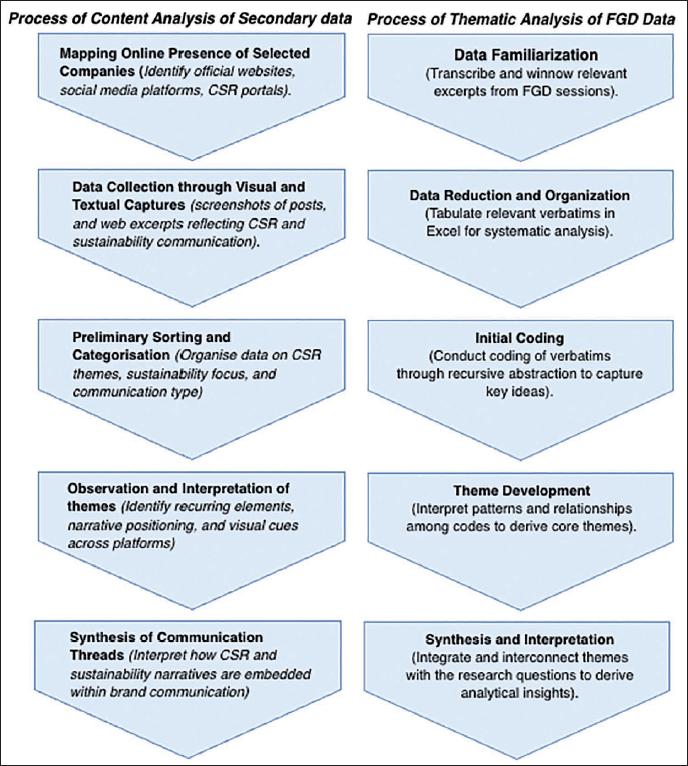
(a and b) Flowchart Depicting Analytical Process.
Sustainability Branding
The content analysis of the corporate communication threads of the selected companies revealed that the term ‘sustainability’ was prominently featured across multiple platforms, including webpages, social media posts, vision and mission statements and reports. Most companies’ webpages explicitly mentioned the term ‘sustainability’. These webpages often contain information on CSR, governance policies and the company’s alignment with SDGs initiatives, along with other organizational activities. Consequently, ‘sustainability’ is deemed a fundamental component of daily corporate communication.
Reporting practices emphasize sustainability over CSR. Integrated or sustainability reports typically focus on outcomes or goals achieved in specific target areas set by the company and contain accounts and metrics of CSR beneficiaries. Rarely do they have separate subheads or sections dedicated to CSR, but it is mentioned among other initiatives to entail relevant operational or sustainable processes. Moreover, although CSR projects are not explicitly mentioned, they are briefly mentioned in areas such as community engagement, business models, healthcare and disaster relief. Some of these reports imply and occasionally state the incorporation of a 360-degree, triple-bottom-line approach to sustainable communication. Hence, these observations conclude that CSR is the mechanism by which organizations promote sustainable practices. This integration of CSR and sustainability also encompasses other concepts that fall under the sustainability domain, such as resilience, ethics, strategic risk management, social welfare and inclusivity.
Stakeholders’ arguments are congruent with the notion that the term ‘sustainability’ is identified as being widely incorporated into both marketing and communication strategies of a corporation. The analysis also found that stakeholders regard ‘sustainability’ as a fundamental component of communication strategies, especially when integrated with CSR activities to enhance stakeholder awareness and information. The participants also concurred that sustainability, at its core, revolves around the principle of future welfare. Consequently, organizations must consistently emphasize sustainability in their CSR communications and actions to align with a broader and futuristic vision.
In sustainability branding, which is leveraged through CSR communication, the focus is not on endorsing specific products or services as being sustainable. It conveys the company’s core vision and values. These strategic messages subtly convey the company’s aspirational sensibilities towards society and can secure stakeholders’ trust and loyalty. Stakeholders tend to favour implicit communication regarding sustainable branding, allowing them to derive their interpretations from messages and subsequently form brand perceptions. Furthermore, by incorporating sustainability into their corporate statements, companies can strategically position themselves in line with their goals, thereby creating a lasting impact. This impact fosters discussions about the company and its focus areas, which, in turn, contribute to positive brand evaluations, marketing advantages and stakeholder loyalty.
For instance, the content analysis emphasizes the use of sustainability as a communication tool, highlighting the deployment of corporate and brand taglines like ‘Good & Green’, ‘Rise’ and ‘Care for a Better Tomorrow’. These taglines exemplify the commitments that companies strive to uphold, showcasing their engagement in responsible practices. Additionally, the vision statements of these entities incorporate concepts such as ‘sustainable mobility’, ‘circular economy’ and ‘connected societies’, thereby reflecting their strategic orientations and operational frameworks.
In contrast, FGDs revealed perspectives from stakeholders across various corporate sectors, including construction, software and fashion, who perceive the term ‘sustainability’ as primarily driven by market considerations. For instance, stakeholders recall certain companies that have introduced a distinct line of sustainable products or services that is sustainable across a cross-section of their product ranges. This niche segment can differentiate the broader product line by commanding a premium price and mitigating competitive pressure. This is an example of incorporating sustainability into marketing, with the potential to attract customers who are keen on ethical and sustainable practices. Here, the corporate entity or brand may not adopt a holistic, sustainable approach; however, the practice is limited to a specific line of products and services.
Similarly, a few other keywords commonly associated with such marketing intent include ‘natural’, ‘organic’ and ‘biodegradable’. In these cases, the brand recall value or corporate recognition is enhanced. Participants in the FGDs also noted a tendency to favour companies that actively undertake and publicly articulate their CSR activities. Such companies are often perceived as more conscientious and relatively more genuine than their competitors. This argument is further substantiated through content analysis, which reveals that the select corporations frequently describe their products or services using terms such as ‘green’, ‘responsible luxury’, ‘eco-friendly’, ‘zero-emission’ and ‘carbon-neutral operations’. These terms convey the embedded notion of sustainability in their operational routines, which can enhance consumer perception, even if their sustainability initiatives are limited to specific products.
To summarize stakeholder insights, sustainability branding is manifested through the strategic integration of marketing, communication and implementation of responsible behaviour in the end-to-end operations of a company. Hence, sustainability is perceived as a multifaceted concept. Table 1 summarizes the key threads from the FGDs and themes identified through the coding process pertaining to sustainability branding aspects.
Focus Group Discussion (FGD) Results on Sustainable Branding.
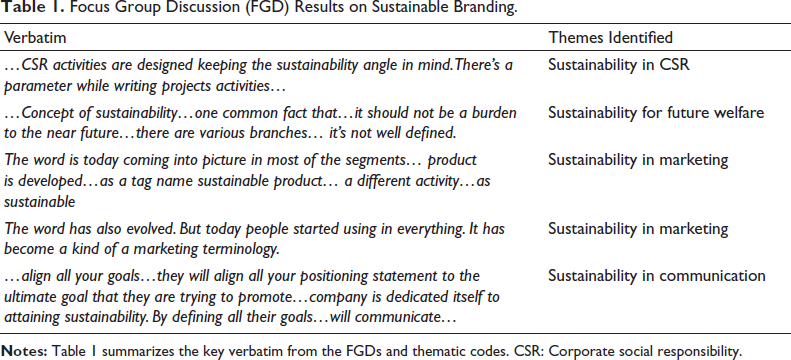
Focus Group Discussion (FGD) Results on Sustainable Branding.
Table 1 summarizes the key threads derived from the FGDs and their thematic coding, showcasing how stakeholders perceive sustainability branding and how it is operationalized. Verbatim responses indicated that stakeholders associate sustainability with an overarching concept, intersecting with marketing, communication and CSR, while also embodying the principle of future welfare. They also acknowledge its evolving role as a vital element for organizations to gain a secure market position and stakeholder trust while advancing a broader social agenda. Furthermore, it is interpreted as a tool to reflect the altruistic motives of organizations in demonstrating their commitment to social and environmental progress.
This study reveals that companies leverage the term ‘sustainability’ as a core component of their branding strategy. A sustainable company or brand can garner stronger relationships and a favourable market position than its competitors. Such companies are also anticipated to consistently define their values and ethics in relation to the community. Therefore, building and sustaining stakeholder relationships are key motives for sustainability branding.
Moreover, stakeholders recognize corporations’ attempts to create a responsible corporate culture that goes beyond using sustainability as a branding strategy. Professionals or managers state that these are integral to the current competitive market environment. Therefore, companies must align their stakeholders’ perceptions through effective communication and action. In such instances, the motive is to optimize competitive advantage through responsible communication while maintaining sustainability and branding protocols.
Secondary stakeholders, such as CSR message recipients and professionals in partner organizations, emphasize the need for clear and transparent communication. Based on the perspectives shared by the stakeholders, two principal conclusions were drawn. First, companies should publicly disclose their intentions and action plans with clear distinctions between the two. This method offers greater transparency, catering to the specific and targeted expectations of stakeholders. Hence, it enables co-creation and collaborative engagement in the learning process.
Second, it is crucial to recognize that stakeholder groups demonstrate diverse levels of awareness and critical evaluation when interpreting CSR messages. Consequently, companies should design CSR communication strategies tailored to the specific needs and expectations of each segment within the multi-stakeholder community. Strengthening the company-stakeholder relationship requires delivering content that resonates with individual stakeholders. This includes incorporating aspects such as conspicuous consumption, self-expression and alignment with personal social and lifestyle choices, which significantly enhance engagement and lead to more favourable brand evaluations.
Social media platforms and company websites allow stakeholders to verify the information they receive, making them more aware of corporate motives. Consequently, stakeholders exhibit greater affirmation in selecting their preferred brands and hold precise notions regarding brand evaluations, including brand recall and image. They also recognized additional outcomes associated with sustainability branding, such as enhanced visibility, stronger emotional connections and opportunities for co-creation, which further reinforced their brand perceptions. Furthermore, strategic sustainability or CSR communication aims to create discussion and raise awareness of social responsibility.
Observations from reports and online platforms also highlight corporate efforts to identify and differentiate various stakeholder communities as internal or external. These stakeholder distinctions are based on their priorities regarding engagement, frequency and manner, with the intent of creating value. Several studies have utilized flowcharts and graphs to visually illustrate organizational approaches to sustainability. The data collected from online platforms suggest that the selected companies use employee engagement as a tool to create awareness. The reports have incorporated terminologies such as ‘culture curation’, ‘employee welfare’, ‘employee satisfaction’, ‘external stakeholder satisfaction’ and ‘future-forward culture’ as potential motives or outcomes of CSR activities.
The study also observes that most stakeholder groups, who are the recipients of CSR communication and sustainability awards, are aware of the regulatory guidelines set for corporate reporting. These regulations primarily include the mandate to conduct and report on sustainability and CSR activities, which are also fundamental drivers for corporations. These reports, as mandated, commonly follow the GRI guidelines or the BRSR framework, encompassing a holistic approach to sustainability.
Furthermore, FGDs initiated conversations about aligning CSR initiatives with a company’s objectives and values. During the scrutiny of corporate values, stakeholders have debated whether altruistic or extrinsic motives are the primary drivers of implementing and communicating responsible initiatives. This debate has also brought forth growing awareness and critical evaluation among stakeholders regarding the authenticity of corporate responsibility initiatives.
Table 2 explicates the analytical progression from verbatim data to interpretive themes, which ultimately lead to higher-order outcomes. The ‘Themes’ column represents the first-order thematic categories derived through inductive coding. This captures how participants conceptually framed sustainability and CSR within organizational contexts (e.g., strategy, positioning or policy alignment). The ‘Outcome’ column depicts second-order abstractions that denote the perceived organizational or communicative consequences that are associated with each theme. These are strategic intent, relationship building or corporate branding. While themes capture the dominant interpretive frames derived from the participant discourse, outcomes represent the functional implications of these frames for sustainability/CSR communication. The mapping between themes and outcomes was iterative and interpretive, wherein multiple verbatim statements were encapsulated into a single theme. Further, these themes were analytically linked to outcomes based on recurring patterns.
Perceived Outcomes of Sustainability/Corporate Social Responsibility (CSR) Communication.
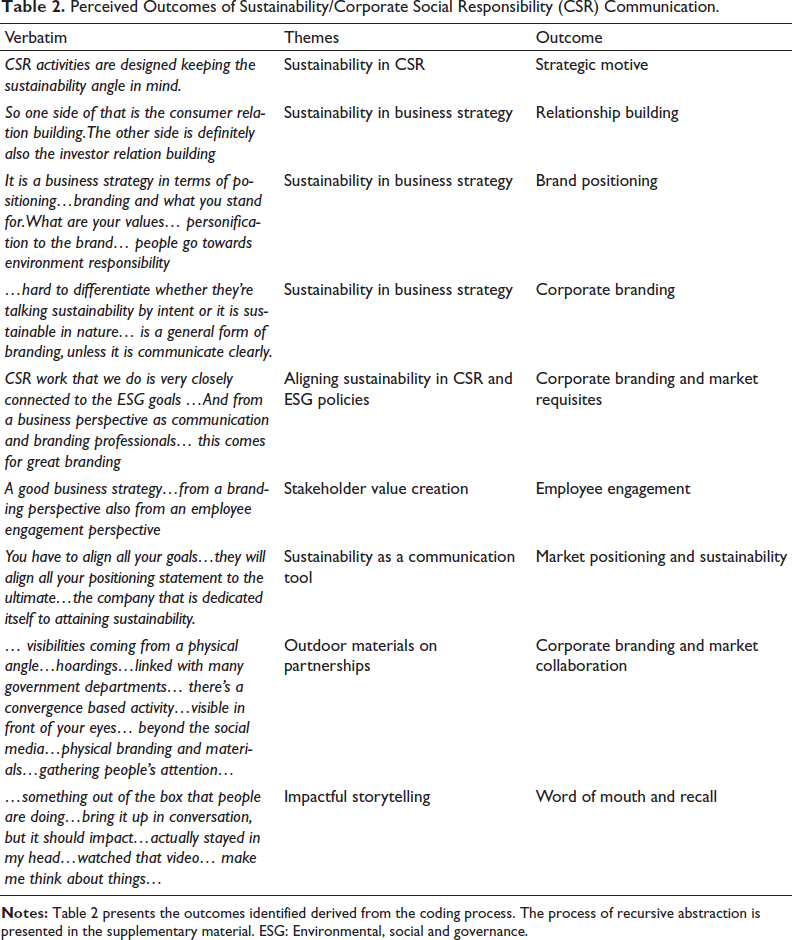
Perceived Outcomes of Sustainability/Corporate Social Responsibility (CSR) Communication.
The threads in Table 2 posit that corporate branding, market positioning and collaborations are extrinsic motives for CSR engagement and communication. However, outcomes such as word-of-mouth, relationship building and recall are signals of more organic outcomes that are solely driven by stakeholder orientations. These subtle outcomes are not under organizational control but are understood to be more effective from a long-term perspective.
The analysis revealed that stakeholders associate a sustainable brand with one that demonstrates responsibility towards all key stakeholder groups. Participants perceived that any corporate initiative aimed at the welfare of stakeholders inherently contributes to responsible branding. In essence, stakeholders interpret a sustainable brand as an entity that consistently prioritizes and demonstrates an ongoing commitment to its key areas.
Stakeholders also articulated that the frequent incorporation of the term ‘sustainability’ has resulted in numerous misconceptions and scepticism. A brand is deemed sustainable only when it has a long-term impact on society and creates value for it. For instance, most participants could instantly recall the Tata Group as a sustainable corporation due to its long-standing heritage and congenial relationship with its stakeholders. Although stakeholders also identify other relevant brands as ethical and conscious, they are hesitant to recognize them as sustainable brands because they are relatively recent entrants to the Indian corporate landscape. The attributes, as shared by the FGD participants, that define a sustainable brand, were derived through the coding process. Verbatim quotes from the FGD, along with their corresponding coded attributes, are presented in Table 3.
Focus Group Discussion (FGD) Results on Attributes Created Through Sustainability Branding.
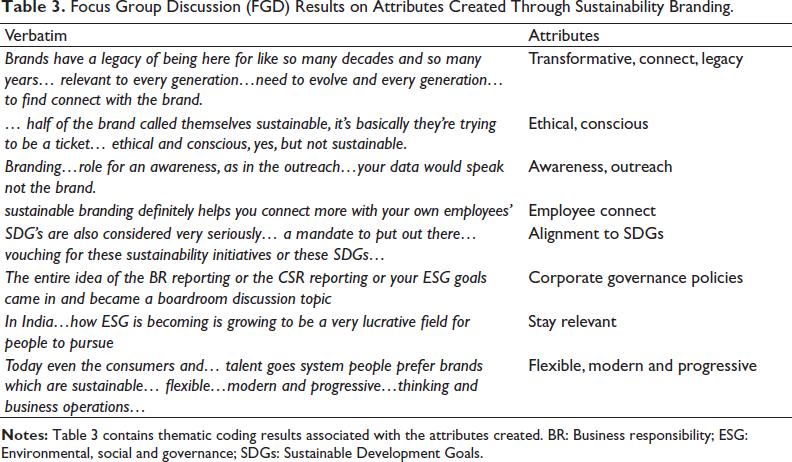
Focus Group Discussion (FGD) Results on Attributes Created Through Sustainability Branding.
The stakeholder insights presented in Table 3 emphasize the imperative of integrating sustainability into organizational practices for brands to remain relevant in the modern stakeholder-driven business landscape. Brands that consistently engage in responsible communication transform perceptions and resonate with emerging stakeholder groups across generations. The stakeholders also postulated that the present and future workforce increasingly evaluate their employers’ sustainability criteria and expect to fulfil their societal responsibilities through the companies.
The study’s observations emphasize that the selected companies appear to have integrated social responsibility and sustainability into their operations and have succeeded in communicating this. This observation is based on the website labels and social media posts that have integrated hashtags and branding. The verbatim comments in Table 1 also support the argument for integrating sustainability and CSR. Additionally, the quotes in Table 2 suggest that this integration is a strategic imperative. These findings align with previous research (Benitez et al., 2020) on the increased awareness of such efforts, possibly due to the ubiquitous access to social media. Customizing content to suit specific stakeholder groups ensures enhanced engagement and relevance. For instance, in the context of ESG, which represents the governance aspect of sustainability, content tailored to shareholders or investors can be emphasized, using detailed brochures or newsletters. On the other hand, consumers are more likely to notice packaging and labelling that underscore eco-friendly practices or upcycling of products and offerings. This approach fosters transparency in information disclosure and facilitates easier access to sustainability communication, making it more impactful and inclusive for all stakeholders.
Stakeholders also expect corporations to adopt a triple bottom line approach (people, planet and profit) (Elkington, 1998), considering the social, environmental and financial impacts of their operations and communicating these impacts effectively. By aligning people elements into their operations, companies can foster social well-being by creating employee engagement and impacting the community (Banerjee, 2025). This argument is further corroborated by the verbatim in Table 2, which posits that employee engagement is a vital element of corporate sustainability. Companies also shrink their environmental footprint by incorporating the planet element. Similarly, by blending economic value or profit with their operations, companies can become more operationally efficient and sustainable. Hence, this approach is regarded as creating a sustainable brand image.
The study also reflects on strategic communication through the lens of the communication metamyth concept (see, e.g., Hutchinson, 2014), underscoring the importance of abundant communication to minimize stakeholders’ quest for information. The results of the current study validate that frequent and consistent communication enhances stakeholders’ perceptions of a company as a sustainable corporation. However, the term ‘sustainability’ should be carefully positioned in communications to withstand stakeholder scrutiny while ensuring that the company’s efforts are visible and transparent (Poojari & Dlima, 2026). The participants’ quotes in Table 1 collectively suggest that the definition of sustainability is ambiguous, and stakeholders expect companies to articulate their own versions or interpretations of sustainability. This transparent articulation of sustainability can mitigate customer scepticism, demonstrating genuineness rather than greenwashing (Moreno & Kang, 2020). Furthermore, stakeholders emphasize the need for corporations to articulate their own interpretation of sustainability in action or intent while aligning their communication with underlying motives and expected outcomes.
The results also indicate that sustainable branding is curated through an integrative effort in marketing and communication of core values and practices. Researchers have previously noted the overlap between communication and marketing functions in the context of relationship-building (Jain et al., 2022). Past studies have briefly mentioned the integration of sustainability as a marketing tool to enhance positive effects (Kumar & Christodoulopoulou, 2014). Participants highlighted the importance of aligning sustainability considerations across all facets of corporate communication while adhering to corporate goals. As observed in the outcomes presented in Table 2, this alignment contributes to market positioning and long-term sustainability. Moreover, the findings indicate that stakeholders’ perceptions are substantially leveraged when a brand portrays communicative efforts to evolve and cater to specific stakeholder communities. This observation aligns with the findings of Morsing and Spence (2019) on the implicit communication of a company’s CSR initiatives, which yields better outcomes than explicitly stating it in routine disclosure.
Bhattacharya et al. (2008) vouch that employees are the backbone of any organization and have a pivotal role in CSR and branding. The current study reiterates this literature, as suggested by the themes of employee engagement (Table 2) and employee connection (Table 3). A recent study by Raza et al. (2021) noted that employees are focusing on their company’s values, particularly in the current evolving business environment. Employees perceive their organization as an extension of their social value and expect it to exemplify a sense of societal responsibility they aspire to uphold. This alignment not only enhances the corporate work culture but also impacts how the brand positions itself through CSR practices for external stakeholders (Kucharska & Kowalczyk, 2019; Mahato, 2025). Moreover, these evaluations are often disseminated through word-of-mouth, amplifying brand reputation. This supports the arguments of Park and Kim (2022), who vouch that a participatory approach through word-of-mouth provides higher self-efficacy and enhances corporate reputation and image. The insights from the FGDs also support the notion that a sustainable corporation prioritizes employee retention and welfare.
This study contributes to the discourse on sustainable branding by unpacking the aspects of authenticity from stakeholders’ viewpoints. This study argues that stakeholders’ validation of sustainability branding is based on two key factors: behavioural consistency and narrative credibility. The attributes such as ‘stay relevant’, ‘flexible’, ‘transformative’, ‘connect’ and ‘awareness’ are a few codes from Table 3 that substantiate this observation. Furthermore, this observation addresses the contention raised by Maon et al. (2021) and Jha and Verma (2022) regarding stakeholder scepticism. While behavioural consistency evokes the enduring nature of sustainable branding practices, narrative sincerity resonates with the integrity of communication. This advances the existing understanding of how responsible corporate communication can effectively bridge the ‘walk-talk’ gap (Schoeneborn et al., 2019) and build genuine brand equity.
The study results align with the foundational principles of signalling theory. CSR communication, as a signalling mechanism, has been found to positively influence brand evaluations, thereby amplifying stakeholders’ perceptions of sustainable branding (Surira et al., 2023). This highlights the crucial role of carefully crafted communication in shaping and reinforcing a brand’s identity within the context of sustainability. As noted by Pecot et al. (2018), signals with marketing intent have cognitive outcomes for stakeholders when they are delivered consistently and clearly.
This study reinforces the theoretical implications of signalling theory, highlighting that consistency and clarity are the two most vital factors that stakeholders consider when interpreting communication signals. The findings suggest that the type of content provided by corporate entities is also perceived as a signal, as emphasized by the stakeholders. We reiterate the implications of stakeholder theory in the context of this study, which postulates that stakeholder value creation is a priority for a sustainable enterprise. Authenticating the relevance of stakeholder theory, this study advocates the integration of stakeholder aspirations and organizational goals for a sustained market presence and enhanced consumer loyalty.
The study’s practical implications draw managers’ attention to adopting a multichannel approach with a clear and consistent message strategy. Integrating storytelling techniques can humanize corporate initiatives and foster deeper stakeholder connections. Managers should also be cognizant of the growing awareness of consumers and stakeholders regarding content consumption (Duong, 2026; Golob & Verk, 2022). Furthermore, the ease of accessibility for stakeholders to communicate responsibly is of primary importance to us. Consequently, communication and CSR managers are encouraged to integrate these insights when crafting CSR or sustainability narratives. In today’s dynamic market, such an approach is essential to remain relevant and effectively connect with the target stakeholders.
Limitations and Future Scope
This study has some limitations and proposes directions for future research to address them. First, the theoretical framework used does not distinctly differentiate between signals related to CSR and sustainability. For instance, CSR signals may focus more on immediate and localized social impacts, whereas sustainability signals emphasize long-term environmental and global welfare considerations. Future research could address how stakeholders perceive these distinct communications and explore this gap by examining the unique effects of specific signals on stakeholder trust, brand evaluation and engagement.
This study focused on MCA award-winning companies from a specific year for their CSR communication, leaving room to explore the CSR-company fit maintained over multiple years. The sampling strategy acknowledges that focusing on award winners deliberately captures the top-tier CSR practices. This may render the findings unrepresentative of the performance of an average firm. Finally, this study did not consider the industry of operation or the ownership structure of the companies in the sample selection criteria. Incorporating these aspects into sample selection can provide more profound and nuanced insights for future studies.
Conclusion
This study conclusively demonstrates that strategic CSR communication is a vital mechanism for aligning corporate intentions with stakeholder expectations. Such strategic CSR communication practices and their outcomes were previously discussed by Chaudhri et al. (2025). The current study’s primary contribution lies in identifying the specific stakeholder-perceived benefits of sustainable branding, which are augmented awareness, increased ethical behaviour, co-creation and enhanced competitive positioning. Stakeholders actively favour brands that employ value-driven, narrative-based communication, which humanizes the corporation and leads to improved loyalty and brand recall.
This study reveals further peculiarities in the established markets. While corporations with a legacy can rely on their long-standing presence for brand identification, a proactive multichannel communication strategy that spans reports, traditional media and interactive social media is needed to build deep and resilient stakeholder relationships. The current study corroborates the role of social media in sustainability practices as a vital component in corporate branding, as proposed by Jha and Verma (2022). This is a practical approach to addressing the diverse needs of stakeholders, ranging from grassroots-level customers to managerial shareholders. Ultimately, this study demonstrates that authentic sustainability branding is achieved through communication that generates a tangible, broader societal impact. Companies that prioritize genuine contributions to environmental and social welfare by aligning with the SDGs can create a positive ripple effect that benefits both the corporation and the larger community, solidifying their status as a truly sustainable brand.
Footnotes
Acknowledgements
The authors extend their appreciation to the academic and administrative staff of Manipal Academy of Higher Education for providing support and resources, which were instrumental during various phases of this study. The authors also acknowledge that the first author conducted and conceptualized the study and the second author contributed to the structuring and maintaining coherence through the writing. The authors also acknowledge the contributions of the institute’s research advisory committee for their valuable reviews in developing the study inquiries. The authors would like to express their sincere gratitude to all the participants who contributed their time and insights to the focus group discussions.
Authors’ Contribution
The first author has contributed in the data collection and conceptualisation process. The second author has contributed in the structuring and articulation.
Declaration of Conflict of Interests
The authors declared no potential conflicts of interest with respect to the research, authorship and/or publication of this article.
Ethical Declaration and Informed Consent
This research involved the collection of data from human participants through focus group discussions. All procedures performed in the study involving human participants were conducted in accordance with the ethical standards of the institutional research committee. Informed consent was obtained from all individual participants included in the study. Participation was entirely voluntary, and the identities of participants have been kept anonymous to ensure confidentiality and privacy. The authors also declare the usage of AI assistance with Paperpal for language refinement.
Funding
The authors disclosed receipt of the following financial support for the research, authorship and/or publication of this article: The authors gratefully acknowledge the University Grants Commission for funding the research under the SJSGC scheme and thank all participants for their valuable contributions to the data collection process.
Supplementary Material

References
Supplementary Material
Please find the following supplemental material available below.
For Open Access articles published under a Creative Commons License, all supplemental material carries the same license as the article it is associated with.
For non-Open Access articles published, all supplemental material carries a non-exclusive license, and permission requests for re-use of supplemental material or any part of supplemental material shall be sent directly to the copyright owner as specified in the copyright notice associated with the article.
