



Abstract
Increasingly, employees are recognized as important enactors and contributors to corporate social responsibility (CSR) activities, making their engagement a critical consideration of internal stakeholder management. While the positive outcomes of employees’ CSR engagement have been extensively investigated, the present study focuses on an essential yet understudied question: How do employees engage in organizational CSR activities through communication efforts? We proposed and tested an employee-centered CSR engagement model based on the reasoned action approach. Findings from a survey with 406 employees indicated that CSR communication consisting of both instrumental and co-creational aspects could effectively foster employees’ cognitive, emotional, and behavioral engagement in CSR. Positive attitudes and perceived supportive workplace norms regarding CSR participation are key mediators. This study answers the call for more research on the individual-level drivers of CSR engagement from an employee perspective and offers practical implications for internal CSR communication design.
Keywords
Corporate social responsibility (CSR) is a broad term that encompasses a variety of voluntary, charitable, or socially and environmentally beneficial actions undertaken by businesses to meet the needs of diverse stakeholders (Carroll, 1999). Compared to the extensive research on external stakeholders (e.g., consumer), CSR from an internal perspective is still a relatively understudied area (Costas & Kärreman, 2013; Duthler & Dhanesh, 2018). This is problematic because employees have strong demands for socially responsible employers. According to a recent research report, 93% of employees believe that employers must make social impacts in addition to making profits, and 69% of employees would not work for a company that lacked social responsibilities (Porter, 2020). The value creation of organizational CSR depends on employees’ engagement as employees are important internal customers, primary enactors, and ambassadors of organizations’ CSR endeavors (Bhattacharya et al., 2008; Rupp et al., 2006; Tao et al., 2018). Rupp and Mallory (2015) pointed out that although CSR is an organizational behavior, its meaning and value cannot be achieved without individuals’ advocacy, compliance, and participation.
A review of the current internal CSR research indicates two important gaps that call scholarly attention. First, the value of CSR engagement has been predominantly studied from a functionalist view, focusing on mobilizing employees to engage in CSR activities, such as improved employer-employee relationship quality (Dhanesh, 2014; Lee et al., 2019), employer-employee identification (Brammer et al., 2015), and employee organizational citizenship (Newman et al., 2015) and advocacy behaviors (Schaefer et al., 2019). Yet, the internal dynamics and tensions arising from CSR initiatives are significantly missed from an employee’s perspective. In fact, despite the well-acknowledged importance of CSR, employees’ voluntary participation in organizational CSR initiatives still has room for improvement (Haski-Leventhal, 2013; Roza, 2016). As Koch et al. (2019) suggested, employees’ positive attitudes toward CSR do not necessarily translate to their actual CSR actions. Instead of highlighting the merits of CSR engagement from an organizational perspective, more research is needed on exploring individual-level drivers of CSR engagement (Jiang & Luo, 2020) and to disentangle the psychological process that creates employees’ experience with and meaning-making of CSR (Bekmeier-Feuerhahn et al., 2017; Bhattacharya et al., 2008; Haski-Leventhal, 2013; Rodrigo et al., 2019).
Second, the role and impact of communication have been undervalued in the current internal CSR research. Employees are more likely to receive and process internal communication messages (Maignan & Ferrell, 2000) but are often poorly informed and less involved in their companies’ CSR efforts (Crane & Glozer, 2016). While many studies examined employees’ CSR perceptions as the antecedents of their engagement behaviors (Lee et al., 2013; Maignan & Ferrell, 2000), such perceptions are assumed without effective CSR communication. How to connect a company’s involvement in diverse CSR activities to its internal stakeholders becomes an issue of communication. Unfortunately, an employee’s perspective on CSR communication is understudied (Jiang & Luo, 2020).
In this study, employee CSR engagement is a multidimensional construct indicating the extent to which an employee is cognitively focused on, emotionally linked to, and physically devoted to the CSR activities organized by their employer. The goal of this study is two-fold. First, we want to demonstrate how strategic communication can foster employee CSR engagement. Drawing on CSR communication literature (Kim & Ferguson, 2018; Kim, 2019; Jiang & Luo, 2020), we argue that internal CSR communication is a holistic construct consisting of instrumental (Kim, 2019) and co-creational aspects (Jiang & Luo, 2020) that can effectively foster employee CSR engagement. Second, we want to articulate the reasons for employee CSR engagement from a psychological perspective. Recent years have seen a burgeoning infusion of psychology theories into CSR research (Ji et al., 2022; Jones et al., 2017; Rupp et al., 2018). In this study, we rely on the reasoned action approach (Fishbein & Ajzen, 2010) as a theoretical framework to guide our search for beliefs associated with employees’ engagement in their employer’s CSR initiatives. To further explicate the underlying psychological mechanism, we tested how different psychological determinants are influenced by CSR communication, and ultimately drive employee CSR engagement.
This study contributes to CSR research in three ways. First, this study enriches internal CSR communication by proposing and testing an employee-centered model that justifies the importance of strategic internal communication in fostering CSR engagement. Second, this study explores beliefs associated with employees’ decisions to engage in CSR. Third, by testing the mediating effects of attitude, PN, and PBC related to employee CSR engagement, this research illustrates the impacts and limitations of micro-CSR communication. In addition, practitioners can use the proposed model to develop employee-centered CSR messages with a comprehension of the process of communication effects.
Literature Review
Corporate Social Responsibility
The definition of CSR is contested and has been evolving throughout history along with the changes in the social and economic environment. Although a universal definition is still absent, a common agreement is that CSR is a stakeholder responsiveness strategy (Kim & Ferguson, 2018). One of the most cited definitions of CSR was proposed by Carroll (1991, 1999), suggesting that CSR encompasses economic, legal, ethical, and discretionary expectations that the stakeholders have for businesses. These responsibilities are structured in a pyramid, in which economic responsibilities are placed at the bottom as the minimum requirement of CSR, and discretionary responsibilities are placed at the top as the highest expectations for CSR. The industry also embraces the stakeholder view. The Commission of the European Communities (CEC) defined CSR as “a concept whereby companies integrate social and environmental concerns in their business operations and in their interaction with their stakeholders on a voluntary basis” (2001, p. 6).
Most research on the impacts of CSR has focused on external stakeholders such as customers (Du et al., 2010). In comparison, internal stakeholders are underrepresented in the CSR literature (Crane & Glozer, 2016; Kim, et al., 2010; Rupp et al., 2013). While employees are critical internal CSR stakeholders, Rupp et al.(2006) discovered that employees are less likely to participate in CSR planning and implementation. Employees were more likely than managers to be exposed to CSR information through both official and informal channels, which may significantly impact their knowledge of the employer’s values and culture (Story & Neves, 2015). Recently, business and management literature has examined the impact of CSR on employees, and this line of study focuses primarily on the instrumental aspects of CSR (Crane & Glozer, 2016), considering CSR as a firm-controlled tool that benefits organizations through mobilizing employee CSR engagement.
Alternatively, a critical perspective of CSR attempts to open the black box of the internal organizational process of CSR by highlighting the power dynamics and tensions around CSR from an employee perspective. Scholars believe that CSR works as an aspirational control that mobilizes employees to voluntarily participate in CSR initiatives via tying their aspirations of ethical responsibilities to their corporations (Costas & Kärreman, 2013). Employees who seek social identity, organizational identity, and have a strong sense of social responsibility, are more likely to commit to and engage in CSR activities (Rodrigo et al., 2019; Rodrigo & Arenas, 2008). However, employees’ participation in organizational CSR should not be taken as their agreement with the employer’s mechanism by which CSR is enforced (Costas & Kärreman, 2013). Cynicism exists regarding the instrumental nature of CSR (Costas & Kärreman, 2013; Lindgreen & Swaen, 2010). The meaning and value of CSR remain on the surface as many critiques, and true concerns employees have about organizational CSR are marginalized from the corporate-controlled CSR agenda. To truly engage employees in organizational CSR initiatives, it is critical to recognize the tension around CSR from the employee perspective.
Defining Employee CSR Engagement
Although engagement has received interdisciplinary interests, a consensus on its definition has not yet been achieved (Morehouse & Saffer, 2018). From a social-psychological perspective, employee engagement is a multifaceted and multidimensional construct (Duthler & Dhanesh, 2018; Jiang & Shen, 2020) that encompasses employees’ cognitive, emotional, and physical expressions of themselves when they perform an organizational role (Kahn, 1990; Saks, 2006). Saks (2006) further specified the subject of employee engagement, distinguishing employees’ job engagement from organizational engagement. While job engagement is primarily associated with specific duties and workload, organizational engagement can include a broader scope of activities in which the organization’s members can be involved (Saks, 2006; Welch, 2011).
Based on our review of management (Kahn, 1990; Rich et al., 2010; Saks, 2006; Welch, 2011) and public relations literature (Jiang & Shen, 2020; Jiang & Luo, 2020), this study defines employee CSR engagement as the extent to which an employee is cognitively focused on, emotionally linked to, and physically devoted to the CSR activities organized by their employer. Employees with high cognitive CSR engagement will show attention and absorption by being cognitively available to process CSR information and engross their role in CSR activities. When involved in the employer’s CSR initiatives, an emotionally engaged employee will experience positive affection and empowerment (Kang et al., 2010). Behavioral CSR engagement refers to an employee’s actual participative behaviors, such as donating, volunteering, and community service, in which time and skills are invested into the CSR activities (Chen & Hung-Baesecke, 2014; Kim et al., 2010).
Understanding Employee CSR Engagement Through Reasoned Action Approach
Fishbein (2008) and Fishbein and Ajzen (2010) proposed the reasoned action approach, which theorizes the key variables that “account for a substantial proportion of the variance in any given behavior” (Fishbein, 2008, p. 834). The reasoned action approach considers attitude, perceived norms (PN), and perceived behavioral control (PBC) as major determinants of a person’s intention to perform a behavior of interest. Attitude is a “latent disposition or tendency to respond with some degree of favorableness or unfavorableness to a psychological object” (Fishbein & Ajzen, 2010, p. 86). Perceived norm (PN) refers to the perceived normative social pressure surrounding performing (or not performing) a given behavior. Perceived behavioral control (PBC) is defined as “the extent to which people believe that they are capable of performing a given behavior, that they have control over its performance” (Fishbein & Ajzen, 2010, p. 154–155). It usually considers the availability of resources (e.g., information, opportunities, time) as facilitators or obstacles to a specific action. In the context of CSR, TRA and TPB have been applied to understand CSR engagement from different stakeholders’ perspectives, such as consumers (Dodd & Supa, 2011) and corporate managers (Mi et al., 2018). However, scant research is available concerning an employee’s perspective.
Drawing on the reasoned action approach, this study argues that attitude, PN, and PBC can help explain employees’ engagement with CSR. Previous studies found that CSR activities can deliver functional, emotional, and moral positivity to employees (Koch et al., 2019). Recognizing these benefits, employees will form positive attitudes toward CSR activities and participate in these activities more (Haski-Leventhal, 2013). Important social referents within the work environment, such as leaders and coworkers, strongly influence employees’ behaviors (Afsar & Umrani, 2020; Chen & Hung-Baesecke, 2014). As for potential barriers, previous research found that CSR engagement intention might be influenced by employees’ financial capability (Haski-Leventhal, 2013). Yet, a comprehensive understanding of employees’ various beliefs associated with their attitude, PN, and PBC in relation to CSR engagement is still lacking. Thus, we ask:
What beliefs do employees have to form their attitude, PN, and PBC about engaging in CSR activities organized by their employers?
CSR Communication
Drawing on internal communication (Lee & Yue, 2020; Tkalac Verčič et al., 2012) and CSR literature (Kim, 2019; Morsing & Schultz, 2006), we define internal CSR communication as any communication efforts initiated by an employer to its employees regarding the employer’s various internal and external CSR efforts. Despite the extensive research on CSR, research on communication’s role and impact is “rather scarce and in the periphery” (Golob et al., 2013, p. 177). CSR communication scholarship is heterogeneous and fragmented (Golob et al., 2013). Recent CSR communication research has revealed two salient approaches: instrumental and constitutive. Stemmed from marketing and management literature, the instrumental approach is organization centered. It regards CSR as a manageable resource helping organizations reach a consensus with key stakeholders and achieve the intended organizational goals (Du et., 2010; Golob et al., 2013). In contrast, the constitutive approach is grounded in constructivism and organizational studies (Golob et al., 2013; Schultz et al., 2013). The constitutive approach argues that CSR communication is a participatory process in which companies and publics co-create CSR meanings and plans through dialogue, negotiation, and symbolic interaction (Schultz et al., 2013).
Although the two approaches indicate different epistemological orientations, they are both valued in constructing strategic CSR efforts. An example of the instrumental approach is the typology of CSR communication factors proposed by Kim (2019), which are useful messaging strategies that can improve publics’ CSR knowledge, trust in CSR commitment, and ultimately, corporate reputation. Park and Kang’ work (2020), on the other hand, is more aligned with the constitutive approach of CSR communication, suggesting that organizations should adopt a crowdsourcing approach to improve the CSR decision-making process by inviting publics to express their diverse perspectives to mutually construct CSR efforts. Communication scholars should acknowledge the existence of both approaches, their interdependence, and their values in strategic CSR communication (Elving et al., 2015).
To integrate these two theoretical approaches, this study primarily relies on the CSR communication typology proposed by Kim (2019) and Kim and Ferguson (2018) and embraces Park and Kang’s (2020) dialogic model, suggesting that employee-centered effective CSR communication is a construct made up of six dimensions: informativeness, consistency, transparency, personal relevance, third-party endorsement, and interactivity. We argue that these strategies can foster employees’ positive attitudes toward CSR participation, create a supportive internal norm of CSR, and enhance employees’ efficacy of acting on prosocial activities.
To elaborate, informativeness refers to detailed information about an employer’s CSR activities, such as the CSR motives, outcomes, and impacts conveyed to employees (Kim, 2019). The prerequisite of CSR communication effects is stakeholders’ awareness (Pomering & Dolnicar, 2009). Although the public demand for CSR information remains high, low awareness of companies’ CSR efforts has been recognized as a critical barrier to maximizing its positive outcomes (Du et al., 2010). By actively disseminating detailed CSR information, organizations can keep employees up to date with available participation opportunities, educate and justify the firm’s motives, and make employees aware of the available resources for their CSR participation, leading to more CSR engagement.
Consistency refers to “how steadily the company communicates its CSR goals (Kim & Ferguson, 2018, p. 554). Single-message exposure has limited power to induce attitudinal and behavioral changes (Ajzen, 2012). Consistent CSR communication can show an employer’s commitment to CSR, reduce CSR skepticism, and increase organizational support (Kim & Ferguson, 2014). During a company’s crisis, a long and consistent CSR record is beneficial in countering negative publicity (Vanhamme & Grobben, 2009).
Transparency is defined as “openness of disclosure including both good and bad” (Kim & Ferguson, 2018), a key indicator of CSR communication quality and ethics. Employees may face information asymmetry (Schaefer et al., 2019) when making decisions about CSR engagement. Thus, they demand transparent CSR information from the employer to accurately interpret and evaluate the employer’s CSR performance (Fernandez-Feijoo et al., 2014). Because CSR creates a social contract between employees and the employer (Slack et al., 2015), openness and honesty about CSR performance can illuminate organizational CSR’s contextual enablers and impediments, influencing employees’ engagement decisions.
Personal relevance is defined as the relatedness between the employer’s CSR activities and employees’ personal experiences and interests. The Elaboration Likelihood Model posits that relevant information can inspire substantial message elaboration, resulting in attitude change and persuasiveness (Cacioppo & Petty, 1989). CSR issue support reflects consumers’ personal needs and values (Du et al., 2010). Thus, CSR with a high personal fit (Schmeltz, 2017) is more likely to evoke employees’ acceptance and engagement.
Third-party endorsement indicates whether credible third parties, such as nonprofits, authorities, or experts endorse the employer’s CSR initiatives. Credible CSR partners can create halo effects for companies, reducing public skepticism and inducing positive attitudes and prosocial behaviors (e.g., Du et al., 2010). From an employee’s perspective, appropriate nonprofit partners also make the company’s CSR commitment more serious (Boccalandro, 2009), boosting CSR engagement.
Interactivity is defined as a dynamic process in which employees are involved in ongoing, co-creative CSR planning and implementation (Jiang & Luo, 2020). Bekmeier-Feuerhahn et al. (2017) argue that internal CSR is beyond functional; it is “self-referential, involving, and participative” in nature (p. 92). Through a dialogical and interactive approach, companies learn about employees’ interests, expectations, and feedback, which help foster the initiation, implementation, and maturation of organizational CSR efforts (Bolton et al., 2011). Through this process, employees can make greater sense of the CSR initiatives, recognize their capability in co-creating CSR values, and become more dedicated participants in their organizations’ CSR efforts.
Taken together, the literature review suggests a theoretical rationale for the current study to examine the role of CSR communication as a multidimensional construct in influencing employees’ CSR-related psychological determinants and driving CSR engagement (see Figure 1). The following hypotheses are proposed: Conceptual model illustrating the relationships among CSR communication, attitude, PN, PBC, and CSR engagement.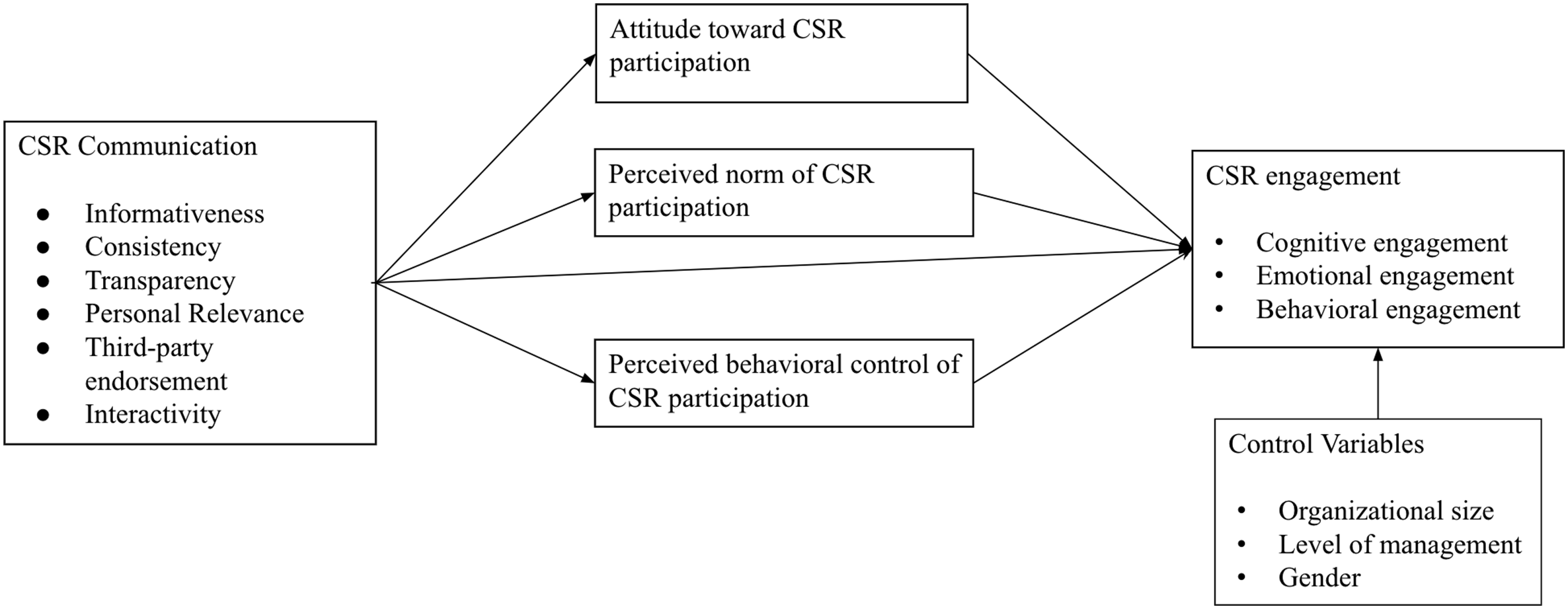
CSR communication (i.e., informativeness, consistency, transparency, personal relevance, third-party endorsement, and interactivity) is positively associated with employees' CSR-related a) attitude, b) PN, and c) PBC.
CSR communication is positively associated with employee CSR engagement.
Employees’ a) attitude, b) PN, and c) PBC toward CSR participation are positively associated with employee CSR engagement.
The Mediating Role of Attitude, PN, PBC
Drawing on the reasoned action approach, this study proposes the mediating roles of employees’ psychological determinants of CSR participation (i.e., attitude, PN, and PBC), which can explain the underlying psychological mechanism of CSR communication effects. Effective CSR communication helps employees rationalize CSR participation by stressing the personal and moral benefits, reinforcing a supportive social environment, and eliminating perceived barriers. Informative, consistent, transparent, personally relevant, endorsed, and interactive communication can jointly trigger employees’ intrinsic motivations to participate in CSR, and ultimately drive cognitive, emotional, and behavioral engagement in prosocial activities.
The relationship between CSR communication and employees’ CSR engagement will be mediated by employees’ a) attitude, b) PN, and c) PBC related to CSR participation.
Method
This study employed a two-step approach to investigating the research inquiries, including 1) a belief elicitation study revealing the key beliefs associated with the psychological determinants of employees’ CSR participation, and 2) a survey testing the effects of CSR communication strategies as proposed in the hypotheses. This research design was created for two purposes. First, few studies have examined the motivations behind employees’ CSR engagement, leaving the understanding and measures of the psychological determinants of their CSR engagement largely unexplored. A belief elicitation can collect a set of salient modal beliefs by identifying the beliefs most frequently produced by a target population (Ajzen, 2012). In this study, we particularly relied on the normative beliefs collected in the belief elicitation study to develop the measures of PN, which captures the important social referent groups who are most relevant to employees’ motivations to engage in CSR. Second, the belief elicitation study allows participants to explain their actions in a free-response format, offering valuable qualitative insights to enhance the interpretation of the survey results. In this study, the behavioral beliefs and control beliefs identified in the first study provide detailed and nuanced understandings of attitude and PBC related to CSR participation and their impacts on employee CSR engagement, which helps to explain the CSR communication effects and develop employee-centered CSR communication programs.
Belief Elicitation Study
Participants
A convenience sample of MBA students (N = 78) at a public university in the Southwest United States completed the online survey on Qualtrics in exchange for extra credit in March 2020. Participants included 48 women and 30 men, and the average age was 32.95 (SD = 8.01). Most participants were White (61.5%), and 58.97% had an annual income above $70,000. As for their employment status, 69 (88.5%) worked full-time, and 9 (11.5%) worked part-time.
Instruments and Data Analysis
We first provided a short statement describing the definition of CSR (CEC, 2001) and a list of typical CSR activities (e.g., environmental protection, volunteering in communities, providing training and education opportunities to employees, etc.). Then, the participants were asked to indicate their awareness of the CSR activities initiated by their employers (Lee et al., 2019), report how often they participate in their employers’ CSR activities (1 = Not at all, 7 = Very often), and provide examples of their previous participation in those and similar activities.
Then, participants responded to open-ended questions and elicited their beliefs about engaging in the CSR activities initiated by their employers in the next 12 months. The belief elicitation procedure was developed following established guidelines (Yzer et al., 2015; Yzer & Gilasevitch, 2019). Specifically, for behavioral beliefs, participants were asked to report their perceived advantages/disadvantages of participating in their employers' CSR activities. For normative beliefs, we asked participants to identify important social referent groups that can influence their decisions on CSR participation. For control beliefs, we asked participants to list their perceived enablers/barriers related to participating in their employers' CSR activities. The open-ended responses to the belief elicitation questions were content analyzed following the established coding procedures (e.g., Yzer & Gilasevitch, 2019). We identified 68 distinct beliefs that are salient in the behavioral (n = 18), normative (n = 24), and control belief (n = 26) categories.
Key Findings of Belief Elicitation Study
The participants reported a relatively high awareness of their employers’ CSR activities (M = 5.18, SD = 1.55). The participants engaged in their employers’ CSR activities on a moderately frequent basis (M = 3.86, SD = 2.00). Typical examples of the CSR activities they engaged in included providing services in the communities, churches, and local nonprofits; joining employer-organized financial assistance programs to help people obtain healthcare, attending training, supporting science fairs, donations to nonprofits (e.g., Red Cross), participating in employee wellness groups, and fundraising for food banks.
The most common advantages of participating in CSR activities were improving communities (n = 20; 21%), achieving self-satisfaction (n = 16; 17%), and building networks with coworkers and higher-level leaders (n = 16; 17%). The most common disadvantage as perceived by employees regarding CSR participation was taking away from personal time with families and friends or other personal obligations (n = 35; 58%).
As for the normative beliefs, approval for CSR participation was most expected from managers and supervisors (n = 39; 32%), the higher leadership (n = 28; 23%), and colleagues (n = 11; 9%). Disapproval was also expected from colleagues (n = 7; 28%), managers/supervisors (n = 7; 28%), and family (n = 6; 24%).
In terms of control beliefs, the most common facilitating factor was paid time to participate (n = 21; 22%), followed by better CSR communication (n = 16; 16%), support and encouragement from the employer (e.g., CEO) (n = 15; 15%), and less time commitment (n = 13; 13%). The most common barriers were large time commitments (n = 37; 43%), heavy workload (n = 17; 20%), and conflicting work schedules (n = 8; 9%) The salient beliefs are reported in Appendix A in Supplementary Files.
Discussion of Belief Elicitation Study
Results from the belief elicitation study indicated that the benefits of participating in CSR can be intrinsic and extrinsic. Community improvement was a positive outcome of CSR participation commonly expressed by employees, suggesting that employees recognize the employer’s positive impact on external stakeholders as a salient positive motivator of their own CSR participation. We also found that many behavioral beliefs were self-interested, such as recognition by the leadership team and potential job promotions. Although numerous studies have documented the positive outcomes of employee CSR engagement, most benefits were from an organizational perspective (e.g., job performance). Our findings suggest that employee-related benefits, such as self-enhancement and career development, should be further researched as potential drivers of employee CSR engagement. Despite the benefits related to CSR (Rupp, et al., 2013), our findings indicate that when it comes to actual CSR participation, a strong disadvantage, as expected by employees, was reducing work productivity, raising conflicts between individuals’ job performance and CSR performance.
As to the normative beliefs, managers and coworkers were listed in both the possible perceived supporters and opponents. Like organizations signaling CSR engagement to consumers, employees may signal their CSR participation, and their target audience is managers or coworkers. Usually, CSR participation is considered a positive, prosocial behavior that people would commonly support. However, many participants expressed concerns that their managers and families will discourage them from engaging in CSR. This finding reinforces that CSR participation could cause tensions between the employees and managers, and between the employees and their families.
Findings of control belief revealed the vulnerability of employees. If taking the time to participate in organizational CSR activities means that employees need to either affect their work schedule or compromise their personal time, they are likely to be placed in a disadvantageous position and forced to comply with an organization-centered CSR agenda. In addition, communication was indicated as a factor that can enable employees’ CSR participation, suggesting the importance of improving strategic CSR communication to internal stakeholders.
Main Survey
Participants
To test the proposed hypotheses, an online survey was conducted in November 2020 via Qualtrics. Participants (N = 548) who were full-time and part-time employed were randomly recruited on MTurk and paid $1.60 per person as an incentive. After data cleaning, 406 responses were included in the analysis. Among them, 55.4% were males (n = 225), and 43.8% were females (n = 178). The average age was 38.67 years (SD = 11.05). Regarding the level of position, non-management positions accounted for 41.6%. More than half of the participants (n = 210, 51.8%) had over 5 years of work experience with their current employer. The majority (n = 138, 34.0%) of participants claimed that their employer had a moderate amount of CSR activities.
Measures
Before measuring key variables, we provided a short statement describing what CSR means in our study, stating that CSR generally refers to companies integrating social and environmental concerns into their business operations and in their interactions with stakeholders voluntarily (CEC, 2001). We also provided a list of CSR examples to show participants several common organizational CSR activities as in Study 1. Then, participants were asked to indicate their awareness of their employers’ involvement in CSR activities and write some examples of their organizations’ CSR initiatives.
Informed by the identified beliefs and previous research, we measured attitude (α = 0.87) using four items on a seven-point bipolar scale (e.g., extremely harmful (1), extremely beneficial (7)). PN was measured by asking participants to indicate how much they perceived coworkers, managers, and leadership would support, want, or approve their CSR participation (α = 0.93). PBC was measured by asking the extent to which participants believed their CSR participation was within their control and under their free will (Taylor & Todd, 1995) (α = 0.86).
To measure CSR communication, we adapted 16 items from Kim and Ferguson’s (2018) scales, including five dimensions: informativeness (α = 0.92), transparency (α = 0.93), consistency (α = 0.94), relevance (α = 0.94), and third-party endorsement (α = 0.91). In addition, we also adapted four items from Yang et al. (2015) (α = 0.93) to measure the dialogue dimension of CSR communication. All items were measured on a seven-point Likert-type scale, ranging from strongly disagree (1) to strongly agree (7).
CSR engagement was measured using a modified nine-item scale from Rich et al. (2010) and Jiang and Shen (2020), and it was treated as a multidimensional construct including cognitive, emotional, and behavioral dimensions. Cognitive engagement measured participants’ attention and cognitive involvement in CSR activities (α = 0.93). Emotional engagement measured participants’ positive emotional state (e.g., proud, enthusiastic, excited) when they are involved in CSR activities (α = 0.93). Behavioral engagement measured participants’ physical participation in CSR activities (α = 0.9).
Data Analysis and Results
Discriminant and Convergent Validity
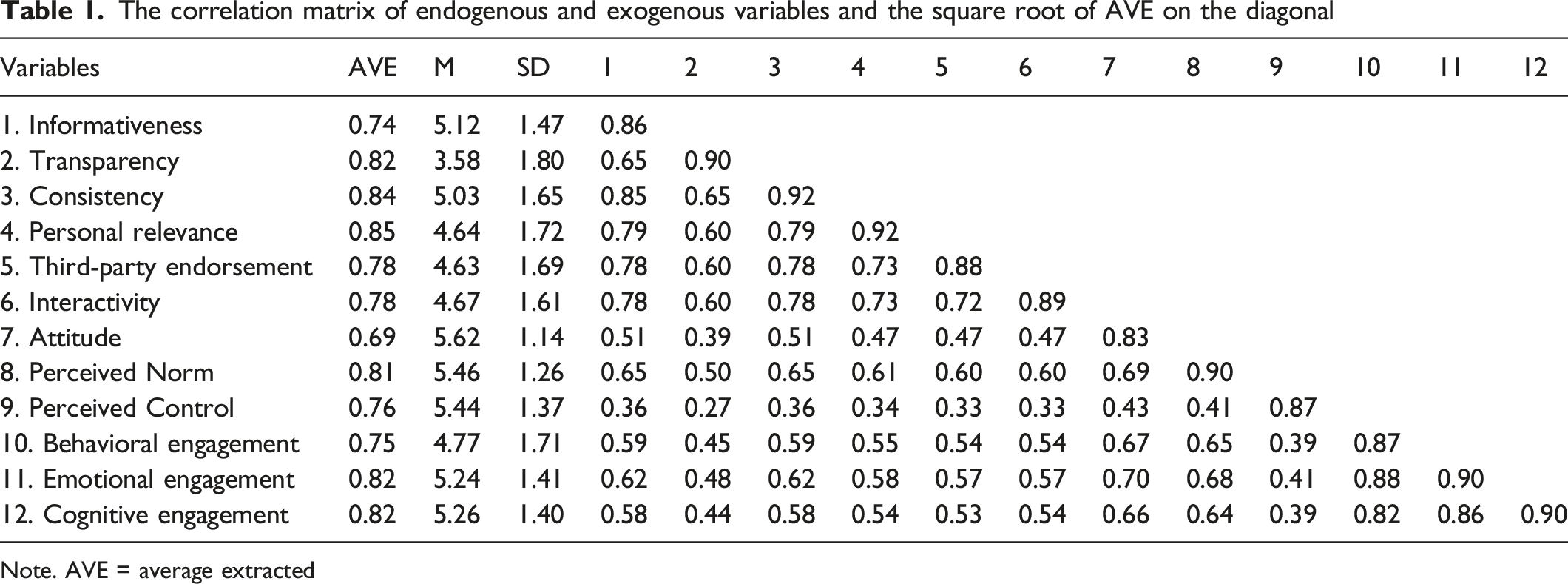
The correlation matrix of endogenous and exogenous variables and the square root of AVE on the diagonal
Note. AVE = average extracted
The correlations among variables and the square root in our model indicated that the correlations among first-order variables were less than the corresponding square roots of AVEs, suggesting the satisfied discriminant validity.
Tests on Socio-Demographic Variables
Prior to testing the hypotheses, we conducted a series of linear regression analyses to examine how relevant demographic variables might impact on the measured relationships in the SEM model, following Shen and Jiang (2019)’s guidelines. Results suggested that the level of management positions (βnon-management = −.68, p < .05) and organizational size (βorganizational_size_between_501_1000 = .70, p < .05; βorganizational_size_1001_more = .64, p < .01) were significant predictors for CSR communication. Gender was a significant predictor for attitudes (βfemale = .29, p < .05) and CSR engagement (βfemale = .39, p < .01). CSR engagement was also affected by the level of management positions (βnon-management = −.55, p < .05). Based on the results, we controlled for organizational size, the level of management, and gender in the SEM model for hypothesis testing.
Measurement Model
Results of the Measurement Model (n = 406).
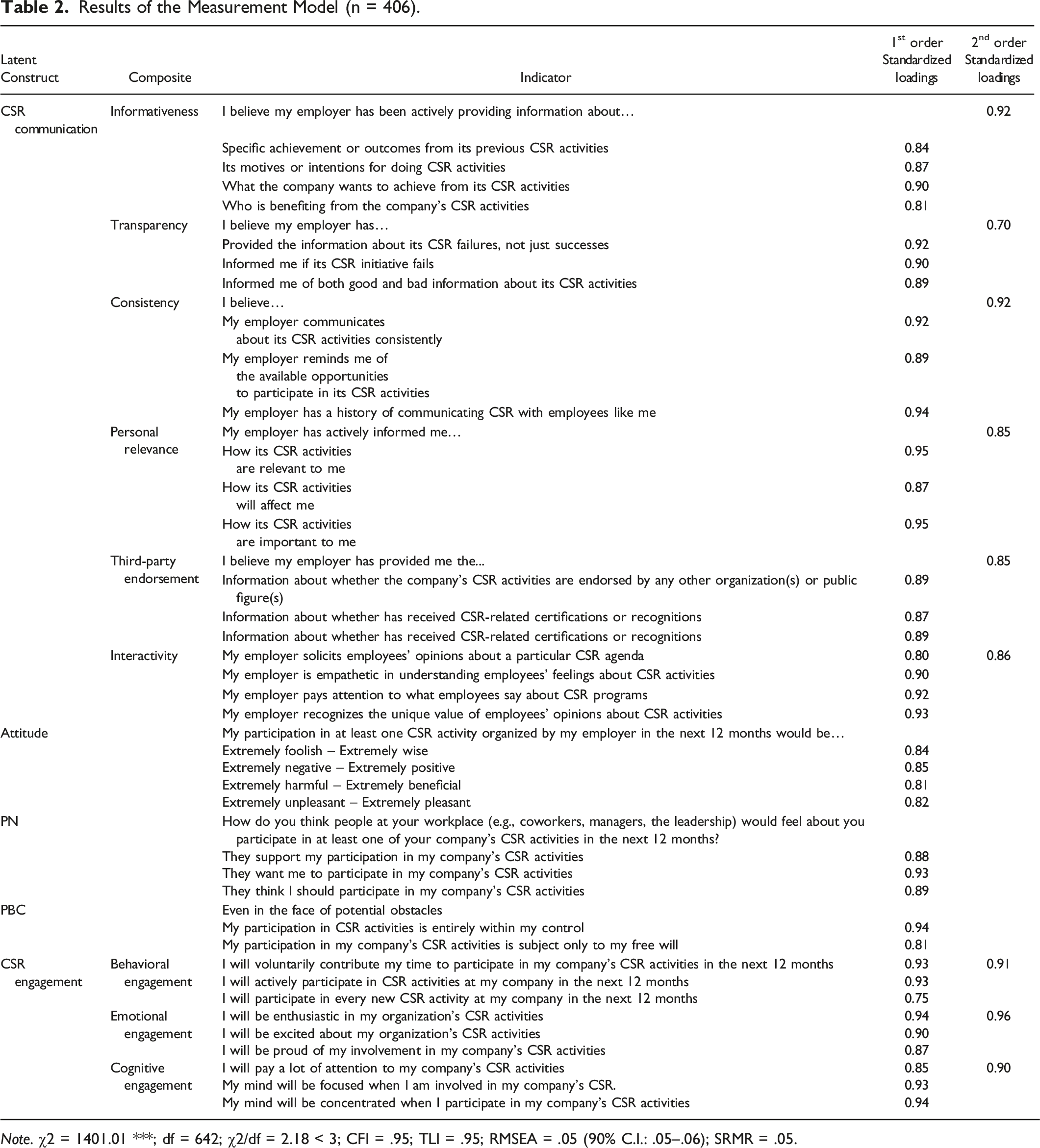
Note. χ2 = 1401.01 ***; df = 642; χ2/df = 2.18 < 3; CFI = .95; TLI = .95; RMSEA = .05 (90% C.I.: .05–.06); SRMR = .05.
Structural Model Fitting and Hypotheses Testing
Results of Direct Effects and Indirect Effects.
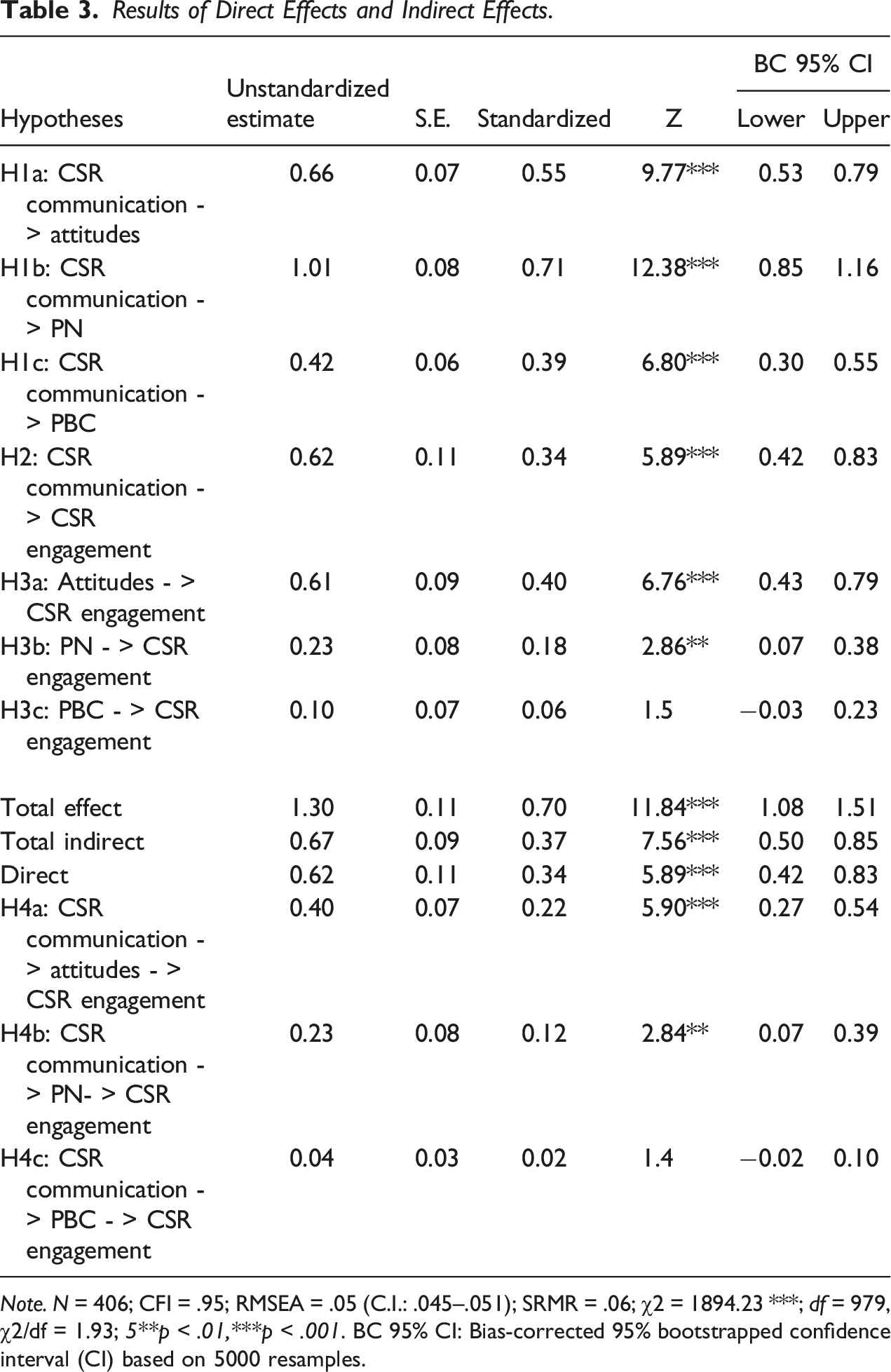
Note. N = 406; CFI = .95; RMSEA = .05 (C.I.: .045–.051); SRMR = .06; χ2 = 1894.23 ***; df = 979, χ2/df = 1.93; 5**p < .01,***p < .001. BC 95% CI: Bias-corrected 95% bootstrapped confidence interval (CI) based on 5000 resamples.
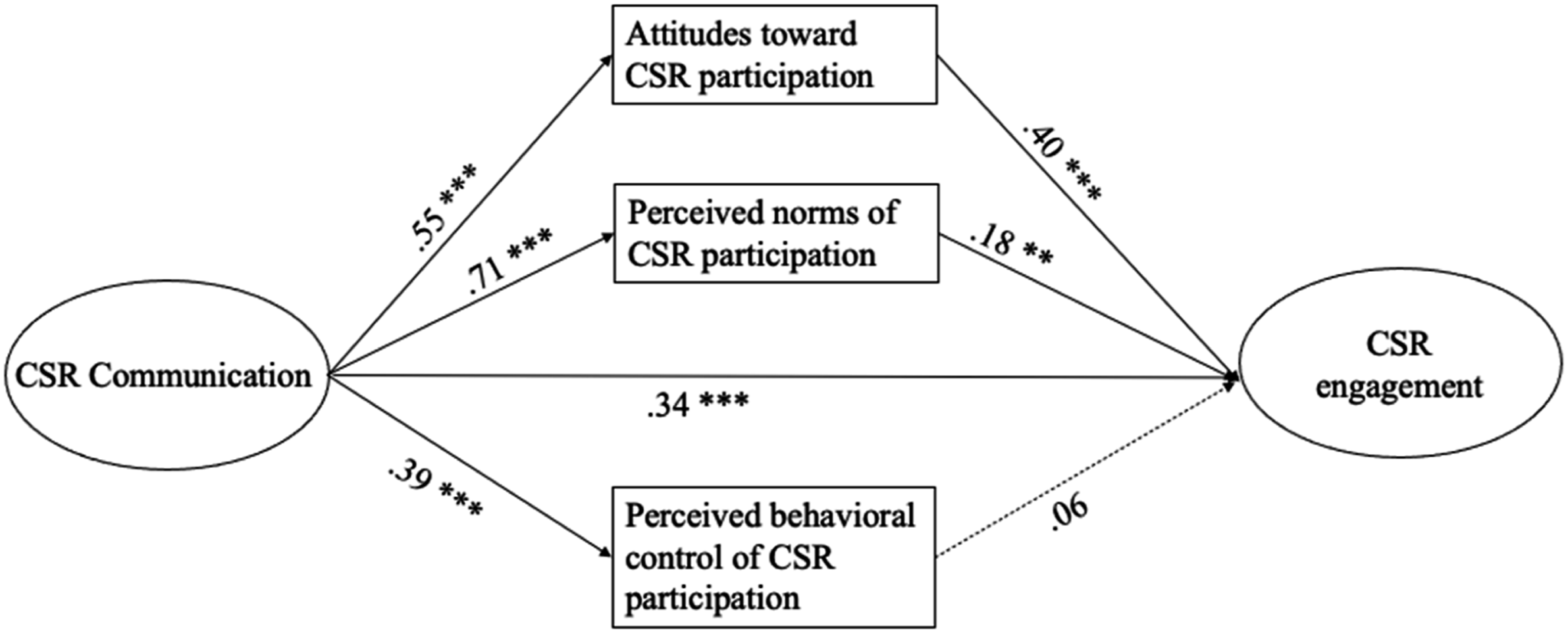
Estimated standardized effects in the structural modeling equation.
We hypothesized that CSR communication was positively associated with employees’ CSR-related attitudes (H1a), PN (H1b), and PBC (H1c). The results suggested that effective CSR communication was positively associated with employees’ positive attitudes toward CSR engagement (β = .55, p < .001), PN supporting CSR participations (β = .71, p < .001), and PBC in their own participation in CSR activities (β = .39, p < .01). Thus, H1 was supported. In addition, effective CSR communication was also a strong predictor of increased employee CSR engagement (β = .34, p < .001), supporting H2. In addition, employees with more positive attitudes (β = .40, p < .001) and perceived more support from important referents in the workplace (β = .18, p < .01) were more likely to engage in CSR activities. Therefore, H3a and H3b were supported. However, we did not observe a direct effect of PBC on CSR engagement (β = .06, se = .07, p > .05), not supporting H3c.
Indirect (Mediation) Effects
A test of indirect effects was performed using a bootstrapping procedure (N = 5000 samples). Results revealed a significant indirect effect of CSR communication on employees’ CSR engagement via employees’ CSR-related attitudes (β = .22, p < .001, 95% CI = [.27, - .54]) and perceived norms (β = .12, p < .01, 95% CI = [.07, - .39]). Thus, H4a and H4b were supported. In other words, the positive effects of CSR communication on driving employees to engage in organizational CSR activities were mediated by employee’s positive feelings toward and the supportive organizational norm about CSR participation. However, the effect on CSR engagement from CSR communication was not mediated by PBC (β = .02, SE = .03, 95% CI = [-.02, - .01]), not supporting H4c.
Additional Analysis
In addition, to further reveal the effect of each individual CSR communication strategy, we conducted six separate structural equation models to examine how informativeness, transparency, consistency, personal relevance, third-party endorsement, and interactivity was directly and indirectly associated with employee CSR engagement. The analyses suggested that all CSR communication dimensions have direct positive effects on employees’ attitudes, PN, PBC, and CSR engagement (See Appendix B in Supplementary Files). In terms of mediation effects, attitude and PN mediated the effects of all individual CSR communication strategies on CSR engagement. In contrast, PBC did not mediate any of the communication strategy effects. In summary, increases in informativeness, transparency, consistency, personal relevance, third-party endorsement, and interactivity in the employer’s CSR communication would lead to employees’ enhanced attitudes toward and PN of CSR engagement, which, in turn, improve their CSR engagement.
Discussion of Main Survey
The findings justified the positive effects of internal communication on employees’ reasoning for CSR participation and their engagement in organizational CSR programs. Although strategies focusing on delivering informative, transparent, relevant, and consistent CSR information to employees are instrumental and can be one-way, they are useful tools to send clear and formal messages to keep informed about the employer’ CSR efforts (Lemon, 2019). Employees can more effectively process such information through internal channels (Maignan & Ferrell, 2000). In addition to the instrumental approach, we argue that an employee-centric, co-creational approach is also important (Lemon, 2019; Taklac Verčič et al., 2012), evidenced in the positive direct effects of interactive strategy on employees’ CSR engagement. Active listening and interaction offer a genuine venue for both sides to interpret and talk about CSR, make sense of CSR, and shape the meaning and practice of CSR (Schoeneborn et al., 2020).
Attitude toward CSR participation was found as a determining factor for employee CSR engagement, which echoes previous research suggesting that employees calculate the benefits of their CSR participation (Haski-Leventhal, 2013; Koch et al., 2019; Mirvis, 2012). By providing informative, transparent, consistent, relevant, endorsed, and interactive communication, CSR’s benefits, whether they are self-oriented or other-oriented, are clearly presented. Employees recognizing such benefits would form more positive attitudes toward CSR participation and become attentive, empowered, and active when engaging in organizational CSR activities.
As Morsing and Spence (2019) suggested, an important goal of CSR communication is to convey values, norms, and rules to stakeholders. Our findings supported this notion by further arguing that CSR communication contributes to creating the internal context. This context introduces new roles of the employer beyond the workplace, which allows employees to share their social views with the employer and develop stronger identification with the organization (Rodrigo & Arenas, 2008). CSR communication can also construct a supportive internal environment for personal connections to be established around CSR topics, which provides a pathway for employees to confirm leadership and peer support of CSR, evokes more CSR-related dialogue exchanges, and ultimately enriches their CSR experiences.
However, the internal CSR norm may put employees in a more vulnerable position. As Costas and Kärreman (2013) warned, CSR can be enforced through soft regulations, such as codes of conduct, standards, and norms. In this way, such norms can become an internal pressure that suppresses employees’ expression of concerns and disagreement with organizational CSR. This concern is also highlighted by our belief elicitation findings that managers, leaders, and coworkers were perceived as the most important endorsers of employees’ CSR participation. To avoid the internal norm becoming an organizational tool for reaching agreement and consensus (Costas & Kärreman, 2013), it is important to engage employees in co-creational communication processes through which the members of an organization construct CSR in a way that is meaningful to them.
The positive association between CSR communication and PBC suggests that CSR communication can help employees to know better about their capability to influence organizational CSR decisions and implementation, their potential to make positive social impacts, and the resources that are available to them. However, our findings also reveal that PBC was insufficient to produce employees’ CSR engagement. There are three possible explanations. First, as Costas and Kärreman (2013) suggested, CSR can be regarded as a type of management control by employees. Considering the imbalanced power between employees and employers, CSR communication might be perceived as manipulative and cannot be trusted by employees (Lindgreen & Swaen, 2010). Thus, even if the CSR communication has informed employees about the available resources, employees may still be reluctant to comply due to the unwillingness to follow a CSR agenda set by the employer.
Second, other variables out of the employees’ control can influence their CSR engagement, which may require inputs from managerial and policy changes (e.g., PTO). It’s also important to note that although most CSR participation is voluntary, it could be difficult to draw a fine line between work and non-work activities when the employees are the participants. This finding is consistent with the control beliefs as discussed earlier, highlighting the potential conflicts between employees’ self needs and job performance. Last, organizational size was treated as a control variable in our model, but organizations have varied circumstances and resources, which may affect their CSR initiatives and the opportunities for employee involvement (Baumann-Pauly et al., 2013).
General Discussion
This research provides an employee’s viewpoint on CSR communication and engagement to help improve organizations’ engagement with employees via CSR activities. The two studies contribute to an employee-centric CSR communication model qualitatively and quantitatively. Specifically, the belief elicitation study identified various beliefs related to attitude, PN, and PBC driving employees’ CSR participation, served as the foundation for developing survey measures (i.e., PN), and provided contextual explanations for the survey results. The main survey focused on a multi-dimensional CSR communication construct and investigated its impacts on employees’ CSR-related psychological reasoning centered on attitude, PN, and PBC, and subsequently on employees’ engagement in organizational CSR activities.
Theoretical Implications
This research makes several theoretical contributions to the CSR communication scholarship. First, while most previous studies focused on proving the values of employee engagement by justifying its positive outcomes (e.g., Chen & Hung-Baesecke, 2014), this study identifies strategic communication as a key antecedent of employee CSR engagement, adding important empirical evidence justifying the value of internal CSR communication. Internal communication is an important venue for bringing employees closer to CSR activities, yet a holistic CSR communication model has not been explicated in previous studies. We argue that strategic internal CSR communication is the synergies of effective messages showing informativeness, transparency, personal relevance, consistency, and third-party endorsement and an interactive process embracing employees’ inputs, feelings, and feedback. This finding provides an alternative view on the CSR communication conceptualization, suggesting that CSR communication is a multifaceted concept involving both instrumental and constitutive elements. Our research echoes Lemon’s (2019) call for switching from binary approaches to multiplicity in understanding internal communication and Kim’s (2022) hybrid CSR approach emphasizing both strategic and ethical considerations in CSR planning.
Our study also enhances CSR communication scholarship by including a stakeholder-centric perspective, which allows for more inclusive and critical theory development (Kim, 2022). By revealing salient beliefs employees hold regarding their CSR participation, our findings show the power dynamics and conflicts around CSR from an employee perspective, which has been less discussed as a dark side of CSR engagement. This critical view is important because the traditional organization-centric approach can easily make CSR an idealized corporate self-agenda (Costas & Kärreman, 2013), hiding employees’ vulnerability in CSR participation. Understanding the employee perspective is a prerequisite to developing ethical communication strategies connecting employees and organizational CSR efforts.
In addition, drawing on the reasoned action approach (Fishbein & Ajzen, 2010), this study bridges CSR communication and CSR engagement through a psychological lens. The reasoned action approach provides a more individual-centered view of understanding employees’ CSR experience. The linkages between CSR communication and attitude, PN, and PBC are theoretically important because they help unpack the underlying psychological mechanism that explains the value of communication in fostering internal CSR. Through receiving deliberatively designed CSR communication, employees’ perceived benefits, social support in the workplace, and controllability of engaging in CSR can be significantly facilitated. In addition, although the reasoned action theory usually focuses on one specific behavior, our findings suggest that employees’ attitudes and PN related to CSR participation were able to predict a multi-dimensional CSR engagement encompassing cognitive, emotional, and behavioral components.
Practical Implications
Our results on the positive relationship between CSR communication and employee engagement suggest that more attention and investment should be directed to developing internal CSR communication programs that carefully design messages and facilitate dialogues with employees. Managers may utilize our belief elicitation approach to better understand their employees’ reasons for engaging in CSR initiatives. For example, provide specific information on goals and achievements that help employees better recognize CSR engagement’s benefit. Managers need to reach out to important stakeholders who can contribute to cultivating an organizational culture that supports employees’ CSR participation. Managers also need to consider employees’ vulnerability when engaging in CSR activities, such as the conflicts between CSR engagement and job-related schedules. In addition, the findings from the main survey offer useful guidelines for developing internal CSR communication strategies. Both one-way and co-created approaches can help communicate CSR to employees. For example, through formal internal channels (e.g., emails and weekly reports), help communicate can deliver clear, transparent, consistent, and relevant messages about CSR. Furthermore, our findings on the mediating effects of PN emphasized the importance of creating a supportive organizational environment for employee CSR participation. An internal norm that supports CSR participation shows that organizations are not pursuing the face value of CSR, but incorporate CSR into their DNA (Nejati et al., 2020). We suggest that to drive employees’ active CSR engagement, leaders of the organization should act as role models to participate in CSR activities, and it would be helpful to create CSR activities that involve co-workers within and across many departments.
Limitations and Future Research
Despite the contributions, this study has some limitations. First, given the positive outcomes of CSR engagement documented in the previous literature, more organizational and job-relevant outcomes could be added to the model to provide a more comprehensive understanding of internal CSR communication effects. Second, our survey was launched during the COVID-19 pandemic, but this study did not measure COVID-related variables, which may affect employees’ job status and their perceptions of CSR. Future research needs to include contextual variables or potential moderators to better understand the nuances of the CSR communication process. Third, to further understand the boundary effects of CSR communication, future research may examine moderators that influence the relationship between CSR communication and employee CSR engagement. Fourth, this study treats attitude, PN, and PBC as conceptually distinctive variables. However, empirical evidence has suggested the potential interrelations among these psychological factors (Lim & Lee-Won, 2017; Mou & Lin, 2015). Future research may employ experiments to analyze the serial mediations among attitude, PN, and PBC to further unpack further the psychological mechanism and sequence underlying employees’ CSR information processing.
Conclusion
Drawing on the reasoned action approach and CSR communication literature, this research employed both belief elicitation and survey techniques to conceptualize and empirically test an employee-centric CSR model. Findings showed CSR communication’s positive effects on employee CSR engagement, revealed the underlying psychological mechanisms, and identified key beliefs associated with employees’ intention to participate in organizational CSR activities. This study contributes to an employee-centered CSR communication model and provides useful guidelines for internal CSR promotion.
Supplemental Material
Supplemental Material - How to Engage Employees in Corporate Social Responsibility? Exploring Corporate Social Responsibility Communication Effects Through the Reasoned Action Approach
Supplemental Material for How to Engage Employees in Corporate Social Responsibility? Exploring Corporate Social Responsibility Communication Effects Through the Reasoned Action Approach by Chuqing Dong, Yafei Zhang, and Song Ao in Management Communication Quarterly
Footnotes
Declaration of Conflicting Interests
The author(s) declared no potential conflicts of interest with respect to the research, authorship, and/or publication of this article.
Funding
The author(s) received no financial support for the research, authorship, and/or publication of this article.

Supplemental Material
Supplemental material for this article is available online.
Author Biographies
References
Supplementary Material
Please find the following supplemental material available below.
For Open Access articles published under a Creative Commons License, all supplemental material carries the same license as the article it is associated with.
For non-Open Access articles published, all supplemental material carries a non-exclusive license, and permission requests for re-use of supplemental material or any part of supplemental material shall be sent directly to the copyright owner as specified in the copyright notice associated with the article.
