




Abstract
This study examines whether belief in just world manages to reduce the negative impacts of conspiracy theories belief on social distancing intention and vaccination attitude. We also examine the mediating effect of perceived COVID-19 threat in these relations. Using a sample of 262 adult participants from Indonesia, results suggest that when people have high belief in just world, they have a more positive attitude towards vaccination and willingness to practice social distancing even though when they believe in conspiracy theories and feel less threatened by COVID-19. Theoretical and practical contributions are discussed in this article.
Keywords
Introduction
Ever since its first case was found in December 2019, the ongoing COVID-19 pandemic has been causing many problems for the global community. To make the pandemic worse, many conspiracy theories regarding the origin of the pandemic have been circulated in society (Bertin et al., 2020). In general, conspiracy theories accuse powerful individuals and entities as the pandemic initiators, which leads to the reluctance to practice authorities’ recommended behaviours (Imhoff & Lamberty, 2020). Typically, conspiracy theories are endorsed as explanations of an event when official records of the event are insufficient (Dagnall et al., 2015). Governments, not-for-profit organisations and public health authorities have held social marketing campaign to diminish negative impacts that may be incurred by conspiracy theories belief. Considering the severe impacts of COVID-19, more knowledge and strategies should be explored to eradicate the issue.
Although the literature has documented numerous studies regarding the origin of conspiracy theories, less is known about the consequences of the theories (Jolley et al., 2020). Most scholars agreed that conspiracy theories affect societies negatively. In the case of COVID-19, the belief of conspiracy theories reduces the intention to comply with public health recommendations (Bertin et al., 2020; Biddlestone et al., 2020; Bierwiaczonek et al., 2020; Romer & Jamieson, 2020). However, a recent study found that conspiracy theory belief is not associated with public health recommended behaviours (Alper et al., 2020). This shows that there are more aspects in the relationship that need to be explored. We argue that a personality trait (i.e., belief in just world) moderates the link between conspiracy theory belief and public health recommendation compliance. Our findings demonstrate that just world belief undermines the negative effect of conspiracy theories belief on public health recommendation attitude.
This study makes significant contributions, both theoretical and practical. First, the present study provides additional insights into the impact of conspiracy theories belief on public health recommended attitude by proposing the role of belief in just world. Second, this study motivates more investigations into the moderating factors in the relationship between conspiracy theories belief and public health recommendation compliance. Third, this study answers the need to investigate the effects of COVID-19 conspiracy theories on societies in developing countries (Chen et al., 2020). Data were collected in Indonesia, one of the most affected countries by the pandemic (Olivia et al., 2020). Lastly, the authorities such as governments, influencers and not-for-profit organisations’ managers can benefit from the findings by employing the principle of deservingness in campaigning public health recommendations.
The remainder of this article is structured as follows. First, we review the literature on conspiracy theories belief along with their impacts on societies. Next, we discuss how perceived COVID-19 threat resulting from conspiracy theories belief may interact with belief in just world to influence public health recommended behaviours. We then present the methods of the study, followed by data analysis that tests our framework. We conclude by discussing the theoretical and practical implications as well as the limitations of the present study and future research directions.
Literature Review
Conspiracy Theory Belief of COVID-19
Conspiracy theories are ‘attempts to explain the ultimate causes of significant social and political events and circumstances with claims of secret plots by two or more powerful actors’ (Douglas et al., 2019, p. 4). Most conspiracy theories are speculative, propose complex stories concealed from the public and involve many powerful actors who use misinformation to hide the actual actions (Lewandowsky et al., 2015). Conspiracy theories find their momentum when a societal crisis occurs, including natural disasters, wars and pandemics (Bierwiaczonek et al., 2020) when people need instant explanations regarding the ongoing crisis. People believe in conspiracy theories if compared with non-conspiracy ones they can satisfy the desires to comprehend the phenomenon, to feel secure, and to maintain a positive self or group image (Douglas et al., 2017).
An essential element in a conspiracy theory is the powerful actors who secretly set up all the scenarios to attain their benefits. While governments are frequently accused, any other groups or individuals who are considered powerful and malicious can be dragged into a conspiracy theory (Douglas et al., 2019). For instance, the conspiracy theories about climate change highlight the involvement of the United Nations, the US government, oil companies, communists and scientists. In the case of the COVID-19 pandemic, conspiracy theories accuse Bill Gates, China government, US government, World Health Organisation and big pharmacy companies (Bertin et al., 2020; Biddlestone et al., 2020). As a consequence, the accused individuals and groups are suffering from an increasing distrust towards them.
Conspiracy theories belief affects the threat perception of the occurring phenomenon. This relates to the feeling of distrust built by the conspiracy theory believers towards powerful forces such as governments, powerful individuals and big companies (Imhoff & Lamberty, 2020). For instance, in the COVID-19 pandemic case, although most scientists and governments suggest to ‘flatten the curve’ and reduce the virus’ spreading by vaccine injections, conspiracy theory believers tend to go against the vaccination (Bertin et al., 2020). It seems that the conspiracy theory believers strategically cope with a societal crisis (e.g., COVID-19) by undermining its potential threat. Thus, our first hypothesis is as follows.
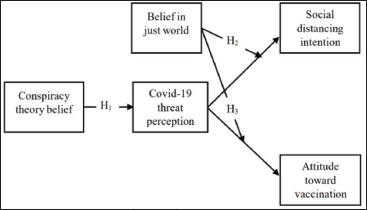
H1: Conspiracy theory belief negatively affects COVID-19 threat perception.
COVID-19 Threat Perception and Public Health Recommendation, the Moderating Role of Belief in Just World
Perceived threat causes people to take necessary actions to eliminate the risks, including complying with others’ recommendations (Wilson et al., 1988). For instance, people are more protective when they perceive that the risk of a threatening event is higher (Brewer et al., 2004). Prior studies found that fear of the COVID-19 pandemic led people to comply more with public health recommendations such social distancing and handwashing practices (Imhoff & Lamberty, 2020; Melki et al., 2020). In contrast, low levels of perceived threat of COVID-19 directed people to be more apathetic and to neglect the recommended behaviours to prevent the coronavirus infection (Imhoff & Lamberty, 2020). Nevertheless, the association between perceived threat and public health recommendation (i.e., social distancing practice and vaccination participation) may depend on other factors.
Belief in just world is rooted in justice world theory which postulates that the world works based on the principle of deservingness (Lerner, 1975). In other words, people get what they deserve, which leads them to believe that the world is an orderly regulated place (Lerner & Miller, 1978). As a consequence, people who have done good deeds would obtain positive outcomes. In contrast, negative behaviours would always generate negative outcomes (Hafer & Rubel, 2015). Just world belief has been associated with positive thinking (Furnham, 1995) and prosocial behaviour (Igou et al., 2020) but is also linked with negative outcomes such as innocent victim blaming (van Prooijen & van den Bos, 2009). More importantly, belief in just world demonstrates how individuals take necessary actions to support the idea that the world is just, regardless of the actions’ social values.
We propose that the effect of perceived COVID-19 threat on public health recommendation (i.e., social distancing and vaccination acceptance) depends upon the belief in just world’s levels. As socially desired behaviours, social distancing and vaccination affect oneself and others’ welfares (Bertin et al., 2020; Fanggidae et al., 2020). Since belief in just world is closely related to the concept of deservingness, chronic just world believers would take any necessary actions to protect themselves and others from any potential risks, including by complying with public health recommendations. Nonetheless, this effect only occurs when people feel less threatened by COVID-19. When people perceive that COVID-19 is highly threatening, concerning to life or death situation, they are more likely to practice public health recommendation regardless of belief in just word levels. Based on the review, we hypothesise:
H2: Belief in just world moderates the effects of COVID-19 threat perception on social distance intention.
H3: Belief in just world moderates the effects of COVID-19 threat perception on attitude towards vaccination.
Methods
Sampling and Data Collection
Two-hundred and sixty-two adult Indonesians voluntarily participated in the study. The data collection was conducted during the COVID-19 pandemic in Indonesia in January 2021. The participants’ average age was 24.46 (SD = 8.51), and 59.5% of them were female. An invitation to participate in the survey was posted in social media (i.e., Facebook and Instagram) and was sent to instant massaging groups. In the invitation, the participants were informed that the questionnaires would ask their opinions regarding the COVID-19 pandemic. There was a link in the invitation that directed the participants to the survey page. The participants were asked to read the information page carefully where they can give their consent to take part. They were ensured that their answers were completely anonymous. The study has passed the institution’s ethics review process.
Measurement
The constructs of our instrument were adapted from previous studies. Each construct was measured on a 5-point Likert scale (e.g., 1 = strongly disagree, and 5 = strongly agree).
Conspiracy Theory Belief
The construct was measured with six items adapted from Biddlestone et al. (2020) and a self-developed item that fits with the Indonesian context. The construct was measured using 5-point Likert scales ranging from 1 (strongly disagree) to 5 (strongly agree). The sample items were: ‘Coronavirus was created to control the population’, and ‘Coronavirus was purposefully created in, and released from a biochemistry lab in a foreign country’.
COVID-19 Threat Perception
A four-item scale was used to measure the construct on a scale from 1 (not at all) to 5 (very much). The scale was adapted from Imhoff and Lamberty (2020). Sample questions were: ‘To what extent are you currently personally affected by the spread of coronavirus?’ and ‘To what extent are you currently worried about the spread of coronavirus?’
Attitude Towards Vaccination
To capture attitude towards vaccination, a four-item scale adapted from Lewandowsky et al. (2013) was used. All the items were measured with 5-point Likert scales (1 = strongly disagree; 5 = strongly agree). Sample items were: ‘I believe that vaccines are a safe and reliable way to help avert the spread of COVID-19’; and ‘I believe that the negative side effects of vaccines are not big deals’.
Vaccination Intention
We adapted a single item from a prior study: ‘Would you take a COVID-19 vaccine if you have the opportunity?’ (Bertin et al., 2020). Participants were asked to respond to the question using a binary scale (1 = Yes; 0 = No).
Social Distancing Intention
A three-item scale were used to assess the intention to practice social distancing were adopted from Bierwiaczonek et al. (2020). The scales were measured on a 5-point scale ranging from 1 (strongly disagree) to 5 (strongly agree). The items were: ‘I will avoid in-person contact with others’; ‘I will avoid attending social gatherings in person’; ‘I will keep a safe distance from others’.
Belief in Just World
We used four items adapted from Lipkus (1991) to measure belief in just world. All items were examined with 5-point Likert scales (1 = strongly disagree; 5 = strongly agree). Sample items were: ‘I feel that people get what they deserve’; and ‘I basically feel that the world is a fair place’.
Data Analysis
This study used partial least-squares structural equation modelling (PLS-SEM) to assess the measurement model and the structural model. PLS-SEM is considered appropriate for predictive research (e.g., predicting intentions). PLS-SEM is also suitable when there is a moderator in the research model and contains of continuous scales (Hair Jr et al., 2017).
Results
Measurement Model
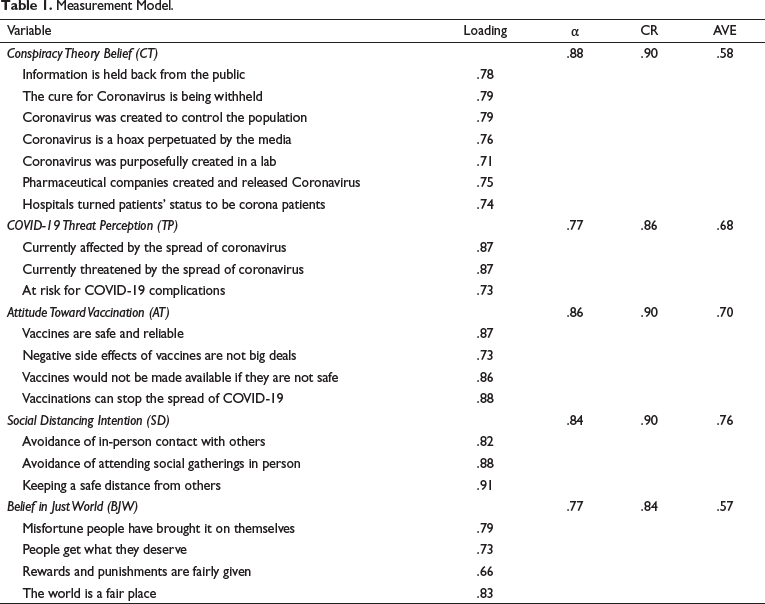
The scales in this study were examined, including the convergent and discriminant validity as well as internal consistency reliability. First, we assessed convergent validity by looking at the average variance extracted (AVE) and loading factors of the constructs. The commonly recommended minimum value of loading factor is 0.708 and is 0.50 for AVE. However, loading factor ranging from 0.4 to 0.7 can be retained if the removal of the item fails to increase composite reliability (CR) and AVE values (Hair Jr et al., 2016). The results described in Table 1 show that the research constructs have sufficient convergent validity.
Measurement Model.
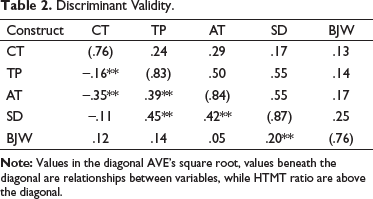
Second, to test discriminant validity, we examined the square root of AVE values as well as the heterotrait–monotrait ratio of correlation (HTMT). The AVE’s square root should be greater than the correlation between the construct and other constructs in order to achieve a good discriminant validity (Fornell & Larcker, 1981). Next, the value HTMT ratios must be lower than 0.90 (Henseler et al., 2015). Table 2 shows that the prerequisites are satisfied.
Discriminant Validity.
Third, we measured internal consistency for reliability by scrutinising the CR and Cronbach alpha (α) values (Fornell & Larcker, 1981). As shown in Table 1, the Cronbach alpha and CR values surpass the cut-off value of 0.70 as recommended (Hair Jr et al., 2016). The constructs are adequately reliable.
Hypothesis Testing
After assessing the measurement model, the following stage is evaluating the structural model as well as examining the developed hypotheses (Figure 1). We conducted a 5,000 resamples bootstrapping procedure to examine the indicator of significance and coefficient paths as suggested by Chin et al. (2008). Hypotheses testing is presented as follows.
Research Model.
First, fully supporting H1, results showed that conspiracy belief negatively influenced COVID-19 threat perception (β = −.22, t = 3.10). It indicates that the more people believe in conspiracy theories, they are less likely to consider that COVID-19 is threatening. In addition, although conspiracy belief did not directly affect social distance intention (β = −.08, t = 1.23), it affected attitude towards vaccination negatively (β = −.19, t = 3.16). Indirectly, conspiracy theories belief influenced both social distance intention (β = −.10, t = 2.90) and attitude towards vaccination (β = −.09, t = 2.90) through COVID-19 threat perception.
Second, supporting H2, the inspection of moderation index value (β = −.15, t = 2.62) indicates that the belief in just world moderated the relationship between COVID-19 threat perception and social distance intention. As illustrated in Figure 2, a simple slope analysis showed that participants with low COVID-19 threat perception have higher social distancing intention if they believe in just world. However, participants with high COVID-19 threat perception have higher social distancing intention regardless of their level of just world belief.
Simple Slope Analyses.
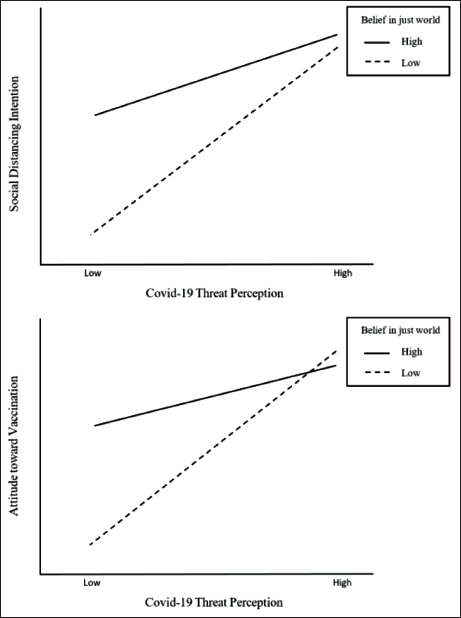
Lastly, supporting H3, results confirmed the moderating effect of belief in just world in the link between COVID-19 threat perception and attitude towards vaccination as demonstrated by the moderation index (β = −.16, t = 2.66). Also, a simple slope analysis depicted the moderating pattern (Figure 2). Participants with low COVID-19 threat perception have a more positive attitude towards vaccination only if they have high belief in just world. Nevertheless, participants with high COVID-19 threat perception have a more positive attitude towards vaccination regardless of their level of belief in just world. We also found a positive effect of attitude towards vaccination on vaccination intention (1 = yes, 0 = no) (β = .46, t = 9.81). However, we did not find the link between social distancing intention and vaccination intention (β = .07, t = 1.14). Results of path analysis of the moderated mediation model is summarised in Table 3.
The Hypotheses Testing Results.
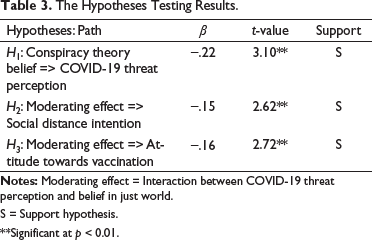
S = Support hypothesis.
**Significant at p < 0.01.
Discussion
This study examines the impact of conspiracy theories belief on health-recommended attitude (i.e., social distancing intention and attitude towards vaccination). It investigates whether increased conspiracy theories belief is positively related to COVID-19 threat perception, which in turn decreases intention to conduct social distancing as well as positive attitude towards vaccination. It also assessed the just world belief’s moderating role in the connection.
We found that conspiracy theories belief significantly influenced health-recommended attitudes. Indirectly, conspiracy theories believers decreased social distancing intention and attitude towards vaccination through a decreasing COVID-19 threat perception. We also found that even when people acknowledged that COVID-19 is less threatening, they still have the intention to conduct social distancing and have positive vaccination attitude if they believe in just world theory. The principle of deservingness directs people to take any necessary actions to protect themselves and others. This indicates that although people feel less threatened by COVID-19, performing socially desirable actions as recommended by public health authorities would reduce the risks of acquiring negative outcomes.
The present study contributes to the literature by highlighting the vital role of personality trait as a moderating factor in the link between conspiracy theories belief and health-recommended attitudes. The finding is novel since most prior findings focused on the impacts of conspiracy theories belief (Bertin et al., 2020; Biddlestone et al., 2020; Bierwiaczonek et al., 2020) and its antecedents (Cassese et al., 2020; Miller, 2020). The presence of personality trait as a mediator answers the literature’s inconsistency regarding conspiracy theories’ effects on health-recommended attitudes (Alper et al., 2020). More precisely, the findings clarified that the just world believers have a higher propensity to practice social distancing as well as have more positive attitude towards vaccines than those who were sceptical to the just world theory. In addition, this study responded to the need to present insights regarding conspiracy theories’ consequences in a developing country’s context (Chen et al., 2020).
Governments, not-for-profit organisations and any health-related authorities can benefit from the study’s findings. Given the ubiquitous conspiracy theories (Jolley et al., 2020), especially during the COVID-19 pandemic, there is a need to have more effective and aggressive campaigns to diminish the negative effects of conspiracy theories. Social marketing campaigns to promote social distancing and positive vaccination attitude may use the principles of belief in just world such as justice, deservingness and fairness. Our findings demonstrated that in any conditions, either people felt high or low threatened by the COVID-19 pandemic, just world believers are more likely to practice social distancing and to have higher vaccination intention.
Despite its contributions, this study has several limitations that can be addressed in future research. First, data were collected from a non-western country (i.e., Indonesia) where cultural values such as collectivity and uncertainty avoidance (Hofstede, 1983) may play a role in determining how people respond to the questionnaires. Future studies may collect data from several countries that may represent various cultures to tackle this potential problem. Second, this is a correlational survey study which opens to other plausible explanations during the data collection. Future studies may conduct experimental field research to investigate the relationship between variables since the research type may reduce confounding results.
Footnotes
Declaration of Conflicting Interests
The authors declared no potential conflicts of interest with respect to the research, authorship and/or publication of this article.
Funding
The authors received no financial support for the research, authorship and/or publication of this article.