




Abstract
Communication for all hazards including widespread public health emergencies is a massive task. The crucial element is to reach and cover maximum people in a timely manner. This article is based on a systematic content analysis of videos on coronavirus disease (COVID-19) on National Television by Indian Public Service Broadcaster and Ministry of Health and Family Welfare. A total of 36 videos were telecasted on National Television channel Doordarshan from 3 March to 21 April 2020 in between programme breaks.
The article analyses the presentation characteristics of these videos with respect to timing, duration, language, characters, format and key message content of communication videos on COVID-19. The article deliberates about the manner in which the chronology of the communication messages synced with the external events of the trajectory of the pandemic and thereby information-need of the community in India. All the messages which evolved in these videos (real and animated) were built on each other and depicted an information hierarchy (e.g., washing hands to social distancing) which could be viewed as an empowering tool for the community.
The videos were analysed based on the nine constructs of conceptual model of emergency risk communication given by Seeger et al. (2018). The key preventive messages in these videos focused on generating awareness, which was the fundamental necessity in view of the new type of pandemic like COVID-19. The summated scores show that 36 videos were appropriate up to 79 per cent times for the nine constructs, indicating the effectiveness of the messages in communicating the intended message as per the assessed construct. Limitations of the messages were primarily related to the inability to design communication messages with respect to specific understanding, needs and culture of the community.
World Health Organization (WHO) declared coronavirus disease (COVID-19) as a pandemic on 11 March 2020, as the focus of this contagious influenza shifted from China to Europe and North America. The WHO advised countries to take a whole-of-government, whole-of-society approach to prevent infections, save lives and minimise the impact of the disease (WHO, 2020). In India, the first case of COVID-19 was diagnosed in Kerala on 30 January 2020. Its rate of spread was initially low, but as time passed, the number of cases increased. On 11 March, the number of COVID-19 positive cases in India was 60; it sprung to 1,965 cases (including 51 foreign nationals) and 50 deaths spread across 29 states/Union territories by 2 April 2020. Initially, the situation was reported to be under control; however, there was a sudden surge in a week’s time and the pandemic expanded its footprints affecting over 6000 people by 10 April 2020. The increase in cases intrigued the authors, thereby leading them to examine the communication made during health emergency for preventive and protective behaviour amidst the COVID-19 pandemic. The Ministry of Health and Family Welfare, Government of India had developed its strategic approach in April 2020 to address COVID-19 and had focused on five possible scenarios to deal with the pandemic. Importance of risk communication was not only recognised under each scenario, but a separate section was devoted in the strategic plan for activities to be undertaken to address the public health emergency of COVID-19 (Ministry of Health and Family Welfare [MoHFW], 2020). Emergency risk communication is a critical component of public health emergency planning and response (Seeger et. al, 2018). Communication was always recognised as one of the important components of a public health response to an emergency. Risk communication too was acknowledged with respect to environmental public health since the late 1970s (Glik, 2007); however, it received more impetus as an important tool for risk management, as scenarios of terrorism and large-scale natural disasters and health emergencies which threaten the physical and mental health of large groups of people increased (Covello et al., 2001; Fischhoff, 2005; Glik, 2007; Mawson, 2005). Effective strategies for health risk communication were essential for protecting public health in the event of pandemic influenza (Center for Disease Control and Prevention [CDC], 2020b; Holmes, 2008; WHO, 2017). Outbreaks of diseases such as the West Nile virus, H1N1, Zika virus and Ebola have underlined the necessity of strategic risk communication efforts by public health authorities in case of an emergency (Koplan, 2003; WHO, 2017); important is to see how risk communication has been managed amidst COVID-19. With an expanded role in pandemic planning and response, communication processes can prepare the public to adapt to changing circumstances or uncertainty during an emerging pandemic, facilitate anticipation of surprising events, create dialogue between potentially affected populations and risk managers and foster an environment of mutual trust (Blumenshine et al., 2008; Holmes, 2008). The first step of credible risk communication is developing and delivering appropriately structured emergency messages. In a risk communication situation, accurate and timely information at all levels is critical in order to minimise unwanted and unforeseen social disruption and economic consequences, and to maximise the effective outcome of the response (Pan American Health Organization [PAHO], 2011) and appropriateness of the messages is an important determinant of the effectiveness of risk communication. Messages embedded in communication have multiple functions; they should not only successfully instruct, inform and motivate appropriate self-protective behaviour by updating risk information but also build trust and dispel rumours (Blendon et al., 2008). Messages should empower groups and individuals to take positive actions; they should help them to affirm their sense of control over an emergency (Collins et al., 2016). The Center for Disease Control and Prevention (CDC) claims that messaging which inform people about what needs to be done to protect oneself (CDC, 2012) will ‘reduce anxiety and can restore a sense of self-control’. When an emerging infectious disease emerges, people want information that would enable them to assess their risk of infection and their risk of becoming seriously ill or dying. They also want information about using vaccines and drugs to enable themselves to assess the risks of using the products (Henrich & Holmes, 2011).
Communication is a massive task in relation to emergency preparation for all hazards including mitigation during widespread public health emergencies. The crucial element is to reach and cover maximum people under the communication in a timely manner. Time plays an important role in controlling outbreaks. Getting good information and acting on it rapidly can halt outbreaks before they need emergency measures (Zhang et al., 2020). Some methods of communication like social media are typically good at reaching the young, while methods such as television and radio are better at reaching older populations (Collins et al., 2016). Studies have found that despite the Internet’s growing reach and importance, traditional mass media are still a main source for information about emerging health threats and disease outbreaks (Jardine et al., 2015; van Velsen et al., 2014).
This article attempts to analyse the presentation characteristics such as timing, duration, language, character, format and content of communication messages on COVID-19 aired via videos on national television under communication initiatives of the Government of India.
Methodology
The article is based on a systematic content analysis of video messages of COVID-19 on television. A total of 36 videos were telecasted regularly on National Television channel, namely Doordarshan from 3 March to 21 April 2020 in between programme breaks. The videos were prepared by Indian Public Service Broadcaster (Prasar Bharti) and Ministry of Health and Family Welfare (Prasar Bharti, 2020). The videos on Doordarshan were selected for two reasons: first, it is a national television and second, during lockdown, all other private channels lost their television rating point (TRP) and Doordarshan came to the top position in the TRP ratings due to its repeat telecast of many of the very popular iconic TV shows of the 1980s and 1990s such as Ramayana, Mahabharata, Buniyad, and so on (Desk, 2020). The messages were analysed for their characteristics and as per nine constructs suggested by Seeger in his conceptual model of emergency risk communication (Seeger et al., 2018). This conceptual model was informed by an extensive review of the emergency risk communication literature, interviews with researchers and discussions with CDC’s stakeholders. This model can be adapted for a wide range of emergency events and incorporates key constructs to assess internal processes, as well as outcomes of emergency risk communication on audiences. The analysis was done by the authors after transcribing and coding the message content of each of the 36 video communications as per the constructs, and their description is presented in Table 1. The summated score of each construct on 36 videos was calculated column wise to assess the overall effectiveness of the messages with respect to emergency risk communication during preparatory, lockdown and partial lifting of lockdown period. Since 36 videos were evaluated for 9 constructs, a total of 324 could be the maximum score.
Constructs Considered for Analysis of Video Messages

Presentation Characteristics of Videos and Messages on COVID-19
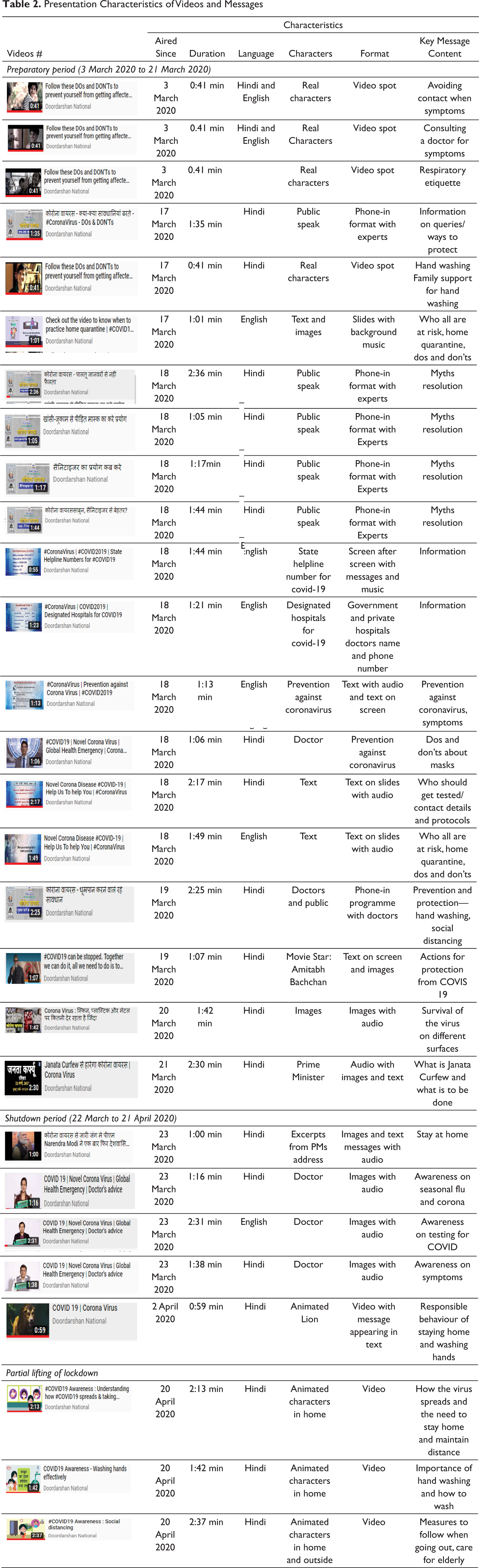
Even before declaration of the disease as a pandemic, India had started preparation for preventing the spread of the disease, which included developing a containment plan and strategy formulation for COVID-19. Accordingly, communication initiatives were started, and videos were telecasted before and in the middle of the lockdown. The article has considered videos telecasted till 21 April 2020 for analysis of the messages. The details of videos that were regularly telecasted on Doordarshan are exhibited in Table 2. The details are given with reference to presentation characteristics, that is, timing duration, language, character, format and key message content of the message, as they have important implications on the extent to which messages are attended to, understood and acted upon.
The earliest of the awareness videos were aired since 3 March 2020. It is noteworthy that these (video # 1–3, 5) were the ones which were earlier being used during swine flu, focusing on hand washing and respiratory etiquette, staying away if suffering from cold and keeping others safe from infection. The promptness with which these videos, prepared under the theme ‘help us to help you’, were adapted and modified for COVID-19 is worth appreciation. These all were of less than 50 s.
Starting from 17 March, three more videos were telecasted; one was on hand washing, particularly before holding child, again a modification of earlier swine flu video. In addition, a video was aired to inform when one should observe home quarantine—slides with text and images under the theme, ‘together we can fight COVID 19’. In another video based on public speak format, whereby a phone call from the public was responded and a doctor was shown to be informing about the precautions to be followed against the spread of the virus.
On 18 March, 10 videos were uploaded. Three videos were on public speak, wherein experts resolved the queries related to use of sanitizers, masks and dispelled the myths related to smoking as a saviour from corona, or chances of transmitting of corona from pets. Videos on public speak did not have any helpline number, website or address to contact later in case of any query. One spot showed slides on help line phone numbers of different states and another showed the list of designated hospitals for COVID-19. Other videos were on measures to prevent and protect from COVID-19. Videos with text and images were supplemented with audios which probably made it more understandable to wider audience and increased the probability of attending compared to simple display of the text. Another video was on information by a doctor about the types of masks to be worn with a clear instruction on wearing of the mask by only those who had symptoms. Some technical words (like N95 for bronchoscopy, aerosol) were also used, which could have posed understanding issues for the layperson.
Another spot with text slides along with audio explained about the situation which warranted laboratory testing for coronavirus. It informed on the process of contacting helpline number and the way in which staff managing the calls at helpline number arrange for the test as per protocols. The information on website with the list of accredited laboratories for testing was given and clarified that no private hospital was authorised to conduct corona lab tests. Another spot (#17) was more like an improvement over #7 as audio was included in it.
On 19 March, two videos were uploaded under the theme, ‘together we can’: one was on protection and prevention measures to escape from COVID-19 by one of the popular movie actors, Mr Amitabh Bachchan, and another was on public speak format, whereby recording of doctors solving queries of the public was aired as video.
On 20 March, one video started to be aired began with an acceptance that the corona menace is continuing and since most of the things related to the virus were still unknown, people were curious to know about it. It further accepted that whereas China has reported the survival of the virus for 9 days in outside environment, experts in India do not agree to it. Referring to CDC and WHO, the video explained about the survival of the virus on different surfaces and the importance of washing hands.
On 21 March, a video on Janata Curfew was started. Taking excerpts from PM’s request for Janata curfew, the audio informed what needs to be done on 22 April, the day of voluntary shutdown, and also included a request to the civil society organisations and youth to inform and educate people about it
On 23 March, four videos under the theme ‘Help us to Help You’ were aired in which doctors were presented as anchors for informing about the disease and its protection measures. Using doctors as anchors is known to improve response efficacy. There was another video on appeal by Prime Minister of India.
On 24 March, one video was telecasted using sign language. It was comprehensive and included information on dos and don’ts. It was an example of inclusiveness, whereby importance of the preventive messages to reach all was realised, and this communication was aired in time.
On 25 March, the official lockdown had started and therefore these two spots, one each in English and Hindi including information on the services which have been stopped and those continued to be functional along with legal action against those not abiding to the orders, were aired.
On 2 April, five videos started to be aired. All communication was on protection and prevention of corona. Two spots were text and images with audio. The other three were more comical with animal characters speaking about safety measures in two spots and another with animation based on a popular Hindi movie character Gabbar and Sambha. Even the one with an animal character used rhyming and tuning as per a popular Hindi movie song. The use of characters and format had the potential to catch attention, enhance understanding and push for action.
On 20 April, three videos started airing on TV. They were all animated but more elaborate and descriptive on the preventive measures and the reasons behind these preventive measures. Acceptance of cultural norms was reflected in the video as it explained reasons to change those age-old norms to fight against the virus and the way hands are to be washed. Use of tumbler for washing hands demonstrated and communicated self-efficacy even when free flowing water from a tap is not available—a situation which resonates with many households in India where running tap water is not available. One of the videos also included advisory on dos and don’ts of going out, maintaining social distancing at the shops and precautions for the vulnerable elderly people who need to restrict even casual walk around their house.
The chronology of the communication messages was in sync with the information need of the community. This can be substantiated with the external events of the trajectory of the pandemic in India. While the initial messages focused on safe preventive behaviour, the later communication focused on staying safe at home and not to move out—when the lockdown was imposed and later communication on social distancing at the time when the first round of lockdown was to be partially lifted on 14 April 2020. All the messages which evolved in these videos were built on each other and depicted an information hierarchy which could be viewed as an empowering tool for the community. In these 36 videos, different characters—real and animated and formats—were used which had a high potential to be able to attract the attention of the people. Some of the videos which were initially just slides and music were improved upon by adding audio to it. The language was primarily Hindi, but English videos were also developed. A few videos were prepared in both Hindi and English languages. An important attribute of message effectiveness is the duration of the message. Shorter messages are more effective in engaging the audience. Studies inform that messages of up to 120 s are most effective and most of the assessed videos were less than this stipulated time. Videos which were based on government orders were most lengthy with a duration of 6.23 min.
Presentation Characteristics of Videos and Messages
Content Analysis of Messages of COVID-19 Videos
The nine constructs proposed by Seeger (Seeger et al., 2018) in his conceptual model for evaluating emergency risk communication were considered for content analysis of messages. Message in each video was analysed against the constructs as per the description (Table 1).
Scientifically Accurate Messages
Accuracy of the communication messages is vital in an emergency, but its newness or changing nature might make it unviable. COVID-19 is a new disease and scientific knowledge about it is uncertain and still evolving. The challenge was undertaken by communication initiatives which provided information on the latest scientific knowledge and modified it in accordance with the available information. For example, in the earlier days of the pandemic, communication centred on informing about the symptoms and measures taken to protect and prevent the disease—hand washing (video # 1, 2, 3, 5) and respiratory etiquette and keeping a safe distance of 1 m if suffering from cold and cough (video # 4, 6, 13, 25). As the scientific evidence became available in support of social distancing as the best means to protect oneself, videos included message on avoiding to move out of home and social distancing (video # 17, 18, 21, 34, 36). Similarly, initial videos promoted wearing of the mask by only those who had symptoms and those who were treating the patients (video # 14), but later, the scientific evidence supported wearing of the mask by everyone and wearing of a cloth mask by everyone was promoted. The subsequent videos had messages favouring the use of masks by everyone (video # 34). Almost all videos had scientifically accurate messages but did not supplement with the word of caution about the probable change to align with emerging science and facts.
Open and Transparent Messages
Transparent communication was the key to inform the community about COVID-19. The messages in phone-in format videos referred to ‘availability or non-availability of scientific information’. Doctors advised and resolved queries on a phone-in like programme and confessed about required, or lack of required, scientific evidence and always supported their answers with it (video # 7, 8 9 10). Communication regarding functional and suspended services was supported with reference to the article and sections of IPC and NDMA (video # 27, 28). Evidence to hiding, manipulation or misrepresentation of the information could not be obtained in the message content of any of the videos.
Clear Messages
Messages in all 36 messages were in simple, understandable language. The messages used a combination of animation, text, audio and voiceover to deliver the message on protective behaviours. The messages emphasised specific actions—a key element in risk communication. Message on hand washing, how to wash hands, symptoms of COVID-19, testing requirements, need of isolation, quarantine, and so on (video # 6, 13, 15, 16) were delivered; however, new terms like quarantine and social distancing were not explained until later. The term social distancing was used since the initial days of the pandemic, without any explanation or rationale of its use. The later videos which were aired from 20 April onwards took this aspect into account (video # 34). Videos on how to practice home quarantine and testing used easy, clear, and readily understandable language (video # 29, 20). One important lapse was related to not understanding and integrating the barriers in the way of practising social distancing and the misnomer in the term, ‘social distancing’; rather, it could be termed ‘physical distancing’, whose explanation would have improved understanding and had helped the internalisation of the message.
Messages Tailored to Target Audiences
Coronavirus disease 2019 infection made no distinction in infecting people; all were required to practise protective behaviour and therefore, the messages were tailored for everyone and did not segment audience. Hand washing with soap is not practised in India up to the expected level, with 36 per cent washing hands before food with soap and 26 per cent not washing hands with soap after defecation (National Sample Survey Organization [NSSO], 2018). The knowledge of correct hand washing is even lower; communication specifically emphasised 20 s of hand washing and how to wash hands. Special protection of vulnerable people such as the elderly, pregnant women and children was emphasised in some videos (video # 6, 29). The messages highlighted vulnerable groups such as pregnant woman, the elderly and children and cautioned to take care of them. The later messages became more elaborate, whereby casual walks by elderly people were discouraged for their safety (video # 36). Similarly, the hesitation faced by anyone on the visits of guests was taken up in one of the later communication where the lady of the house was shown to refuse visits by the relatives politely without spoiling their relation, which is a fear faced by the people in refusal of some social advancements (video # 36). It shuns those who are interested in making such casual visits and supports wise refusal. In a culture of, athithi seva parmo dharm (honouring the guest is the highest dharma), in which the thought of refusing to welcome guests is uncomfortable, the video helped out by providing a reason and a way to negotiate and avoid being a host and guest in pandemic times.
Consistent Messaging
The messages were not only consistent within the videos telecasted on the national television but also across different mediums, though they differed in execution. Videos by network of private news channel like The Times Group and Aaj Tak used funny ways to give the message of prevention and protection. However, a few videos aired on this platform appeared inconsistent. For example, in one initial video (video # 2) a person was applauded for seeking the advice of doctor for the slightest symptoms, but in later videos, self-care and management of lighter symptoms was emphasised at home (video # 24, 25), as all symptoms were not of COVID-19. This could be owing to the emerging situation and new knowledge and not indicative of any understanding flaws in the content developers of the messages. Overall, there were a few specific behaviours to be followed or avoided; much scope of inconsistency in the key messages did not arise.
Message Sufficiency
The way different messages were aired in every commercial break and in between different programmes show that messaging was enough. The community would be most appropriate in responding if the messages were as per their information needs and sufficient; a theoretical analysis of the messages shows that almost all the required information was provided in different ways and in different formats. Messages need to be understood and retained and, for that, they are to be repeated. There was repetition and reinforcement of the required desired actions through multiple ways.
Actionable Messages
The most important ingredient of effective communication in a risk situation is action. Desirable action can save lives; information on desirable behaviour without specific action cannot give any benefits, as people will not know what is expected. The messages delivered during COVID-19 in India were action-based. Almost all the messages had integrated action into it and specifically included what protection and prevention mean (Video 13, 14, 15, 18, 31, 32, 33, 34, 35, 36).
Timely Dissemination of Messages
The timing with which the communication was managed was remarkable. Communication addressing the community was not static but dynamic. Messages were developed and delivered as per availability of new information and events in the community. For example, at the time of lockdown announcement (video # 20), at the time of partial lifting of lockdown (video # 27, 28), realisation of the importance of face cover for everyone (video # 34) and how to shop and bring things from the market (video # 36), messages were added or revised as per the external environment.
Messages Disseminated Through Multiple Channels
Use of multiple mediums and channels for disseminating the messages improves its reach and coverage. As part of this article, only videos telecasted on one platform were selected to examine the effectiveness; however, it was found that the messages across different videos were supporting each other by disseminating messages related to coronavirus. While all national channels were circulating the messages, other private channels had also developed their own animation videos to inform and educate people. In the lockdown situation, a few mediums could only be used; these included TV, mobiles, websites, social-media platforms and loudspeaker announcements. All these mediums were appropriately used. Websites were promoted and updated information was uploaded on a regular basis. Almost all videos concluded with helpline numbers or websites, or both, to contact for further information. Other conventional IPC measures including door-to-door visit and support of influential people could not be utilised due to the lockdown situation. Similarly, support of community leaders to seek acceptance could not be sought to the expected level due to the lockdown and the primary requirement of keeping distance. The national channel also used celebrities to promote preventive and protective actions against COVID-19.
Effectiveness of Messages
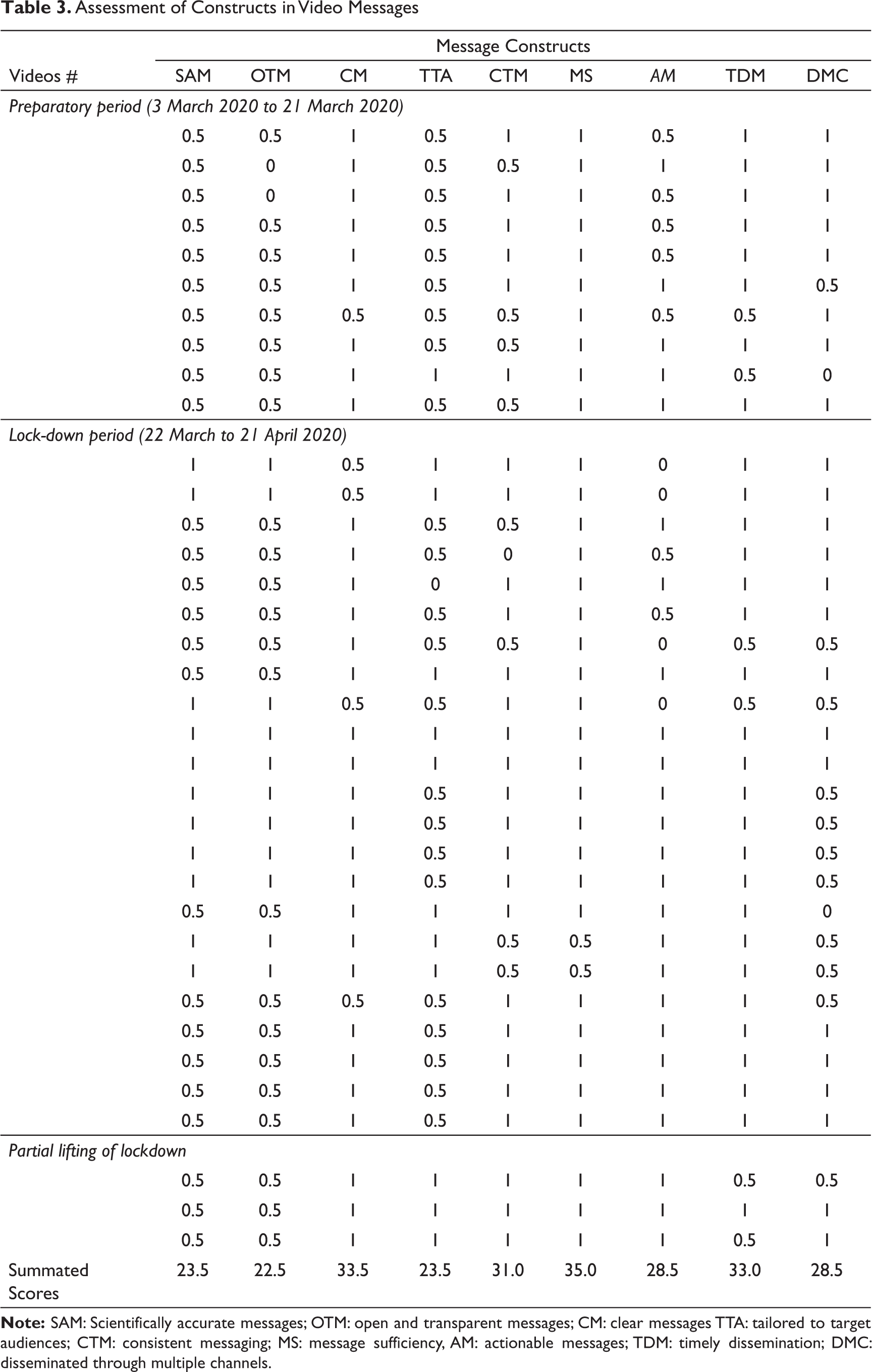
Each video was assessed for the presence of the construct in the delivered message. Absence of the characteristics of the construct was marked as 0, partial presence of attributes of construct in message was given 0.05 and satisfactory presence of attributes of the construct characteristics in message content was marked as 1.
A summated column-wise score, indicative of status of these nine constructs in each video, was generated. For example, in the scientifically accurate messages construct, a score of 23.5 was indicative of the presence of this construct up to 65 per cent in 36 videos (Table 3). Overall, 36 videos were appropriate up to 79 per cent for the nine constructs, demonstrating the effectiveness of the messages as per the assessed construct. Though six constructs could be appropriately coded but for the remaining three (CTM, MS and DMC) slightly different definition was considered for analysis and allocation of score. For example, consistent message and message sufficiency could be principally assessed by taking into account all available sources of communication on COVID-19, but since it was beyond the purview of the article, the consistency of the message in all messages which appeared on this platform was considered and accordingly assessed. Message sufficiency was assessed in terms of completeness of the information embedded in the message. Similarly, dissemination through multiple sources could be known only when all sources of communication are assessed, but it was known that the same information is being disseminated at other platforms too due to pandemic, so it was mostly marked in affirmation. The high score of construct of clear, consistent and timely message (CM, CTM and TDM) indicated the effectiveness of the messages in communicating the intended construct. Some constructs scored low as the messages could not overtly state the possibility of change in view of change in scientific evidence for the disease. Messages that did not overtly state the possibility of change in view of change in scientific evidence (SAM) and failed to take into account cultural preference, needs and existing knowledge (TTA) led to relatively low scores.
Assessment of Constructs in Video Messages
Discussion
The occurrence of health emergencies in the form of severe acute respiratory syndrome (SARS), bird flu, swine flu, Middle East respiratory syndrome (MERS), Ebola and Nipah had affected us in varied ways and efforts were made to address them. It was the COVID-19 pandemic that tested the waters regarding the preparedness and execution of community-dependent measures in India by using communication as an important tool of prevention and protection measures against COVID-19. It is generally agreed that preparedness at individual, community and organisational levels is important for ameliorating hazard impacts or preventing disease outbreaks. The communication messages discussed in this article are primarily for the individuals and community to enable them to save themselves and their loved ones from COVID-19.
Almost all communication messages focused on awareness generation. In view of the new type of pandemic, COVID-19, awareness was the fundamental necessity; therefore, presentation of the videos and messages in it were analysed with respect to their strength of being attended to, understood and acted upon. A pandemic may require minimally disruptive actions (e.g., increasing hand washing), but other behaviours may be difficult and may evoke strong emotions, raise concerns and fuel controversy (e.g., quarantines and school and public facility closures) (Cutter, 2003; Rasmussen et al., 2008). The messages in videos dealt with the concepts and the imposed lockdown probably facilitated the sensitisation.
The communication messages were excellent with respect to their clarity, consistency and focus on actions. The action part was remarkably taken up, as this is the part which is most often missed and left to the community to make sense. Messages delivered could exhibit hierarchy in information by ensuring latest updates and myth dismissal. One important thing noticed in many videos with doctors as experts was that unawareness and uncertainty were accepted and accordingly communicated to people. Candidly admitting ‘we don’t know’ and acknowledging uncertainty are often the best ways to earn long-term public confidence and acceptance of eventual recommendations (Koplan, 2003).
Message consistency may be relevant, particularly for new or emerging threats for which knowledge regarding treatment, prophylaxis and the epidemiology may change over time. Consistency also refers to similarity between the tone of the message and the information contained therein (Glik, 2007). All the messages maintained consistency in their content and tone. Messages were excellent in providing the thrust and emphasis on some words, cautiously used adverbs and were specific in completing the message in entirety. For example, in the statement, frequent washing of hands for 20 s with soap and water, ‘frequent’, ‘20 s’, and ‘soap and water’ were emphasised. Before COVID-19 too, there were messages on hand wash promotion, but the messages aired at present were clear, warranting specific, urgent action. In some communication, inconsistency was found in messages, but that was due to emerging information and updating, as these videos appeared at different times. Literature too accepts that sometimes inconsistency occurs when events are impending or evolving (Glik, 2007). The key preventive messages were repeated but with different execution, sparing them from monotonous redundancy.
A few limitations remained primarily in terms of limiting of the messages to information-giving and not being able to design communication with respect to the needs and culture of the community. A few concepts could not be taken up in the analysed communication material to handle this health emergency. For example, none of the videos explained the reasons to be fearful of corona. None of the messages explicitly stated that there is no treatment for COVID-19. The common man probably could not have understood the consequences of contracting the virus and spreading it to others. Further, social distancing is an alien concept to the Indian population and moreover, the term is misnomer, which was not explicitly explained. Realising the mismatch between the term and meaning, international health organisations are now using ‘physical distancing’ as another word for ‘social distancing’ (CDC, 2020a). The same explanation could have been provided in videos for greater understanding.
The authors realised that Seeger’s constructs for message, as proposed in risk communication model, make complete sense when the entire communication model is assessed. The approach used by the authors did not do complete justice as a few constructs could not be assessed as proposed. For example, completeness of the messages in terms of their ability to extract the desired behaviour delivered via different platforms could not be assessed; it only analysed clarity of the specific delivered messages via videos. Further, Seeger’s model provides an appropriate framework to assess the messages in its entirety when all communication platforms used for risk communication are accounted for and the risk has ended. The purpose of the authors was to assess the early initiatives of risk communication when the risk was underway and communication initiatives midway, and the constructs were largely relevant and appropriate even with the restriction stated above.
Despite these few limitations, the article provides important insights about presentation characteristics of the video communications in terms of their usefulness as a traditional mass communication method. It also explored the effectiveness of this medium with a viewpoint of duration, timing format and message content, with special attention to emergency risk communication in managing outbreaks.
While the threat of COVID-19 triggered a serious global health concern, a great deal of the fear surrounding the disease was being fuelled by widespread misinformation. Separating the truth from outright falsehoods can be a daunting task, especially in the era of social media, and what WHO (2020) has termed as world’s first infodemic—an overabundance of information, some accurate and some not—makes it hard for people to find trustworthy sources and reliable guidance when they need it. Amidst the pandemic, several communication methods were used for creating awareness. In these times of practice of Omni-channel presence for information sharing, the findings of this article specify that risk communication through trusted mass media methods like videos on national television using appropriate timeframe to allay fears is much more relevant. The article also throws light on another important aspect, that is, building trust, which includes taking control of the narrative as the outbreak evolves and recognising that what is communicated is just as important as how it is communicated. Open and honest approach in communicating the messages for desired action and behaviour cannot be undermined.
This work can also be taken into consideration by communication agencies to get insights for developing effective health emergency communication targeting the community against disease outbreaks.
Future Research Possibilities
Future work on communication during health emergency could attempt to supplement the theoretical understanding of the constructs with community perception to develop a holistic picture of the effectiveness. Despite good communication, desired behavioural norms were flouted by many people, indicating yet again that good communication is necessary but not a sufficient condition and the need to identify and address barriers to behavioural change. The same could be explored for behaviours during pandemic too.
Further, safe behaviour resulting as an outcome of emergency risk communication is not akin to safe behaviour of routine health communication. Studies could be conceived to see the similarities and difference of these two different communications for behavioural change in Indian settings.
Footnotes
Acknowledgments
We are highly indebted to Dr S. D. Gupta, Chairman and Dr D. K. Mangal, Dean, Research, IIHMR University for their valuable and insightful discussion on COVID-19 and role of behaviour in communication.
Declaration of conflicting interests
The authors declared the following potential conflicts of interest with respect to the research, authorship and/or publication of this article: None
Funding
The authors received no financial support for the research, authorship and/or publication of this article.