




Abstract
In recent years, the importance of social media has grown analytically, emphasizing the importance of an appropriate framework that can clarify its role in financial investment decision-making. This essay aims to establish a link between social media use and stock market participation. We used the SPAR-4-SLR technique with theory, context, characteristics and methodology framework analysis to conduct a systematic literature review of essential journal articles published between 2013 and 2023. This review summarizes theoretical and empirical research on social media use and stock market participation. By revealing a significant association between social media use and stock market participation and explaining the impact of other elements that remain unresearched, this study has added a new perspective to the literature. This study will help financial specialists, economic institutions and policymakers design better stock market strategies, make financial decisions and add to the body of knowledge concerning the relationship between social impact and SMP.
Keywords
Introduction
Background
Over the past few decades, the global financial system has witnessed significant expansion driven by the increasing trends of privatization and marketization (Haddad & Hornuf, 2017). This transformation has democratized financial markets, providing ample opportunities for retail investors to participate actively and compete vigorously. Understanding the underlying psychology guiding investors in their financial decisions is at the core of behavioural finance, a discipline that amalgamates insights from psychology and economics (Hirshleifer, 2015). This interdisciplinary approach aims to elucidate why individuals often make irrational financial choices when navigating the realms of borrowing, spending, investing and saving their hard-earned resources (Georgarakos & Inderst, 2021). The amalgamation of traditional financial theory with personal and social psychology insights empowers researchers to scrutinize and elucidate the factors influencing stock market participation (SMP) (Jin et al., 2017). Central to the tenets of behavioural finance theory is the examination of how cognitive biases and perceptual thinking impact investor decision-making (Raut & Kumar, 2018) and, consequently, influence stock market dynamics and stock market dynamics (Bustos & Pomares-Quimbaya, 2020).
In investor behaviour, prevailing wisdom often posits that individuals frequently make investment choices swayed primarily by their emotions, a tendency strongly discouraged by scholars (Hirshleifer, 2015). The idiosyncratic nature of investors, coupled with their emotional predispositions, often leads them to base investment decisions on their prior experiences, domain expertise or personal inclinations to maximize returns and profits (Bauer & Smeets, 2015). Moreover, various determinants such as social norms (Lee-Partridge & Ho, 2003), interpersonal interactions (Westaby, 2005), herd behaviour (Shantha, 2019), regulatory compliance (Hamed et al., 2012), information cascade (Raut et al., 2020) and other similar aspects significantly contribute to the decision-making process. Some investors draw inspiration from their confidence level in their ability to generate profits from their investments (Liang & Guo, 2015). Conversely, individuals with underperforming investments often seek to bolster their confidence and, as a result, tend to emulate the investment choices of successful peers (Jiao & Walther, 2020; Yang et al., 2021). Nonetheless, research underscores that the perceptions and behaviours of investors influenced by media and social platforms are often marked by biases and exaggerations (Grossman & Owens, 2012). Consequently, procuring information from media outlets necessitates critical evaluation, intelligent information screening and astute decision-making (Abreu & Mendes, 2012).
The interplay between investors and the media assumes a social–psychological dimension, profoundly influencing investor behaviour (Raut & Kumar, 2018). Social media, in particular, has achieved unparalleled prominence in adoption and usage rates (Khadjeh Nassirtoussi et al., 2014). It has ushered in a paradigm shift in how people interact, communicate, express opinions and engage with products, processes and organizations (Duffy, 2020). Social media has evolved into a rich repository of societal behaviours, emerging as a vital conduit for disseminating information and knowledge (Lam & Nie, 2020). Research suggests that widespread access to various social media platforms (SMPs) has played a pivotal role in intensifying financial markets, extending the reach of marketing and financial strategies across the globe (Antoci et al., 2014; Harchekar et al., 2017; Ouirdi et al., 2014).
Leveraging its less formal and easily digestible format, media, including social media, can swiftly capture the attention of investors who share common conventions and values (Litt et al., 2020; Mustafa & Hamzah, 2011). Investors often rely on media sources, trusted individuals or neutral channels to inform their investment decisions, further underlining the impact of media on their choices (Hirshleifer, 2015). Consequently, the term ‘social media interaction’ encompasses interactions involving individuals with varying degrees of influence, serving as a precursor to actual participation in the stock market (Liang & Guo, 2015; Haritha & Uchil, 2020). Thus, this study explores the role of social media interaction in bolstering SMP. By examining factors that incentivize participation and drawing on a wide range of literature from 2013 to 2023, we aim to illuminate the emergence of demographic, socioeconomic, psychological and social factors and their collective influence on SMP. To identify gaps in existing research regarding the impact of social media interaction on financial markets and to propose future research directions, our study employs a systematic classification and critical analysis, considering pertinent exogenous and endogenous factors. This comprehensive review article seeks to provide policymakers with a robust foundation for decision-making and action. Therefore, the primary objective is to conduct a systematic review, offering an up-to-date overview of the field’s state and contributing critical theoretical developments, contextual insights, behavioural traits and methodological approaches to chart potential avenues for future research in this dynamic domain of inquiry.
Systematic Review Organization
This comprehensive review highlights three critical distinctions in financial decision-making and social media interactions. First, it underscores the pressing need for more research into the influence of social media interactions on financial choices. While the impact of social media on financial decisions has gained significance, there remains a gap in research that necessitates exploration (Karpenko et al., 2021). Second, it points out the limited discussion of social media-influenced investors within stock market academia. Academic discourse often overlooks the unique characteristics and behaviours of investors influenced by SMPs (Haritha & Uchil, 2020). Third, the article advocates for systematic reviews in the intersection of SMPs and investment literature, emphasizing the importance of understanding how these two domains interact and shape financial decisions.
Furthermore, this article highlights the divergence between social media activity and financial outcomes. It highlights the need for empirical studies that define and quantify these constructs. The study aligns with Li et al. (2017) research, which investigates social media’s influence on the stock market and employs a framework that treats investors as customers without compromising the integrity of speculative activities. It emphasizes the importance of banks and financial institutions delving into the study of retail investors and their strategies. This integrative review, grounded in a comprehensive framework, delves into various aspects, including investors’ perspectives (Shantha, 2019), socioeconomic diversity (Saliya, 2021) and the psychological and behavioural aspects (Park et al., 2014) of financial decision-making. It is poised to significantly enrich the literature concerning retail investors’ decision-making processes, particularly in the context of information diffusion via SMPs—a highly relevant topic in today’s dynamic market conditions (Lee & Ma, 2012). Moreover, it offers valuable insights at the intersection of behavioural economics, economic and social volatility, and investor psychology, making it pertinent for multidisciplinary SMP research.
The article employs the SPAR-4-SLR (Paul et al., 2021) and TCCM (theory, context, characteristics and methodology) (Paul et al., 2023) approaches to provide specialized reviews, allowing for a comprehensive examination of the theoretical and empirical landscape within the field. It accentuates the importance of understanding the outcomes and the methodology, theoretical frameworks and environmental contexts of construct studies (Goyal et al., 2021). The insights from this evaluation can pave the way for stock market professionals to design intervention studies and support systems to enhance investor participation. Furthermore, it is a guiding beacon for future research that builds upon a strong theoretical foundation. To achieve the research goals, the study adopted the SPAR-4-SLR approach to intricate into the nitty-gritty of SMP (Khatri & Duggal, 2022). Moreover, a clear understanding of the TCCM framework helps scholars navigate the complexities of this interdisciplinary field. Thus, our analysis of SMP features can contribute to creating a comprehensive measure that includes retail investors, socioeconomic viewpoints and insights from the cognitive and psychological literature.
Consequently, this review’s systematic and well-focused nature, as acknowledged by other systematic reviews (Paul & Bhukya, 2021), provides valuable insights for academics and industry professionals worldwide seeking effective strategies for attracting retail investors.
Methodology
While Dwertmann and van Knippenberg’s (2021) work is notable in discussing integrative literature reviews, the concept of integrative literature reviews has been explored by various scholars and authors (Montuori & Donnelly, 2016; Torraco, 2005). Unlike conventional literature reviews that summarize previous studies, an integrative literature review takes a more inclusive stance by synthesizing information from various types of reviews and research methodologies (Olanrewaju et al., 2020). By incorporating insights from this diverse range of review types, an integrative literature review enables researchers to construct a comprehensive understanding of the existing body of knowledge. This holistic perspective facilitates the identification of patterns, gaps and areas ripe for future investigation, thereby enhancing the overall comprehension of the research topic (Torraco, 2005).
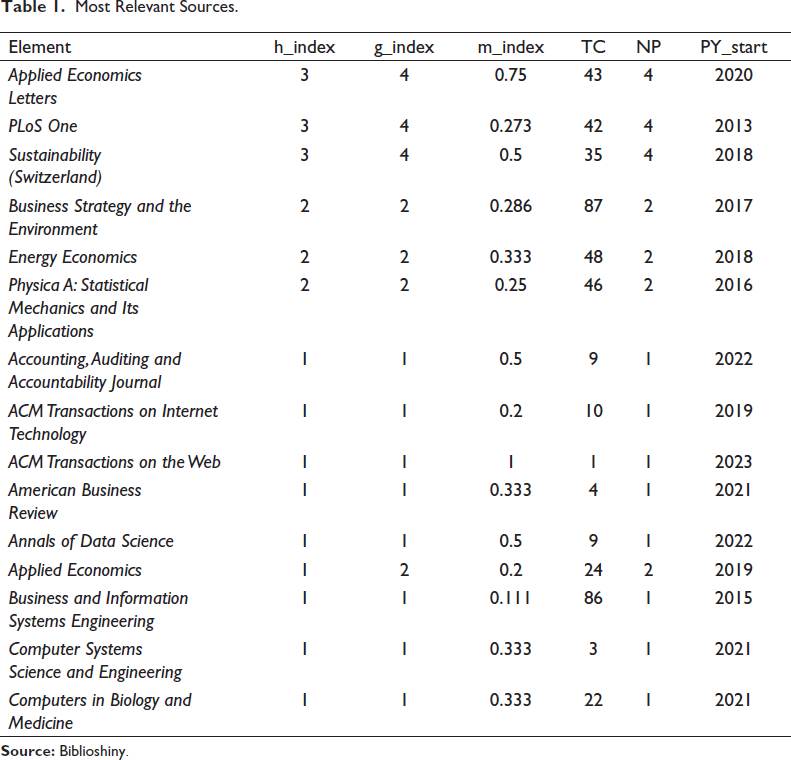
Table 1 lists the top 15 relevant bibliographic sources based on their respective indices. The results of the literature review are reported in the section that follows. This study combined the TCCM of SMP research with a systematic, framework-based review focussing on widely accepted approaches, theories and constructs. This is done primarily due to the stronger structure that framework-based reviews portray (Paul et al., 2023). To guarantee the inclusion of high-calibre research publications for this investigation, we employed Scopus and the Web of Science (WoS), arguably the most well-known bibliographic database (Paul & Criado, 2020). We describe the methods used using the SPAR-4-SLR architecture (Table 2) provided by Paul et al. (2021). Following Paul and Bhukya (2021), we also provide comprehensive guidelines for upcoming research.
Most Relevant Sources.
SPAR-4-SLR Framework for Systematic Review.
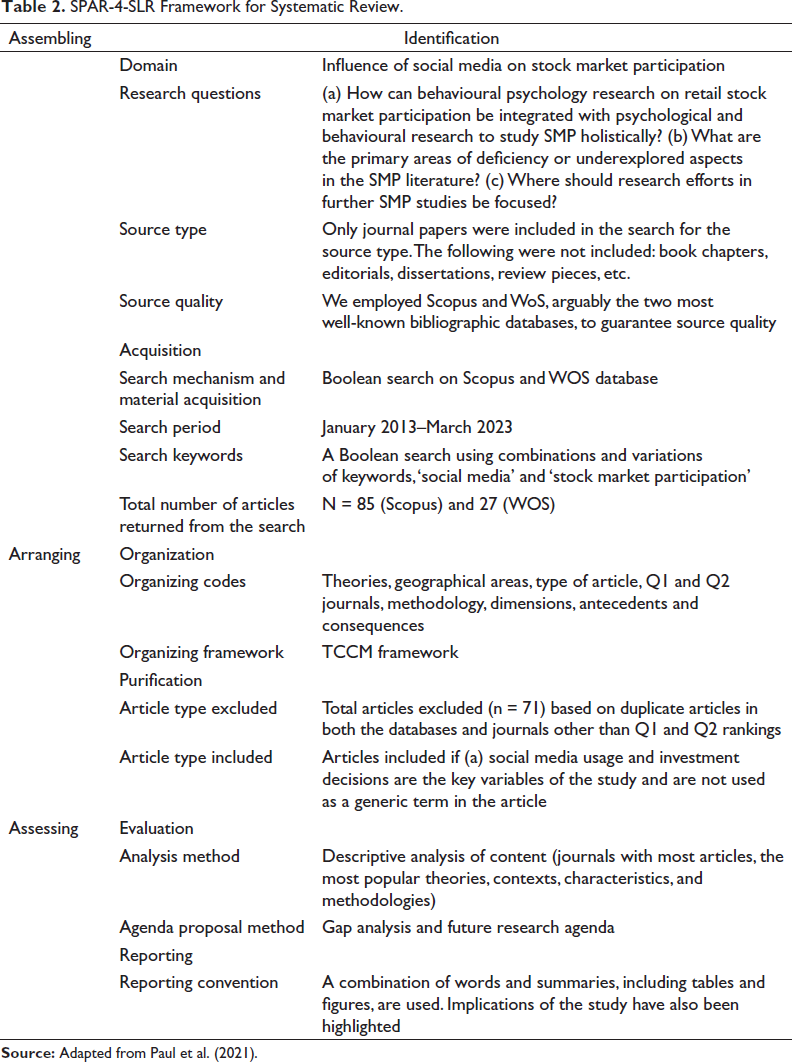
SPAR-4-SLR Method
The very reliable SPAR-4-SLR methodology described by Paul et al. (2021) has been employed in this review to logically, methodically and transparently synthesize the body of literature. This protocol comprises six sub-steps (identification, procurement, organization, purification, evaluation and reporting), broken into three main stages (assembly, arranging and assessing) and shown in Table 2.
Stage 1: Assembly and Preparation
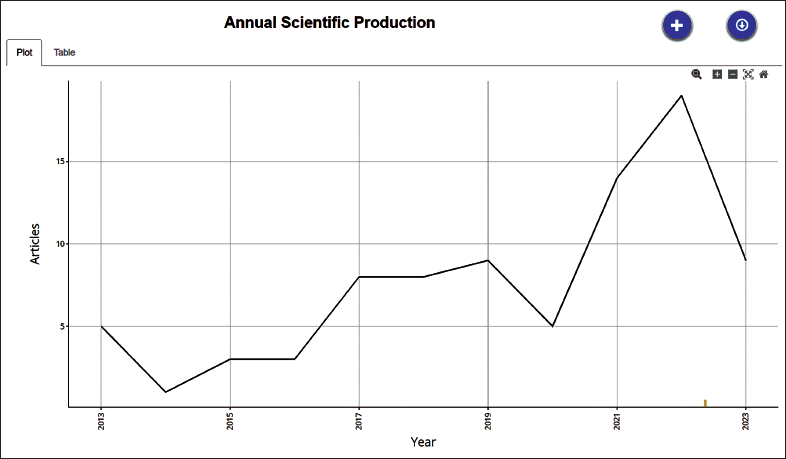
The field, research questions, sources and credibility were searched and reviewed in the identification phase. This review’s subject matter is the impact of social media use on SMP. The following research inquiries guide this review: (a) How can psychological and behavioural research on SMP be combined with retail SMP research to study SMP? (b) What are the primary areas of deficiency or underexplored aspects in the SMP literature? (c) What should be the research focus of SMP? Only journal articles were searched. The review only included journals in Q1 and Q2 rankings and Social Science Citation Indexed (SSCI) journals with an impact factor threshold greater than 1.0. A Boolean search using ‘social media’ and ‘stock market participation’ was conducted on the Scopus and WOS databases in the acquisition sub-stage to include all pertinent results. To include studies from the most recent decades, we restricted our search to January 2013 through March 2023 (see Figure 1 for a list of publications each year). This period was picked because up until the twentieth century, brokers’ investing strategies were the main focus. Due to a lack of technology orientation, retail investors could not use the information available through numerous web sources (Reith et al., 2020). From this point forward, there was a catalytic change away from a market driven by brokers and toward creating a market worth living in with valued subjective experiences like social cohesion, social belongingness and social influence. After deleting the duplicate articles from both databases, our initial search, which was restricted to English, yielded 112 records.
Annual Publication of Articles (2013–2023).
Stage 2: Arranging
In the second step of the process, following the methodology outlined by Paul et al. (2023), we organized and cleaned the collected items. During the organizing sub-stage, we developed organizational codes and frameworks. This review specifically focuses on utilizing the TCCM framework in the context of SMP research to ensure a systematic and objective approach (Sharma et al., 2020).
To determine eligibility, we assessed the quality of the sources in the purification sub-stage. Initially, we excluded 26 articles as they were present in both databases. Additionally, we checked the journals for their Q1 and Q2 rankings. Whether the articles were indexed in the SSCI, we did not consider the Journal Impact Factor. Consequently, 45 articles were excluded from our analysis. We established content relevance using the following criteria: (a) the article needed to use SMP as a general term rather than a specific variable under investigation and (b) the article should not focus on social media usage and interaction in any particular context. After applying these criteria, we selected 41 full-text articles for inclusion in this study.
Stage 3: Assessing
The final stage involves the appraisal and reporting of literature. This framework-based review was based on content, and a descriptive analysis was performed. We investigated publications in SMP research based on the journals with the most articles, popular theories, characteristics, settings and methodologies (Paul et al., 2021). The dependability of the results was improved by using the TCCM framework as an organizational structure for the evaluation and analysis of existing literature. Based on the taxonomy developed by Singh and Dhir (2019), a future research agenda has also been developed. The analysis is provided in the next part using this structure to improve the transparency of the results reporting.
Analysis of the Four-circuit Model (TCCM): Social-media-induced Investment Decisions
In the context of social media interaction, investment decisions and SMP, our study explores the intricate dynamics of individuals’ engagement in online platforms and their influence on investment choices (Gilal et al., 2019; Hosen et al., 2021). TCCM analysis aids in filling gaps identified in earlier studies and provides avenues for future research (Sharma et al., 2020). This research indicates the major TCCM, allowing for further investigation of the unexplored or underserved areas. Our study encompasses a theoretical framework rooted in established behavioural and social theories, examines diverse global and demographic contexts, delves into the characteristics of social media interactions and investment decisions and employs a robust methodological toolkit. Through this comprehensive approach, we aim to contribute valuable insights into the evolving landscape of social media-induced SMP and its impact on individuals’ financial behaviours.
Theory (T)
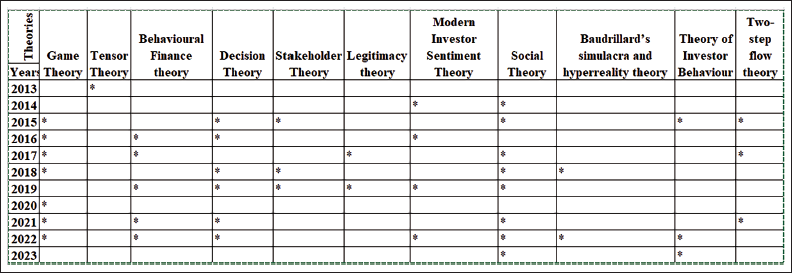
The exploration involves a deep analysis of diverse theoretical frameworks (T) such as behavioural economics, social influence theory, information processing theory and network theory. These theories serve as foundational pillars for understanding the psychological and behavioural aspects of individuals engaging in social media-driven investment decisions and SMP. The use of social media and its impact on investment decisions has substantially improved (Bagozzi et al., 2007). The most widely used theory to study the subject domain is social theory (Bollampelly, 2016; Lin et al., 2020; Ouimet & Tate, 2020; Tham, 2018), which is followed by behavioural finance theory (Dayaratne & Wijethunga, 2015; Glaser & Weber, 2007; Hirshleifer, 2015; Shiundu, 2009), tensor theory (Li et al., 2017), social movement theory (Chong et al., 2021; Hong et al., 2004), decision theory (Pelster & Gonzalez, 2016; Shiundu, 2009), stakeholder theory (Popovic et al., 2018; Sendra et al., 2019), legitimacy theory (Wu et al., 2018), modern investor sentiment theory (Tham, 2018), social theory (Cheung et al., 2015; Hirshleifer, 2015; Ouimet & Tate, 2020; Reith et al., 2020) and theory of investor behaviour (Afif et al., 2018; Dayaratne & Wijethunga, 2015; Nadeem et al., 2020). The impact of social contacts on investor attitudes, behaviours and engagement has been investigated using social theories. Various research has proven a relationship between social contact as a factor of behavioural relationship and the theory of investor behaviour (Afif et al., 2018; Cuong & Jian, 2014; Pascual-Ezama et al., 2014).
Alternatively, many scholars have based their research on game theory (Rhode et al., 2016). According to academics, it gives structural grounds for strategy development in organizations to sustain a competitive edge; thus, it needs studying and measuring the effects of various technologies and trends on establishing one that is more successful with the help of strategy formulation. The matrix (refer to Figure 2) depicts the most popular ideas utilized in developing the theoretical foundations of social media influence based on their later advancements. Aside from all of the expansion, there is a need for new theoretical lenses to expose the unexplored portions of responsiveness in business and management studies.
Prominent Theories (2013–2023).
Characteristics (C)
Our study focuses on characterizing social media interactions, investment decisions and SMP. We explore the behavioural patterns, emotional responses and decision-making processes exhibited by individuals engaged in these activities, shedding light on the complex interplay between digital interactions and financial choices. A rising number of academic scholars have investigated social media influence as a component of many demographic (Brandt et al., 2020), socioeconomic (Hamal et al., 2020), psychological (Raut & Kumar, 2018) and social issues (Valli, 2017). The diagram depicts commonly utilized approaches to research notable traits identified in the literature. It shows that demographic factors such as age, gender, years of experience and educational qualification were investigated using quantitative analysis, event study analysis, sentiment analysis, regression analysis, correlation analysis, technical analysis, forecasting analysis, multivariate analysis and case study analysis. However, there is a significant research deficit in the studied topic regarding using qualitative research. No studies used qualitative analysis or the grounded theory technique (Kumar & Goyal, 2015). As a result, future researchers have the task of studying the topic through qualitative analysis. Similarly, a thorough literature analysis revealed that one of the important characteristics is social factors (Lee-Partridge & Ho, 2003; Raut & Kumar, 2018). According to the findings, most techniques below used social factors as the independent, mediating and moderating variables (see Figure 3). In contrast to the preceding qualities, psychological aspects are primarily limited to an event study-based approach (Ge et al., 2020).
Methodologies Used for Top-ranked Characteristics.
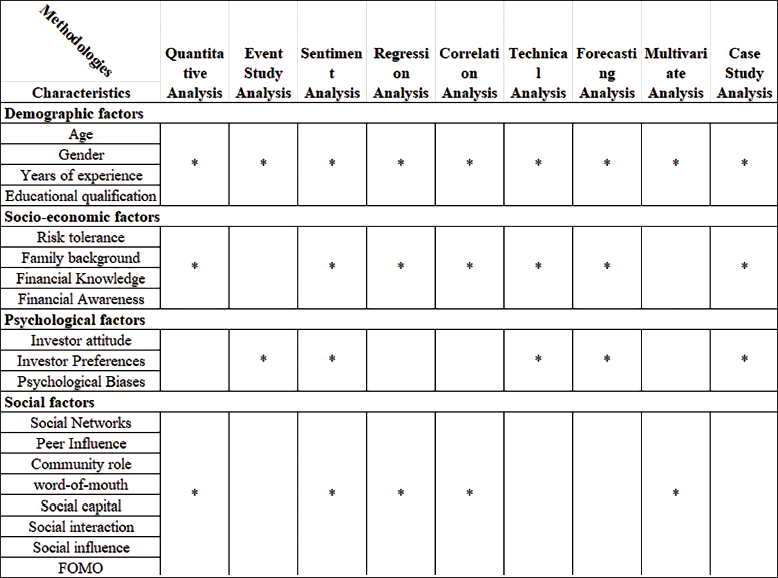
Thus, the study’s findings lay the groundwork for future studies to employ various analytic tools to nudge participants’ psyches toward greater SMP. Similarly, SMP relies heavily on the fear of missing out (Moueed & Hunjra, 2020). There is a need for further development of mixed-methods research that combines quantitative and qualitative techniques. A thorough literature review has examined and evaluated the prospects for further study.
Context (C)
To enhance the depth of our investigation, we consider various contexts (C) within which investment-related research has been conducted. These contexts encompass different countries and specific demographic groups, offering a nuanced understanding of how social, cultural, and economic factors shape individuals’ investment decisions and SMP facilitated by SMPs. The systematic review found that sentiment analysis was used in more than 70% of the studies. Few studies concentrated on predicting techniques to describe stock market movement. On the other hand, more than 69% of research studies were conducted in China, followed by India (37%), the United States (29%), Italy (22%), Spain (22%) and many other developing and developed countries (Figure 4). However, the USA topped the most-cited countries ranking, followed by China, Germany, Spain, the United Kingdom, Italy, etc. However, regarding the frequency of each nation’s mentions, the United States came out on top, then China, Germany, Spain, the United Kingdom, Italy and others (Figure 5).
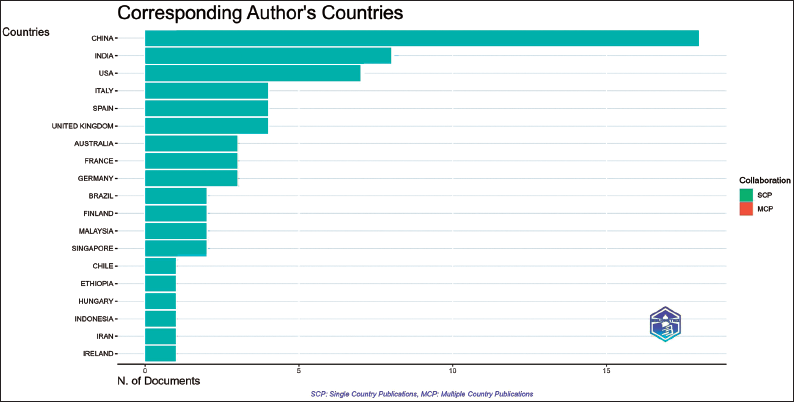
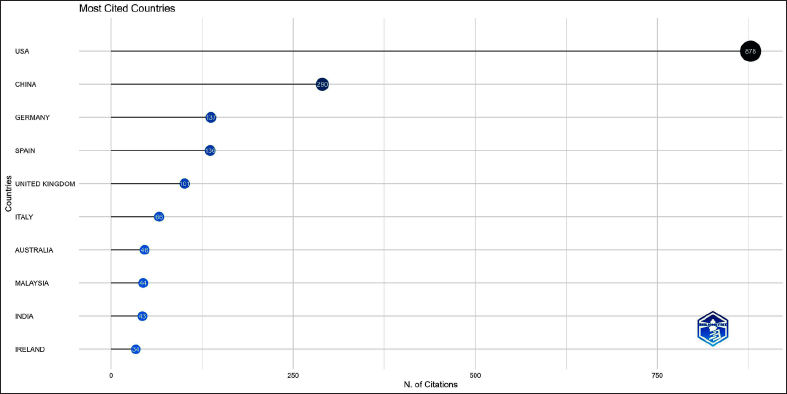
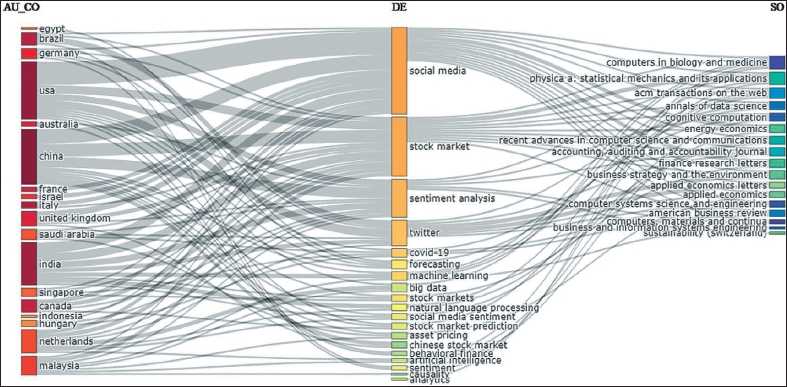
These findings reveal that industrialized countries have undertaken the greatest number of studies, with developing countries conducting the least amount of research, which supports the findings of the Balcilar et al. (2014) study results. As a result, collaborating with emerging countries on the empirical underpinnings of the subject domain is a future gap. Figure 6 summarizes the research findings conducted in notable nations for the top six criteria within the topic domain. As can be seen, three countries—the United States, China and India—have penetrated the research for the qualities above. As a result, there is a gap for the remainder of the countries to focus on widening their research domain.
Methodology (M)
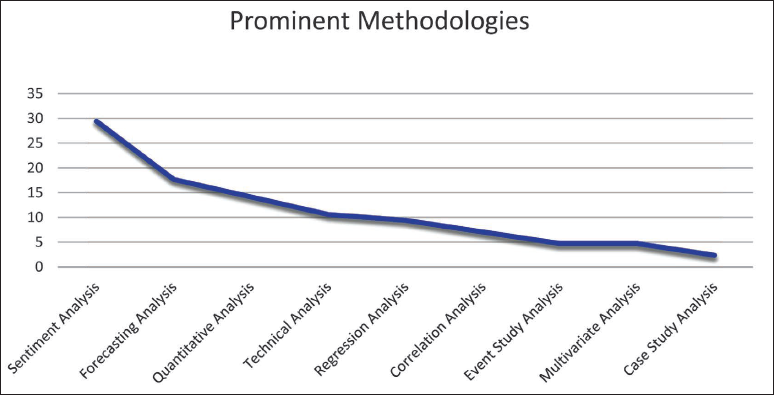
Methodologically, our analysis employs a diverse range of research approaches and analytical tools (M) to draw meaningful insights. These methodologies include quantitative techniques to analyse social media data, qualitative methods to explore in-depth narratives and statistical tools to assess the impact of social media interactions on investment decisions and SMP (refer to Figure 7). By employing a multidisciplinary approach, we aim to comprehensively unravel the intricate dynamics of social media-driven investment choices and stock market engagement. In previous studies, sentiment analysis was used to conduct most of the research, followed by forecasting analysis (30% and 18%, respectively). As can be seen, only a few (2%) studies used case study analysis, and none used a qualitative or mixed-methods approach. As a result, the task for future researchers is to conduct additional studies using qualitative and mixed-method approaches to examine the antecedent and consequence patterns of social impact. Most investigations were conducted in the quantitative analysis with sentiment analysis using NLP and machine learning approaches (Saxena et al., 2018; Thakkar & Chaudhari, 2021; Tham, 2018), factor analysis utilizing equation modelling structures (Akhtar & Das, 2019; Alenazy et al., 2019), regression analysis (Liu et al., 2014) and correlation assessment (Coyne et al., 2018; Henseler et al., 2015; Shiundu, 2009; Tham, 2018). Through mixed-research analysis, researchers revealed the complex trade-offs of social impact with its antecedents (Bakar & Yi, 2016).
Prominent Methodologies Used 2013–2023.
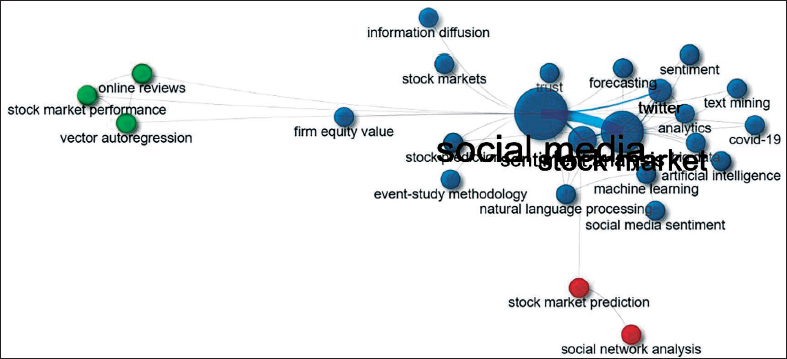
Future research directions are revealed by conducting systematic literature reviews. Figure 8 emphasizes the author’s keyword co-occurrence network to show how little study has been done on the relationship between social network analysis and stock market forecasting. Information dissemination is the most important source of knowledge exchange and influence, so researchers should keep that in mind. Important context factors that need to be studied by researchers include online reviews, information diffusion and social network analysis.
Discussion
In this study, we undertook a comprehensive exploration of social media-induced SMP, focusing on four crucial dimensions: theories, context, characteristics and methodologies. Each dimension provides unique insights into the intricate interplay between digital interactions and financial decision-making processes.
Theoretical Foundations
Our analysis delved into established theories, including behavioural economics, social influence theory, information processing theory and network theory. These frameworks provided a theoretical lens through which we interpreted the behaviour of individuals engaged in social media-driven investment decisions. Behavioural economics shed light on the cognitive biases and heuristics that influence investors, while social influence theory elucidated the impact of peer interactions on decision-making. Information processing theory allowed us to explore how individuals assimilate and interpret financial information in digital spaces. Network theory helped in understanding the structure and dynamics of online investment communities. Integrating these theories deepened our understanding of the psychological and social factors guiding investors in the digital age.
Diverse Global and Demographic Contexts
Our research considered diverse contexts, encompassing various countries and demographic groups. Recognizing the influence of social, cultural and economic factors on investment behaviours, we analysed how regional disparities and cultural nuances shape online investment discussions. By studying specific demographic groups, such as students, we gained insights into how different age cohorts approach social media-induced SMP. This contextual diversity enriched our understanding of the global landscape of digital investment activities.
Behavioural Characteristics of Social Media Interactions
We focused on characterizing social media interactions, investment decisions and SMP behaviours. By examining behavioural patterns, emotional responses and decision-making processes within digital platforms, we identified key characteristics. These characteristics ranged from the impact of market influencers on social media to the virality of investment-related content. Understanding these traits provided a nuanced perspective on how social media interactions influence investor sentiments and trading activities.
Robust Methodological Approaches
Our study employed a multidisciplinary approach, integrating quantitative and qualitative methodologies. Quantitative techniques, such as sentiment analysis and network analysis, allowed us to quantify market sentiments and analyse the structure of online investment communities. Qualitative methods, including in-depth interviews and content analysis, provided rich narratives, unveiling the qualitative aspects of investors’ experiences. The use of advanced statistical tools facilitated the exploration of complex relationships between social media interactions and investment outcomes. By adopting these diverse methodologies, our research ensured a comprehensive analysis of the phenomenon under study.
Conclusion and Future Scope
The study has provided a deep understanding of social media-induced SMP, dissecting the phenomenon through the lenses of theories, context, characteristics and methodologies. The incorporation of behavioural economics, social influence theory, information processing theory and network theory has illuminated the psychological and social underpinnings guiding individuals in their investment decisions within digital landscapes. Contextual understanding emerged as a pivotal aspect of our research. By analysing diverse global and demographic contexts, we uncovered the intricate interplay of social, cultural, and economic factors shaping online investment behaviours. This nuanced perspective allowed us to recognize regional disparities and cultural nuances that significantly influence digital investment discussions, enriching our comprehension of the global landscape of digital investment activities. Characterizing social media interactions and investment behaviours provided vital insights into the behavioural patterns exhibited within online platforms. From understanding the roles of market influencers to dissecting the emotional responses of participants, we delved into the complexities of investor sentiments and trading activities driven by social media interactions. These insights have contributed to a more nuanced understanding of the influence of digital interactions on financial decision-making. Methodological rigour was central to our study. Through a multidisciplinary approach integrating quantitative and qualitative methodologies, we ensured a comprehensive analysis of the phenomenon. Techniques such as sentiment analysis, network analysis, in-depth interviews and content analysis were employed, enabling a robust exploration of the intricate relationships between social media interactions and investment outcomes.
Looking ahead, several promising avenues for future research in this dynamic field emerge. Longitudinal studies tracking the evolution of online investment trends and investor sentiments over time could provide valuable insights into the sustainability and dynamics of social media-induced SMP. Additionally, exploring the ethical implications of social media’s influence on financial decisions is imperative. Future studies can delve into ethical challenges related to persuasive tactics, the responsibilities of influencers, and the role of platform providers in this context. Predictive modelling presents an exciting prospect. Developing accurate models based on social media interactions to forecast market trends and potential shifts could revolutionize market analysis. Leveraging advanced machine learning algorithms can enhance the accuracy of predictions and inform timely investment decisions. Cross-cultural studies remain an essential area of exploration. Further research into how social, cultural and economic factors shape investment behaviours on SMPs across different regions can provide valuable insights into the complexities of global digital investment landscapes. Lastly, intervention strategies are crucial for the well-being of investors. Research on effective interventions to mitigate potential negative consequences, such as speculative bubbles or misinformation spread through social media, can inform investor education initiatives and contribute to financial stability in the digital age.
Implications
Practical Implications
Experts in the stock market, economic institutions and government policymakers will all benefit from this study. This research showed that investors’ social networks significantly influenced their SMP decisions. Governments and stock market experts can benefit from this study by learning how essential investor interactions are. Factors that influence social impact should be given more consideration. It can help show why people do (or do not) invest in the stock market and the factors that influence that choice. In addition, the importance of social interactional variables such as herd behaviour, the contagion effect, overconfidence bias and the social transmission bias has been briefly discussed in this study.
Theoretical Implications
More research is needed on the subsets of social interaction, such as those that occur on social media, the peer effect, observational learning and electronic word of mouth, especially regarding SMP. The findings of this study will enhance our knowledge of how society influences behaviour. This research has shown how investors’ social behaviour significantly affects their decisions to participate in the stock market. The extent to which one invests in the stock market can be clarified by looking at various factors; the influence of social media can play a significant role. Additionally, this study explicitly broadens the concept of financial intelligence by investigating how much investors rely on social media interactions to ‘frame’ the effects of the stock market. It has the potential to contribute to investors’ rising financial optimism significantly.
Footnotes
Declaration of Conflicting Interests
The authors declared no potential conflicts of interest with respect to the research, authorship and/or publication of this article.
Funding
The authors disclosed receipt of the following financial support for the research, authorship, and/or publication of this article: This work was supported by grants from Indian Council of Social Science Research (ICSSR) in the form of Doctoral Fellowship.
