




Abstract
The Central Committee of the Communist Party of China (CPC) has proposed that Jiangsu should ‘explore the way for the development of the whole country’. Therefore, Jiangsu has naturally become a testing ground and demonstration site for accelerating the construction of an innovative country. This paper takes the construction of a decision-making advisory system in Jiangsu Province, China, as an example. By examining the current situation and problems of the construction of a decision-making advisory system for electricity and energy in Jiangsu Province, it examines the internal logic of optimising the management system and mechanism of decision-making institutions and the scientific and democratic decision-making of the government for the construction of an innovative country. This is of great theoretical and practical significance for understanding the development of decision-making advisory research in the country.
Introduction
At present, a new round of scientific and technological innovation and industrial modernisation is progressing and taking shape. The speed, scope, and scale of the global flow of talent, knowledge, technology, capital, and other innovation factors have reached unprecedented levels in China. The complexity of decision-making on innovation strategies and policies in science and technology assumes a crucial position. Consequently, the participation of economic, educational, and human resources and various think tanks play an important part. The report of the 19th Congress of the Communist Party of China (CPC) in October 2017 proposed to be among the top innovative countries by 2035, emphasising the need to accelerate the construction of an innovative country. In October 2022, the report of the 20th Congress of the CPC again emphasised the need to ‘achieve self-reliance and self-improvement in high-level science and technology, and enter the forefront of innovative countries’. At this important stage of China’s social development transformation, it has become a proposition for a new era for governments at all levels to further integrate innovation strategies, and coordinate and optimise the allocation of innovation resources. This also entailed setting up innovation decision-making advisory mechanisms with different modes of operation at multiple levels.
As early as 2014, CPC proposed that Jiangsu should explore the way for national development, which urgently requires Jiangsu province to take up the ‘role model’, and demonstrate exemplary terms of innovation drive, industrial transformation and institutional innovation. In October 2022, Zhang Aijun, spokesman of the Jiangsu delegation of the 20th National Congress of the CPC, answering questions from reporters, stressed that Jiangsu will keep in mind the ardent advice of the General Secretary that the region will ‘strive to set an example in reform and innovation, promote high-quality development, strive to set an example in serving the new development pattern of national construction, and take the lead in achieving socialist modernization’. This meant that the rich connotation and essential requirements of the Chinese path to modernisation are clearly understood, which will take the lead and make greater contributions to the overall development of the country.
In August 2022, the Climate Change Centre of the China Meteorological Administration released the Blue Book of Climate Change in China, which showed that the current global warming trend will continue to pose a challenge. In 2021, China’s average surface temperature, coastal sea level, the thickness of the permafrost active layer, and other climate change indicators broke records and posed a challenge. However, China has always stressed the coordination between domestic sustainable development and global response to climate change to achieve green and low-carbon development. In recent years, the Chinese government has also strengthened the strategic adjustment of industrial structure, carried out industrial upgrading and promoted structural energy conservation. Therefore, the overall vegetation coverage in China has increased steadily, showing a green trend. From the driving factor of climate change, the average annual total radiation in China is decreasing. In view of the global problems and China’s position in the global system, it is of great theoretical and practical significance to explore how the Chinese government can achieve scientific energy policy formulation.
Therefore, this paper intends to take Jiangsu Province, a Chinese testing ground for the construction of an innovative decision-making consultation mechanism, as the object of analysis focusing on energy issues related to environmental sustainability. By exploring the current situation and problems of the construction of the decision-making consultation system in Jiangsu Province, this paper investigates the inner logic of the optimisation of the management system and mechanism of decision-making consultative bodies and the democratisation of government decision-making and discusses how to strengthen the construction of the decision-making consultation system for the construction of an innovative country.
Brief Review of Research on Decision-making Advisory Service System
Research on government decision-making in Europe and the US has focused on the scientific and rational nature of government decision-making processes, the use of decision-making models for different administrative decision-makers in different situations and the role of advisory institutions in decision-making consultation. Dudley and Richardson (1998) argue that one of the core functions of government lies in the construction of an advisory mechanism for government policy-making to coordinate the demands of different interest groups. Such a mechanism should include several elements: the scope of consultation, the qualifications of consultation agencies, the regulation of the consultation market, the tracking of the performance of consultation, and so on. In the study of public policy-making mechanisms in the USA, Rich (2001) finds that the ideological bias of the experts themselves does not have a significant impact on the impartiality of the consultation mechanism, so he argues that the construction of a rational expert consultation mechanism is of paramount importance. In Public Policy Making, Anderson and Company (2003) state that the decision-making process is ‘the way in which a process is conducted’ and consists of a number of ‘specific functional’ processes of action. This is also true of energy policies, but the formulation process of energy policies is more complex, because energy, as the basic element of economic operation, involves more interests in all aspects than other fields and has a more far-reaching impact. Deviations in policy formulation, such as overly aggressive renewable energy goals or overly conservative power demand forecasts, will have a fatal impact on the stable operation of the economy. Therefore, the US pays more attention to the scientific and standardised construction of expert consultation systems and decision-making processes when formulating energy policies. For example, the Department of Energy of the US gathers experts from several major energy think tanks to formulate policies for energy development goals, A model called ENERGY 2020 has been built. This model is quite complex. In the energy demand module alone, hundreds of subdivision parameters are required, covering almost all forms of energy consumption demand. Stone (2007), based on his analysis of the mechanisms inherent in policy-making advice, points out that policy-making advisory institutions are a bridge between politics and science, and a mechanism for the transformation from academic to technical, which is the core issue of the mechanisms inherent in policy-making advice. For example, during the construction of the U.S. ENERGY 2020 model, not only the energy demand module construction fully adopts the opinions of experts from major think tanks, but also the division of the energy supply module is very detailed, including electricity, oil, natural gas, refined oil and gas products, ethanol, natural gas, coal, and so on. In addition, all specific scenarios of energy from supply to use are also considered. Abelson explains the critical importance of think tanks in influencing public policy through a comparative study of think tanks in the US and Canada.
China’s research on the construction of a decision-making advisory system is mainly a localised innovation, based on the experience of European and American countries. Yang and Li (2001), after analysing the system construction of decision-making consultation in Western developed countries such as the US, Britain and Germany, point out that decision-making consultation agencies can be divided into internal government consultation and external government consultation. They also divide the organisational structure and operation mode of consultation agencies according to the situation in China and predict the development trend of decision-making consultation in China. Hao (2003), based on analysing the current situation of the construction of decision-making consultation systems in the US, Japan, Russia and Germany, summarises the main characteristics of the organisation, affiliation, personnel composition, operation, and research methods in the construction of decision-making consultation systems in developed countries. He points out the importance of the business quality of decision-making consultation experts, research independence and interdisciplinary cooperation in the construction of decision-making consultation systems. According to Meiling (2007), even if the decision-makers themselves are highly qualified, without the participation of experts in decision-making mistakes will inevitably occur. She indicates that administrative decision-making consultation aims to help decision-makers anticipate and analyse relevant situations, optimise decision-making objectives and draw up various alternatives for decision-makers to choose from. Yang and Chen (2008) argue that improving and perfecting the expert consultation system for local public decision-making will help to promote scientific and democratic decision-making and will help party committees and governments at all levels to improve the effectiveness of decision-making. It is assumed that this will lay a solid foundation for the construction of socialist democracy in China. From the above studies, the construction of the decision-making consultation system in developed countries is more standardised under the profound historical accumulation and has embedded decision-making consultation into the whole process of policymaking. Compared to this view, it may be said that China is still a long way to go.
International Energy Science and Technology Innovation Decision-making System
Current Status
As Figure 1 shows, some economies and countries are committed to deepening their participation in global energy governance and are actively involved in the formulation of international energy policies. Figure 2 shows the number of different national international, national and regional energy science and technology innovation decision-making advisory outcomes. The US leads the world in the number of national-level energy science and technology innovation decision-making advisory outcomes that have been successfully translated into energy policy, followed by Australia and Canada. Other countries have also introduced a certain number of energy policies in response to the changing global energy landscape. EU ranks first with 127 international energy policies and the USA, Australia, Germany, Hungary, the Netherlands and the UK follow becoming important drivers of international energy decisions.
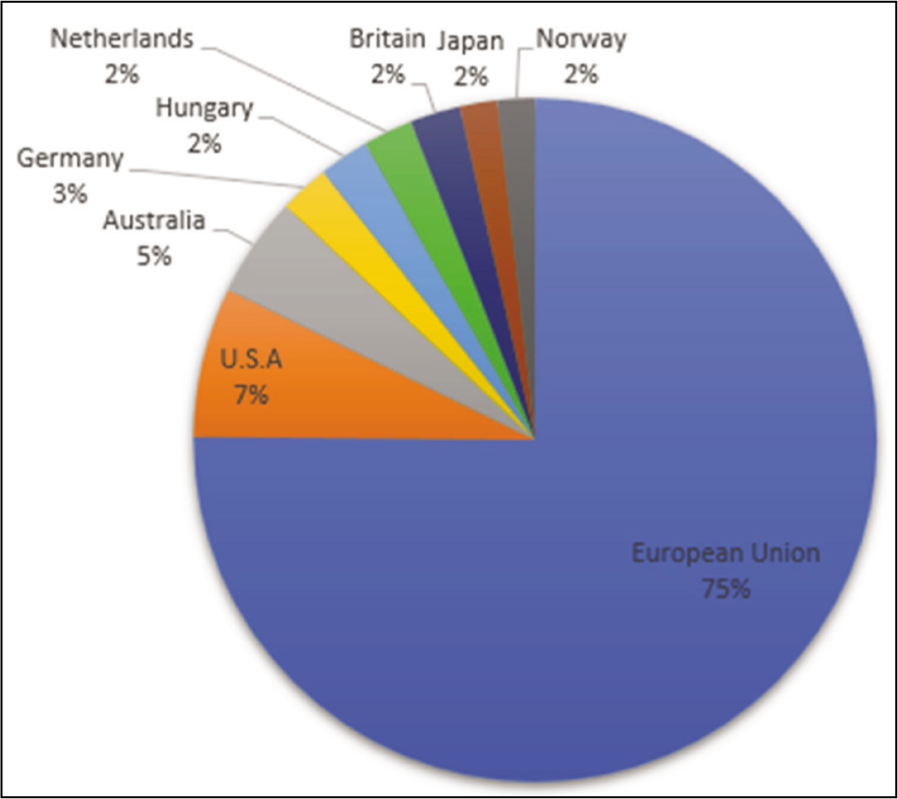
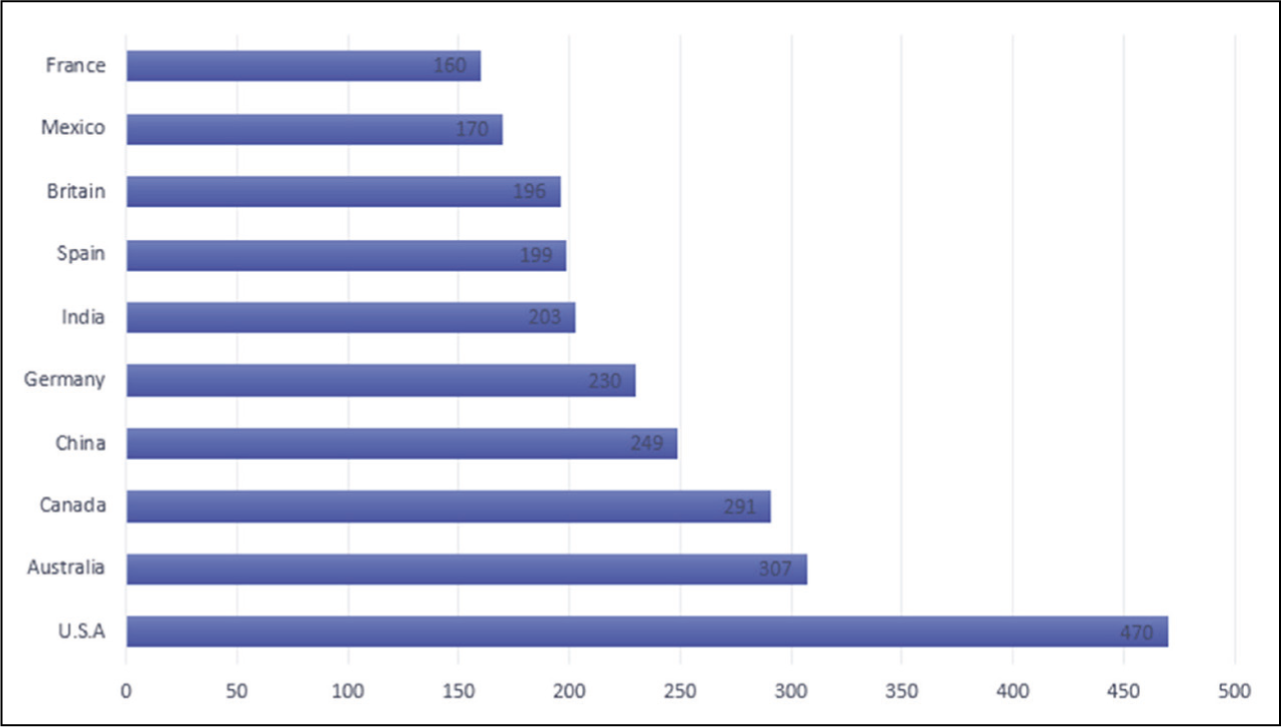
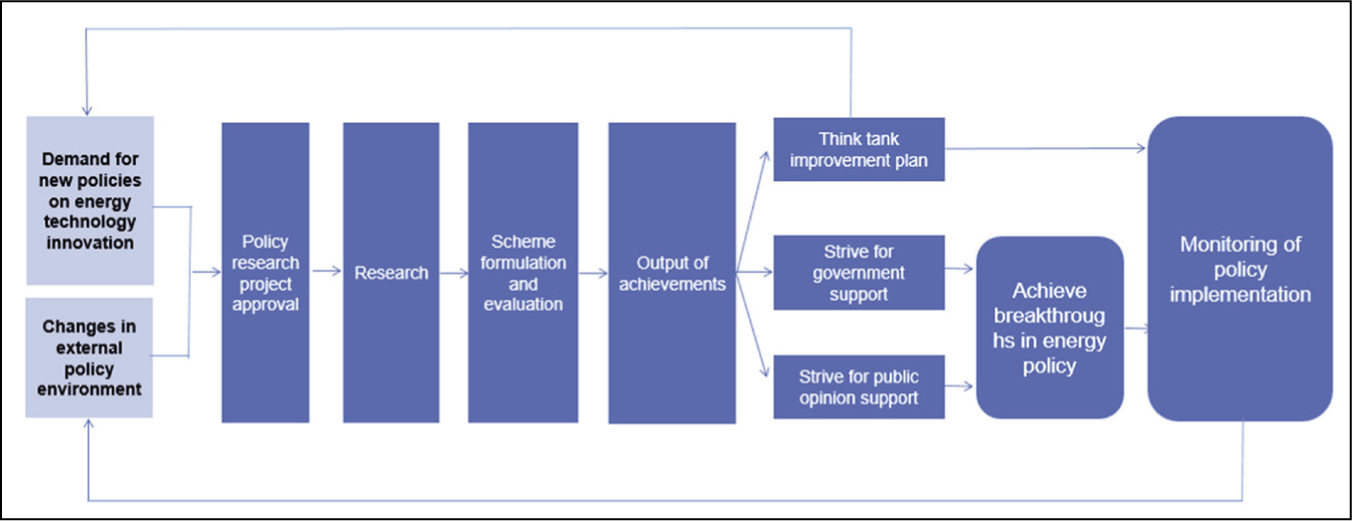
Although the EU, the US, Japan and other countries and regions have their focus on decision-making advisory on energy science and technology innovation, they still present some common features. Firstly, they all regard energy diversification and efficient and clean use of energy as a common goal for decision-making advisory on energy science and technology innovation. Secondly, they take science and technology innovation as important tools to achieve their energy targets. Thirdly, as shown in Figure 3, the whole process of decision-making advisory bodies influencing the formulation of energy science and technology policies is from the formulation of new policy requirements for energy technology innovation to the improvement of solutions based on the original energy management. Other factors include the publication of research reports, extensive interaction with the public and industry experts to gain public opinion to support and achieve policy breakthroughs at the government level and through the monitoring and evaluation of new demands, and carrying out a new round of policy research in a complete closed loop.
The Whole Process of Energy Technology Innovation Policy Formulation in the US. Some Important Factors in the Decision-making Process in Energy.
Case of Advisory System for Decision-making on Energy Science and Technology Innovation in the US
According to a report by Chen et al. (2015) in China Science Daily, 2015 and the U.S. Department of Energy Report (2017), the organisation and implementation of the U.S. energy technology innovation plan includes four levels: decision-making, consultation, management and implementation. According to the principle of separation of powers and mutual checks and balances, scientific and technological strategic decisions are scattered in the legislative, administrative and judicial systems. Think tank expert consultation and evaluation is an important part of the organisation and implementation structure of the U.S. Energy Technology Innovation Program. Many important science and technology decisions originate from the suggestions of third-party think tanks. For example, the President’s Science and Technology Advisory Committee mainly includes well-known scientists and business people from non-governmental institutions directly appointed by the president. They provide feedback on government science and technology programmes, including energy, from an unofficial perspective and also actively propose scientific and technological issues related to national development. In addition, although the National Academy of Sciences is a non-governmental organisation established by official legislation, it is also an important science and technology think tank of the government and Congress. It is usually entrusted by the government and Congress to provide scientific decision-making advice. For example, the Advanced Energy Research Program (ARPA-E) was established under the proposal of the National Academy of Sciences. The establishment of ARPA-E fully reflects the characteristics of the construction of the U.S. energy technology innovation decision-making consulting system. Since its establishment in 2007, ARPA-E has provided more than US$3 billion for more than 1400 projects to purchase decision-making consulting services and corresponding technology development from outstanding energy science and technology experts at home and abroad (Crownhart, 2023). For example, in 2021, ARPA-E will fund $8.5 million from the special programme of ‘Advanced Nuclear Energy Technology Development’ for the research and development of ‘nuclear energy recycling’ technology. On this basis, it urged New Mexico State University (NMSU), USA to cooperate with Terra Energy the Idaho National Laboratory (INL) and the Savannah River National Laboratory (SRNL) to complete the decision-making consultation on the energy policy related to ‘nuclear energy recycling’. We will take Jiangsu, a major economic province in China, as an example to compare the different construction of the decision-making consultation system of energy science and technology innovation in China and that in the US.
Decision-making Advisory System for Energy Science and Technology Innovation in China: Case of Jiangsu Province
According to reports given by the consulting firm on energy and government official records in 2021, China’s energy production will grow steadily. Energy utilisation efficiency will continue to improve, energy consumption structure will be further optimised and the level of electrification of terminal energy consumption will be accelerated. As shown in Figure 4, in 2021, China’s GDP will reach 114.4 trillion yuan, an increase of 12.6% over the previous year and 5.8% points over 2020 at constant prices. With the sustained and stable recovery of China’s economic and social order, energy demand is also picking up gradually. According to a preliminary accounting, the total energy consumption in 2021 will be 5.23 billion tons of standard coal, an increase of 5.2% over the previous year and 3 percentage points over 2020.
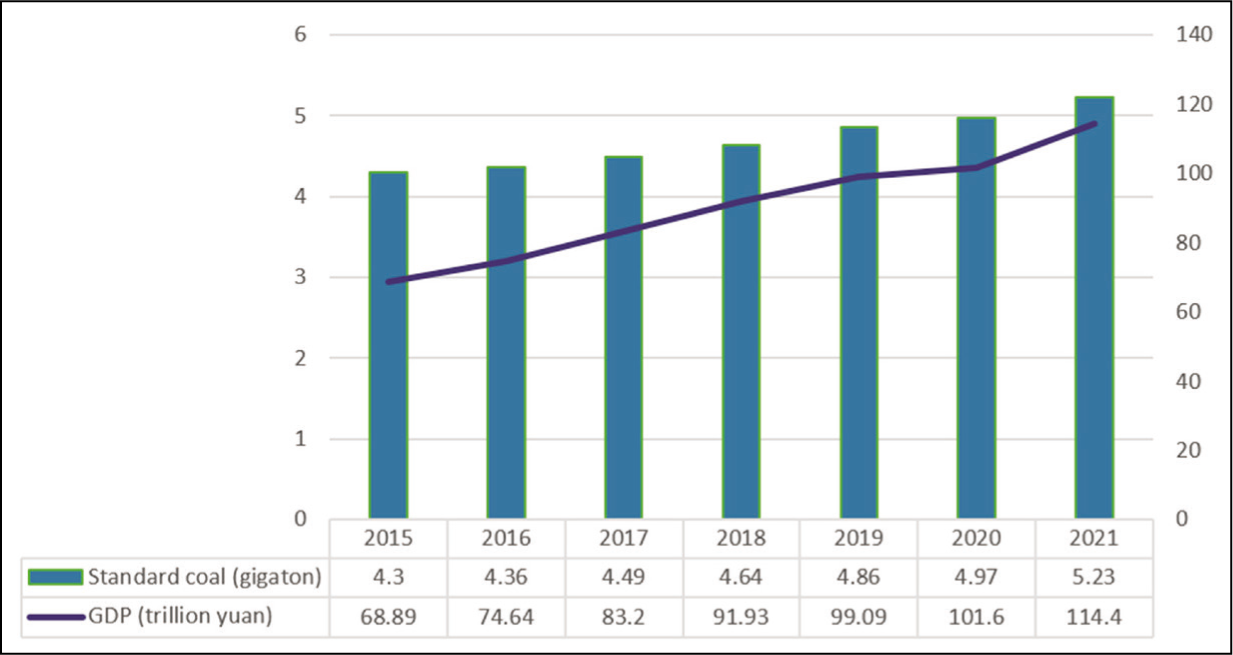
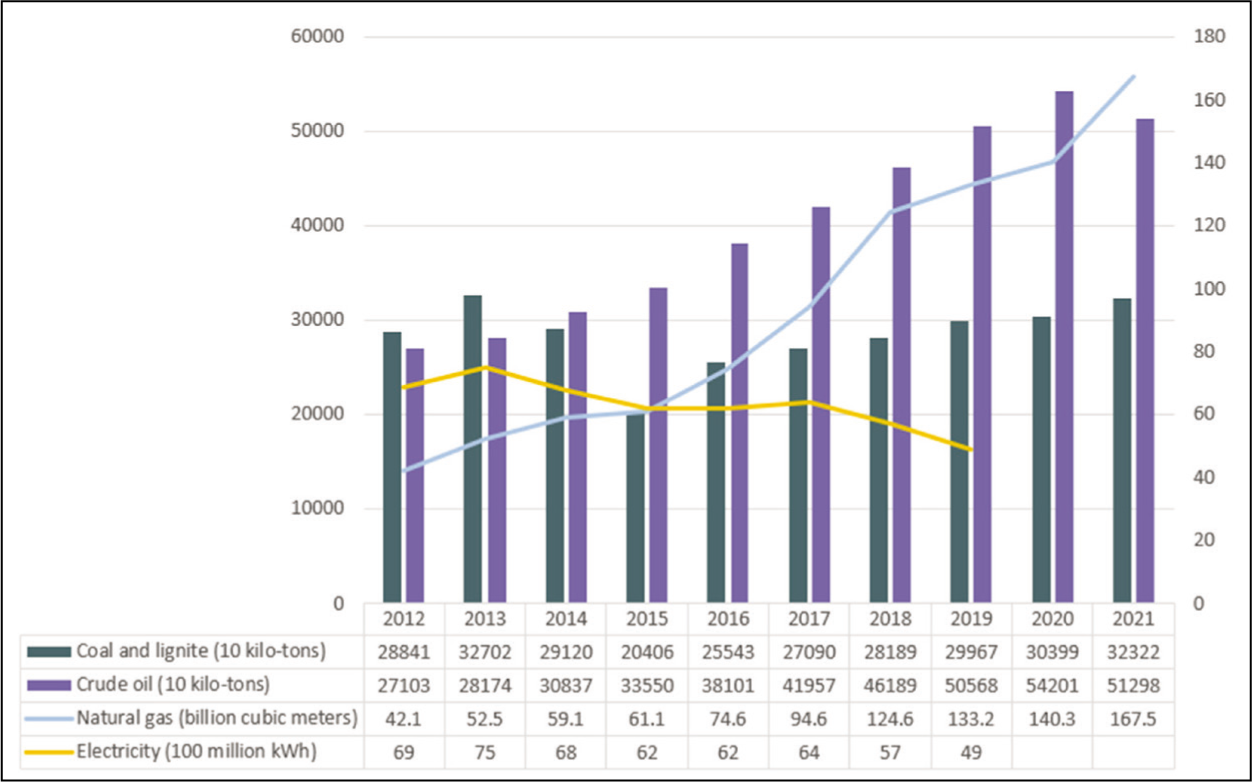
As shown in Figure 5, from 2015 to 2021, China’s energy demand grew strongly and China’s crude oil and natural gas imports also grew steadily. However, due to the changes in the supply and demand relationship in various markets and the adjustment of China’s energy policy, the import volume of coal and electricity increased with minor fluctuation. In general, China’s energy consumption demand is gradually rising, and the energy consumption structure is rapidly changing to a clean and low-carbon one, which requires continuous innovation in China’s energy science and technology. Given this, the demand for relevant decision-making consultation assumes considerable importance.
State Grid Jiangsu Electric Power Company is the pioneer in the construction of China’s energy science and technology innovation decision-making consultation system. China’s energy science and technology innovation decision-making consultation, implementation and management are often first tested in Jiangsu. At the same time, especially under the background of global climate change and the rise of alternative energy, it is also hoped that State Grid Jiangsu Electric Power Company can play the same role as ARPA-E. The energy science and technology innovation decision-making and consulting system of State Grid Jiangsu Electric Power Company is mainly assigned to build a ‘1+5+N’ policy research organisation system internally. It is also tasked to build an energy science and technology innovation decision-making, consulting and research cooperation network externally in the form of project cooperation.
Firstly, the layout of internal energy science and technology innovation decision-making advisory research with office control, multi-departmental support, and all-around linkage ensure the unity of technical hard power and policy research soft power. The ‘1’ means one office. With the office as the lead department, the company’s policy research work is centrally managed to ensure the orderly promotion of the research on energy science and technology innovation decision-making advisory. The ‘5’ refers to five institutions, namely, the Economic and Technical Research Institute of State Grid Jiangsu Electric Power Company (hereinafter referred to as Provincial Economic and Technical Research Institute); the Electric Power Scientific Research Institute of State Grid Jiangsu Electric Power Company (hereinafter referred to as Provincial Electric Power Research Institute); the Urban Energy Research Institute of State Grid, Suzhou (hereinafter referred to as ‘Suzhou Urban Research Institute’); the Marketing Service Centre of State Grid Jiangsu Electric Power Company (hereinafter referred to as Marketing Service Centre); and the Management Training Centre of State Grid Jiangsu Electric Power Company (hereinafter referred to as Management Training Centre). The government can take them as the main implementation entities, which mainly carry out soft science research and supports the development planning and enterprise association in performing the professional support duties and management functions of strategic research, energy consulting and power development planning at the Company level. The Provincial Electric Power Research Institute mainly develops hard science and technology, doing short-term or medium-term forecasting and calculation work. The Suzhou Urban Research Institute focuses on urban energy research and plays a knowledge supply function. The ‘N’ means several support activities. It means that other business departments and city and county units link up with the main support units and work in flexible teams and other grouping modes to promote the overall development of the company’s policy research work.
Secondly, the external network layout of industry-academia-research collaboration and joint construction of government-enterprise cooperation strongly enhances the position and vision of the research on energy science and technology innovation decision-making advisory. As the main soft science institution of the company, Jiangsu Economic and Research Institute internally integrates internal resources of the State Grid system with the platform of the State Grid Economic and Research System, the platform of the company’s ‘Think Tank Cloud’ and the platform of the Energy and Power Economy Laboratory. Externally, it cooperates with the platform of government R&D institutions, forming a cooperative layout that combines internal and external and synergises industry, academia and research. The Provincial Electric Power Research Institute is adept at using and maintaining a network of experts to obtain information on topical social issues and domestic and international industry trends through multiple approaches. On the one hand, through the form of journal analysis, it maintains a stable academic network by cooperating with faculty members of well-known universities with obvious advantages in the field of power systems, such as Tsinghua University and Southeast University. On the other hand, through participation in industry associations, it establishes a network of cooperation with well-known organisations in the industry and maintains regular contact with them. Suzhou Urban Research Institute continues to enhance it is connecting, guiding, and shaping power to the government, energy enterprises, research and consulting institutions, and so on and plays an important pivotal role by cooperating with the Beijing Institute of Low Carbon and Clean Energy and other industry-academia research institutes.
However, at this stage, there are still obvious shortcomings or missing links in the process of conducting policy research. A systematic, integrated and refined policy research system has not yet been fully formed and integrated. It may be said that specific problems might include the following aspects:
The research on energy science and technology innovation decision-making advisory is significantly isolated or fragmented, and the ability to integrate resources needs to be enhanced. The nature of State Grid as a central enterprise determines its strong vertical management and strong work execution. However, it also makes internal cross-departmental interaction weak and external communication and cooperation constrained, and the degree of importance attached to energy science and technology innovation decision-making advisory research work varies from department to department. Therefore, the internal and external research forces cannot coordinate and collaborate and research data and results cannot be shared immediately. Meanwhile, isolated islands of energy science and technology innovation decision-making advisory research are formed, lacking long-term tracking and self-driven policy research. The management system of energy science and technology innovation decision-making advisory research is relatively weak and the system and mechanism need to be improved. The company has issued management norms and established a monthly meeting mechanism to ensure the steady promotion of policy research in provincial grid enterprises. However, it has not yet designed a full set of systems around policy research work with integrity, compliance and specificity features. Nor has the process of policy research work management formed a process, fine-tuned binding norms, process control and assessment and evaluation mechanisms. As a result, the actual guidance of the existing system is not very effective. The advisory research function of energy science and technology innovation decision-making seems to be weakened. Hence, specialised and in-depth research needs to be strengthened. Although the Policy Research Office of State Grid, the new Strategic Research Office of the Provincial Economic Research Institute, and the offices at all levels charged with the decision-making advisory research functions of energy science and technology innovation have gradually invested in policy research, their main function is still to write speeches and the research function is relatively weak. As a result, the research topics are often superficial, the type of research is mainly short-term emergency and task-driven, and the research content is not closely linked to the company’s strategy and does not go deep enough into the issues reflected by the grassroots base, making it difficult to maximise the effectiveness of policy research. The awareness of social responsibility and the influence of results of energy science and technology innovation decision-making advisory research should be improved. The gradual emphasis on policy research work by the leadership of State Grid has led to a more significant role for State Grid’s decision-making support function and several research highlights. However, the starting point for State Grid Jiangsu Power’s energy science and technology innovation decision-making advisory still remains at the level of serving the company’s decision-making, failing to deeply embed itself in the energy decision-making process of the party committee and government, making it difficult to fully release the reform benefits and to take on the important task of adding value to customer welfare and to create a relaxed policy environment for the power system through effective policy breakthroughs.
In general and from a global perspective, the international energy policy discourse is still controlled by the developed countries in Europe and the US, which is closely related to the high level and systematic policy research work and high quality and influential think tank research consultation system. China’s energy science and technology innovation decision-making advisory is still dominated by domestic energy science and technology innovation policy-making and has not yet developed regional policies that can affect surrounding countries. Moreover, there is a lack of understanding of international energy policies with global coverage. In addition, China’s energy enterprises, energy think tanks and consulting firms in related fields have very limited influence in the energy community and policy, failing to make their voices heard effectively at the international level and lacking influential, authoritative and widely radiated results.
Several Paths for the Development and Improvement of China’s Decision-making Advisory Service System
From the problems of State Grid Jiangsu Electric Power Company in energy innovation, there seem to be a number of problems and challenges in the construction of Jiangsu’s decision-making advisory system. Some of the main issues include poor supply-demand interface; adequate policy support system, field investigation capability, weak service capability and insufficient technical and resource security. The remaining part of the paper seeks to suggest some pathways for improving the decision-making system.
Optimise Strategic Deployment and Accurately Match Supply and Demand for Decision-making Advisory
Paying Attention to the Development of Professional Decision-making Advisory Institutions to Ensure the Plurality of Advisory Subjects
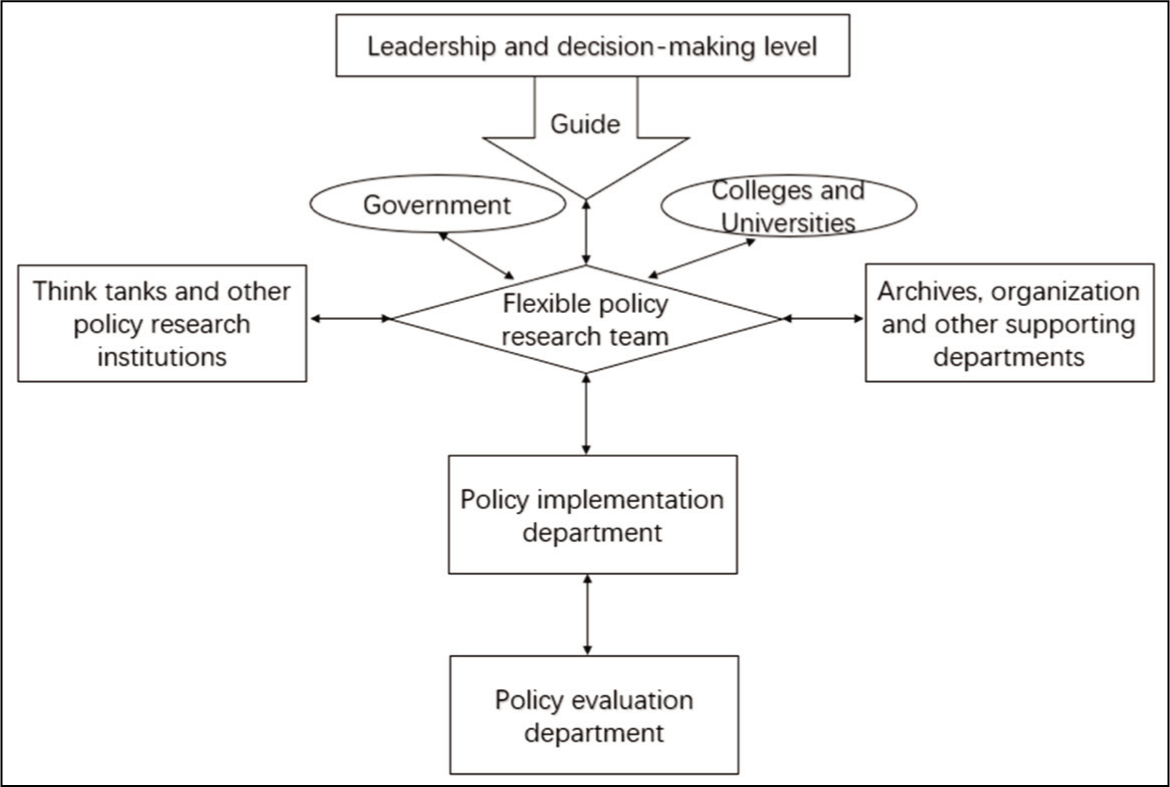
Li Gang, a Chinese think-tank scholar, believes that the government’s decisions are far from being able to solve a large number of professional and technical problems in the real world by relying on ‘generalists’ which poses a problem in building trust in institutional think tanks. Policy-making departments should consciously strengthen the importance of professional decision-making consultancies. Figure 6 shows, China’s face-to-face decision-making consultation service system is organised from the government leadership decision-making level to the final policy evaluation institution. Except for some private think tanks and other decision-making consultation service institutions, it is basically an organisation within the government system, including the final policy evaluation institution, which also belongs to the government agency.
The Organisational Structure of China’s Decision-making Consulting Service System.
Source Compiled by Authors
The system could include appropriate professionals in the decision-making advisory system of Jiangsu Province to improve the efficiency of the use of resource endowments. Some non-official think tanks such as social think tanks and corporate think tanks with a good foundation and potential in Nanjing could be given a role in policymaking. Through a selection and tendering process for high-end social think tanks, the system could make full use of their resource endowment in terms of research objectivity, diversity of perspectives and internationalisation of channels. It could focus on university think tanks with innovative potential and pay attention to the combination of academic theory and practical exercises to fully integrate the resources for decision-making advisory in Nanjing universities. The government could consider assigning space to different types of decision-making institutions. At the level of research fields, it could include fields such as economics, science and technology, national relations and local stakeholders. They could be given space in the overall decision-making process.
Setting up a Government Consultancy Procurement Assessment Process and Selecting Consultants on Demand
Jiangsu Province could establish a ‘service provider evaluation system’ for decision-making advisory with a traceable and justifiable standardisation of the entire process of ‘wisdom seeking’ and ‘wisdom use’. Firstly, a preliminary division could be made according to the basic situation of the types, research fields, and character strengths of the existing think tanks under the decision-making advisory market in Jiangsu Province. Additionally, a think tank research field orientation table will be established to clarify the service fields of each think tank, to provide a reference for future government decision-making advisory projects. Secondly, the government could regularly assess the various active think tanks and leading experts, and conduct pre-assessment before commissioning projects. For example, based on the approval or adoption of the think tanks, the transformation degree of the results, and the high rate of the government services’ return, a set of classification and evaluation systems may be established through the quantitative assignment of points. Thirdly, a feedback mechanism for project results could be set up. It can provide post-services evaluation feedback based on the indicators of the think tank when providing consulting services, such as report quality and communication, and so on. Afterward, the evaluation report will be counted in the overall evaluation of the think tank. In summary, establishing an evaluation system for decision-making advisory service providers in Jiangsu Province will gather high-quality resources, avoid inefficient services and improve the selection rate of scientific decision-making advisory suppliers.
Establish a Permanent and Long-lasting Supply-demand Matching Model to Grasp the Demand for Decision-making Promptly
To achieve scientific and timely decision-making, the demand side of decision-making advisory and the service provider should fully communicate so that demand and research can go hand in hand. As far as possible, various hearing sessions, interviews, round tables, conferences and other communication platforms should be organised. Think tanks within and outside the institution should be invited to participate together to broaden the scope of consultation on government policy-making and to take the views of different stakeholders. Secondly, the system could establish various decision-making consultation service information platforms such as policy consultation demand database, consultation expert database, decision-making consultation results database, and so on. The government also needs to establish a big platform of supply and demand for linking up think tanks with the decision-making departments of the party committees and governments to release demand promptly, avoid ineffective supply, achieve precise use of wisdom, better guide think tanks to grasp macro policies and frontier issues to combine government customisation with marketisation. Thirdly, the government can select some professional and high-quality social think tanks to establish direct reporting points and establish long-term cooperation to form a peer-to-peer communication channel, through which the think tanks can reflect public opinions and provide countermeasures promptly. As a result, they can serve the decision-making centre more quickly and efficiently.
Promote Institutional Innovation and Guarantee the Standardisation and Orderliness of Decision-making Advisory
Scientific Design of Top-level Strategy and Clear Target Orientation of Decision-making Advisory
The construction of the decision-making advisory system could be incorporated into the development plan of Jiangsu Province in the 14th Five-Year Plan. It could be an important part of the strategic objectives of urban development in Jiangsu Province to build a new decision-making advisory system and to be effective in advising on political issues. The government could closely focus on the overall development layout of the city, coordinate the resources of all parties and accelerate the formation of a new pattern of decision-making advisory in Jiangsu Province. Secondly, the government needs to study and formulate a special ‘Planning Outline for the Construction of Decision-making Advisory System in Jiangsu Province’. Detailed short-term and medium- and long-term development plans in terms of matching supply and demand, institutional mechanisms, working capacity, resource guarantee and technical support can be drawn up. Such a planning outline will most probably facilitate the full integration of decision-making advice into urban governance, continuously enhance the competitiveness of soft science and policy influence of cities and promote cities’ strategic planning capacity, political advisory capacity, resource allocation capacity, data-driven capacity and other key indicators to lead both at home and abroad.
Systematic Establishment of a Policy Framework for Effective Management of Advisory Institutions at all Levels
Firstly, a general charter for decision-making advisory work in Jiangsu Province could be drawn up, including modules on organisation management, personnel management, research management and results management, and so on. For example, in the construction of the general charter, the decision-making management could formulate the policy research work plan; In terms of organisation and management construction, the decision-making management could formulate the construction plan of the main unit of the policy research system. In terms of personnel management, the decision-making management could formulate the regulations on employment and assessment of policy researchers. In terms of scientific research management, decision-making management could formulate management measures for policy research projects. In terms of product management, the decision-making management could formulate the policy research product management. To strengthen the concept of unified leadership and hierarchical management, we should not only seek upward communication and docking channels with national and provincial policy research offices but also establish a permanent and long-lasting supply and demand docking mechanism for various decision-making advisory departments or institutions at all levels in the city with the supply side of advisory services regularly reporting research progress and milestones. Similarly, the demand side could be also taken into account.
Classify Work Requirements to Guarantee the Advantages of Different Institutional Systems
The government could improve the coordination and co-construction mechanism of decision-making advisory institutions and integrate the advantages of various decision-making advisory institutions. Jiangsu Province could further clarify the strengths and characteristics of different types of institutions when deploying the overall layout of the decision-making advisory system. In addition, it could set specific work requirements according to their research strengths and characteristics, and design a personalised evaluation index system. These measures can make sure that decision-making advisory institutions give full play to their function of advising the government and manifest their characteristic research advantages to releasing policy dividends. Thus, institutional guarantees can be provided for maximising the benefits of the decision-making advisory system.
The government could strengthen the concept of participation in the whole policy-making process. By refining the decision-making advisory system, various think tanks should be guided to effectively utilise their strengths and participate in different stages of the policy-making process. For example, if party and government research departments are in the upper reaches of the policy industry chain, they should be provided with institutional safeguards to carry out short, flat, and fast policy research. Meanwhile, university think tanks and other research institutes think tanks and social think tanks are in the lower reaches of the policy industry chain. They should be provided with institutional safeguards to ensure their abundant talent advantages, diversified disciplinary fields and flexible operation mechanisms. As a result, they can focus on long-term, strategic and tracking policy research and provide solid theoretical support for policymakers.
Strengthen the Resource Endowment and Effectively Activate the Stock to Continuously Improve the Increment
Coordinate and Optimise the use of Matching Funds to Broaden the Sources of Funding for Decision-making Advisory
Firstly, a detailed budget report for decision-making advisory work should be drawn up to improve the efficiency of using funds. Based on the existing budget and funding management policies, government departments should formulate scientific and detailed rules for the management of funding for decision-making advisory, allocate funding rationally, and regulate the use of funding for various decision-making advisory departments and institutions, to ensure maximum efficiency in expenditure. Secondly, the financial support for the construction of the decision-making advisory system should be increased. Additionally, various types of decision-making advisory institutions need to be supported in a differentiated manner to carry out decision-making advisory work. Government departments not only need to increase the government’s efforts to purchase consulting services based on setting up special funds for decision-making advisory work but also need to vigorously cultivate the independent ‘blood-making’ ability of various decision-making advisory departments or institutions and appropriately relax the restrictions on the use of funds by each institution or department to give them the flexibility to generate income. At the same time, it should also provide differentiated support according to the types of decision-making advisory institutions. As a result, healthy competition among various units will be stimulated and the enthusiasm for decision-making advisory work will be enhanced.
Add Senior Advisors to Chief Executives to Play a Leading Role as Industrial Strategy Experts
For example, Jiangsu will soon study and issue Opinions on Promoting the High-quality Development of the New Energy Vehicle Industry this year, in order to ensure that the new policies can help promote the transformation and upgrading of the automobile industry towards electrification, intelligence, networking and sharing and further enhance the core competitiveness of the new energy vehicle industry. First of all, based on strengthening the functions of the Jiangsu Provincial Decision Advisory Committee, a senior consultant team of the chief executive officers of Jiangsu Province will be formed, consisting of leading figures and well-known experts in the fields of information management, chemical energy, machinery manufacturing, social management, and so on. The team can provide direct consultation services to decision-makers, communicate with them from time to time, understand their needs in a timely manner, and provide accurate decision suggestions. Therefore, decision-makers can always obtain the latest research results and development trends in different fields through the opinions of experts in different fields, so as to ensure that decision-makers can maintain a high level when making major decisions and strategic decisions. Secondly, Jiangsu could establish an entity, platform-based new energy vehicle development decision-making advisory group or research centre by gathering top human resources nationwide and integrating expert resources in relevant fields in Jiangsu Province. High-quality experts and top consulting institutions from advanced cities such as Beijing, Shanghai and Shenzhen should also be invited to participate in the research on specific topics. The entities of the group will be retained after the completion of the project, and expert teams from inside and outside the city will follow up on the transformation and application of the results respectively. By holding alliance forums, seminars and conferences regularly to exchange follow-up progress, Jiangsu will be able to introduce national intellectual resources and promote the consulting achievements of Jiangsu to the whole country. As a result, Jiangsu will continuously attract new intellectual resources and achieve a spiral upward.
Realise Internal and External Interoperability and Upward and Downward Linkage to Enhance the Level of Open Access to Data Resources
Government departments could improve the open-sharing system of government information and data to provide solid data support for decision-making advisory bodies to conduct in-depth research. To begin with, when holding major strategic meetings and decision-making meetings, government departments can appropriately invite internal decision-making advisory departments such as the Policy Research Office of the provincial party committee, as well as official think tanks such as think tanks of the party and government departments, think tanks of administrative colleges of party schools, think tanks of universities and think tanks of the Academy of Social Sciences to participate in the meetings. Therefore, immediate information resource sharing between internal and external, upper and lower levels, will be achieved. At the same time, it can break down existing information barriers and solve the problem of lagging access to information. Besides, a wide work exchange network should be built between different decision-making advisory departments or institutions to ensure active open sharing based on data security. Through sharing of data resources across institutions, types and fields, the emerging value of data resources could be explored in depth, policy processes should be restored, existing data should be expanded and new hypotheses should be put forward to break the barriers of industry fields based on solving the isolation of information. Thus, the level of decision-making advisory work could be improved and the results of decision-making advisory research can be optimised.
Strengthen Capacity Building to Ensure Efficient Transformation of Decision-making Advisory Results
Comprehensively Solicit Research Needs and Form a Monthly or Quarterly Field Research Mechanism
Research is separated by a layer of paper and the quality of political advice is separated by a layer of the mountain. Only by going deep into the grassroots, can we find out the real situation, make practical solutions and seek effective results. The Jiangsu government needs to actively promote the scientific layout of grassroots research sites. The government should select representative grassroots units, organisations and enterprises to establish regular cooperation mechanisms and fixed research contact sites, extend the scope of policy research work in terms of information acquisition, reporting, publicity and interpretation, and continuously enhance the support of field research for policy research. As a result, problems can be identified and analyzed from field research, thereby enhancing the quality of decision-making advisory and the value of policy research. The government should initiate thematic research activities in a planned manner, following a combination of ‘distinctive’ and ‘comprehensive’ research themes, establishing a research team that coordinates a ‘small core’ with a ‘large network’, to standardise the process of research work and to complete various research tasks in an active and orderly manner.
Establish Specialised Research Centres and Long-term Strategic Research Groups
Specialised research centres for policy research should be set up by linking government departments, universities, research institutes and social think tanks to form research groups in different specialised fields. They can conduct long-term follow-up research and evaluation on thematic issues, summarise experiences, solve problems and make continuous improvements. A system of division of responsibility for research could be implemented to strengthen the accumulation of data and knowledge. It is important to develop the sensitivity of personnel to policy research and strengthen the ability to identify and raise issues. To establish a broad strategic view, we should mainly start with the overall and strategic deployment of the central government to the local community. After the introduction of some new theories, new formulations, new strategies and new spirits at the central and national levels, researchers should make timely and accurate interpretations and predictions, so as to put forward directional, principled and fundamental ideas and suggestions according to local conditions. It is also necessary to strengthen the perspective and content innovation in relation to the knowledge structure of policymakers and where they are unable to pay attention daily so that valuable and high-quality results can be produced and resonate with leaders. In addition, regular forums based on the city, the province, and the country can be held, inviting experts and scholars and practical staff from first-tier cities to actively speak out on the development of Jiangsu Province, discuss development trends, absorb professional experience and advice from all sides. These measures will open up the landscape of Jiangsu Province and guarantee the foresight of long-term decision-making advice.
Organise Regular Teaching Seminars to Create a Regular Training Model for Report Writing
The research reports submitted by decision-making advisory institutions are about policy directions. Therefore, they should be both policy and legal, theoretical and application-oriented, realistic and forward-looking. To improve the training and learning mechanism that focuses on enhancing the ability to research and write. According to the medium and long-term talent planning and short-term subject needs, experts are invited to conduct thematic training in a planned and organised manner, emphasising strengthening academic literacy and research capacity building, such as thematic training on the specifications of essay writing, training on data mining and analysis capabilities, training on policies and development dynamics, and so on. In particular, the training will focus on improving the writing ability of decision-making advisory reports in terms of the essentials of topic selection, excavation of specific issues, acquisition of research data, selection of report structure, writing of countermeasures and suggestions, conversion of language and style, grasp of reporting channels and timing, and so on. Secondly, the government could regularly hold internal sharing sessions on the excellent results of decision-making consultation, inviting researchers who have won the leadership’s approval to teach their writing experience and summarise the excellent consultation achievements in a booklet. This process could lead to high-quality achievements.
Promote Technology Empowerment and Realise Digital Intelligence of Decision-making Advisory
Establish Various Characteristic Databases to Enrich the Supply of Information Resources
The collection and accumulation of information and data is an important cornerstone for high-quality decision-making advisory research. Resourceful databases include general-purpose databases that can be acquired through transactions and specialised databases that have been developed on a self-built or co-built basis. The former strongly supports decision-making advisory research with its rich data resources and huge data scale, while the latter realises the longitudinal and personalised development of decision-making advisory institutions based on the precipitated characteristic results and authoritative primary data, which enhances the value of policy research. Decision-making advisory institutions could pay more attention to famous domestic and international general-purpose databases. Researchers in decision-making consultancies should be encouraged to focus on and make full use of niche databases and overseas databases to expand their information reach. They could also tap research themes, tracking and collecting data, entering them into their own small databases for long-term accumulation, thus forming their unique competitiveness.
Create a Data and Information Platform to Support Intelligence Assurance Needs
To better promote the intelligent construction of decision-making advisory work in Jiangsu Province, and ensure operational efficiency and a modern development process, it is necessary to actively promote the demand database, information database, expert database, results database and other information platform construction. Information collection and analysis and focus on research work to continuously improve the level of intelligent policy research work also count. Therefore, the automation of research and management should be promoted to enhance the business level and management efficiency. Policy research data and various information platforms such as the information bank, and results bank can integrate scattered data models and tools, link various types of research and promote data sharing and integration. The platform information and data can provide quicker training for new researchers in decision-making consultancies, enabling them to familiarise themselves with the various work processes thereby improving efficiency and promoting rapid collaboration in research teams.
Connect with Cutting-edge Technology Companies to Utilise High-end Data Resources
At present, data resources are mainly concentrated in the hands of government departments, internet giants, telecom operators and financial institutions. Therefore, two-way data-sharing services between government and enterprises have become the mainstream of development in the contemporary situation. On the one hand, one needs to enhance the willingness of both government and enterprises to open up and establish an incentive mechanism for enterprise data opening. The government itself should publicise the huge value released by the integration of government and enterprise data, and clarify the purpose, scope and channels for the government to use enterprise data. The government could establish a government-enterprise data service mechanism, and give corresponding financial subsidies, project support and financial support to enterprises. On the other hand, cutting-edge technologies such as artificial intelligence and big data could be fully utilised and deployed for big data mining, analysis and prediction. Based on massive data such as open social data, mobile communication data and social network data, a big data-driven research paradigm could be established to capture information on relevant major decision-making topics. Policy research trends could focus on foresight and future strategies in decision-making systems with a focus on sustainable energy-related projects.
Concluding Remarks
This research has several limitations and can determine the future research focus, which will help to better understand the similarities and differences of the decision-making consultation systems of the EU, the US and China in achieving their policy objectives. First, in the suggestions for improving China’s decision-making advisory service system, the development and improvement path of China’s decision-making advisory system serving the whole process of government decision-making was limited to a major region of Jiangsu. Secondly, the stages of the generation and evaluation of the embedded policies of various organisations in China’s decision-making advisory services, such as think tanks, are different. The different characteristics of embedded services at each different stage are also worth looking at in an in-depth study covering other regions.
With the construction and development of China’s decision-making consultation system, China’s energy revolution continues to advance in-depth and is writing a new chapter of high-quality energy development. As the world’s largest energy consumer and producer, China is also actively promoting the green transformation and development of global energy. Looking forward to the future, China’s energy consumption continues to upgrade and China’s energy science and technology policies continue to improve, which can contribute to the upgrading of the global new energy consumption model. At the same time, international cooperation in energy has achieved more results around joint construction, consultation and sharing. The degree of cooperation has been further deepened.
Footnotes
Declaration of conflicting interests
The author declared no potential conflicts of interest with respect to the research, authorship and/or publication of this article.
Funding
The author received no financial support for the research, authorship and/or publication of this article.