



Abstract
Academic spinoffs have received great attention in recent years as a means of transferring the knowledge generated by the research activities of higher education institutions (HEIs). Despite the contribution identified by the literature, there remains a lack of empirical evidence substantiating how the creation of academic spinoffs is enabled by entrepreneurial orientation (EO) and HEIs. This study theorises on the relevance of EO within the context of universities and how such an orientation may drive the founding and development of academic spinoffs. Based on a qualitative study, with 15 interviews from university rectors/presidents, faculty/school deans, degree program directors at Portuguese public HEIs, and founders of spinoffs, the results generate two relevant insights: (i) EO is relevant to the creation, growth, and performance of academic spinoffs, and (ii) personal fulfilment, the transfer of knowledge acquired in HEIs and the search for economic independence represent the main motivations for the creation of academic spinoffs. The findings are discussed to highlight their implications for theory, practice and policy-making.
Keywords
In recent decades, universities have not been limited to the production and transfer of knowledge, but have also adopted the function of technology transfer, reiterating their role as a socioeconomic agent (Etzkowitz, 1998). In this context, the university paradigm has changed, and the mission no longer includes only generating knowledge but also its application to foster innovation and economic growth (Cvijić et al., 2019).
Within this framework, universities need to act strategically to become effective socio-economic actors (Klofsten et al., 2019), thereby shaping entrepreneurial universities (Cerver Romero et al., 2021) able to generate academic spinoffs (O’Shea et al., 2008). Hence, according to Caputo et al. (2022), academic spinoffs rank among the potential means for universities to comply with their mission as contributors to society.
At the university level, we refer to an academic or university spinoff as a creation within a higher education institution (HEI), putting into practice the knowledge generated by these centres through the research and development (R&D) activities (Miranda et al., 2018). The creation of companies by universities does not only account for a means of transferring technology but also contributes towards developing the regional economy. However, due to the relatively recent nature of university spinoffs, there is a lack of enough empirical studies (Civera et al., 2020). Linking academic entrepreneurship with creating and developing academic spinoffs.
Furthermore, parallel to the generation and transfer of knowledge, a fundamental objective of universities in their social involvement stems from guaranteeing that their students acquire the skills necessary to meet the demands of society (Guerrero et al., 2018). Hence, entrepreneurial orientation (EO) stands out as a strong factor that assists universities in attaining their essential goals (Sidrat & Boujelbene, 2020). Additionally, in the academic entrepreneurial context, the role of EO may emerge as particularly relevant in keeping with how academic spinoffs require entrepreneurial strategies to commercially orient their respective innovations (Knockaert et al., 2011).
However, despite the existing literature on EO and academic spinoffs, few studies deal with how EO and HEIs enable the creation, growth and performance of academic spinoffs. Hence, this study aims to contribute towards filling this gap and simultaneously understand how academic entrepreneurship influences academic spinoffs as well as the relationship prevailing with the founding, growth and performance of these spinoffs. Hence, this study attempts to address the following research questions: (i) in what ways do HEIs seek to encourage their academics to creation, and academic spinoffs?; (ii) what are the motivations for academics to create academic spinoffs?; and (iii) what is the role of EO and the HEIs in enabling the founding, growth and performance of academic spinoffs?
Hence, the specific objectives of this study are: (i) examining how HEIs encourage and incentivise their academics to create spinoffs; (ii) identifying what motivates academics to advance with founding academic spinoffs; and (iii) ascertaining whether EO enables the founding, growth and performance of academic spinoffs.
The study adopted a qualitative methodology to study the roles of EO and HEIs in creating and developing academic spinoffs. It deployed individual semi-structured interviews of 13 different Portuguese public HEIs and two academic spinoffs as data sources (Gioia et al., 2013) to.
The article is structured as follows. The next section presents the theoretical background in respect of HEI, academic spinoffs and academic entrepreneurship. Next, in the methodology section, the research context and data collection are described. The data analysis is presented next and, finally, the results, their theoretical and practical implications and the limitations and future lines of investigation are discussed.
Theoretical Background
HEIs and Academic Spinoffs
Universities need to adopt more business-oriented practices, commercialising the results of their research and creating new companies (academic spinoffs) based on knowledge (Kirby, 2006). Thus, academic spinoffs represent companies set up by professors and students within the scope of education institutions to commercialise their research and knowledge and correspondingly assume one of the most relevant roles in technology transfers (Borges & Filion, 2013).
Universities have changed greatly in recent decades with academics emerging from their traditional ‘ivory towers’, and these changes are largely due to the political will of various governments (Henkel, 2007). Furthermore, academic spinoffs are under constant pressure to change, which places great importance on regional innovation systems within the scope of national economies and competitiveness (Anderson et al., 2011). Academic spinoffs are viewed as important means of generating business and jobs, maintaining the balance in economic systems, and positively influencing innovative processes (Miranda et al., 2017).
Universities represent one of the partner institutions of great importance to academic spinoffs as they very often provide the support infrastructures for the early years of these companies (Buarque et al., 2021; Pacheco et al., 2021; Simões et al., 2012). Furthermore, one way of sourcing knowledge is interacting with universities, which provide various channels that may transfer knowledge and technology between universities and industries (Miranda et al., 2018).
In the last decade, academic spinoffs have emerged as one of the most effective means of transferring knowledge from the R&D undertaken by HEIs to companies (Miranda et al., 2017; Rubini et al., 2021).
According to Prokop et al. (2019), the survival of academic spinoffs depend on three key actors in university networks: investors, external entrepreneurs and technology transfer offices.
Academic Spinoffs and Academic Entrepreneurship
Academic spinoffs incorporate activities based on the exploitation of new processes, products, or services deriving from the knowledge acquired and the results obtained in the respective university (Wood, 2011). The processes by which individuals integrate into universities and research centres and deal with the research findings to generate business ventures or academic spinoffs are known as academic entrepreneurship in the literature (Miranda et al., 2017). Ahmad et al. (2018) identified the prevailing perception that the creation of spinoffs is vital to any university wishing to engage in entrepreneurship.
According to Muscio et al. (2022), the creation of spinoffs by students constitutes a rising trend in keeping with how some academic institutions provide encouragement and incentives to become more entrepreneurial by running entrepreneurship programs, supporting installations such as company incubators, business competitions and research awards. Research on motivations in the academic context (Berggren, 2017) shows that academics are strongly motivated to create academic spinoffs driven by a sense of social responsibility and a need to use knowledge and skills when participating in the transfer of technology process. In other words, academic scientists are often dedicated to improving society by transferring knowledge and disseminating technology based on their academic research (Berggren, 2017). Consequently, we may state that academic spinoffs are mostly founded and managed by academics from particular university institutions in which the available knowledge and technology underpin the creation of new companies (Diánez-González et al., 2021).
The literature also extends to studying need-oriented academic spinoffs, which are created to protect academics from eventual unemployment (Roach & Sauermann, 2010). Hence, academic spinoffs may provide an opportunity to commercialise the knowledge developed within universities (Czarnitzki et al., 2016) and provide compensation employment. Correspondingly, academics, pushed into entrepreneurship as alternative employment to support their livelihoods (Horta et al., 2016), invest in academic spinoffs out of economic need and, therefore, focus on their survival.
Academic entrepreneurship needs to expand in the institutions, including its respective faculties/schools, departments and the entire leadership chain, from the rector and/or president down to the students (Cleverley-Thompson, 2016). Hence, in achieving success, academic spinoffs, in addition to reflecting the results of academic entrepreneurship, may also bring economic benefits to the HEIs (Su & Sohn, 2015).
The existing literature on academic spinoffs has identified essential determinants at the individual and team levels (demographic characteristics, involvement of the entrepreneur, team development and human capital), alongside determinants at the company level (technological characteristics, company and network development processes) as well as determinants in the surrounding ecosystem and institutional environment (support policies and programs, university relationships and the regional context) (Migliori et al., 2019).
In the last two decades, researchers have deployed significant efforts to better understand how to raise the efficiency around the creation of academic spinoffs (Fini et al., 2017; Miranda et al., 2018). Hence, the growing relevance of academic spinoffs to the economic and social development of their host regions has received widespread recognition in research on entrepreneurship and, consequently, the literature examining academic spinoffs have expanded rapidly (Miranda et al., 2018; Prokop et al., 2019). The literature also details how academic spinoffs may require EO to effectively manage the intersection between the research activities developed in academic contexts and the commercialisation of their innovations in the industry (Migliori et al., 2019).
Riviezzo et al. (2019) report that EO positively interrelates with the number of spinoffs created with this relationship moderated by age, department size, national gross domestic product and expenditure on R&D. Diánez-González et al. (2021) state that the relationship between EO and the performance results of academic spinoffs is strong and positively influenced by the level of EO prevailing in companies. Thus EO emerges as a crucial driver of the performance of academic spinoffs.
Diánez-González et al. (2021) demonstrate the relevance of the institutional environment for defining and developing the EO of academic spinoffs and emphasise how the EO of academic spinoffs significantly benefit from technology transfer offices serving as connectors between the academic and business environments. Civera et al. (2020) describe how the human capital of the university leadership plays an important role in academic spinoffs, and identify this as shaping the university, its values and cultures, with academic leaders serving as the drivers of the EO in their organisations.
Methodology
Research Context
The study opted for the qualitative methodology in keeping with its leading position among the feasible alternatives for studying fields that include high levels of subjectivity (Günther, 2006). This approach is applicable whenever there is a dearth of existing knowledge on the area being studied (Fassinger & Morrow, 2013).
According to Yin (2014), the qualitative research methodology aims to identify relationships and is the most efficient when applied to examining contemporary phenomena in depth and their real contexts. In this case, the qualitative method is used to understanding the roles of EO and HEIs in creating and developing academic spinoffs.
Data Collection
Data collection was carried out through individual semi-structured interviews (Gioia et al., 2013). The interview method aligns with the theme under study and the objective of grasping the role of EO and HEIs in creating and developing academic spinoffs.
It was decided to choose different Portuguese public HEIs, namely universities (which are divided into universities, university institutes and even include other educational institutions) and polytechnics (which combine the theoretical aspect with practice) since these have not been studied in the specific context of Portugal. Furthermore, considering the principle of diversification in qualitative sampling, different Portuguese academic spinoffs were studied (Yin, 2014), to capture diverse perspectived on the subject.
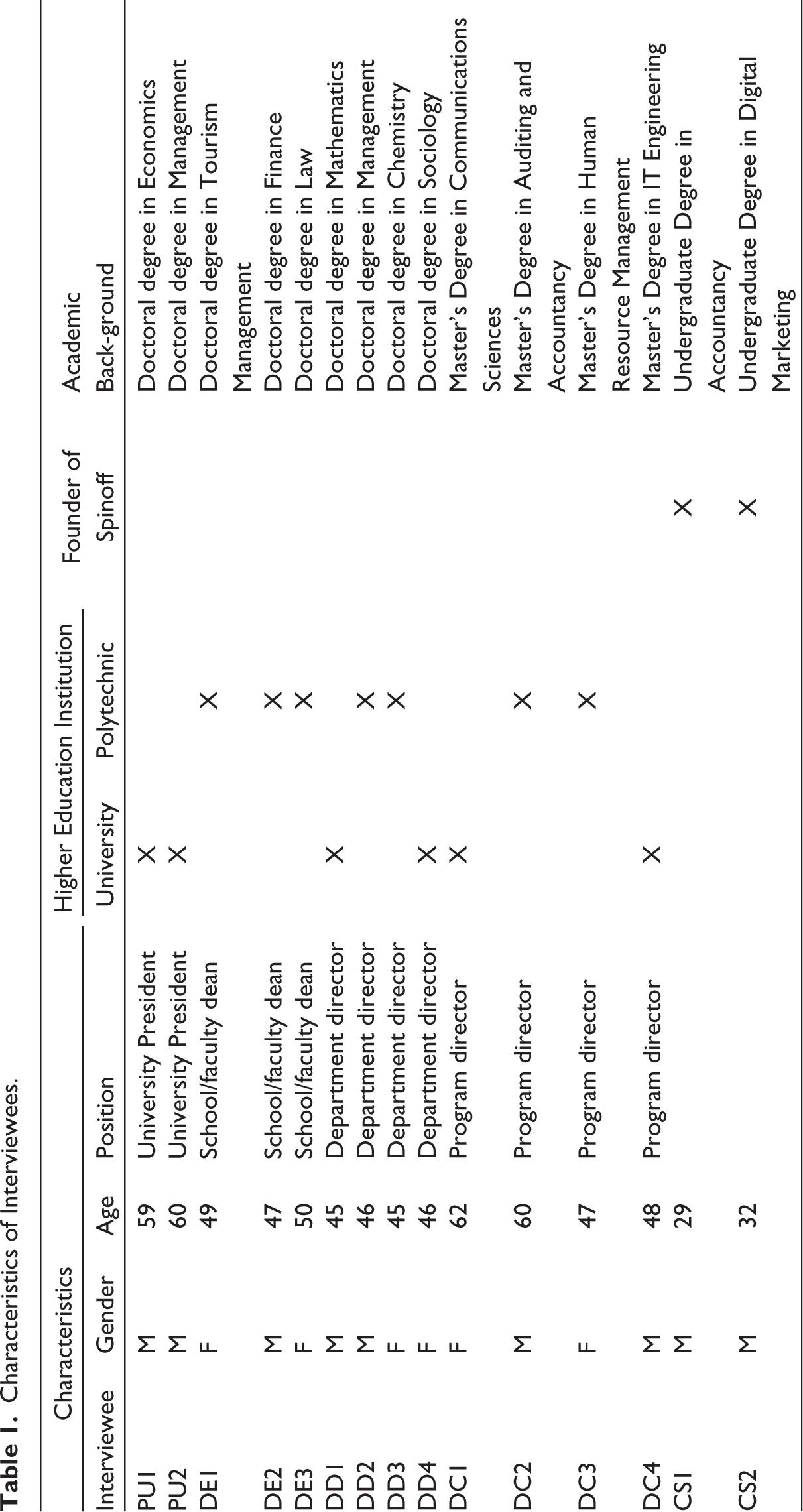
Based on the literature review, the interview script of Miranda et al. (2018) was adapted with its mutually interrelated and structured questions. Interviews of 15 participants (13 hold positions inside Portuguese public HEIs and two spinoffs), who hold knowledge about the theme under study and are capable of producing narratives about the role of EO and HEIs in the founding and development of academic spinoffs (Table 1), were undertaken. These interviews involved diverse participants: university presidents (n = 2 and hereafter referred to as PU1 and PU2); school/faculty deans (n = 3 and hereafter referred to as DE1, DE2 and DE3); department directors (n = 4 and hereafter referred to as DD1, DD2, DD3 and DD4); degree program directors (n = 4 and hereafter referred to as DC1, DC2, DC3 and DC4) and founders of spinoffs (n = 2 and hereafter referred to as CS1 and CS2). Coding of the interviewees was done for maintaining the anonymity of interview participants. Table 1 presents a brief overview of the interviewees’ characteristics.
Characteristics of Interviewees.
During the interviews, the interviewer posed direct questions which were limited in number. However, two main focal points were taken into account—not restricting the information provided by the interviewee, and guiding the interview so that it does not stray from the area of the study.
The interview script featured eight questions divided into four groups. The first group detailed the personal characteristics of the interviewees. The second group contained questions regarding academic entrepreneurship and the third group of questions approached academic spinoffs and the last group dealt with questions about the EO of universities. The interviewees were contacted by e-mail and telephone to schedule the interview date and time. The interviews took place via the Zoom platform between 22 June 2022 and 29 July 2022 and lasted an average of 30 minutes to capture interviewees’ perceptions about the role of EO and HEIs in creating academic spinoffs.
Data Analysis
Data analysis incorporated the following four stages. In the first stage, after transcribing the interviews, the collected information were submitted to content analysis, a widely used qualitative research technique, which consists of a set of systematic text analysis techniques (Hsieh & Shannon, 2005), allowing the definition and analysis of information categories (Weber, 1990).
The second phase began with the content analysis by identifying initial concepts in the data and grouping them into categories (Strauss & Corbin, 1998). It used the language of the interviewees, brought together and compared it (Gioia et al., 2013). At this stage, the views of different interviewees were compared to identify similarities and differences across all categories. This was followed by continuous iterations and reflection following the constant comparative method (Jack & Anderson, 2002) to analyse qualitative data. This approach also helped to determine the sampling and content foci for later data collection. The similar sentences of the interviewees were grouped into first-order groups (Corley & Gioia, 2004).
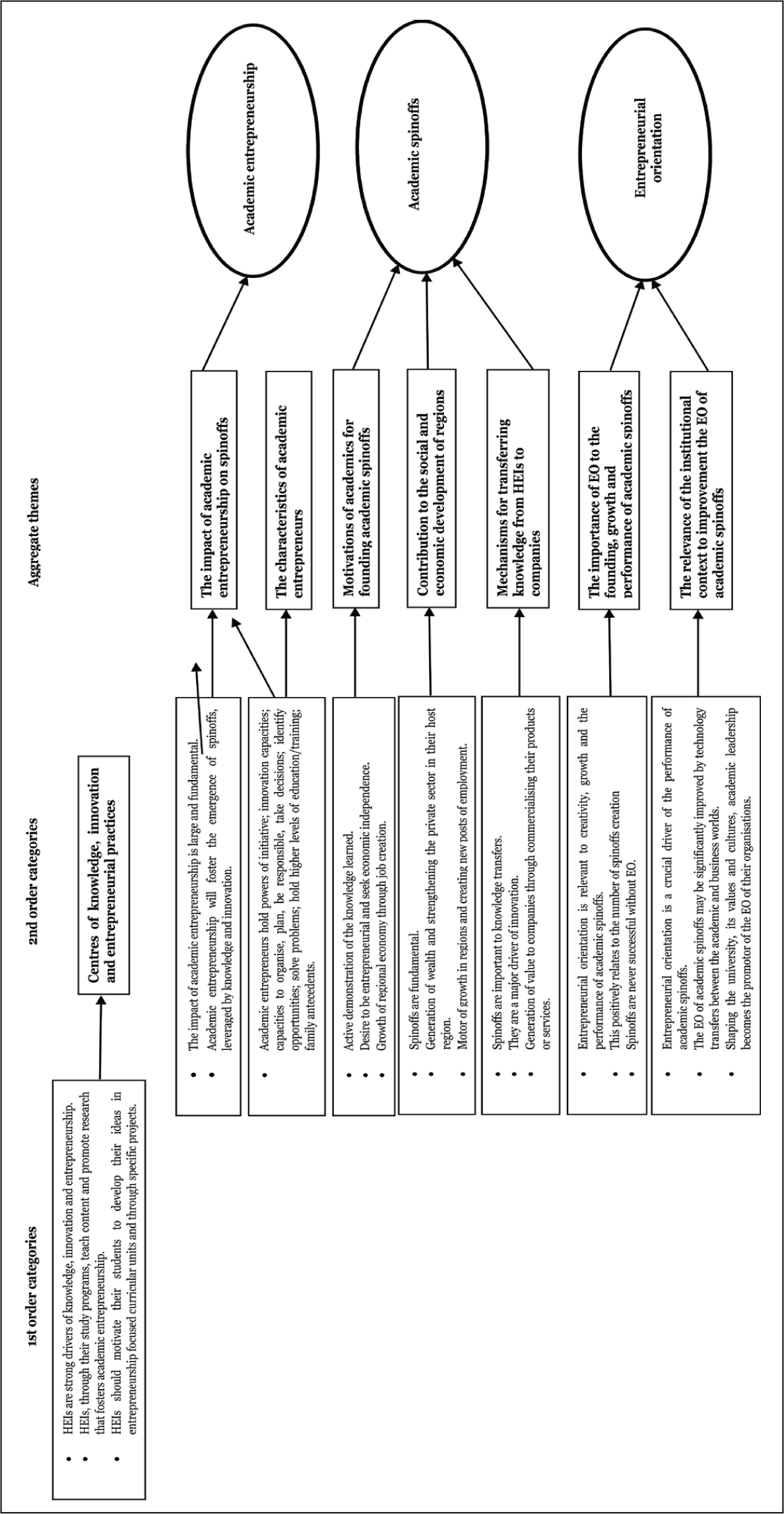
In the third phase, and following the aforementioned grouping of similar sentences, the researchers compared them to identify their patterns and derive more specific second-order categories. The main patterns in the answers were categorised into the following themes: (i) centres of knowledge, innovation and entrepreneurial practices; (ii) the impact of academic entrepreneurship on spinoffs; (iii) the characteristics of academic entrepreneurs; (iv) motivations of academics for founding academic spinoffs; (v) contributions to the social and economic development of regions; (vi) mechanisms for transferring knowledge from HEIs to companies; (vii) the importance of EO to the founding, growth and development of academic spinoffs; and (viii) the relevance of the institutional context to improvement the EO of academic spinoffs.
Table A1 presents sample quotes that highlight each of these dimensions.
The fourth and final stage transformed the aforementioned provisional categories into theoretical codes: (i) academic entrepreneurship, (ii) academic spinoffs and (iii) EO. Figure 1 depicts the data structure.
Data Structure.
Academic Entrepreneurship
Regarding the role of HEIs as promotors of academic entrepreneurship, we interpret how the mission of universities has evolved over recent decades to result in rising levels of adaptation to the needs of society and nurturing the entrepreneurial spirit of their academics. There was a broad consensus among the interviewees, who stated that HEIs are taking on a new mission and are centres of innovation and knowledge, thereby fostering academic entrepreneurship. On this issue, DE1, DE3, DD3, DC1, DC3 and CS1 all state:
‘The HEIs increasingly have entrepreneurial roles, through the various departments of schools that encourage the entrepreneurial and innovative spirit’.
Furthermore, DC1, DC3 and DE1 present similar arguments: ‘The HEIs contribute to the development of knowledge at the academic level and the strategies for sharing know-how contributing to academic entrepreneurship’; ‘HEIs are centres of research that enable student involvement in projects, thus developing their entrepreneurial spirit through the search for opportunities, innovation and creativity’ and ‘HEIs are dynamic drivers of knowledge, innovation and entrepreneurship’.
Second, the interviewees referred to how HEIs act to foster academic entrepreneurship and increasingly engage in the transfer of knowledge and technology to the community and in this sense have begun paying greater attention to academic entrepreneurship:
HEIs play an important role in developing knowledge and science and in the transfer of this knowledge to business organisations’ (DD3); ‘hold a fundamental role in making available scientific capacities, knowledge, and technology susceptible to transformation into businesses, through the transfer of this knowledge, contributing to economies in this way. (DE3)
Furthermore, various interviewees believed that the role of HEIs as promotors of academic entrepreneurship extends in the direction of running entrepreneurship units and displaying entrepreneurial practices, thus, fostering initiatives to deepen the entrepreneurial spirit, through various means such as conferences, post-graduate programs, master’s and doctoral degrees and incorporating the subject matter into the different study cycles:
‘The role of HEIs should be, in the first place, running a Centre of Entrepreneurship and Innovation’ (CS1); the teaching staff foster entrepreneurship through the continuous transmission of knowledge and the incentives that lead to the innovative spirit and that HEIs in recent years have invested greatly in with competitions run internally, fostering entrepreneurial and innovative projects and providing support to students who advance with their projects, offering installations with incubators for them. (CS2)
PU1 stated that
the role of HEIs should be as a catalyst and promote the involvement of students as a means of motivating them to develop their ideas. This may be done in specific curricular units on entrepreneurship, as well as in specific projects such as, for example, Poliempreende and Link me Up.
Meanwhile, PU2 stated, ‘the teaching of entrepreneurial practices, that is, providing students with situations or projects that may stimulate the entrepreneurial spirit’, are crucial to HEIs nurturing academic entrepreneurship. Interviewee DE2 added that
HEIs promote academic entrepreneurship through the continuous transmission of knowledge and incentives that help build the innovative spirit and HEIs, in recent years, have invested greatly in internal level competitions, promoting entrepreneurial and innovative projects, and later supporting students who advance with these projects, providing them with installations and incubators for their development.
In turn, DD4 affirmed that ‘HEIs, through means of post-graduate programs, master’s and doctoral degrees should foster academic entrepreneurship, whether through means of lecturing content or backing for research’.
In relation to the impact of academic entrepreneurship on the founding, growth and performance of academic spinoffs, the interviewees were unanimous in affirming that the impact of academic entrepreneurship provides a fundamental input. DE1, DE3 and DD3 maintained that academic entrepreneurship leads to the emergence of academic spinoffs and DE2 emphasised how innovation and knowledge drive the creation of spinoffs:
‘It’s through academic entrepreneurship that spinoffs are created’; and ‘academic entrepreneurship, through means of the contents disseminated, as well as the academic involvement, will lead to the emergence of spinoffs, leveraged by knowledge and innovation’.
As regards the characteristics of academic entrepreneurs, the interviewees were all in agreement and listed personal characteristics, characteristics related to their academic backgrounds, family antecedents, professional experience, as well as referencing as a characteristic of the knowledge they acquire from HEIs:
‘Power of initiative and capacity for innovation’ or ‘capacity for organisation, planning, responsibility, decision-making, identification and resolution of problems’ (all interviewees); ‘people with higher levels of education, with large networks of contacts, and who hold the advantage of being inserted into HEIs’ (DE2); ‘the family antecedents, take on great relevance’ (DD2 and DC2); also when they already hold professional experience, we verify how that same experience can positively contribute to the emergence of entrepreneurs and to a subsequent greater facility for setting up academic spinoffs’ (PU2); beyond the individual characteristics, the knowledge acquired from the HEIs is crucial in terms of different fields and arguing ‘that academic entrepreneurs have more means and technologies available that then serve for the creation of academic spinoffs’ (PU1 and DD4).
Academic Spinoffs
During the interviews, we interrogated the motivations for academics to create a spinoff and gained insights into the diversity of motivations, including those of a personal nature: ‘self-realisation, dynamism, opportunity’ (PU2) or ‘the desire to become entrepreneurs and seek economic independence’ (DD2) as well as ‘having a product on the market’ (CS2); and according to DD1 and CS1, what motivates academics to advance with spinoffs is ‘the fact that spinoffs provide an opportunity for employment in which academics apply a great deal of the knowledge learned during their time in the HEIs’.
Furthermore, a strong motivational desire for academics to set up spinoffs derives from the HEIs:
‘The motivation and courage transmitted by the lecturers and the development of a creative and innovative spirit’ (DC3); ‘the great motivation arises from the impetus to actively demonstrate the knowledge learned’ (DE2); with DD1 adding that ‘students are very often encouraged to creation a spinoff under the influence of the HEIs they belong to’.
From the interviews, it may also be concluded that the economic growth of their host region provides another motivation for academics advancing with spinoffs such that they may combine personal motivations with that what stems from their HEIs while contributing economically to the region of their location:
Academic spinoffs contribute to the growth of regional economies through the creation of more jobs, so, the motivations underlying the roots of the creation of an academic spinoff go beyond profit. Developing the economic reality of the assumptions developed in scientific research is one motivation behind creating an academic spinoff. (DE3)
When questioned about whether academic spinoffs contribute to the economic and social growth of their host regions, the overwhelming majority of interviewees deemed their role as fundamental in creating wealth and employment and, consequently, enhancing the regional economy:
‘Spinoffs create wealth and strengthen the private sector in the regions they are located in’ (PU2 and DE1); ‘they are the motor of regional development, generating posts of employment based on knowledge and innovation, generating value from a more sustainable perspective’ (DE3, DD3, DD4 and CS2); and PU2, DE1, and DD1 also added that ‘the impact of academic entrepreneurship is increasing for local economies and HEIs, given that most academic spinoffs only get creation through means of academic incentives but can then shape the local economies and consequently the reputation of HEIs’. The respective interviewees continued in stating that ‘this situation is more notable in lesser developed regions to the extent that innovative companies in the area may attract more target-publics, helping to ensure the growth of the spinoffs themselves and regional economic growth’.
Only DD2 and DC3 returned contrary opinions to their peers in not considering spinoffs as fundamental:
‘Spinoffs do not contribute to the economic and social growth of their host regions’ (DD2); and there certainly are spinoffs that contribute to the economic and social growth of their respective regions. This would be one of the objectives of the regions and institutions that host them. Indeed, beyond contributing to economic growth, they may raise the visibility and reputation of the stakeholders involved. However, on occasion, due to the lack of support at various levels, these spinoffs tend to relocate in search of better economic returns whenever they do not obtain them in the creation region. (DC3)
Most of the interviewees felt that academic spinoffs have become one of the most useful mechanisms for the transfer to companies of the knowledge generated by the R&D of HEIs:
‘Academic spinoffs represent a major motor of innovation, passing onto companies this same innovation (knowledge that is transformed into technology), generating value for companies through the commercialisation of their products or services that incorporate this same technology’ (DE2 and DE3); and PU2 and DC1 also stated that ‘not only are they useful but also essential so that there is no rupture between science and the business world and society in general’.
For two of the interviewees, the spinoffs were not relevant to the transfer of R&D knowledge produced by HEIs for companies. They opined that the spinoffs ‘are a mechanism for this, however, they are not the only one nor even the most important. Most of the knowledge and research, disseminated and dealt with through the HEIs, are important contributions for this to bear fruit in the business sector’ (DD1 and CS2).
Entrepreneurial Orientation
The empirical evidence described above demonstrates the relevance of EO to the founding, growth and development of academic spinoffs in keeping with how the interviewees made numerous references to the various dimensions of EO as being of great importance to HEIs and associating EO to the transfer of knowledge and setting up spinoffs:
‘Yes, and in the case of an HEI, this EO is based not only on the innovation and motivations of the participants’, but ‘also on the consolidated usage of methodological knowledge’ (PU2); ‘Yes and the development of an EO is important to effectively managing the research carried out in the academic context and to the commercialisation of the resulting innovation in industry’, with DE2 adding that ‘EO is positively related with the number of spinoffs created’; and ‘yes, and there needs to be an EO for the transfer of knowledge and the development of spinoffs’ (DE3 and DD3). In turn, DC3 responded that ‘yes, as these spinoffs in the majority of cases are aggregated in research centres in which the core activity is precisely the transfer of the knowledge, research and development of projects’. In turn, interviewee DC4 went further in stating that ‘a spinoff will never be successful without EO, especially without innovation, proactivity and accepting risks’.
Finally, this study observed that the institutional context is relevant to enhancing the EO of academic spinoffs; the interviewees referred to this. However, across all the interviews, this question received the most disparate responses from interviewees:
‘The institutional context is fundamental to the improvement of the EO of academic spinoffs’ (DE2, CS1 and DC1); and ‘the institutional context is relevant to enhancing the EO to the extent that this EO is a crucial driver of the performance of academic spinoffs’ (PU1). Meanwhile, PU2 and DE1 responded that ‘technology transfers between the academic and business worlds may significantly improve the EO of academic spinoffs’. In addition, CS2 answered that ‘the EO of any HEI should take into account the alignment and integration of all projects and partnerships, for the construction of consistent paths and consolidated networks between HEIs and academic spinoffs’. DE3 and DD3 responded similarly ‘in shaping the university, its values, and cultures, academic leaders become the promotors of the EO of their organisations’. DD2 and DD4 also provided similar responses in stating ‘the institutional context is highly important as this exposes the spinoff to various sources of technical and scientific knowledge that would otherwise be very difficult to aggregate, such as the level of innovation, proactivity and risk-taking’.
Discussion
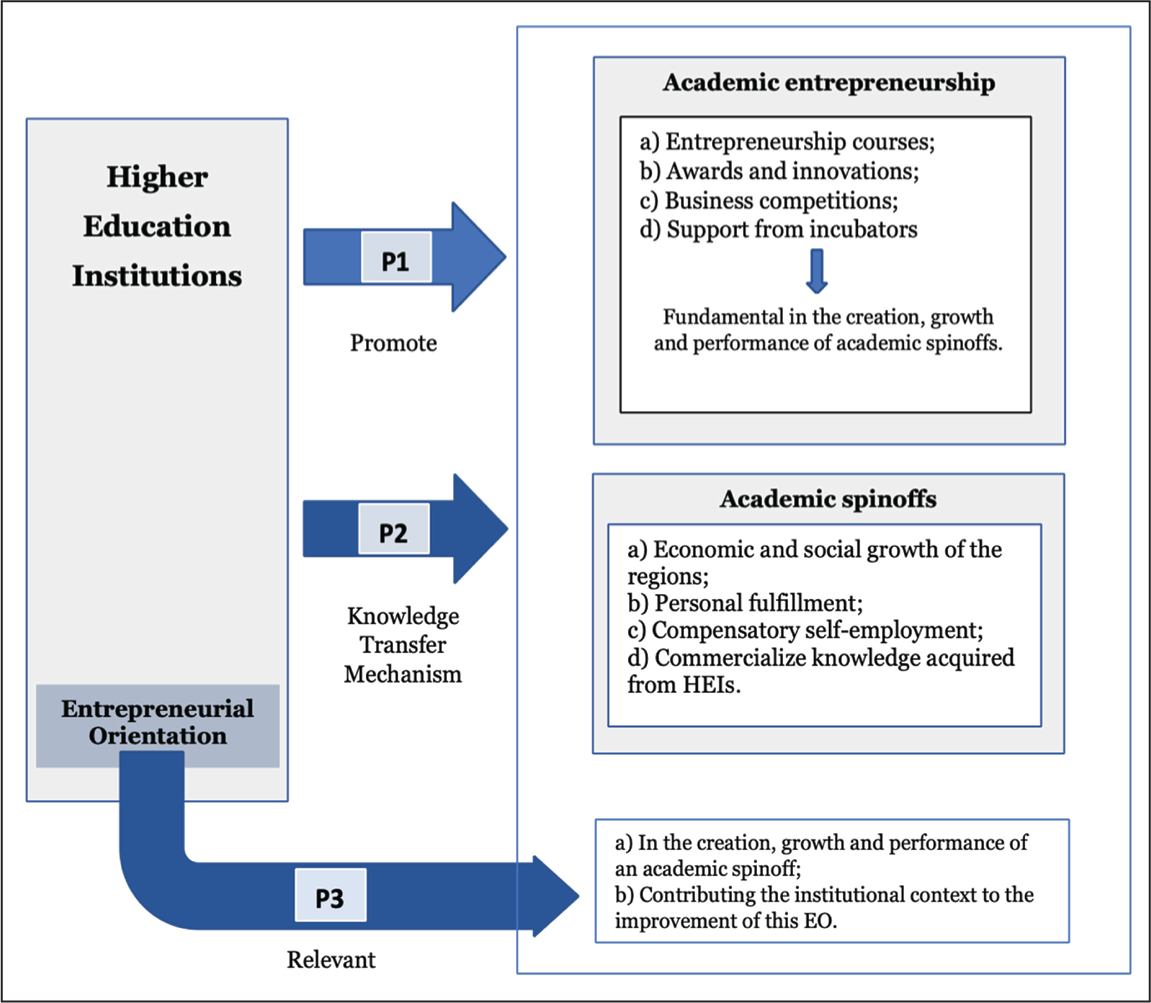
Based on the findings set out above, this section advances a structural process for the role of EO and HEIs in academic spinoffs and academic entrepreneurship as detailed in Figure 2.
The EO Framework of HEIs for Founding and Developing Academic Spinoffs.
First, the core objectives of this study involved contributing to a deeper understanding of (i) the ways HEIs encourage and incentivise academics to create academic spinoffs; (ii) what motivates academics to create spinoffs; and (iii) how EO enable the founding, growth and performance of academic spinoffs.
Based on the empirical results, this qualitative study demonstrates the important role played by HEIs as promoters of academic entrepreneurship in keeping with how academic entrepreneurship is fundamental to the creation, growth and performance of academic spinoffs. Furthermore, this study also shows that the major motivations for establishing academic spinoffs include self-realisation, the transfer of knowledge acquired in HEIs and the search for economic independence. The findings also convey how EO is relevant to the creation, growth and performance of academic spinoffs with the HEIs contributing to enhancing this EO.
Hence, in the case of academic entrepreneurship, the findings strengthen the results of the study carried out by Muscio et al. (2022) which highlights how the creation of spinoffs by students represents a growing trend in keeping with the encouragement of academic institutions to become more entrepreneurial, running entrepreneurship programs, providing support for installations such as company incubators, business competitions and innovation awards.
This study deepens the understanding of the fundamental impact of academic entrepreneurship on the creation, growth and development of academic spinoffs. Hence, this study corroborates what Ahmad et al. (2018) already put forth when describing how the creation of spinoffs represents a vital facet for any university with inclinations towards entrepreneurship.
As regards the characteristics of academic entrepreneurs, the empirical data in this study demonstrates how training and education, alongside family antecedents, hold great relevance. It suggests that professional experience positively contributes to the emergence of entrepreneurs and correspondingly greater facilities for creating academic spinoffs. According to the interviewees, training/education, family antecedents and professional experience emerge as core factors as stated by Migliori et al. (2019), who argue that individual and team-level characteristics determine the emergence of academic spinoffs. It may, therefore, set out the following proposition:
Proposition 1: HEIs promote academic entrepreneurship through (a) entrepreneurship programs/courses, (b) prizes and innovation awards, (c) business competitions and (d) support for incubators, which are fundamental to the founding, growth, and performance of academic spinoffs.
Second, this qualitative study shows that personal self-realisation, the transfer of knowledge acquired in HEIs and the quest for financial independence stand out as the major motivations for academics engaging in academic spinoffs. Therefore, this study aligns with the literature indicating that students seek to use their knowledge and abilities gained during the learning process (Colombo & Piva, 2012). This study also reflects the position of Czarnitzki et al. (2016), who state that academic spinoffs may represent an opportunity to commercialise the knowledge developed within the university and generate worthwhile self-employment. This furthermore deepens the findings of the studies by Berggren (2017) that identify how the motivations of academics over setting up spinoffs also derive from a sense of social responsibility and a need to deploy their knowledge and abilities through participating in technology transfer processes. It also highlights how these leading motivations incorporate the transfer of the knowledge acquired in HEIs corroborating the proposition of Diánez-González et al. (2021), stating that the majority of academic spinoffs are founded and managed by academics from institutions where the knowledge and technology available serve as the foundations for the creation of new companies.
Regarding the contribution of academic spinoffs to the economic and social growth of their host regions, as proposed by Miranda et al. (2017), academic spinoffs contribute to generating new businesses, job creation and maintaining a balance in the economic system. Czarnitzki et al. (2016) also put forward academic spinoffs as the source of contributions to economic and social growth and the prosperity of their surrounding regions. Fini et al. (2017) maintain that academic spinoffs based on knowledge and technology are the central drivers of economic, social and technological development. Hence, we may report that academic spinoffs are highly important to the economic and social growth that contribute to the regional economy and job creation.
The results of the research also portray how academic spinoffs represent one of the most useful mechanisms for transferring the knowledge and research, and development of HEIs to the private sector. This result strengthens the position of Borges and Filion (2013), who propose that academic spinoffs have taken on one of the leading roles in transferring technology and knowledge. This also aligns with Miranda et al. (2017) and Rubini et al. (2021) who maintain that academic spinoffs represent a priority mechanism for transferring the knowledge produced by the R&D of HEIs to companies.
In accordance with this, the second proposition can be arrived at:
Proposition 2: Academic spinoffs provide one of the most useful mechanisms for transferring knowledge from HEIs, thereby contributing to (a) the economic and social growth of their host regions, (b) personal self-realisation, (c) worthwhile self-employment and (d) commercialising the knowledge acquired in HEIs.
Thirdly, the study also tested EO. It was studied whether EO is relevant to the founding, growth and performance of academic spinoffs with the study participants unanimously affirming this significance and asserting that no academic spinoff will ever obtain success without an EO. Notably, this study portrays two distinct patterns. The first one is observed and already detailed by Knockaert et al. (2011), who defend how, in the context of academic entrepreneurship, the role of EO may be especially important given that academic spinoffs may require the development of entrepreneurial strategies to orient their innovations commercially. Additionally, the results also reflect the findings of Riviezzo et al. (2019) showing how EO positively interrelates with the number of spinoffs created. This corroborates the findings of Verbano et al. (2020), who point to the relevance of EO to the growth of academic spinoffs stating that EO provides a catalyst for the formation of an entrepreneurial team and a motivator for the performance of academic spinoffs.
The study also tested how the institutional context shapes the EO of academic spinoffs and it found that the offices for transferring knowledge and technology are important to improving EO and consequently exposing spinoffs to various sources of technical and scientific knowledge that help deepen their levels of innovation, proactivity and capacity to take on risks. Thus, the findings correspond to those of Diánez-González et al. (2021), who empirically demonstrate the relevance of the institutional context to the improvement of the EO of academic spinoffs and emphasise how the EO of academic spinoffs may receive significant improvements through the role of offices for transferring technology and as connectors between the academic and business worlds. The results are also consistent with Civera et al. (2020), who convey how the human capital of the university leadership performs an important role in the case of academic spinoffs as these leaders shape the university, values and cultures and act as promoters of EO in their organisations. Keeping the arguments set out above, the third proposition is presented as follows:
Proposition 3: EO is relevant to the creation, growth and performance of academic spinoffs with the institutional context enhancing their EOs.
Theoretical Implications
The current study emphasises (i) the role of HEIs and (ii) academic entrepreneurship for academic spinoffs, especially the creation, growth and performance of academic spinoffs, thus reflecting the findings of authors including Kirby (2006) and Buarque et al. (2021). Furthermore, the empirical research strengthens the role of EO and HEIs in the founding, growth and development of academic spinoffs, contributing to meeting the existing gap in the literature and reinforcing the studies of Riviezzo et al. (2019) and Verbano et al. (2020).
Consequently, it identifies three new research propositions about academic spinoffs. It also details the existence of eight first-order categories, which convey the most prominent answers in this study, and eight second-order categories, which led to the three grouped themes of study (academic entrepreneurship, academic spinoffs and EO).
The empirical study verifies a strong dependence between these three themes; hence, academic entrepreneurship is fundamental to academic spinoffs, but both require EO as an essential factor for success. The emergence of academic spinoffs primarily derives from knowledge transfer activities. It also ascertains how the motivations of academic entrepreneurs in creating academic spinoffs stem from a strong desire for personal self-realisation and a need to experience the deployment of their knowledge. Academic entrepreneurs dedicate themselves to improving society through transferring and disseminating technology (Berggren, 2017).
This study also lends additional support to the existing literature on academic spinoffs and contributes to the theory by expanding the applicability of EO in an otherwise poorly explored context, that is, studies focusing on company creation within the boundaries of universities (academic spinoffs).
It is believed that this analysis of Portuguese HEIs provides an important vision of how the phenomenon of academic spinoffs has spread and received acceptance in other countries of Europe. Finally, this research results indicate significant consensus within the academic community regarding academic entrepreneurship and academic spinoffs and that the EO and HEIs represent fundamental factors for academic spinoffs.
Practical Implications
The results suggest that EO and academic entrepreneurship both influence academic spinoffs. Therefore, the study puts forward a new perspective and methodology to identify the factors that nurture EO and HEIs, academic entrepreneurship, and the founding, growth and development of academic spinoffs.
The study makes a significant contribution to the extent that the sample features the presidents of both universities and polytechnics, faculty directors and directors of study programs at Portuguese state HEIs, the founders of spinoffs with different academic backgrounds. These important players in the process show just what their optimal strategy might be for founding and developing academic spinoffs in keeping with the EO of their HEIs.
The results also hold relevance to HEIs and their entrepreneurial teams leading academic spinoffs, especially regarding technology and knowledge transfer offices as these attain the greatest relevance when oriented towards the market and thereby improve business performance.
Limitations and Further Studies
This study has a few limitations. First, the empirical study spanned only the context of Portuguese public HEIs. Hence, any generalisation of the results is limited since this study did not include private HEIs or consider other international contexts. However, this study includes a range of interviewees who hold different positions within public HEIs and with different research interests and academic backgrounds, such as university and polytechnic presidents, school, faculty and study program directors at HEIs and, thus, advances the understanding of how the EO and HEIs enable the creation, growth and performance of academic spinoffs.
As future lines of research, there would be significant benefit from undertaking comparative empirical research and extending this methodology to the HEIs of other countries, especially other European countries, and verifying the differences among the HEIs from different settings, with differences in their university governance structures. Furthermore, future research may complement this study by including private HEIs rather than exclusively approaching public HEIs, as in the case of this study.
Another limitation relates to the number of founder interviewees, which included only two different spinoff founders. Thus, this limited number restricts the generalisability of the research results. Further studies are needed to expand this sample. Furthermore, this theme was approached only from a qualitative perspective and, as such, even while this methodology displayed its effectiveness, this may have conditioned the nature of the responses. Therefore, it is suggested that future research may expand the data collection methodology to ensure validity and generalisability of the findins of this study
Future studies could adopt more diversified and sophisticated analytical techniques than those hitherto applied. Furthermore, it is also important to carry out a longitudinal study to observe the impacts of EO and academic entrepreneurship.
Footnotes
Declaration of Conflicting Interests
The authors declared no potential conflicts of interest with respect to the research, authorship and/or publication of this article.
Funding
The authors received no financial support for the research, authorship and/or publication of this article.