




Abstract
This paper reviews the key theories of the firm and considers their relevance to studying and understanding academic spinoffs as a special case of firms. The theory of the firm is an important aspect in entrepreneurship literature, as without clear understanding of the parameters influencing firm's behaviour, it remains difficult to predict its decisions to secure sustainable growth and ensure development of the economy overall. The paper considers the contribution of transaction cost theory, managerial theory, resource-based view, knowledge-based view, and dynamic capabilities, to the understanding of the academic spinoff. In essence, these theoretical explanations lend multiple perspectives that offer a greater insight into the academic spinoff firm by illuminating the issues of its boundaries, entrepreneurs, resources, knowledge, and networks. It is concluded that understanding academic spinoffs requires acknowledging this theoretical plurality. In response to this challenge, the paper proposes the Academic Spinoff Theory of the Firm.
Keywords
Introduction
Academic spinoffs (ASOs) are one of the key mechanisms for universities to engage in regional economic development, allowing more direct and tangible involvement in such process (Bower, 2003). ASOs are companies that commercialise university faculty's research by establishing a firm to lead the development of the underlying knowledge into a product or service that can be sold in markets. As such, ASOs are unique in that they originate from a non-commercial background, yet many are very successful at both attracting venture capital and achieving high rates of survival (Prokop et al., 2019). The founding academic typically becomes the entrepreneur leading the development of the company, often without prior entrepreneurship or industry experience, reflecting public sector attachment (Colombo and Piva, 2012). In overcoming this, many universities started using surrogate entrepreneurs to instil a more commercially oriented focus in spinouts (Franklin et al., 2001).
Dasgupta and David (1994) argue that commercialising university knowledge is a difficult process, as it involves the transfer of tacit and codified knowledge in order to achieve full economic potential. This attribute together with the involvement of the academic behind the knowledge production makes ASOs one of the most effective forms of university-generated knowledge transfer (Bekkers and Freitas, 2008), given their ability to envelop both codified and tacit elements of knowledge in a single form. This challenging character attracts both hope of economic impact through the creation of highly-skilled employment opportunities (Shane, 2004), and critique, as universities devote disproportionate amounts of attention to ASOs (Lambert, 2003), which may have limited effects as many remain small businesses (Harrison and Leitch, 2010).
The resultant scholarly focus on ASOs asserts the need to better understand how such companies are formed in the first place (e.g. Franklin et al., 2001; Landry et al., 2006) or their performance (Bolzani et al., 2020; Ortín-Ángel and Vendrell-Herrero, 2014), revealing a continuous interest of academic entrepreneurship scholars (e.g. Bagchi-Sen et al., 2020; Verbano et al., 2019). However, limited scholarly attention has been devoted to theorising the ASO firm.
As such, this paper aims to bridge this gap by exploring how some of the major theoretical foundations enable understanding of the ASO firm. In doing so, the paper draws on key theories of the firm, namely: transaction costs, managerial, resource-based view, knowledge-based view, and dynamic capabilities, to propose one that captures and extends these rich perspectives, namely the Academic Spinoff Theory of the Firm. These theories have been selected as some of the more commonly used in academic entrepreneurship studies (e.g. Bessiére et al., 2017; Hayter, 2016; Messina et al., 2022; O’Shea et al., 2005) as well as for their coverage of issues characterising the typical ASO: public and private contexts, management issues, resource constraints and knowledge dependence, as well as ability to transform its capabilities. The paper employs a narrative literature review to examine these developments in proposing the Academic Spinoff Theory of the Firm. The article adds to understanding of the ASO firm by recognising its networked and spatial character.
The paper begins by discussing transaction costs theory, managerial theory, the resource-based view, the knowledge-based view, and dynamic capabilities. It concludes by proposing the Academic Spinoff Theory of the Firm.
Transaction cost theory
Although the profit maximisation theory could be portrayed as a plausible explanation of a firm's goal (Hillmann, 1939; Machlup, 1946, 1967), it clearly fails to explain why firms exist in the first place, and how the profit maximisation or earning of revenue is achieved. Undisputedly, the most influential responses to those questions has been given by Coase (1937), who first posed such problems. For Coase the firm is formed when there is an opportunity to produce a product below the cost of what is currently available on the market. The firm achieves its cost advantage by being organised under an entrepreneur/owner who is capable of managing firm's resources (inclusive of human, equipment etc.) at below market costs (Coase, 1937). The way the firm collects revenue is based on transactions (i.e. contracts) (Coase, 1937). The firm grows when the entrepreneur secures additional transactions, and shrinks (or exits the market) when the entrepreneur either abandons or starts securing fewer transactions (Coase, 1937).
Coase also notes that there is a diminishing return to organising additional transactions, limiting the growth of the firm, however he proposes that innovation would have the opposite effect, influencing growth. Therefore, he suggests that smaller firms have an advantage over larger ones with reference to Kaldor’s (1934) and Robinson’s (1934) diminishing returns to management concept, i.e. at some point in the firm's growth, management becomes erratic or too costly due to administrative burden. This notion has been contested by Florence (1934), who notes that firms achieve growth by enlarging their product portfolio, and that management could actually play a crucial role in growth through using top management techniques to achieve efficiencies, as well as by splitting managerial roles into general (e.g. line manager) and specialist (e.g. technical manager) functions. When a firm intends to reduce its costs, it can either start producing in-house or merge with/acquire its supplier (referred to as ‘combination’) (Coase, 1937).
Alchian and Demsetz (1972) deal with Coase’s (1937) central question of ‘why’ firms are formed. The existence of economic organisations (firms) as theorised by them is a more detailed picture of Coasian firm: a transaction-based entity, which utilises the transactions (or contracts) to efficiently manage productivity within an internal organisation's market (Alchian and Demsetz, 1972). This internal market is composed of employees and the transactions governing their work are employment contracts, which are flexibly executed (Alchian and Demsetz, 1972). The key to their theory is the measurement of productivity, which is performed more precisely and cost-effectively within an organised entity.
Coase's work has been further extended by Klein et al.’s (1978) who focus on firms dealing in vertical transactions, specifically earning rent on investments. In their theorising, firms that are linked through low quasi-rents (e.g. one firm earning quasi-rents from another for the use of their assets) are more likely to remain in contractual transaction-based relationships; conversely, those that are involved in high quasi-rents tend to integrate/merge (Klein et al., 1978).
Williamson (1979, 1981) has drawn scholarly attention to the internal organisation of the firm (Baudry and Chassagnon, 2010). He stresses the importance of dimensionalising transaction cost theory to develop a workable practical model. Williamson focuses on three core dimensions of transactions: (1) uncertainty, (2) frequency, and (3) the degree of specificity (Williamson, 1979, 1981). The context within which transactions occur differs across transactions and firms; however, Williamson admits himself that his dimensions are not exhaustive in defining a firm's behaviour (Williamson, 1979). The transactions of unspecialised assets (or in the case of human resources, unskilled) tend to be related to low uncertainty and higher frequency, which characterises markets with many actors (Williamson, 1981), pointing towards monopolistic competition (Chamberlin, 1933; Robinson, 1933). The character of such assets/resources is substitutable (Williamson, 1981). Conversely, transactions of highly specialised assets (e.g. skilled human resources) are related to high uncertainty and lower frequency, suggesting a market of a few actors only, with assets of this kind being hardly substitutable (Williamson, 1981). Such transactions are indicative of oligopolies (or in extreme cases, monopolies). Finally, Williamson (1981) stresses that human assets need to be considered in a network form due to their relational aspect.
Since markets are imperfect (Knight, 1921), the transactions/contracts between firms would reflect a similar character. Hart (1988) introduces an elaboration on Coasian theory in the concepts of incomplete contracts and residual right of control. An incomplete contract is one that does not account for all possible terms, as some eventualities might not be easily planned in advance, at times leading to revision of the contract (Hart, 1988). When one of the parties wishes to change the contract, it must seek the agreement of the other. The party that needs to agree has the bargaining power, and hence retains the residual right of control (Hart, 1988).
The transaction cost theory, although very attractive at explaining the behaviour of firms and has since been adopted in other fields (e.g. Rindfleisch, 2020), nevertheless is subject to many limitations. Notably, all scholars consider manufacturing firms, and base the theories on very limited assumptions. This simplifies the theory for comprehension, but excludes the parameters required for the complexity of the real world. Furthermore, the human element is rather suppressed in the considerations (with an exception of Alchian and Demsetz, 1972), as the behaviour of individuals could play an essential role in the behaviour of the firm.
In particular, it remains difficult to utilise transaction cost theory to explain ASOs. First of all, ASOs have a long product or service development path, and as a result their manufacturing activities (for a portion of firms) become important after a transitionary period of knowledge translation. Second, the products and services the ASOs transact have never been (and perhaps would never be) traded in an open market exchange, following original Coasian theorisation, due to the complexity of knowledge involved, strongly limiting the number of potential individuals or firms. Williamson (1979, 1981) suggestes that such high specificity of transactions could point to oligopoly or monopoly market structures, which could explain IP-based short- to medium-term monopolies enjoyed by ASOs thanks to patenting (Shane, 2004). However, internal transactions (Alchian and Demsetz, 1972), especially related to personnel, open an uncharted territory of ASO complexity with regards to academic founders. They straddle the internal/external boundary of the firm (Williamson, 1979), as they typically retain their university employment while simultaneously working in the ASO. Although their engagement with the ASO could be contract-based (Alchian and Demsetz, 1972), cross-boundary existence is not necessarily explained by Williamson’s (1979) theorisation, which has a strong binary character. Finally, as ASOs internalise innovation market based on university IP, they become intermediaries between public and private sector markets. Specifically, they are connected through shared ownership (equity stakes) and the academic founder. This connecting role of ASOs appears to have no particular explanation in transaction cost deliberations.
Managerial theory
The interest in the individuals running the firm has been very much part of the scholarly considerations within the theory of the firm (Coase, 1937; Florence, 1934; Harbison, 1956; Kaldor, 1934; Machlup, 1946; Machlup, 1967; Monsen and Downs, 1965; Reder, 1947; Robinson, 1934). However, it has never been put together into a clearly-expressed separate theory of the firm; rather, its ‘floating’ existence in the literature has been observed by Machlup (1967), and then Bartlett and Ghoshal (1993). The early foundations of the managerial theory note that there are diminishing returns to management (i.e. limiting firm's growth) (Coase, 1937; Hillmann, 1939; Kaldor, 1934; Robinson, 1934), although this is contested by Florence (1934; to some extent followed by Harbison, 1956), who points to management's functional specialisation and the use of the newest management techniques. However, with reference to the neoclassical profit-maximisation assumption, Machlup (1946: 524) notes that in reality: Business men do not always “calculate” before they make decisions, and they do not always “decide” before they act. For they think that they know their business well enough without having to make repeated calculations; and their actions are frequently routine.
In other words, the actual behaviour of the firms might not coincide with the expected behaviour of the firm due to firm's management, i.e. individuals. According to by Reder (1947: 451), a firm's output is dependent on the effort and skill of the management, adding a vital element of individual personal motivations to the understanding of the firm's behaviour. This in turn could lead to the perception of economic inefficiency of the firm (Harbison, 1956). In other words, firms might be acting more in a satisficing rather than efficient way (Monsen and Downs, 1965). As Monsen and Downs (1965), who focus on large firms, outline top managers that are only partial (i.e. minority shareholders) or non-owners of the firm might focus on uninterrupted steady growth, avoid making any radical decisions or investing heavily in radical innovations, as those could disrupt the firm's stable performance and undermine their job prospects. In a similar fashion, they describe lower-rank managers pursuing their own employment stability and progression goals by pleasing their superiors in the firm (Monsen and Downs, 1965: 236). The individual behaviour deviating from the utility maximisation has been further developed in prospect theory (Kahneman and Tversky, 1979) highlighting how decision-making is influenced by the way the problem is stated, leading to non-maximising behaviour (Levy, 1992). Similarly, Simon (1979) stressed that the individual's decision-making is subjected to bounded rationality, which limits the utility-maximising behaviour through cognitive and informational limitations.
Bartlett and Ghoshal (1993) engage in the task of theorising the firm by examining a multinational enterprise. In particular, they observe that firms are shaped through the roles played by different layers of management, and specifically, by redesigning these roles the traditional inefficiencies of management could be mitigated. They propose that front-line management should have a degree of empowerment to induce entrepreneurial behaviour among them, leaving the middle management with information brokerage and capability integrative roles, and top management with leadership roles.
Clearly, the behaviour of the firm deviates from the profit-maximisation assumption. Therefore, the role of human actors within the firm is crucial to understanding this behaviour, which might have a whole distribution of effects on firm's performance. However, within this contextualisation of the firm's existence, it is important to note that key managerial theorisations relate to large firms, in which management roles can be developed. Thus, these theories fail to take account of young or small firms, which may have no managerial levels or mainly owner-managers who, within their limitations, may make imperfect decisions.
In the context of ASOs, individuals involved in the formation and running of these firms could perhaps shed light on their behaviour, in particular related to company development, leading to sustainability issues. Particularly, ASOs are founded by non-market-oriented individuals (Fini et al., 2009; Goktepe-Hulten and Mahagaonkar, 2010) - i.e. academics, whose ownership of the firms is only partial due to stakes held by parent universities and investors. Thus, it is expected that ASOs led by academic founders would have a limited focus on economic efficiency (Monsen and Downs, 1965; Reder, 1947), which could translate into lower growth compared to ASOs managed by market-oriented individuals, for example, experienced management team (Franklin et al., 2001), or investors. This is noted in the academic entrepreneurship literature as ‘performance premium’ for younger ASOs (Czarnitzki et al., 2014).
Furthermore, as ASOs typically involve the academic founder, in cases when a professional management team leads the firm, a conflict of interests and motivations in terms of the direction of ASO ‘s development might arise between owners (i.e. academic founders, universities, investors) and managers (Reder, 1947). Some of these inefficiencies could be overcome through the use of skilled management or investment in training and development (Harbison, 1956). However, it is not stipulated whether training and development should focus on minimising the decision-making role of non-market-oriented owners, rather than transforming them into a skilled management team. Finally, managerial theorisations fail to capture small firms and rely on the development of management levels (Bartlett and Ghoshal, 1993; Monsen and Downs, 1965). As such, it is difficult to apply all tenets of managerial theory to ASOs, as many of them tend to be small or infant firms (Harrison and Leitch, 2010). Consequently, the theory provides some understanding of the behaviour of individuals within the ASO, especially around bounded rationality (Simon, 1979), related to motivations and productivity. Nevertheless, it does not permit understanding of firms that have complex ownership structures that span private and public sectors, organisations and individuals.
Resource-based theory
An alternative approach to the firm theory has been presented by Wernerfelt (1984) as resource-based view (RBV) of the firm. It considers the firm's resources, both intangible and tangible (including human actors and equipment, etc.), as the basis for understanding the firm. In other words, firms exist by managing their resources in an efficient way that secures them market advantage (Barney et al., 2001; Wernerfelt, 1984), which undoubtedly has Coasian roots (Coase, 1937; Kraaijenbrink et al., 2010), with management of resources to increase productivity pointed out by Harbison (1956). Wernerfelt (1984) states that four dimensions characterise a firm's competitive position in terms of resources: (1) resources need not be imitable, (2) nor substitutable, (3) resources should be unique to the firm, and (4) they need to build the firm's strength – thus be valuable. As Wernerfelt puts it (1984: 173): What a firm wants is to create a situation where its own resource position directly or indirectly makes it more difficult for others to catch up.
The RBV of the firm has been discussed and ‘re-theorised’ by other scholars (Barney, 1991; Conner, 1991; Conner and Prahalad, 1996; Prahalad and Hamel, 1990), who put it against the existing strong foundations of the Coasian (followed by Williamson, 1979, 1981) transaction cost theory (Conner, 1991; Conner and Prahalad, 1996). Nevertheless, their contribution is more in ‘translating’ (Barney, 1991; Prahalad and Hamel, 1990) or ‘converting’ (Conner, 1991; Conner and Prahalad, 1996) this theory, rather than building on it. More recently, RBV has been extended to account for resources that are released from the firm's control, further strengthening the competitiveness of the firm (Alexy et al., 2017) by positing that this strategic openness exercised over certain resources may reduce costs and maintain competitiveness if the firm develops complementarities to the open resource. Firm's competitiveness is then strengthened through its unique ability to employ the open resource rather than through the control of it. The complementary resources are particularly interesting, as their coordination by the firm's management may lead to different types of innovation activity, including incremental and radical (Stieglitz and Heine, 2007). In incremental innovation, firms build on existing complementarities, whilst in radical innovation, firms need to develop new ones and integrate them into the company's assets.
Undisputedly, the strongest point of the theory is the departure from the omission of the role of the firm's endowments in what the firm is, and recognising that without those resources it would be difficult to describe the behaviour of the firm. As noted by Conner (1991), RBV of the firm connects all other theories by its more comprehensive treatment of firm's parameters. For ASOs it helps in recognising the university's reputation effect as a unique resource contributing to their success (Bonardo et al., 2010). Nevertheless, firms develop and accumulate such resource strengths over time, and as a result RBV's main weakness lies in explaining the existence of infant firms (i.e. start-ups) that may have no strengths developed at the time, as RBV theorisations focus on established firms (Alexy et al., 2017; Wernerfelt, 1984). This is especially true for ASOs, whose only resource at company registration is its knowledge of untested applicability or usefulness. Furthermore, it remains difficult to establish whether having a university parent is an ASO's unique resource, i.e. reputation (Grandi and Grimaldi, 2003) or weakness, i.e. inefficiency stemming from academic's non-profit motivations (e.g. Goethner et al., 2012).
Finally, whilst ASOs accumulate resources by first acquiring and then developing them, RBV poses a particular paradox for explanation: early-stage ASOs equipped with untested and undeveloped knowledge (i.e. non-resource) receive investment (i.e. resource). From a resource-based point of view, this exchange should be impossible, as only established firms that have proved they possess unique inimitable and valuable resources could convey a message about their strengths to radiate credibility with which they attract investment, for example, by exchanging equity in a firm for funding. For ASOs, this unusual feature has prompted public intervention in market failure, by establishing publicly-sourced early stage funding (Huggins, 2008). Whilst RBV becomes useful once ASOs acquire some resources, its early stages cannot be accurately captured by the theory.
Knowledge-based theory
Although the RBV of a firm is very much an all-inclusive theory, what consistently transpires from the scholars is the increasingly important attention devoted to knowledge in various aspects related to markets and firms: uncertainty and risk in markets/knowledge asymmetry (Higgins, 1939; Knight, 1921), knowledge distance and decay in hierarchies (Robinson, 1934), knowledge as commodity (Coase, 1937), knowledge and uncertainty in firm survival theory (Alchian, 1950), knowledge/innovation as infinitely produced good (Penrose, 1952), asymmetric knowledge and its variable effect on decision-making (Simon, 1955), diminishing returns to information/knowledge and a ‘learning’/’adapting’ firm (Winter, 1964), and the contract/transaction cost relative to knowledge (Klein et al., 1978). Although in the RBV knowledge seems to be regarded as one of firm's many endowments, the turning point in the approach to understanding of the firm has come with the ‘knowledge-creating company’ (Nonaka, 1991, 1994). The firm is portrayed not as a resource-holder, but rather as a knowledge-endowed entity (knowledge-based view (KBV)), whose primary goals are to create and exploit knowledge, which provides it with a market advantage (Nonaka, 1991, 1994).
The core interest has been drawn to the individual in the firm, as the unit that possesses the knowledge (Grant, 1996), although some debate remains over the firm being responsible for knowledge creation (Spender, 1996), knowledge application (Grant, 1996) or both (Kogut and Zander, 1992; Nonaka, 1991, 1994). The core agreement in the versions of KBV of the firm is that the knowledge of individuals is managed at firm level (Grant, 1996; Kogut and Zander, 1992; Nonaka, 1991, 1994; Spender, 1996). Thus, the firm's ability to efficiently manage the knowledge of individuals is its main purpose, and how much more efficient it is than other firms in the market determines its competitive position.
Although knowledge and individuals in the RBV are regarded as firm's resources, their dynamics are only acknowledged in the KBV of the firm. The distinction between explicit and tacit knowledge with relation to its respective codifiability and transmissibility (Grant, 1996; Kogut and Zander, 1992; Nonaka, 1991, 1994; Spender, 1996) adds the necessary dimension that starts to consider the knowledge in a more networked sense. Kogut (2000) points to markets being nothing but networks of firms that trade knowledge, and the structure of the network and each particular firm's position in it determines its behaviour. This view could be further expanded by looking at it from the actor network perspective which involves individuals, organisations, and governments (Spender, 1996), positing that firms are embedded in highly complex multi-unit-actor networks, enabling both theoretical quality and complexity. In fact, this leads to a more organic view of the firm with its actors interacting, exchanging, processing and reproducing knowledge without being limited by strict organisational boundaries (Nonaka and Toyama, 2003).
Although the KBV of the firm appears to be a very appealing and even more all-embracing theory than RBV, it is clearly closely related to other theories, and the complimentary character is difficult to ignore (Grant, 1996). The theory seems to be broadly presented, yet it still appears to be interested mainly in multi-person firms (e.g. Nonaka, 1991), clearly leaving some theoretical gaps in excluding one-person firms, which exist in larger numbers.
In the context of ASOs KBV allows to resolve issues around placing knowledge of limited utility as an underlying resource of the firm (Van der Sijde and Van Tilburg, 2004). Firm's knowledge applicability and creation (Kogut and Zander, 1992; Nonaka, 1991, 1994) lends understanding of the untested IP ASO has been formed to exploit. Furthermore, KBV posits that knowledge resides in individuals (Grant, 1996), pointing to the core role played by academic founders of ASOs as tacit knowledge holders. Furthermore, the existence of other actors involved in ASO formation and development processes finds a clearer explanation here: experienced management teams employed in ASOs hold knowledge of business operations, whilst investors contribute their knowledge of the future value of the ASO. Although theory development has been based on large established firms (e.g. Nonaka, 1991), Spender’s (1996) multi-unit-actor networks contribute to understanding the complex positioning of a ASO between public and private sectors. Specifically, ASOs appear to exist as connectors between universities that generate knowledge, and the private sector that typically applies knowledge. Nevertheless, there remain unexplained aspects of ASOs, such as how a firm emerges in such networks, how it develops its network position, or how different structuring of its network position influences ASO ‘s survival. Although there have been some recent developments in the field (e.g. Prokop et al., 2019; Rasmussen et al., 2015), these issues still require further explanation.
Dynamic capabilities
Although dynamic capabilities (DC) are not precisely a separate theory of the firm, such aspirations could be sensed (e.g. Teece et al., 1997, 2019), hence it would be mere intellectual complacency to place DC with RBV as competing theories of the firm. RBV has a very strong focus on the endowments of the firm; however, these endowments being somewhat efficiently managed, however ambiguous it sounds, would seem to beg for an element that would complement the RBV's existence as a theory. Therefore, DC offer a missing theoretical element that defines what has not been defined before in the behaviour of the firm. The dynamic capabilities of the firm are about managing firm's competencies: (1) managerial and organisational processes, (2) specific (idiosyncratic) resources, and (3) evolutionary paths, in such a way that the firm's long-term competitive advantage can be secured (Teece, 2007; Teece et al., 1997). A slightly discounted DC view is presented by Eisenhardt and Martin (2000), who argue that effective dynamic capabilities are necessary, but not sufficient, conditions for competitive advantage (p. 1117), and could be best conceptualised as tools that manipulate resource configurations (p. 1118).
It is essential to note that in order to provide it with the competitive advantage, the DC of a firm must be purposeful, unique and inimitable (Teece et al., 1997). This is not far from the preconditions of the core competencies in the RBV of the firm (Prahalad and Hamel, 1990; Wernerfelt, 1984). Thus, the proponents of the DC argue rather cautiously that the DC are an extension of the RBV (Eisenhardt and Martin, 2000; Teece, 2007; Teece et al., 1997). Furthermore, capabilities are present as either ordinary or dynamic in a firm, with the first ones related to generic business administration, whilst the latter specific to the firm, impossible to internalise as they need to be organically developed (Teece, 2019). Finally, it is essential to observe the geographical context in that the local or regional environments influence firm's capabilities (Teece et al., 1997).
Overall, the contribution of the DC appears to position them as an element that strengthens the RBV, and yet it is a distinct piece of the puzzle in the theory of the firm. Its contribution to understanding ASOs can be derived from two core aspects: (1) evolutionary (Teece, 2007; Teece et al., 1997), and (2) geographical (Teece et al., 1997). From the evolutionary point of view, a ASO's metamorphosis from academic research into an untested IP-equipped firm and then into a successful business through the accumulation and development of dynamic capabilities expands the theoretical focus from pure knowledge or resource importance to less tangible processes. Furthermore, dynamic capabilities draw attention to geography ignored by other theories (Taylor and Asheim, 2001), which play a role in ASOs differential existence and survival outcomes across UK regions (Prokop et al., 2019), especially if sector clusters, financial and support institutions are considered. As such it allows to capture the complexity (Maskell, 2001) highlighted in economic geography.
Discussion and conclusions
The existence of ASOs is primarily based within knowledge transfer activity, clearly separating it from key theorisations of firms discussed here. As ASOs involve both public and private sector spheres within a region and multiple actors that cross traditional firm boundaries, it remains difficult to understand how they come to be, and their early stages in particular. Whilst some transitional processes are well captured by KBV, none of the theories depicted in this chapter are designed to explain ASOs, especially as the behaviour and development of these firms differ from typical private, manufacturing or large enterprises, as can be observed from extant research, e.g. performance premium behaviour (Czarnitzki et al., 2014; Ortín-Ángel and Vendrell-Herrero, 2014). Each one, however, seems to illuminate a different aspect of a firm's existence and activity. The attempt to combine those complementary theories seems like a natural answer to growing scholarly dissatisfaction with over-theorisation and division in the area of the theory of the firm (Hart, 1989; Machlup, 1967; Maskell, 2001).
ASOs exist as intermediary vehicles in university knowledge transfer. This process starts at the level of the university, passing through the medium of ASOs to reach the wider external environment of private industry or region. As such, stages of an ASO's development (e.g. Parmentola and Ferretti, 2018; Vohora et al., 2004) distinguish the ownership divide of the underlying knowledge. Initially publicly-owned IP, originating from research activity, undergoes a process of ownership transfer through an ASO until that knowledge becomes privatised. Consequently, the development of an ASO has a translatory character where knowledge becomes externalised with the firm's growth. These processes suggest boundaries of the networks in which ASOs exists. These include a spectrum, with ASOs positioned within a university's entrepreneurial ecosystem (Prokop, 2021), but also reaching out to a broader regional ecosystem. A summary of this paper's main theoretical contributions to understanding an ASO is depicted in Table 1 across six dimensions identified in the literature discussed.
Summary of theoretical underpinnings of academic spinoff.
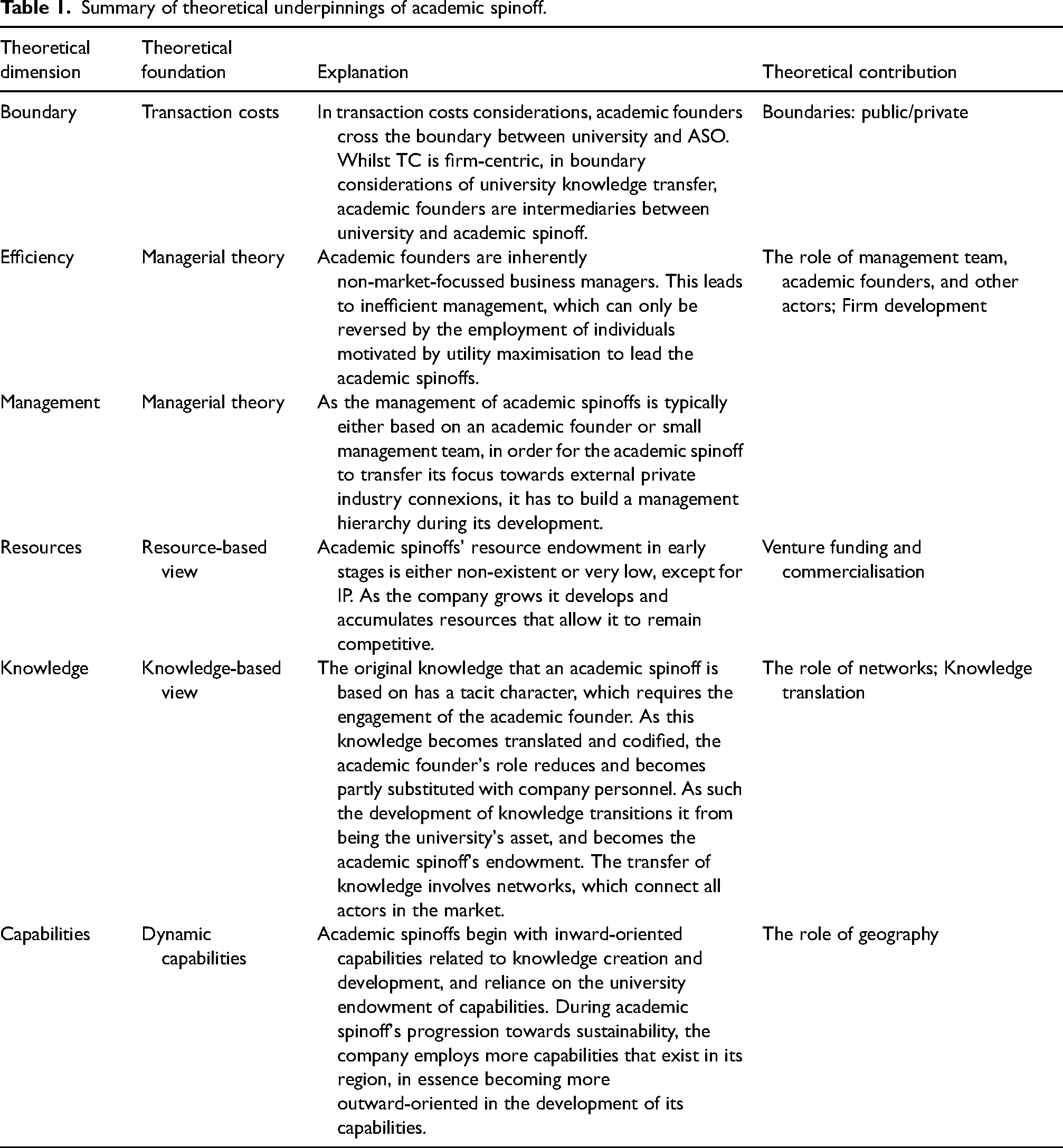
Figure 1 assembles these separate theoretical strands to build a theory that captures the phenomenon of ASOs, referred to as the Academic Spinoff Theory of the Firm. It defines a firm as pursuing a goal of translating knowledge to generate profits. The underlying knowledge constitutes firm's competitive advantage. This firm is a boundary spanning actor between the public sector (e.g. higher education) and private sector (i.e. industry). As such, it develops rich networks that at first have a strong homophilious character with reliance on parent organisation's resources, but with the firm's growth they transition towards more heterophilious connexions that draw on the actors from the local and non-local ecosystems. The firm's academic entrepreneur originates from a non-commercial background, therefore firm's management improves effectiveness and efficiency with the inclusion of commercially-oriented individuals from the industry. Essentially, the networks developed by the firm with investors and other actors bridge resource gaps of the parent organisation, enabling firm's knowledge translation and growth. This growth is characterised by the firm's ability to translate original tacit knowledge into codified, resulting in a marketable product or service. While the firm develops, its presence, networks, and products, sprawl spatially from the local towards the international.
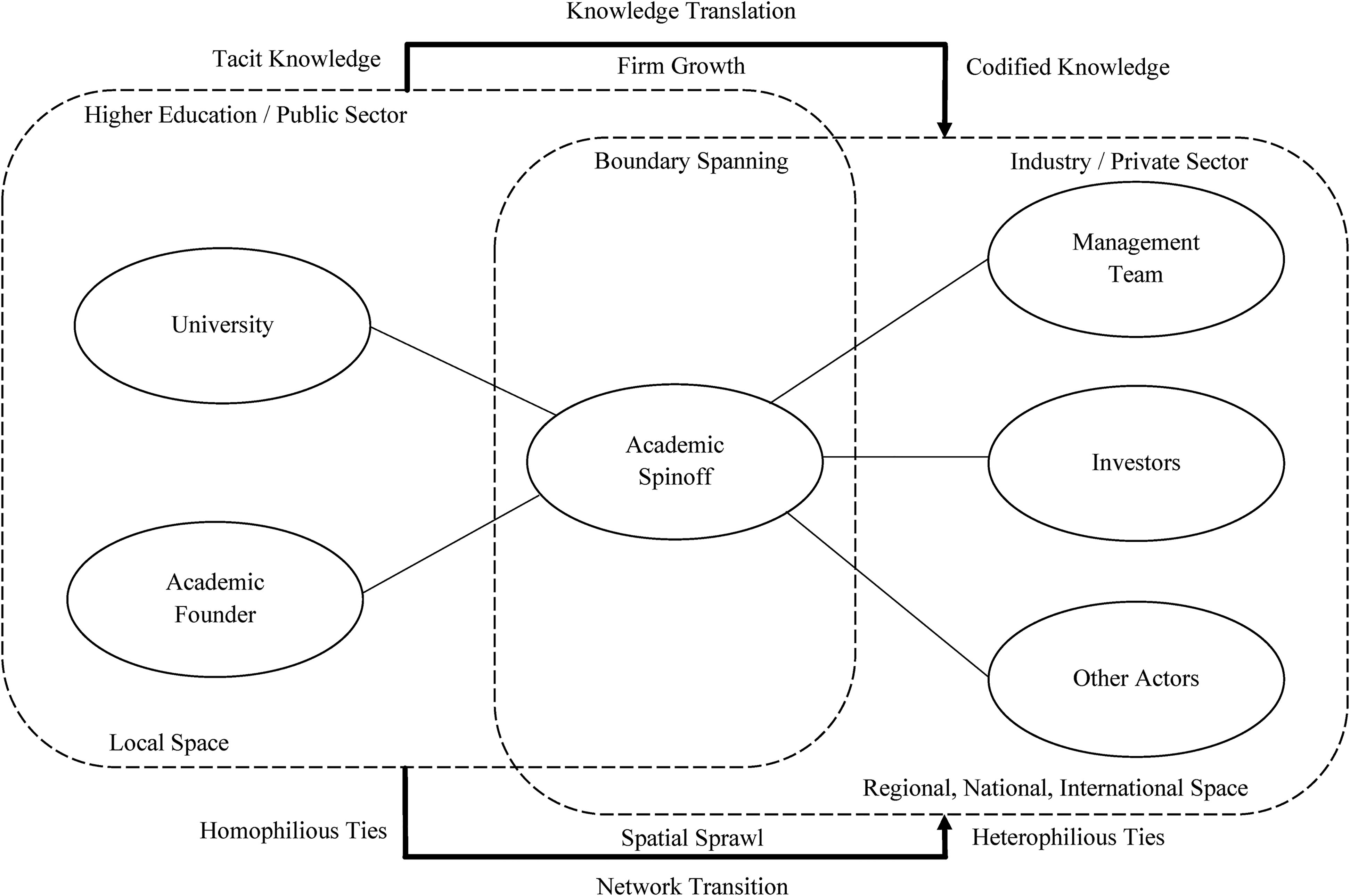
The conceptual model of the Academic Spinoff Theory of the Firm.
ASOs’ existence can be elaborated from transaction cost theory, which considered firm boundary (Williamson, 1979). The academic founder is identified as an intermediary between a university and a firm. In essence, the academic founder's university is a parent organisation bordering its ASO. As a connecting entrepreneur, the academic founder acts to reduce transaction costs of knowledge transfer between university and industry, or public and private sectors.
Managerial theory of the firm provides two vital insights to understanding ASOs: efficiency (Reder, 1947; Monsen and Downs, 1965) and management (Bartlett and Ghoshal, 1993; Monsen and Downs, 1965). Given that academic founders are characterised by non-financial motivations to form ASOs (Goethner et al., 2012; Hayter, 2011), it is expected that with such university-skewed non-market orientation ASOs would be operating at sub-efficient levels. To overcome this inefficiency problem, ASOs require a commercially-focussed management team to pursue utility maximisation (Franklin et al., 2001). Furthermore, as the ASO develops its management, it would transform from a single-person (i.e. academic founder) or a small management team towards a hierarchical managerial structure. This transformative process results in management specialisation, further strengthening the company's efficiency and alignment with private industry, or firms in the broader network environment.
From RBV (Wernerfelt, 1984), ASOs appear to be poorly endowed at the initial development stages, with IP representing the core resource strength of the firm. However, due to the untested nature of such knowledge, ASOs are vulnerable to failure. As the firm grows, it develops and accumulates resources that define its competitiveness. In order to achieve this, the ASO requires its main resource endowment of IP and the academic founder to have the ability to convince investors to spark that growth. As a result, the IP needs to consist of inimitable and unique characteristics that allow the ASO to transform from a knowledge-endowed fragile entity into a competitive firm with developed resources.
At the outset of ASO formation, its knowledge has a tacit character, residing in the academic founder. KBV (Nonaka, 1991) offers an understanding of the development and translation of knowledge into externalised codified knowledge. As such, the translation process allows knowledge to be shared with the ASO's employees, increasing the probability and efficiency of transforming it into a marketable product or service. Essentially, university knowledge undergoes externalisation processes, strengthening the ASO's competitive position. Furthermore, all actors engaged in these processes are connected, allowing for the exchange of knowledge. Consequently, these connexions become networks that reach out to all market actors.
Since an ASO starts as an inward-oriented firm, it focuses on dynamic capabilities (Teece et al., 1997) that control the process of knowledge translation and development. With time, each company approaches sustainability stage (Vohora et al., 2004), when its dynamic capabilities shift towards market development and become outward-oriented. In other words, ASOs develop dynamic capabilities that are region-specific, utilising geographical strengths to further firm growth.
The proposed Academic Spinoff Theory of the Firm is the first attempt at conceptualising its existence, adding to the academic entrepreneurship literature a theory that originates from the plurality of scholarly voices, partially answering the call from Rasmussen (2011). As such, the paper contributes towards greater understanding of how the ASO comes to be, how it grows, and why it is a unique type of a firm. The theory outlined above has significant implications, especially for the academic, practitioners’ and policymaking communities.
The academic communities interested in academic entrepreneurship research could benefit from a more focussed and comprehensive theory, resolving many shortcomings of previously applied theoretical positions, e.g. RBV. In light of this, the Academic Spinoff Theory of the Firm enables clearer empirical examination of the ASOs, by outlining the unique nature of these firms, as boundary spanners. For practitioners the new theorisation helps explain the behaviour of the firm and concomitantly predict its behaviour. Given that ASOs are atypical firms, this new understanding employed by the technology transfer officers, academic founders, investors, management teams, and other actors, could potentially be used to improve the success chances of the ASOs. Finally, the policymaking community could better distinguish between ASOs and other firms, consequently adding to their ability to devise more tailored policies that support their formation and growth. In so doing, this unusual character of ASOs could entice the policymakers to better understand how complex yet important this university knowledge transfer mechanism is.
Scholars in the academic entrepreneurship field would be well placed to apply the theory in their research, to improve the consistency in studying the ASOs. However, the Academic Spinoff Theory of the Firm itself is not without limitations, and empirical research testing it, expanding the conceptual model, and revising its tenets, would be particularly important to further the understanding and explanation of the ASO firm.
Footnotes
Acknowledgements
The development of this paper benefitted from the comments of two anonymous reviewers. The support is greatly appreciated.
Declaration of conflicting interests
The author(s) declared no potential conflicts of interest with respect to the research, authorship, and/or publication of this article.
Funding
The author(s) disclosed receipt of the following financial support for the research of this article: This work was supported by the Economic and Social Research Council (grant number 1231191).
