




Abstract
Background:
New-day technology evolutions and modern pedagogical approaches have significantly benefitted teaching environments and teachers. While digital tools have helped ease a lot of work, the challenges of proficiency, better performances, long workable hours and overload of duties have created a cognitive burden on teachers, making them feel mentally, emotionally and physically tired.
Objective:
The objective of this study is to find and fill research gaps in understanding the facets of work-related fatigue in teachers in Indian scenarios. Furthermore, a framework is proposed that investigates the dimensions and facets of fatigue associated with common work stressors, moderated by various categories of coping strategies.
Key Arguments:
The study highlights the prevalence of work-related fatigue in teachers, the impact of stressors, the effectiveness of coping strategies and the need for targeted interventions to enhance teacher well-being and educational outcomes.
Theoretical Framework:
The research is grounded in the job demands-resources theory and conservation of resources theory, which explain the relationship between work demands, available resources and resultant fatigue.
Main Conclusions:
The findings underscore the necessity for educational institutions and policymakers to implement targeted interventions that support teachers in managing fatigue, thereby improving educational quality and fostering a healthier work environment.
Introduction
The demands of today’s educational settings are indeed changing the overall environments of our schools and higher educational institutions. Worldwide, significant implications have been observed in teachers, especially at school levels and in students. The stressors associated with high demand and achievement-focused work have resulted in physical, mental and emotional fatigue in teachers (Hockey, 2013). In fact, daily management of student-related needs, staying alert on their behaviour modifications and management of interpersonal relationships at classroom and staff levels often leave teachers experiencing emotional drainage (Techera et al., 2016). Over time, in such cases, physical fatigue becomes even more visible (Skarpsno et al., 2020). Additionally, longer hours spent on multiple duties, physical supervision of students while standing most of the time, organizing extra co-curricular activities and modern digital equipment and its usage can cause more physical strain on teachers (Ahmadi et al., 2022). Combined with physical exhaustion, emotional burden can lead to mental breakdown in teachers, which can be observed in the form of aggression on the one hand and detachment and depersonalization to work on the other hand in extreme cases (Van Cutsem et al., 2017).
Consequently, those institutions that provide sufficient opportunities for rest and relaxation to teachers, offering adequate breaks in between work, colleagues accommodating each other and no working outside formal hours, leaving teachers enough time to practice health-promoting activities such as exercise (Tong et al., 2021), yoga (Park et al., 2021), mindfulness (Conversano et al., 2021), spending time with loved ones or anything they like, have proven to be highly effective (Jolly et al., 2021) and increase overall productivity and satisfaction in the workplace as compared to those educational settings where rules are strict and rigid (Ondrejková & Halamová, 2022). Moreover, engagement in self-contemplative practices and support from management can help teachers cultivate resilience, build emotional and physical strength and find satisfaction with their job and life and inner calmness which is beneficial both for teachers as well as students.
Review of Related Literature
Work-Related Fatigue Among Teachers
Numerous studies have demonstrated a significant rise in the cases of work-related fatigue among teachers, especially due to high expectations and increasing demands associated with this profession. Gu et al. (2020) found that prolonged states of physical, mental and emotional exhaustion can lead to stress, burnout and fatigue, not only affecting teachers’ job performance and well-being but also negatively affecting the students. Work-related fatigue is a persistent feeling of overtiredness or lack of energy that affects teachers at physical, cognitive and emotional levels primarily due to the multidimensional nature of their work (Garrick et al., 2018). Prominent factors associated with stress, such as classroom management, heavy workloads, longer working hours, emotional engagement with students, handling student behaviours and administrative work, are reasons that make teachers vulnerable to the onset of work-related fatigue (Shimizu et al., 2011). Additionally, a wider student–teacher ratio, lack of resources, extra work and higher expectations from teachers can further result in chronic fatigue if they are not able to cope with it initially (Leme & Maia, 2015).
A particular study in the Indian context, completed in the State of Punjab, concluded that high pressures backed by inadequate support and lack of facilities resulted in higher levels of work-related fatigue in teachers (Kaur, 2019). The consequences of this issue are severe, ranging from demotivation and detachment from work to impaired cognitive functioning, where a teacher faces difficulty in maintaining discipline in work (Ozoemena et al., 2021), which, left untreated, can lead to fatigue, burnout, absenteeism, turnover and eventually reduce the quality of education (Verdonk et al., 2010).
Coping Strategies to Address Work-Related Fatigue
Coping strategies are essential to maintaining a balance between professional demands and mental and physical health. While problem-focused strategies address reasons that cause stress and work-related fatigue, behavioural strategies target an individual’s emotional response to the sources of stress (MacIntyre et al., 2020). Cognitive strategies include reframing and restructuring one’s own thought process during stressful times. Efforts such as planning well in advance, prioritizing tasks according to time and staying physically active can help prevent feelings of overwhelm, thus mitigating any further feelings of fatigue (Bhagat et al., 2020). Regular physical activity, breathing exercises and yoga have been associated with lower levels of fatigue among individuals and are known to promote mental and physical well-being (Metcalf, 2021). It is also reported that teachers who have a stronger support network, be it from family, friends, colleagues or seniors, handle moments of stress and work-related fatigue in a better way (Atmaca et al., 2020).
Teachers who are strong-headed, who can restructure and reframe their thoughts and negative responses during stressful situations at work and who have a more optimistic outlook are more likely to handle well the phases of emotional exhaustion and behave far more resiliently to work-related fatigue as compared to those who are not able to control thoughts during such situations (Wang et al., 2022). Several teachers may choose to avoid such situations at work by distancing themselves from them, which may provide temporary relief but is not a well-recommended coping intervention for the long term (Amponsah et al., 2020). Teachers who adopt avoidance-based strategies are most likely to build up fear over time as the unresolved stressful situation leads to higher experiences of work-related fatigue (Wang & Hall, 2021). Cognitive strategies, on the other hand, focus on preparing teachers to view challenges as opportunities, adopting a growth mindset that makes them more capable of handling emotional tolls and thus moderates the effects of work-related fatigue (Herman et al., 2020).
In recent years, mindfulness-based interventions such as present-moment awareness, meditation and calm and focused states of mind have gained popularity and are considered excellent techniques for controlling emotional exhaustion, resulting in greater job satisfaction (Agyapong et al., 2023). Teachers who engage in proactive behaviours, focus on planned management of their time, delegate tasks, do not hesitate to work in collaboration, ask for help whenever needed and organize their workloads are more likely to cope with exhaustion, stress and fatigue in a better way (Valosek et al., 2021).
Behavioural coping strategies suggest that one should try to build social support, which fosters a sense of belonging for a person, reduces isolation feelings and is most likely to help with the issues related to fatigue in teachers (Wink et al., 2021). Self-reflection, adoption of a non-judgemental attitude and efforts to stay connected to intrinsic motivation have been increasingly recognized for their positive effects in helping teachers build emotional regulation (Lee et al., 2021). The integration of coping strategies in accordance with individual needs can largely help in controlling work-related fatigue and ensuring their well-being (Xhelilaj et al., 2021).
Research Gap
Despite research studies confirming the prevalence of work-related fatigue issues in teachers, research is scarce in the Indian context. Also, fewer studies have attempted to establish the moderating role of coping mechanisms. The paucity of relevant literature conducted with respect to physical, mental and emotional fatigue; factors associated with educational setups; and moderation of these issues by cognitive, behavioural and contemplative strategies to cope have been foundational grounds for the conceptualization of the proposed framework.
Research Methodology
Our study conducted a systematic review of relevant empirical studies published in peer-reviewed journals from 2007 to 2024. The studies were identified using a range of meta-search engines and databases, such as SCOPUS, EBSCO, Elsevier and JSTOR, and several full-text articles were sourced through Research Gate and Google Scholar. Inclusive and exclusive criteria were applied to carefully select research papers for the review, and appropriate keywords were used when searching research titles or abstracts.
Objectives and Rationale of the Study
The primary objective of this study is to investigate the facets and dimensions of work-related fatigue moderated by cognitive, behavioural and contemplative coping strategies, resulting in improved mental health of teachers. As such, understanding these relations can be a solid basis for designing intervention programmes for teachers and reducing the negative impacts of fatigue and stress. This research is important for promoting the well-being of teachers, ensuring educational quality is maintained in schools, student outcomes are ensured and fostering the personal and professional growth of all involved.
Theoretical Foundation for Model and Conceptual Framework
Job demands-resources (JD-R) theory and conservation of resources (COR) theory are used to develop the research model. JD-R theory postulates that work-related fatigue results from polarity between higher demands of work that contribute towards fatigue and lesser presence of resources (Bakker & de Vries, 2021). The availability of coping mechanisms and support can help in controlling this impact. COR theory underpins that the acquisition of resources and the use of coping strategies on an individual level can help mitigate the negative impacts caused by stressors and exhaustion levels. The integration of both these theories allows for a deep understanding of how different coping strategies can help teachers maintain professional and personal balance in their lives (Bakker et al., 2023). The model, thus, based on these theories, will help in the formulation of clear and testable hypotheses that can be used for the development of specific interventions and can be applied to practical settings.
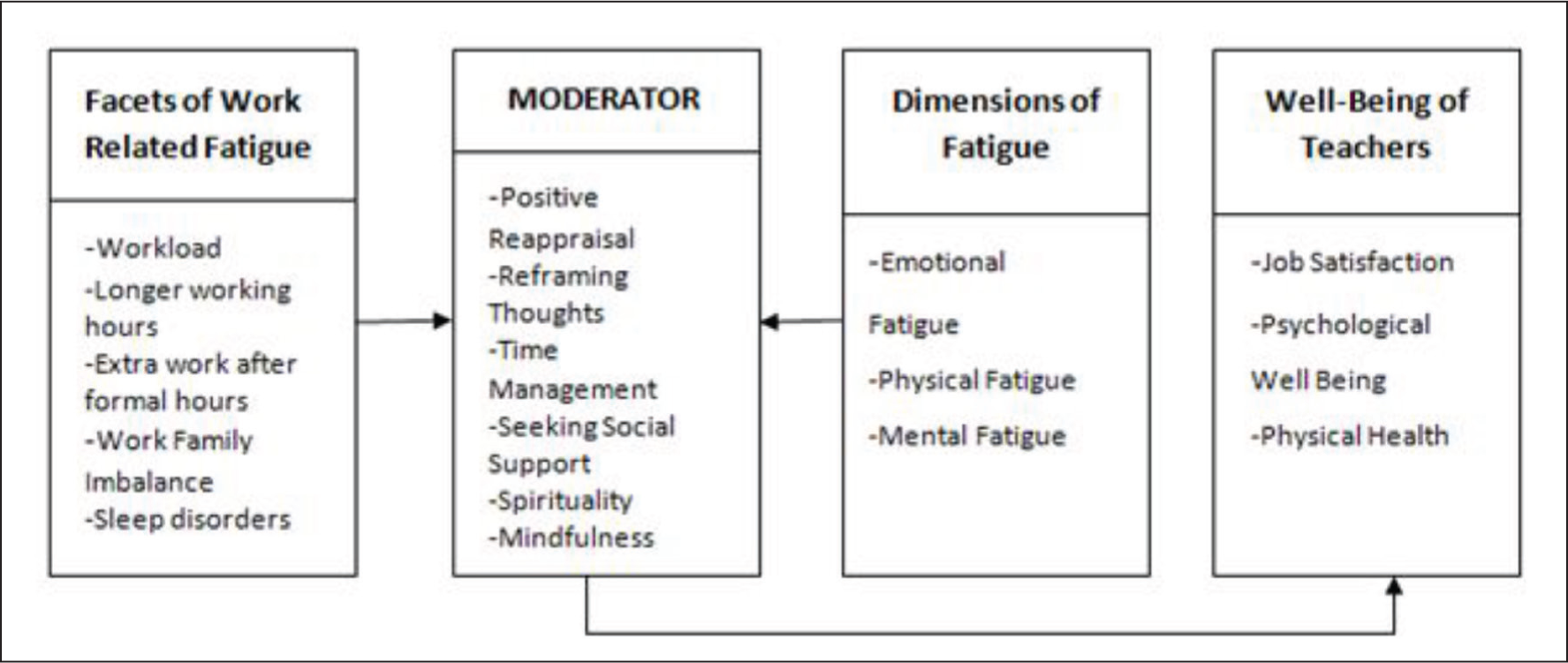
The framework outlines the various facets of fatigue, such as extra time spent on work after formal workable hours, less time left for personal health-related activities, work–family imbalance and sleep disorders resulting in either mental, emotional or physical fatigue or a combination of two or all further being moderated by cognitive (active and avoidance), behavioural (active and avoidance) and contemplative (spirituality and mindfulness) strategies. This study is an analysis towards the various facets of fatigue given in Figure 1.
Conceptual Framework of the Study.
Constructs and Hypotheses
Work-related fatigue is a phenomenon whereby an individual experiences exhaustion with regards to his/her emotions, physical activity and mental levels, often arising from work overload and unexpected demands of one’s job, causing difficulty in concentration, increased moments of drowsiness, emotional detachment, depersonalization, sleep disorders and headaches among major symptoms (Frone & Tidwell, 2015).
Coping strategies are essentially individual efforts that one consciously makes in order to resolve difficult situations and challenging negative thought processes and emotions in one’s life. Different individuals deal with the same situations in different ways depending on their basic nature, personality traits and mental levels. Coping strategies range from those providing immediate or temporary solutions to those targeting behavioural modifications, in the long run, to tackle situations now and in future to those dealing with circumstances by strong cognitive levels and others taking the help of contemplative mechanisms such as spirituality and mindfulness.
Cognitive coping strategies target reinterpretation of difficult circumstances and reframing one’s own perception, which includes teachers’ focusing more on positive aspects of teaching jobs such as student success rate, acknowledgements and appraisals, rewards for performance and remaining calm and composed. These strategies are associated with increased psychological well-being (Gustems-Carnicer & Calderón, 2013).
Behavioural coping focuses on taking direct action to handle workplace situations such as doing regular exercises, building social support, effective time management techniques and prioritizing tasks which help in the prevention of building up of stress and thus fatigue (Springer et al., 2023).
Contemplative coping strategies include the use of mindfulness techniques, meditation and self-reflection, which help to form mind balance, emotional regulation and resilience that helps in reducing stressful burdens from excessive workload and control work-related fatigue (Skinner & Beers, 2016).
Teacher well-being is a multifaceted construct that includes emotional, occupational and social well-being circumscribing teachers’ role in managing emotional resilience, commitment towards work, job satisfaction, autonomy and positive impact on students, colleagues and society on the whole (Gu et al., 2020).
Research Model
This section highlights the documented work, which is thoroughly reviewed and is considered to formulate proposed hypotheses with research gaps found hitherto (Table 1).
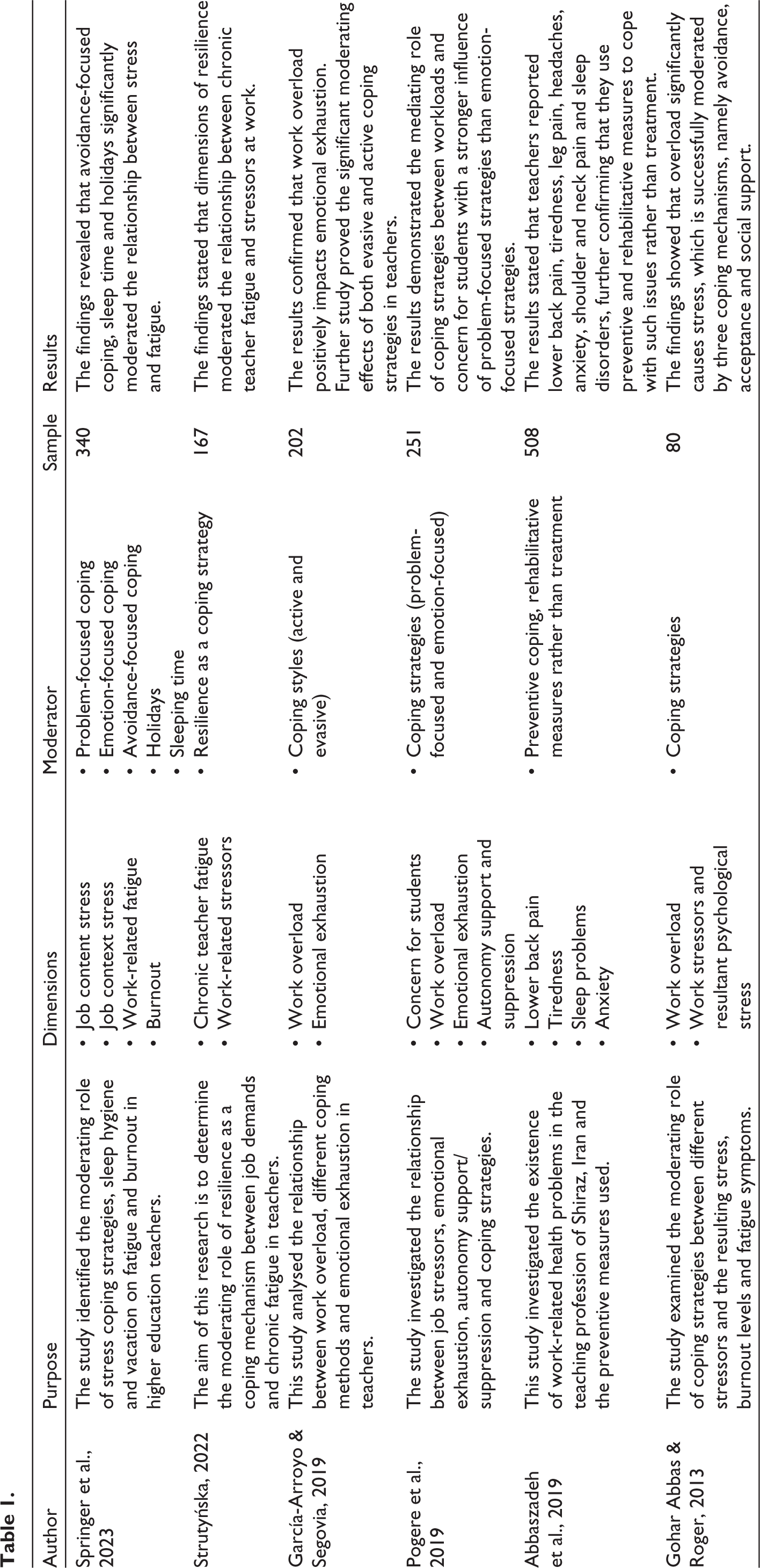
Considering the results found by previous research, followed by research gaps that are identified, the following hypotheses are framed:
H1: Work overload (extra work outside formal hours) and prolonged working hours significantly impact physical and mental fatigue. H2: Lesser time for personal activities and work–life imbalance significantly impact mental and emotional fatigue. H3: Cognitive and behavioural coping strategies moderate the relation between facets of work-related fatigue and physical–emotional fatigue levels. H4: Contemplative coping strategies moderate the relation between facets of work-related fatigue and emotional–mental fatigue levels.
The hypotheses framed are supported by Mearns and Cain (2003) and von Haaren-Mack et al. (2020), prioritizing the need for framing appropriate coping strategies and regulation mechanisms for handling work-related negative emotions and difficult circumstances. However, further investigations are required to establish its relevance in the Indian context.
Implications for Teachers
In-depth studies on work-related fatigue significantly contribute to ensuring greater awareness among teachers themselves about the symptoms associated with fatigue, its recognition, causes and additional negative consequences it may create in work –family balance (MacDonald, 2003). Furthermore, the research-proven effectiveness of coping strategies that may be adopted to handle difficult situations at the workplace backs teachers in their overall well-being by inculcating a set of strategies in their daily lives that are best suited to their own circumstances at home and at the workplace. Moreover, research findings can also become the basis for the development and design of professional development programmes and policies focused on such workplace systems that help to reduce fatigue, stress and related issues. Ultimately, fatigue-related studies help to foster resilience and colleague support systems among teachers that offer benefits to teachers as well as students.
Implications for Educational Institutions
Evidently, addressing the issues of fatigue and stress in teachers at institutional levels can help build confidence and commitment among teachers towards their workplace, impacting morale and overall productivity. Research clearly points to the benefits institutions can generate by designing and implementing support programmes for faculty to manage stress levels and work-related fatigue, offering them to be psychologically and physiologically strong to perform their assigned tasks besides ensuring overall well-being. Educational institutions can frame tailor-made programmes to meet the needs of their faculty, such as personalized schedules, adequate time breaks in between work, mentorship and counselling, which further boost teachers’ motivation, satisfaction and better teacher–student outcomes.
Implications for Government
The Ministry of Education, India, is significantly working towards establishing a highly competitive yet supportive educational system that regularly updates the requirements and needs for the betterment of students and teachers. However, more rigorous research on psychological and physical health-related issues caused by workplace situations can help the government to frame and amend policy requirements in terms of support to teachers in their overall well-being. Such governmental initiatives can significantly monitor the causes of fatigue and stress in teachers, develop programmes to reduce them at the onset and support teachers in building coping skills to mitigate the risks associated with these issues. The government can also support this by funding specific research that goes in deep, finding the potential causes of such issues and ensuring the effective means to combat them. As the government plays a crucial role in building a safe society, prioritizing mental health in teachers can help them to build a holistic social environment that benefits all.
Limitations and Future Directions for Model Refinement and Empirical Validation
This conceptual article acknowledges limitations inherent in the qualitative approach, including the potential for subjective interpretation of the literature and the absence of empirical data. Future research should aim to validate the proposed framework through empirical studies that explore the relationships between fatigue, coping strategies and teacher outcomes.
To enhance the proposed model on work-related fatigue and coping strategies among teachers, several areas require refinement and empirical testing. First, the measurement of constructs such as fatigue and coping strategies must be clearly defined and validated through reliable instruments. Additionally, establishing causal relationships through longitudinal studies can clarify how specific coping strategies mitigate different types of fatigue. Contextual factors, including school environment and cultural influences, should also be considered, as they may moderate these relationships. Finally, implementing intervention studies can evaluate the effectiveness of targeted coping strategies, providing practical insights for improving teacher well-being and reducing fatigue.
Conclusion
This research highlights the intricate need for studies focused on understanding the need for supportive coping mechanisms that teachers can adopt to reduce their fatigue levels, supportive initiatives by educational institutions to help teachers to face such stressors with strength and ease and for the government to frame the overall system in such a way that targets to reduce the very causes of work-related stress issues that are responsible for fatigue and even psychological traumas in teachers. Future research can be focused on testing comprehensive programmes specially designed to reduce fatigue so that the best possible options can be suggested to teachers in their time of need. To foster a healthy workplace culture, teachers need support from themselves, each other as colleagues, higher management of institutions and government on larger levels so that work-related issues can be resolved and better focus be made on improving students’ performances. Ensuring teacher well-being is also crucial to enriching student experiences and outcomes and developing a holistic social network where a brighter future is ensured for all.
Footnotes
Declaration of Conflicting Interests
The authors declared no potential conflicts of interest with respect to the research, authorship and/or publication of this article.
Funding
The authors received no financial support for the research, authorship and/or publication of this article.