




Abstract
In this article, we explore how organizational actors cope with a perceived misalignment between their organization’s identity and strategy. Based on an inductive, interpretive case study at a public broadcasting organization, we identify three cognitive tactics through which organizational members cope with an identity–strategy misalignment: contextualization, abstraction, and fatalism. Furthermore, we show that the enactment of these cognitive coping tactics coincides with specific strategy-related tasks that prioritize different aspects of an organization’s identity and, therefore, invokes different conceptions of the identity–strategy misalignment. Based on these findings, we develop a framework that conceptualizes how organizational members cope with an identity–strategy misalignment. We end the article by discussing the implications of our study for further research on the linkages between organizational identity and strategy.
Introduction
Research is increasingly interested in gaining an understanding of the interplay between organizational identity, defined as actors’ understandings of “who we are as an organization” (Gioia et al., 2013b: 123), and strategy, defined as an organization’s “deliberate allocation of resources to address the needs and expectations of constituents by enhancing organizational capabilities, defining product features, etc.” (Ravasi and Phillips, 2011: 205). Earlier work argued that an organization’s identity shapes and is in turn reflected in its strategy (e.g. Ashforth and Mael, 1996; Fiol, 2002; Reger et al., 1994). This work builds on the idea that organizational identity raises expectations about appropriate and inappropriate strategies (Wickert et al., 2017) such that “‘who we are’ has implications for ‘what we should do’” (Anthony and Tripsas, 2016: 418). Thus, from this perspective, an organization’s identity invokes “identity imperatives” that elicit identity-consistent strategies (e.g. Dutton and Dukerich, 1991; Tripsas and Gavetti, 2000; Whetten, 2006), thus producing an identity–strategy “alignment” that, as Anthony and Tripsas (2016) argued, “is desirable, as conflict and dysfunction arise when organizational members engage in behaviors that violate the expectations of organizational identity” (p. 418).
Recent work, however, indicates that organizational actors might also “betray” an organization’s identity and pursue identity-inconsistent strategies (e.g. Phillips and Kim, 2009; Ravasi and Phillips, 2011; Tripsas, 2009). As this work suggests, perceived rival expectations about what one should do to be competitive might unfold as “market imperatives” that require organizational members to “act […] out of character” (Whetten, 2006: 221), thus eliciting an identity–strategy misalignment. In keeping with a situated, less monolithic understanding of organizational identity (e.g. Corley, 2004; Ravasi et al., 2019), organizational actors experience such a misalignment differently. Some members might be able to live with an identity–strategy misalignment for longer periods of time with few, if any challenges (Nag et al., 2007; Ravasi and Phillips, 2011). In turn, other organizational actors experience a sense of discomfort (Corley and Gioia, 2004), anxiety (Gioia et al., 2013b), and a lost sense of integrity (Schultz and Hernes, 2013), which can have “damaging consequences for both individuals and organizations” (Haslam et al., 2017: 324) if left “[u]nattended or improperly managed” (Ravasi and Phillips, 2011: 106). Prior research indicates that, in such situations, organizational actors “engage in […] varied [cognitive] coping strategies” (Brown, 2015: 29) to live with an identity–strategy misalignment (Elsbach and Kramer, 1996; Tracey and Phillips, 2016). Despite the recognized importance of such coping tactics in general terms, there has been very little direct theorizing and research on what these tactics are (Gioia et al., 2013b).
In this article, we present the findings of an inductive, interpretive case study of how members of an organization coped with an identity–strategy misalignment at a German public broadcasting organization. In the examined case, we found that actors coped with the misalignment through the performance of different cognitive tactics, which we termed contextualization, abstraction, and fatalism. As our study shows that these cognitive coping tactics are associated with specific strategy-related tasks. Accordingly, members who performed similar strategy-related tasks enacted the same coping tactics because these tasks invoked different aspects of the organization’s identity, that is, its distinctiveness, centrality, and enduringness (Whetten, 2006), and, therefore, different conceptions of the identity–strategy misalignment.
Based on these observations, we develop a framework that uncovers the cognitive tactics through which organizational actors cope with an identity–strategy misalignment, and that conceptualizes the strategy-related task context in which the performance of these tactics is situated. In doing so, we address the call of prior research (Gioia et al., 2013b) to theorize with more clarity and depth how members of an organization cope with an identity–strategy misalignment. Our theoretical framework thus adds to the burgeoning literature on the interplay between organizational identity and strategy (e.g. Ashforth and Mael, 1996; Corley and Gioia, 2004; Ravasi and Phillips, 2011) by extending our understanding of the cognitive tactics through which organizational actors cope and, thus, live with an identity–strategy misalignment.
Theoretical background
Albert and Whetten’s (1985) seminal work has spurred considerable interest in organizational identity (Gioia et al., 2013b). Building on this work, organizational identity is generally understood as specifying the attributes of an organization that are central, enduring (or continuous), and distinctive (e.g. Gioia et al., 2000; Ravasi et al., 2019; Whetten, 2006. One strand of literature, referred to as the “social actor” view (Gioia et al., 2013b; Haslam et al., 2017), considers organizational identity a global feature of organizations that make claims about these attributes as monolithic actors in society (e.g. Whetten, 2006). In turn, the “social constructionist” view (Gioia et al., 2013b; Haslam et al., 2017; Ravasi and Schultz, 2006), which we adopt in our study, foregrounds the perceptions and interpretations of organizational actors as producers of meaning who generate understandings of an organization’s identity (e.g. Gioia et al., 2000). This perspective defines organizational identity as “those features of an organization that in the eyes of its members are central to the organization’s character or ‘self-image’, make the organization distinctive from other similar organizations, and are viewed as having continuity over time” (Gioia et al., 2013b: 125, emphases in original). The social constructionist view advances a relatively consensual understanding of an organization’s identity that is widely shared among its members (Haslam et al., 2017). More recent work has refined this view by showing that organizational identity is less monolithic than prior studies suggest (Cornelissen et al., 2007). Specifically, this work demonstrates that actors mobilize different views of an organization’s identity (e.g. Hoon and Jacobs, 2014; Kreiner et al., 2015) to make sense of or give sense to their work experience depending upon their hierarchical position (Corley, 2004), or prioritize different aspects of an organization’s identity based on identity-related tasks such as product design and brand management (Ravasi et al., 2019).
Despite these differences, the overall literature on organizational identity acknowledges that the construction of an organization’s identity implies situating the organization within a social category of similar organizations (e.g. Anthony et al., 2016; Gioia et al., 2013b; Glynn and Navis, 2013; Haslam et al., 2017; Whetten, 2006). For example, Whetten (2006) argued that defining the central, enduring, and distinctive attributes of an organization involves positioning the organization in a “social space” in which it differs from outsiders of a specific category (e.g. “(we are) a bank and not a school”; Glynn and Navis, 2013: 1125) and specifying how it differs from similar organizations within this category (e.g. “(unlike other banks) we are a decentralized bank”; Whetten, 2006: 223). Implicit in constructing an organization’s identity based on category membership are “identity imperatives,” that is, identity-related expectations about “appropriate” and “inappropriate” activities and investments (Anthony and Tripsas, 2016) that “provide […] a guide for what an organization’s members should do” (Gioia et al., 2013b: 161).
Much of the burgeoning literature on the interplay between organizational identity and strategy (Pratt et al., 2016; Schultz and Hernes, 2019) has in fact shown how an organization’s identity guides members in pursuing its strategy (Ashforth and Mael, 1996; Gioia et al., 2013b). For example, in their seminal study at the Port Authority of New York and New Jersey, Dutton and Dukerich (1991) showed how an organization’s identity might elicit identity-consistent strategies in response to a degraded image. They argued that members used their understanding of the central, enduring, and distinctive features of the organization as a frame of reference to select strategies that they considered appropriate (see also (Hoon and Jacobs, 2014; Tripsas and Gavetti, 2000). Relatedly, Reger et al. (1994) argued that organizational actors oppose identity-inconsistent strategies because they evaluate them as inappropriate, such that strategic change implies invoking a more fundamental identity change (see also Fiol, 2002; Gioia and Thomas, 1996). More recently, Irwin et al. (2018) reaffirmed the view that identity-related expectations about what one should do “‘inform […] managers’ strategic choices (and, thus,) guide […] managers to align strategies with identity” (pp. 272, 288).
Recent studies, however, also suggest that organizational actors might pursue strategies that are inconsistent and, thus, misaligned with an organization’s identity (e.g. Nag et al., 2007; Ravasi and Phillips, 2011; Tripsas, 2009). These studies demonstrate that actors can “betray” their organization’s identity, in part, by catering to competing “market imperatives,” that is, expectations about what one should do “to be competitive with other organizations” (Gioia et al., 2013b: 162). For example, Nag et al. (2007) showed how managers of an R&D organization attempted to pursue market-oriented strategies to remain competitive, a move that was inconsistent with the organization’s technology-focused identity (see also Tripsas, 2009). In turn, Ravasi and Phillips (2011: 117) showed how managers at Bang & Olufsen served the “rise of a young, affluent social class” and, in doing so, gradually pursued strategies that reflected the organization’s identity to a lesser extent. Relatedly, Phillips and Kim (2009) showed that actors at Victorian-era jazz-recording companies betrayed these organizations “high-brow” identities by penetrating the mass markets with “low-brow” products for which they expected greater market demand.
Prior work highlights that identity–strategy misalignments place organizational actors into “troublesome” (Whetten, 2006: 223) situations. Such situations include discomfort (Corley and Gioia, 2004), anxiety (Gioia et al., 2013b), and a lost sense of integrity (Schultz and Hernes, 2013). Prior studies primarily interpret such situations as “an impetus for identity [or strategic] change” (Gioia et al., 2013b: 175), generating “a sense of urgency” (Corley and Gioia, 2004: 194) in “attempt[ing] to reestablish alignment between organizational identity and [strategy]” (Anthony and Tripsas, 2016: 418). In this vein, prior research has in large part focused on the tactics and practices through which organizational actors realign an organization’s identity and strategy (e.g. Clark et al., 2010; Corley and Gioia, 2004; Gioia and Thomas, 1996; Ungureanu et al., 2019). For example, Ravasi and Phillips (2011) showed how actors at Bang & Olufsen reassessed, refocused, and tuned the organization’s identity to realign internal and external beliefs and perceptions with the organization’s strategic investments and projections. In turn, Corley and Gioia (2004) observed how identity ambiguity following a corporate spin-off imposed an “imperative” on top managers to regain clarity about, and realign, the organization’s identity and strategy through sensegiving tactics. Their study suggests that an identity–strategy misalignment can only be temporary at best because the ambiguity that it creates leads actors “to resolve it quickly to achieve some renewed semblance of clarity” (p. 173).
Although these studies are insightful, their partial assumptions about “almost inevitable” (Glynn, 2000: 287) pulls toward resolving an identity–strategy misalignment leads them to overlook an important alternative means of managing such gaps, which is that members of an organization simply cope with such a misalignment (e.g. Elsbach and Kramer, 1996). Prior studies do hint at the fact that members who perceive an identity–strategy misalignment might employ various tactics through which they cognitively reconcile an organization’s identity and strategy (Gioia et al., 2013b). These tactics, then, might help organizational actors alleviate the detrimental features associated with an identity–strategy misalignment (Haslam et al., 2017) and, thus, live with this gap (Brown, 2015). However, despite this reference, little direct research on these coping tactics exists (Gioia et al., 2013b). We therefore ask in this article: How do organizational actors cope with an identity–strategy misalignment?
Method
Our findings and interest in this phenomenon emerged from an inductive, interpretive case study that, in keeping with the “social constructionist” approach to organizational identity (Gioia et al., 2013b; Haslam et al., 2017; Ravasi and Canato, 2013), foregrounds organizational actors’ accounts of the phenomenon under study. Specifically, we built on what others refer to as the “Gioia methodology” (Gioia et al., 2013a; Langley and Abdallah, 2011) to develop theory on organizational members’ cognitive coping tactics. This methodological approach enhances grounded-theory development with structured procedures for analyzing data and articulating theory, leveraging a key strength of qualitative research—embracing and theorizing the messiness of real-life phenomena (Cornelissen, 2017; Klag and Langley, 2013)—to develop more robust theoretical and transferable results.
Case and context
Our empirical analysis is based on the case of MediaCorp (anonymized), a public broadcasting organization based in Germany that ran one TV station and six radio stations at the time of our study. MediaCorp is one of nine regionally operating public broadcasters that, together, constitute the public-broadcasting system in Germany, which is financed by license fees that all households are obliged to pay monthly. In keeping with the public-broadcasting system’s federal structure and the system’s overall mission to provide high-quality news to society, actors at MediaCorp understood the organization’s identity as “the public broadcaster that is responsible for our regional transmission area” (emphases added). Thus, MediaCorp’s members placed the organization in the category of “public broadcasting” to distinguish the organization from private broadcasters that, they said, would produce lower-quality journalism. In addition, they distinguished MediaCorp from other organizations in this category by emphasizing MediaCorp’s responsibility toward a specific regional transmission area, given that the other public broadcasters were responsible for other regional transmission areas. Accordingly, actors at MediaCorp associated two imperatives with the organization’s identity: investing in (1) high-quality TV and radio programs that (2) reflect the citizens and issues of their regional transmission area.
At the same time, however, MediaCorp faced fierce external pressures. Since the founding of the organization, the TV station had a viewing rate of approximately six percent, which was the lowest of all German public broadcasters. Furthermore, in the face of technological and social changes such as changing consumer preferences from linear in-the-moment-viewing through broadcasting services toward nonlinear viewing delivered through on-demand services (see also Knight and Paroutis, 2017), the radio stations operated in shrinking markets and regularly lost major parts of their audience. These developments reflect broader trends in public broadcasting (see also Gylfe et al., 2016) and have given rise to a serious, polyvocal societal debate on the relevance of the German public-broadcasting system and the license-fee paying system that is in place.
To contribute to the legitimacy of the public-broadcasting system among license-fee payers, MediaCorp’s strategy was oriented toward increasing the audience rates of its TV and radio programs and toward using the revenues from license fees responsibly and efficiently. However, these aims were entwined with market imperatives that at least partly conflicted with MediaCorp’s identity imperatives: (1) investing in lower-quality programs and (2) licensing content from other public broadcasters. Specifically, the prospects of increasing the audience rate were associated with investments in “lighter,” lower-quality entertainment programs, rather than in “heavier,” “fact-based,” higher-quality content. In addition, considering the cost-intensive nature of producing regional content, perceived expectations about cost-efficient operations were associated with low-cost take-overs from a program pool to which all German public broadcasters contributed their content, which these organizations had produced with a focus on their respective transmission areas.
Consequently, only approximately one-fifth of MediaCorp’s programs emanated from investments in own productions with regional content, of which only a fraction was considered “high quality” by many actors at MediaCorp. Many organizational members perceived this situation as a “betrayal” of MediaCorp’s identity and, thus, as constituting an identity–strategy misalignment. However, they found means of coping with this misalignment to live with it, which became particularly salient in the course of data collection and analysis. Thus, the focal case became a “revealing case” (Yin, 2018) that rendered the tactics through which members coped with an identity–strategy misalignment accessible to investigation.
Data collection and analysis
Access to MediaCorp was negotiated through a research project that focused on strategic processes and practices and their organizational embeddedness. We conducted the fieldwork at the media company between October 2014 and June 2017. During this period, we not only engaged in the collection of “both retrospective and real-time accounts” (Gioia et al., 2013a: 19) across different sources of data but also regularly met to exchange and discuss our observations and began to analyze the gathered data.
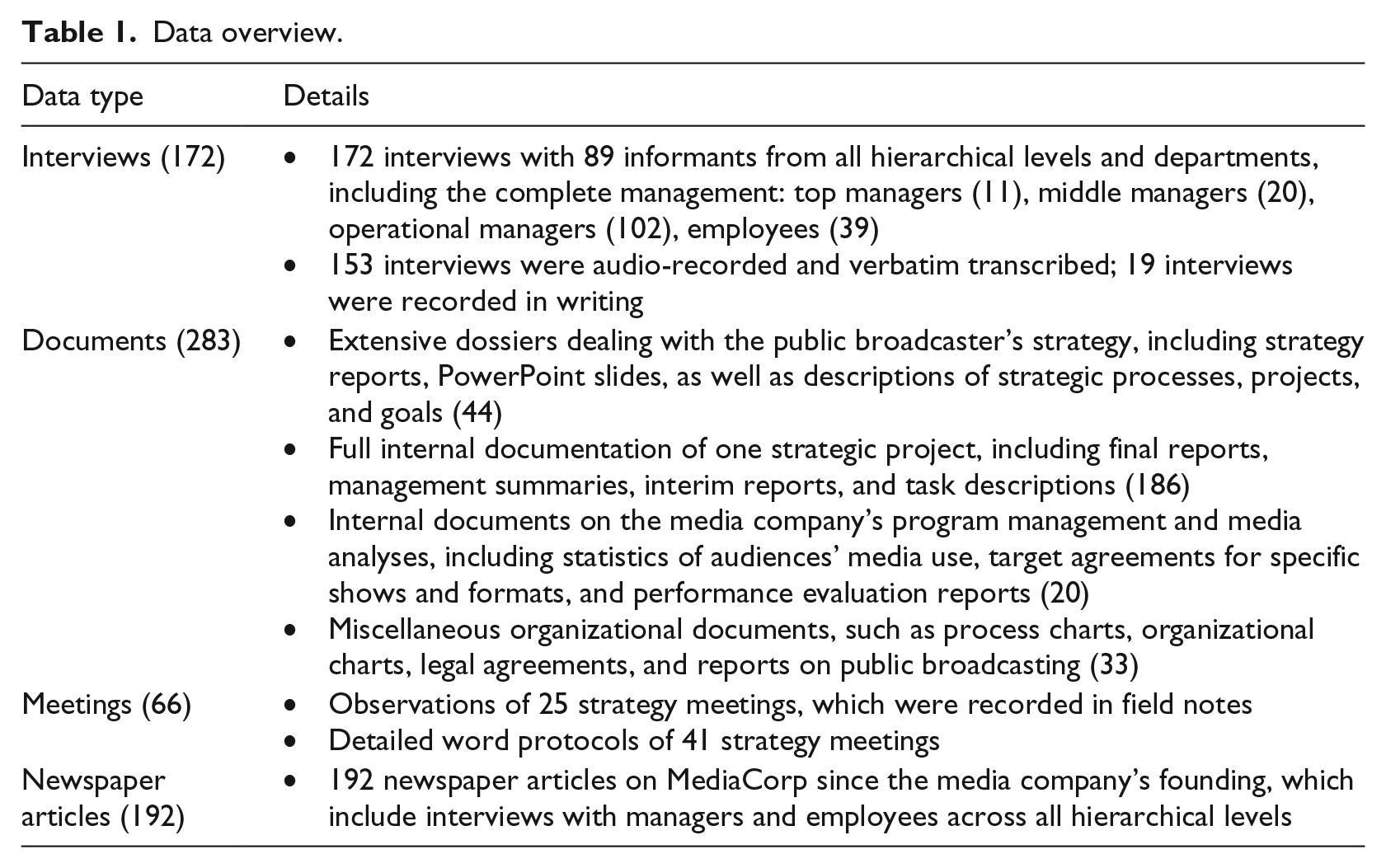
Similar to other studies (e.g. Nag and Gioia, 2012; Ravasi and Schultz, 2006; Stigliani and Ravasi, 2012), our inductive, open-ended methodological approach followed an iterative process of data collection and analysis that gradually invoked our theoretical interest in the issue of how members cope with an identity–strategy misalignment. We started by (1) familiarizing ourselves with the field of public broadcasting and gathered and analyzed publicly available material about the media company. We then (2) obtained a preliminary understanding of the case and specified the theoretical puzzle. Next, we (3) delved deeper into the theoretical puzzle, returning to informants and meetings to explore the phenomenon under study in greater depth. Finally, we (4) formulated and validated a theoretical framework that is grounded in the data and informed by prior studies. In the remainder of this section, we will explain each step in more detail. Table 1 summarizes the data that we used for this study, which consist of 172 semistructured interviews, 283 documents, field notes and detailed word protocols from 66 strategy meetings, and 192 newspaper articles. Table 2 provides an overview of our data collection and analysis.
Data overview.
Stages of the empirical project with data collection and analytical activities.
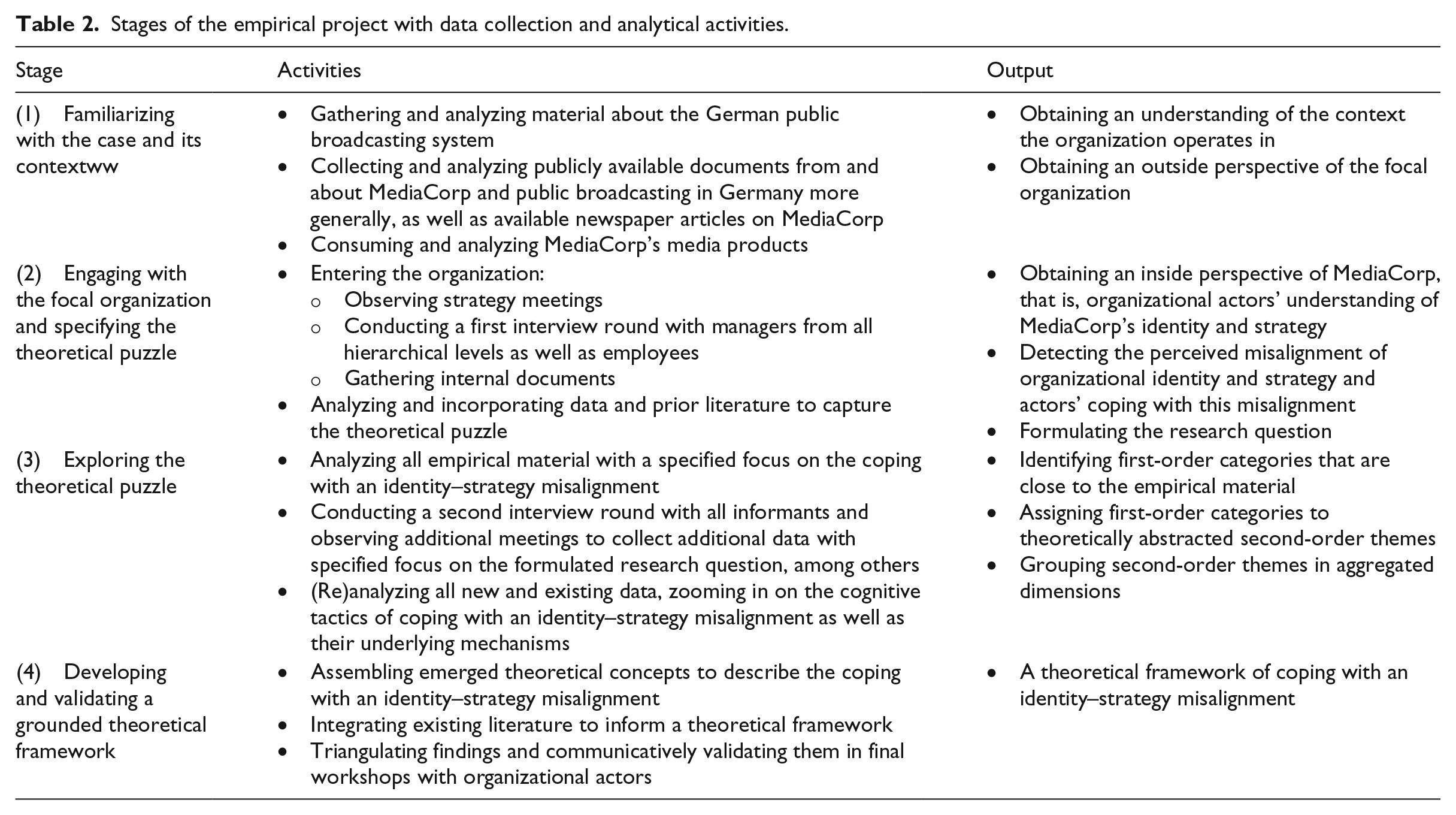
We began this project in summer 2014 with a broad research interest in how strategy-making occurs in public organizations that are situated in pluralistic settings (e.g. Denis et al., 2001, 2007). To obtain a preliminary understanding of the field of broadcasting in Germany in general and MediaCorp in particular, we began by (1) consulting news articles and publicly available documents from relevant institutions associated with broadcasting and media management in Germany, including MediaCorp, to immerse ourselves in the historical origins and development of the media company in particular and the German public-broadcasting system more broadly. Simultaneously, we began to examine MediaCorp’s “products,” that is, its TV and radio programs. We did so by consuming broadcast material and investigating the structure of the programs and their development based on publicly available documents.
We then (2) entered MediaCorp in fall 2014 and observed several strategy meetings to identify more specific theoretical puzzles in the empirical field. During these meetings, managers elaborated on the challenges faced by MediaCorp and how they aimed to respond (or not to respond) to these challenges. Some managers openly lamented the misalignment of MediaCorp’s investments into low-quality, nonregional programs (which we later came to understand as organizational actors’ understandings of MediaCorp’s strategy) and the organization’s self-understanding as a regional public (i.e. high-quality) broadcaster (which we later defined as organizational actors’ understandings of MediaCorp’s identity). This apparent betrayal of the organization’s identity to attend to market imperatives, creating a perceived identity–strategy misalignment, was a key issue that already drew our attention to the burgeoning literature on the interplay between organizational identity and strategy (e.g. Anthony and Tripsas, 2016; Ravasi and Phillips, 2011) at this early stage.
Next, in the spring of 2015, we conducted a first round of interviews with all managers and several employees from all departments. Inspired by our initial experiences at MediaCorp, we asked the organizational actors about their daily work and to reflect on how it contributed to their understandings of “who they are” as an organization (i.e. MediaCorp’s identity) and of the organization’s investments into its programs (i.e. MediaCorp’s strategy), among others. When we shared our interview experiences and critically discussed our ad hoc insights in weekly meetings within our research group, we recognized a perceived misalignment of MediaCorp’s identity and strategy across all hierarchical levels. Therefore, we decided to observe additional strategy meetings in which discussions of the misalignment of MediaCorp’s identity and strategy manifested, and we collected internal documents that included narrative accounts of the organization’s identity and strategy. Thus, in addition to using interview data as our primary data source (see also Ravasi and Canato, 2013), we built our emergent theoretical understanding on the back of additional observational data.
In this iterative process of data collection and analysis, we came to specify the focal theoretical puzzle. Specifically, when we coded actors’ accounts of MediaCorp’s identity and strategy, we were struck by our observation that most actors at MediaCorp problematized and, thus, produced accounts of an identity–strategy misalignment, although with different emphases. Perhaps even more surprisingly, the organizational actors did not use such problematizations as a motive for adjusting their understanding of MediaCorp’s identity or strategy (e.g. Corley and Gioia, 2004) but rather coped and, thus, lived with this misalignment. Because prior work on the interplay between organizational identity and strategy did not fully help us explain this phenomenon, we decided to explore how organizational actors cope with an identity–strategy misalignment in more depth.
The third step consisted of (3) returning to our interviewees in a second interview round in fall 2015. This helped us to place even greater emphasis on the focal phenomenon in our data collection. Then, we (re)coded the newly and previously gathered data with a particular focus on the specified phenomenon. To develop theoretically abstracted “second-order themes” from these openly coded “first-order categories” (Gioia et al., 2013a), we grouped those codes that were similar in character and scope. In doing so, we identified several variants of the perceived misalignment of organizational identity and strategy and the strategy-related task context in which such constructions were embedded. We also conceptualized a set of cognitive tactics whose performance was consequential for coping and, thus, living with this misalignment. The first-order concepts, second-order themes, and aggregate dimensions were continuously refined by constantly mirroring our emergent findings in the empirical data. Figure 1 displays our data structure.
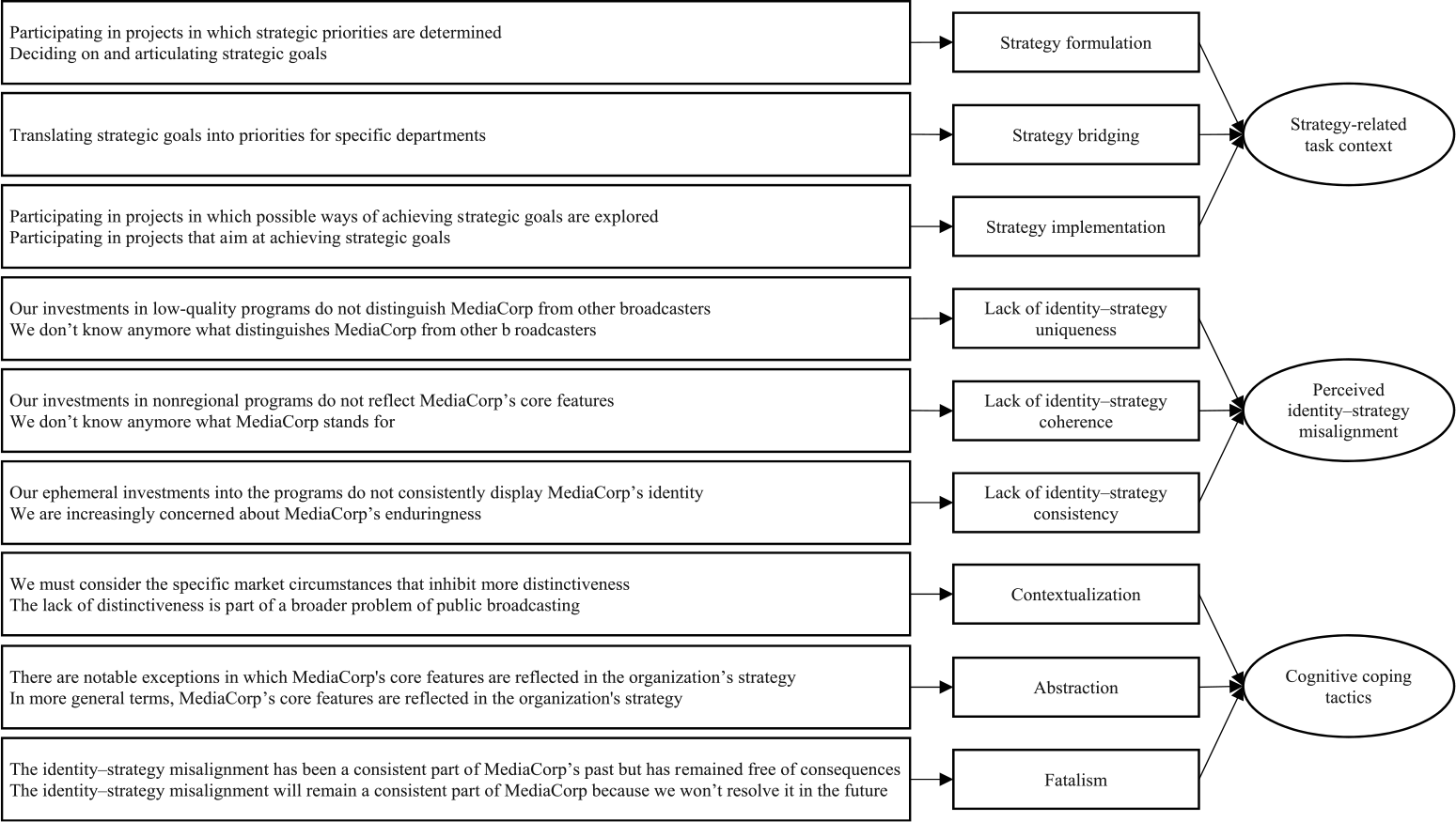
Data structure.
Finally, we (4) developed and validated a grounded theoretical framework of coping with an identity–strategy misalignment. Specifically, we developed alternative theoretical frameworks that established links between the theoretical concepts that had emerged. We then “tested” these frameworks by going back to the empirical data and synthesized those aspects of different variants that most closely matched our observations in one theoretical framework. In this process, we realized that earlier organizational-level conceptualizations of the phenomenon did not reflect important variations among organizational members concerning the strategy-related tasks that they performed, the ways in which they constructed the identity–strategy misalignment, and, ultimately, the specific cognitive coping tactics that they enacted. Therefore, we went back to our data to compare such coded instances across all organizational actors who perceived an identity–strategy misalignment based on a tabular overview (available upon request). Once we found a pattern that helped us explain the nuanced variations, we rebuilt and refined our emerging theoretical framework with a focus on this pattern.
After explicating our framework, we discussed our findings with organizational members in several follow-up meetings. These meetings were conducted repeatedly from summer 2016 to fall 2018 and were held among various groups, from the top management to employees across different departments. These “member reflections” (Tracy, 2010) helped us verify and refine our theoretical arguments.
Findings
Because MediaCorp’s strategy drew members’ attention to market imperatives in the face of dissatisfactory market performance through investments in “lighter” lower-quality and nonregional content, many informants felt that they “betrayed” the organization’s identity as a regional public broadcaster, which implied imperatives to invest in high-quality, regional programs. Therefore, they considered the organization’s identity and strategy to be misaligned. As a middle manager commented,
This [identity–strategy misalignment] is an […] ambivalence [a]nd this is not extraneous to us: this is at the heart of what we do every day. […] We have to cope with this somehow [because] if this ambivalence dominates us, we lose our orientation or get frustrated and even sick in the worst case. (Interview 29, middle manager, emphases added)
Thus, given the salience of the identity–strategy misalignment in day-to-day work, actors at MediaCorp employed cognitive coping tactics that, they felt, were necessary to avoid the adverse side-effects of such a misalignment.
Our empirical analysis uncovered three cognitive tactics through which actors at MediaCorp coped with an identity–strategy misalignment. These tactics were associated with explicit strategy-related tasks that actors were involved in (strategy-related task context) because these tasks led them to prioritize different aspects of MediaCorp’s identity (distinctiveness, centrality, or enduringness) and, consequently, to construct and problematize the identity–strategy gap in different ways (perceived identity–strategy misalignment). Thus, the three cognitive coping tactics, which we termed “contextualization,” “abstraction,” and “fatalism,” differed primarily in that they helped organizational actors reconcile and, thus, live with different facets of this gap and their detrimental features; namely, the discomforting lack of distinctiveness of MediaCorp’s identity and strategy, the inauthentic noncoherence of MediaCorp’s strategy with central features of the organization’s identity, or fears related to the inconsistent (or nonenduring) reflection of MediaCorp’s identity in the organization’s strategy.
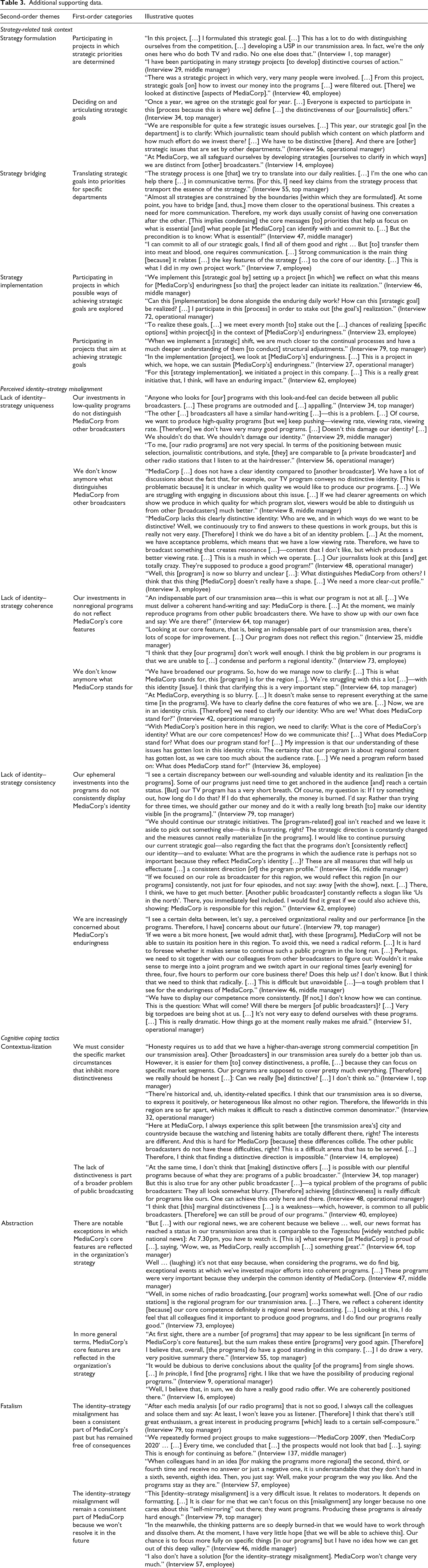
Below, we provide a narrative of our observations of this phenomenon at MediaCorp, which is structured around the cognitive coping tactics that emerged from our empirical analysis. Table 3 provides additional empirical evidence.
Additional supporting data.
Contextualization
“Contextualization” refers to a coping tactic through which organizational actors cognitively reconcile an organization’s identity and strategy in terms of the overarching dimension of distinctiveness. Next, we describe the strategy-related task context in which this tactic is embedded, the specific conception of an identity–strategy misalignment that this context provokes, and how this tactic helps organizational actors live with such a misalignment.
Strategy formulation and identity distinctiveness
At MediaCorp, we observed how organizational actors engaged in tasks related to strategy formulation. Such tasks primarily included defining priorities for MediaCorp’s investments into the organization’s programs and setting and articulating annual strategic goals based on these priorities. Whereas such tasks are traditionally associated with the top management of an organization (Hambrick and Mason, 1984), we observed that actors “across all hierarchical levels” (Interview 81, operational manager), that is, top managers but also middle managers, operational managers, and employees, participated in tasks related to strategy formulation. As an informant clarified,
We all contribute a lot to strategic projects [in which we] prepare strategic decisions. […] In doubt, we have a strategic project more, rather than less. In these projects, we deal a lot with ourselves […]: How does MediaCorp work? In which ways is MediaCorp distinctive? (Interview 48, operational manager)
Thus, as a broad range of actors invested much of their work time into projects that aimed at defining MediaCorp’s strategic priorities, they specifically focused on “identify[ing] distinctive aspects” (Interview 20, operational manager) of the organization. As an informant further explained, doing so enabled them to reflect on “how we can do things in a distinctive way” (Interview 81, operational manager) to gain a competitive advantage.
Perhaps somewhat surprisingly, we observed how not only top managers but also other actors from other hierarchical levels articulated strategic goals. As an informant highlighted,
Everyone [at MediaCorp]—every middle manager, every operational manager, … —has to formulate strategic goals […]. It is part of the strategy [process] to clarify [in all parts of the organization]: We are distinctive here in this region. (Interview 8, middle manager)
Given the decentralized spending of budgets on specific programs, lower-echelons also reflected on and articulated strategic goals for themselves. As an informant specified, this activity helped them “develop a distinctive hand-writing” (Interview 78, operational manager) in the programs for which they were responsible to gain market traction.
Thus, the performance of tasks related to strategy formulation involved reflections on the distinctive features of MediaCorp’s strategy. In doing so, these tasks prioritized reflections on the distinctive aspects of the organization’s identity.
Lack of identity–strategy uniqueness
Those actors at MediaCorp who primarily engaged in tasks related to strategy formulation and, thus, the distinctiveness of the organization’s identity and strategy also tended to problematize the organization’s identity–strategy misalignment by raising concerns that MediaCorp’s identity and strategy were “not distinctive” (Interview 78, operational manager). Their discomfort became manifest in two ways.
First, actors who performed tasks related to strategy formulation criticized that MediaCorp’s investments did not result in programs that could be distinguished from the programs of other broadcasters. This lack of distinctiveness of MediaCorp’s strategy implied that “[o]ur programs do not correspond with our identity [because] you could watch the programs of many other […] broadcasters as well” (Interview 81, operational manager). For example, as an informant lamented,
Our programs [are] based on criteria that are valid for ad-financed, private broadcasters. […] With these appetizers, snippets, and the blurredness that results from this formatting of our programs, […] we do not achieve anything. (harrumphing) If we want to be distinctive, we need distinctive programs. (Interview 3, employee)
Thus, whereas the difference between MediaCorp, as a member of the public broadcasting category, and private broadcasters was supposed to be reflected by investments in high-quality content, these actors highlighted that the organization competed in the TV and radio markets with a strategy that is similar to that of private broadcasters and, therefore, equally resulted in what they considered lower-quality programs (e.g. “appetizers, snippets”). This lack of distinctiveness of MediaCorp’s strategy, they thus argued, did not reflect the distinctiveness of MediaCorp’s identity.
Second, the lack of distinctiveness of MediaCorp’s strategy raised ambiguity about what is distinctive about the organization’s identity. As an informant who primarily performed tasks related to strategy formulation explained,
Like most other broadcasters […], our programs are oriented toward the mainstream. [Therefore] we have to invest more efforts into clarifying the distinctiveness of our identity. […] I believe that we have to take care of this sooner or later because the identity question is inherently related with the question […]: What is the content that distinguishes us most from others and is, thus, identified with us […]? Then, we can invest all we have there and close down other shows [so that] we invest our […] budget on distinctive, high-quality “public” programs […]. I think that this is inevitable. (Interview 1, top manager)
Thus, among those actors who performed tasks related to strategy formulation, the lack of distinctiveness of MediaCorp’s strategy led to a questioning of the distinctiveness of the organization’s identity. This ambiguity, the informants lamented, blurred the priorities of MediaCorp’s investments into the organization’s programs, given that members of MediaCorp were less able to identify the investment opportunities that would reflect more fully the organization’s identity distinctively.
Coping through contextualization
Actors at MediaCorp who expressed their discomfort with the lack of identity–strategy uniqueness, as they primarily performed tasks related to strategy formulation, coped with the perceived misalignment by situating it in broader contextual conditions. Because references to such conditions suggested that it would be difficult, if not impossible to convey a distinctive identity in MediaCorp’s strategy, they could accept and, thus, live with this misalignment. This way of coping with the identity–strategy misalignment became manifest in two ways.
First, actors who performed tasks related to strategy formulation included the specific market circumstances in MediaCorp’s transmission area into their considerations. These conditions, they said, inhibited a clearer reflection of the distinctiveness of MediaCorp’s identity in the organization’s strategy. For example, as an informant argued,
Well, we also have to consider that our transmission area is a special one. We are responsible for a [large] city with many new inhabitants, a commuter belt, and the countryside. We are responsible for [further] cities that are, again, quite different. Therefore, it is not very easy [to] convey a distinctive identity [in] our programs. (Interview 8, middle manager)
Thus, given the perceived heterogeneity of the regional transmission area, for which they felt responsible due to MediaCorp’s identity as a regional public broadcaster, these actors argued that this very transmission area inhibited conveying a distinctive identity in MediaCorp’s programs, as it implied dispersed investments that would do justice to “different regional needs … [Therefore, d]isplaying distinctiveness [in our programs] is kind of a curse” (Interview 22, operational manager) that, they argued, would be difficult, if not impossible to achieve. Consequently, by putting MediaCorp’s lack of distinctiveness into perspective, they were able to accept and live with the identity–strategy misalignment.
Second, actors who performed tasks related to strategy formulation contextualized the perceived lack of identity–strategy uniqueness by considering this issue as a broader problem that is “not MediaCorp-specific” (Interview 24, operational manager) and, therefore, difficult if not impossible to resolve for these actors. For example, as an informant stated,
We don’t have to dramatize that […] we don’t convey a distinctive identity in our programs [because] we operate in the context of public broadcasting. […] We’re not so naïve to believe that we can achieve this […]—this is practically impossible with the programs of a public broadcaster. (Interview 29, middle manager)
Thus, these actors situated the perceived identity–strategy misalignment in the social category of public broadcasting to which MediaCorp belonged. As they argued, public broadcasters all shared the same challenge of appropriately displaying a distinctive identity through their investments in programs. This diagnosis, then, served as evidence for their conclusion that it would be “practically impossible” to “convey a distinctive identity in our programs.” Hence, putting the very demand of uniqueness into perspective allowed actors to accept the premise that standing out may be difficult, if not impossible in the broader context in which they operated.
In summary, actors who performed “contextualization” referred to broader contextual conditions to cope with the perceived lack of identity–strategy uniqueness. This rendered resolving the perceived misalignment difficult, if not impossible. Therefore, rather than attempting to increase the distinctiveness of the organization’s identity and strategy, these actors were able to accept and live with this otherwise discomforting situation.
Abstraction
“Abstraction” relates to a cognitive tactic through which organizational actors cope with an identity–strategy misalignment in terms of the central features of an organization’s identity and strategy. Next, we refer to the strategy-related task context in which this tactic is situated, the specific conception of an identity–strategy misalignment invoked in this context, and how this tactic helps organizational actors live with such a misalignment.
Strategy bridging and identity centrality
At MediaCorp, we observed how organizational actors engaged in what we called “strategy bridging.” This task primarily included communicating MediaCorp’s investment priorities, as determined and articulated through strategy formulation, throughout the organization to invoke the realization of these priorities through corresponding investments in the organization’s programs. Whereas such tasks are conventionally associated with an organization’s middle management (Floyd and Wooldridge, 2000), we observed that actors “across all hierarchical levels” (Interview 9, operational manager) were involved in strategy bridging. Specifically, “every one of us is expected to participate in strategy” (Interview 16, employee) meetings in which actors learned about and later translated MediaCorp’s investment priorities into the departments in which they worked. An informant clarified the role of strategy bridging as follows:
My work is aimed at realizing the strategy in communication, what strategic outcome we would like to achieve in the programs. [For this, I] condense the core aspects that we aim to achieve in the programs and translate these into a strategic focus [to] carry the strategy broadly into the entire company. [This] communicative work […] is, of course, related to the core features of the broadcaster: Who are we? (Interview 21, operational manager)
Thus, the communication task that strategy bridging involved implied translating the strategy into central aspects that would provide the cornerstones for its subsequent implementation. As the informants indicated, this task involved reflecting on the central features of MediaCorp’s identity. Hence, strategy bridging extended beyond the mere communication of strategic priorities across different parts of the organization, because this task also implied “build[ing] a bridge to the identity” (Interview 49, middle manager) of MediaCorp. As other informants explained, by doing so, actors who performed this task aimed to “commit [other actors] to the strategy” (Interview 165, operational manager) when implementing it later on and to focus on “the core things that, I would say, we have to do [to] develop a condensed hand-writing” (Interview 64, top manager) in MediaCorp’s programs that would reflect the core features of MediaCorp’s identity.
Thus, the performance of the communicative task related to strategy bridging involved reflections on the central features of MediaCorp’s strategy. In doing so, this task prioritized reflections on the central aspects of the organization’s identity.
Lack of identity–strategy coherence
Those actors at MediaCorp who primarily performed strategy bridging and, thus, were concerned with the central features of the organization’s identity and strategy also tended to problematize the organization’s identity–strategy misalignment by referring to an inauthentic lack of coherence between the central features of MediaCorp’s identity and strategy. This problematization became manifest in two ways.
First, actors who performed strategy bridging highlighted that MediaCorp’s investments resulted in programs that would not reflect the central features of the organization’s identity. This lack of coherence between MediaCorp’s strategy and these features implied that “[w]e don’t display ourselves in the programs. […] There’re very few productions that I can be proud of” (Interview 18, operational manager). For example, as an informant reflected,
We have to broadcast content that we purchase from other public broadcasters. This does not look like MediaCorp. […] This is not regional. [If] we want to be indispensable in our region, we have to produce programs that are like … like a regional newspaper so that, whenever something happens in people’s vicinity, they learn more about it when they watch us. […] I would like to see more courage for real regionality. (Interview 17, operational manager)
Given that the other public broadcasters produced their programs with emphases on their specific transmission areas rather than on MediaCorp’s regional transmission area, the practice of licensing content from other public broadcasters in response to the market imperative to make responsible, low-cost investments led actors with an emphasis on the centrality dimension of MediaCorp’s identity to criticize the programs as inauthentic because, as they argued, these investments violated “regionality” as a core feature of the organization. The perceived inauthenticity resulted in a lost sense of integrity because “nothing is more discomforting than the revelation that there’s no regionality in our programs” (Interview 42, operational manager). Therefore, these actors demanded investments in “authentic programs” (Interview 45, operational manager) that would “represent the core of our identity” (Interview 165, operational manager). As an informant specified, “I find it important to show more fully that we are a regional broadcaster, we are committed to this, and we position MediaCorp as such in the market. […] Regional topics are less popular … but this is our task” (Interview 36, employee). Thus, by placing central features of MediaCorp’s identity center stage, these actors problematized the underrepresented nature of these features in the organization’s strategy.
Second, the violation of core features of MediaCorp’s identity in the organization’s strategy raised ambiguity about what the central features of the organization’s identity were. As an informant who primarily performed the communicative task related to strategy bridging explained,
Our weakness is a bigger one: What identity do MediaCorp’s programs represent? What does this identity stand for at its core? How do I explain to people [at MediaCorp] what viewers are supposed to receive from us? […] No one knows. Therefore, I think that we have to invest a lot into clarifying: We stand for this and that. (Interview 49, middle manager)
Thus, among those actors who performed strategy bridging, the lack of coherence between MediaCorp’s strategy and central features of the organization’s identity called into question what MediaCorp stood for. This ambiguity complicated the internal communication of priorities related to MediaCorp’s investments into programs, given that actors who engaged in strategy bridging were less able to condense the investment opportunities around core features of the organization’s identity. Therefore, they demanded “an identity discussion: Who are we? What are our core features? How do we communicate these?” (Interview 52, operational manager) to contribute to developing “a more coherent program philosophy [based on answers to] the question: What does MediaCorp stand for?” (Interview 9, operational manager).
Coping through abstraction
Actors at MediaCorp who primarily performed the communicative task related to strategy bridging and, thus, raised concerns about the inauthentic lack of identity–strategy coherence coped with the perceived misalignment by seeking and demonstrating partial evidence for the coherence between MediaCorp’s strategy and central features of the organization’s identity. Because references to such evidence restored their sense of integrity, they could live with this misalignment. This way of coping with the identity–strategy misalignment became manifest in two ways.
First, actors who performed strategy bridging referred to exceptional parts of the programs that, in their view, did reflect at least some of the central features of MediaCorp’s identity. Through such “a differentiated look at” (Interview 45, operational manager) the programs, they could tolerate the lack of identity–strategy coherence in other parts of the programs. For example, as an informant argued,
What’s coherent and also identity-building for MediaCorp is our regional news: This is us. […] This is the core format that has to work; then comes the peripheral part [of the programs]. If the periphery works as well, this is fine. (Interview 9, operational manager)
Thus, picking out formats (such as regional news) that, they said, did reflect core features of MediaCorp’s identity (such as “regionality”) enabled these actors to argue that “we mirror ourselves 100 percent there because I think that … we’re 100 percent coherent there” (Interview 165, operational manager). Such selective references to formats that, in their view, reflected coherence between MediaCorp’s strategy and core features of the organization’s identity allowed these actors to tolerate and, thus, live with identity–strategy discrepancies in other, what they argued were “peripheral,” less important parts of the programs.
Second, actors who performed strategy bridging also abstracted from investments in specific parts of the programs to create a sense of overall coherence between MediaCorp’s strategy and central features of the organization’s identity. Such an abstracted perspective enabled these actors to tolerate that core features of MediaCorp’s identity would not be fully reflected in the single formats in which they invested. For example, as one informant reflected on this issue,
When we deal with the question whether our programs are coherent [with our identity], it is difficult to talk about […] specific formats. In such formats, we perform sometimes better, sometimes worse […]. But overall, this core idea [of MediaCorp] is reflected [in the programs], and this is decisive for me. (Interview 47, middle manager)
In this way, these actors could turn to “overall” judgments, based on which they could conclude that “in principle, I believe that we do achieve our core principles [as a regional public broadcaster] in the programs—we do it well, reasonably well.” (Interview 25, middle manager). This was the case even when they acknowledged that some investments in MediaCorp’s programs displayed less coherence with the central features of the organization’s identity (“sometimes better, sometimes worse”). Consequently, these actors were able to live with the identity–strategy misalignment.
In summary, actors who performed “abstraction” selectively referred to exceptional but seemingly representative cases of identity–strategy coherence, or to an overall coherence between MediaCorp’s strategy and central features of the organization’s identity. In doing so, these actors could tolerate a lack of identity–strategy coherence in other specific parts of the programs. Thus, they could restore a sense of integrity to live with this situation.
Fatalism
“Fatalism” refers to a cognitive tactic through which organizational actors cope with an identity–strategy misalignment in terms of the enduring aspects of an organization’s identity and strategy. We describe the strategy-related task context within which this tactic emerged, the specific conception of an identity–strategy misalignment that is invoked in this context, and how this tactic helps organizational actors live with such a misalignment.
Strategy implementation and identity enduringness
At MediaCorp, we observed how organizational actors engaged in tasks related to strategy implementation. These tasks primarily included determining the specific ways in which strategic goals and priorities would be realized, as well as the eventual realization of these goals. Whereas such tasks are conventionally associated with lower-level managers and employees (see Hambrick and Mason, 1984), we observed that “many of us” (Interview 51, operational manager), not only employees and operational managers but also middle managers and top managers, participated in projects in which they contributed to fulfilling these strategy-related tasks. For example, as an informant explained,
Once strategic goals are set [and communicated], it is part of the strategy process to reflect jointly in projects […]: How do we realize them? […] How do we do this [while sustaining] our ongoing work? There’s no doubt that this is already meaningful and enough work, right? (Interview 79, top manager)
Thus, as actors from different hierarchical levels “jointly” invested their time and energy into projects aimed at finding ways to realize the strategic goals, they were also concerned with keeping up their ongoing operational work “in an enduring way” (Interview 81, middle manager). Furthermore, as another informant further elaborated, these projects engaged participants in reflections on how they would be able to “implement [strategies] with an enduring impact on the strategic direction of MediaCorp” (Interview 51, operational manager), rather than performing short-lasting initiatives.
Once actors finished the projects in which they reflected on how to implement a strategic goal, they would engage in projects in which they realized the implementation. An informant described her or his contributions to one of these projects as follows:
Then, we bundled these topics into a strategic project […] in which everyone at MediaCorp participated [to] implement it [the strategy] as an enduring task. (Interview 81, middle manager)
Thus, in these projects, actors were, again, concerned with “implement[ing] these [strategies] in an enduring way” (Interview 71, operational manager). Therefore, as another informant clarified, “[m]y colleagues and I are responsible for such implementation projects [and] conduct them. […] And this process [targets MediaCorp’s] enduringness” (Interview 70, operational manager).
Thus, the performance of tasks related to strategy implementation involved reflections on the enduringness of MediaCorp’s strategy. Consequently, enacting these tasks invoked reflections on the enduring aspects of the organization’s identity.
Lack of identity–strategy consistency
Those actors at MediaCorp who primarily performed tasks related to strategy implementation and, thus, were concerned with the enduring aspects of the organization’s identity and strategy also tended to problematize the organization’s identity–strategy misalignment. Specifically, they referred to a lack of displaying MediaCorp’s identity consistently in the organization’s strategy over time, which raised fears about the organization’s continued survival. This problematization became manifest in two ways.
First, actors who performed tasks related to strategy implementation criticized that MediaCorp’s investments in the programs were ephemeral. Such investments, they argued, resulted in a “bouquet” (Interview 60, operational manager) of short-lived, nonenduring programs and, therefore, did not display MediaCorp’s identity in a consistent, enduring way over time. For example, as an informant noted,
It is very, very difficult for us to convey a consistent appeal of regionality, like “This is MediaCorp,” [in our programs] because we only ephemerally invest into them [as we] work a lot with licensed content. [Therefore] I would find it good if we managed to display our identity more consistently [so that] our programs constantly convey […], “This is our broadcaster.” (Interview 68, operational manager)
As informants explained, vast parts of MediaCorp’s investments into programs were committed to licensing content from other broadcasters that was less expensive than their own productions. In keeping with perceived market imperatives, such investments contributed to securing the organization’s broadcasting operations by filling up program slots at lower cost. However, as informants with an emphasis on the enduringness dimension of MediaCorp’s identity complained, this practice left few resources for investments into their own productions over longer periods of time. Therefore, most self-produced content that would display MediaCorp’s identity had to be discontinued after three to four episodes. Consequently, they argued that the programs displayed “no consistent conception” (Interview 75, operational manager) of MediaCorp over time.
Second, the inconsistent reflection of MediaCorp’s identity in the organization’s strategy raised concerns about the enduringness of the organization’s identity. As an informant who primarily performed tasks related to strategy implementation explained,
Something happens, we broadcast about it, and then, it is forgotten. And we produce the next thing. […] This ephemerality [may] steal […] our identity. […] I really hope that we will be able to weave this loose wire “We make these programs and we watch these programs because these programs are for us and from here” into a big, strong rope. (Interview 57, employee)
Thus, among those actors who performed tasks related to strategy implementation, the lack of consistency of MediaCorp’s identity and strategy called into question the continuity of MediaCorp’s identity. Because the state treaty formulated that the organization’s reception of license fees was contingent on producing high-quality journalism that is relevant to the specific regional transmission area, that is, pursuing the identity imperatives, these actors also raised fears about the overall enduringness of MediaCorp. For example, as an informant stated, “I’m not very optimistic that we can continue like this. […] I don’t know whether we will be there in the future” (Interview 75, operational manager). Due to MediaCorp’s and other public broadcasters’ perceived underperformance concerning their identity imperatives, these actors envisioned major structural reforms of the public-broadcasting system, such as mergers, so that MediaCorp could play a lesser role in its transmission area or even vanish.
Coping through fatalism
Actors at MediaCorp who primarily performed tasks related to strategy implementation and, thus, raised fears related to the lack of identity–strategy consistency coped with the perceived misalignment by seeking and demonstrating temporal consistencies. More specifically, they referred to the past and future to argue that the identity–strategy misalignment would be a long-standing issue at MediaCorp that would be difficult, if not impossible to resolve and may, in fact, outlast them. This sense of continuity alleviated fears about the organization’s future survival and enabled these actors to acquiesce and live with this misalignment. This way of coping with the identity–strategy misalignment became manifest in two ways.
First, actors who performed tasks related to strategy implementation considered the identity–strategy misalignment a consistent part of MediaCorp’s past. Based on this observation, they concluded that they would be able to continue and, thus, live with this misalignment. For example, referring to the long-standing nature of the misalignment, an informant argued,
Our CEO said ten years ago that there would be only one national public program left [in the German public-broadcasting system]. The ten years are over now (laughing). […] I think that, even if there were only a national program left, regional broadcasting would still be necessary. Therefore, I continue to consider MediaCorp to be deeply anchored in this region. (Interview 27, operational manager)
Thus, these actors referred to the past to argue that the identity–strategy misalignment remained free of consequences. As they suggested, MediaCorp had endured despite this gap, such that they envisioned features such as regionality to continue to be enduring features of the organization’s identity. Consequently, they could tolerate and, thus, live with the identity–strategy misalignment.
Second, actors who performed tasks related to strategy implementation also lacked a clear vision of how the identity–strategy misalignment could be resolved at all. Therefore, they predicted that this misalignment would remain an integral and continued part of MediaCorp in the future. For example, as an informant argued,
Will we be able to reflect this regional transmission area in our program somehow? Will we be able to do that […] with a stronger focus on our identity? […] Whatever. I personally concluded that I can’t change this [identity–strategy misalignment]. I have to live with it. (Interview 60, operational manager)
Thus, these actors considered the resolution of the identity–strategy misalignment “an unsolvable task [for which there is] no great recipe” (Interview 35, operational manager), so that such a resolution would be worth winning a “Nobel Prize” (Interview 44, operational manager). Therefore, any attempt at aligning the organization’s identity and strategy, they argued, would be a temporary “band-aid” (Interview 85, middle manager) that they could not sustain over time. As they envisioned that it is difficult, if not impossible to resolve this misalignment in the future, they simply accepted its presence.
In summary, actors who performed “fatalism” considered the identity–strategy misalignment as a feature of MediaCorp that would be consistently reflected in the organization’s past and future. These actors argued that this misalignment has remained free of consequences in the past and will probably not be solved in the future. This sense of continuity alleviated fears about the organizations’ continued survival. It also rendered the task of resolving this misalignment unnecessary or impossible, given that the identity–strategy misalignment seemed to be fixed in advance. As these actors felt powerless to change the misalignment, they acquiesced and lived with this situation.
Discussion and conclusion
In this article, we set out to explore how organizational actors cope with an identity–strategy misalignment. We uncovered three tactics that actors performed as ways of cognitively reconciling gaps between an organization’s identity and strategy. The performance of these cognitive coping tactics is related to different strategy-related tasks, which had consistently triggered emphases on different facets of an organization’s identity and had therefore cued different conceptions of the identity–strategy misalignment. In doing so, such performances bring to mind their discomfort with such a misalignment. However, at the same time, these cognitive tactics help organizational actors “unmind” their discomfort, enabling them to cope with the identity–strategy misalignment (see Table 4).
Coping with an identity–strategy misalignment: A theoretical framework.
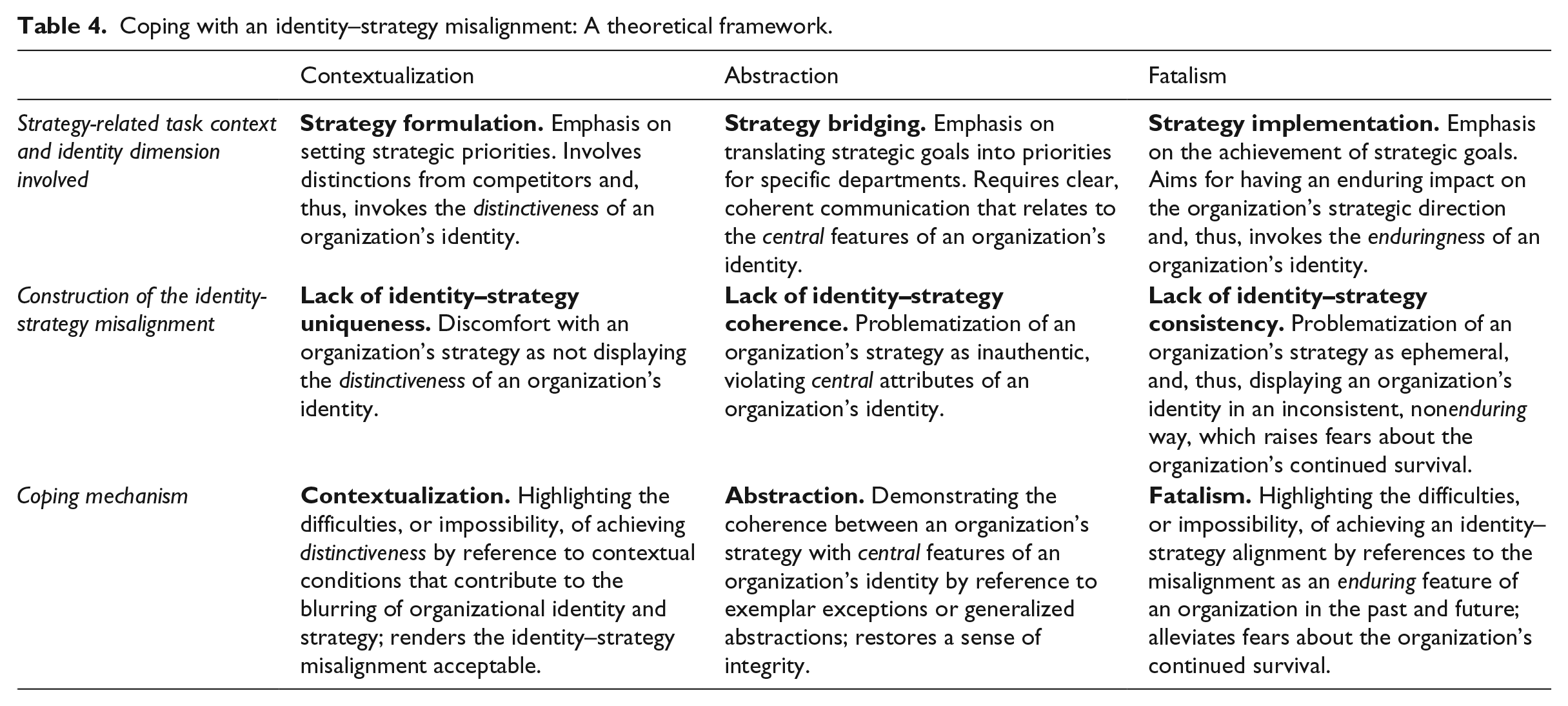
Contextualization refers to coping with an identity–strategy misalignment by referring to contextual conditions that inhibit a more clear-cut distinctiveness of an organization’s identity and strategy. Thus, this cognitive coping tactic relates to the distinctiveness dimension of organizational identity. Its use as a tactic is primarily invoked by the performance of tasks related to strategy formulation, given the associated focus on identifying and leveraging distinctive aspects of an organization relative to the competitive environment. Here, discomfort (Corley and Gioia, 2004) with the identity–strategy misalignment arises from a perceived lack of identity–strategy uniqueness. “Contextualization” helps actors alleviate this discomfort by viewing the missing uniqueness as a broader issue that can hardly if ever be changed. Consequently, actors are able to accept and live with the identity–strategy misalignment.
Abstraction refers to coping with an identity–strategy misalignment by demonstrating exemplar exceptions or generalized abstractions that do display coherence between the organization’s strategy and central features of its identity. Thus, this cognitive coping tactic relates to the centrality dimension of organizational identity. Its performance is primarily invoked by the performance of tasks related to strategy bridging, which focus on communicating an organization’s priorities based on central features of an organization’s identity. This tactic, then, addresses the identity–strategy misalignment in terms of a perceived lack of identity–strategy coherence, which creates a sense of inauthenticity. “Abstraction” helps actors restore their integrity (Schultz and Hernes, 2013) by seeking an overall coherence between an organization’s identity and strategy. Consequently, actors are able to tolerate and, thus, live with singular instances of an identity–strategy misalignment.
Finally, fatalism refers to coping with an identity–strategy misalignment by references to the past and future that highlight this misalignment as a consistent, fixed, and enduring feature of the organization that can hardly if ever be changed. Thus, this cognitive coping tactic relates to the enduringness dimension of organizational identity. Its enactment is invoked by the performance of tasks related to strategy implementation, which focus on realizing strategies with an enduring effect on the organization’s strategic direction and in view of other ongoing tasks that are simultaneously performed. This tactic, then, addresses the identity–strategy misalignment in terms of a lack of identity–strategy consistency, which spurs fears (Gioia et al., 2013b) about the organization’s continued survival. “Fatalism” helps actors alleviate these fears by fixing an organization’s identity–strategy misalignment as an enduring state. This revitalizes a sense of identity and strategy continuity and renders the misalignment difficult, if not impossible to change. Consequently, actors are able to acquiesce and live with the identity–strategy misalignment.
These findings are, we believe, not fully unique to our context. Indeed, we explored the focal phenomenon in a special setting, namely, publicly financed broadcasting. Whereas an identity–strategy misalignment in organizations with commercial interests might induce changes in organizational identity or strategy because the misalignment might undermine organizational performance and, therefore, place organizational survival at risk (e.g. Tripsas, 2009), MediaCorp’s members could cope and, thus, live with an identity–strategy misalignment without necessarily harming the long-term viability of the organization, although they partially questioned the organization’s enduringness. However, as Anthony and Tripsas’ (2016) overview shows, identity–strategy misalignments are a relatively ubiquitous phenomenon that can be observed in different types of organizations and settings. For example, similar to our case, both startups and incumbents with commercial interests might continuously be kept alive by investors despite identity–strategy discrepancies, which opens up the possibility for observing similar dynamics in such cases. Even members of the ever-growing number of “hybrid organizations” such as social enterprises as extreme cases for potential identity–strategy misalignments (Albert and Whetten, 1985) appear to be prone to the need for “cop[ing] with the demands imposed by the charity and business [imperatives] that they combine” (Battilana and Lee, 2014: 417) for extended periods of time and are, thus, inclined to change their blended identities or strategies primarily in exceptional times of crisis and unrest (Glynn, 2000). Such observations point to the transferability of our findings beyond the immediate context of our study.
Our findings have implications for understanding the management of an identity–strategy misalignment (e.g. Corley and Gioia, 2004; Ravasi and Phillips, 2011) and add to the recent turn that considers organizational identity a form of situated cognition (Ravasi et al., 2019). We discuss these implications and opportunities for future research in more detail below.
Coping with a misaligned identity–strategy nexus
Much of the extant literature assumes that an organization’s identity guides and is reflected in its strategy (e.g. Dutton and Dukerich, 1991; Reger et al., 1994). In turn, more recent work indicates that actors might also “betray” an organization’s identity to attend to competing market imperatives by pursuing identity-inconsistent strategies (e.g. Nag et al., 2007; Phillips and Kim, 2009). However, despite this theoretical progress, this burgeoning literature mostly focuses on examining how organizational identity and strategy might be realigned again (e.g. Clark et al., 2010; Corley and Gioia, 2004; Ungureanu et al., 2019). Implicit in this focus is the assumption that organizational identity and strategy are tightly interrelated concepts that must eventually be realigned to circumvent the challenges and dysfunctions associated with their misalignment (e.g. Anthony and Tripsas, 2016; Whetten, 2006). Therefore, how actors cope with demanding situations of an identity–strategy misalignment has remained undertheorized (Gioia et al., 2013b).
Our findings extend this line of inquiry by developing a theoretical framework of how organizational members cope with an identity–strategy misalignment. Specifically, our paper uncovers different tactics, that is, contextualization, abstraction, and fatalism, that help organizational members live with divergent understandings of an organization’s identity and strategy by rendering this misalignment tolerable or difficult, if not impossible to change. Thus, our paper offers to explain how organizational actors cope with an identity–strategy misalignment.
These observations are important because, as our study shows, these cognitive coping tactics help organizational actors live with an identity–strategy misalignment rather than struggling to realign the organizational identity and strategy. Our study indicates that cognitive coping tactics play a key role in alleviating the sense of urgency for realigning identity–strategy gaps that has traditionally been associated with such discrepancies (e.g. Corley and Gioia, 2004). Thus, acknowledging such tactics more fully implies that the “nexus” (Pratt et al., 2016: 4) of organizational identity and strategy might be much looser than prior research suggests, given that cognitive coping tactics provide organizational actors with degrees of freedom to carry on with an identity–strategy misalignment even when they recognize it and find it problematic, rather than having to heal this gap.
Future research might extend our findings by exploring the identified cognitive coping tactics more fully in day-to-day work. Specifically, although we found strong evidence for these tactics across our data sources, we could not unambiguously identify the specific actors involved in all cases, for example, in documents, newspaper articles, or even in some larger meetings. Therefore, these data sources did not allow us to substantiate the nuanced variations that we found in and theorized from the interview data. Future work might, thus, zoom in on the mundane, everyday activities and practices through which organizational actors cope with an identity–strategy misalignment to enrich our understanding of day-to-day responses and of the dispersed nature of the interrelationship between organizational identity and strategy.
Future work might also uncover the specific conditions under which organizational actors might choose to overcome an identity–strategy misalignment by realigning these concepts rather than continuing to live with this misalignment. For example, in contrast to Corley and Gioia (2004), we did not observe any top-down sensegiving activities that were aimed at realigning MediaCorp’s identity and strategy despite the considerable ambiguity that arose from the identity–strategy misalignment. To shed light on such deviations, we find a more fully articulated process perspective (Fachin and Langley, 2017; Langley, 2007) on this phenomenon particularly promising. Specifically, although rich in character, our data did not allow us to map specific constructions of the identity–strategy misalignment over time or to link the identified cognitive coping tactics to different points in time. Such a process perspective, however, might help future research empirically uncover additional context factors, such as longitudinal variations of the perceived distance between an organization’s identity and strategy (see Reger et al., 1994) or increasing commitments that come along with tenure (Gioia et al., 2013b), as potential explanations for varying approaches to addressing an identity–strategy misalignment over time.
Strategy-related task context and organizational identity as situated cognition
Our observations also have implications for recent formulations of organizational identity as situated cognition (Ravasi et al., 2019). Prior research has long considered organizational identity a global (e.g. Albert and Whetten, 1985; Whetten, 2006) or consensually constructed (e.g. Corley and Gioia, 2004; Gioia et al., 2000) feature of organizations. In turn, a few studies indicate that an organization’s identity is less monolithic than most work suggests (e.g. Hoon and Jacobs, 2014; Kreiner et al., 2015). This work has begun to show how organizational members interpret an organization’s identity with different emphases based on their hierarchical position (Corley, 2004) and the identity-related and audience-specific tasks that are associated with it (Ravasi et al., 2019).
In turn, our paper shows how the strategy-related task context contributes to different emphases on the relationship between organizational identity and strategy. Specifically, our study theorizes how the performance of specific strategy-related tasks, that is, strategy formulation, bridging, and implementation, prioritizes different dimensions of an organization’s identity, that is, its distinctiveness, centrality, or enduringness (Whetten, 2006). We, then, found that these task-related contexts were consequential for different conceptions of the identity–strategy misalignment, that is, a lack of identity–strategy uniqueness, coherence, or consistency, and for the specific ways in which members coped with such situated constructions.
We believe that these observations are important because they shift the focus on situated constructions of organizational identity away from hierarchical positions (Corley, 2004) and toward the strategy-related tasks that are performed within organizations. Whereas Corley (2004) associated strategy-related views on an organization’s identity with higher hierarchical levels by considering these hierarchical positions the locus of strategy-making, our study shows how organizational actors from various hierarchical levels perform similar strategy-related tasks and, therefore, invoke similar constructions of identity–strategy misalignment based on similar prioritizations of specific identity dimensions. Thus, our empirical analysis suggests that the observed patterns operate across hierarchical levels and are, thus, not bound to specific hierarchical positions.
For future research on organizational identity as situated cognition, these observations imply including more fully the recent turns to “strategy as practice” (Vaara and Whittington, 2012) and “open strategy” (Hautz et al., 2017). These streams of literature posit more explicitly than others do that strategy-making occurs in many parts of organizations, not only at higher hierarchical levels (e.g. Mantere, 2005). With such a more open perspective, future research can explore the discursive, bodily, and material activities and practices through which organizational actors from various hierarchical level engage in strategy-making and, in doing so, produce situated understandings of an organization’s identity. Thus, future research might further contribute to a less monolithic view of organizational identity, one that does justice to the multifaceted nature of strategy-related tasks and prioritizations of identity dimensions that are associated with these tasks.
Such future work might also explore more fully the dynamics of organizational identity continuity and change that are associated with the strategy-related task context, which surfaced as an implicit issue in our study. More specifically, in our study, we observed how organizational actors across all hierarchical levels heavily engaged in strategy-related tasks alongside their day-to-day work, many of which were aimed at invoking changes in the organization’s identity or strategy. Although prior research makes a case for such formal initiatives as a potential trigger for changing an organization’s identity or strategy (e.g. Gioia and Thomas, 1996), most informants did not consider any of these initiatives successful in achieving these aims, such that they remarkably had not noted any significant changes in the organization’s identity or strategy ever since the founding of the company. One possible explanation for the persistent reproduction of the organization’s identity and strategy is the enactment of cognitive coping tactics that the performance of strategy-related tasks invoked, given that these tactics alleviate the need for such adjustments and, thus, allow organizational actors to live with these conceptions even when they problematize them as being misaligned. However, we acknowledge that the continuity of an organization’s identity and strategy can be explained in many ways, such as inertia (Tripsas and Gavetti, 2000), material memory (Anteby and Molnár, 2012; Ravasi et al., 2019), path dependence (Sydow et al., 2009), psychological defenses (Brown and Starkey, 2000), and organizational resistance (Nag et al., 2007). Therefore, we encourage future research to examine the astounding persistence of an organization’s strategy or identity more systematically and in greater depth.
Footnotes
Acknowledgements
The authors thank Davide Ravasi and three anonymous reviewers for their thoughtful guidance. In addition, the paper benefited from helpful feedback received from participants of the 10th International Symposium on Process Organization Studies and the 34th EGOS Colloquium.
Declaration of Conflicting Interests
The author(s) declared no potential conflicts of interest with respect to the research, authorship, and/or publication of this article.
Funding
The author(s) received no financial support for the research, authorship, and/or publication of this article.
