




Abstract
Purpose:
The research explores the consumers’ behavioural intention towards electric vehicle adoption (EVA) specifically in the Indian milieu. It examines the impact of social influence (SI), facilitating conditions (FC) and knowledge about electric vehicles (EVs) on the consumers’ perceptions, further affecting their behavioural intention to adopt EVs.
Methodology:
This empirical research extends the traditional Technology Acceptance Model (TAM) within the Stimulus-Organism-Behaviour-Consequence (SOBC) framework to predict the consumers’ behavioural intention to adopt EVs. A cross-sectional analysis of data collected from 288 respondents is done employing partial least squares-based structural equation modelling.
Findings:
The findings of the research ratified all the hypothesised relationships establishing the sufficiency of the proposed framework. Outcomes emphasised that SI, FCs and knowledge about EVs significantly contribute to shaping positive consumers’ perceptions, ultimately leading to willingness to pay a premium (WTPP) price for EVs.
Practical implications:
The results offer intriguing implications for marketers and policymakers to speed up the adoption of EVs in emerging markets. It delivers valuable insights into how people with favourable adoption intentions in developing nations (like India) are willing to pay a premium for EVs, despite a low per capita income.
Originality/Value:
The current study adds value to the existing literature as it is the first study attempting to explore the intention to adopt EVs in an emerging market by integrating TAM within the SOBC framework.
Keywords
Introduction
Greenhouse gas (GHG) emissions emitted from fuel combustion in the industrial and transportation sectors are the primary contributor to environmental pollution (Boo & Tan, 2024). This study focuses on the transportation sector as vehicles are crucial to people’s daily lives. Moreover, this sector accounted for 14% of GHG emissions in 2022, making it the second-highest emitter globally (Statista, 2024b). To be precise, road vehicles are the major source of transportation emissions, comprising 12% of global transportation GHG emissions (Statista, 2024b). As concerns regarding environmental issues are increasing, the demand and development of eco-friendly products are also escalating (Higueras-Castillo et al., 2021). To address the persistent environmental challenges posed by road transportation, electric vehicles (EVs) are universally acknowledged as a promising innovation (Huang & Ge, 2019). In comparison to conventional fuel-powered vehicles, EVs can cut emissions of CO 2 by 30%–50% thereby, boosting fuel efficiency by 40%–60% (Jaiswal et al., 2022). EVs are characterised as vehicles that rely on energy derived from the electrical grid either partially or fully for their propulsion (She et al., 2017). Therefore, this study includes all the variants of EVs as the research subject including battery, hybrid or plug-in EVs following Boo and Tan (2024).
Talking about India, the third-largest automotive market in the world (Invest India, 2024), the adoption rate of EVs hit 6.4% in 2023, recording the sales of 1.5 million EVs, depicting a remarkable growth compared to a decade ago (Statista, 2024a). Although electric vehicle adoption (EVA) is still at its nascent stage, it is steadily gaining traction. The gradual pace of EVA can be attributed to the competitiveness issues faced by EVs against traditional fuel-powered automobiles. Prime issues include consumers’ reluctance towards innovative technology, high upfront cost, absence of charging facilities and insufficient knowledge about EVs (Riley, 2019). According to IBEF (2024), EVA is projected to expand from USD 3.21 billion in 2022 to USD 113.99 billion by 2029 in the Indian market, reflecting a compound annual growth rate (CAGR) of 66.52%.
Being a prominent area contributing towards sustainability, it has captured the interest of numerous scholars who have conducted various studies in this domain. For instance, Wang et al. (2018) studied how knowledge about EVs (PK) affects consumers’ EVA intention utilising Technology Acceptance Model (TAM) in China. Besides that, Jaiswal et al. (2022) also investigated the influence of PK on consumers’ intention to adopt EVs employing an extended version of TAM in India. Manutworakit and Choocharukul (2022) explored the influence of facilitating conditions (FC) and social influence (SI) on consumers’ behavioural intention to adopt BEVs among Thailand car owners by expanding the UTAUT model. In addition, Khazaei and Tareq (2021) also analysed the influence of FC and SI on consumers’ adoption intention towards BEVs in Malaysia employing UTAUT 2 model. In contrast, this study examines how PK, FC and SI shape consumers’ perceptions of pro-environmental vehicles covering all variants of EVs, ultimately influencing their intention towards EVA in India by integrating TAM within the Stimulus-Organism-Behaviour-Consequence (SOBC) model.
The current study addresses three research gaps. First, while existing literature has explored various factors influencing EVA but FC and PK coupled with SI as an external stimulus is overlooked in the early adoption stages for novel technologies (Lu, 2014). The study reconciles this knowledge gap by examining the specific interplay of SI, FC and PK. Second, no study has yet explored the influence of SI, FC and PK on consumers’ perception towards EVA as well as its subsequent association with behavioural intentions further leading to their willingness to pay a premium (WTPP). Present research closes this gap by exploring the interplay of these variables by incorporating the SOBC paradigm in the realm of EVA. Third, it explores the emerging EV market of India, bridging a pivotal research gap in a geographical context. As pointed out by Singh et al. (2020), the research exploring EVA is more prevalent in developed countries compared to developing countries. To bridge this significant knowledge and geographical gap, the present study outlines the subsequent research questions (RQ):
RQ1: How does stimulus (SI, FC, PK) influence consumer perception towards EVs? RQ2: How does consumer perception towards EVs influence their behavioural intention to adopt EVs? RQ3: How behavioural intention to adopt EVs is associated with the WTPP?
By addressing these questions, the study offers some pioneering theoretical contributions. First, it enriches the EVA literature by illustrating the influence of stimuli in shaping consumer perceptions leading to WTPP employing the SOBC paradigm. It offers a pioneering addition to the existing body of work by exploring the perception-intention-WTPP interconnection in the EVA domain. Second, it provides a comprehensive understanding of EVA by integrating TAM with the SOBC framework adhering to Duong (2024), who mentioned that relying solely on a single theory is insufficient to offer a holistic knowledge of eco-friendly behaviours. To the extent of the authors’ acumen, no study to date examined the EVA extending TAM within the SOBC framework.
The research also offers several practical insights for marketers, government authorities and policymakers. First, by examining the influence of FC and PK, it offers actionable insights for the government to create more effective educational campaigns about EVs and ensure investments in infrastructure upgrade plans for speedy uptake of EVs. Second, understanding consumers’ perceptions of the usefulness and ease of use of EVs will assist manufacturers in refining product development to better align with customer expectations. Third, the intention-WTPP association will help the policymakers to design effective financial and non-financial incentives to pace up the penetration of EVs in the Indian market.
Theoretical Framework and Hypotheses Formulation
A Unified Model Based on TAM and SOBC Model
The SOBC model advocated by Davis and Luthans (1980) rooted in Social Learning Theory (Bandura, 1977) is a hybrid model of Stimulus Organism Response (SOR) theory (Mehrabian & Russell, 1974) and Antecedent Behaviour Consequence (ABC) theory (Skinner, 1963) which helps in understanding the complicated human behaviour. It explores how intrinsic and extrinsic cues acting as stimulus (S) trigger the internal state of the organism (O) prompting their behavioural reactions (B) which ultimately result in observable or hidden consequences (C) (Talwar et al., 2021). The framework analyses the consequence of behavioural responses of an individual when exposed to external or internal stimuli affecting their beliefs, attitudes, and thoughts. Therefore, previous literature has used it to explore consumer behaviour in various contexts like Whelan et al. (2020) for social media overload; smartwatch usage (Saheb et al., 2022); online purchase intention during COVID-19 (Awal et al., 2023), and food wastage behaviour (Islam et al., 2024).
Since EVs are perceived as innovative technology (Shanmugavel & Michael, 2022) and individual’s behavioural intentions to adopt EVs are influenced by various psychological factors. TAM is one of the widely used cognitive frameworks which helps to comprehend the intention of an individual to use an innovative technology (Jaiswal et al., 2021) and is extensively applied in the realm of EV adoption (Adu-Gyamfi et al., 2024); influence of tourism on EVA (Prakhar et al., 2024) and EVA in paratransit owners (Hull et al., 2024).
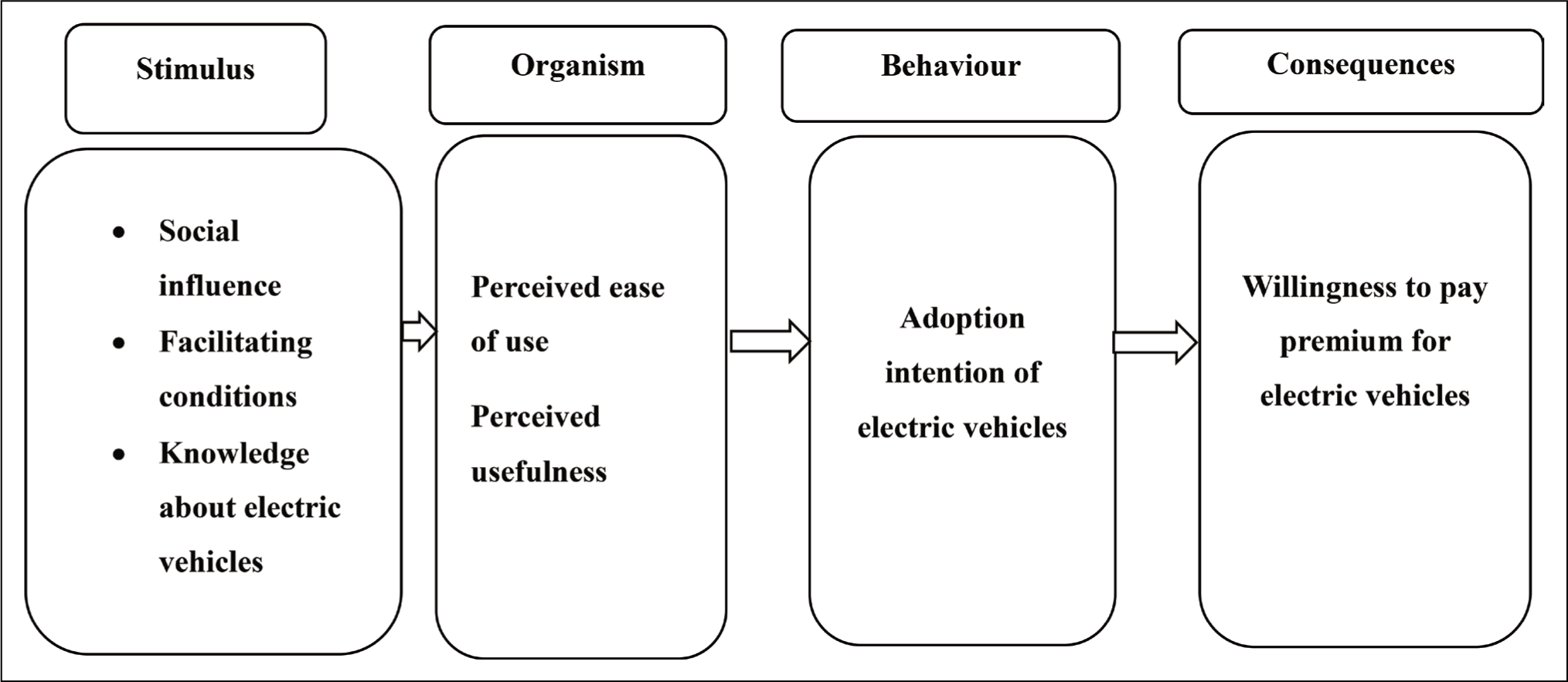
Although, few prior studies have applied TAM within the SOBC framework (Saheb et al., 2022; Lennita et al., 2024) it has not been utilised in the domain of EVA. Therefore, this research outlined a conceptual framework (Figure 1) reasoned on TAM and SOBC to encompass the progression of stimulus to consequence indicating how SI, FC and PK acting as stimuli activate organisms incorporating perceived ease of use (PEOU) and perceived usefulness (PU) which are the two widely used antecedents of behavioural intentions to adopt any technology of TAM framework to investigate the EV adoption intention as behavioural response resulting into WTPP for EVs as a consequence.
Conceptual Framework.
Stimuli and Internal State of Organism
The framework states that stimulus would induce the internal state of an individual resulting in certain behaviour and in this study SI, FC and PK are introduced as stimuli in the context of EVA.
Social Influence
SI reflects the degree to which people within a peer group influence mutual behaviour (Lu, 2014). According to Axsen et al. (2013), it is considered to occur when a person’s feelings, thoughts or actions are affected by the opinions and approvals of referents. Williams et al. (2015) noted that 86 of 110 studies signified a favourable relationship between SI and the perception of consumers towards novel technologies. In developing nations, such as India, where joint families and socio-economic reliance are prevalent, SI is prominent in framing purchase decisions (Ray et al., 2019). Notably, with pro-environmental innovations, like EVs, individuals often lack prior opinions for their new features. For instance, an individual’s perception of EV price is significantly influenced by their friends’ opinions (Zhang et al., 2011) and Abbasi et al. (2021) observed that social factors significantly influence the EVA intention of Malaysian consumers. Therefore, it is incorporated in the proposed model to anticipate its influence on EVA.
According to Lu et al. (2005), SI shapes the perception of an individual of how easy it will be to use a technology before they experience it. Moreover, SI also affects an individual’s perception of the usefulness of novel technologies (Lewis et al., 2003). Since EVs are green and innovative technologies (Bhat et al., 2022) offering societal functional benefits like reducing GHG and fuel requirements (Axsen et al., 2013), individuals will be more inclined to embrace the EVA considering their ecological and personal usefulness. Thus, the following hypotheses are proposed:
H1: SI is positively associated with PEOU. H2: SI is positively associated with PU.
Facilitating Conditions
FC means the essential technical and managerial backing provided to individuals to enable the use of the given technology, system, or novel product (Venkatesh et al., 2003). FC here refers to an individual’s beliefs about the resources and assistance available for EVA including the charging facilities, infrastructure, and the overall number of operational stations (Wang et al., 2023). Practical usage of any technology is contingent on the presence of necessary infrastructure facilities (Sahoo et al., 2023). In the case of EVs, the limited driving range (Jain et al., 2022) and the scarcity of charging stations are significant barriers to improving the FC required for speedy uptake of EVs (She et al., 2017).
Although previous literature has mentioned that EVA intention is associated with FC (Bhat et al., 2022; Singh et al., 2023) but the findings are inconsistent for instance, Manutworakit and Choocharukul (2022) found no effect of FC on EVA intentions whereas Jain et al. (2022) found FC to influence EVA intentions positively and Wang et al. (2023) found moderating effect of FC on EVA intentions. Therefore, to address these inconsistencies, this study expands the existing knowledge of FC with the individual’s internal state such as PU and PEOU towards EVA.
The presence of FC increases the likelihood of adoption of novel technology with less perceived effort and more PU (Dwivedi et al., 2017). It is also affirmed by the existing studies in various contexts such as Chen and Aklikokou (2020) for e-government adoption, Ebadi and Raygan (2023) for mobile-assisted language learning. Therefore, the following hypotheses are formulated:
H3: FC is positively associated with PEOU. H4: FC is positively associated with PU.
Knowledge about EVs
Knowledge regarding the product is pivotal in deciphering the individual’s decision-making mechanism and comprehending their behaviour (Kaplan, 1991; Liu et al., 2018). PK includes zero-carbon emissions aspect, no reliance on fossil fuels, required charging duration and presence of charging infrastructure, etc (Tu & Yang, 2019). Prior studies show that PK significantly predicts the purchase intention of a pro-environmental product (Qian & Yin, 2017; Uddin & Khan, 2018). Since EVs are also a pro-environmental product, PK has a significant influence on adoption intention (Wu et al., 2019). According to Berliner et al. (2019), insufficient PK is one of the prime causes behind lower acceptance rates of EVs. Furthermore, existing research has noted the importance of an individual’s knowledge regarding eco-friendly products as a cognitive factor that influences the cognitive state of individuals (Laroche et al., 2001; Uddin & Khan, 2018). Therefore, to comprehend the various facets of EV adoption, exploring the connection of knowledge about EV with PEOU and PU is highly imperative. PEOU in the context of EVs refers to the capacity of an individual to understand the operation and usage of EVs with minimal effort (Jaiswal et al., 2022). Knowledgeable individuals are more likely to perceive EVs as convenient to use, as they have prior knowledge of various performance attributes.
Additionally, according to Liu et al. (2018) knowledge regarding the features and benefits provided by the technology or product are related to the PU of the technology or product. Past literature also showed this in various contexts such as Wang and Hazen (2016) for renewable energy products and Pagiaslis and Krontalis (2014) for green products. Along similar lines, individuals possessing PK have a high likelihood to perceive EVs as beneficial for them as well as for society. Rooted on the viewpoints discussed above, the following hypotheses are posited:
H5: PK is positively associated with PEOU. H6: PK is positively associated with PU.
Organism’s Internal State and Behavioural Response
The paradigm postulated that the emotional and cognitive state of an individual influences the behaviour and in the current study, PEOU and PU are incorporated as organisms.
Perceived Ease of Use
PEOU refers to, ‘the extent to which a user perceives that using the target system will be free of physical and mental effort’ (Davis, 1986, p.136). It means the usage of a technology with minimal effort. The efforts of individuals are a limited resource that would be allocated to multiple tasks (Radner & Rothschild, 1975) and any technology or product that saves effort is considered user-friendly and has a high likelihood to get adopted due to increased perception of easiness in operation (Davis, 1989; Jaiswal et al., 2022). Previous research has shown a significant positive influence of PEOU on behavioural intention to adopt the concerned technology in different domains (Kaplan, 1991; Fagan et al., 2012; Wu et al., 2019).
In this study, PEOU refers to the ease of using EVs compared to conventional vehicles, including factors like battery charging, vehicle handling, etc. According to Wolff and Madlener (2019), the gradual adoption of EVs into everyday lives requires various adaptations to daily routines, especially the charging process compared to the refuelling of conventional vehicles, acceleration, etc. Thus, it is imperative to investigate whether individuals perceive it easy to adopt EVs along with these adaptations. While prior research has explored the impact of PEOU on consumer intention to adopt EVs, results have been inconsistent. For instance, Chen (2016) found an insignificant effect for electric bikes. In comparison, Lieven et al. (2011) and Wang and Dong (2016) found a significant positive influence. Hence, this study tries to address these discrepancies by expanding the existing knowledge on the relationship of PEOU of EVs with their adoption intention towards EVs. Hence, based on the abovementioned discourse, the following hypothesis is postulated:
H7: PEOU is positively associated with the adoption intention towards EVs.
Perceived Usefulness
PU refers to, ‘the degree to which a person believes that using a particular system would enhance his or her job performance’ (Davis, 1989, p.320). Simply, it is the perception of benefits an individual anticipates getting by adopting the novel technology (Shanmugavel & Michael, 2022). In various research contexts, it is acknowledged as a significant factor influencing the behavioural intentions of individuals (Fagan et al., 2012; Wang & Dong, 2016). In the realm of EVs, it means the degree to which a person perceives that he can accomplish the task swiftly and efficiently with EVs compared to conventional vehicles which might be because of the technical variations in the engines. According to Wang and Dong (2016), it can be addressed as the perceived travel efficiency expected by an individual while using an EV. Considering EVs as innovative and pro-environmental products, Jaiswal et al. (2022) provided the operational measures of PU of EVs incorporating energy efficiency by reducing the demand for fossil fuels (White & Sintov, 2017), eco-friendly as these reduce carbon emissions (Han et al., 2017). Thus, if individuals perceive EVs as useful, they are more likely to adopt them. Thus, we suggest the following hypothesis:
H8: PU is positively associated with the adoption intention towards EVs.
Behaviour Response and Consequence
In the present research, adoption intention is introduced as behavioural response and WTPP as the consequence.
Adoption Intention Towards EVs and WTPP
According to Venkatesh et al. (2003), intention signifies an individual’s determination to carry out a particular action and it serves as a predictor of the inclination of an individual towards using a technology in case of adoption of a technology. In the case of behavioural intentions to purchase or adopt, it indicates the readiness of an individual to purchase or adopt a particular product or technology. Yet it need not mandatorily be supported by the propensity to pay a higher price compared to the variants available (Gam et al., 2010). Although some studies have considered both these variables as one, as both are the outcomes of value propositions of products and technologies. A slight difference between them is that intention ranks the individual’s preferences for acquiring a product or technology (Liu et al., 2006) whereas WTPP analyses the impact of these values via monetary perspective (Stefani et al., 2006). Behavioural intention to adopt EV leading to WTPP is the ultimate decision-making factor of the current study’s framework. Chatterjee and Kumar (2017) highlighted that willingness to pay more is affected by the unique value effect, which accentuates the distinct features of the product or technology. According to Sukhu et al. (2017), managers must know the greatest amount a consumer is willing to spend to formulate an effective pricing strategy and predict the demand for a product with effectiveness. Previous research in the realm of green and clean technology found that the WTPP price is influenced by the adoption intention of individuals such as Farzin et al. (2023) for eco-fashion, Selem et al. (2023) for digital concierge services. Therefore, in the current study the following hypothesis is postulated:
H9: Adoption intention towards EVs is positively associated with the WTPP towards EVs.
Measurement Scale and Data Collection
Measurement Scales
The questionnaire comprised seven constructs including adapted measurement items of prior validated scales. Items of SI were adopted from Bhat et al. (2022), FC was assessed utilising the four items of Wang et al. (2023) and items measuring PK and PU were extracted from Wang et al. (2018). Items for PEOU were adapted from Wu et al. (2019). To measure adoption intention three items were utilised from Han et al. (2017) and three items were adapted from Zhang et al. (2020) to assess WTPP price. Each item is rated on a five-point Likert scale, with one representing ‘strongly disagree’ and five representing ‘strongly agree’. Comments were taken from three professors regarding the content and clarity of the questionnaire and minor modifications were incorporated as per the suggestions. After that, a pilot survey was undertaken by distributing the questionnaire to 25 respondents who were aware of the EV technology out of which 20 completed the survey. It was conducted through face-to-face engagement, employing convenience sampling. Cronbach’s alpha values exceeded 0.7 (Hair et al., 2018) for all constructs, confirming the reliability of the scale. Drawing on the insights from the pilot survey, minor adjustments were incorporated in the statements to enhance the relevance of the questionnaire. Thereafter, the scale was used for the final data collection.
Data Collection
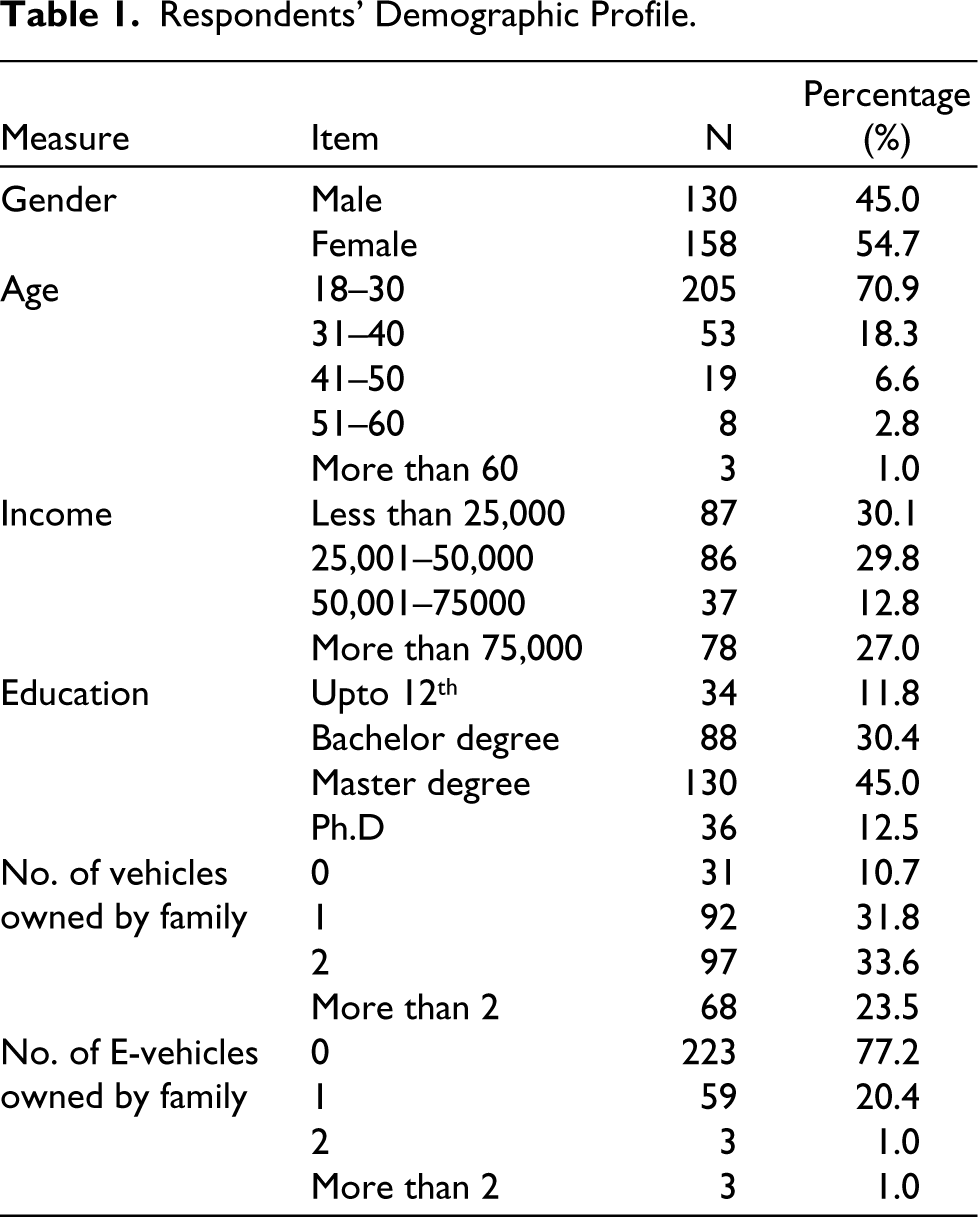
A cross-sectional survey was conducted in Delhi NCR employing both online and offline means applying a non-probabilistic convenience sampling technique due to pragmatic constraints. Individuals who knew about EVs were chosen as subjects of the study. After eliminating the invalid responses (like uniform responses for all the items or missing data), 288 valid responses were retained for further analysis which seemed sufficient for multivariate analysis according to Hair et al. (2010) who recommended 10:1 as a sample to variable ratio. Table 1 demonstrates the sociodemographic profile of the respondents. The majority of respondents in the current study belong to a younger demographic, considering current trends in EVA. Moreover, the buying decision for new vehicles is predominantly being shaped by the young and educated adults within the family (Young & Hinesly, 2012).
Respondents’ Demographic Profile.
Data Analysis
The proposed research model was analysed using partial least square structural equation modelling (PLS-SEM). PLS is acknowledged as a second-generation method with several advantages, including less restrictive presumptions about non-normal data distribution, adaptability in handling intricate relationships across constructs and efficiency in identifying the primary driver of construct outcomes (Hair et al., 2012). Using PLS-SEM, the measurement and structural models can be assessed concurrently.
Measurement Model
The following criteria are used to evaluate the measurement model: reliability, discriminant validity and convergent validity. The several assessment components for reflective measurement models are listed in Table 2.
Measurement Model Analysis Results.
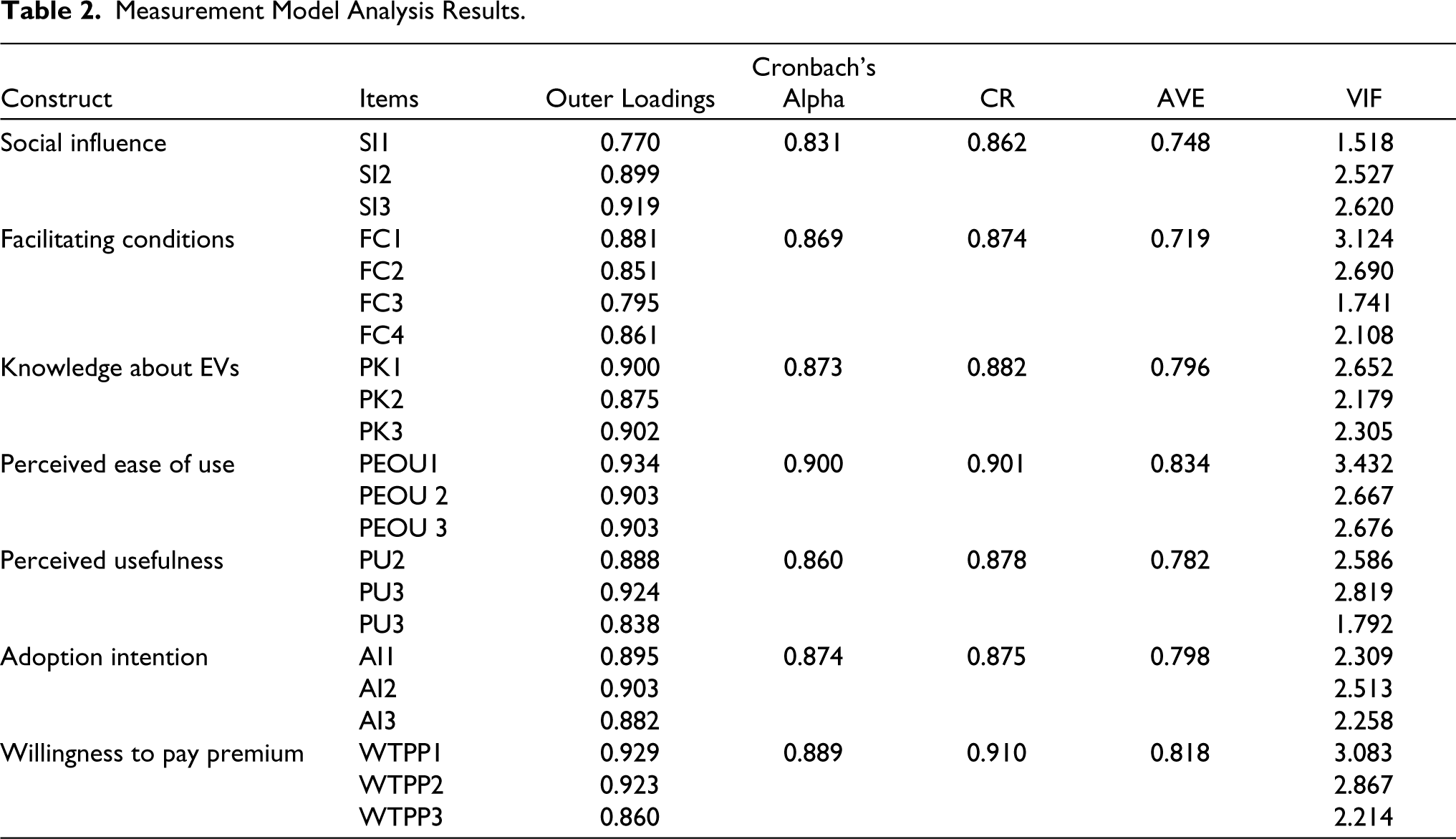
Using Cronbach alpha and Composite reliability (CR), the observed variables’ reliability was assessed. All of the latent construct values were over the minimal threshold level of 0.70, as indicated by Cronbach alpha and CR, showing a reasonable level of reliability for the scales. The convergent validity was assessed using the factor loadings for the reflective constructs and the average variance extracted (AVE). The results are shown in Table 2. Each indicator showed factor loading of more than 0.7 and AVE values between 0.719 and 0.834, which are higher than the 0.5 criterion. These standards demonstrate that the constructs load well on corresponding latent variables and that the final model exhibited convergent validity.
To compute multicollinearity, the variance inflation factor (VIF) must be assessed in addition to validity and reliability before structural model analysis. A cutoff value of 5.0 for multicollinearity was proposed by Hair et al. (2014). The VIF results for each construct showed that there were no collinearity problems between the constructs in this study, as they were all below the threshold value of 5.0
The Heterotrait-Monotrait ratio technique (HTMT) as recommended by Henseler et al. (2015) and the Fornell-Larcker criterion of cross-loading indicators (Hair et al., 2017) were used to evaluate the discriminant validity of the measurement model. Discriminant validity assessment ensures that in contrast to other constructs and their indicators, reflective constructs and their indicators have significant relationships (Hair et al., 2017). Table 3 shows that all of the reflective constructs show adequate or satisfactory discriminant validity (Fornell & Larcker, 1981), where the square of AVE (diagonal) is greater than the correlations (off-diagonal).
Discriminant Validity (Fornell-Larcker Criterion).
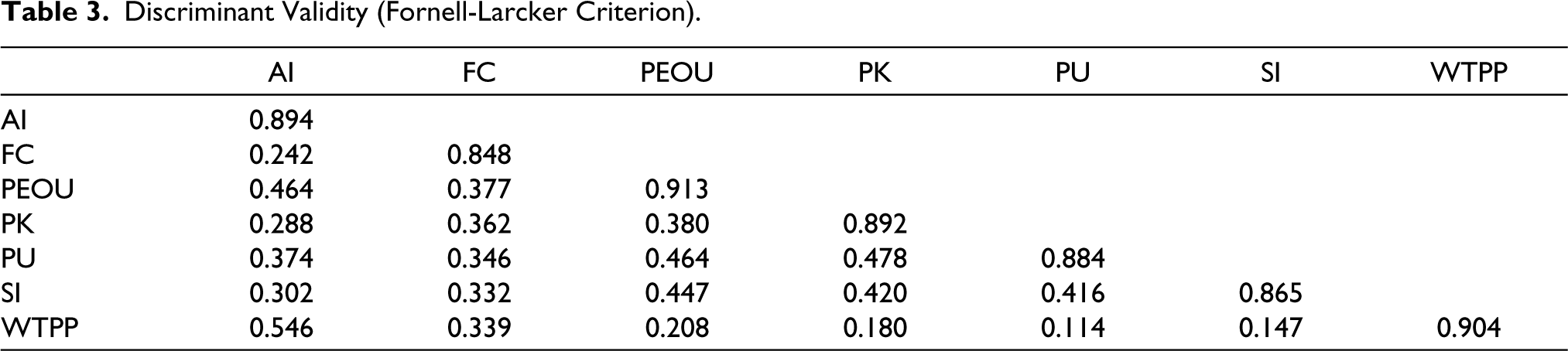
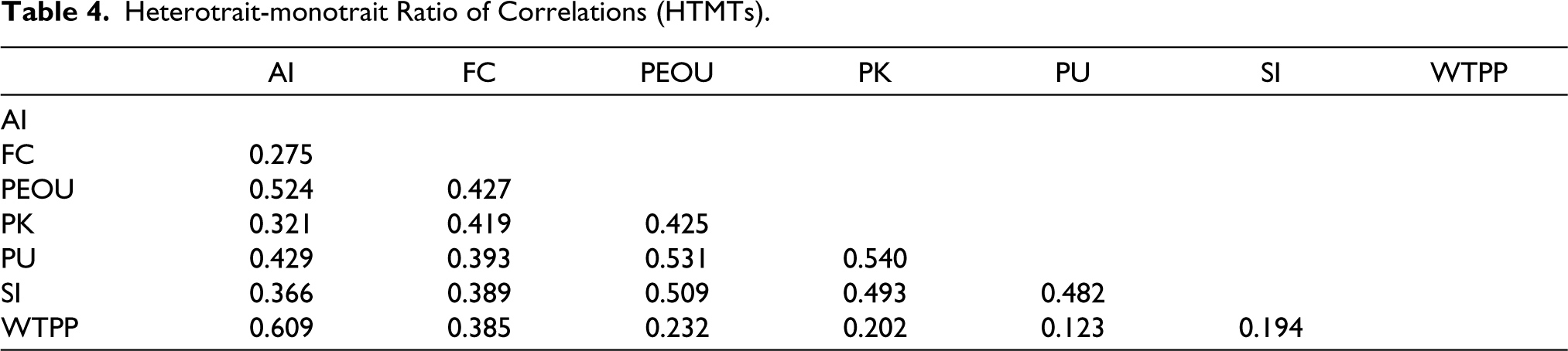
Table 4 shows that the HTMT values for each variable are less than 0.85. As a result, the constructs differ from one another empirically.
Heterotrait-monotrait Ratio of Correlations (HTMTs).
Furthermore, before testing the structural model its fitness was examined. SmartPLS 4.0 produced the goodness of fit results with an NFI value of 0.769, which is less than the recommended standard of 0.95. According to Hu and Bentler (1999), the SRMR value should be less than 0.08. The findings of the study indicated a good model fit, with an SRMR value of 0.064.
Structural Model
The next stage of the PLS-SEM technique is the structural model assessment after the measurement model has been validated. A bootstrapping technique using 5000 resamples was used to assess the given hypothesis. According to Ramayah et al. (2016), the quality of the structural model is gauged by the R2 value (Table 5). The coefficient of determination (R2) values for PU, PEOU, adoption intention and WTPP were 0.304, 0.282, 0.247 and 0.298, respectively.
R2 and R2 Adjusted.

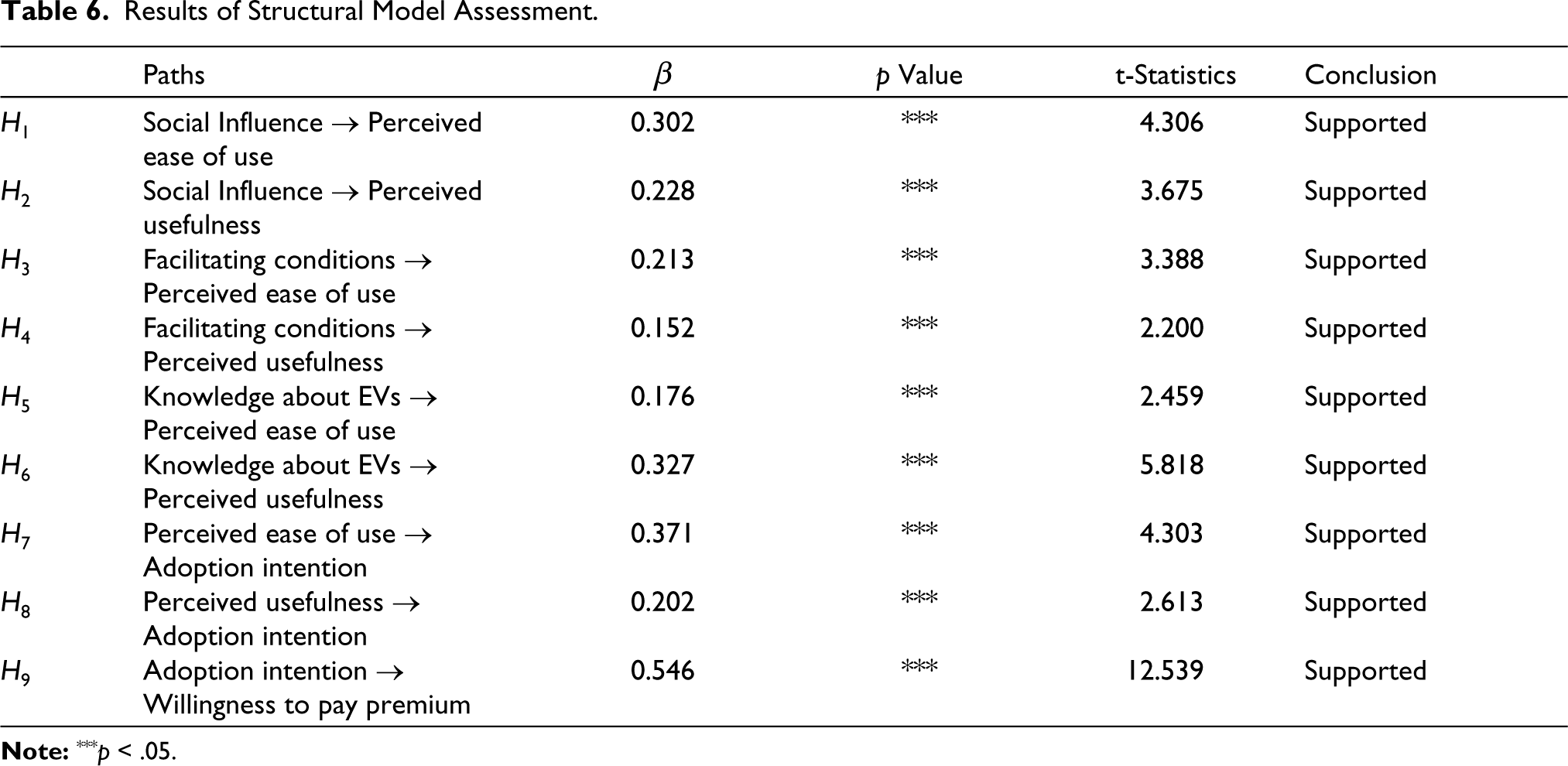
Table 6 shows the results of the structural model assessment. The results confirm H1 by demonstrating that SI has a favourable and significant impact on PEOU (β = 0.302, t = 4.306, p < .05). Furthermore, the relationship indicates that SI significantly impacts PU (β = 0.228, t = 3.675, p < .05). Thus, H2 is accepted. FC shows a significant impact on PEOU and PU (β = 0.213, t = 3.388, p < .05; β = 0.152, t = 2.200, p < .05). Thereby accepting H3 and H4. In addition, H5 and H6 are accepted as PK positively impacted PEOU and PU (β = 0.176, t = 2.459, p < .05; β = 0.327, t = 5.818, p < .05). PEOU and PU also positively impacted adoption intention (β = 0.371, t = 4.303, p < .05; β = 0.202, t = 2.613, p < .05). Thus, H7 and H8 are also accepted. Adoption intention also shows a significant impact on WTPP (β = 0.546, t = 12.539, p < .05) (H9 supported) (Figure 2).
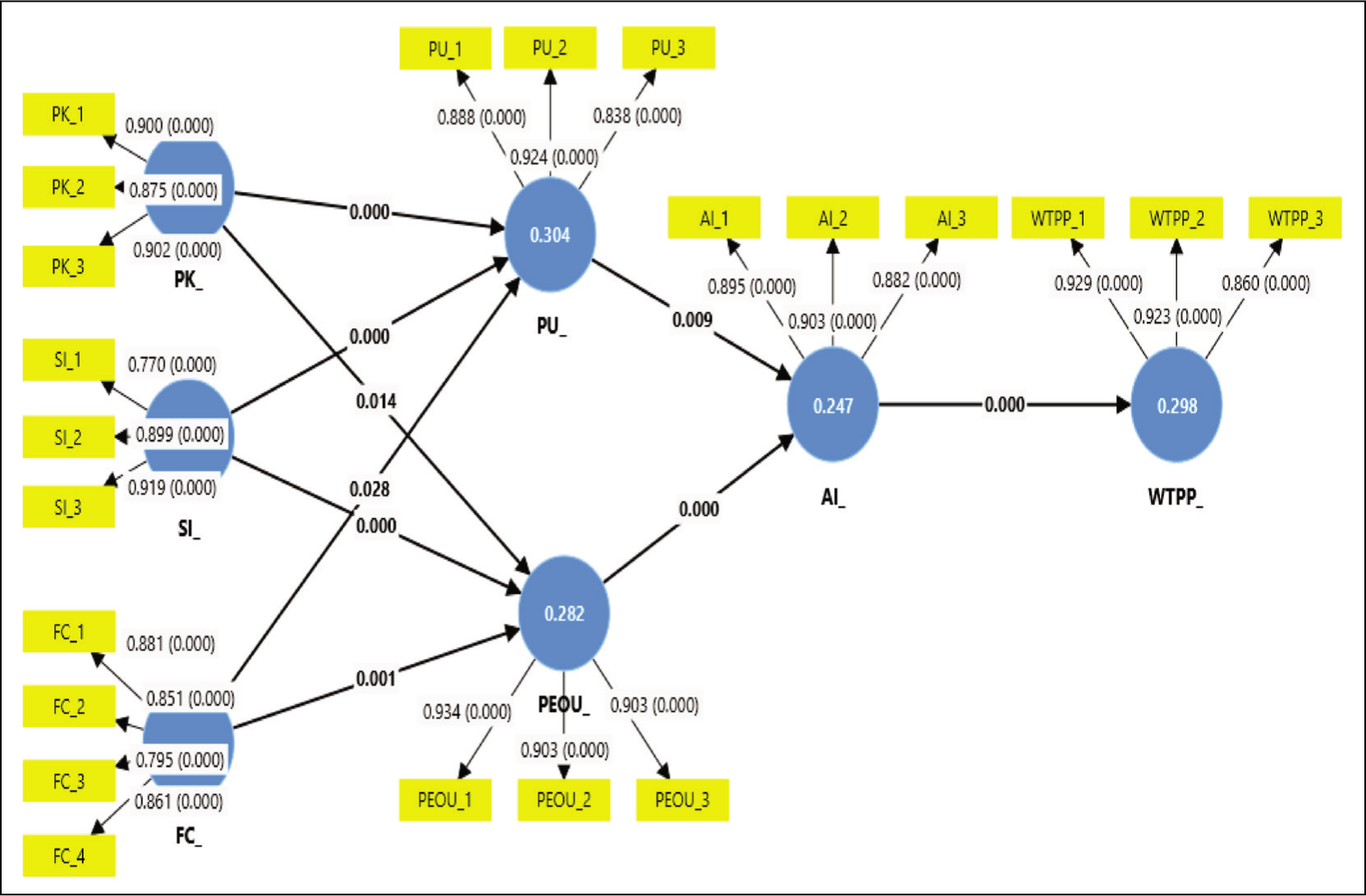
Results of Structural Model Assessment.
Discussion and Conclusion
All the proposed associations are confirmed by the results of the study affirming the effectiveness of the proposed unified model integrating TAM and SOBC paradigm towards EVA in the Indian milieu. Findings confirmed the significant and positive association of SI with PEOU (H1) in congruence with the prior investigation of Lu et al. (2005). H2 proposing the significant association of SI with PU is supported in consonance with the evidence (Lu, 2014; Lu et al., 2005). It exhibits that the consumers’ perception of EVs is influenced by their social networks. Additionally, the study corroborated the findings of previous studies illustrating the favourable influence of FC on PEOU (Chen & Aklikokou, 2020; Ebadi & Raygan, 2023) and PU (Chen & Aklikokou, 2020), respectively (H3, H4). It entails that the presence of FC like robust charging infrastructure, will shape consumer perception towards EVs favourably. Similarly, H5 and H6 were supported by the results of present research replicating the prior studies affirming the positive association of PK with PEOU (Jaiswal et al., 2022) and PU (Wang et al., 2018; Jaiswal et al., 2022) respectively. It highlights the relevance of PK in shaping the consumers’ perception of effortless usage besides the usefulness of EVs. Moreover, results demonstrated a positive and significant influence of PEOU and PU on AI following the existing research works (Huang et al., 2021; Jaiswal et al., 2022) (H7, H8). It implies that if consumers perceive driving EVs as convenient and beneficial for them, their inclination toward its adoption will increase. Furthermore, the conclusions of Kant et al. (2024) and Zheng et al. (2022) were ratified by the current study highlighting AI as a dominant antecedent of WTPP for EVs (H9). The prominence of these outcomes is underscored by the fact that willingness to pay signifies a favourable mindset that is on the verge of resulting in actual purchase behaviour (Fleșeriu et al., 2020).
Theoretical Implications
The research makes prominent theoretical contributions to EVA literature. First, it aims to model consumers’ behavioural intention towards EVA leading to WTPP by underscoring the relevance of the intention-WTPP association. This pathway from intention to economic behaviour is often overlooked in existing TAM-based models. By incorporating this link, the current study theoretically enriches TAM-based EVA literature on how to translate the adoption intention of consumers into their willingness to pay premium for eco-friendly technologies including EVs. Second, by incorporating the peer influence along with product-specific stimuli (PK, FC), it offers an in-depth theoretical insight into the SOBC mechanism on how social factors beyond the product features contribute to shaping consumer behavioural decisions in the context of EVA. Third, by adapting the validated frameworks (TAM & SOBC) in the field of EVs, it advances the theoretical grounding to accentuate the significance of SOBC for providing more nuanced insights on how social and product factors comprehensively contribute towards the broader adoption of eco-friendly innovations.
Practical Implications
The outcomes of the research provide some pioneering practical applications for promoting EVA. First, by emphasising the favourable influence of the social group, it suggests that marketers to capitalise on social forces by collaborating with community leaders, influencers, and satisfied customers to design social marketing campaigns that boost trust in EVs. Second, by highlighting the positive association of PK with perception, it guides marketers to develop awareness and educational campaigns to disseminate information about the environmental and economic benefits of EVs. Third, the correlation between adoption intention and WTPP offers a more nuanced perspective to marketers for the formulation of efficacious pricing strategies. By leveraging the consumers’ WTPP for eco-friendly features of EVs, marketers can effectively justify the high upfront cost in a developing country like India where the per capita income is relatively low.
Limitations and Future Research Directions
Despite its potential to advance the EVA literature, the current study has some shortcomings that must be considered before generalising the outcomes. The cross-sectional aspect of the study limits its potential to examine the causal associations among variables. Considering this, future studies can undertake longitudinal studies to evaluate these associations over time. Moreover, the influence of cultural differences on the consumers’ perceptions and intentions to adopt EVs can be analysed by conducting a comparative study across different regions with high and low adoption rates. Furthermore, future researchers can integrate both qualitative and quantitative methods to gain detailed insights into current EV user experiences by providing a comprehensive understanding of factors affecting EV usage. Additionally, this research applied the unified model of TAM and SOBC to assess adoption intention towards EVs in a developing nation for the first time, focussing solely on direct associations but future researchers are urged to incorporate mediators and moderators like financial incentives, innovativeness, socio-economic demographics, to strengthen the conceptual model. Furthermore, current research analysed the behavioural intentions towards EVA as it is considered a dominant antecedent of actual behaviour. However extant literature has shown that behavioural intentions might not turn into actual behaviour (Hsu & Huang, 2010). To offer more robust insights, future studies can extend it by focussing on actual adoption behaviour towards EVs.
Footnotes
Declaration of Conflicting Interests
The authors declared no potential conflicts of interest with respect to the research, authorship and/or publication of this article.
Funding
The authors received no financial support for the research, authorship and/or publication of this article.