




Abstract
Purpose:
This study aimed to investigate the variations in work motivation and Gen Z employee retention concerning the demographic characteristics of the employees and to assess the moderating impact of demographic variables on the relationship between work motivation and Gen Z employee retention.
Design/Methodology/Approach:
The empirical research was conducted by employing a quantitative research design from Indian Gen Z employees working at various organizations. A cross-sectional time frame was followed, wherein data was collected from 755 participants for their perception of work motivation and employee retention using a questionnaire. Descriptive and inferential statistical methods were used to examine the relationships between the study variables and to validate the developed model for the study using Smart PLS v3 software.
Findings:
Overall, the study found that workplace motivation has a significant effect on Gen Z employees’ retention. Moreover, the association between job motivation and Gen Z employee retention was moderated by gender, income, and industry type. However, the association between work motivation and Gen Z employee retention was unaffected by the level of education.
Research Implications:
The findings of the study specifically provide insights for HR practitioners. It can be implied that motivating employees and retaining them are among the essential elements of every organization. The organizations must create equal opportunities for males and females.
Introduction
The competitiveness of a business depends on retaining talent (Coetzee & Pauw, 2013). Attracting and retaining top talent has become a strategic advantage as the world economy becomes more knowledge oriented. At the workplace, the Gen Z demographic, which comprises those born between 1995 and 2010, is anticipated to account for almost a quarter of all workers worldwide by 2025 (Oh, 2021). Gen Z has been classified as a subset of Gen Y by Tulgan (2013), which shares features such as incentive preferences and work values of the latter. Gen Z also has specific traits, for example, being digital natives, flexible, practical, and competitive, that distinguish them from previous generations (Puiu, 2017). However, they have also been found to have difficulty in adjusting at the workplace, resulting in intergenerational disharmony, decreased collaboration, and reduced job satisfaction (Benítez-Márquez et al., 2022). Consequently, they have been ‘job hoppers’ (Nabahani & Riyanto, 2020). In general, while high turnover can disrupt pooled knowledge, erode established connections, and raise stress and achievement demands on other employees (Hale et al., 2016), not much is known about what stimulates Gen Z since this generation is rather new to the workplace. According to Cogin (2012), generational traits and ideals might affect how members of a generation define the aspects of their jobs that excite them the most. In this regard, it has been found that direction, meaning, and personal motivation are highly valued by Gen Z (Park & Shaw, 2013). Thus, to inspire and keep these workers, a job design that fosters experience-based meaning in employment will be necessary.
One of the key components of every business is motivation, which encourages people to apply extra effort (Akhtar et al., 2014). Motivation levels affect an organization’s overall efficacy and efficiency as well as its ability to succeed. Unmotivated workers do not apply effort themselves and, given the opportunity, quit their jobs (Cheema et al., 2013). Employees may be extrinsically or intrinsically motivated (Anwar et al., 2018; Lin, 2007; Meilani et al., 2021; Ryan & Deci, 2000). Each employee, regardless of their area of employment (Asad et al., 2011), understands the value of both extrinsic and intrinsic motivation. In contrast to the extrinsic motivation factor, such as pay, incentives, promotions, and job protection (Prabakaran et al., 2014), intrinsic motivation is an element of the job that increases inner satisfaction among staff and involves recognition, new task challenges, favorable and soft attitudes from one’s employer, and job continuation (Ryan & Deci, 2000). Research, consequently, suggests that the primary elements that affect retention rates are motivation and work satisfaction (Jones et al., 2015; Jost, 2014). Researchers such as Al-Hawary et al. (2013), discovered a favorable correlation between motivation and workers’ job satisfaction. In addition, numerous studies that looked into employment attitudes using demographic variables such as age and gender have revealed that these variables are excellent predictors of intentions to quit (Furnham et al., 2009; Schroder, 2008).
The HR department is encountering fresh challenges due to the generational shift in the workplace (Batistič, 2018). Researchers, such as Batistič (2018), Singh and Dangmei (2016), among others, draw attention to the significance of organizations changing to consider the unique perspectives and priorities of the different generations of employees in the workplace. For example, Batistič (2018) proposed using generational interventions to lower employee turnover. Singh and Dangmei (2016) highlighted the findings of earlier studies which demonstrated that employee turnover is significantly impacted by generational values. Similarly, Jiři (2016) emphasized the significance of considering generational values in the workplace to enhance worker retention and productivity. To retain a Gen Z workforce specifically, HR should focus on how they are motivated and formulate strategies to motivate and retain them (Barhate & Dirani, 2022). This article intends to study the relationship between work motivation and employee retention in Gen Z employees. In addition, the study will investigate the role of Gen Z employee demographics in moderating the relationship between work motivation and Gen Z employee retention.
Theoretical Framework and Hypothesis Development
Various theories such as the two-factor theory and Maslow’s Need Hierarchy Theory, have been utilized to provide a theoretical framework for understanding the function of work motivation and demographic factors in retaining workers for the present study. These theories connect the reasons why individuals join and why they leave establishments (Schneider, 2001). Herzberg’s (1968) two-factor concept (motivators and hygiene concept) postulates that innate rewards (motivators) and extrinsic rewards (hygiene aspects) contribute differently to job satisfaction and discontent, respectively. According to Herzberg (1968), motivation alone is responsible for job satisfaction, suggesting that roles must be rethought to provide more opportunities for appreciation, responsibility, accomplishment, and promotion. Maslow’s Need Hierarchy Theory (1943) elaborates that individuals, including those working for businesses, are driven by the need to attain or retain the different conditions onto which these primary gratifications such as physiological, security, affection, self-worth, self-actualization needs, and intellectual aspirations are met. Consequently, the present study utilizes these theories as a basis for the theoretical framework.
Work Motivation and Employee Retention
There are divergent views on what stimulates and motivates Gen Z in the workplace (Bulut & Maraba, 2021). Kutlák (2020) reported 481 motivational drivers and 496 motivation barriers, which were grouped into 5 clusters. These include achievement, out-of-work, work-person fit, relationships at work and the work-related cluster of Gen Zs. A total of nineteen well-being requirements were identified and categorized into four-dimensional retention strategies including extrinsic motivation, intrinsic motivation, eudemonic needs, and hedonic needs among Gen X, Y, and Z white-collar employees from the automobile industry (Verma, 2020). Results showed differences among the generations in terms of the four dimensions of retention strategies. Similarly, disparities have been reported in motivation across these generations (Mahmoud et al., 2021). Literature marks financial benefits as the most effective motivator for Gen Z (Randstad, 2016; Rothman, 2016; Safarov & Kalafatoglu, 2020; Tysjac, 2017), followed by prospects for growth, meaningful jobs, a generous benefits plan, autonomy, flexible work, and work-life balance (Kariuki & Rohula, 2020; Nabahani & Riyanto, 2020). Yousaf et al. (2014) argued that monetary rewards are more effective at motivating and keeping employees than nonmonetary ones. Apart from salary, job security, and job stability also acts as motivators for Gen Z (Gabrielova & Buchko, 2021). On the contrary, it was discovered that ‘pursuing passion’ (Graczyk-Kucharska & Erickson, 2020), social incentives (Ngoc et al., 2022), mentoring, and feedback schemes motivate Gen Z more than financial rewards (Gurchiek, 2016). Similarly, Mitchell (2016) found Gen Z prefers rewards like career progression over high pay, while Tarigan et al. (2022) attributed equal weightage to a combination of monetary as well as nonmonetary policies together as a part of total reward systems. Meaningful work, rewards, a friendly team, leadership, and good relationship with their supervisors were found to motivate Gen Z (Goh & Baum, 2021; Kutlák, 2020; Sakdiyakorn et al., 2021).
Even though Gen Z has higher motivation (Gabriel et al., 2022), however, their tolerance decreases when their requirements are not met and are likely to look for work elsewhere if they are not satisfied (Racolţa-Paina & Irini, 2021) or when the work remains unexplained (Chillakuri, 2020). The value of nonmonetary rewards for workforce satisfaction has been widely studied in the literature, and the results show that employee retention is connected to work satisfaction (Haider et al., 2016). Although monetary incentives like salary, perks, insurance, etc., are crucial, the morale of the workforce can also be boosted through nonmonetary incentives such as benefits, training, professional progress, recognition, workforce management, and work–life balance (Aguenza, 2012; Haider et al., 2015). Therefore, the first hypothesis proposed is as follows:
H1: Work motivation has a significant impact on Gen Z employee retention.
Demographics of the Gen Z Employees
Gender: Several studies have found that workers’ gender is a major factor in determining the intention to quit voluntarily. There are contradictory findings on the intention to quit among genders. Doran (1991) found that compared to men, women are more likely to voluntarily leave their jobs, while Moynihan and Landuyt (2008) found females were 23% less likely than males to affirm an intention to quit. Research has shown, however, that women have a much more immediate response to retention efforts than their male coworkers (Igbaria & Chidambaram, 1997). Furthermore, they opined that female employees generally appreciate any effort made by their employers to keep them on staff. Ahuja (1995) found the opposite to be true, that is, retention initiatives are met with enthusiasm from male workers. Storey (1999) found confirmation that female workers experience gender disparities even in so-called ‘equal opportunity’ companies. It was suggested that gender may have a ‘moderating influence’ on motivation (Acheampong, 2021). As a result, female employees are showing less loyalty to the company. This leads us to propose the following:
H2a: Gender moderates the relationship between work motivation and Gen Z employee retention.
Education: Kyndt et al. (2009) noted a negative correlation between employee retention and a lack of education, learning initiative, and preparedness. This finding may indicate that workers who are willing and able to learn would benefit from more challenging assignments at their current jobs. Barkhuizen and Rothmann (2006) discovered that the level of education influenced levels of engagement with work. According to McCrindle (2014), today’s Millennials and Gen Zers constitute the most educated and technically inclined generation to date. Hence, a study of their work motivation/retention will be of considerable interest. This leads us to propose the following:
H2b: Education moderates the relationship between work motivation and Gen Z employee retention.
Industry: Various sectors, including government (Nyanjom, 2013), heavy industries (Sinha & Sinha, 2012), hospitality (Christensen & Rog, 2008), power (Mabuza & Proches, 2014), healthcare (Lam et al., 2015), and small and medium enterprises (Zin et al., 2012) have all researched worker retention. The effect of different types of businesses on employee retention, however, has received less attention. Therefore, the following are proposed:
H2c: Industry moderates the relationship between work motivation and Gen Z employee retention.
Income: Financial security, according to Kirchmayer and Fratričová (2020), is a top priority for Gen Zers. Income and benefits are two factors that Haldorai et al. (2019) found to affect staff retention. In their view, employees will be more inclined to stay with a company if they are paid a competitive wage and are given reason to believe that their earnings potential will increase if they remain with the company. There is a favorable correlation between earnings and retention rate, as reported by Raihan (2012), who found that employees’ feelings and level of commitment had an indirect but significant impact on their pay and a direct and decisive impact on their willingness to stay with the company. The vast majority of researchers agree that salary has a significant association with employee retention, as evidenced by the studies cited here. Hence, the following are proposed:
H2d: Income moderates the relationship between work motivation and Gen Z employee retention.
Methodology
Study Design
The study utilized a quantitative method to investigate the moderating effect of demographic factors (gender, education, industry, yearly income, number of times switched jobs, type of city) on the relationship between work motivation and employee retention of Gen Z employees. A structured questionnaire was prepared for the study and used to gather data from participants, who belonged to the service, retail, manufacturing, and communication industries. The focus of the study was to find if the respondents from the industry behave similarly. The questionnaire was administered to the participants using Google Forms.
Sampling
The target populations for the study were Gen Z individuals working in different organizations in India. The snowball sampling technique was used by the study to collect data from 755 Gen Z individuals. This sampling technique also known as network selection, involves the usage of referral, word of mouth, and related methods to identify prospective participants for a study through participants who were previously identified (Hutchinson, 2004). The researcher invited the prospective participants via email. The email clearly stated the study’s objectives, guidelines for filling in the questionnaire, the promise of anonymity and confidentiality, and that participation in the study was voluntary.
Measures
The questionnaire prepared for the study used close-ended questions and included questions where the response was measured on a 5-point Likert scale. The following data were collected:
Sociodemographic data of the participants such as gender, highest education, industry, yearly income, number of times switched jobs, and type of city (six items). Work motivation (18 items) was adapted from (Anwar et al., 2018). A 5-point Likert scale was utilized for this construct ranging from 1 indicating Strongly disagree, to 5 indicating Strongly agree. Employee retention (12 items) was adapted from (Kossivi et al., 2016). A 5-point Likert scale was utilized for this construct also, ranging from 1 indicating Strongly disagree, to 5 indicating Strongly agree.
Data Analysis
SPSS (v24.0) was used to perform statistical analyses on the raw data collected from the study’s sample population, including descriptive and inferential statistics. Additionally, Smart PLS v3 was used to test the structural equation model (SEM) created for testing the moderating effect. Moderation analysis tests the influence of a third variable on the relationship between independent variables and dependent variables. Specifically, moderation examines the effect of a moderator variable on the strength and direction of the association between dependent variables and independent variables. The testing of the effect of moderation is intended to detect the position of the moderating variable in the model. Moderation presumes the absence of measurement error and assumes that the moderator is not caused by the dependent variable. The collection of the moderator’s measurement or experimental manipulation of the variable before the introduction of independent variables ensures that the moderator is not caused by dependent variables. The moderating effect is said to be significant if the p value is .05.
Results
Participants Demographics
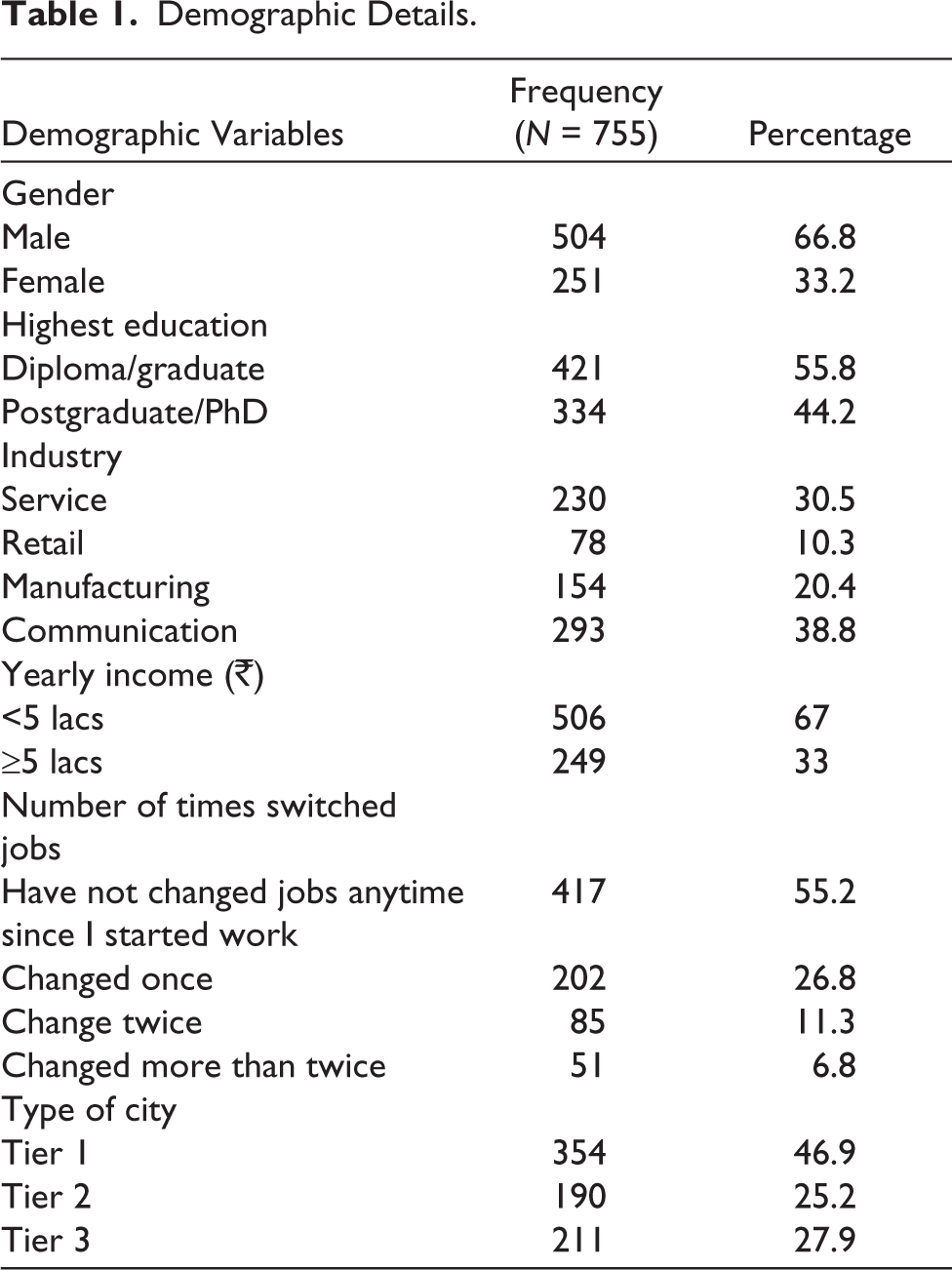
The majority of the participants were male (66.8%) having a diploma or degree (55.8%), while the rest were postgraduates or PhDs (44.2%). Further, 38.8% of the respondents were working in the communication industry (38.8%) followed by service (30.5%), manufacturing (20.4%), and retail (15.8%) industries. More than half of the employees had a yearly income of less than ₹5 lacs (67.0%), followed by those over ₹5 lacs (33.0%). In addition, the majority (55.2%) had not changed jobs since they started working and the majority were working in a Tier 1 city (46.9%) (Table 1).
Demographic Details.
Difference in Work Motivation and Employee Retention Based on Demographics
From Table 2, it can be observed that there was a significant difference in both intrinsic motivations based on gender (t(753) = –10.917, p = .000). In addition, the findings indicated that female employees have greater intrinsic motivation when compared to male employees. In terms of education, it could be seen that there was a significant difference in intrinsic motivation based on education (t(753) = –5.334, p = .000). It could be inferred that employees who had completed higher education like postgraduation or PhD had high intrinsic motivation. In addition, the study found a significant difference in intrinsic motivation based on employees’ industry (t = 20.236, p = .000). For example, the study found that employees who worked in the service industry had higher intrinsic motivation rather than other industries. Further, based on income, it was found that there exists a significant difference in intrinsic motivation (t = 4.123, p = .000). Employees with income <₹5 lacs were found to have high intrinsic motivation in comparison with employees with income ≥₹5 lacs. Moreover, the study found that the type of city had a significant impact on employees’ intrinsic motivation (t = 9.758, p = .000).
Difference in Work Motivation and Employee Retention Based on Demographic Factors.
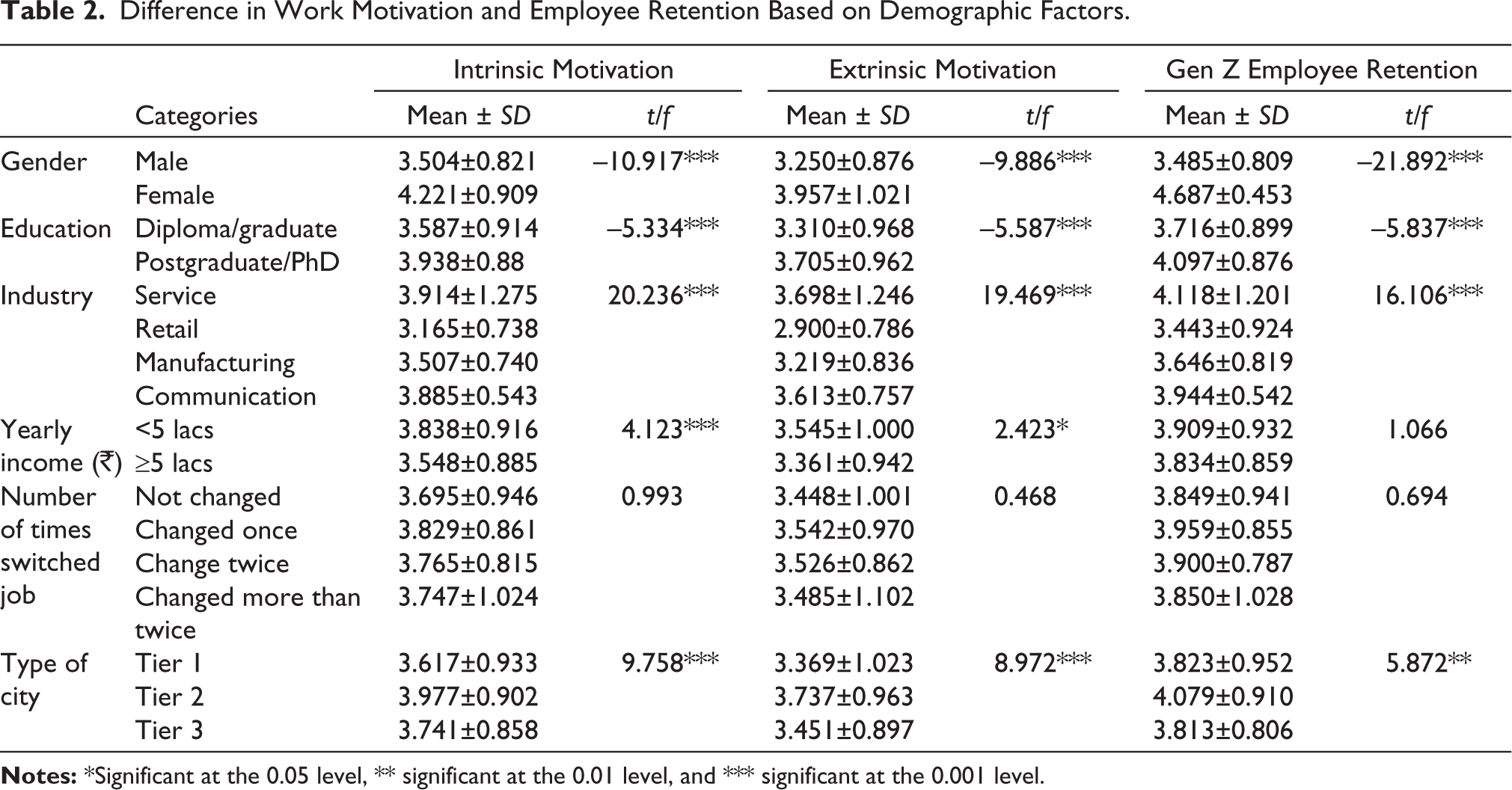
Similarly, concerning extrinsic motivation, the study found that employees’ extrinsic motivation was significantly influenced by gender (t(753) = –9.886, p = .000), education (t(753) = –5.587, p = .000), industry (t(753) = 19.469, p = .000), yearly income (t(753) = –2.423, p = .016), and type of city (t(753) = 8.972, p = .000). The majority of the employees contributing to this perception of extrinsic motivation were females, had completed postgraduation or PhD, worked in the communication industry, and had income less than ₹5 lacs.
Regarding employee retention of Gen Z employees, the study found a significant difference based on gender (t = –21.892, p = .000), education (t = –5.837, p = .000), type of industry (t = 16.106, p = .000), and type of city (t = 5.872, p = .000). Most of the employees contributing to this perception seemed to be female, had completed postgraduation or PhD, worked in the service industry, and had income less than ₹5 lacs.
SEM Model
The moderating effects of gender, education, industry, and income were analyzed using the SEM model. SEM utilizes assumptions of sample adequacy, data normality, and outliers.
Measurement Model
The measurement model (Figure A1) was assessed by examining the reliability of individual items, performing reliability analysis, and ascertaining the discriminant validity of the constructs. The findings (Table A1) indicate that the Cronbach Alpha, CR, and rho_A value for all study constructs namely, employee retention, extrinsic motivation, and intrinsic motivation were greater than 0.7. Thus, the measurement scales are internally consistent and have high reliability. In addition, the indicator reliability value of all constructs was found to be greater than 0.4 thereby confirming the reliability of the scale. The findings indicate that AVE (average variance extracted) is greater than 0.5 for all constructs. This indicates the high validity of factors adopted for measuring the constructs. The VIF (variance inflation factor) values were used to determine the existence of collinearity, and VIF values are found to be less than 5, which indicates that there is no collinearity problem between the variables.
The Fornell–Larcker criterion and the Heterotrait–Monotrait (HTMT) ratio were used to assess the discriminant validity of a test. The findings of Fornell–Larcker Criterion (Table A2) show that the values for all the factors namely, employee retention (0.823), extrinsic motivation (0.856), and intrinsic motivation (0.842), are higher than the highest correlation of the specific variable with other variables in the model. This establishes the discriminant validity of the constructs. The HTMT values (Table A3) of all constructs were found to be lesser than the cutoff value of 0.85. This indicates the optimal difference established between the constructs and hence the validity of the factors is assured.
Structural Model
The structural model (Figure A3) was assessed by evaluating the extent of R-squared values, ascertaining the effect size, determining the predictive relevance (Figure A2), evaluating the significance of path coefficients, and investigating the moderating effect. The coefficient of determination (R2) value indicates that 50.5% of the variation in employee retention could be accounted for by work motivation and 97.9% of the variation in work motivation could be accounted for by extrinsic motivation and intrinsic motivation (Table A4). The Stone–Geisser’s Q2 value is a measure of predictive relevance. If the Q2 value is greater than 0, then the model is predictive. It is seen that Q2 of employee retention was 0.683. Thus, it was evident that the model shows good predictive relevance. The goodness of fit was assessed using standardized root means square residual (SRMR). A value less than 0.08 indicates a good fit. In the present study, the SRMR value of 0.062, d_ULS value of 2.15, d_G value of 2.55, chi-square value of 3682.39, and NFI value of 0.910 indicates a good fit for the model (Table A5).
The effect size is indicated by f2 values. It indicates the impact of independent/exogenous constructs on the dependent/endogenous constructs. The effect size of extrinsic motivation (f2 = 2.280) and intrinsic motivation (f2 = 11.639) was large on work motivation (Table A6).
Testing of Model
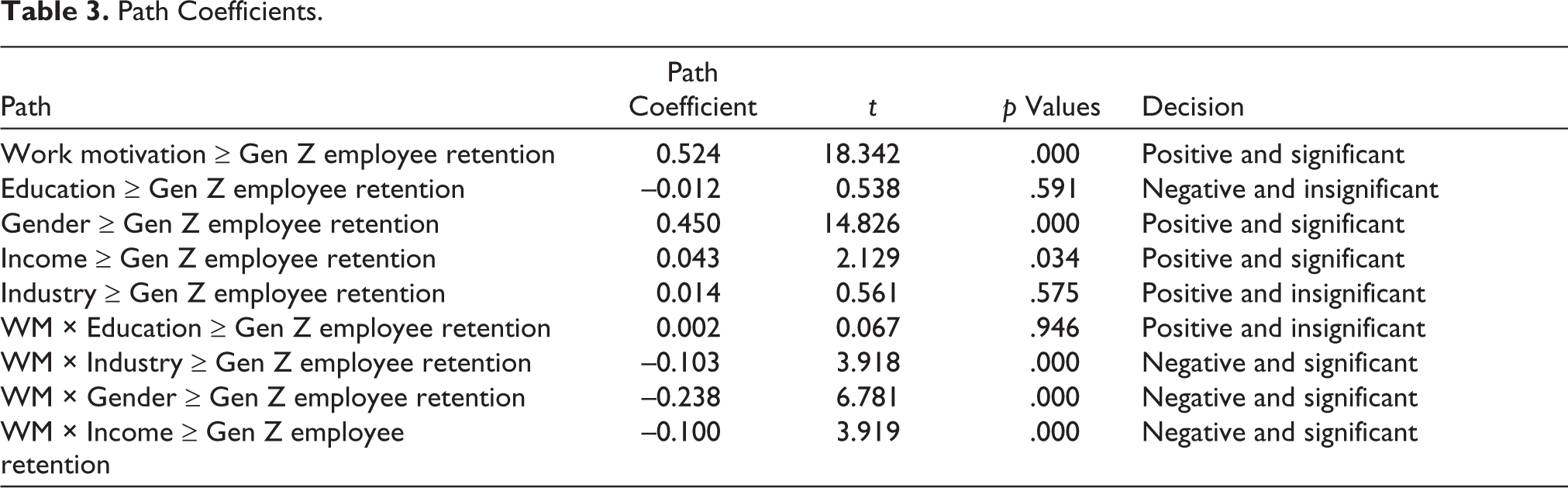
The testing of the model showed that employee work motivation significantly influences employee retention (t = 18.342, p < .01). Thus, hypothesis ‘H1: Work motivation has a significant impact on Gen Z employee retention’ was accepted. Education was not found to moderate the relationship between work motivation and employee retention (t = 0.538, p > .05). As a result, hypothesis ‘H2a: Education moderates the relationship between work motivation and Gen Z employee retention’ was not accepted. Gender had a positive and significant influence on employee retention (t = 14.826, p < .01), and the relationship between work motivation and employee retention was moderated by gender (t = –0.238, p < .01). Thus, hypothesis ‘H2b: Gender moderates the relationship between work motivation and Gen Z employee retention’ was accepted. Furthermore, income had a positive and significant influence on employee retention (t = 2.129, p < .05) and moderated the relationship between work motivation and employee retention (t = 3.919, p < .01). As a result, hypothesis ‘H2c: Income moderates the relationship between work motivation and Gen Z employee retention’ is also accepted. Finally, while industry did not influence employee retention (t = 0.561, p > .05), the relationship between work motivation and employee retention was moderated by industry (t = 3.918, p < .01). Thus, hypothesis ‘H2d: Industry moderates the relationship between work motivation and Gen Z employee retention’ was accepted. Based on these findings, hypothesis ‘H2: Gen Z demographics moderate the relation between work motivation and Gen Z employee retention’ was partially accepted. The path coefficients can be seen in Table 3.
Path Coefficients.
Discussion
HR managers, in the present day, face a new set of challenges as a result of the generational shift in the workplace (Batistič, 2018). Studies have highlighted the importance of adjusting organizational change to accommodate the unique perspectives and priorities of each generation in the workplace (Batistič, 2018; Singh & Dangmei, 2016). To reduce employee turnover, Batistič (2018) proposed using generational interventions. Singh and Dangmei (2016) pointed out that prior studies have shown that generational values are major factors in employee turnover. Jiři (2016) found similar issues, emphasizing the importance of incorporating generational values in the workplace to increase retention and productivity.
Overall, the findings of this research indicated that workplace motivation among members of Gen Z influenced employee retention. This is in line with earlier studies which indicated that different motivators, monetary and nonmonetary, can improve retention of Gen Z employees (Gurchiek, 2016; Haider et al., 2016; Mitchell, 2016; Racolţa-Paina & Irini, 2021; Randstad, 2016; Rothman, 2016; Tysjac, 2017; Yousaf et al., 2014). Gender, income, and industry were found to have moderating effects on the relationship between work motivation and employee retention. Since the study had found that the difference in the employees’ perceptions concerning intrinsic and extrinsic motivation, and employee retention, was greater with female employees, employees with less than ₹5 lac income, and employees of the service industry, the moderating effect was not unexpected. The finding related to the effect of gender on work motivation was consistent with the findings of Doran (1991), Igbaria and Chidambaram (1997), and Moynihan and Landuyt (2008), among others. In another study, the motivation of the Gen Z respondents was found to vary depending upon the principles of sustainable development that the organization follows (Rzemieniak & Wawer, 2021) The study is perhaps among the first to study the effect of different types of businesses on employee retention and the finding that the nature of the industry has an impact on workplace motivation and employee retention is thus noteworthy. Further, the moderating impact of income is consistent with the findings of researchers such as Kirchmayer and Fratričová (2020), Haldorai et al. (2019), and Raihan (2012), who submitted that the financial aspect of work was a significant concern for Gen Zers.
A significant finding of the study was that education level does not moderate the relationship between work motivation and employee retention. This was surprising as there were differences in the employees’ perceptions of work motivation and employee retention based on their educational qualifications. Nevertheless, according to Trevor (2001), irrespective of the state of the job market, low-educated workers are less likely to quit than their more-educated counterparts. This makes it more likely that the company will lose the skills necessary to carry out its strategy of protecting its current market position and expanding its customer base. In contrast to the findings of the present research, Barkhuizen and Rothmann (2006) discovered that those with more education demonstrated higher levels of engagement than those with less education.
In line with the theoretical framework of the study, the findings indicated that motivation is responsible for job satisfaction (Herzberg, 1968). In addition, individuals appear to be driven by the need to attain or retain the different conditions onto which their primary gratifications such as physiological, security, affection, self-worth, self-actualization needs, and intellectual aspirations are met (Maslow, 1943).
Conclusions and Recommendations
The purpose of this research was to examine the influence of work motivation on Gen Z employee retention and the moderating effect of demographic factors including gender, education, income, and industry on the relationship between work motivation and employee retention among Gen Z workers. It was noted that while gender, income, and industry type moderated the relationship between work motivation and employee retention, education level had no moderating effect between the variables. Hence, this study provides suggestions based on the outcomes of the research about Gen Z employees’ likelihood of staying with the company. Therefore, if organizations want to keep their employees around for the long term, they need to invest in better HR practices that influence the internal and external motivation of Gen Z employees. Talented employees who leave their positions represent a loss of valuable employees and result in additional costs for the company in the form of hiring, training, and general management. Additionally, opportunities should be created equally to meet the requirements of both genders. Organizations should understand the value of their staff members because their team of devoted and productive employees is a key component of their success.
Overall, in light of the characteristics of the contemporary motivational profile of Gen Z individuals, business leaders must give special attention to a set of nonmaterial motivation instruments that include fairness in wages, flexibility in working hours, good-quality communications, mental health support during uncertain times, and other instruments of well-being management.
The study is not without limitations. The survey was administered online and consequently, some of the data were exposed to some risks such as the biases and understanding of the participants. In addition, only a few industries were chosen for the study limiting the generalizability of the outcomes. A future researcher can look at performing a wider study including more industries.
Footnotes
Declaration of Conflicting Interests
The authors declared no potential conflicts of interest with respect to the research, authorship, and/or publication of this article.
Funding
The authors received no financial support for the research, authorship, and/or publication of this article.