




Abstract
In forensic medicine and toxicology, fingerprints, palmprints, and blood group systems are widely used tools for personal identification. When friction ridge details are unclear or absent in palm prints, palmar flexion creases may serve as an alternative feature for identification. This study aimed to assess the association of sex with fingerprint patterns, palmar flexion crease density, and ABO and Rh blood groups among medical students. A cross-sectional study was conducted among 200 medical students aged 18–25 years. Fingerprint patterns, palmar crease density, and blood group data were analyzed to evaluate their relationship with sex. Statistical analysis was performed to determine the significance of observed associations. Loops were the most common primary fingerprint pattern, while composite patterns were the least frequent. No significant association was observed between sex and fingerprint patterns or blood groups. In contrast, a statistically significant difference was noted in palmar flexion crease density between males and females (p < .001). The mean palmar crease density was higher in females (5.88 creases/cm²) compared to males (3.54 creases/cm²). This study demonstrates that while fingerprint patterns and blood group systems show no significant association with sex, palmar flexion crease density exhibits clear sexual dimorphism. These findings highlight the potential forensic value of palmar crease density as an adjunct tool for sex determination, particularly in situations where conventional ridge details are insufficient or unavailable. Because palmar crease features offer several practical advantages, this study indicates that crease density may serve as a helpful parameter for sex determination.
Keywords
Introduction
Fingerprints are formed by the impressions of friction ridges present on the skin of the fingers and have long been recognized as a reliable means of personal identification in forensic practice. The scientific study of these epidermal ridge patterns on the fingers, palms, and soles is known as dermatoglyphics. Individually distinctive friction ridges on the palms and soles have been extensively used for identification purposes due to their uniqueness and permanence. 1
During embryonic development, around the twelfth week of gestation, ridge formation begins with the appearance of epidermal ledges at the dermo-epidermal junction. Rapid cellular proliferation over these ledges gives rise to primary and secondary ridges, which later become visible as friction ridges on the outermost layer of the skin. 2
These ridge patterns remain unchanged throughout life, except in cases of injury or disease. Sir Francis Galton established that fingerprints could be systematically analyzed and compared for the purpose of individual identification. Based on the arrangement of papillary ridges, fingerprints are classically categorized into three primary patterns: loops, whorls, and arches. 3
While fingerprints remain the most used dermatoglyphic feature, palmprints have gained increasing importance in forensic investigations. Palmprint identification plays a significant role in forensic science, as nearly 30% of latent prints recovered from crime scenes originate from the palmar surface. 4
Compared to fingerprints, palmprints offer a larger surface area and contain a greater number of identifiable features, making them particularly valuable when fingerprint details are incomplete or absent. Even monozygotic twins, who share identical genetic material, possess distinct palmprints, underscoring their individuality. 5
Palmprints are frequently encountered on objects handled during criminal activities, including weapons and surfaces at crime scenes. The forensic distinctiveness of palmprints arises from friction skin patterns that develop during fetal life and persist unchanged until death. Palmprint analysis primarily focuses on two anatomical features: friction ridges and palmar flexion creases. Notably, palmar creases develop concurrently with volar pads and precede the formation of friction ridges during embryogenesis. 6
Despite the established forensic value of fingerprints and palmprints, limited studies have systematically explored the role of palmar flexion crease density and its association with sex, particularly in comparison with traditional fingerprint patterns and blood group systems. This gap in the literature forms the basis for the present study, which aims to evaluate the relationship between fingerprint patterns, palmar crease density, and blood groups in relation to sex among medical students.
Materials and Methods
Study Population
For this cross-sectional study, 200 medical students (76 male and 124 female) in total were selected. Simple random sampling was used to choose study participants. The sample size was determined using an a priori power analysis performed with G*Power (version 3.1); assuming a moderate effect size (Cohen’s d = 0.45), a two-tailed significance level of 0.05, and 80% power, the minimum required sample size was calculated to be approximately 188 participants, and therefore 200 participants were included.
Study Period
The study was carried out between October 2022 and April 2024, a duration of 18 months. Accuracy and dependability were guaranteed because the blood grouping data originated from the students’ prior laboratory medical records. Prior ethical approval was obtained for the present research (Ref: MDC/JNMCIEC/18; dated September 27, 2022). Written informed consent was acquired before the data was collected. Throughout this study, the principles and standards of the Helsinki Biomedical Ethics Guidelines, which pertain to the ethics of human subjects’ research, have been honored and followed.
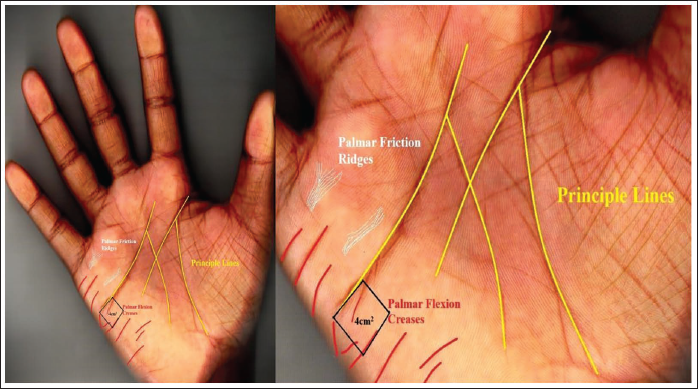
The anatomical landmarks used for palmprint sampling, including the principal lines, palmar flexion creases, and palmar friction ridges, are illustrated in Figure 1. Each student was assigned a unique enrollment number when the corresponding medical students gave their details.
Right Palm for Palmprint Sampling. (Yellow Line: Principal Lines; Red Line: Palmar Flexion Creases; White Line: Palmar Friction Ridges).
Exclusion Criteria
Participants with conditions that could compromise fingerprint or palmprint quality, such as scars or lesions, hand injuries or deformities (acquired or congenital), worn or obscured fingerprints, bandaged or webbed fingers, hypersensitivity to fingerprint ink, prior radiation exposure, and dermatological or systemic disorders affecting the skin were excluded.
Data Collection Procedure
Each student was assigned a unique enrollment number when the corresponding medical students gave their details. A color photo and document flatbed scanner with optical resolution was utilized to collect the palmprint photos for our study. After being scanned at 300 dpi × 300 dpi, the pictures were saved in JPEG format. A bifurcating palmar crease was counted as two separate creases, as each one was counted independently. This figure shows the crease density value and the quantity of creases in 4 cm 2 in the selected region for all (2 cm × 2 cm) over the hypothenar area just below the distal palmar crease. The square’s total number of creases was calculated. Additionally, every participant was instructed to properly wash their hands with soap and water and then let them air dry. Using a roller, ink was applied to the tips of the fingers or to the whole region directly above the fold of the first phalangeal joint. The ink rolling method was used to obtain primary fingerprint patterns using specified proforma (Figure 2).
Proforma for Primary Fingerprint Collection to Analysis.
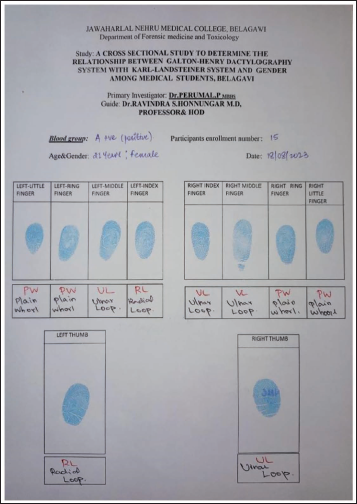
Each volunteer’s fingerprints were recorded on to standard fingerprint proforma after being rolled over an ink pad. To make sure each fingerprint was distinct and readable, each one was closely inspected. Subsequently, an examination was conducted on the blood grouping information and fingerprint patterns to investigate any possible associations and sex-related discrepancies within the research.
Statistical Analysis
The SPSS software (Statistical Package of Social Sciences) version 20.0, combined with the computer software, jamovi (Version 2.4) (2023) were utilized to statistically assess the acquired data utilizing frequency distribution and the Chi-square test. p value of less than .05 is regarded as statistically significant when it comes to variable relationships.
Results
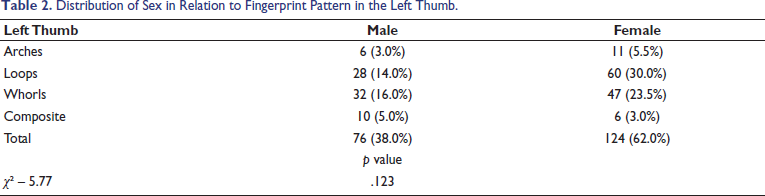
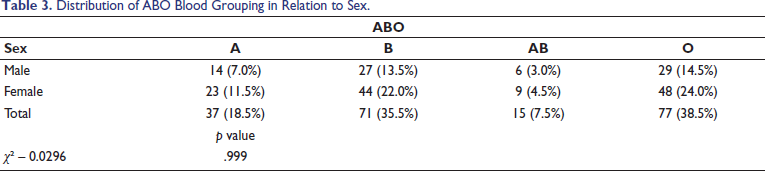
This study was conducted to compare the ABO blood categorization system, dermatoglyphics and palmar flexion crease with sex differences. A total of 200 students aged between 18 and 25 years were included in the study, comprising 76 males (38.0%) and 124 females (62.0%). The findings show that across all primary fingerprint patterns, the loop is the most common pattern, and the composite is one of the least noticeable. The purpose of our study was to determine whether a person’s blood group, palmar flexion creases density and fingerprint patterns are related to sex differences, and whether this relationship aids in personal identification. Throughout the investigation, we were able to find 1,055 (52.75%) loop patterns in total, 759 (37.95%) whorls, 144 (7.2%) arch patterns, and the least composite patterns, numbering 42 (2.1%). Fingerprint patterns could be utilized not just to help with criminal investigations but also to identify a person’s sex along with their blood group. The following are the tabulated results of our analysis (Tables 1–4). The current study’s findings showed that there was no discernible correlation between blood type (in the Rh or ABO systems) and primary fingerprint patterns with sex differences.
Male and Female Palmar Flexion Crease Density is Compared Using an Independent Sample t-test.
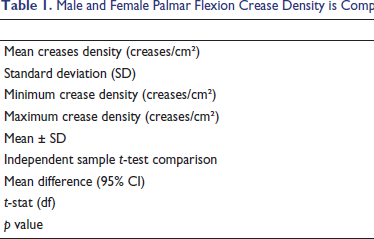
But the findings showed that there were substantial differences in the density of the palmar creases between men and women (p < .001). The mean crease density of palm prints for male and female individuals was found to be 3.54 and 5.88 creases/cm 2 , respectively. The findings showed that the crease density in the targeted area was much higher in females than in males.
Distribution of Sex in Relation to Fingerprint Pattern in the Left Thumb.
Distribution of ABO Blood Grouping in Relation to Sex.
Distribution of Rh Blood Typing in Relation to Sex.

Discussion
The results revealed that men and women differed statistically significantly in the density of their palmar creases. But this study demonstrates that there is no statistically significant correlation between the primary fingerprint pattern, distribution of ABO blood grouping, and Rh type with sex. Another study supported our findings. ABO and Rh blood types cannot be determined using fingerprints instead of other methods, as demonstrated by the research conducted by Chaudhary et al. (2017) on the subject, in which 700 participants were chosen. They declared at the study’s conclusion that blood grouping cannot be done using fingerprint patterns. 7 Geipel et al. (1935) demonstrated that there was no significant correlation between blood group and dermatological features by looking at 381 Germans. 8 And some of the prior research showed that blood types and dermatoglyphics were related. The investigations also showed that loops are the most prevalent design, followed by whorls, and that arches are the least common. This was reinforced by additional research on the Gowda Saraswat Brahmin community in Karnataka by Gowda and Rao (1996). Furthermore, the research discovered a noteworthy correlation between whorls in Rh -ve individuals and loops in Rh +ve persons. 9 Furthermore, ridge route is often not continuous across the whole area of a finger, as shown by a detailed analysis of the friction ridge skin. There are two types of ridges: dividing ridges, also known as bifurcations, which flow and split into two different ridges, and ending ridges, which flow and suddenly end abruptly. Moreover, some ridges—known as dots—are as long as they are wide. With the suggestion that the actual and ideal selves are diametrically opposed, and personality theorists have focused a considerable deal of emphasis on this relationship. 10
Measurements of the interdigital palmar area using the distances between digital tri-radii on the palm have also been shown in related research to be statistically significant and to be useful for predicting sex from palmprints in the Croatian population. 11
Given that women are typically more resistant to damage from environmental impacts than men are, prenatal sex differences in environmental sensitivity may contribute to the development of sexual dimorphism in fingerprints and palmar creases. Dermal growth, the thickness of the fetal epidermis, the elevation of the embryonic pad, and the location of the fingers are environmental factors that influence the development of characteristics on the palm. 12 Furthermore, one of the possible explanations for the lower crease density in males compared to females might be because men have coarser epidermal surfaces than women. Males often have bigger hands or palmar surfaces than females due to their larger bodies and proportions compared to females, which results in differences in male and female characteristics. 13 According to the results of previous research, the conventional approach, which often employs friction ridge and minutiae points as identifying markers, may be substituted with the crease on a palmprint. Here, palmar flexion creases may be recognized using the same technique as friction ridge skin. A palm print has many more creases than a fingerprint and has eight times more minutiae points. 14
Research from the past has shown that women have more ridge density than men in the palm area. Our research results are supported by these studies.15–18 Comparable to the palmar flexion crease density, the finger ride count density was used as a sex difference in earlier research. According to research by Nayak et al. (2010), there are significant sex differences in the finger ride count. Specifically, Chinese participants with 12 or less ridges are more likely to be male, whereas those with more than 13 ridges are more likely to be female. In Malaysian males, there are 11 ridges or less, but in females, there are more than 13. 18 According to research by Gungadin et al. (2007), females are more likely to have 14 ridges than men, with a mean ridge count of 13 ridges. 19 Palmar flexion crease density showed clear sexual dimorphism, whereas fingerprint patterns and blood groups did not demonstrate sex-specific variation. This difference likely reflects the influence of hand morphology and developmental factors rather than genetic markers linked to fingerprints or blood groups. In forensic practice, palmar crease density may therefore provide supportive information for sex estimation when conventional ridge-based analysis is limited.
Conclusion
The present study found no significant association between sex and primary fingerprint patterns or ABO blood group systems, indicating that these parameters have limited value for sex-based identification. In contrast, a statistically significant difference in palmar flexion crease density was observed between males and females, with females exhibiting higher crease density than males. This finding highlights palmar flexion crease density as a meaningful indicator of sexual dimorphism. Consistent with previous dermatoglyphic studies, loops were the most common fingerprint pattern observed, followed by whorls, arches, and composite patterns. Although fingerprint pattern distribution reflects population variability, it does not appear to contribute substantially to sex determination. From a forensic perspective, the findings suggest that palmar flexion crease density may serve as a useful supplementary tool for sex estimation, particularly when an unidentified palmprint is recovered from a crime scene and the conventional friction ridge detail is insufficient. Further studies involving larger and more diverse populations are recommended to better evaluate the genetic and environmental factors influencing palmar crease patterns and to strengthen their forensic applicability. Crease density of palmprints shows significant sexual dimorphism and may be a valuable forensic tool for sex determination. Fingerprint patterns and blood groups showed no correlation with sex. Larger studies are needed to validate these findings.
Footnotes
Acknowledgments
I express my gratitude to all my respected professors for their constant support and guidance.
Declaration of Competing Interests
The authors declared no potential conflicts of interest with respect to the research, authorship, and/or publication of this article.
Ethical Approval
A prior approval was obtained from the Institutional Ethics and Research Committee (Ref: MDC/JNMCIEC/18; dated September 27, 2022).
Funding
The authors received no financial support for the research, authorship, and/or publication of this article.
