




Abstract
The number of unwanted pregnancies globally remains high. This is one of the contributing factors to the frequent discovery of decomposing newborn bodies, which can make forensic examinations challenging for pathologists. In April 2022, the body of an unidentified baby, wrapped in a plastic bag, was found in the bushes. An autopsy was conducted following a visum et repertum request. The examination revealed a decomposed infant with a fully formed earlobe, fingernails extending beyond the fingertips, female genitalia with the labia majora covering the labia minora, and ossification nuclei present in the distal femur, proximal tibia, and cuboid bone. Wreden’s test also indicated the presence of air inside the middle ear cavity. Based on these findings, it was concluded that the baby was born alive, with a gestational age of 9–10 months.
Introduction
An unwanted pregnancy is a pregnancy that occurs in a woman who does not plan to have children or an untimely pregnancy. Globally, in 2015–2019, there were an average of 121 million unwanted pregnancies each year in women aged 15–49, with 61% ending in abortion. The desired pregnancy rate tends to be higher in middle-income countries than in high-income countries. 1 In Indonesia, the incidence of abortion reaches 2.3 million per year with the largest contributors to the incidence of abortion related to unwanted pregnancy are school-age adolescents and unmarried. 2 Unwanted pregnancies can be caused by sexual violence, promiscuity, parenting, low socio-economic levels of the family, low level of education and others. This can cause the still rampant cases of finding newborns in the trash, even if some are found dead or decomposed, which can be challenging for forensic experts to conduct examinations, primarily to determine gestational age and whether the baby was born alive or dead.
Discussion
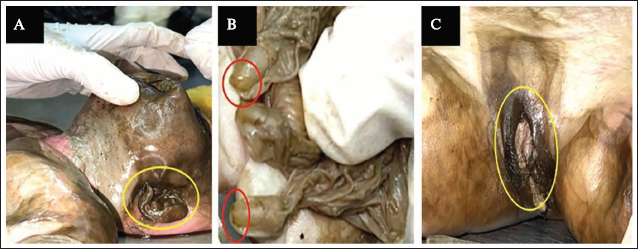
Age estimation is an important point that must be sought in an autopsy to determine the exact age of an unknown person or body, especially in the process of investigation or trial of a criminal act.3, 4 In forensic examination of infant corpses, the age determined is the gestational age calculated from the first day of the mother’s last menstruation until the baby is born. 5 When the baby is found in a decomposed condition, the determination of gestational age can be done by looking at developmental features unaffected by decay. Fully formed earlobes, nail growth that had exceeded the fingertips, and female genitals with labium major conditions covering the labium minor suggest that the estimated gestational age of the baby is about 9–10 months. In addition, gestational age can also be determined by looking at the ossification centre of the epiphyses, commonly referred to as secondary ossification 6 (Figure 1).
Developmental Characteristic Visible on External Examination: (A) Auricles Tense With Perfect Deep Creases (Yellow Circle); (B) Growth of Nails That Have Exceeded the Fingers (Red Circle); (C) Female Genitalia With the Labium Minor Covered by the Labium Major (Yellow Circle).
Case Report
In April 2022, the body of an unidentified newborn wrapped in a plastic bag was found in the bushes and taken to the hospital for an autopsy under the visum request letter. The autopsy showed the corpse of a baby with an umbilical cord still attached without a placenta, accompanied by signs of further decomposition in the form of a brownish-green body, epidermal peeling throughout the body, all decayed internal organs, fully formed earlobes, nail growth that exceeds the fingertips, and female genitalia with labium major covering labium minor. Secondary ossification centres appear in the distal femur, proximal tibia and Cuboid. Positive Wreden’s test indicates the presence of air inside the middle ear.
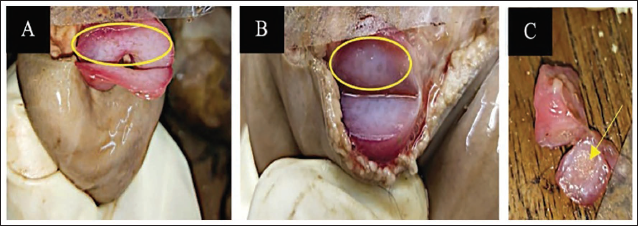
Human bones develop from primary and secondary ossification centres. Bone growth of both centres will continue until the bone is fully formed. 7 Ossification of the limb begins at the end of the embryonic period. The primary ossification centre is present in all long bones at 12 weeks gestation. From the primary ossification found in the diaphysis, ossification will develop at the ends of the bones by forming epiphyseal plates, which are cartilage. 8 The secondary ossification centre in the epiphyses mainly consists of blood vessels, which can be seen directly in the autopsy process by flexing the leg on the knee joint and making a longitudinal incision over the patella. After that, the bone is pushed forward and makes a transverse incision in the cartilage (epiphysis) at the distal end of the femur. If the reddish blood vessel points on the epiphysis are visible, the transverse incision is continued in the proximal direction until it reaches the diaphysis’s core. The same step is also performed to look at the proximal tibia. The ossification centre can also be seen in cuboids by making an incision between the third and fourth toes parallel to the axis of the long bone and then deepening towards the ankle until it finds a cube-shaped bone. 9 In this case, the secondary ossification centres can be seen in both the distal femur and proximal tibia and in the cuboids that appear pale red in the middle, which indicates that the gestational age of the baby is between 9 and 10 months. An important test to determine whether the baby was born alive or dead is the middle ear test (Wreden’s test) because the air in the middle ear cannot be affected by decomposition. A baby who has breathed at birth will make swallowing movements, and because the Eustachian auditive tube is open, air can enter the middle ear cavity. This test is done by making sculptures or small holes in the tympanic tegmen below the water’s surface. If a bubble comes out of the hole, as in this case, it can be said that the baby was breathing and born alive 6 (Figure 2).
Ossification Centre in the (A) Distal Femur (Yellow Circle); (B) Proximal Tibia (Yellow Circle); (C) Cuboid (Yellow Arrow).
In the case of the discovery of infant corpses in Indonesia, several possible criminal acts must be considered, namely child homicide, criminal provocateuse abortion, child neglect, intrauterine foetal death and infanticide. 6 Child homicide can be categorised as an intrafamilial or extrafamilial homicide. Intrafamilial murder is committed by biological or step-parents, guardians or caregivers equivalent to the parents, while extrafamilial murder is committed by perpetrators who are outside the intrafamilial. 10 Forensic medicine defines abortion as the removal of conception results at any stage of its development before complete gestation is reached. It can be classified into spontaneous abortion and abortus provocatus. Abortus provocatus is divided into medicinal abortion and criminal abortus provocatus, which is performed without medical consideration. Infanticide, in the perspective of Indonesian law, is defined as the murder of a child committed by a mother against her biological child at birth or shortly after birth for fear of being caught giving birth.6, 11 Determination of criminal acts is the task of the investigator by considering the results of the autopsy by the forensic pathologist.
Conclusion
In the condition of decomposing infant corpses, gestational age is determined based on visible developmental characteristics and ossification centres, while the determination of live birth is done through Wreden’s test. Autopsy results can be evidence and provide clues for investigators in determining the criminal act that occurred.
Footnotes
Acknowledgements
The authors are thankful to our teachers and friends in the Department of Forensic Medicine and Medicolegal, Faculty of Medicine, Universitas Airlangga for the permission and motivation given to us to compile this research.
Declaration of Conflicting Interests
The authors declared no potential conflicts of interest with respect to the research, authorship and/or publication of this article.
Ethical Approval
The study was approved by the relevant ethics committee. The autopsy was conducted under a visum request letter issued by the police for an unidentified corpse.
Funding
The authors received no financial support for the research, authorship and/or publication of this article.
Informed Consent
Informed consent was not required as the autopsy was performed on an unidentified corpse, and no personal identifying information was involved.