




Abstract
Human anatomical variations, influenced by genetics, ethnicity, and environmental factors, play a crucial role in forensic identification. This study evaluates the reliability of inter-acromial length (IAL) as a sex-determining anthropometric parameter in forensic cases. Conducted at Shaheed Hasan Khan Mewati Government Medical College, Nalhar, the prospective study analyzed 100 postmortem cases (68 males, 32 females) aged ≥20 years, excluding those with deformities, trauma, or decomposition. IAL was measured using a sliding caliper between the acromial processes of the scapulae. Statistical analysis revealed a significant sex-based difference in mean IAL (males: 32.5 cm, females: 27.6 cm; p < .01). Receiver Operating Characteristic (ROC) analysis demonstrated strong diagnostic accuracy (AUC = 0.891), with an optimal IAL cut-off of 28.60 cm yielding 86.8% sensitivity, 78.1% specificity, and 84% overall accuracy. Positive and negative predictive values were 89.4% and 73.5%, respectively, supporting IAL’s utility in sex estimation. The findings align with sexual dimorphism principles, where broader male shoulders contribute to higher IAL values. Comparative analysis with prior studies confirmed IAL’s consistency as a sex predictor, though population-specific variations necessitate further validation. The study concludes that IAL is a practical, non-invasive tool for forensic sex determination, particularly in fragmented remains or mass disasters, complementing traditional methods. Future research should explore multiparameter models to enhance accuracy across diverse populations.
Introduction
Humans, as Homo sapiens, exhibit anatomical and physiological variations shaped by ethnicity, genetics, and environmental adaptations. 1 These differences, rooted in evolutionary and migratory history, are further influenced by geographic isolation and distinct local gene pools. 2 Observable traits such as facial features, skin color, hair texture, and body morphology reflect underlying genetic ancestry and serve as valuable markers in biological and forensic investigations. 3
In forensic contexts, personal identification may be either complete (absolute) or incomplete (partial). Complete identification establishes an individual’s unique identity and social role, while partial identification provides limited but critical information that aids in achieving full identification. This process is essential in medicolegal scenarios involving both living and deceased individuals. Medical expertise becomes particularly crucial in cases involving unidentified bodies, where establishing corpus delicti and preventing wrongful accusations are of paramount importance. 4
To facilitate identification, anthropometry, the systematic, non-invasive measurement of body size and shape, is widely employed. 5 When integrated with anthroposcopy, it yields comprehensive data for assessing living standards and examining human remains. The four principal components of biological identity include sex, age, stature, and race. 6 Among these, sex determination is especially significant in narrowing down identity, particularly in cases involving mass disasters, homicides, or severe trauma.
Sex estimation helps forensic experts reduce the pool of potential victims or suspects. Techniques are broadly categorized into morphological (shape-based) and metric (size-based) approaches. The pelvis is considered the most reliable morphological indicator, while metric analysis, especially of the skull and postcranial skeleton, can yield accuracy rates exceeding 90%. 7 Anthropologists typically begin with a 50/50 probability, as sex is biologically binary (male or female). Understanding sexual dimorphism involves recognizing consistent differences in skeletal size, shape, and robustness.
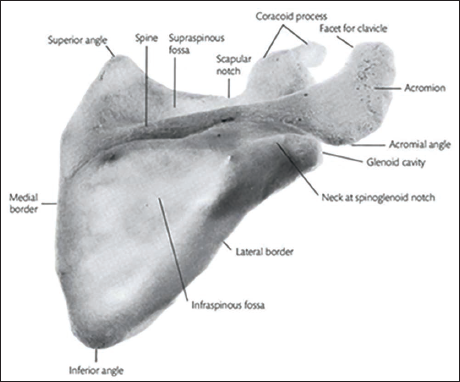
Among postcranial elements, the scapula offers promising potential for sex determination. This thin, triangular bone lies tangentially on the posterolateral thoracic wall and features a long medial border, a thin superior border, and a truncated lateral angle forming the pear-shaped glenoid cavity, which articulates with the humeral head. The dorsal surface is divided into supraspinous and infraspinous fossae by the scapular spine, which broadens laterally into the flattened acromion 8 (Figure 1).
Dorsal Surface of the Right Scapula. 9
Building on this anatomical framework, the present study proposes a sex determination standard based on scapular metrics. Specifically, the inter-acromial length is evaluated as a dependable parameter for narrowing down victim profiles in mass fatality incidents and routine forensic casework. This technique holds significant promise for advancing forensic medicine by offering a reliable, reproducible method for sex estimation.
Material and Methods
The present study will be conducted in the Department of Forensic Medicine and Toxicology, Shaheed Hasan Khan Mewati Government Medical College, Nalhar, Nuh. It was a one-year study of the cases brought to the mortuary of Shaheed Hasan Khan Mewati Government Medical College, Nalhar, Nuh, for postmortem examination.
Type of Study
This was a prospective study.
Sample Size
This study analyzed 100 cases. Sample size for a study was calculated from the number of cases coming to the mortuary in a year by using standard formulas that consider total cases as the study population and factoring in prevalence, desired precision, and confidence level.
Sampling Technique
Consecutive sampling technique.
Inclusion Criteria
All the cases brought to the mortuary of Shaheed Hasan Khan Mewati Government Medical College, Nalhar, Nuh, for postmortem examination, irrespective of the manner of death above 20 years of age.
Exclusion Criteria
Cases of age less than 20 years of age.
Cases where one or both of the acromial processes cannot be appreciated and located.
Cases with spinal deformities and a history of spinal surgeries.
Cases where there are bony deformities over the back.
Cases of deep burns and trauma over the deep muscular tissue or bones over the back.
Cases of decomposed bodies.
Anthropometric Measurements
Inter-acromial length (IAL): The maximum distance between the two bony landmarks, that is, acromial process of scapula on each side. 10
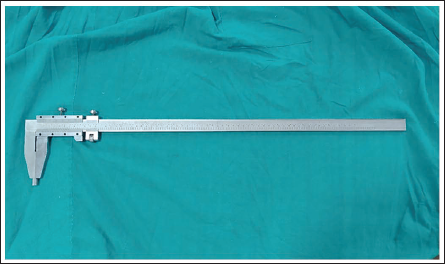
Instrument 1: Sliding caliper (Figure 2).
Sliding Caliper (Full View).
Measurement Technique
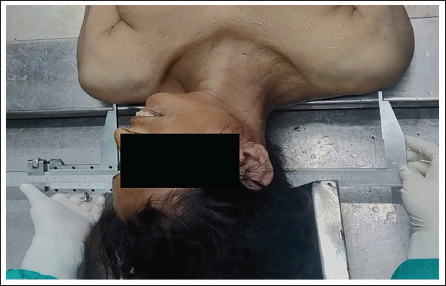
Before taking the measurements, rigor mortis will be broken manually if required. The body will be put in the supine position, and the lateral borders of the acromial process will be located by following the spinous process and then will be marked on each shoulder as L for the left acromial process and R for the right acromial process. Then the length between the points L and R will be taken. Measurements will be taken with the sliding caliper (Figure 3).
Measuring Inter-acromial Length by Sliding Caliper.
Statistical Analysis
The collected data will be entered into a Microsoft Excel Spreadsheet. Mean + SD will be calculated for quantitative data. Percentages and proportions will be calculated for qualitative data. Students’ t-test will be used to find out the mean difference between the male and female inter-acromial length.
Observation and Result
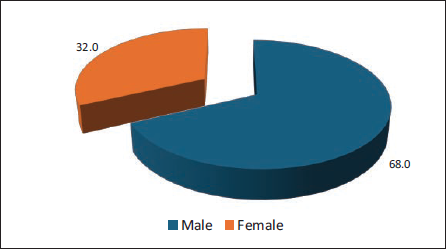
Gender Distribution: Male predominance was observed in the study subjects. A total of 100 subjects were included in the study fulfilling the inclusion and exclusion criteria. Out of these 100 subjects, 68 (68%) were male, and 32 (32%) were female (Figure 4).
Percentage Distribution of the Sample According to Sex.
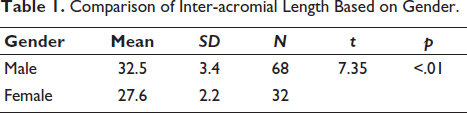
Comparison of Inter-acromial Length Based on Gender.
Observations of IAL Differences in Males and Females
The study found a significant mean difference in IAL between males (32.5 cm) and females (27.6 cm), consistent with broader male shoulders and larger skeletal structures. These differences stem from biological factors like hormones, genetics, and muscle mass distribution, with males developing broader shoulders for greater upper body strength. Females typically have narrower shoulders, resulting in lower IAL. This makes IAL a useful anthropometric indicator for gender distinction.
The statistically significant difference in IAL (p < .01) validates its reliability as a gender-specific measurement, confirming that the observed variation between genders is not due to chance. This consistency is crucial for forensic applications, ensuring IAL can be confidently used in similar populations. The strong statistical support underscores its robustness for gender differentiation, making IAL a valuable tool in forensic protocols where accuracy is essential.
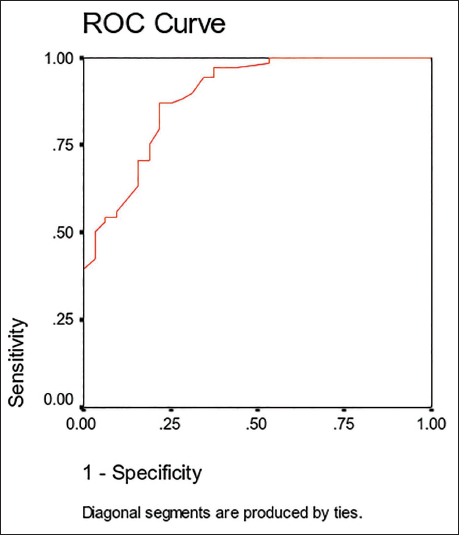
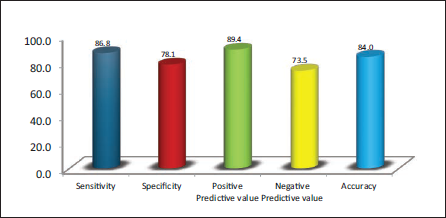
The study evaluated inter-acromial length (IAL) as a diagnostic tool for gender prediction, revealing a significant difference between males and females. Using ROC analysis, an optimal cut-off of 28.60 cm was identified, achieving 86.8% sensitivity and 78.1% specificity, with an overall diagnostic accuracy of 84%. These results highlight IAL’s reliability as a practical forensic tool for gender identification, particularly when other indicators are unavailable (Figures 5 and 6).
Diagnostic Accuracy of IAL in Detecting Gender.
ROC analysis evaluates IAL’s ability to classify individuals as male or female, with an AUC of 0.891, indicating excellent diagnostic accuracy. AUC values between 0.8 and 0.9 signify strong discriminatory power, supporting IAL’s potential as a reliable measure. The optimal cut-off of 28.60 cm was identified, with IAL ≥28.60 cm indicating males and <28.60 cm indicating females. This cut-off maximizes sensitivity (correctly identifying males) and specificity (correctly identifying females), ensuring high accuracy in forensic applications.
Sensitivity and Specificity
Sensitivity (86.8%) measures IAL’s ability to correctly identify males, while specificity (78.1%) reflects its accuracy in identifying females. High sensitivity is crucial in forensics, minimizing the risk of misclassifying males as females. The balanced accuracy of 84% highlights IAL’s reliability, making it a valuable tool for gender estimation, especially in cases with limited or fragmented remains.
Predictive Values and Likelihood Ratios
The study’s positive predictive value (PPV) of 89.4% indicates a high probability that individuals classified as male are truly male, while the negative predictive value (NPV) of 73.5% reflects the likelihood of correctly identifying females. These values, along with positive and negative likelihood ratios (4.0 and 0.2), reinforce IAL’s reliability in gender classification. A positive likelihood ratio of 4.0 shows males are four times more likely to exceed the IAL cut-off, while a negative likelihood ratio of 0.2 minimizes misclassification risks. This high diagnostic accuracy makes IAL a valuable tool in forensic investigations.
Implications of Diagnostic Accuracy in Forensic Applications
The high diagnostic accuracy of IAL, as evidenced by sensitivity, specificity, and the AUC, makes it particularly valuable in forensic settings:
Sex Estimation for Identification: Accurate gender determination is essential in forensic identification, as it narrows down possible matches in missing persons databases. With an 84% overall accuracy, IAL serves as a dependable indicator for estimating gender when pelvic or cranial measurements are unavailable. Application in Fragmented Remains: In cases where bodies are incomplete or fragmented, such as in mass disasters, shoulder width (IAL) may be one of the few available measurements. IAL-based gender estimation allows forensic professionals to reconstruct biological profiles and facilitate identification efforts. Complementary to Other Sex Indicators: While IAL is effective on its own, combining it with other measurements such as pelvic dimensions or cranial features can further improve gender classification accuracy, especially in cases with borderline IAL values close to the cut-off point.
These findings show that males generally have a greater IAL than females, which aligns with the biological expectation that men, on average, have broader shoulders due to larger skeletal structures and muscle mass. The mean difference between male and female IAL values supports the use of IAL as a gender indicator in forensic applications, where gender estimation is often needed for identification. While population-specific adjustments may be necessary, the results confirm IAL’s robustness as a gender predictor, reinforcing its utility in forensic and anthropological applications. This diagnostic accuracy underscores IAL’s potential for contributing to accurate and rapid gender differentiation in challenging investigative contexts.
Discussion
This study evaluated the effectiveness of inter-acromial length (IAL) as a tool for sex classification, demonstrating strong diagnostic performance through ROC analysis with an AUC of 0.891. At the optimal cut-off of 28.6 cm, the method achieved 86.8% sensitivity and 78.1% specificity, resulting in an overall accuracy of 84% with positive and negative predictive values of 89.4% and 73.5% respectively.
The significant difference in mean IAL between males (32.5 cm) and females (27.6 cm) confirms its reliability for gender determination, though the presence of false positives (21.9%) and false negatives (13.2%) suggests limitations in populations with overlapping measurements. These findings align with previous research demonstrating sexual dimorphism in shoulder breadth, while highlighting the need for population-specific considerations.
Yadav et al. 11 (2023) reported significant sex differences in IAL but noted its limitations as a sole predictor, particularly for South Indian females, suggesting the need for additional parameters. Sharma et al. 12 (2022) found a slightly lower predictive value (R² = 0.387) for bi-acromial breadth in stature estimation but achieved 78.3% gender classification accuracy, with better performance for females. Yeasmin et al. 13 (2022) acknowledged IAL’s sexual dimorphism but identified ulnar length as superior for stature prediction. More comprehensive approaches, such as those by Shah et al. 14 (2015) combining IAL with foot and arm lengths, and Igiri et al. 15 (2008) using bi-acromial diameter with various ratios, demonstrate how multiparameter models can enhance predictive power in forensic applications, and Patel et al. 16 (2015) reported a positive correlation between the stature and the inter-acromial length in both males and females combined (p < .001), which was highly significant. Their study was conducted among the Gujarati population, which also showed a low degree of positive correlation in the case of males and females measured separately. While IAL proves valuable as a standalone metric, these comparative findings emphasize that its effectiveness varies across populations and can be improved through the incorporation of additional measurements.
Limitation of the Study
Future studies could incorporate variables such as limb lengths, chest circumference, and cranial dimensions to develop a multivariate model in a large sample size, which would give a stronger predictive capability. Our sample, though representative of a specific demographic, may not fully capture the anthropometric diversity of the larger population. Expanding this research to include individuals from different age groups, ethnic backgrounds, and geographical regions would offer a more comprehensive understanding of the applicability of inter-acromial length for sex determination across diverse populations.
Conclusion
Our study confirms inter-acromial length as a reliable anthropometric marker for sex estimation within the studied population, with findings suggesting a particularly high predictive value in certain demographic groups. This highlights the need for population-specific research in anthropometry. Further refinement and expansion of these findings, along with considering a large sample size, could improve the precision and forensic utility of such measurements.
Footnotes
Declaration of Conflict of Interests
The authors declared no potential conflicts of interest with respect to the research, authorship, and/or publication of this article.
Ethical Approval
Ethical clearance was taken for this study.
Funding
The authors received no financial support for the research, authorship, and/or publication of this article.
Informed Consent
Informed consent has been obtained from the next of kin of the deceased for the study.
