




Abstract
Sex determination is one of the key components for establishing the individual's identity in forensic anthropology casework. It is a known fact that anthropometric assessment can have population-specific variations. The present autopsy study was conducted on the sterna of 102 cadavers (52 males and 50 females) of age more than 25 years at a tertiary care centre in Central India. Anthropometric measurements included the length of the manubrium (M), mesosternum (B) and combined length of manubrium and mesosternum (CL). Applicability of Hyrtl's law, Ashley's rule and the sternal index were also assessed for sex determination. A statistically significant correlation (p < 0.001) was observed between sternal measurements and the sex of the study population. The highest coefficient of correlation was seen between sex and the combined length (r = 0.726), followed by mesosternal length (r = 0.620), and manubrial length (r = 0.509). The difference between the means of the sternal index in males and females was not statistically significant (p > 0.05), and the difference between the means of the ratio of the body with manubrium in males and females for Hyrtl's law is also not found to be statistically significant (p > 0.05). It is concluded that the length of the body and the combined length of manubrium and mesosternum are valuable criteria for sexing the sternum in an adult population of Central India. The sternum can be useful for sex determination, particularly when bones like skull, pelvis, or long bones are not available or fragmented.
Introduction
Identification means the determination of a person's individuality based on certain characteristics. 1 To establish identity in many criminal and civil cases, forensic experts depend mainly on the determination of sex and ancestry and estimation of age and stature and other parameters. However, determination of all these vital parameters is not always an easy task for forensic experts as, many times, the body is skeletonized, partially dismembered, highly decomposed or mutilated by animal activities.
Sex can be determined from skeletal remains by two methods, i.e. morphologic and metric. The morphologic method considers parameters like roughness and shapes of bones and is more subjective. The metric method contemplates different measurements of the bone and is more objective and accurate. According to Krogman, the accuracy of determining sex from the entire skeleton is 100%, from pelvis and skull combined is 98%, from pelvis alone is 95%, from skull alone is 90% and from long bones alone is 80%. 2 While pelvis, skull, and long bones are considered the best indicators of sex of an individual, these might not always be available to forensic anthropologists, and they might have to rely upon other bones such as the sternum.
The use of the sternum in sex determination has been researched thoroughly across the globe. However, as variations in sexual dimorphism are population-specific, the results of these studies may not apply to the present population, and there is a need to establish separate standards for sex determination from the sternum in the present population. Hence, this study was conducted to estimate sex based on morphometric analysis of the sternum in an adult Indian population. We also attempted to test the applicability of Ashley's rule 3 and Hyrtl's law 4 for sex determination in the present adult Indian population.
Materials and methods
The present cross-sectional study was conducted in the Department of Forensic Medicine of a tertiary care centre located in Central India. Sterna of 102 cadavers (52 males and 50 females) of age more than 25 years brought for medicolegal autopsy were investigated to determine sex. Approval was obtained from the Institutional Ethics Committee before the commencement of the study. All charred and mutilated bodies and bodies having congenital or acquired malformations or injuries to the sternum were excluded from the study.
Written, informed, witnessed consent was taken from relatives of the deceased. The sternum was removed from the cadaver by making incisions at the sternoclavicular joints and at the junctions of costal cartilages with ribs as described by Otto Saphir. 5 After removal, the sternum was rigorously cleaned by removing the soft tissues as much as possible and air-dried. No maceration was performed. Vernier calliper was used to take midline measurements of the sternum. We did not consider the length of the xiphoid process while taking measurements as it was highly variable in its size and shape.
Sternal measurements were defined as follows:
Length of the manubrium (M): This is a straight distance between the centre of the suprasternal notch to the centre of the manubrio-mesosternal junction, i.e. angle of Louis on the anterior surface in the midsagittal plane (Figure 1a).
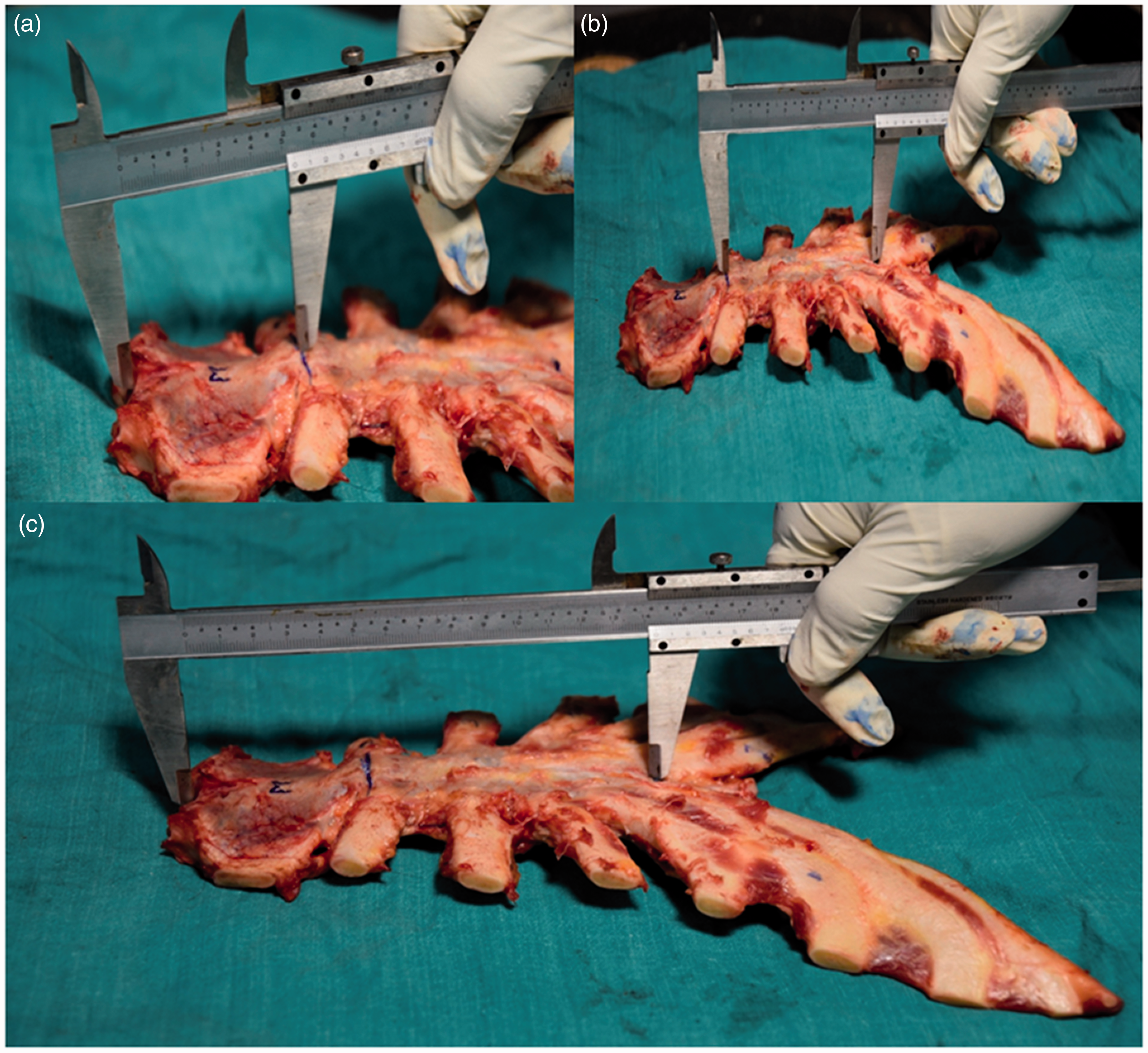
(a) Measurement of the length of manubrium. (b) Measurement of the length of mesosternum and (c) Measurement of the combined length (manubrial length + mesosternal length) of the sternum.
Length of the mesosternum (B): This is the straight distance between the centre of the manubrio-mesosternal junction (angle of Louis) to the xiphisternal junction in the midsagittal plane. The lower ends of the two lateral articular facets for the seventh costal cartilage were connected by a line, representing the junction of mesosternum and xiphoid process and the midpoint of the line on the anterior surface of the mesosternum was marked as a point to take measurements (Figure 1b).
Combined length of manubrium and mesosternum (CL): This is a straight distance between the centre of the suprasternal notch to the centre of the xiphisternal junction on the anterior surface in the midsagittal plane (Figure 1c).
Identification point (IP) and limiting point (LP) were identified for the length of manubrium, mesosternum, and the combined length of manubrium and mesosternum based on overlapping values. “Identification point” was derived by determining the overlapping range of the sample, and “limiting point” was obtained from the average of male and female identification points. Based on the limiting point for each parameter, the cut-off value was determined by “trial and error” demarcating between the males and females. The sternal index (manubrio-corpus index) was calculated for each sternum using the formula: Sternal index = (M/B)/100. The applicability of Hrytl's law in sex determination of the sternum in the present sample was also analyzed.
Statistical analysis
The data was analyzed using the statistical analysis package of SPSS version 17. Shapiro-Wilk's test was conducted on the data to confirm that the data was normally distributed and parametric tests were applied for further analysis. Student's t-test was applied to test whether the difference between means is statistically significant. P-value was set to 0.05. Pearson's correlation of coefficient was calculated between the different sternal measurements and sex of the study population. Logistic regression models to determine sex using the different sternal measurements were generated.
Results
The descriptive statistics of the different measurements of the sternum studied in the present investigation are shown in Table 1. The results of Student's t-test are shown in Table 1. There were statistically significant differences between the mean values of all the study measurements of females and males (p < 0.05).
Descriptive statistics of the different measurements of the sternum in females and males.
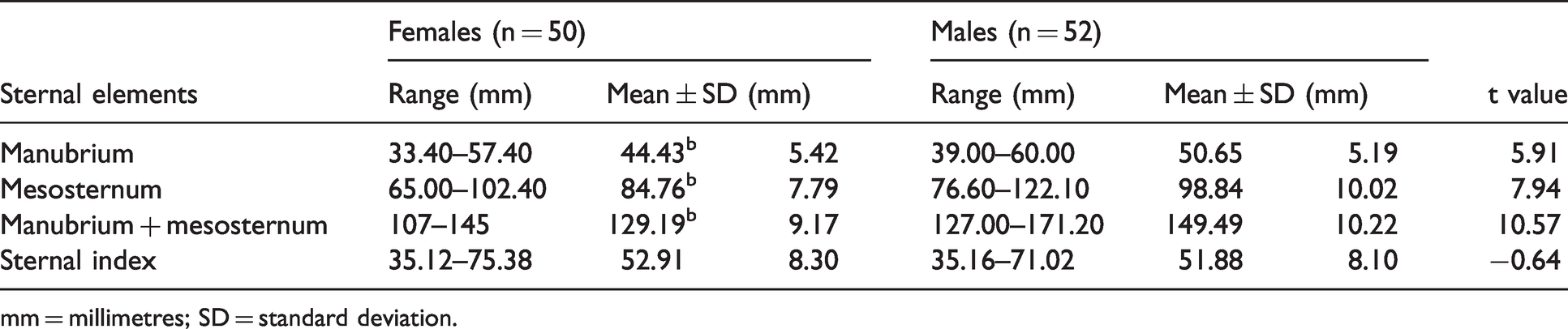
mm = millimetres; SD = standard deviation.
A statistically significant correlation (p < 0.001) was observed between sternal measurements and the sex of the study population. The highest coefficient of correlation was seen between sex and the combined length (r = 0.726), followed by mesosternal length (r = 0.620), and manubrial length (r = 0.509).
Identification points to discriminate between the two sexes were calculated by determining the overlapping region in the measurements of males and females. The identification points for all the different measurements studied are shown in Table 2. In the case of manubrial lengths, a sternum with its manubrial length less than 33.4 mm belongs to a female, and greater than 57.4 mm belongs to a male. For mesosternal length, a length of less than 76.6 mm belongs to a female, and greater than 102.4 mm belongs to a male. In the case of combined length (manubrium + mesosternum), a sternum with a length less than 127 mm belongs to a female, and one with a length greater than 145 mm belongs to a male.
Identification points for determining sex.

IP = identification point.
Limiting points were calculated for each linear sternal measurement and are shown in Table 2. The limiting point was calculated to be 48.2 mm for the manubrial length. Any individual with a manubrial length less than 48.2 mm was considered to be female, and any with more than 48.2 mm was considered to be male. It was observed that using this limiting point, 80% of the female study participants and 73.08% of the male study participants were correctly classified.
The limiting point was calculated to be 102.4 mm for the mesosternal length. Using this limiting point, it was observed that 68% of the female study participants and 84.61% of the male study participants were correctly classified. For the combined length (manubrial length + mesosternal length), the limiting point was 136 mm, and 74% of the female study participants and 92.30% of the male study participants were correctly classified.
Univariate binary logistic regression models were generated using the different sternal measurements to estimate sex. These models and the respective correctly predicted percentages are shown in Table 3. The combined length of the sternum (manubrial + mesosternal length) showed the highest percentage of correctly classified individuals (84% in females and 88.5% in males), followed by the mesosternal length (80% in females and 80.8% in males) and finally the manubrial length (74% in females and 75% in males).
Binary logistic regression models to estimate sex using sternal measurements.

Ma = manubrial length; Mb = mesosternal length; CL= combined length.
The sternal index was calculated for the study population. In males, the index was observed to range between 35.16 and 71.02, with a mean of 51.88. In females, the sternal index ranged between 35.12 and 75.38, with a mean of 52.91. The difference between the means of the sternal index in males and females was not statistically significant (p > 0.05). In the present study, 64% of female and 84.61% of male specimens obeyed Hyrtl's law which states that, in females, the manubrium generally exceeds half the length of the sternal body, whereas in males the body of the sternum is usually twice as long as the manubrium. 4 However, the difference between the means of the ratio of the body with manubrium in males and females was not found to be statistically significant (p > 0.05), hence limiting the value of applicability of Hyrtl's law to the studied population.
Ashley defined the “rule of 149” for sex determination from the sternum in the European population and the “rule of 136” for sex determination from the sternum in the East African population by using the combined length of manubrium and body. For defining these rules, Ashley first derived the cut-off value by trial and error. This cut-off value was similar to the value obtained by halving the overlapping ranges of the combined length of manubrium and body in males and females. Hence, he concluded that sternums with measurements larger than the cut-off value belonged to males and those smaller than the cut-off value belonged to females. 3 We also derived “rule of 49”, “rule of 91” and “rule of 137” to determine sex from manubrium, mesosternum and the combined length of manubrium and mesosternum, respectively, by using Ashley's method.
Discussion
The sternum has been extensively studied as an indicator of sex using morphological and metric methods. Researchers using morphological methods depend on the visual assessment of sexually dimorphic characteristics like roughness, shape or particular traits of bones, and hence these observations show subjective variations. Also, observations are difficult to classify and analyze. These methods are of limited use when incomplete or fragmentary remains of bones are brought for examination. Metric studies are based on the difference in male and female dimensions and use statistical methods to derive various rules that can be utilized for accurate determination of the sex of individuals. Results obtained from metric studies are easier to analyze and interpret. 6 Due to higher accuracy and easy reproducibility of results, we tried to determine the sex of the sternum in our study by using metric methods.
Estimation of sex from sternum has been carried out using dry sterna, fresh sterna and CT imaging. The present study results were compared with the results of all three methods. Table 4 summarizes the comparison of the manubrial length, mesosternal length, combined length and sternal index with various studies.
Comparison of results of the present study with those given in the literature.
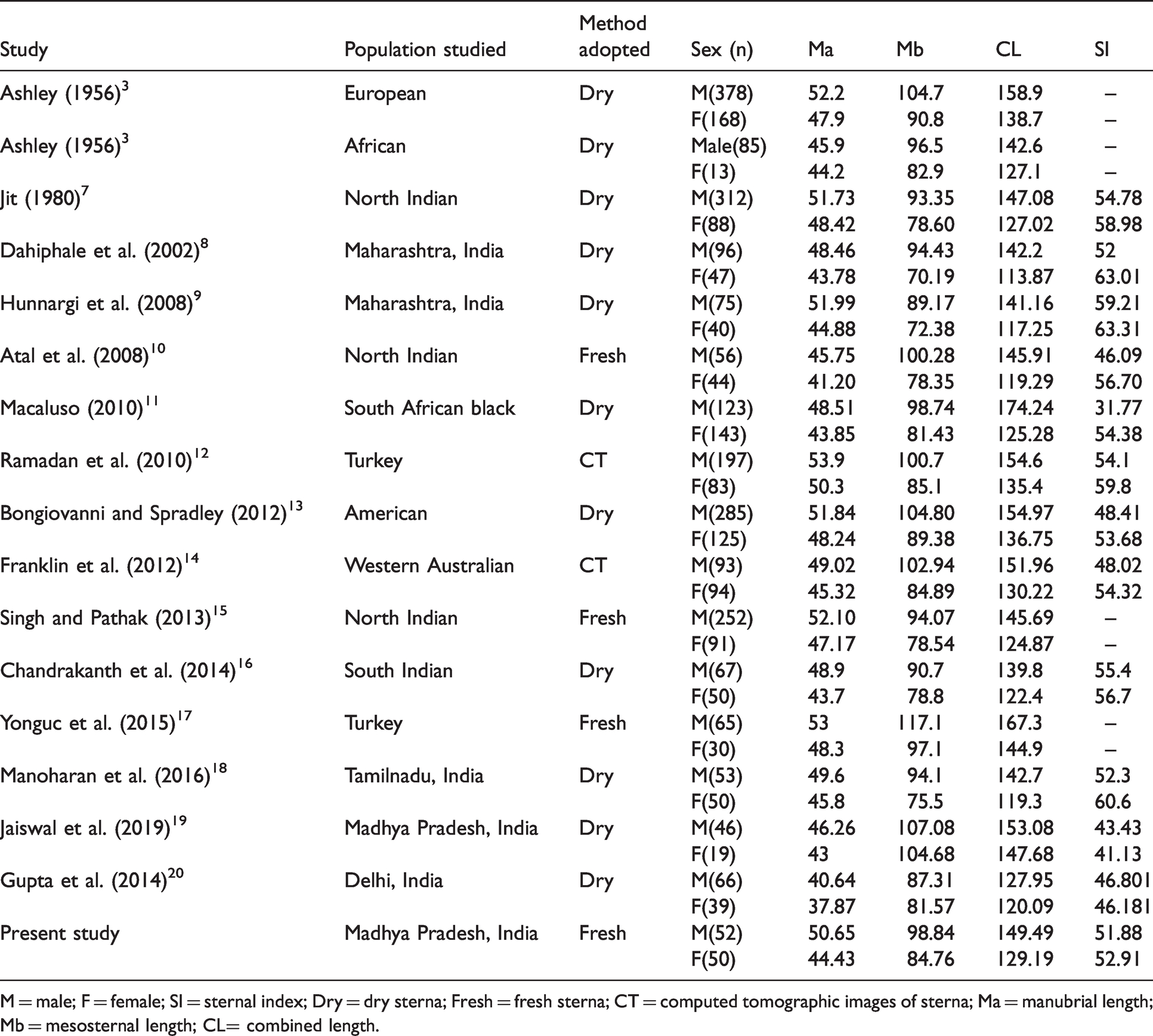
M = male; F = female; SI = sternal index; Dry = dry sterna; Fresh = fresh sterna; CT = computed tomographic images of sterna; Ma = manubrial length; Mb = mesosternal length; CL= combined length.
We observed statistically significant differences in mean values of different sternal measurements between the two sexes. This also confirms that these sternal measurements can be successfully used for determining sex. Similar to the present study, other studies conducted on dry sterna, 3, 7 –9, 11, 13, 16, 18, 19 fresh sterna 10, 15, 17 and CT images of sterna 12, 14 also observed statistically significant differences between different sternal measurements in males and females. Length of body and the combined length of manubrium and body were found to be useful criteria for sex determination from the sternum in the present study.
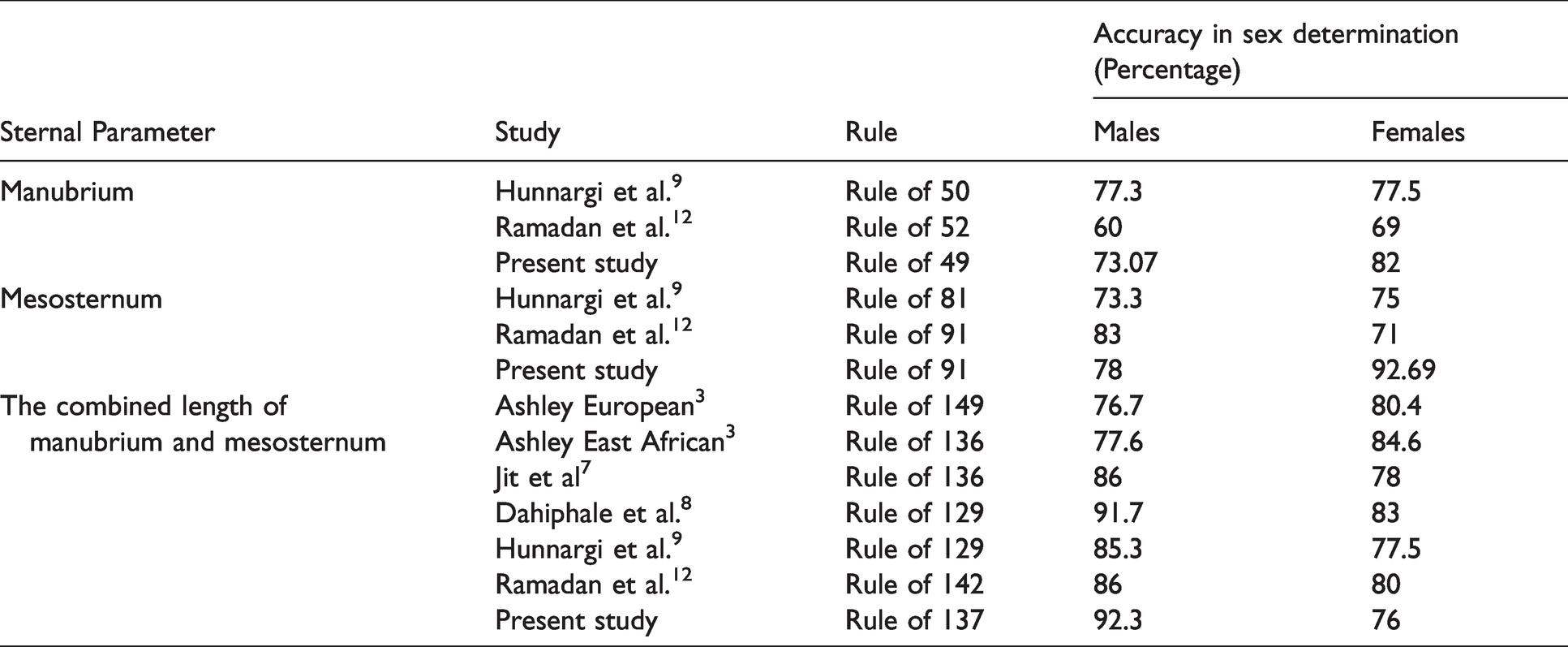
The present study also dwells on applications of various rules derived for different populations by researchers to determine sex from sternal parameters. “Rule of 49” defined in the present study for determination of sex from manubrium is almost similar to “rule of 50” and “rule of 52” as derived by Hunnargi et al. 9 and Ramadan et al. 12 Accuracy for sex determination from “rule of 49” derived in the present study is 73.07% in males and 82% in females which is higher than that of Ramadan et al. 12 “Rule of 91” observed in the present study for determination of sex from mesosternum is showing a cut-off value higher than that of Hunnargi et al. 9 but congruent with that of Ramadan et al. 12 Accuracy for sexing the sternum from “rule of 91” derived in the present study is 78% in males and 92.69%. “Rule of 137” observed in the present study for sexing sternums based on measurements of combined length of manubrium and mesosternum is almost similar to “rule of 136” derived by Ashley 3 and Jit et al. 7 for sexing sternums in East African and North Indian population, respectively. However, higher cut-off values were observed by Ramadan et al. 12 and Ashley 3 when they conducted studies on Turkey and the European population, respectively. Dahiphale et al. 8 and Hunnargi et al., 9 in their studies on the Maharashtrian population, observed lower cut-off values when sexing of the sternum was done based on the combined length of manubrium and mesosternum. Table 5 shows the comparison between various rules derived for different populations by researchers with the present study. Variations in all these rules are due to different body sizes and proportions of different populations due to various genetic, socioeconomic and environmental factors. Hence, all these rules are population specific.
Comparison between various rules derived for different populations by researchers for determination of sex from sternal parameters.
We found that sex can be determined from the sternum more precisely when the length of the mesosternum and the combined length of manubrium and mesosternum are taken into consideration than the length of the manubrium. Hunnargi et al. 9 , Bongiovanni et al. 13 and Singh J, Pathak RK 15 found the combined length of manubrium and mesosternum as the most useful parameter for sexing the sternum. Manoharan et al. 18 and Jaiswal et al. 19 found that the length of the manubrium and the combined length of manubrium and mesosternum are useful variables for sex determination from the sternum. Contrary to observations of the present study, Gupta et al. 20 did not find the length of mesosternum and the combined length of manubrium and mesosternum as useful criteria for sexing the sternum. Instead, they observed that the length of manubrium is the only reliable parameter for sex determination from the sternum.
Chandrakanth et al. 16 and Jaiswal et al. 19 found that the sternal index is not useful for sex determination in their studies on different populations. Thus, our findings are consistent with the aforementioned studies as we did not observe any statistically significant differences between sternal indices of males and females (p > 0.05). Hyrtl's law states that, in females, the manubrium generally exceeds half the length of the sternal body, whereas in males, the body of the sternum is usually twice as long as the manubrium. 4 The ratio between body and manubrium did not show any statistically significant difference between the two sexes in the present study. Hunnaragi et al. 9 concluded the same in their study.
Conclusion
Sex can be determined successfully by using different sternal measurements. Length of body and the combined length of manubrium and mesosternum were found to be valuable parameters for sexing the sternum in an adult Indian population. The sternal index was not found to be useful in sex determination in the studied population. Also, the practical application of Hyrtl's law in sexing the sternum is of limited value. Hence, the present study's findings will be useful for determining sex in a badly decomposed body or skeletal remains when other bones like skull, pelvis or long bones are not available or partially broken and fragmented.
The smaller sample size is a limitation of the present study. The authors recommend that more such studies be conducted on larger sample sizes in different population groups to establish standardized data for a particular population.
Footnotes
Declaration of conflicting interest
The author(s) declare that there is no conflict of interest.
Funding acknowledgement
The author(s) received no financial support for the research, authorship, and/or publication of this article.