




Abstract
Forensic odontology is a fundamental approach to identifying people, especially if alternative methods may not be attainable. Dental pattern variation, such as virgin, decaying, filled, and missing teeth, constitutes a valuable resource enabling the identification of individuals and acts as a distinct characteristic. This research explores the relevance of the diversity of dental patterns by employing the nonradiographic dental records method in forensic odontology, assessing their efficacy and reliability for individual identification in Delhi NCR populations, and highlighting the necessity for keeping thorough and precise dental records. Clinical examination, though often overlooked, provides a wealth of information that can supplement forensic investigations, particularly in the absence of radiographic records. The study incorporated 120 individuals (60 males and 60 females) aged 18–55 years from Delhi NCR clinics. The criteria comprised virgin (V), decayed (D), filled (F), and missing (M) teeth, which were assessed using SPSS software version 27.0 and Simpson’s Index of Diversity for determining diversity of dental patterns. The findings revealed a significant difference in virgin teeth across age groups (p = .001). Simpson’s Diversity Index indicated that age was the predominant factor influencing dental diversity, while sex differences were not statistically significant. Clinical dental examination yields valuable forensic insights, offering a practical nonradiographic method of assessing dental diversity. While antemortem dental records remain the gold standard for accurate identification, clinical examination plays a crucial role where radiographic facilities are unavailable, thereby strengthening forensic investigations.
Introduction
Over the last decade, there has been a drastic spike in criminal and disaster incidents. 1 The current high prevalence of violent and criminal actions has prompted the use of advanced techniques for criminal investigations. 2 Furthermore, the current prevalence of casualties related to mass disasters, such as travel and transportation accidents, terrorism, and exceptional meteorological conditions include earthquakes, tsunamis, landslides, and floods, 3 where the body is severely decomposed or mutilated to conceal the identity of the individual purposefully necessitates the development of novel effective approaches for identifying victims 4 is stated to as personal identification. 3 One of the greatest obstacles in forensic science is the identification process. 5 The initial step in establishing personal identity is determining whether or not the skeletal remains are human. If the remains are human, several anthropological procedures can be utilized to identify the deceased. The “big four” of personal identification are age, sex, stature, and ethnicity. These are the characteristics of “tentative identification.” 6
This needs to be established on trustworthy and objective approaches, as well as technological and scientific knowledge, to ensure that the conclusion of the technique of identification is not in controversy. 7 Forensic odontology is frequently used to identify victims of multiple-fatality disasters, although not always. Its effectiveness is dependent on sufficient dental remains surviving the natural disaster and the availability of dental documents. In 1970, Keiser-Neilson designated forensic odontology as “the branch of forensic medicine which, in the interest of justice, deals with the proper handling and examination of dental evidence, as well as the proper evaluation and presentation of the dental findings.” 8 Natural teeth, with Knop Hardness 270–350, are highly resilient organs in humans, making them valuable for identifying people in large-scale disasters or accidents where visible methods are insufficient.
Forensic dentistry, originating in 49 AD, uses natural teeth to identify people in large-scale disasters. Disaster victim identification (DVI) involves comparing dental records from antemortem and postmortem bodies. Forensic Odontology helps ascertain socioeconomic status, past dental history, age, and race of unidentified individuals. Adams’ research on adult dentition patterns has shown that dental patterns are a reliable method of identifying a person, similar to the variety of mitochondrial DNA structures.9–15
The dental pattern (DP), which can be used as a tool in the identification process, is characterized as the amalgamation of different symbols designated with particular dental conditions, such as virgin, missing, filling, and restored teeth on the entire dental arch, or a set of teeth. The application of dental patterns has been proven to be a great means of identifying an individual.15, 16 This study aimed to evaluate the diversity of dental patterns through clinical examination and to analyze the impact of sex and age on dental status. It became apparent that even in the lack of radiographic standards of comparison, charts, and notes that precisely describe the antemortem dental status of a missing person might be crucial for making an identification. 15 Dental radiographs are more objective and less subjective than dental charts, and postmortem investigators can assess both antemortem and postmortem radiographs, reducing potential inaccuracies. 17
Materials and Methods
Sample Population
This is a cross-sectional study involving 120 participants (60 males, 60 females) aged 18–55 years by using simple random sampling technique, categorized into three age groups as shown in Table 1, selected from Delhi NCR clinics after attaining ethical approval from the ethical committee of the Department of Anthropology, University of Delhi, India. Informed written consent was obtained from all participants before collecting data based on pre-planned inclusion and exclusion criteria. Inclusion criteria included permanent, complete dentulous or partially edentulous teeth, aged 18 to 55 years, and a clinical method, with the geographical area being the Delhi region. Exclusion criteria included deciduous teeth, radiographs, age < 55 years, cysts, and any oral abnormalities such as supernumerary teeth, cleft lip, and cleft palate. The parameters were virgin (V), decayed (D), filled (F), and missing (M), with assigned dental codes as shown in Table 2.17, 18 Each of the teeth was assessed, documented in a tabular format, and statistically evaluated using SPSS 27.0 software. The variety of dental patterns has been assessed using
Sample Dispersion Based on Sex and Age (n = 120).

Parameters with Dental Coding.

Result
This study evaluated dental diversity across a population of 120 individuals, considering sex and age variations. Descriptive statistics revealed that participants had an average of 26.96 virgin teeth (standard deviation [SD] = 3.354), with 1.67 decayed teeth (SD = 1.907), 0.53 filled teeth (SD = 1.614), and 1.36 missing teeth (SD = 1.878) (Table 3).
Descriptive Statistics of Dental Variables.

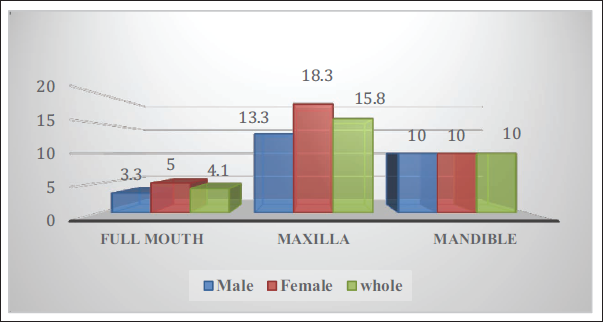
Only 4.1% of the participants retained all 32 virgin teeth, with a slightly higher prevalence in females (5.0%) compared to males (3.3%). Arch-wise distribution demonstrated that virgin dentition was more frequently preserved in the maxilla (15.8%) than in the mandible (10.0%) (Table 4, Figure 1)
The Frequency and Percentage of 32 Virgin Teeth Dental Patterns Sex-wise.

Percentage of 32 Virgin Teeth Common Dental Pattern Sex-wise.
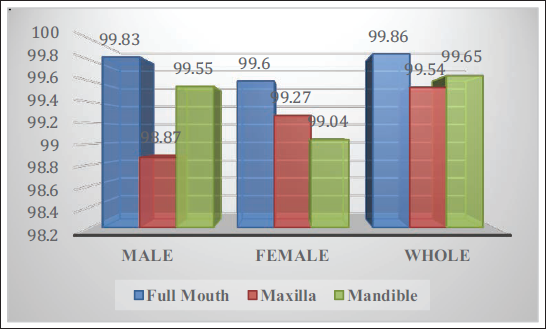
The diversity percentage for unique patterns of teeth remained consistently high across the population. In males, the full-mouth diversity was 99.83%, with 98.87% in the maxilla and 99.55% in the mandible. In females, the values were slightly lower: 99.60% (full mouth), 99.27% (maxilla), and 99.04% (mandible). Overall, the population exhibited 99.86% diversity for the full mouth, 99.54% for the maxilla, and 99.65% for the mandible, suggesting minimal loss of virgin teeth across both sexes (Table 5, Figure 2).
Diversity Percentage of Dental Pattern in the Sample.

Diversity Percentage of Dental Patterns.
Independent samples t-test showed no significant sex-wise differences in the mean number of virgin, decayed, filled, or missing teeth (p > .05). However, one-way analysis of variance (ANOVA) demonstrated a significant difference in virgin teeth across age groups (F = 7.065, p = .001), confirming that younger individuals retained more intact dentition than older individuals. No significant differences were observed across age groups for decayed (p = .516), filled (p = .068), or missing teeth (p = .562) (Tables 6 and 7).
Simpson’s Diversity Index values reinforced these findings, indicating that dental diversity was influenced more strongly by age than by sex. Younger age groups exhibited greater homogeneity in dental status, while older groups showed increased variability due to the cumulative effects of caries and dental intervention. Overall, the results demonstrate that although most individuals retained a majority of their teeth intact, complete virgin dentition was rare in adults. Age emerged as the most significant determinant of dental diversity, whereas sex differences were minimal. These findings underscore the forensic potential of dental diversity patterns in age estimation and biological profiling.
Independent t-test (Sex-wise Comparison).

One-way ANOVA Test (Age-wise Comparison).

Discussion
Identification is the process of distinguishing the living from the dead. It will be more significant in forensic identification cases involving deaths that are suspicious in both single and mass fatality instances for moral, social, spiritual, compassionate, and legal purposes.19–21 Dental identification is an easy and efficient technique for identifying individuals by comparing antemortem and postmortem data for similar characteristics. 22 Forensic dentistry can help identify persons when other methods are ineffective. The unique characteristics of our dental anatomy, along with the appropriate use of custom restorations, confirm precision when methods are used appropriately. 23
This study observed a variety of dental patterns using a nonradiographic method within the full mouth (99.86%), corresponding with previous research which had been conducted using an orthopantomogram (OPG).24–27 However, the outcomes differed substantially when the maxilla (99.54%) and mandible (99.65%) were examined independently compared to other authors. The authors structured the study using characteristics of virgin, missing, restored, and impacted using an OPG, contributing to the low heterogeneity rate within the maxilla (59%) and mandible (82%), 18 whereas this study is structured using characteristics of decayed, virgin, missing, and filled teeth using the nonradiographic method.
Earlier research by different authors has stressed the implications of using OPGs for forensic identification. These studies concentrated on dental diversity through radiographic examination. While radiographic approaches have already been widely explored in person identification, there is a lack of research specifically focused on the potential of the nonradiographic method as a standalone tool for the same reason. This study seeks to fill the aforementioned gaps by exploring the effectiveness of nonradiographic methods in establishing individual identity when antemortem dental records are lacking.
According to Adam (2003), even in the lack of a dental radiograph, dental variety was sufficient for forensic identification. On a basic dental chart, he just contrasted missing, restored, and unrestored teeth. Adam used actual findings of substantial information to provide insight into the variety of adult dental patterns and to illustrate the diversity through nonradiographic dental comparisons using dental charts. 15 Dental radiography holds a greater objective and exhibits comparatively fewer mistakes when compared to postmortem investigators for identification, notwithstanding the subjectivity of dental charts. The study emphasizes assessing the nonradiographic method’s efficacy where no antemortem dental data is available. This limitation may restrict the depth of analysis and the ability to detect subtle dental variations that are critical for forensic identification. Similarly, this study also highlights the diversity of dental patterns, without relying on dental radiographic records, as a whole in establishing personal identification using four dental characteristics and emphasizing the importance of preserving complete and accurate dental records for positive dental identification.
Conclusion
This study highlights that dental diversity, expressed through virgin, decayed, filled, and missing teeth, serves as a valuable parameter in forensic science. While most individuals retained a majority of their dentition intact, the rarity of complete virgin dentition and the age-related decline in tooth integrity underline the importance of dental examination in biological profiling and age estimation. Sex-related differences were minimal, reinforcing the observation that age exerts a greater influence on dental diversity.
Importantly, this study reaffirms that clinical examination yields a wealth of information in personal identification, offering a practical, cost-effective, and noninvasive approach to forensic investigations. However, it must be recognized that antemortem dental records remain the gold standard, providing objective, verifiable, and highly accurate details for personal identification.
Nevertheless, in contexts where imaging techniques and radiographic records are unavailable, nonradiographic clinical examination plays a critical role. It bridges the gap by offering preliminary yet significant insights that can assist forensic experts in narrowing down identity, establishing biological profiles, and corroborating other forms of evidence.
Thus, the findings emphasize that clinical dental examination, while complementary to antemortem dental records, continues to be an indispensable tool in the forensic identification process, particularly in resource-limited or challenging investigative settings.
Footnotes
Acknowledgements
The authors extend their heartfelt gratitude to the previously reported work done by researchers. The authors are also thankful to all the participants.
Declaration of Conflicting Interests
The authors declared no potential conflicts of interest with respect to the research, authorship, and/or publication of this article.
Ethical Approval
Ethical clearance was obtained from the ethical committee of the Department of Anthropology, University of Delhi, India (Ref. No./Anth./ 2022-23/638).
Funding
The authors received no financial support for the research, authorship, and/or publication of this article.
Informed Consent
Informed written consent was obtained from all participants prior to data collection.
