




Abstract
We report the case of a 37-year-old male whose burned body was discovered under suspicious circumstances in an abandoned location. Postmortem examination revealed the body in a pugilistic attitude with extensive burns, sparing the upper half of the face, portions of the scalp, and parts of the back. The absence of a line of redness at the junction of burnt and unburnt areas indicated that the burns were sustained in the postmortem period. Multiple lacerated wounds and fractures of the facial bones with ecchymosis of surrounding structures were noted, confirming antemortem blunt force trauma. The tracheal mucosa was unremarkable, with no evidence of soot deposition, thereby ruling out antemortem inhalation of smoke. Internal examination revealed subarachnoid and subdural hemorrhages over the left cerebral hemisphere and at the base of the brain, findings consistent with fatal cranio-cerebral injury resulting from blunt force trauma. Correlation of external and internal findings established that death resulted from cranio-cerebral damage due to multiple blunt force injuries, with postmortem burning inflicted to conceal the homicidal nature of the death.
Introduction
One of the most challenging tasks in forensic medicine is determining the cause of death in cases involving burnt bodies under suspicious circumstances. Such investigations often require careful consideration of several critical aspects. The foremost concern is whether the individual was alive at the time the fire began or whether the burns were sustained postmortem. Establishing whether death resulted directly from burn injuries or whether another cause of death preceded the fire is equally important. In situations where burns are not the primary cause of death, it must be assessed whether they contributed in any way to the fatal outcome. 1
The manner of death also plays a crucial role in medico-legal evaluation. Differentiating between accidental burns, suicidal self-immolation, and homicidal burns is central to reconstructing the sequence of events. In some instances, the possibility of fire being used to conceal a crime must also be considered. Furthermore, investigations frequently extend to understanding how the fire originated, which may provide insights into intent or accidentality. 1
Another significant challenge lies in the identification of the victim, particularly when the body is extensively charred. This becomes even more complex in cases of mass fatalities, where forensic experts must also attempt to establish the order of death among multiple victims. 1
Case Report
On January 11, 2023, the burnt body of a 37-year-old male was brought to the mortuary of our institute. According to police records, the deceased was found in an abandoned place under suspicious circumstances. Subsequent investigation established the personal identity of the deceased, revealing that he was a businessman by occupation.
Observation
The extremities were observed to be in a semi-flexed posture, consistent with a pugilistic attitude due to heat stiffening (Figure 1). A piece of burnt cloth, emitting a distinct odor of petrol, was found adherent to the neck region of the deceased. Scalp and facial hair were singed. Superficial-to-deep burns were present over the bilateral temporal and occipital regions of the scalp, lower part of the face, anterior and posterior aspects of the neck, right upper limb, both sides of the chest, abdomen, both lower limbs, genital region, and gluteal regions bilaterally. A loop of intestine was noted protruding through the right side of the abdomen.
Pugilistic Attitude of the Deceased.
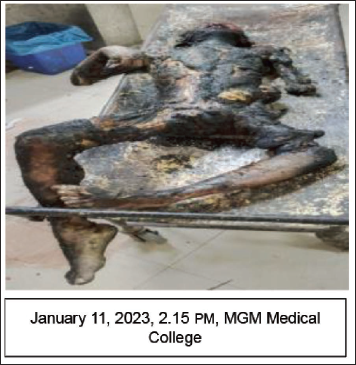
The left hand and the distal to middle one-third of the left forearm were absent; the remaining portion of the left upper limb was charred, with exposed bone showing burn effects. The burned tissues were indistinguishable by type and appeared blackened. The posterior aspect of the body, bilateral frontoparietal regions of the scalp, and the upper half of the face were unburnt. No line of redness was observed at the junction of burnt and unburnt areas.
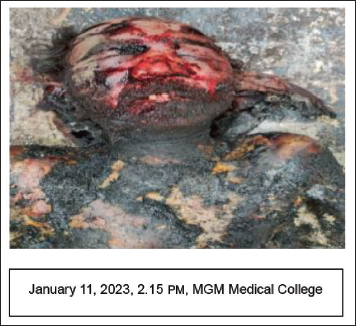
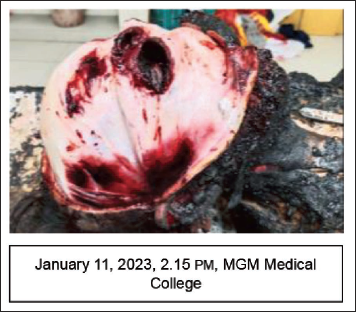
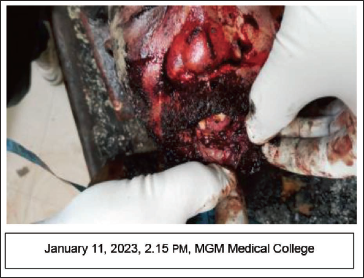
The nose was depressed and deformed; an underlying nasal bone fracture was present, with surrounding soft tissue showing reddish ecchymosis (Figure 2). A lacerated wound measuring 5.0 × 1.0 cm × bone deep was present over the right frontal region; another lacerated wound measuring 4.5 × 1.0 cm × bone deep was present over the right parietal region; and a lacerated wound measuring 3.0 × 1.5 cm × bone deep was present over the left frontal region. The margins of all injuries were irregular, and the edges were contused (Figure 3). The mandible and maxilla were fractured at multiple sites, with reddish ecchymosis noted in the surrounding soft tissues. The tongue was unburnt and found within the oral cavity. Multiple teeth were missing, and the respective sockets showed reddish ecchymosis (Figure 4).
Depressed Nose with Fracture of the Underneath Nasal Bone.
Lacerations With Underneath Reddish Ecchymosis
Socket of Teeth Showing Reddish Ecchymosis.
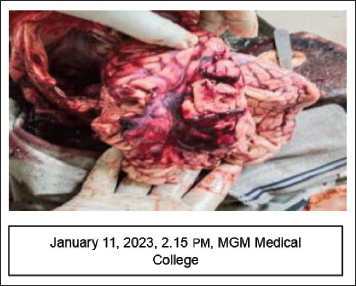
Upon opening the skull, reddish ecchymosis was present over multiple areas of the scalp. The dura was intact. Subarachnoid and subdural hemorrhages were present over the left cerebral hemisphere and at the base of the brain (Figure 5).
Subdural Hemorrhage and Subarachnoid Hemorrhage Over the Brain.
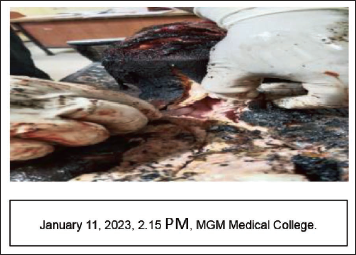
All visceral organs were grossly normal and appeared pale on cut section. The heart was empty. The tracheal mucosa was unremarkable, with no evidence of carbon soot deposition (Figure 6). No fluid blood was found in the pleural or peritoneal cavities. The stomach contained approximately 200 mL of brownish fluid; the gastric mucosa appeared pale. Histopathological examination of tissues and carbon monoxide estimation were not performed.
Trachea Without Evident Soot Particles.
Discussion
Examination revealed multiple fractures involving the facial bones, accompanied by marked ecchymosis of the surrounding soft tissues. The distribution and pattern of injuries over the scalp were consistent with antemortem infliction and indicated a homicidal manner of causation. The injury characteristics suggested the use of a hard, blunt object capable of producing fatal injuries in the ordinary course of nature. These findings are consistent with those reported in the textbooks authored by Saukko and Knight 2 , Aggrawal 3 , Dikshit and Behera 4 , Vij. 5
The pugilistic attitude observed in this case occurs because intense heat causes the muscles to coagulate and contract, leading to flexion of the arms and legs. As a result, the upper limbs rise as though the individual were holding a defensive posture. Importantly, this position develops solely due to heat and is not an indicator of whether the person was alive or dead before the fire. This finding is consistent with those reported in the textbooks authored by Aggrawal 3 , Dikshit and Behera 4 , Vij 5 , DiMaio and Molina. 6
Notably, there was an absence of burns over the posterior aspect of the body, no soot particles were detected within the trachea, and no distinguishable line of redness was observed at the junction of burnt and unburnt skin. These findings were indicative of burns sustained in the postmortem period. These findings are consistent with those reported in the textbooks authored by Saukko and Knight 2 , Aggrawal 3 , Dikshit and Behera 4 , Vij. 5
Based on the correlation of external and internal findings, the cause of death was determined to be cranio-cerebral damage resulting from multiple blunt force injuries to the head and facial region. Differentiation between blunt force trauma and heat-related artifacts was achieved through assessment of tissue vitality; the presence of ecchymosis and vital reactions surrounding the scalp injuries confirmed their traumatic and antemortem nature, thereby excluding heat ruptures. These findings are consistent with those reported in the textbooks authored by Aggrawal 3 , Dikshit and Behera. 4
Although histopathological and toxicological analyses could have provided further corroboration, the gross autopsy findings were deemed sufficient to establish both the cause and manner of death.
Conclusion
Determining the cause of death in charred bodies demands a high level of expertise and a systematic approach. The destructive effects of burns, along with heat-induced artifacts, often obscure critical autopsy findings, making the process highly challenging. In certain cases, burns may be present despite the victim having died from an unrelated cause, further complicating interpretation. A meticulous evaluation that integrates a well-documented case history, scene evidence, and relevant laboratory investigations is essential to arrive at a scientifically valid conclusion. Such an approach not only strengthens the medico-legal opinion but also helps prevent wrongful conviction of the innocent and acquittal of the guilty.
Footnotes
Authors’ Contributions
All authors have contributed to this manuscript.
Availability of Data and Materials
Data sharing is not applicable.
Declaration of Conflicting Interests
The authors declared no potential conflicts of interest with respect to the research, authorship, and/or publication of this article.
Ethical Approval
Not applicable as a Medico-legal autopsy does not require consent.
Funding
The authors received no financial support for the research, authorship, and/or publication of this article.
Informed Consent
Authors declare consent for publication.
