




Abstract
Education has been compromised by the COVID-19 pandemic. Due to the crisis, online teaching is provided as an ideal teaching and learning environment by educationists as an adjunct to traditional teaching. E-learning has become beneficial in academic and epidemiological aspects. Initially, distance education courses alone used E-learning methods, but now it has developed to be part of any formal education. To evaluate whether online methods are convenient for students compared to traditional methods.
This descriptive study period was three months with a sample size of 183 MBBS students. The questionnaire (variables) was classified into General, Academics, and Evaluation which was mailed to students as Google Form with feedback form. The Likert Scale was used to evaluate the questionnaire. A comparison was made between traditional and online teaching. Based on the data obtained, calculations were done using the Likert Scale. Among the total study participants, the majority said that the traditional teaching method was interesting, useful and more effective compared to online teaching. This study concluded that traditional teaching has more advantages such as orientation knowledge, learning skills, problem-solving, level of concentration, questioning, reflections, and feedback sessions related to clinical and practical knowledge compared to online teaching.
Introduction
In recent years, digitalization has been included in the Indian educational system. Though the start is slow, its growth is increasing every year. As developed countries have changed swiftly to a digital world, developing countries like India are adapting to the new phase of the digital world. Medical education is the prime face of Indian education seeing different kinds of challenges over the decades. From its evolution to its advancement, the field of medicine is continuously upgrading its people (faculties & students). Over the years, teachers taught with blackboards and with advancements in technology, these boards have been replaced by multimedia like PowerPoint presentations (PPT’s). Faculties of the medical field are being trained with updation to keep the students on track with the subject through modern technology. This has been achieved as the system is changing from lecture-based education to a student-based education. 1 Studying MBBS is a lifelong process of learning and practice for a desirable outcome. For medical students, this outcome primarily reflects on the knowledge, skills and ability to perform, irrespective of the teaching methods. 2
The concept of E-learning is the application of technology in education. 3 It has become a part of the curriculum along with the traditional teaching and learning methods. Online learning is one of the multifaceted modes of technology adopted by the faculty and students to cope with the pandemic lockdown.
COVID-19 pandemic crisis has made a great impact on the educational sector, the learners were affected especially during the lockdown, imposed worldwide to stop the disease’s spread. In India, 19% learners were using online methods. Coursera, an online platform for educators and learners reported that 18 million globally, in which 1.3 million in India were using online methods, thus making India the 3rd largest online user in the world. 4 Teaching–learning methods are achieved by various methods such as basic online approach, blended learning, flipped classrooms, and enhanced learning by using advanced technologies etc. 5 These variants are provided by many interactive tools which are available globally, such as Zoom, WhatsApp, WeChat, Skype etc. 6 In the Indian scenario, though global tools are used for online teaching, its limitations are more. To overcome these limitations, the Government of India has developed National portals, such as Swayam and E–PG Pathshala, where education is for everyone with very minimal limitations. 7
Material and Methods
The study was done for three months, conducted with 2nd-year students who were referred to the Department of Forensic Medicine and Toxicology, MGMCRI, Puducherry. The study design was a hospital-based cross-sectional study with a sample size of 183 (male: 80 nos. and Female: 103 nos.). Study participants were selected based on the inclusion and exclusion criteria. Volunteering students (male & Female) of 2nd year MBBS, who were above 18 years of age are included in the study. Students who are not willing to participate are excluded from the study.
Study Procedure
The study was conducted with the 2nd year MBBS students (male & female), who were willing to participate and have undergone equal time duration of online and offline (contact) classes, in the Department of Forensic Medicine and Toxicology, a written informed consent was obtained from the students. A common questionnaire was mailed to the participating students individually as a Google Form, from the Deanery of MGMCRI. The filled-in Google forms (questionnaire) were mailed back to the Deanery by the students on a given date and time. These forms were handed over to the Principal and Co-Principal investigators by the Deanery, after masking the student’s identity. The investigators, after collecting all the completed Google forms, studied the replies given by the students and were automated into percentages according to the questions answered for each criterion, to know their perception. The study tool used is the Likert Scale. The Likert Scale ratings were categorized as, Good: 1; Average: 2, and Poor: 3. The variables were classified into three parts, such as general, academics, and evaluation.
Statistical Analysis
The data were collected and recorded in a systematic way. The collected data were categorized into demographic information perception variables used (General, Academics, and Evaluation) as numerical values in the form of tables. Secondary sources are used for reviewing the concept and supporting the findings. The data are analyzed by using Statistical Package for Social Science (SPSS) version 25. The results were projected in the form of tables and graphs as required.
Result
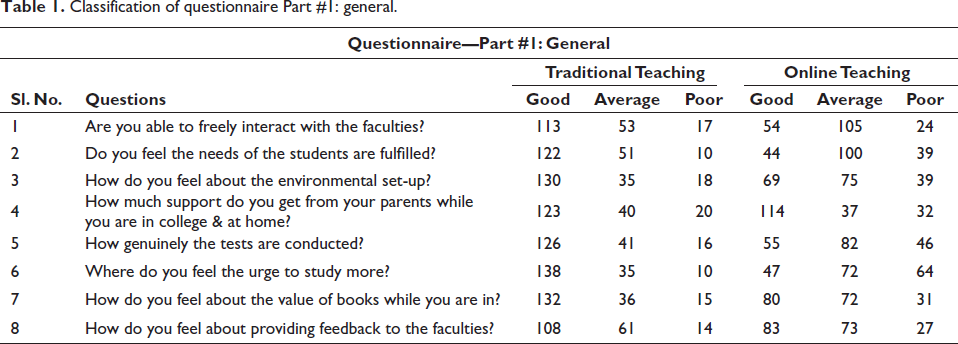
The study participants answered the questions given in the questionnaire categorized under three different parts such as Part #1: General (eight questions), Part #2: Academics (five questions), and Part #3: Evaluation (A–E five questions). The answers received from the study participants were analyzed, tabulated in the form of tables and obtained the following results. Based on the tables the graphical representation charts are prepared. In the total study participants 183 nos., the gender classification was done and it was recorded as male (43.7%) 80 nos. and female (56.3%) 103 nos. The questionnaire Part #1: General, was prepared in consideration of the following points, such as the ability to freely interact with the faculties, the needs of the students being fulfilled, the environmental set-up, support from parents, genuine tests conducted, the urge to study more, the value of book’s and providing feedback to the faculties. The result was found that the majority of the study participants chose the traditional teaching method as interesting, useful and more effective, which are not found satisfactory when they attend the online teaching method as shown in Table 1.
Classification of questionnaire Part #1: general.
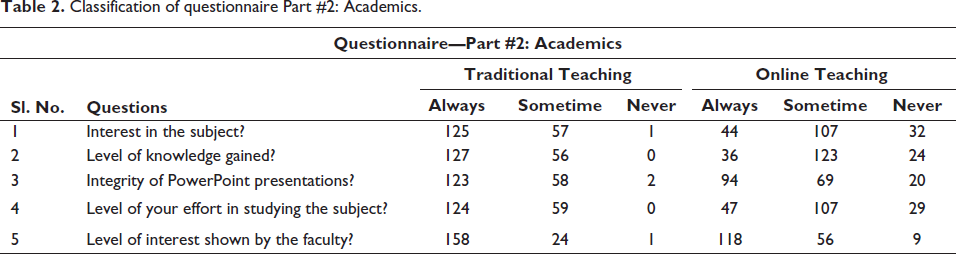
Based on the questionnaire Part #2: Academics, the result was found that the majority of the study participants chose the traditional teaching method, based on their interest in the subject, level of knowledge gained, the integrity of PPTs, level of their effort in studying the subject and level of interest shown by the faculty, as shown in Table 2.
Classification of questionnaire Part #2: Academics.
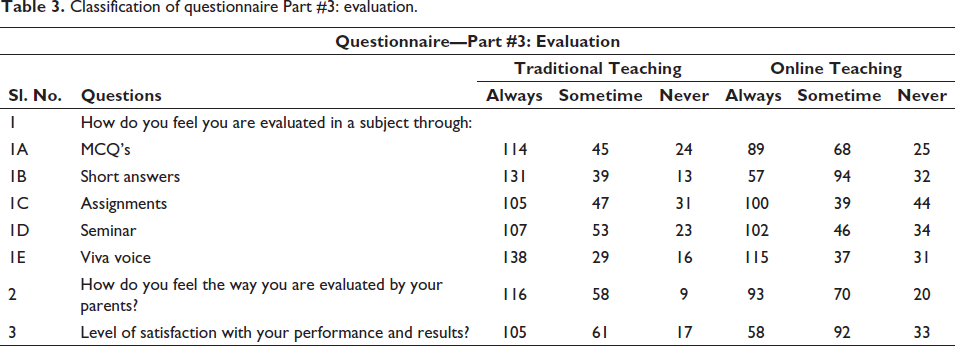
In this study, questionnaire Part #3: Evaluation, it was found that the majority of the study participants preferred the traditional teaching method based on the MCQs, Short Answers, Assignments, Seminar, Viva Voice, the way they are evaluated by their parents and the level of satisfaction with their performance and results when compared to online teaching method as shown in Table 3.
Classification of questionnaire Part #3: evaluation.
The majority of the study participants (80.3%) 147 nos. responded that they are more comfortable with traditional teaching (classroom teaching) out of 183 study participants in which males were 64 nos and females were counted to 83 nos. Out of 183 study participants, 13 (7.1%) preferred online teaching (E-learning), of which males were eight nos. and females were five nos. Similarly, 23 nos. (12.6%) preferred both the teaching methods (traditional teaching and online teaching) out of the total study participants, with males 4 (4%) and females 2 (2%).
The overall result obtained from this study is found that the most effective method of teaching strongly preferred by the study participants was the traditional teaching method (classroom teaching).
Discussion
Diversity in teaching is always a major tool in traditional teaching methods, though faculties try to incorporate the same in online teaching. The use of different techniques always gains the student’s attention leading to better concentration during traditional, where there is always a question of “How much?” in online mode. Students are motivated by the faculty to adhere to the subject as the goals and objectives of the topic remain the same and by providing equal opportunity to everyone either traditional or online mode of education.
Students exhibit a better level of knowledge, skills and attitude while interacting in person, whereas the seminar online becomes a non-communicative dialect. The question and answering sessions give an idea about the understanding level of students of a particular year, educated through a traditional or Conventional method, with that of an online method.
Makhdoom et al., stated that in the online teaching method communication gap, face-to-face interaction and student-staff teamwork are not found up to the level. In addition, the online teaching method does not improve the perception of students based on the education environment. 8 In our study, the study participants summarized that they always strongly prefer the traditional teaching method (classroom teaching) of teaching in lecture halls as that makes a student more sincere and increases their concentration capabilities
Hugenholtz et al., stated in their study, that no significant difference was found between online teaching and traditional teaching of the medical doctors in constant learning was performed and reported. 9 In our study, some of the study participants said that both traditional teaching and online teaching methods are comfortable for them, but they are stressed/tired of staying home for a long time due to the pandemic COVID-19 and they need to go back to college.
The traditional teaching method has proved to be the best method of teaching when compared to the other teaching methods. The disadvantages of online teaching/E-learning are clearly stated in the studies conducted by the following authors at various periods/years. Collins et al., 10 Scott et al., 11 Lewis et al., 12 Almosa et al., 13 Marc et al., 14 Dowling et al., 15 Klein et al., 16 Akkoyuklu et al., 17 and Hameed et al., 18 In our study, based on the study participants it is found that traditional teaching method is always preferred more when it is in consideration with the practical knowledge is more important for medical students.
Online teaching always gives on to the usage and obstruction of various websites which are used for learning. This makes the students meet the unexpected expenses in an aspect of money and time which are stated in the following authors’ Collins et al., 10 Klein et al., 16 Hameed et al., 18 Almosa, 13 Akkoyuklu et al., 17 Lewis et al., 12 Scott et al., 11 and Marc et al. 14 In our study, the traditional teaching method is found better as the unexpected expenses in terms of money and time are avoided when compared to online teaching (E-learning).
Burdman et al., 19 Young et al., 20 Bettinger et al., 21 Kaur et al., 22 stated in their study, that classroom teaching competes for the limitations such as knowledge gained by an interaction between the teacher and students which is not meeting the level of interaction during online teaching. In our study, it is found that the traditional teaching method is best for the practical part in which the students learn better and they get exposed to the specimens and slides.
Ni et al., concluded in their study that, classroom-based teaching (traditional teaching) is the most effective and preferable method of teaching because teacher-student interaction and communication are very important while learning. 23 In our study, the study participants opted traditional teaching method as the best practice for communication between teachers and students. This method also increases comfort when face-to-face interaction occurs between teacher-students and their colleagues.
Kemp et al. and Grieve et al. stated in their study that dynamic learning attributes are found only when the students and staff interact face-to-face. 24 Xu et al., stated in their study that the communication between the students and staff has several benefits when the interaction is done face-to-face. 25 In our study, the majority of the study participants strongly preferred the traditional teaching method as it is conducted in lecture halls which makes the students more sincere and increases their concentration capabilities.
Roval et al. and Jordan et al., stated in their study that dynamic learning attributes are found only when the students and teachers cooperation, in face-to-face interactions, in teacher-student bonding and in discussions held during pre- & post-class. 26 In our study, the traditional teaching method is found to be the best teaching method because students can easily contact teachers in person, get more knowledge in hands-on training during practical sessions and they gain more time in the aspect of getting clarified to their doubts.
Kemp et al. and Grieve et al., stated in their study that the style of teaching and class structure may be adjusted to improve the retention of the students. 24 In our study, we found that as the study participants are from medical college they prefer the traditional teaching method in which the interactions between the teacher and students occur in the classroom which makes them feel comfortable because of the classroom infrastructure and the teaching style improves the concentration of students more.
Similarly, several authors Wentling et al., 27 Marc et al., 14 Nichols, 28 Klein et al., 16 Hameed et al., 18 and Algahtani et al., 29 in their studies stated that online teaching has many advantages and benefits. They concluded that E-learning/online teaching should be considered the best education method. In addition, they said that the new technologies shall be incorporated into E-learning/online teaching in schools and in higher education according to the current development which may result in the best knowledge of the students. In our study, a very minimal study participants stated that they feel both techniques have their own advantages and disadvantages.
In other studies, the authors Urdan and Weggen, 30 Codone et al., 31 Marc et al., 14 Klein et al., 16 Amer et al., 32 and Algahtani et al. 29 stated that online teaching makes students make the speed of learning according to their capacity which results in reduction of stress and satisfies their learning. In our study, in the online teaching method (E-learning) the study participants faced internet connectivity problems and this ruined everything during the class, question-answer sessions and viva voice. They requested that during the online classes, the lectures be taken without wearing masks.
Maniar et al. 33 and Elias et al., 34 stated that online teaching has the disadvantage that the hardware/equipment (mobile/laptop) merely relies on technology which may fail or be inadequate related to insufficient battery life or inadequate screen size of the hardware/equipment used. In our study, we found that the majority of the study participants preferred the traditional teaching method because during online classes they may not be attentive at all times and they are facing severe problems with internet connectivity, especially during viva voice they are not able to cooperate with the clarity of voice on both sides. But Clark et al., stated in their study that the delivery of teaching content based on websites and teleconferences is found effective as classroom teaching. 35
To overcome the disadvantages of online teaching, both the traditional teaching and online teaching methods should be combined together and it should be a mixed teaching method while handling the classes. The same was also supported by author Dodiya et al. in the study.36, 37
Limitations
The present study sample size was limited to 2nd-year MBBS students. The sample size can be increased by including 1st, 3rd Part I & Part II MBBS students.
Conclusion
The mainstay of the program outcome and course outcome always remains the same to date, irrespective of the learning methods. Does a student who was taught by the traditional method and a student taught by the online teaching method exhibit the same level of skills and attitude at the time of practice? In our study, we concluded that the traditional teaching method (classroom teaching) is the best method of teaching and learning when compared to the online teaching (E-learning) method.
Footnotes
Declaration of Conflicting Interests
The authors declared no potential conflicts of interest with respect to the research, authorship, and/or publication of this article.
Ethical Approval
The ethical clearance for the study was obtained from the Institutional Ethical Committee of Mahatma Gandhi Medical College and Research Institute (MGMCRI), Puducherry.
Funding
The authors received no financial support for the research, authorship, and/or publication of this article.
Informed Consent
Written informed consent was obtained from the study participants after explaining the study procedure.