




Abstract
Background:
To authors’ knowledge, in Saudi Arabia, information regarding patients’ knowledge about their medications is lacking.
Objectives:
This study aimed to fill this literature gap by assessing patients’ knowledge and perceptions about their medications.
Design:
To achieve the objective of the study, a cross-sectional survey was conducted outside community pharmacies in Qassim region through an exit interview with patients after getting their prescriptions filled or refilled.
Methods:
A convenient sample of patients was chosen based on acceptance to participate. A form was prepared based on the core and complementary medicines use indicators for evaluation of medicines use in healthcare settings developed by the World Health Organization (WHO).
Results:
Four hundred forty-three forms were completed. A total of 70% of the indicators of patients’ knowledge about their medications were found to be satisfactory, and a total of 89% of the patients were found to have positive perceptions about safety and effectiveness of their medications.
Conclusion:
Overall, patients’ knowledge about their medications was found to be reasonable with exception of the area “information about precautions and possible side effects” which had shown poor patients’ knowledge.
Key questions
What is already known?
Inappropriate use of medicines is a common problem in many countries, especially in developing countries.
What are the new findings?
Patients had weak knowledge about precautions and possible side effects of their medications.
Patients had positive perceptions about safety and efficacy of their medications.
What do the new findings imply?
Level of patients’ knowledge about their medications impact therapeutic outcome, in other words, the level of patients’ health improvement most probably reflects better patient knowledge about their medications.
Introduction
Inappropriate use of medicines is a common problem in many countries, especially in developing countries. The World Health Organization (WHO) estimates that more than half of all medicines are inappropriately prescribed or dispensed and more than half of the patients fail to adhere to prescribed regimens. 1 Inappropriate use of medicines can have a significant adverse effect on healthcare costs, quality of pharmaceutical care, and emergence of antimicrobial resistance. 2 One of the most common reasons for inappropriate use of medicines is lack of adequate information about the prescribed medicines. This is not only because no adequate information or counseling being given but also may be because, even after counseling, not adequate information understood by the patient. 3 There are several studies in the literature, especially in developing countries, documenting nonadherence to medicine regimens due to poor patients understanding about their medications.4,5 Also, poor patients’ knowledge about their medication was reported to be among main reasons that had led to increased number of emergency department visits. A study reported that lower medication adherence and lack of knowledge of prescribed dose were the main reasons for increases in the number of emergency department visits among congestive heart failure patients aged 50 years and older. 6
In response to that, over the past 30 years, the role of community pharmacists has shifted from dispensing medicines to engaging in a pharmaceutical care approach that is centered on educating patients, and optimizing adherence and therapeutic objectives. 7 Several studies documented the importance of this role played by community pharmacists in enhancing patients’ knowledge about their medications.8–10 Because they are among the most accessible health professionals, in addition to the absence of consultation charges and the readily available over-the-counter medicines to solve problems for minor ailments that are often self-limiting, community pharmacists have the potential to play a decisive role in optimizing patients’ knowledge about their medications.11–16
It is documented in the literature that evaluation of counseling services delivered by pharmacists should also include an assessment of whether or not the information was received as intended and that the patient understands how to use the information to improve the probability of the therapeutic outcomes. 17 Therefore, to evaluate the effectiveness of counseling and educational services delivered by community pharmacists, there is a need to evaluate the patients’ knowledge about their medications, in addition, whether demographic characteristics are associated with this knowledge. 18
Also, as part of patients’ knowledge about their medication, assessment of patients’ perception about their medication had been proven to be an important therapy-related knowledge. 19 Therefore, this study aimed to contribute to this area through assessing patients’ knowledge about their medications, including perceptions, by conducting an exit interview with patients once they step out of community pharmacies after getting their medicines dispensed.
Method
This is a cross-sectional study conducted in Qassim, Saudi Arabia from January through February 2018. The target population was all clients who visited community pharmacies to get their prescriptions filled during the study period and who were also volunteered to participate. Three males and one female senior Pharm-D students gathered data during their graduation project. Patients eligible for the study should be older than 18 years. Patients who had major disability like deafness and blindness or with cognitive or perceptual problems were excluded.
There were 422 community pharmacies in Qassim Region in 2017. 20 Convenient sampling technique was used because having a representative sample is difficult in the context of the study due to constraints of time and money and lack of information on the population. Therefore, the sampling approach was based on the availability of participants. However, to maximize sample diversity, enhance the generalizability of the findings, and minimize selection bias, data collectors visited 53 community pharmacies during different days of the week, at different times of the day throughout the 2 months of the study. Selection of those 53 community pharmacies was based on the population density in the different governorates, in addition to practical criteria including geographical proximity. In total, 450 participants were interviewed, generating 443 useable forms, which is larger than the sample size of 385 calculated by following the Cochran formula. 21 This formula was chosen because it is considered especially appropriate in situations with large populations. It allows researchers to calculate an ideal sample size given a desired level of precision and desired confidence level. Inclusion and exclusion criteria for the survey and data collection process were illustrated in the flowchart given in Figure 1.
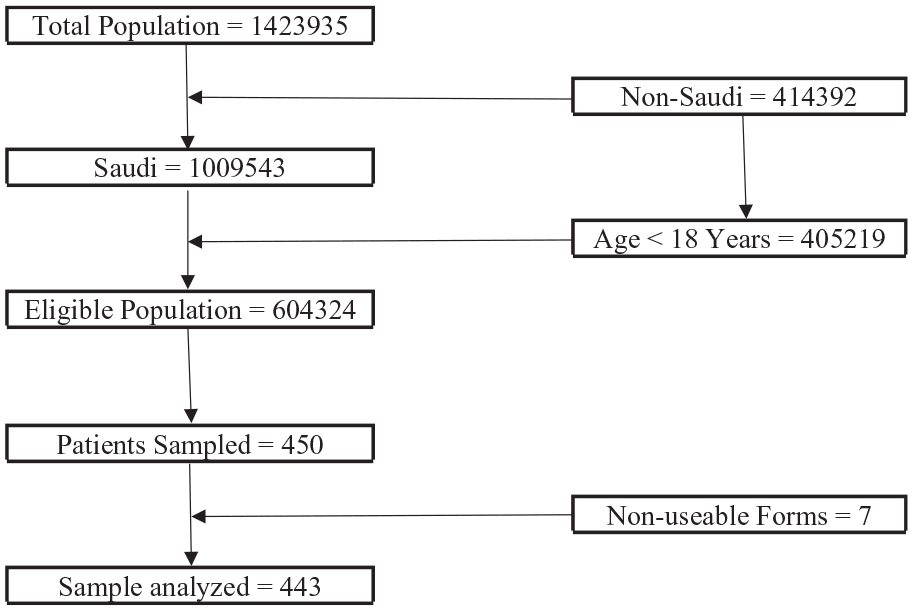
Flowchart documenting inclusion criteria, exclusion criteria, and the number of individuals included in the study population.
Patients’ knowledge about their medications was evaluated through administration of a form to gather information which was prepared based on the core and complementary medicines use indicators for evaluation of medicines use in healthcare settings developed by WHO.17,22 The form consisted of two sections. The first section was “Patients knowledge about their medications” and the second section was “Patients’ perception about their medications” (for chronic diseases only). Patients’ knowledge about their medications was measured using four subsections: “Why the medication is being given?,” “How each medication should be used?,” “What do you expect from this medication?,” and “Information about precautions and possible side effects.” These subsections have one, five, one, and four items, respectively. Each subsection carries an equal weight of 25% (i.e. each item in each subsection is rated out of 25% and the rate of the subsection is the average rate of its items). The maximum rate for each section is 100% divided equally among its subsections. Patients’ perception about their medications was measured using two items.
Using an exit interview, the trained senior Pharm-D students first ask the participants about the indications of all medications dispensed for them. If the participants manage to state the indications correctly, the interviewer records this as a satisfactory response. They then ask each participant all other questions in the sequence listed in the form regardless of the participant’s initial response. A number of satisfactory responses were used to assess the total medication knowledge score.
Ethical considerations
This is an observational survey study used an anonymous form for data collection. As the study is descriptive by nature, with no diagnostic or clinical intervention, it was determined to be exempted from review by the institutional review board at Qassim University. However, the Research Unit, Unaizah College of Pharmacy, had reviewed and approved the study protocol. In addition, prior to form administration, the study was explained to the participants and verbal consent was granted before engaging them in the study. The participants were verbally informed that all data were for academic research purpose only, and no expected risk or benefit for helping in this study. Also the respondents were assured that their participation is completely voluntary, and they could freely opt out at any time during the survey. Last, confidentiality was assured, and the names of the respondents were not requested during the interviews.
Results
Demographic profile of the respondents
Data were gathered from a convenience sample of 443 respondents. Sample was not balanced with regard to gender with more than 60% of the respondents were male. In relation to educational level, most (61.5%) of the respondents were college, while those whom their level is primary school were least (0.7%). Demographic profile of the respondents was presented in Table 1.
Demographic profile of the sample.

Patients’ knowledge was measured using two sections. The first section was “Patients knowledge about their medications” and the second section was “Patients’ perception about their medications.” The second section was filled only by 113 participants who have chronic diseases and visited the pharmacy for prescription refill.
Patients’ knowledge about their medications
A total of 69% of the indicators of patients’ knowledge about their medications (based on the summation of the satisfactory results of the items of the three subsections) were found to be satisfactory. Majority (88.5%) of the participants satisfactorily answered the items listed under the subsection “Why the medication is being given?” Also, about three quarters (18.6% out of 25%) of the participants in this study considered knowledgeable about usage of their medications. With the exception of the item “What to do if a dose is missed” which obtained less than half (11.8% out of 25%) satisfactory answers, the majority of the patients answered items listed under the subsection “How each medication should be used?” in a satisfactory way. The investigation showed that 84.0%, 84.2%, 71.6%, and 84.2% of the participants managed to recall the dose, frequency, duration of treatment, and route of administration, respectively. The single item under the subsection “What do you expect from this medication?” was answered satisfactorily by more than three quarters (18.9% out of 25%) of the participants.
The last subsection “Information about precautions and possible side effects” reported least patients’ knowledge among other subsections with none of its items answered satisfactorily by more than 40% of the patients. Frequencies and percentages for the patients’ knowledge about their medications items as listed in the evaluation form were recorded in Table 2.
Patients’ knowledge about their medications.

Overall score of the four subsections.
Patients’ perceptions about safety and effectiveness of their medications
Patients’ perceptions about safety and effectiveness of their medications were measured using two items. Each item carries an equal weight of 50%. A total of 90.3% of the patients were found to have positive perceptions about safety and effectiveness of their medications (based on the summation of the satisfactory results of the two items). Frequencies and percentages for the patients’ perceptions about safety and effectiveness of their medications as listed in the evaluation form are recorded in Table 3.
Patients’ perceptions about safety and effectiveness of their medications.

Summation of the satisfactory results of the two items.
Association between patients’ knowledge about their medications and their socio-demographic characteristics
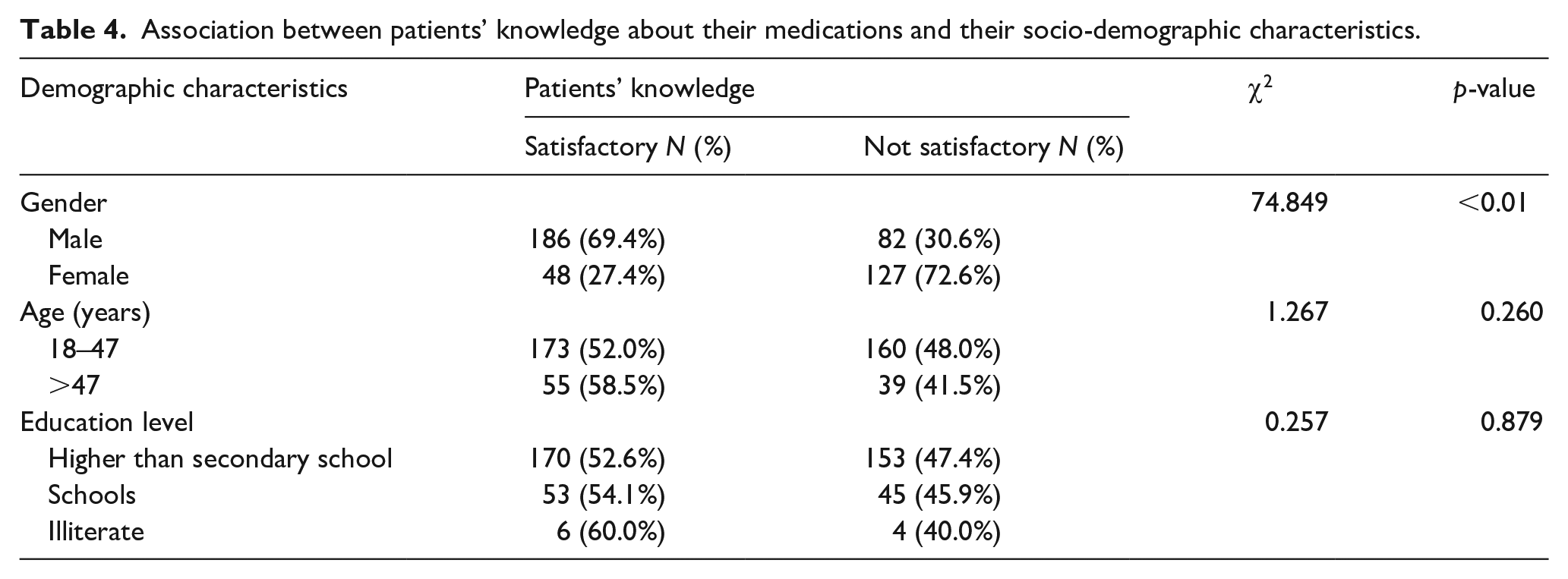
Finally, inferential statistic of chi-square test was used to determine the association between each patient’s knowledge about his medications, and his socio-demographic characteristics. SPSS version 18 was used to analyze data. Alpha level was set at <0.05. Details of the obtained results were presented in Table 4.
Association between patients’ knowledge about their medications and their socio-demographic characteristics.
Discussion
Patients’ knowledge about their medications
Generally, patients’ knowledge about their medications was acceptable. Out of the 443 patients included in the study, 69% were knowledgeable about their medications. This finding is supported by a study conducted in Portugal and reported that 78% of the participated patients were found to be knowledgeable about their medications. 23 Another study conducted in Istanbul, Turkey documented similar results, with 65% of the participants were knowledgeable about their medications. 24 Lower results were documented in a study conducted in South West Ethiopia reported that only 8% of the clients were knowledgeable about medicines dispensed to them. 25 However, low knowledge documented in the Ethiopian study may be due to the exclusion of patients with chronic diseases who assumed to be more knowledgeable about their medications than those with acute diseases. Other studies conducted in Saudi Arabia and elsewhere also reported low patients’ knowledge about their medications.26–28
Higher percentages (92%) for recalling the reason for the medicines prescription was reported in other studies than in this study. 26 Similar ranges (60%, 79%, 79%, 76%) for recalling reason for dispensed medication were documented in the literature.23,29–31 However, the WHO recommends a 100% rate, as patients’ orientation about the reason of the dispensed medicines can increase adherence of patients to their medications.
Several studies had documented results almost similar to those reported in this study for patients’ knowledge about dosage of their medications.25,26,32 Also, similar findings regarding recalling dosage frequency were reported in Botswana (83%) and Ethiopia (79%).25,26 Marks et al. 30 recorded that the percentages of participants stating correct dosage schedules were 93%. Duration of treatment was recalled by lower percentage of participants than that reported in a study conducted in Ethiopia (89%), 25 but higher than another study reported in Botswana (44%). 26 The lowest rate of patients’ knowledge reported in this study was in the area of missed dose, with less than half of the participants managed to explain what to do if a dose is missed. However, similar findings were documented in the literature as Barat et al. 29 reported that less than one quarter (73 out of 348) of the participants in a cross-sectional survey understood handling of such situation.
The lower level of knowledge of medication side effects compared to other aspects of medication knowledge has been previously reported in the literature by Modig et al. 33 who found that 60% of the elderly patients knew the indication for their medications while only 6% knew the risks, side effects, or interactions related to their medications. Furthermore, it has been reported in another study that 56%, 93%, 79%, and 12% of the patients were able to state their correct medication names, dosages, indications, and at least one side effect, respectively. 30
A study conducted in Saudi Arabia reported findings about “Information about precautions and possible side effects” similar to this study with percentages of patients satisfactorily recognized medication name, indication, and dosage schedule were 67%, 60%, and 65%, respectively, while only 31% of the sample showed acceptable knowledge about the medications’ side effects. 34 However, it is common in the literature that lower level of patients’ knowledge reported on patients’ knowledge of precautions and possible side effects. For example, Modig et al. 33 reported that only 6% of the studied patients knew the risks, side effects, or interactions related to their dispensed medicines, while 60% of them knew the indications. Similarly, several other studies reported lower level of knowledge of medication side effects compared to other aspects of medication knowledge.27,30,35
Patients’ perceptions about safety and effectiveness of their medications
Although patients’ ability to assess risks and benefits of their medications is a controversial issue, it is still important to explore that area. 36 This is because patients’ perceptions regarding risks and benefits of their medications considered important indicator of their compliance with their prescribed regimen.37,38 Also this study explored the safety and effectiveness because the literature reported that patient trust in medication is highly related with patients’ knowledge about their medications.39,40 This study revealed high percentage (90.3%) of the participants had positive perceptions about safety and efficacy of their medications. Findings consistent with this study were reported in the literature. 41 Interestingly, it can be noted that all participants satisfied with the safety of their medications are also satisfied with the effectiveness.
Association between patients’ knowledge about their medications and their socio-demographic characteristics
This study revealed that, with exception of gender, no socio-demographic characteristic is associated with patients’ knowledge about their medications, with male have better knowledge than female. This may be due to the conservative nature of the society in Saudi Arabia where women avoid personal communication with unrelated men, 42 bearing in mind that the vast majority of pharmacists working in community pharmacies in Saudi Arabia are male.
Study limitations
As limited studies have been conducted, in developing countries in particular, to explore patients’ knowledge about their medications, this study had made an important step toward filling the literature gap in this area. However, despite contribution, this study has limitations that should be addressed in further research works. The convenient sampling approach is not the best sampling method, but it was used because having a representative sample is very difficult in the context of the study, due to the lack of a sampling frame and inadequacy of information on the population. Also, recall bias my negatively affect the reliability of the data. However, to compensate for this, an exit interview was employed in which patients were interviewed once they stepped out of the community pharmacies. Finally, there is a need to conduct this study in regions other than Qassim for better generalizability of the results.
Conclusion
Findings of this study revealed reasonable patients’ knowledge about their medications with exception of the area “Information about precautions and possible side effects” which had shown poor patients’ knowledge. Patients’ perception about safety and efficacy of their medication was generally acceptable. However, there is a need for further studies in the future to explore the outcome of patients’ knowledge on therapeutic outcome, in other words, the level of patients’ health improvement as a result of better patient knowledge, in order to further support the need for intervention. Also the study showed that education of doctors and pharmacists about their role in improving patient’s understanding of prescribed medications is required to improve medication use. Therefore, the authors recommend setting of a policy and conducting on-the-job training that encourage community pharmacists to adequately counsel their patients about dispensed medications, with special emphasis on safety issues.
