



Abstract
Small and medium businesses are considered to be one of the most important drivers of economic growth in most economies throughout the world. Micro, Small and Medium Enterprises (MSMEs) are considered to be the main drivers of economic growth in India, and the sector fosters a balanced regional growth. The MSME sector plays a vital role in Uttarakhand’s production, investment and job creation. The sector is helping in mitigating the problem of migration and underutilisation of natural resources. This article focuses on analysing the current status and the problems faced by MSMEs in Uttarakhand. The research also examines the state’s MSMEs before and during the COVID-19 pandemic. The sector faces a new set of issues as a result of COVID-19. The study also looks at government support for the business during the COVID-19 pandemic. An extensive literature survey of different research papers, articles and government reports has been done to identify problems and incentives available to MSME units operating in the state. The current incarnation of the MSME sector in Uttarakhand is investigated using descriptive analysis. The article concludes that despite various incentives the MSME sector is facing various challenges in the state which need to be addressed for smooth functioning of the sector.
Introduction
Small and medium businesses (SMEs) are considered to be one of the most important drivers of economic growth in most countries throughout the world (Nadaf & Kadakol, 2017). According to a World Bank estimate, SMEs account for 90% of all enterprises and more than half of all jobs worldwide, while formal SMEs contribute up to 40% of GDP in emerging nations. The report also shows that in emerging markets SMEs are creating 7 out of 10 jobs. All these numbers show the importance of SMEs globally. In India, small and medium enterprises are termed Micro, Small and Medium Enterprises (MSMEs). Following the global trend, the Indian economy also considers MSMEs as a major growth driver and factor of equitable regional balance growth (Dash, 2018).
Definition of MSMEs
Classification of MSMEs as per MSMED Act 2006.
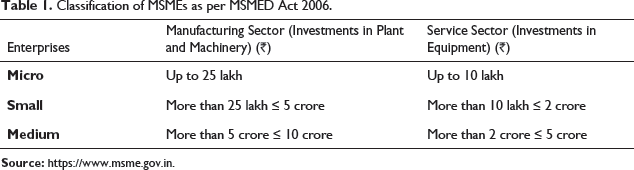
Classification of MSMEs as per Amendment of 1 June 2020.

Objectives
To examine the current prominence of MSMEs in Uttarakhand.
To identify the various issues faced by MSMEs in Uttarakhand.
To investigate COVID-19’s influence on MSMEs in Uttarakhand.
Research Methodology
The study is founded on existing literature, theories and concepts. An extensive literature review of different research papers, articles, and Government reports on MSMEs related to the problems, challenges and prospects of MSMEs especial reference to the state of Uttarakhand. The study takes into consideration the period of 10 financial years from 2012 to 2021. The study strives to gather knowledge about the issue faced by MSMEs in Uttarakhand and the assistance provided by the government to overcome the challenges of COVID-19.
Current Prominence of MSMEs in Uttarakhand
Uttarakhand is one of the provinces of northern India. The state has a total area of 53,483 sq. km and is divided into two regions, namely Garhwal and Kumaon, in addition to that the regions are further classified under 13 different districts. Uttarakhand province is a hilly area with a forest stretch of 34,662 sq. km which means that more than 64% of total area of the state is covered with biodiversity-rich forest. The present scenario depicts that the state lacks the infrastructural facilities such as decent transportation facilities, reliable internet connection and legitimate warehousing facilities (Gupta & Pathak, 2017) The geographical and infrastructural factors do not favour the establishment of large industrial plants, so the MSME sector plays a vital role in Uttarakhand’s production, investment and job creation. As per the MSME annual report of 2020–2021, there are approximately 4.17 lakh MSME units are operating in the state these include both registered and unregistered units with the investment of sum of amount ₹127.4357 crore focusing majorly on tourism and hospitality, food processing, horticulture, floriculture, natural fibre, pharmaceuticals, wellness and Ayush. The sector helps in mitigating the problem of migration by furnishing employment opportunities to large numbers of people, currently the sector (including both registered and unregistered) is providing employment to 6.60 lakh people in the state, this workforce comprises 5.91 lakh males and 0.69 lakh females.
District-wise Distribution of MSMEs in Uttarakhand.
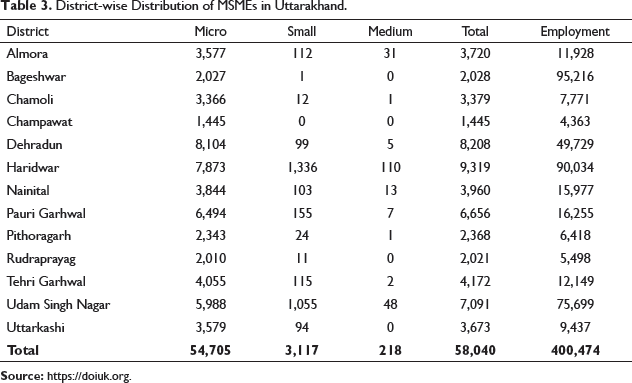
Figure 1 shows the total number of registered MSME units and the jobs they created over a 10-year period, from 2012 to 2021. During his term, a total of 24,894 MSME units were registered in the state, providing jobs for 141,841 people. During the tenure, micro-units play a dominant role, accounting for more than 91% of all registered units.
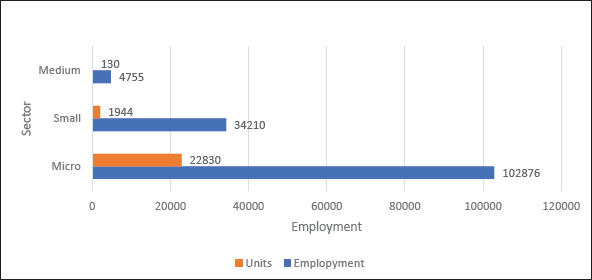
Figure 2 shows the year-by-year registration of MSME units that began in Uttarakhand from 2012 to 2021. The graph depicts the modest growth in MSME unit registrations over the first four years of 2012 to 2015. The financial year 2017–2018 had the most registrations, however the number of registrations has been steadily decreasing since then. This demonstrates the need for the sector to be supported.
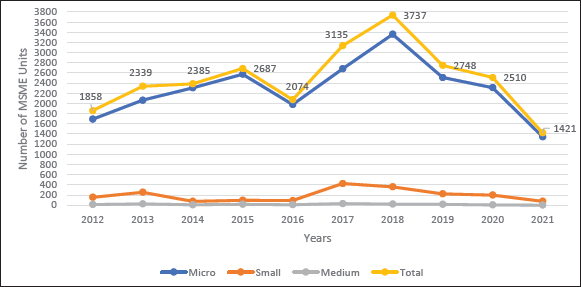
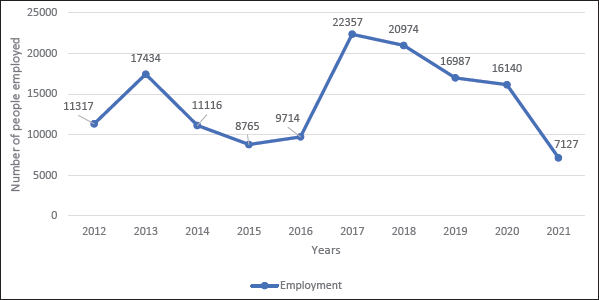
Figure 3 depicts the year-by-year employment generation by the MSME sector in Uttarakhand over the study period. In the first five years, the MSME sector generated a mixed trend in terms of job creation. The financial year 2017–2018 saw a surge in job creation, but since then, the MSME sector has seen a steady decline in job prospects.
Motivational Factors for MSMEs in Uttarakhand
Uttarakhand being a hilly state with large forest cover has a clean and pollution-free environment and vast land resources at reliable cost. The abundant and reliable water and power supply favour the MSME Units to operate smoothly. The availability of cheap semi-skilled labour and industry supportive law and order policies of the government creates a positive environment for MSMEs in Uttarakhand (Jain & Jain, 2012). Land rate rebates, electricity duty rebates, tax holidays and special incentives to women entrepreneurs are examples of support provided by the state government to MSME units. Religious tourism, adventure sports.
The MSME Ministry of India provides different financial and non-financial schemes for the prosperity and development of MSMEs. In addition to that, the state government also provides different schemes to the MSMEs operating within the state. The schemes of both central and state governments act as incentive for the incorporation, growth and development of MSMEs (Virk & Negi, 2019).
Major Schemes by Central Government
Prime Minister’s Employment Generation Programme (PMEGP)
This programme began in 2008 with the goal of increasing job possibilities and balancing regional growth. Beneficiaries can receive a government subsidy ranging from 15% to 35% of the project cost under this programme. Furthermore, up to a loan amount of ₹10 lakh, no collateral is required. Only new projects are considered under this scheme and for FY 2020–2021 funds of ₹1,650 crore were allotted for this scheme.
Credit Linked Capital Subsidy Scheme (CLCSS)
This scheme was launched in 2005 for small scale industry (SSI) units. The scheme focuses on facilitating technological up-gradation by providing 15% upfront capital subsidy on institutional credit up to ₹1 crore. The scheme is available for both existing as well as new MSMEs and an amount of ₹503.28 crore was allotted for this scheme during FY 2020–2021.
A Scheme for Promotion of Innovation, Rural Industry and Entrepreneurship
A Scheme for Promotion of Innovation, Rural Industry and Entrepreneurship (ASPIRE) was introduced in the year 2014 with the main objectives of creating new jobs, promoting entrepreneurship culture in India and promoting innovation among MSME sector. Under this scheme, various incubation sectors were established throughout the country. For the FY 2020–2021 funds ₹30 crore were allotted for this scheme.
Scheme of Fund for Regeneration of Traditional Industries (SFURTI)
The scheme was started in the year 2005. The scheme concentrates on providing sustainable employment by organising the traditional and artisans’ industry into clusters. The programme boosts traditional industry’s competitiveness while also ensuring its long-term viability. A sum of ₹464.85 crore was allotted for this scheme during FY 2020–2021.
Support for Entrepreneurial and Managerial Development Through Incubators
This scheme was launched in May 2019 with the main objective of promoting and supporting untapped creativity of individuals and to promote adoption of latest technologies. The scheme provides assistance u to ₹15 lakh for developing and nurturing ideas and assistance up to ₹1 crore for procurement and installation of plant and machinery. This initiative has authorised 62 proposals through December 2020, and a budget of ₹50 crore has been set aside for FY 2020–2021.
Major Schemes by State Government
Chief Minister Self-employment Scheme
This programme was launched in May 2020 with the primary goal of assisting young and aspiring entrepreneurs in Uttarakhand. The Scheme offers financial assistance to MSMEs up to ₹25 lakh for manufacturing and up to ₹10 lakh for service businesses.
Mahila Udhyami Vishesh Protsahan Yojna
This scheme was started in 2015 by the state government of Uttarakhand. The scheme promotes the culture of women entrepreneurship by providing a subsidy of 25% of the total fixed capital or ₹25 lakh maximum. This scheme also gives interest subsidies for the loans taken by women Entrepreneurs.
Purchase Preference Policy
The scheme launched in August 2019, under this scheme the government departments and public bodies will give preference to the item produced by MSME sector while purchasing goods or services for their consumption. This scheme promotes the quality production and competitiveness among MSMEs in the state.
Issues Faced by MSMEs in Uttarakhand
Despite the various favourable factors supporting the MSMEs in Uttarakhand, there are still various factors that hamper the operation of MSMEs in the state. In this section, these factors are classified under the following six categories.
Finance-related Problems
Finance is one of the most crucial elements of any business irrespective of size, nature and type of industry. All the business requires optimum amount of finance to start and operate the business activities smoothly. The requirement of finance varies among MSMEs but effective management of finance is the prime requirement of all of the enterprises. MSMEs in Uttarakhand are facing various financial problems. Most MSME units were self-financed by the owners who lacked the financial resources which resulted in low capital base. Raising funds in Uttarakhand is also a tremendous problem for MSMEs because of unavailability of credit, inadequate access to the monetary institutions, lack of banking facilities, difficulty in accessing the equity capital and high mortgage requirement (Sawan et al., 2015). Proper financial planning, proper capital budgeting and maintenance of optimum working capital level are some of the other financial challenges faced by MSMEs in Uttarakhand (Goel & Madan, 2021).
Market-related Problems
Market refers to the arrangements where the exchange of goods and services against money is done. The prime objective of business is to earn profit and survive in the competition which is only possible if the business can sell its goods and services in the market at the right price. Most of the MSMEs in Uttarakhand cater to the demand of the local market only. There are various market-related issues faced by MSMEs in Uttarakhand consisting of inadequate market support, tough competition from large business houses and internationally established brands, low market demand and problems in accessing the national and international markets (Shiralashetti, 2012). MSMEs in Uttarakhand are lacking the information about the market and are not aware of the national and global trends. All these act as barriers to the growth of MSMEs.
Human Resources-related Problems
Human resources refers to all the people working in an organisation. Proper utilisation of the human resources helps in getting the competitive edge over the competitors. MSMEs are considered as the labour incentive sector as it provides employment opportunities to a large number of people, but MSMEs in Uttarakhand are facing various challenges related to the human resources and its management (Patra & Chaubey, 2014). Lack of proper education, technical knowledge and experience create the problem of non-availability of skilled labour. The State also facing problems in providing proper training and skill development programmes to the people working in MSMEs. Lack of professionalism and managerial skill is some major issues faced by MSMEs in Uttarakhand.
Technology and Innovation-related Problems
Technology is that branch of knowledge that deals with the inception and adoption of technical means such as machines and equipment for operations which results in reduction of cost, time and efforts at the same time increasing the level of production and its quality. On the other hand, innovation deals with adoption and use of new ideas, methods or machines for different business activities. Both technology and innovation are directly proportional to the growth and development of MSMEs. The firms that adopt technology and are always ready to innovate have a competitive edge. MSMEs in Uttarakhand are facing challenges including problems in accessing the technology, inadequate technical knowledge, and lack of awareness and information. The sector also lacked the proper research and development works resulting in less innovation and modernisation of the sector (Ali & Hussain, 2014).
Socio-cultural-related Problems
Socio-cultural factors refer to all these forces available within the cultures and societies which affect the thought, feeling and behaviour of individuals living in the society. Socio-cultural factors have a direct impact on the growth and performance of MSMEs. Lack of family support and gender discrimination restrain women enter in the industry (Naithani et al., 2018). Lack of entrepreneurial knowledge, lack of proper guidance and lack of faith and confidence restrict an individual to start and operate their own business unit (Sharma & Madan, 2013). All these factors act as obstacles in the path of growth and development of MSMEs in Uttarakhand.
Other Problems
Apart from the above domain-specific problem, MSMEs in Uttarakhand were also facing many other challenges which create hurdles for smooth operations and growth of MSMEs. These issues include lack of raw material, high cost of material and other inputs, regulatory and taxation issues, low utilisation of installed capacity, and natural climatic constraints (Jaswal, 2014). All these issues result in slow growth of MSMEs in the state and because of these issues, many MSME units came to stand still and were unable to survive.
COVID-19 and MSME
COVID-19 pandemic was upsurge at the beginning of December 2019 and spread all around the globe. On 30 January 2020, the World Health Organization labelled the outbreak a Public Health Emergency of International Concern, and on 11 March 2020, it was declared a pandemic. Indian economy also suffered due to this pandemic and the government imposed the lockdown in the country from 24 March 2020. The COVID-19 Pandemic wreaked havoc on small enterprises across the country. The COVID-19 pandemic had an adverse influence on the MSME sector in Uttarakhand. The impact is evident from the fact that during the peak of the pandemic in financial year 2020–2021, only 1,421 MSME units were registered in the state and only 7,127 individuals were employed by the MSME sector. Both the number of units registered and the number of jobs created by the sector are at an all-time low for the research period. In comparison to the average employment creation and average registrations in the sector between 2012 and 2020, employment generation and registrations in FY 2020–2021 are 52.42% lower and 45.51% lower, respectively.
COVID-19 provokes a new set of problems in the MSME sector. The Indian government’s proclamation of lockdown has brought the economy to a halt. Slowing economic activity causes a variety of problems, including insufficient cash flow, lower market demand, raw material scarcity, labour concerns, and supply chain disruptions. According to the FICCI report, the COVID-19 epidemic has caused 73% of MSMEs to experience decreased orders and 60% of MSMEs to experience supply chain interruptions. Inadequate cash flow has an influence on all types of payments, including wages, salaries, interest, loan repayments, and taxes. During lockdown, several units cease operations, and even after the lockdown, the activities of MSMEs are severely harmed.
Government Assistance to MSMEs
Aatma Nirbhar Bharat Package
On 12 May 2020, Prime Minister Narendra Modi launched the initiative as a ₹20 lakh crore special economic package. The scheme was created to give all businesses, including MSMEs, with no-collateral loans and to subordinate MSMEs’ obligations. The package also recommended clearing government and central public sector firms’ payment dues to MSMEs within 45 days. Global tenders of up to ₹200 crore would not be allowed in government procurement contracts to shield Indian MSMEs from international competition. It was also proposed that the tax collected at source (TCS) be decreased by 25%.
Chief Minister Self-employment Scheme
This plan was started in May 2020 with the primary goal of assisting young and aspiring entrepreneurs in Uttarakhand. The Scheme offers financial assistance to MSMEs up to ₹25 lakh for manufacturing and ₹10 lakh for service businesses.
CHAMPIONS Portal
CHAMPIONS is an acronym that stands for the creation and harmonious use of contemporary procedures to increase output and national strength. On 9 May 2020, the Ministry of MSME launched it. The portal’s main purpose was to help MSMEs with money, raw materials, labour, and permissions during the difficult COVID-19 time, among other things. As a result of the platform, MSMEs have been able to seize new prospects. In just five weeks, the platform had handled more than 50,000 complaints from small businesses.
Fund of Funds Scheme
Finance Minister Nirmala Sitharaman announced the Fund of Funds Scheme. The scheme’s main goal is to provide MSMEs with ₹50,000 in equity. The scheme was created to meet the needs of the country’s 25 lakh MSMEs. The scheme’s total value was ₹10,000 crore. The programme’s purpose was to assist MSMEs with their viability and growth potential during a period when they were suffering from a severe lack of equity and revenue.
Discussion
The MSME sector is one of India’s most vigorous economic players. Around 29% of India’s GDP and 49.5% of its exports are generated by the sector. As per MSME annual report 2020–2021, there are currently 4.17 lakh MSME units are operating in the state of Uttarakhand. These units are providing employment to more than 6.60 lakh people in the state. The unregistered sector is more dominant as only 14% of total MSMEs are registered in the state. The MSMEs play a vital role in generating employment, promoting entrepreneurial culture and developing the state. The sector also helps in mitigating the major problem of migration and underutilisation of natural resources in the state. The state has several favourable factors for installation and smooth operation of MSME units such as land rate rebates, electricity rebates, funding schemes, and other government incentives. Despite being one of the major players, the MSME sector is still facing various issues related to financing, marketing of products, technology and innovation, socio-cultural issues and human resources development issues. COVID-19 has had a significant impact on the operations and functioning of MSMEs in Uttarakhand. The MSME sector faces a new set of issues as a result of COVID-19. Lockdown imposes poor marketing demand, unavailability of raw materials, labour difficulties, supply chain disruptions, and insufficient financial flow. The central and state government is dispensing due importance to this sector. Various financial and non-financial incentives are provided by the government at both national and state levels. Women’s participation in the MSME sector has been secured through the development and implementation of special programmes. Youth were also encouraged to participate actively in entrepreneurship through a variety of programmes. To lessen the impact of COVID-19 on the MSMEs sector, the government has offered a number of financial packages at both the national and state levels. Various strategies were developed to aid the growth and development of the MSME sector during the difficult period of COVID-19.
Conclusion
Uttarakhand is giving vital resources to help MSMEs in the state operate and function smoothly. The state’s MSMEs industry continues to flourish as a result of the favourable environment. The government is funding the incorporation and operation of MSME units, as well as other training and incubation centres, to promote entrepreneurship in the state, but there is still a lot of work to be done. Regular surveillance is required in this sector so that appropriate policies may be developed to address the issues that MSMEs encounter. This issue should also be examined because the industry lacks research and development work in the state. COVID-19 has had a significant influence on the performance of the MSMEs sector at the state and national levels, but the impact is so severe that it will take time for the sector to recover. If significant effort is done for the sector, it will undoubtedly aid the state’s overall growth and development.
Footnotes
Declaration of Conflicting Interests
Funding
The authors received no financial support for the research, authorship and/or publication of this article.