




Abstract
Artificial intelligence (AI) and emotional intelligence (EI) are primary game changers in Industry 4.0. To ensure growth, organisations look to technological advances for support but should remain focused on developing people and resources that power organisations and drive it forward. This study attempts to combine these two concepts. This research investigates the impact of EI and AI on employee performance with focus on the Indian service industry. The data was collected from different service industry employees. Employee performance has been observed through internal and external services provided to customers and co-workers, respectively. Descriptive statistics and PROCESS macro were used to test the mediation (Model 4) and moderation model (Model 1). Both EI and AI significantly impact employee performance. All the bivariate correlations were significant at the 0.01 level. Correlations between the dimensions of EI and dimensions of employee performance were higher as compared to dimensions of AI and employee performance.
To conclude, EI has a major impact on employee performance, while AI moderates the relationship between EI and employee performance.
Introduction
Over the past two decades, the literature has seen a rise in the popularity of both emotional intelligence (EI) as a form of human intelligence and artificial intelligence (AI) as machine intelligence. As a personal intelligence, EI has been an inspiring word in the service industry for personal and organisational success. Though this is a trendy topic, debates over its theories, methods and applications are ongoing among researchers. An individual with a high EI level frequently experiences greater success in their personal, social and professional lives. EI is crucial for businesses and those who operate in customer-facing fields (Yao et al., 2019). High EI leads to better relations at the workplace. EI has the capacity to significantly impact work environments. Many studies have linked EI to the creation of strong ties and interpersonal relationships between employees, and empirical evidence has proven a favourable association between EI and the sustainability of a company’s business operations (Clarke, 2010).
AI, often known as machine intelligence, refers to the intelligence displayed by systems as opposed to that displayed by people. A system of intelligent agent machines that are able to observe their surroundings and use that information to achieve their goals is how AI is portrayed. Over the past few decades, AI has grown significantly, and experts have worked hard to improve its concepts. The work resulted in several significant innovations, including big data analytics and machine learning applications in a wide variety of sectors and contexts. AI has the potential to provide significant financial profit for enterprises, notably in service industries including banking, human resources recruiting, healthcare units, tourism units and the hotel industry (Kim, 2011; Wirtz et al., 2018; Yu & Schwartz, 2006) AI improves client experience by providing customised services, while simultaneously increasing operational efficiency by automating repetitive operations (Bolton et al., 2018). AI is being utilised in service organisations to automate tasks that were previously done by service professionals and boosts the level of service in technical and managerial areas through the implementation of Chatbots and messaging. AI is one of the main game changers because it facilitates decision-making and streamlines several processes, which helps organisations compete in the market. The business is now concerned about how AI might affect people’s lives and the most recent advances influencing the workplace. Automated systems that mimic intelligence from humans are being utilised more frequently in services and are quickly becoming a major source of original thinking and research. For instance, to make our lives easier, robots have automated many aspects of our daily lives in our homes, hospitals, hotels and restaurants, including cooking and cleaning. Big data AI apps are being used to replace portfolio management, and virtual bots are being used to automate customer service. The fourth industrial revolution is characterised by the blurring of the boundaries between the physical, digital and biological worlds as a result of technological advancements (Schwab, 2017). Although AI recognises its presence and effect on improved corporate efficiency, there is also rising concern about replacing human employment (Larivière et al., 2017). An investigation by McKinsey in 2017 estimated a 5% loss of jobs as a result of AI. According to an Oxford University research, by 2033, 47% of jobs would be automated. However, multiple studies have found that low-skilled jobs are the only ones where AI can be dominant. While it is anticipated that AI and robotics will be able to carry out high-level tasks such as investigation and technology; they are just a small part of providing high-level services. According to Huang and Rust (2014), AI, which is represented by computers that display elements of human intellect (HI), is a primary driver of innovation in today’s society. For instance, robots for our homes, healthcare, hospitality and restaurants have automated many aspects of our lives. Virtual bots also transform customer service into self-service, portfolio managers are replaced by big data AI applications (Javelosa, 2017), and social robots like Pepper are used to welcome clients in customer-facing services (Choudhury, 2016). Due to these advancements, some claim that the fourth industrial revolution has begun, during which technology is obliterating the distinction between the physical, digital and biological domains.
Despite becoming a significant driver of innovation, AI also poses a danger to the jobs in service industry. A significant transition from production to the service sectors has already occurred as a result of severe job losses in the manufacturing sector.
So, are the service occupations exempt from this replacement? Which intelligence is more important in better customer service? Most studies have been focused on EI and AI as an individual factor in employee performance. While both EI and AI play a key role in customer service, as per literature, no research has yet examined how the two factors in combination affect performance from the perspective of workers in the service sector. Understanding the connection between AI and EI has the potential to improve results connected to organisations because both AI and EI have an impact on employees and/or consumers. This study aims to shed new light on the impact of EI and AI in combination on employees’ internal and external performance, with a focus on the service industry.
Literature Review
Emotional Intelligence
EI is the capacity to recognise, express, comprehend, manage and utilise emotions (Mayer & Salovey, 1997). The last three decades, however, have seen the emergence of two additional, conceptually distinct forms of EI (popularly referred to as ‘trait EI’ and ‘mixed-model EI’), as well as a plethora of psychometric tools for measuring these forms. Unless an individual can process emotional cues at the most basic level, it is unlikely that he or she will be able to manage emotions at a higher level. The research demonstrates that those with high EI levels are more successful in their careers and make more effective leaders (George, 2000; Gupta & Bajaj, 2017). Developing EI is essential for living a fulfilling and happy life. It is possible to apply standards of intelligence to emotional responses and recognise that these responses may be rationally compatible or inconsistent with particular views about emotion using the framework of EI. Professionals in the front lines of the service sector, in particular, need a high degree of EI. Increased EI and successful employee–customer contact are advantages for service industry workers. Even interpersonal and intrapersonal abilities and EI have been related in the service industry. The study’s conclusions indicate that emotional tiredness is linked to psychological suffering and work dissatisfaction (Lee & Ok, 2012). Emotionally intelligent individuals are more likely to manage, understand and control their own emotions as well as those of others. These individuals should have a good understanding of the emotional parameters that influence the work process and the quality of the service. When it comes to job satisfaction, EI has a positive correlation since it influences one’s ability to successfully cope with environmental demands and pressures, which allows one to manage difficult working situations (also known as emotional labour). EI has been linked to job satisfaction. In addition, job happiness and dedication have been found to be critical indicators of long-term employee satisfaction (D’Amato & Herzfeldt, 2008; Saari & Judge, 2004). Many studies have been conducted to determine the utility of EI in predicting work performance, and the results have been promising (Cote & Miners, 2006). Internal service performance (also known as job efficiency with co-workers) is highly influenced by an employee’s EI (Clarke, 2010; Mayer & Salovey, 1997) in positions that need teamwork. This is because emotionally intelligent people possess stronger interpersonal skills, which are necessary for group work. Accordingly, the following hypothesis is formulated:
H1. EI is positively related to employee performance.
Artificial Intelligence
‘Artificial intelligence is a computer program designed to acquire information in a way similar to the human brain.’ According to Elon Musk, a machine will be smarter than humans by the year 2040. Cognition and learning (based on historical data) are used to influence future decisions by a subset of analytic AI. AI that draws inspiration from humans is capable of both cognitive intelligence and EI. This AI system can comprehend and take into account human emotions while making decisions. AI that draws inspiration from humans is becoming more and more common (Kaplan & Haenlein, 2019). As an example, Walmart identified unsatisfied customers waiting at checkouts using facial recognition algorithms (i.e., AI inspired by humans) (e.g., opening new cashiers). Cognitive, emotional and social intelligence are all required in a humanised AI system, as well as the ability to be conscious of one’s relationships with others. This AI system, on the other hand, has not yet been put into action. A wide range of service sectors has made use of AI capabilities. For example, Amazon uses analytical AI to help with retail inventory management at museums, AI-assisted robot tour guides are being employed to increase visitor numbers (Burgard et al., 1999). AI with analytic capabilities can help with candidate screening and selection in HR management. Customers’ service is routinely improved with the help of AI, (Bolton et al., 2018). AI has also been implemented in customer care centres to boost consumer happiness (Kirkpatrick, 2017). Even though AI is widely used in business, its role in organisations differs depending on the nature and complexity of the vocations. Routine and low-level jobs are typically automated using AI. Emotional-social jobs that are difficult for robots to do will be handled by humans and AI can assist humans to perform well. Employees in the service industry have occupations that are considered emotionally and socially complex because they must maintain interpersonal connections with customers (Ashkanasy & Daus, 2005; Sjoberg et al., 2005).
AI can be operationalised along a range of dimensions that indicate the quality of information and systems, including dependability, reliability, adaptability, accessibility and timeliness. Employees can benefit from AI by better understanding client needs (for example, through the use of language translators), examining the company’s knowledge management systems and offering human-friendly responses (Kirkpatrick, 2017). When it comes to charge adjustments and conflicting schedules, AI can help. Serbanescu and Necsulescu (2013) concluded how analytical AI can boost the travel industry’s productivity and efficiency. Workers are more productive, which could have an impact on their satisfaction and career prospects. This discussion leads to the following hypotheses:
H2: AI mediates the relations of EI with employee performance.
H3: AI moderates the relationship between EI and employee performance.
Theoretical Framework
This article is based on the theoretical underpinnings of AI job replacement theory. According to Haug and Rust (2018), AI job replacement theory is ‘a theory of four intelligences’. The key principles of the theory are four types of intelligence required to perform service tasks. These four intelligences are mechanical, analytical, intuitive and emphatic intelligence.
Mechanical intelligence: The ability to carry out repetitive, routine actions automatically is known as mechanical intelligence. Because mechanical methods have been used repeatedly and can be completed with little to no additional thought, they do not demand much originality from humans. Mechanical work is unskilled work in the human services sector, often requiring no formal education or training. Taxi drivers, call centre workers, retail salespeople, waiters and waitresses are a few professions that mostly demand mechanical aptitude.
Analytical intelligence: The capacity to analyse data in order to solve problems and gain knowledge from it is known as analytical intelligence. Information processing, logical thinking and mathematical abilities are involved. These challenging skills are acquired through training, experience and specialisation in cognitive thinking; for instance, analytical skills are heavily utilised by those working in the computer and technology industries, as well as by mathematicians, data scientists, financial analysts accountants, auto mechanics and engineers.
Intuitive intelligence: The capacity to think imaginatively and respond skilfully to unfamiliar situations is known as intuitive intelligence. Based on integrative and experience-based thinking, it might be regarded as wisdom. Marketing managers, management consultants, doctors and sales managers are just a few professions that heavily rely on intuitive intelligence for their hard-working professional skills that need insights and innovative problem-solving.
Empathetic intelligence: Empathetic intelligence is the capacity to identify and comprehend the feelings of others, express them correctly and to exert emotional impact on others (Goleman, 1998). It encompasses social, interpersonal and people skills that allow people to understand others’ emotions and get along with others.
Method
Sample
To study the role of EI and AI in employee performance, the study was undertaken among the employees of different service industries in India. Service industries such as IT, finance, healthcare and telecommunication use different AI tools in their day-to-day activities and providing better service. These tools help them to provide different information which helps these organisations to serve better. The data were collected from different levels of employees in the service industry who are directly in contact with customers and using different AI tools.
Instruments
A five-point Likert scale, with 1 denoting strongly disagree and 5 denoting strongly agree, is the basis for all of the items used in this study to examine the various variables.
Emotional intelligence: To assess EI, the self-report EI measure (WEIS) created by Law et al. (2004) was used. There are a number of EI assessment tools available in the literature; WEIS was selected since it is widely used and cited and is based on the four ability dimensions described in the ability EI model (Brackett & Mayer, 2003). Additionally, cross-validation has demonstrated the high validity and reliability of WEIS. The original WEIS contains 16 elements (statements) and 4 dimensions. The four dimensions (ROE) are self-emotion appraisal, other-emotion evaluation, emotion’s use (UOE) and regulation of emotions. The study’s Cronbach alpha value was 0.85.
Employee performance: To evaluate the performance of employees, both internal and external service performances were focused. An external service which is based on customer-oriented behaviours during service interactions with customers and internal service performance, which is focused on work behaviours with co-workers over internal encounters and required activities within the organisation, were used. Items from O’Reilly and Chatman (1986) that were modified to reflect internal service performance were used to gauge each employee’s overall job performance within the company. The employee performance scale’s Cronbach alpha scores for this study was 0.89. External service performance items were derived from Hallowell (1996) for staff service that is especially directed at customer satisfaction. These items demonstrate that the staff provides consistent, dependable, fast and tailored service.
Artificial intelligence: Wixom and Todd’s assessment of employee perceptions of AI was adapted for this study (2005) to collect data regarding the use of AI. Comprehensiveness, format, accuracy, currency, reliability, accessibility, adaptability, integrity and timeliness are all aspects of this metric. There are three objects in each dimension. Statements like ‘AI tools give me with a complete collection of information’ were among the items used to assess comprehensiveness. Items like ‘The information produced by AI tools is well prepared’ were incorporated in the dimension format. The dimension accuracy includes items like ‘AI tools produce correct information’. The Cronbach alpha value for the AI scale was 0.89.
Data Collection Procedure
The researchers had a thorough discussion with some of the expert employees of the service industry who are using AI tools in their organisations. For content validity, a pilot study was conducted on 25 employees by sharing the questionnaire and asking them to give feedback. After the pilot study, the questionnaire was updated as per the feedback of participants to make terms clearer. 150 employees from the service industry were contacted to fill out the questionnaire only 132 responses were found to be relevant.
Statistical Analysis
To analyse the data, IBM SPSS software was used. The PROCESS macro was used to test the mediation model (Model 4) and the moderation model (Model 1). The indirect impacts were investigated using bias-corrected data. 95% confidence intervals (CI) for bootstrapping (n = 5,000) indicators. When a 95% bootstrapped CI does not include 0, it denotes a statistically significant parameter.
Data Analysis and Results
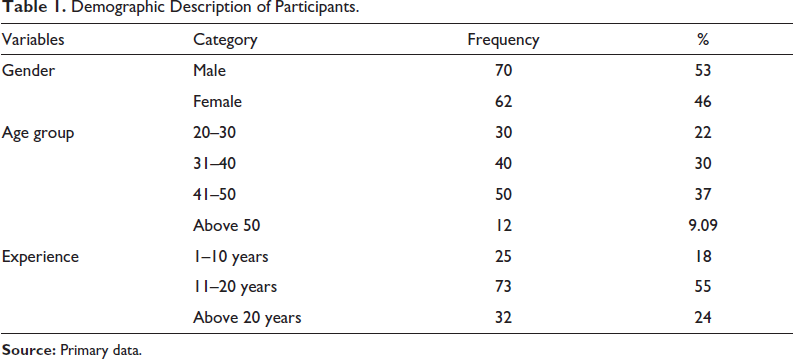
Table 1 presents the demographic data from the respondents. Out of 131 participants, 70 (53%) were men and 62 (46%) were women. The participants were between the ages of 20 and 50. Approximately 22% of people were in the 20–30 age range, 30% in the 31–40 range, 37% in the 41–50 range and 9.09% were beyond 50. Out of 132 participants, 18% had experience of 1 to 10 years, 55% had experience of 11 to 20 years and 24% had experience of 20 years or more.
Demographic Description of Participants.
Descriptive Statistics
To study the relation, means and standard deviation between all the study variables, the Pearson correlation was calculated. According to Table 2, p value shows that EI is positively related to employee performance (r = 0.70). So, hypothesis H1 was proved. employee performance was positively correlated with AI (r = 0.52), and AI was positively related with EI (r = 0.50). All the bivariate correlations were significant at 0.01 levels. Correlations between the dimensions of EI and dimensions of employee performance were higher as compared to dimensions of AI and employee performance.
Descriptive Statistics and Correlation of the Study Variables.
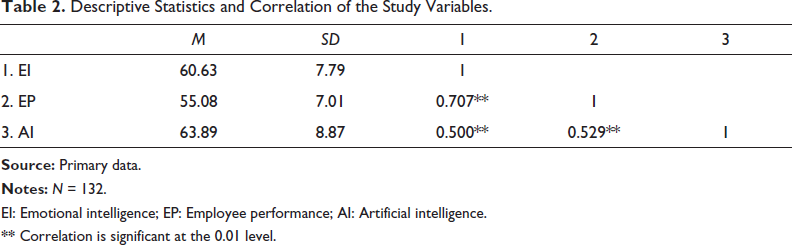
EI: Emotional intelligence; EP: Employee performance; AI: Artificial intelligence.
** Correlation is significant at the 0.01 level.
Table 2 shows the results of testing hypothesis H2 providing the value of the direct and indirect effect of EI on EP and the effect of EI on EP through AI. The direct and indirect effects are considered significant when 0 falls out of the CI
Mediation Analysis of AI Between EI and EP
Direct effect of EI(X) on EP(Y): Table 3 shows the effect, p value and 95% bias-corrected bootstrap CI for a direct effect of EI on EP (C11 = 0.5307 with a p = less than .001). A 95% bias-corrected bootstrap CI is entirely above zero (0.4074–0.6539) in Table 3 the zero does not lie between both the CI, so the relationship between the independent and dependent variables is statistically significant. Therefore, it can be concluded that employees with high EI can perform better.
Direct Effect of EI (X) on Employee Performance (Y).

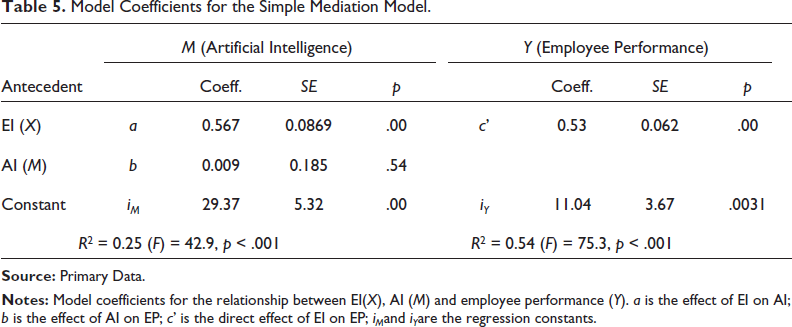
A mediator variable M changes the link between the antecedent variable X and the outcome variable Y in a simple mediation model. Table 4 (employee performance consequent) provides a basic mediation model (PROCESS Model 4) for the employee EI– performance link through AI. On each path, the model coefficients are indicated. Both a and b regression coefficients are positive, implying that individuals with a higher EI are expected to have a higher company performance. The indirect effect of X on Y through M is the product of these two coefficients a and b. Accordingly, ab (0.63) represents the impact of EI on employee performance through AI.
Indirect Effect of AI on EI–Employee Performance Relationship.
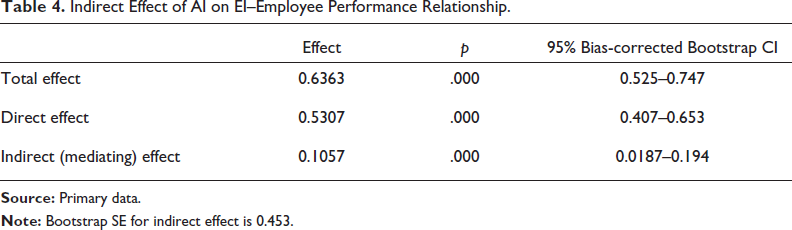
Table 4, for inference about the indirect effect in mediation analysis, the bias-adjusted bootstrap CI has become the more generally suggested method. The indirect effect of AI on the EI and employee performance connection is given in Table 4 with a 95% bias-adjusted bootstrap CI.
In Table 4, a 95% bias-corrected bootstrap confidence range of 0.0187 to 0.194 for employee performance is totally above zero. As a result, the mediation impact of AI on the connection between EI and employee performance is substantiated.
Table 5 shows the calculated regression coefficients and standard errors, p values, R2 and model summary information for the basic mediation model. With R2 ranging from 0.25 to 0.54 (p = .000), each of the two conditional process models indicated that both the models were statistically significant. EI (0.567, p = .001) and AI (0.426, p = .05) had substantial regression coefficients on employee performance.
Model Coefficients for the Simple Mediation Model.
Moderation Analysis of Artificial Intelligence
Hypothesis H3 was tested by estimating a simple moderation effect by PROCESS macro Model 1 (Hayes, 2013).
Table 6 shows the statistically significant relation between EI and employee performance as p value is < .001. The model is significant according to the model summary where r2 = 0.572, F = (56.6) and p = .000. So, EI is a significant predictor of employee performance.
Model Coefficients for Simple Moderation.
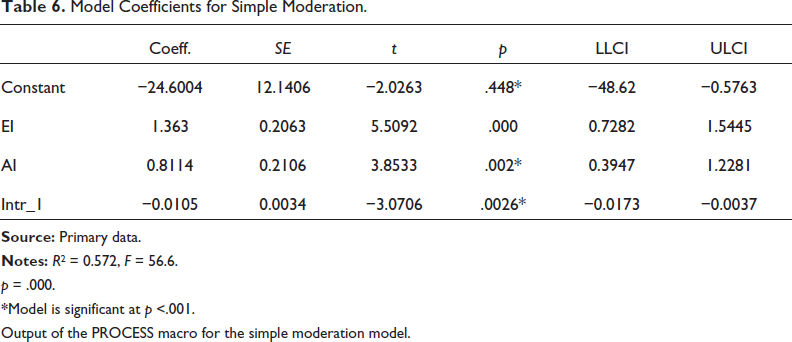
p = .000.
*Model is significant at p <.001.
Output of the PROCESS macro for the simple moderation model.
In Table 6, the output for moderation is given. To check whether the interaction effect between the independent and moderator variables is significant, we check that LLCI and ULCI values do not contain zero. As per the value of LLCI (−0.0173) and ULCI (−0.0037), both values are negative, so zero does not lie in this value. As the p value of the interaction (Int_1) between the variable X(EI) and variable M(AI) is 0.00, both the conditions say that there is statistical evidence of moderation in the relation between X and M.
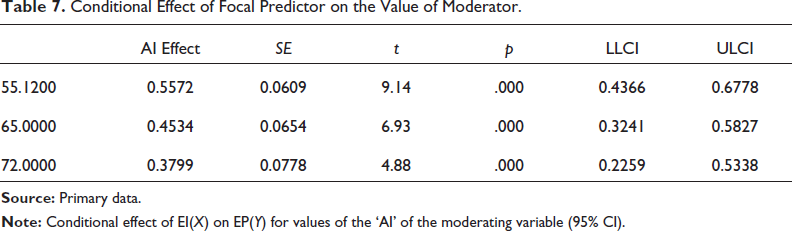
Table 7 shows the result of the conditional effect of the focal predictor on the value of the moderator. According to the value shown in Table 6, zero does not lie between the value of ULCI and LLCI in all three conditions. In the case of the least presence of the moderator, the ULCI (0.4366)–LLCI (0.6778) means both values are positive. In the second case, the average presence of the moderator is the value of ULCI (0.3241) –LLCI (0.5841). In the last case, the full presence of the moderator is the value of ULCI (0.2259)–LLCI (0.5338). In all three conditions, the moderation effect is present. Hence, hypothesis H3 is statistically significant and proved that AI moderates the relation between EI and employee performance.
Conditional Effect of Focal Predictor on the Value of Moderator.
Discussion
The current study was prompted by debates over AI’s role in replacing human jobs. The result of this empirical study revealed that both the AI and EI in combination affect internal and external service performance. The findings show that EI is a significant predictor of employee performance and AI plays a mediating and moderating role in the relationship between EI and employee performance. The study results are generally supported by the AI job replacement theory, which says that EI and AI play a significant role in the service industry (Haung & Rust, 2018). These days, AI is increasingly being used in the service sector, and for better customer service, EI is very essential (e.g., Larivière et al., 2017; Prentice et al., 2013). Acknowledging, managing and understanding your and others’ emotions are very crucial when working with customers (Coetzee & Harry, 2014; Fitness, 2001; Law et al., 2008; Sony & Mekoth, 2016).
Emotional Intelligence and Employee Performance
Different researchers acknowledged EI as a valid predictor of job satisfaction. This study provided proof that a significant portion of an employee’s internal and external performance is related to their EI. Despite the widespread use of cutting-edge technology, emotions continue to be a major factor in customer service and interaction (Larivière et al., 2017). The study’s findings are consistent with past studies showing that employees with high levels of EI can manage clients and provide a great customer experience, which influences how well-trained staff performs in providing services to consumers and how satisfied they are with their jobs. Studies (Nasution & Mavondo, 2008; Wu & Liang, 2009; Xiang et al., 2015) have shown that client experience is for the most part ascribed to employee service providing. Employees who are emotionally charged can manage their customers’ issues and problems more wisely (Nasution & Mavondo, 2008; Wu & Liang, 2009; Xiang et al., 2015). Customer satisfaction, on the other hand, is affected by employee external service performance. The results of the study support the findings that employees who are good at managing their emotions, transforming negative feelings into more positive feelings and then reinforcing positive feelings can provide better service. For example, an effective service recovery technique is to provide more than expected service to a disgruntled client or to fix concerns promptly. This is consistent with findings by Xu and Li (2016), Ogbeide et al. (2015) and Wu et al. (2018). Because service industries rely more on contextual awareness and spontaneous interactive communication, service jobs—even low-skilled ones—have historically been thought to be more difficult to automate. Customer service is fundamentally about establishing sincere, trustworthy relationships. High EI allows customer service representatives to connect with clients, handle disputes, show empathy and control their stress levels.
Artificial Intelligence and Employee Performance
AI and employee performance are positively correlated. Additionally, AI has a favourable moderating impact on customer satisfaction (external service performance) and work effectiveness (internal service). According to this study, AI helps workers perform better by acting as a performance buffer. Employees with higher levels of EI typically perform better when AI is rated poorly. Employees who scored good on AI but poor on EI did no better at work than those who did well on AI but poorly on EI. These results support the assertions made by Bowen (2016), Larivière et al. (2017), McKendrick (2018) and Mohanty (2018) that AI will not likely take the place of humans in the workforce. However, embedded services powered by AI help them function better when EI is high. According to the Gartner Reports, AI actually creates more employment than it eliminates and the degree of replacement of AI depends upon the type of work.
Conclusion
Both machine intelligence and human intelligence have a great influence on employees, especially in people-oriented businesses. The key findings of this study are the link between EI and the performance of employees, where AI acts as a moderator. Employees’ EI has long been thought to be an indicator of attitudes and behaviours (such as job performance, organisational commitment and employee retention), and the study supports this argument. Employee EI has long been recognised as a reliable predictor of employee attitudes and behaviours (e.g., job performance, organisational commitment and employee retention), and the results of this study back up these claims in the service industry. This study mainly highlights the respective and integrated impacts of different types of intelligence on organisational success through employee behaviour from a research point (performance). This study, in particular, broadens the area of loyalty of customers by connecting EI and customer service, which may affect the attitude and behaviour of customers. The findings shed light on how machine intelligence influences employee behaviour and corporate effectiveness.
Implications
The findings have implications for practitioners in different service industries. The findings provide direction to EI and AI experts in the industry on what should be prioritised to improve organisational performance by managing employee and consumer behaviour. Although AI is improving corporate operations, human intelligence is still the most important factor in managing staff performance and consumers. Because customers want to talk to employees as compared to machines and the considerable impact that EI has on employees and customers, organisational resources should be utilised to give training to improve employees’ emotional competence, as it is acknowledged that successful EI can be learned (Schutte et al., 2013). EI training not only enhances employee performance but may also reduce the negative consequences of emotional labour on employees (see Prentice et al., 2013). These characteristics suggest that EI should be factored into the hiring process as well.
Limitations and Future Research
The researchers made every endeavour to ensure the rigorousness of this study. However, collecting data on employees from different service organisations was not an easy task. The number of employees varies in various service organisations. Comparing the results across different service industries may be made easier by using a similar percentage of personnel from each organisation. Employees also appraised the customer service they received, but dyadic ratings—those based on encounters between one customer and one employee—might offer more useful information. To understand customers’ perspectives and experiences with services provided by humans and/or AI, the research could also be conducted from their point of view.
Footnotes
Declaration of Conflicting Interests
The authors declared no potential conflicts of interest with respect to the research, authorship and/or publication of this article.
Funding
The authors received no financial support for the research, authorship and/or publication of this article.