



Abstract
This article examines how different configurations of regional integration into global production networks (GPNs) shape the capacity of local and regional institutions to support circular economy (CE) initiatives. We present a theoretical framework that connects GPN theory with regional processes and CE territorialization. This framework focuses on how key GPN characteristics—cost–capability ratios, governance structures, and product materialities—condition the ability of institutions to foster regional circular transitions through processes of strategic decoupling and territorial circular recoupling in specific industries. Empirically, we draw on a comparative case study of the construction and textile industries in South-West France. Our findings show that in the construction sector, the regionally embedded structure of production networks facilitated circular territorial recoupling: local institutions leveraged geographical and organizational proximity to coordinate actors and overcome logistical constraints. In contrast, the textile sector’s highly globalized configuration strongly constrained local institutions’ enabling capacities. Fragmented material flows, global sourcing, and unfavourable local cost structures created significant barriers to territorializing circularity in the absence of broader regulatory support. These results highlight that circular transitions depend not only on local initiatives, but also on the spatial and organizational configuration of GPNs. In regionally embedded production networks like construction, local institutions can play a strong enabling role in promoting strategic decoupling and circular territorial recoupling. In globalized networks like textiles, advancing CE requires stronger multi-level regulatory frameworks and coordination to rebalance cost–capability structures and support new circular pathways.
Keywords
Introduction
Public policy efforts to enhance business sustainability are increasingly integrating the need to transition to a “circular economy” (CE) (Giraldo Nohra et al., 2020; Milios, 2018). The CE refers to an economic model aimed at minimizing waste and resource use by keeping materials, products, and components in use for as long as possible through reuse, repair, remanufacturing, and recycling. A broad set of policies across different levels has been implemented to advance this concept (Fitch-Roy et al., 2021). In particular, the local scale has been shown to play a crucial role in the shift to circularity, as the territorialization of the CE can foster resource-efficient systems that reduce waste, minimize environmental impact, and enhance local economic resilience (Bourdin et al., 2022; Chembessi et al., 2024). In this context, local and regional institutions—understood not only as public authorities but as territorially embedded networks of actors, norms, and organizational structures—play a crucial role in shaping the conditions for CE initiatives (Henrysson and Nuur, 2021). By structuring economic behaviour, fostering coordination, and legitimizing new practices, they can act as facilitators of circular transitions, providing regulatory frameworks, incentives, and support systems that help anchor CE practices at the territorial level (Arauzo-Carod et al., 2022; Chembessi et al., 2024; Christensen, 2021).
Yet, the capacity of institutions to support CE transitions is not determined by local dynamics alone, but also by whether and how local economic activity is embedded within global production structures. Indeed, regions exhibit varying degrees of integration within global production networks (GPNs) (Horner, 2014), which may consequently affect their capacity to territorialize the CE. In turn, GPNs vary significantly in terms of their geography, governance structures, and the degree to which they are embedded within regional and/or global linkages (Yeung and Coe, 2015). Economic geographers have thus conceptualized GPNs as dynamic, complex networks of interconnected functions, operations, and transactions through which products and services are globally produced, distributed, and consumed (Coe et al., 2008). This framework extends beyond firm-centric views, incorporating non-firm actors such as states, civil society organizations, and consumers (Coe and Yeung, 2019). Within this approach, the concept of “coupling” is key in understanding GPN dynamics. This describes how regional assets—such as labour, resources, and institutions—connect to GPNs (Horner, 2014). While regional actors can drive local development by supporting “strategic” coupling, integration into GPNs also imposes constraints, creating challenges for sustainability transitions, including circularity (Coe and Gibson, 2023).
In this article, we examine whether and how the degree of regional integration of specific industries within GPNs shapes the capacity of local and regional institutions to support circular practices. While GPN integration is recognized as a key determinant of economic outcomes at the territorial level (Horner, 2014), there is still limited understanding of how it may influence the effectiveness of institutional efforts to foster circularity across different sectors. To address this gap, we propose an analytical framework that combines insights from GPN theory with recent debates on CE territorialization. This framework serves as a heuristic device to examine how specific configurations of industry-specific GPNs shape the institutional conditions for circularity at the local and regional levels.
Building on this framework, this article addresses the following research question: How do varying modes of regional integration into Global Production Networks shape the capacity of local and regional institutions to support and advance CE initiatives in specific industries?
To explore this question empirically, we conducted a comparative analysis of CE dynamics in the textile and construction industries in South-West France. While much of the GPN literature has emphasized firm-level dynamics, we follow recent suggestions to pursue “industry-level [GPN] analyses that can offer realistic appraisals of the progress towards decarbonisation” (Coe and Gibson, 2023). We thus focused on industry-specific GPNs to examine how sectoral characteristics influence the potential for CE territorialization in construction and textiles. Both sectors have significant negative environmental impacts (UNEP, 2020, 2023) and have been among the early targets for CE policies and initiatives (Diemer et al., 2022; Real et al., 2020).
Our findings reveal that the characteristics of industry-specific GPNs significantly influence the capacity of local and regional institutions to foster CE initiatives. Specifically, the structure of the regionally embedded GPN linkages reflects both the network’s underlying coordination dynamics and the physical and technical characteristics of the products involved. These factors create both constraints and opportunities for territorializing firms’ sourcing and production activities, and establishing regional CE loops. In the construction industry, the territorially embedded characteristics of production networks enhances the ability of local and regional institutions to play an enabling role. In contrast, the textile industry’s highly globalized production network and cost structure impose significant constraints on the capacity of local institutions to support CE dynamics. These findings highlight that different modes of regional integration into GPNs shape the institutional and structural conditions under which circular regional networks can emerge.
The remainder of the article is structured as follows. We begin by reviewing existing research on the enabling role of local institutions in CE transitions and the ways in which modes of regional integration into GPNs shape opportunities and constraints for circularity. Building on these insights, we develop a theoretical framework that links GPN configurations to CE territorialization processes. We then present our research methodology and empirical materials, followed by the main findings. The article concludes with a discussion of policy implications and research limitations.
Local institutions, GPN integration, and the CE
Local and regional institutions as key enablers of the CE
The transition from a linear economy based on extraction, production and disposal to a CE leveraging the principles of reduction, reuse, and recycling represents a significant paradigm shift for business. The literature on CE emphasizes the need for firms to change their business models to integrate these principles, promoting resource efficiency (Geissdoerfer et al., 2020; Kirchherr et al., 2017). Circularity implies that firms rethink their value propositions, value creation processes, and delivery mechanisms to minimize waste and maximize resource efficiency (Bocken et al., 2016; Geissdoerfer et al., 2023). These shifts toward more circular business models (CBMs) often lead to reconfigured sourcing strategies and supply chains (Neessen et al., 2021; Qazi and Appolloni, 2022), with significant spatial implications (Lessard et al., 2021).
In this context, existing studies have shown that local institutions—defined as territorially embedded networks of actors, norms, and organizations—can play a key role in facilitating the development of efficient, territorialized CE loops (Henrysson and Nuur, 2021). For instance, local authorities and intermediary actors have supported the implementation of CE by organizing local waste management systems (Vanhamäki et al., 2020). In parallel, local circular material libraries have assisted public and private actors by providing information on regional waste generation (Virtanen et al., 2017). These kinds of tools foster collaboration among companies, academia, and regional development actors, thereby supporting a transition toward territorial circularity (Vanhamäki et al., 2020). In addition, local circular institutions can help mainstream the emergence of CE initiatives (Bianchi et al., 2023; Bourdin et al., 2022; Chembessi et al., 2024). For instance, such circular institutions have promoted pilot projects to test reuse and repair services, thereby encouraging new consumption models (Lechner et al., 2021).
Prior literature has also highlighted that public policies and regulations were particularly significant enablers of CBM adoption (Briguglio et al., 2021; Geissdoerfer et al., 2023; Hina et al., 2022). Research has shown how policy can drive more comprehensive territorial circular transitions at the regional and local levels (Arauzo-Carod et al., 2022; Bailey et al., 2018). Local governments’ roles in material certification or financial incentives can for instance be vital in enabling the CE (Kirchherr et al., 2018; Milios, 2018). Other measures include providing access to facilities (e.g. publicly owned storage infrastructures), facilitating waste management, and integrating CE criteria into public procurement (Vanhamäki et al., 2020).
Nevertheless, some authors have underscored several remaining challenges to CE territorialization, particularly in terms of supply chain governance (Bressanelli et al., 2019; De Angelis et al., 2018). These include the need for greater structural flexibility in supply chains to accommodate regional and local loops, as well as the need to ensure closer collaboration beyond immediate industry boundaries to facilitate CBM adoption.
Therefore, while local policies and institutions can play a critical role in supporting circular transitions, their effectiveness is a function of the varying modes of regional integration into GPNs in core target industries (Horner, 2014). Industrial activity embedded in regionalized production networks often benefits more easily from institutional support, whereas globalized networks may impose additional coordination constraints (Yoon and Nadvi, 2018). However, the extent to which industry-specific global-local linkages mediate the success of regional coordination for circularity remains an underexplored avenue empirically.
The constraints of global-local linkages on the territorialization of the CE
The organization and geography of the GPNs in which local firms are embedded have important implications for the agency of territorial actors. As the literature underscores, “[regional] clusters will have divergent responses to [the pressure of global buyers], depending not only on the characteristic and effectiveness of local institutions but also the form of global–local linkage and the nature of governance regimes they have” (Gereffi and Lee, 2016: 27). Thus, the nature of regional ties to GPNs can strongly influence the opportunities for circular transitions within territories. In other words, GPN linkages matter, not only as enablers of regional specialization and circular innovations, but also as powerful constraints on restructuring processes (Coe and Yeung, 2019; Horner, 2014).
Early GPN scholarship focused on how transnational corporations’ production networks influence regional development and how regions interact with GPNs (Coe et al., 2004). A central argument was that the strategic coupling of regional assets (such as technology, labour, and institutions) within GPNs can favour regional development by creating, enhancing, and capturing value (Coe et al., 2004; Yeung, 2015). For circular transitions, however, the success of this coupling often depends on how well regional assets align with both global production requirements and local institutional support. While the importance of detailed GPN-level analysis for understanding the challenges and opportunities of decarbonizing production has been increasingly recognized (Coe and Gibson, 2023), research in this area remains in its infancy.
Meanwhile, the GPN framework has long recognized the dynamic nature of production networks and sought to explain how they change over time. The more recent GPN 2.0 framework highlights three competitive dynamics which drive shifting firm strategies within GPNs: optimizing cost–capability ratios, sustaining market development, and working within financial discipline (Yeung and Coe, 2015). These dynamics may imply both coupling and decoupling processes. Horner (2014) has highlighted that local institutions may not always view coupling favourably. Where prior coupling processes have negative externalities (like unequal distribution of value), policymakers may seek to encourage “strategic decoupling.” Horner (2014) argues that “with the enhanced development of territorial assets, strategic decoupling may pave a path toward more symmetrical forms of recoupling (‘strategic’ or ‘organic’) in the future” (p. 1121). For industries embedded in GPNs, strategic decoupling can thus provide a pathway to (re)territorializing production systems and fostering circularity. In this context, “strategic coupling” refers to the process by which regional actors and assets are embedded within GPNs, while “modes of regional integration into GPNs” describes the resulting spatial configuration which emerges from that coupling. This conceptual distinction allows us to assess not only how regions connect to GPNs, but also how that integration shapes the capacity of local institutions to support circular transitions.
Developing a framework to analyze CE territorialization within GPNs
Building on the insights from economic geography’s GPN approach (Coe and Yeung, 2019; Dawley et al., 2019) and regional studies on circular transitions (Bourdin et al., 2022; Vanhamäki et al., 2020), we argue that the ways in which industries are regionally integrated into GPNs are critical to understanding how local and regional institutions can foster CE initiatives.
We thus propose an integrated theoretical framework that connects GPN configurations and regional processes, with territorial approaches to the CE. Rather than attempting to apply the full GPN 2.0 framework, and in line with prior literature (Wilhelm and Chilla, 2023), we focus on those elements most relevant to our research objective. To this end, we mobilize three key dimensions from GPN theory—cost–capability ratios, governance structures and power relations, and product materialities—as they appear likely to be key factors that shape firms’ ability to adapt to circular objectives. Cost–capability ratios refer to how firms balance cost-efficiency with technical and organizational capabilities (Yeung and Coe, 2015); governance structures and power relations concern how control is exercised across the value chain (Alford and Phillips, 2018; Ponte et al., 2023); and materialities—“the nitty gritty complexity of products” (Coe and Gibson, 2023: 3)—affect the carbon, capital and labour intensity of goods and the potential for circular loops (Coe and Gibson, 2023). These three dimensions are particularly important for understanding how circular strategies can be embedded territorially, as they directly shape the spatial configuration of production networks, the distribution of power among actors, and the infrastructural and logistical feasibility of closing loops at the regional scale.
Our framework thus highlights how key GPN characteristics can impose structural constraints on regional processes aiming to foster circularity, while these regional processes can, in turn, reshape GPN dynamics—illustrating a bidirectional relationship (Figure 1). Such processes include strategic decoupling and territorial recoupling, which mobilize novel forms of institutional support and multi-actor network coordination.
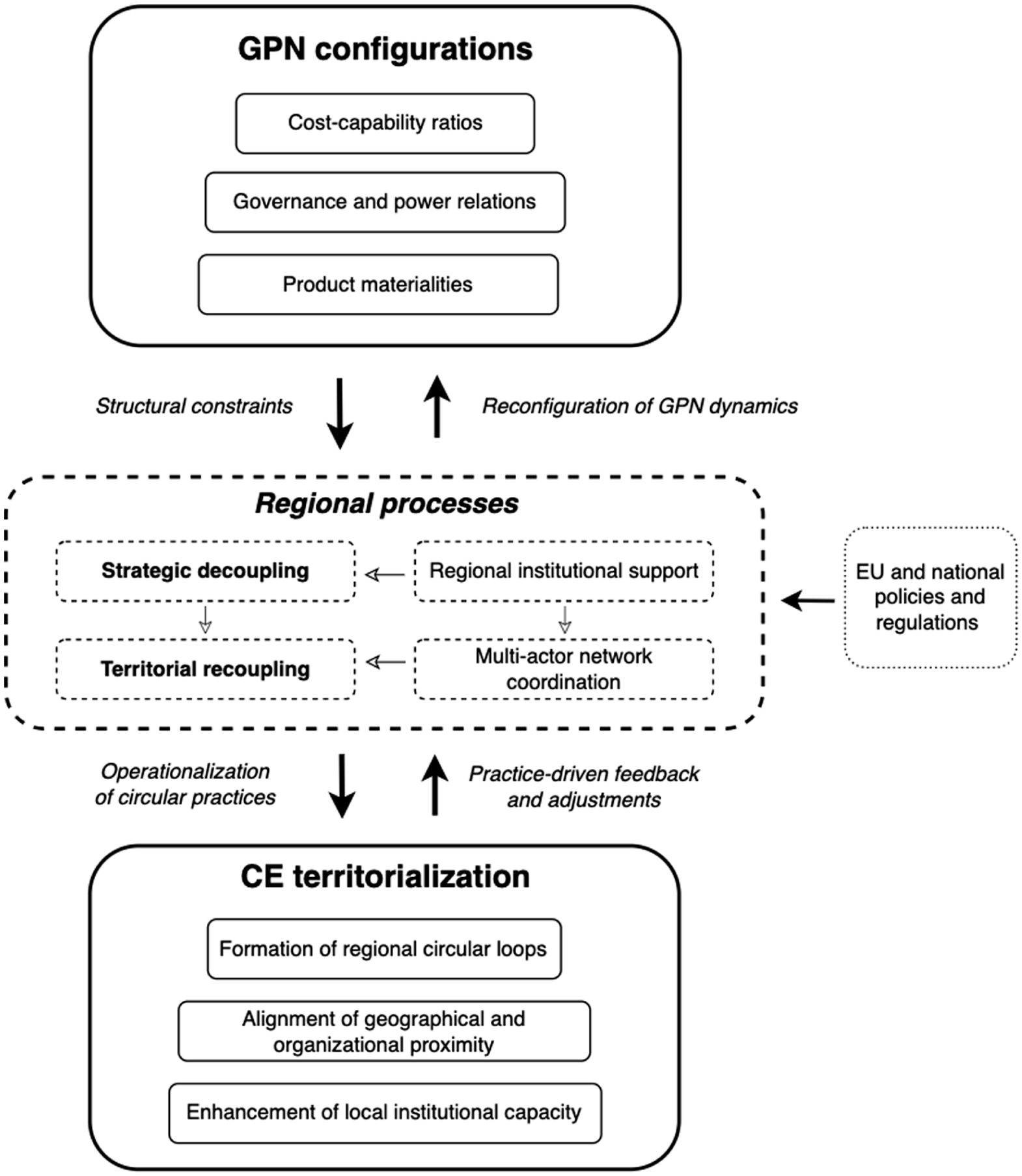
Theoretical framework: integrating GPN dynamics and territorial approaches to CE.
Here, strategic decoupling refers to efforts by regional actors to reduce dependence on globally organized production systems that constrain circular practices, while territorial recoupling describes the reconfiguration of value chains around regional flows that enable circularity. These processes are central to our framework because they highlight to what extent local and regional institutions can actively support such reconfigurations and, in doing so, reshape spatial production dynamics—particularly when cost–capability ratios, governance structures, and materialities favour greater institutional agency.
In this article, we use this framework as a tool to investigate how different modes of regional integration into GPNs influence the capacity of local institutions to support and advance CE initiatives within specific industries. While the framework informs our analysis, it is applied flexibly, without presuming that all of its components can be fully observed in our empirical cases. Such an approach leaves room for future refinement as the framework is tested across different contexts.
Case studies and research methods
In order to explore our research question, we needed to analyze sectors in the same region, under similar pressures to strengthen circularity, but with varying modes of regional integration into GPNs. We chose two key French industries: construction and textiles. Construction and textile are among the most polluting industries, making them high-priority targets for CE transitions (UNEP, 2020, 2023). In France, construction generates 46 million tons of waste annually (MTECT, 2022). Of this, 49% comes from demolition, 38% from renovation and 13% from new construction. The overall waste recovery rate in the sector varies: 60%–80% for demolition, 10%–30% for renovation, and 40%–60% for new construction (MTECT, 2022). Textiles, 1 meanwhile, is characterized by a low recycling rate. Less than 1% of clothing is recycled into new garments (EMAF, 2017). The fast fashion model exacerbates this issue by promoting rapid product turnover and consumption cycles, leading to a large increase in textile waste.
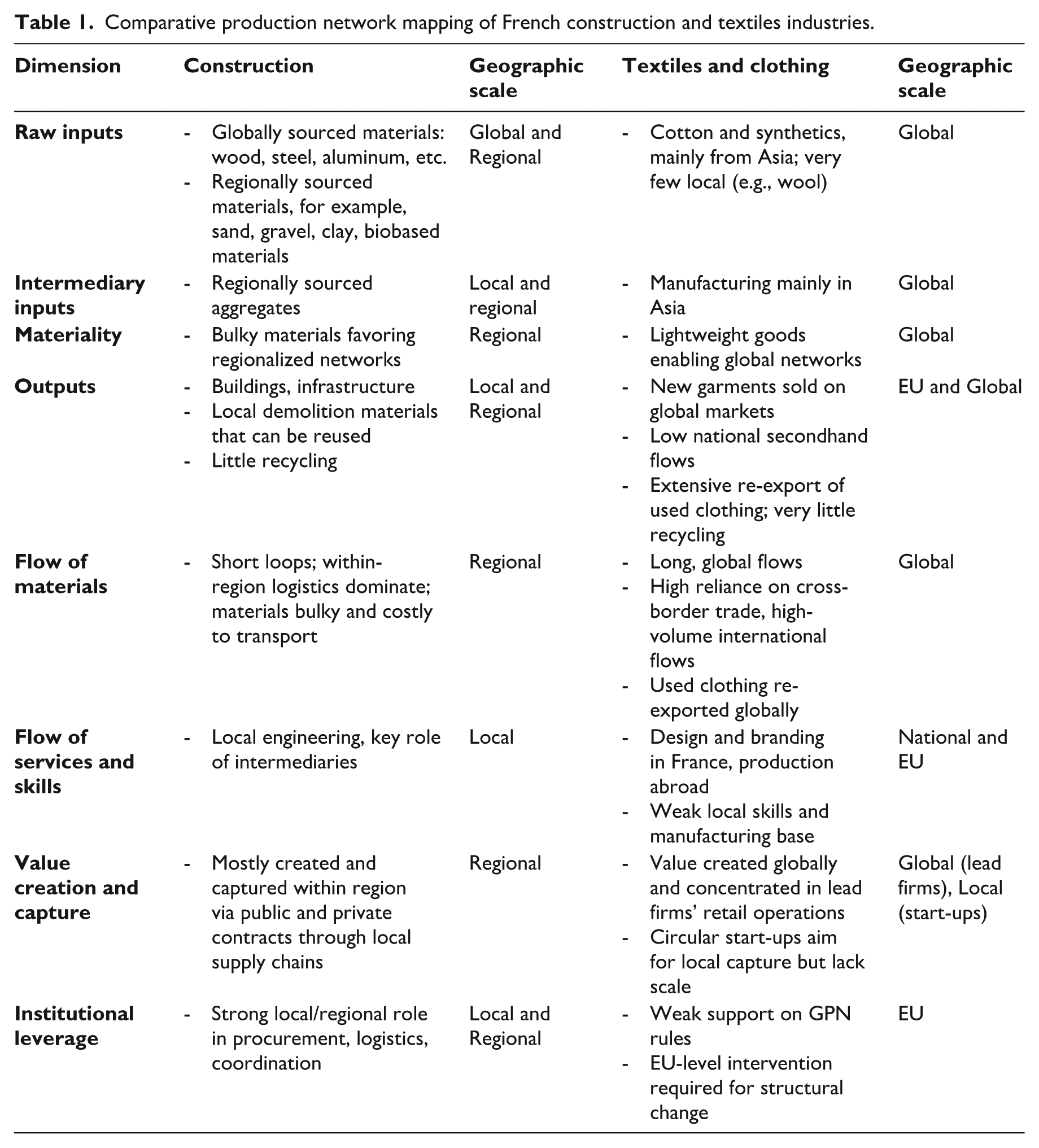
Despite their apparent differences, both industries are intricately connected to GPNs in ways that vary across materials, processes, and actors. In construction, although much activity is inherently regionalized due to the physical immobility of construction sites and transportation costs for heavy materials, certain inputs—such as steel, sand, and gravel—depend on global supply chains, revealing embedded global-local linkages (Ecorys, 2016). Similarly, in textiles, lead firms with globalized GPNs coexist with territorially embedded firms, including born-circular start-ups that prioritize local supply chains and regionalized sourcing strategies (Real et al., 2020). Table 1 provides an overview of the production networks in both industries, highlighting the interplay of multiple geographical scales. This diversity challenges simplistic dichotomies of regional versus GPNs, underscoring the need for a more granular analysis of how global-local linkages within a given sector interact with local institutional capacities to foster circular transitions.
Comparative production network mapping of French construction and textiles industries.
France is a relevant case for our study due to its progressive circular policy framework (OECD, 2016) and because of the significant global position of French textile and construction lead firms (Davies et al., 2015; Palpacuer, 2006). Both sectors are priorities for CE policies due to high waste generation and environmental impacts. Construction accounts for 70% of total French waste (INRS, 2024), while textiles is a significant consumer of water and contributor to global waste streams. Recognizing this, the French state has implemented Extended Producer Responsibility (EPR) schemes in both industries: textiles in 2007 and construction in 2023.
Under the EPR system, firms contribute to waste management by providing financial support to accredited sectoral eco-organizations that ensure government-mandated targets for circularity are met. For textiles, the scheme is managed by “Refashion” and includes garments, household textiles, and shoes. In construction, EPR obligations require firms to estimate waste quantities for each site, identify collection points, develop circularity action plans every 5 years, and support networks for reuse, recycling, and repair. These EPR frameworks create a role for local and regional institutions in operationalizing CE policies. In the South-West of France, both local and regional authorities have targeted textiles and construction as priority sectors to support circular loops.
A qualitative methodology based on semi-structured interviews was deployed. We sought to identify actors’ representations of the contexts and geography of their respective industries. In addition to interviews with both lead firms and small enterprises, we also interviewed policymakers. While we started at the local and national level, many interviewees referred to constraints and/or potential support emanating from EU level. We therefore undertook interviews at all levels, to explore how the enabling capacity of local institutions and policies interacted with national and EU regulatory frameworks. We first examined perceived barriers to the adoption of circular strategies, to identify whether constraints related to GPNs were directly or indirectly referenced. Second, we explored perspectives on the opportunities and drivers that enable firms to regionally decouple and/or recouple through circular strategies, with particular attention to how local institutions can help overcome related barriers.
In both sectors, we interviewed representatives from lead firms, local CE operators and intermediaries, policymakers, and sectoral interest groups. Our analysis for the construction sector is based on 50 interviews conducted between October 2022 and May 2024 in the Occitanie region. For the textile sector, we conducted 27 interviews in 2024, including 21 in the South-West of France (Occitanie and Nouvelle-Aquitaine) and 6 with national and EU actors.
Tracing circular decoupling processes across sectors
The French construction industry: local institutions as strong circular enablers within regionalized production networks
In France’s construction industry, small- and medium-sized enterprises (SMEs) play a central role, employing 69% of the workforce and generating 65% of the sector’s added value (INSEE, 2024). Such firms generally lack the resources to internationalize, focusing instead on regional markets where network embeddedness and established relationships enhance their competitiveness. The construction industry thus mostly relies on regional rather than global production networks. While some raw materials are imported, most core products used in construction are manufactured within Europe (Interview, EU policymaker, May 2024). Construction projects are location-bound, requiring on-site work and locally embedded labour, materials, and knowledge (Affolderbach and O’Neill, 2024). The weight and transportation costs of materials such as concrete and steel, along with the need for just-in-time delivery, make local suppliers critical and further reinforce the regionalization of the network.
In this context, we gathered actors’ representations on global-local linkages and barriers to CE implementation, and examined how production network configurations enable local institutions to support CE integration into regional value chains.
Perceived barriers to circularity within the construction production network
Across the construction production network, interviewees broadly agreed on the main obstacles to adopting CE practices. These challenges fell into three main categories. First, coordination issues were frequently mentioned, including fragmented supply chains and limited collaboration among key actors. Second, technical and regulatory constraints—such as rigid project specifications and limited design modularity—were seen to hinder the integration of circular principles. Third, economic barriers remained significant, with high purchasing and logistics costs making virgin materials more cost-effective than recycled and reused alternatives. These barriers made project managers reluctant to stray from the “business as usual approach” (Interview, construction engineering consultancy, December 2022).
Firstly, a key insight emerging from our fieldwork is that circularity often depends on well-established local ecosystems, including structured and professionalized supply chains for recycled, reused or biobased materials. Yet such networks remain underdeveloped in the region: [when sourcing circular and biobased materials], we don’t have a streamlined supply chain where everything’s automated, and we know exactly who to talk to get things moving quickly. (Interview, engineering firm, December 2022)
This fragmentation reflects the incomplete integration of circular principles into the regional production network. Scaling CE practices in construction requires robust supply chains for specific materials (e.g. straw insulation) and processes (e.g. deconstruction expertise or design adaptation). In addition, the lack of supply visibility complicates projects using reused materials: We don’t have anything concrete to reassure our clients that it’s all good, that someone out there will take the right materials and equipment from this site, store them until we’re ready, then resell and secure them. (Interview, engineering firm, December 2022)
The reuse loop requires an organizational change in the industry’s production network. The CE system and the necessary processes are not yet stabilized or routinized. Therefore, while the construction industry benefits from geographical proximity through a GPN characterized by strong regional linkages, interviewees identified the main barriers to circularity not in global-local linkages, but in a lack of organizational proximity among stakeholders.
Nevertheless, some interviewees highlighted the potential to build on existing territorial resources and improve coordination: Implementing circularity is challenging, but it’s absolutely possible if we strengthen local supply chains and improve coordination and networking among actors. To me, the key is having a clear understanding of the regional ecosystem and identifying the right players . . . (Interview, engineering firm, December 2022)
These shared representations were frequently echoed in our interviews, suggesting that in the construction sector, global-local linkages pose relatively few constraints on CE implementation. Beyond coordination issues, a second, recurrent theme concerned the challenges posed by norms—such as safety standards and insurance requirements—for the use of recycled and reused construction materials. These rules were often regarded as ill-adapted to circular practices, creating uncertainty and discouraging firms from experimenting with reused materials. Taken together, these observations highlight the potential role of local institutions not only in addressing coordination gaps but also in developing certification schemes to support the adoption of circular practices, as discussed below.
Finally, a third set of barriers identified by interviewees was arguably more problematic, as it pertained to the industry’s cost structure and, consequently, to its economic profitability. Unlike conventional demolition, deconstruction involves meticulous dismantling, material sorting, storage, and refurbishment—processes that are costly and require new coordination and cost-sharing mechanisms among local actors (Interview, public buyer, November 2022). Yet, many interviewees emphasized that innovative local logistics could generate savings to support profitability. This highlights how organizational proximity among stakeholders can facilitate the coordination and logistical efficiencies needed to overcome cost barriers to territorialized circularity (Chembessi et al., 2024; Kim, 2024). It also suggests that favourable cost–capability ratios can support territorial recoupling, allowing firms to develop viable circular supply chains without relying on global linkages. In addition, national regulations have improved waste sorting for recycling strategies, although limited regional recycling capacities remain a key constraint to achieving economies of scale, as noted by interviewees.
The enabling role of local and regional institutions in creating territorial circular loops
In France, initiatives such as the EPR scheme have sought to overcome these identified barriers by fostering reuse and recycling within local production systems. Regional actors can also leverage procurement policies, notably the circular procurement obligations of the national CE law. We thus hypothesized that the regional organization of construction production networks would create favourable conditions for local and national CE policies to strengthen and scale up circular practices within territorial value chains.
Our fieldwork confirms that policy incentives have fostered a diverse ecosystem of public and private institutions and CE intermediary actors emerging in the Occitanie region. For instance, the local government of Toulouse Métropole has implemented circular procurement policies, established a structured circular construction network, and enhanced skills, such as waste management diagnostics, through targeted training. Its “LIFE-Waste2Build” project has involved stakeholders across local authorities, businesses, and educational institutions, incorporating activities such as promoting reuse of demolition waste, optimizing material flows, and supporting innovative circular construction practices. By facilitating actors’ matchmaking through the creation of a centralized digital platform, 2 this has significantly increased visibility and traceability of secondhand and waste material flows broadening territorial linkages beyond Toulouse Métropole, enhancing connections across the Occitanie region, and reinforcing regional circular loops.
In addition to public authorities, interviewees emphasized the essential role of engaged local associations—in this case, SYNETHIC—in fostering territorialized circularity in the sector by connecting and coordinating public and private actors within the production network and supporting material recovery during renovation and deconstruction projects: . . . we didn’t have enough connections to source sufficient reused materials. Since we met SYNETHIC, they’ve been making proposals to us every week. It really changes the game. (Interview, architecture firm, December 2022)
This association has also worked with Toulouse Métropole to establish a centralized CE information hub and the digital platform to link supply and demand. This speeded up CE processes: The advantage of the digital platform is that we can access more sources . . . see materials that are for sale but haven’t been deposited yet . . . The earlier we anticipate circular economy aspects, the more financially viable it becomes. (Interview, real estate developer, November 2022)
These efforts illustrate how local institutions have enabled circular territorial recoupling and value capture within the construction industry’s regional network. The coordination initiatives of local intermediaries also helped address the financial challenges of circularity by mitigating the cost constraints imposed by regulation. The regionalized structure of the production network has enhanced firms’ adaptive capacities, fostering favorable cost–capability ratios. SYNETHIC has facilitated dialogue among stakeholders to optimize regional material flows. Regarding CE skills, another new local intermediary, a professional association named ENVIROBAT, offered free training sessions on circularity and developed educational tools for project support. Overall, local institutions played a pivotal role in disseminating best practices and technical information. They acted as intermediaries between firms and regulatory authorities, helping companies interpret evolving standards and comply with complex legal requirements for circular construction. As one interviewee noted: There are quality control offices overseeing us, ensuring compliance with current regulations, and so on . . . SYNETHIC takes care of that. (Interview, major real estate development group, October 2022)
Such intermediary support was instrumental in helping firms navigate regulatory uncertainty and overcome normative barriers to the use of secondary materials intended for reuse.
In summary, this first case study shows that despite organizational challenges and profitability concerns, local institutions have leveraged the construction sector’s regionalized production network to align geographical and organizational proximity in support of CE implementation. Within our framework (Figure 1), favourable cost–capability ratios support territorial recoupling through localized supply chains, embedded labour markets, and proximity-driven coordination efficiencies. Our fieldwork confirmed that global-local linkages were not seen as major constraints to the CE, suggesting that construction’s regionalized integration into GPNs reduces dependence on global inputs and facilitates strategic decoupling from globalized linear production models. This territorial embeddedness enables institutional initiatives to ease coordination and reconfigure value creation within the CE, thereby reinforcing regional circular practices.
The French textile industry: local institutions as weak circular enablers within globalized production networks
The textile market has long been highly globalized. Textile production, encompassing raw material extraction, production, transport, consumption, and waste, has relied on a traditional linear business model, involving minimal reuse or recycling. Global production of textile fibres has nearly tripled since 1975 (EEA, 2019). Geographically, the GPN is complex and spans many regions. China is the world’s largest producer of polyester, as well as other synthetic fibres, while cotton, the other most widely used fiber, is produced in China, India, the United States, and Brazil (Fernandez-Stark et al., 2022). China dominates the spinning and weaving stages, although India is also a major player in cotton. Garment production is concentrated in low-cost sources like Bangladesh and Vietnam, which rely heavily on imported raw materials (Fernandez-Stark et al., 2022). Given the geographical fragmentation of textile value chains, the territorialization of CBMs presents significant challenges. In fact, while circularity is receiving increasing attention in the sector, its implementation remains limited. As with construction, we will first outline the barriers to CE implementation perceived by textile firms in South-West France, before analyzing the extent to which local institutions could mitigate these obstacles given the globalized structure of the textile production network.
Perceived barriers to circularity within the textile production network
Our analysis distinguishes between two broad categories of firms: the traditional textile lead firms that dominate the market and have led historical sectoral restructuring processes through globalized, linear business models (Gereffi, 1999), and born-circular start-ups, which often promote territorially embedded sustainable innovations. Our empirical study finds that in textiles, this distinction—explored theoretically in the literature (Briguglio et al., 2021; Re and Magnani, 2022)—is fundamental to firms’ perceptions of barriers to circularity.
Within lead firms, products are rarely designed with end-of-life reuse or recyclability in mind. Circular design principles prioritizing durability, reparability, and recyclability, are not widely adopted. On the contrary, fast fashion’s focus on rapidly changing trends prioritizes low-cost, disposable goods over durability, while designers defend the creative benefits of mixed-material designs despite the significant recycling challenges they pose. French lead firms seeking to move toward circularity thus face GPN cost constraints. In particular, shorter loops tend to be more labour-intensive, undermining their feasibility: “The shorter the loop in the value chain [in my circular strategy], the more it costs me” (Interview, French textile lead firm, April 2024). This illustrates how, in textiles, the cost–capability ratios of globalized production—driven by low labour costs and economies of scale—create significant advantages over circular strategies that rely on localized, small-scale, higher-cost processes.
Yet, driven by positive “market signals,” particularly the rising acceptance of secondhand products, lead firms have developed reuse, especially secondhand and rental programmes. One company we interviewed was for instance testing renting for maternity wear, with the goal of extending it to other products (Interview, French lead firm, March 2024). These experiments reflect lead firm attempts to sustain market development within a rapidly evolving environment, where regulatory pressures and shifting consumer preferences incentivize CBM innovation. However, the globalized nature of the textile GPN has led these firms to specialize in retail, where responsibility for the product “ends at the cash register” (Interview, French lead firm, March 2024). This model presents significant capacity challenges in terms of reverse logistics and refurbishment.
Finally, in terms of product end-of-life management and textile-to-textile recycling, French regulation has banned the destruction of unsold textile items. This has stimulated the creation of circular intermediaries to convert surplus stock into raw materials—especially recycled yarn. As in the construction case, these intermediary actors have played a coordination role, matching retailers with recycled material producers: “I do a lot of networking . . .” (Interview, recycled yarn producer, February 2024).
However, the lighter and higher-value nature of textiles facilitates the creation of extensive global reuse and recycling networks. This complexity has fostered the emergence of CE intermediaries that bridge global and local scales, such as secondhand clothing networks that connect producers and recyclers across countries and continents (Brooks, 2013). These intricate chains of collection, sorting, and redistribution span the Global North and South alike, illustrating how circular strategies are enabled by sustained collaboration among globally dispersed, but interconnected actors.
Indeed, these new circular linkages are rarely local. Interviewed lead firms perceived the optimal CE scale to be within the Pan-Euro-Med region, which has a strong textile tradition, related manufacturing capabilities and easy access to the EU market. Decoupling and recoupling dynamics at this scale seemed more feasible to them than “regional”—in the sense of European—circular loops.
Nevertheless, these firms still perceive many barriers to large-scale, viable circularity. Like in construction, transparency and availability of materials were issues. The textile industry’s waste streams are diverse, encompassing pre-consumer production waste and unsold goods, customer returns, and post-consumer discarded garments. Effective circular strategies must address all these streams. Information on the composition of textile waste is crucial, as recyclability varies widely across fibres. Indeed, many fast fashion products are unrecyclable: The real challenge is post-consumer fast fashion. Today, there is no economic model. (Interview, textile recycling intermediary, February 2024)
To summarize, the lead firms we interviewed identified several barriers to circularity: resistance to the constraints of circular design, logistical and skills-related challenges associated with reuse, and the high costs and limited traceability of value chains for recycling.
By contrast, innovative born-circular firms perceived different barriers to their development. These offer circular value propositions centered on territorial embeddedness and sustainability. During the time of our fieldwork, their strategies emphasized the use of easily recyclable materials, environmentally friendly production processes, and products designed for durability, reuse, and recycling. Most adopted “local” or “regional” sourcing strategies to reduce carbon footprints, supporting regional economies, and promoting territorial sustainability and development. Their definitions of “local” and “regional” varied: one clothing firm in the Pyrenees sourced wool waste locally “up the mountain,” while another used materials from Italy “just across the Alps.” Collectively, these firms expressed their willingness to secure regionalized value capture within otherwise globalized production networks. Almost without exception, their consumer markets were distinct from lead firms, although some of their suppliers overlapped.
These small enterprises also pointed to a deeper structural issue: the precarity of the sector in France, which faces intense competition, particularly from Asian companies operating under less stringent regulatory frameworks: . . . we are in a very fragile sector, with production tools that are highly dispersed across France, all of which are very precarious. (Interview, born-circular start-up, February 2024)
Born-circular start-ups therefore called for regulation to establish a “fair playing field” and reshape GPN dynamics. Although they welcomed local institutional efforts to revive regional supply chains and finance ecological experimentation, they were cognizant that potentially impactful regulation—especially imposing minimum standards on imports and better regulating competition—would be at EU, not local level.
The challenge of creating territorial circular loops within globalized production networks
Local and regional institutions in the South-West of France have attempted to tackle barriers to circularity of both lead firms and born-circular textile start-ups. Yet, their enabling capacity has been limited by the structural constraints of the GPN and their incapacity to leverage regulation to support new circular models.
Sorting end-of-life clothing is labour-intensive, and the high cost of labour in France significantly increases the expense of these operations. Automation is perceived to offer a solution in the sector. For instance, we interviewed stakeholders in an innovative project supported by €2.4 million of public funds, developing a textile sorting and dismantling factory. This research sought to support a decoupled, closed-loop recycling industry, perceived as having potential at the European scale. Stakeholders underlined that the industry lacks enough waste streams to create closed loops, while developing such a “regional” textile recycling model implied that textile waste should stay in Europe rather than being exported: We need to keep textile waste in Europe, that’s the crux of the matter. We need political regulation . . . (Interview, public intermediary for textile recycling, April 2024)
Regulating trade in waste with non-EU actors would need to balance such demands with the constraints of World Trade Organization rules, which outlaw trade bans, except in very specific circumstances (Curran et al., 2021). In addition, given that much of the relevant regulation is developed at EU level, policies to support recoupling would require multi-level coordination.
Unlike in construction, we did not find evidence of strong local institutional leverage. Rather, among born-circular firms there was notable disillusionment and frustration with the perceived disconnect between political rhetoric, which praised circular innovations, and the lack of supportive public policy instruments: There is a lot of political discourse on reshoring and reindustrialization, but when it comes to specific measures to revive sectors, it’s a void. (Interview, born-circular start-up, February 2024)
Interviewees criticized public authorities for favouring large-scale industrial projects. They considered that local projects that support ecological innovation through experimentation should be prioritized. Another local circular start-up confirmed their disappointment with public policies: “We have been heavily solicited by regional authorities, but after four years of meetings, I can say it doesn’t work” (Interview, born-circular start-up, April 2024).
In summary, in the case of the textile industry, global-local linkages significantly constrained the enabling capacities of local institutions to territorialize CE practices. Unlike construction, the industry’s GPN is characterized by extensive geographical dispersion, making territorial recoupling particularly challenging. The barriers to circularity were not only organizational but also deeply rooted in the geographical disconnection of material flows, limiting the feasibility of regional circular loops. In the context of our framework (Figure 1), the cost–capability ratios in this sector favored globalized production structures, where economies of scale and labour cost advantages undermine the economic viability of localized CE initiatives.
Lead firms thus felt that regional institutional efforts should primarily focus on R&D-driven technological interventions, particularly in textile recycling—an approach aligned with sustaining market development, rather than fostering strategic decoupling from globalized linear models. Interviewees expressed hope that scaling up European recycling infrastructure could facilitate partial decoupling from the global textile GPN, allowing limited (re)territorialization of value creation. However, this remains dependent on broader EU-level regulatory shifts and investments in circular supply chain coordination.
For born-circular start-ups, institutional support was largely non-financial and fragmented and failed to counterbalance the structural disadvantages they faced in a competitive globalized market. Their territorially embedded business models struggled to compete with the cost-efficiency of global fast fashion, where mass production and dispersed supply chains minimize costs. Unlike in construction, where multi-actor network coordination facilitated circular recoupling at the regional level, the textile industry’s globalized value chain limited the ability of local institutions to support viable CE pathways. Without stronger regulatory frameworks or targeted economic incentives to realign cost–capability ratios in favour of regional CE loops, territorial circularity in textiles remains constrained.
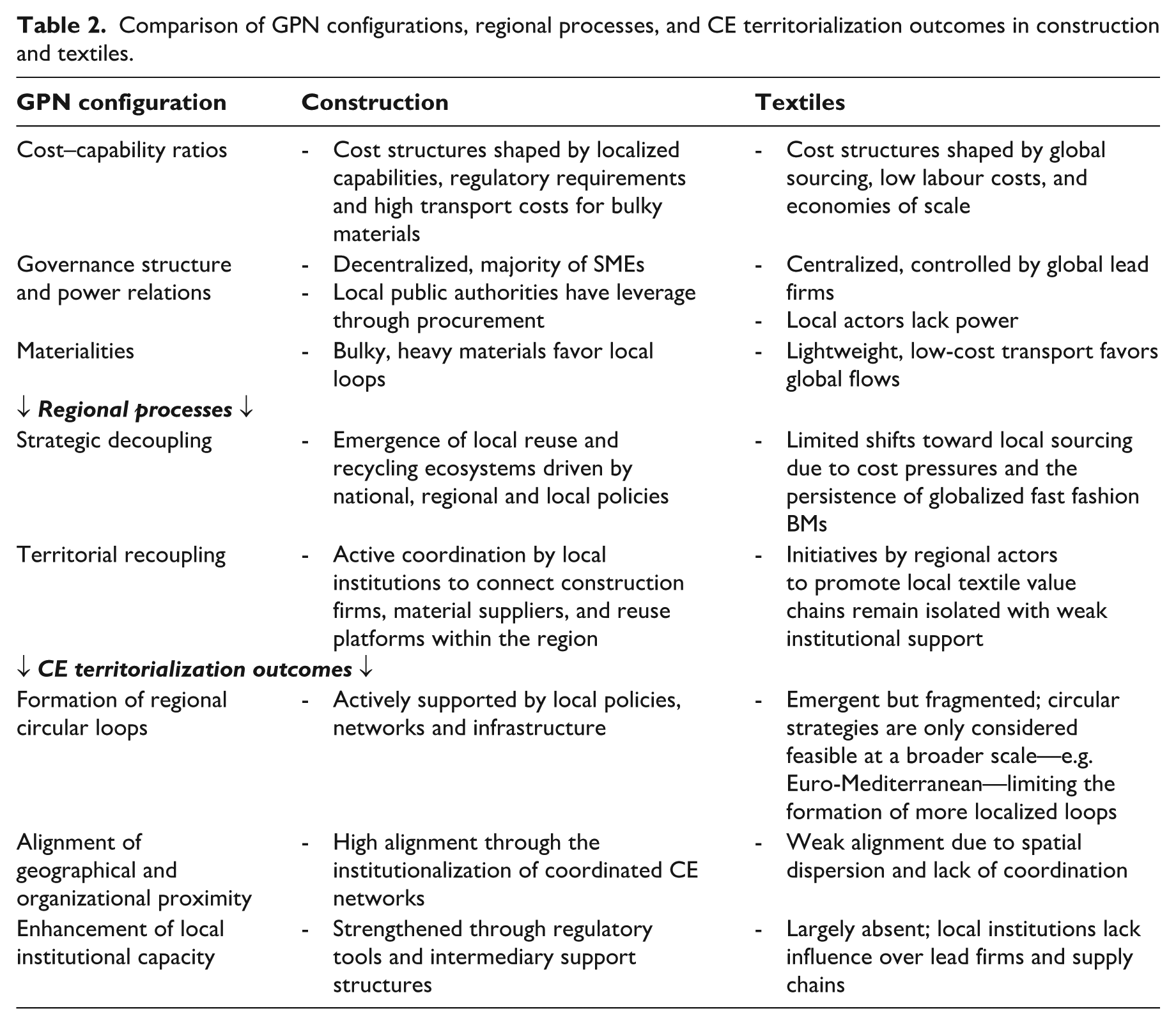
Table 2 summarizes our comparative findings, aligning key GPN characteristics with observed regional processes and CE territorialization outcomes, in line with our theoretical framework. The findings highlight how, in construction, the combination of regionally embedded cost–capability structures, decentralized governance, and bulky materialities has enabled strategic decoupling from global inputs and facilitated territorial recoupling through institutional coordination. By contrast, the textile sector’s globalized cost structures, centralized lead firm governance, and light, easily transportable materialities have severely limited both decoupling and recoupling efforts.
Comparison of GPN configurations, regional processes, and CE territorialization outcomes in construction and textiles.
Conclusion and policy implications
Our findings demonstrate how industry-specific configurations of regional integration into GPNs—shaped by cost–capability ratios, governance structures, and materialities—can enable or constrain the capacity of local institutions to support and operationalize CE practices at the territorial level. In the construction industry, the regionally embedded GPN configuration allowed local institutions in the Occitanie region to play an enabling role in CE territorialization. Emerging CE intermediaries and local authorities leveraged regionalized production systems to support strategic decoupling from global inputs and foster territorial recoupling through novel actor networks. This, in turn, facilitated the coordination required for reuse and recycling. Within this dynamic, the territorial embeddedness of construction activities and the physical materialities involved created opportunities for local actors to rebalance cost–capability ratios and capture value within the regional production system. The alignment of geographical and organizational proximity enhanced coordination and helped address logistical, regulatory, and economic barriers to CE implementation—confirming the findings of Chembessi et al. (2024).
In contrast, the textile industry’s highly globalized GPN configuration constrained the enabling capacity of local institutions. Here, unfavourable cost–capability ratios, centralized lead firms’ governance, and the materiality of lightweight, easily transportable products limited both strategic decoupling and opportunities for territorial recoupling. Indeed, the textile industry faces dual challenges: the lack of both geographical proximity due to its globalized GPN and the limited organizational proximity among its territorially embedded actors. Unlike in construction, most textile firms’ business models remained structurally dependent on globalized sourcing and production.
Materiality further shaped these constraints: while bulkiness and transport costs favoured localized recycling in construction, the lightweight nature of textile materials facilitated globalized reuse and recycling networks, limiting the feasibility of regionalized CE loops. This materiality has implications for cost–capability ratios. In construction, local capacities and the high cost of transport have favoured territorial recoupling, whereas in textiles, production capacities are largely located outside the EU and transporting used clothing and textile waste remains relatively inexpensive. This favoured recoupling attempts with the “near abroad” (Euro-Med), rather than locally. This reinforces Coe and Gibson’s (2023) argument that “materiality influences carbon intensity . . . and determines capital and labour intensity (p. 3).”
In this context, textile lead firms argued that regional institutional efforts should focus on R&D investments in recycling, the least environmentally impactful CE strategy, rather than fostering strategic decoupling from globalized production models. While some interviewees saw potential in scaling European recycling infrastructures to enable partial territorial recoupling, this remains contingent on broader EU regulatory shifts. Born-circular start-ups, meanwhile, struggled against the cost-driven imperatives of globalized value chains. Unlike in construction, where multi-actor coordination helped reduce CE costs, textile start-ups lacked institutional mechanisms to compensate for competitive disadvantages. They perceived that strategic decoupling and territorial recoupling was unfeasible without stronger institutional interventions at the EU level.
Our research thus revealed how varied representations of the appropriate spatial scale for implementing circularity are shaped by the mode of regional integration within industry-specific GPNs. In construction, stakeholders perceived this scale to be inherently “local” or “regional,” taken in the sense of territorial proximity. This perception was driven by the on-site specificity of construction activities, the high costs of transporting bulky materials, and the inherent need for close coordination among local suppliers, policymakers, and CE intermediaries. Consequently, local institutions could act as crucial enablers, effectively fostering circular practices through locally anchored networks and initiatives. In contrast, views on the appropriate scale for CE in the textile industry were more fragmented. Nested within a highly globalized GPN, lead firms saw potential for recoupling at the “regional” level, understood as Europe and near-abroad. Given the need to leverage large markets to finance recycling infrastructure and secure waste streams, they considered this scale to be appropriate for establishing circular loops. Meanwhile, born-circular start-ups emphasized a more territorialized approach, focused on recoupling within regional supply chains and fostering local production. However, they faced strong competitive pressures given the cost structures of the globalized fast fashion model.
Study limitations
Our focus on two industries with different GPN structures and environmental impacts—construction and textiles—limits the generalizability of our findings to other sectors. In addition, the study is restricted to France, a country with specific policy frameworks and institutional contexts, which may not reflect regional dynamics across other European or global settings. Finally, while qualitative interviews provide rich insights, they may not fully represent the broader perspectives of all industry stakeholders, particularly those less involved in CE initiatives. Future research could address these limitations by incorporating additional sectors, cross-country comparisons, and mixed-method research designs to provide a more comprehensive understanding of CE territorialization.
Policy implications
Our findings emphasize the importance of multi-level policy coordination to support CE territorialization. Local and regional intermediaries—CE actors, public-private platforms, and industry networks—play a vital role in bridging supply-demand gaps and facilitating circular territorial recoupling. Given this, support for these intermediaries should be prioritized in public funding for industry-specific circular loops. While regional authorities are best positioned to mobilize local capabilities, their influence depends on national and EU frameworks that address structural constraints in GPNs. CE implementation will thus require multi-level coordination to realign cost–capability ratios and support local institutional agency. Regional actors can act as key enablers by utilizing their proximity to local stakeholders, but their efforts should be supported and scaled through national and EU frameworks which incentivize firms to reconsider sourcing practices, integrate supply chain cooperation, and invest in circular decoupling and recoupling.
In GPN-dependent industries like textiles, stronger environmental and CE standards can help reshape governance structures by imposing requirements on both domestic and imported products. This implies a role for trade and regulatory policies to enable cost–capability rebalancing in favor of regional CE loops. The EU’s Circular Economy Act, currently under development, offers an opportunity to launch more ambitious policy initiatives. These could be leveraged by local and regional actors to incentivize firms to adopt localized sourcing practices and relocate parts of their value chains, thereby supporting strategic decoupling.
Ultimately, CE transitions depend on a bidirectional interaction between territorial initiatives and GPN reconfiguration. Policy frameworks should support local innovation and institutional capacity-building, but they also need to integrate the broader structural constraints embedded in industry-specific production networks. Supporting intermediaries, fostering CE actor coordination, and embedding circularity in multi-level regulatory regimes will be essential to enabling territorialized CE models and building regional economic resilience.
Footnotes
Acknowledgements
This research was conducted within the framework of the TWIN SEEDS and Waste2Build projects, both funded by the EU. The authors express their gratitude to all partners and stakeholders involved in these initiatives. An earlier version of this article was presented at the Workshop of the European Chair of Excellence on Circular Economy and Territories, entitled “Regional Policy and Territorial Governance for the Circular Economy,” co-organized by EM Normandie Paris, INRAE, and the European Urban and Regional Studies journal on October 8, 2024. We are grateful to the colleagues who provided feedback during this event. We also wish to thank the anonymous reviewers for their valuable comments and suggestions on earlier versions of this paper. Any remaining errors or omissions are our sole responsibility.
Declaration of conflicting interests
The authors declared no potential conflicts of interest with respect to the research, authorship, and/or publication of this article.
Funding
The authors disclosed receipt of the following financial support for the research, authorship, and/or publication of this article: This research has benefited from funding within the Horizon Europe program (TWIN SEEDS, Grant agreement ID: 101056793) and LIFE Waste2Build (European program LIFE20 GIE/FR/000118).
