



Abstract
Chinese actors have emerged as major funders and developers of large-scale transnational infrastructure projects in Europe and beyond. Despite this profound shift, geographers have not yet arrived at a clear conceptualisation of such projects. We show how the literature is overly reliant on a functional view of the Chinese state, structural economic factors, single case studies, and bilateral relations, generating monocausal explanations of outcomes. We develop a new conceptual framework emphasising variegation driven by shifting assemblages of actors, dynamic strategic coupling, and multi-scalar processes of territorialisation. To operationalise our framework, we draw on process tracing and incorporated comparisons across cases.
I Introduction: China’s European infrastructure turn
In a major reordering of global development processes, Chinese firms and government bodies have emerged as major funders and developers of large-scale transnational infrastructure projects in Europe and across the world. The ‘infrastructure turn’ (Dodson, 2017: 88) refers to the ‘promotion of infrastructure in pursuit of national goals’ and has seen renewed emphasis on national infrastructure frameworks and investments. China has pursued domestic infrastructure development for many years which was given a fillip following the Global Financial Crisis as part of its stimulus package. Latterly there has been an internationalisation of the infrastructure turn (Ougaard, 2018) led, though not exclusively, by China (Furlong, 2022; Strange, 2024) whereby after investing heavily in the global South China has turned its attention to European infrastructure. New transport, energy, and information geographies have emerged, with profound economic and political effects. These projects are not only designed, financed, built, and maintained but also questioned, contested, and fought over by new constellations of actors assembling and disassembling in complex cross-border networks. States incorporated into or transversed by such projects find themselves subjected to unpredictable processes of de- and re-territorialisation across multiple scales. Infrastructure projects have thus become central to major shifts in the global political economy (DiCarlo and Schindler, 2022). We therefore need a more integrated understanding of the emerging economic and political geographies of these projects, of how such infrastructure investments come together and of what are their economic, political, and social implications – a project that has acquired renewed urgency due to the geopolitical standoff between China and the US.
China has made the financing and construction of connective infrastructure a key plank of its foreign policy. Many such projects are gathered under umbrella programmes such as the Belt and Road Initiative (BRI) (Bach, 2016; Schindler et al., 2022) and, latterly, the Global Development Initiative (MoFA, 2022; Mulakala, 2022). These investments, which include the creation of land-based transport networks across Asia, are linked to other pillars of Chinese policy, including industrial, technology, innovation, and security policies (Financial Times, 2022). While China’s early forays into overseas infrastructure investment under the ‘Going Out’ policy were largely directed at countries of the Global South and were often bound up with resource access (Corkin, 2013; González-Vicente, 2013; Mohan and Tan-Mullins, 2019), over the past decades investment flows have shifted into Europe. Although many recipient countries broadly welcomed the finance and potential market opportunities, Chinese infrastructure investments have continued to generate political controversies (Economist, 2018; Meunier, 2014; Turcsanyi and Kachlikova, 2020).
The moves by Chinese policy and corporate actors to take greater stakes in European infrastructure have raised a range of interrelated concerns around procurement, security, governance, competition, the environment, and innovation (Babić and Dixon, 2023; EC, 2019; Friis and Lysne, 2021; Starrs and Germann, 2021). Critics have highlighted financial risks resulting from poor planning (Barney and Souksakoun, 2021; Ferchen and Perera, 2019), links to repression at home and abroad (Furlong, 2022), social and environmental risks (Gransow, 2015), and limited benefits for local populations in at least some projects (Rowedder, 2020). Indeed, Babić and Dixon (2022) argued that it was the infrastructure/security nexus that has been the main catalyst for the recent wariness towards China in Germany and the UK. Since at least 2019 – and boosted by the COVID-19 pandemic – these concerns have coalesced into calls for ‘deglobalisation’ or ‘decoupling’ (European Chamber of Commerce, 2021; Sternfels and White, 2023; Williamson, 2021) and – more apocalyptically – even a ‘new cold war’ (Brands and Gaddis, 2021). However, patterns of (dis)engagement with China are uneven across countries and sectors and ‘Europe’ cannot be reduced to the EU. Rather than blunt either/or binaries, a more variegated and watchful interdependence between European and Chinese actors seems to be emerging under the banner of ‘de-risking’. De-risking shares much of the same DNA as decoupling but is seemingly more nuanced than a wholesale severing of ties with Chinese firms (The Economist, 2023). While de-risking across Europe is partly about distancing the continent from the US’s more strident decoupling agenda, these distinctions may be relatively minor in practice given that the G7, which includes the US, recently endorsed de-risking (Financial Times, 2023, G7 Hiroshima Leaders, 2023). The stakes are high for all involved, and we need to develop the analytical frames and research designs that can deliver the insights needed.
In this paper, we take stock of the available literature and propose an analytical framework which foregrounds a more variegated and complex set of actors and interests. For example, security concerns are increasingly salient among (parts of) Germany’s national policy elites, but regional state and city-level actors have quite different concerns (Gottwald et al., 2019; Heberer and Shpakovskaya, 2022; Mohan et al., 2024). Similarly, on the Chinese side firms may not share the strategic goals of the central government. For instance, large Chinese consumer-facing technology firms like Alibaba and Tencent have apparently been deemed to be insufficiently aligned with longer-term Chinese Communist Party (CCP) strategy (Shrivastava, 2023; To, 2023). These observations point towards potentially diverging interests between national political elites and local areas desperate for inward investment, as well as between state and corporate actors, which means we need a scale-sensitive political economy approach (Brenner, 2019). Moreover, China’s move into European infrastructure is relatively recent and while we have learnt much from the rapidly growing literature on the topic, we believe it is time to approach this research in a more systematic manner.
The challenge is to create a conceptual framework that can explain, rather than just describe, both why infrastructure projects come together – or fail to – in particular ways as well as the differential developmental impacts such projects have. We propose a new framework that incorporates concepts from across the field of human geography: thinking with assemblages, global production networks, and multi-scalar territorialisation processes. In addition, a focus on particular projects, as well as a comparative lens across projects, is necessary to move beyond sweeping, and frequently simplistic, generalisations about ‘China’ or the impact of Chinese development on ‘the West’ (Liu et al., 2020). Such an understanding of variegation can give pointers to a more watchful interdependence and better inform political decisions. We have calibrated the framework to illustrate China–Europe investment flows and relations, but suitably modified versions could work in settings where different political-economy relations prevail.
The rest of the paper is structured as follows. In the following section, we lay out the conceptual challenge inherent in analysing and explaining Chinese transnational infrastructure projects. The next section discusses the existing literature and identifies what we see as several shortcomings that our approach hopes to address. We then introduce our analytical framework. Across three sections we build the conceptual basis for our framework before the next section incorporates the three core elements. Finally, we suggest a methodological approach to operationalise the framework for empirical work.
II Framing Chinese transnational infrastructure projects
Transnational Chinese infrastructure projects are complex structures involving a multiplicity of actors spanning sectors and national borders (Cheng and Apostolopoulou, 2023; Mayer and Zhang, 2021; Su, 2014). They typically involve both private and state actors, linked through networks of contractual and financial obligations, as well as by laws and regulations, all of which traverse a variety of scales from the local to the global. Key actors, both inside and outside the state, engage in strategic action (Chen, 2023; Furlong, 2022; Raco et al., 2023). Firms pursue higher profits, civil society actors seek to mould projects to the benefit of their constituents, and the Chinese and host country states, or rather fractions of these state apparatuses, pursue a mixture of economic, political, and geostrategic aims that may or may not cohere into a unified strategy (Jones and Hameiri, 2021). In addition, none of these sets of actors are guided solely by rational economic or political calculations (Clarke, 2020; Ferchen and Perera, 2019; Sum, 2019) and analyses must make room for the power of ideas and ideology, tactical and strategic miscalculation, rule-breaking, and outright criminality.
Figure 1 illustrates the conceptual aspects common to Chinese transnational infrastructure projects. All such projects are part of the wider ‘infrastructure push’ (Ougaard, 2018) that takes place within an evolving global capitalist system. Rather than seeing infrastructure projects as a uniquely Chinese form of internationalisation we see them as one aspect of the country’s internationalisation that fulfils a range of political, economic, and socio-cultural functions (Franceschini and Loubere, 2022; Lee, 2017). States and companies are compelled to develop dynamic accumulation strategies, though they exercise considerable agency in doing so (Knafo and Teschke, 2020). Market and investment dynamics are complicated by the geopolitical rivalry between the US and China (Ferdinand 2016; Ho 2020). The potential risks of economic dependence are driving a strategic reorientation among the governing elites of some, but by no means all, European states (Kaim and Stanzel, 2022). In addition, the rise of China as a powerful autocratic regime expressly hostile to ‘Western’ notions of democracy comes at a time where the deleterious effects of decades of neoliberal economic policy on the social and political fabric of European societies (and the US) are fuelling a crisis of the liberal international order, bringing about an unstable interregnum (Babić, 2020; Taggart, 2022). Conceptual aspects of transnational Chinese infrastructure projects.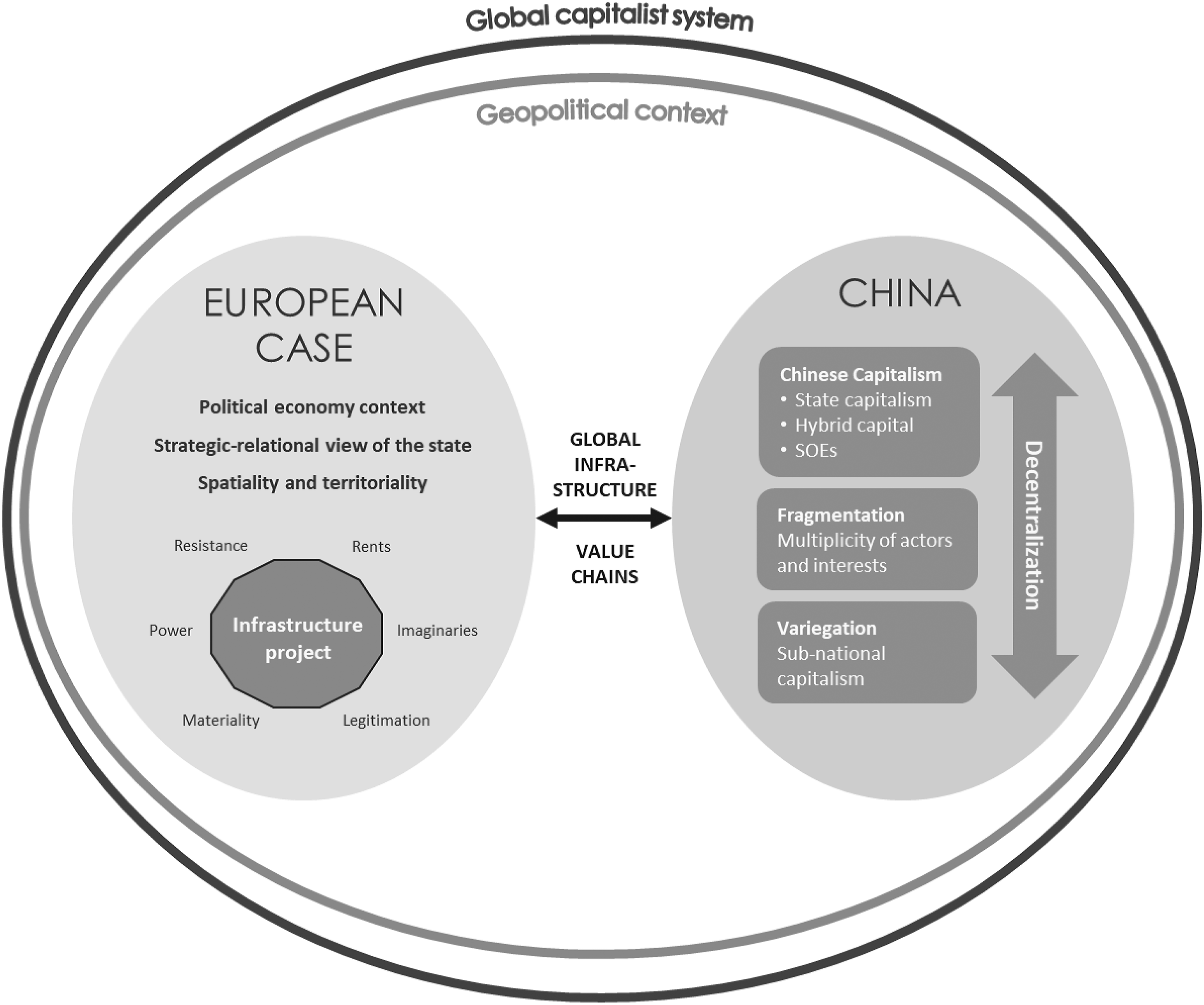
The Chinese economy is made up of a variety of different, historically evolved growth models that differ in their integration into global production networks, dominant modes of firm ownership and finance, and links with overseas Chinese business networks (Zhang and Peck, 2016). A similar picture holds for host countries, which have – at times sharply – divergent views as to how best to further their own interests and ideological goals (ETNC, 2023). Just as in the Chinese case we encounter a heterogenous assortment of firms from private firms to the companies created by national, regional, and local state structures to manage infrastructure or deliver services, and differentially integrated into a variety of global production networks. We view the states of host countries as institutional ensembles operating across multiple geographical scales. Within the state ensemble, the goals and perspectives of local and regional political actors can differ substantially from those most prevalent at the national level. Many European regions are in dire need of new investments to overcome either comparative underdevelopment or histories of economic decline. For example, the IMF (Ari et al., 2020) calculated that Central, Eastern, and Southeastern Europe lags substantially behind the EU15 group both in terms of quantity and quality of infrastructure. In the context of the EU’s infrastructure gap, the European Parliament (2018: 1), even prior to the pandemic, observed ‘plummeting investment is below the levels needed…(and)...The mobilisation of resources required is therefore significant’. This EU-wide picture is confirmed at the municipal level with an EIB (2023) survey finding almost 90% of municipalities see infrastructure investment as ‘insufficient’ in at least one investment area, and this is most acute in climate mitigation and adaption infrastructures. Local actors may base their assessment of individual projects on their immediate expected effect on local economies and societies of those projects rather than on considerations such as macroeconomic vulnerabilities, technological leadership, or national security.
III Partial conceptions of Chinese infrastructure in Europe?
In this section, we review existing analyses of Chinese infrastructure projects as a starting point for reconfiguring our own conceptual framework in subsequent sections. We see five inter-linked dimensions in which the rich literature on Chinese infrastructure investment remains partial – a functionalist view of the Chinese state, an overly capital-centric account of firm behaviour, a reductionist explanation of the logics of Chinese infrastructure investment, an excessive focus on national political elites in investment-receiving states, and a methodological approach which underplays comparative insights.
First, in some of the literature on Chinese infrastructure projects we see an incomplete and functionalist view of the Chinese state which posits a centralised foreign policy that is internationalised unproblematically and whose centrepiece is connectivity through infrastructure (Godehardt and Postel-Vinay, 2020). Two otherwise sophisticated analyses of the geostrategic significance of ports, by Iftikhar and Zhan (2022) and Noorali et al. (2022), exemplify the issue well in identifying security needs as linking China’s economic imperatives to the necessity for expanding the network of ports. The implication is that such investment decisions are unproblematically driven by the CCP’s strategic needs. Even if they remain ultimately subservient to the goal of maintaining the rule of the Chinese Communist Party, contemporary Chinese capitalism encompasses variegated accumulation processes and spatial development strategies (Su and Lim, 2023). From a broader perspective, Schindler et al. (2022) argue that infrastructural connectivity and economic integration rather than spatial exclusiveness characterise the current ‘Cold War’ geopolitical rivalry between the US and China. They argue this rivalry conditions how infrastructure-led foreign policy plays out on the ground, yet there is no real attempt to problematise the idea of ‘China’ as a coherent geopolitical actor. Such accounts of China’s ‘infrastructure push’ (Ougaard, 2018) can underplay the fragmented and multi-scalar nature of China’s political economy (Ang, 2016; Flint and Zhu, 2019; Jones and Hameiri, 2021; Jones and Zeng, 2019; Liu et al., 2020; Narins and Agnew, 2019) in which multiple forms of capital and different types of state actors engage in international infrastructure activity (see Figure 1). While close coordination of something as massive and complex as the BRI is clearly impossible, this does not mean that the Chinese central state does not pursue strategic interests, but rather that it may be less adept at doing so than some more security-focused analyses imply. These observations suggest that we need to understand the Chinese state as an ‘ensemble of institutions’ (Jessop, 2016) which can achieve a measure of structured coherence in policy but is subject to ongoing tension between actors and institutions within and outside of the state apparatus meaning coherence is likely temporary and incomplete. For example, Lampton et al. (2020: 56) argue in the context of rolling out a high-speed rail network through Southeast Asia that while President Xi has a consensus around the limitations of the free market ‘there is enormous internal disagreement and friction over which specific endeavors to bet on’. Recent work (Liu and Bennett, 2023) supports this analysis and shows that in extending China’s environmentalism through the BRI that different state agencies differ in their willingness and ability to implement such policies, with the powerful MOFCOM and NDRC concerned that further green regulations will erode the international competitiveness of Chinese companies.
Second, in the realm of the economy we have also seen a reductionist logic in which structural tendencies in the Chinese economy are seen to be driving various spatio-temporal re-organisations of the internal and external economy (Zhang, 2014; Mayer and Zhang, 2021, 2001). Such accounts draw on a functionalist capital logic whereby overseas infrastructure investment is viewed simply as the expression of the needs of some (undefined) collective capital rather than being a more complex and indeterminate mix that includes agency, short-termism, miscalculation, and varied goals. Many scholars have used David Harvey’s idea of the ‘spatial fix’ (1982, 2001) to explain the export of surplus Chinese capital in various forms (Apostolopoulou, 2021; Carmody et al., 2012; Mohan and Tan-Mullins, 2019; Sum, 2019; Wijaya and Camba, 2023; Zajontz, 2022a; Zhang, 2017). Such analyses are vital for situating China’s internationalisation as a response to an overaccumulation crisis (Furlong, 2022), but they can underplay the variegated and sometimes contradictory motives for China’s ‘infrastructure push’. Zajontz (2022a) argued for a relational approach which examines how Chinese capital actually operates in places and what role political institutions play in this (see also Camba et al., 2023; Lee, 2017; Lampton et al., 2020; Mohan and Lampert, 2013). Zajontz (2022a: 17) argues for more focus on the ‘extra-economic dimensions’ especially ‘directing analytical attention towards the role of actors in recipient states in facilitating, mediating or forestalling particular spatio-temporal fixes’. A related issue is around analytical timeframes because Harvey’s fixes operate at the level of decades, and so cannot easily explain fluctuations in Chinese investments in Europe, which grew rapidly until 2016 but have fallen away since (Kratz et al., 2021; Raco et al., 2023). For future analysis, we need to combine understandings of Chinese capitalism as animated by structural forces but also embodied in multiple actors and institutions (Chen, 2021; Liu et al., 2020; Peck and Zhang, 2013; Zhang and Peck, 2016).
Third, relatedly, Chinese investments are often viewed through the lenses of singular – and mutually exclusive – ideal-typical categories such as market-seeking, resource-seeking, and knowledge-seeking (Dunning and Lundan, 2008). These can underplay both the ‘bundled’ way in which Chinese lending and investment often operate (Brautigam, 2009; Buckley, 2019; Buckley et al., 2018; Power et al., 2012) and how infrastructure financing and construction serves multiple ends, what Lee (2017) terms ‘encompassing accumulation’. From the perspective of China’s national elites, the BRI can give concrete form to the ‘Chinese dream’ (Gloria, 2021), provide foreign markets for SOEs, allow for the delivery of a development programme for the poorer western provinces of China, enable closer relations with Europe (Ferdinand, 2016), and has been touted as a model for inclusive international cooperation (Liu and Dunford, 2016). In addition, singular readings of outward investment can also fail to appreciate the specificities of infrastructure as a sector, as well as important differences within categories of infrastructure (Bunkenborg et al., 2022; Han and Webber, 2020; Lauria, 2023; Rogelja, 2020). Large infrastructure projects are notorious for promising much yet delivering below expectations and at additional cost (Flyvbjerg, 2014; Flyvbjerg and Bester, 2021). Approaches which examine the outcomes of an infrastructure project at a single, fixed point in time fail to capture how infrastructures can have effects many years after completion (Appel, 2018) or how actors can use infrastructures in ways that subvert their original purpose (Harvey and Knox, 2015; Wiig and Silver, 2019). This suggests that we need to understand Chinese overseas investment as motivated by multiple factors and we need a similarly broad view of possible outcomes.
Fourth, partly resulting from a tendency to foreground bilateral relations, the analysis of recipient states tends to be quite rationalist and focuses mainly on national elites (e.g. Carmody et al., 2012; Mohan and Tan-Mullins, 2019; Wijaya and Camba, 2023). Schindler et al. (2022: 332), for instance, look at state restructuring to attract inward investment in infrastructure as comprising ‘rebalancing power within national institutions or establishing new ones’. Such analyses usefully unpack the recipient state but can parallel the treatment of the Chinese state noted earlier in positing a relatively unproblematic and rational process which can downplay the transnational nature of formal and informal political relations (e.g. de Graaff and Valeeva, 2021; Klinger and Muldavin, 2019). Relatedly, infrastructure projects are relational across scales (Raco et al., 2023) and therefore also link into multiple development aims, strategies, and regulatory environments across the territories they span. As a result, these projects can get caught up in local political disputes and struggles across different scales (Apostolopoulou, 2021b; Lampton et al., 2020; McFarlane and Desai, 2015; Murton and Lord, 2020; Zajontz, 2022b). For example, Chan and Bhatta (2023) surveyed Nepali citizens around their perceptions of a proposed Chinese-built highway to reveal a range of possible outcomes with different distributional implications. At the heart of a more complete understanding of Chinese infrastructure projects is focus on a range of actors and interests – as well as ideas – and on multiple scales of activity investigated via in-depth comparative case studies.
Fifth, a lot of analyses of infrastructure projects have focused on single countries and/or single infrastructure projects (e.g. Grgić, 2019; Han and Webber, 2020; Neilson, 2019; Rogers, 2019). This initially made sense because many deals are done bilaterally, and these detailed case studies were important for enriching our understanding. However, this empirical tendency is increasingly producing undesirable outcomes. One issue is that by foregrounding bilateral relations such studies underplay how infrastructure investments may be affected by wider geopolitical forces, especially the role of the US (Friis and Lysne, 2021; Schindler et al., 2022). A second outcome of the focus on single cases is that we miss out on comparative insights across cases. There have been some multiple case studies (e.g. Apostolopoulou, 2021b; Bunkenborg et al., 2022; Iftikhar and Zhan, 2022; Liu et al., 2020; Rogelja, 2020; Rogers, 2023) which begin to discern patterns or explore cross-case causality, which in turn inspires us to think more globally about China’s infrastructure footprint (Lee, 2022). A related point is an assumption of difference with respect to Chinese actors and infrastructure projects. The preceding critiques often result in a ‘Chinese exceptionalism’ (Chalmers and Mocker, 2017) argument that sees ‘China’ as different to ‘non-Chinese’ actors in the infrastructure field (and more broadly – Lee, 2017). We contend that whether such exceptionalism exists and, if so, with what consequences remains an important empirical question with pressing policy implications. As we discuss in the methodology section, we follow McMichael’s (1990) incorporated comparisons, which helps us move beyond case studies as ‘examples’.
IV A dynamic analytical framework
In sum, a fuller understanding of transnational Chinese infrastructure requires a close analysis of diverse and shifting sets of actors, of the national and sub-national political economies in which projects originate and which they target or traverse, as well as with the ways in which key actors are networked across and within these national and sub-national territories. We combine three analytical approaches – assemblage thinking, global production networks, and the territoriality of state spaces – to form a new conceptual framework for empirical analyses that captures the motives of actors driving transnational Chinese infrastructure projects, the multi-scaled modalities of these projects, and the outcomes of and reactions to such investments. The next three sections lay out the constitutive elements of our framework. We then turn to how these elements can be integrated and the research design that we feel most naturally flows from it.
1 Element 1: Assembling diverse actors
Assemblage thinking focuses on how diverse and shifting groups of actors come together in transient, and frequently contested, networks that nonetheless impart discernible causal force in a particular direction. Given the wide and shifting array of actors, as well as the importance of physical factors, to the success or failure of large-scale transnational infrastructure projects, assemblage thinking forms a natural starting point. An assemblage can be understood as a combination of different and distinct elements into a fleeting whole that allows for a certain functioning (Müller, 2015). Unlike analytical lenses that foreground structure and the power of structures, assemblage thinking focuses on contingency and a multiplicity of causes (McFarlane and Anderson, 2011).
Assemblage thinking has three distinct advantages. First, the empirical focus is on how diverse groupings of actors assemble into structures that impart a directional thrust to collective action. As Allen (2011: 155) states: ‘The idea that institutional arrangements of power, for example, can more or less hold together, despite being made up of a co-existence of diverse logics and priorities, often pulling in different directions, suggests something of the tenuous achievement that institutions can display in achieving consistency across their practices’. Second, assemblages combine both human and potential non-human elements which can be useful in the context of large-scale infrastructure where the physicality of the construction plays an important, and frequently unpredictable and idiosyncratic role. Third, assemblage thinking takes account of the work necessary to form and maintain such assemblages, as well as contestations from within and without. This focus on the process of assemblage is central to understanding agency as de-centred and subject to contingency: ‘Indeed, part of the way assemblage thinkers act on the assumption of multiplicity is by collapsing structure and agency into a concern with process’ (Baker and McGuirk, 2017: 431).
While both the materiality and temporality of infrastructure can be important in understanding a project’s impacts (Appel et al., 2018; Knox, 2017; Ramakrishnan et al., 2021), the first and third factors are especially relevant to our goal of identifying relevant actors involved in transnational Chinese infrastructure projects. For instance, it is not all clear whether the BRI amounts to a coherent, cohesive, and – crucially – centrally controlled programme at all (Hu, 2022). Instead, according to Mayer and Zhang (2021: 978), the BRI is more akin to an ‘open and evolving set of practices rather than a single grand strategy’: partly a regional manifestation of broader trends in large-scale spatial planning, partly a post hoc rationalisation for actions that diverse actors were interested in anyway, and partly an intrusive form of influence seeking abroad. Similarly, an empirical focus on the processes of assembling itself is useful in capturing the ever-shifting set of actors involved in bringing about transnational infrastructure projects.
However, assemblage thinking also has a major drawback. Many assemblage practitioners insist on starting from a ‘flat’ ontology that gives no a priori priority to any actor (for exceptions, see Allen and Cochrane, 2010; Gilbert and Williams, 2022). Structure and power relations are seen instead as emerging as researchers come to understand the assemblages in question (McFarlane, 2011). This insistence not to impose theoretically derived structures onto assemblages precludes a closer analysis of how macro-structural factors influence micro-level outcomes. More concretely, there is too little recognition that these investments occur in the context of a global capitalist economy bound to a conflictual inter-state system. This reluctance to identify power in structures ‘leaves unaddressed important explanatory questions regarding the broader (global, national and regional) structural contexts within which actants are situated and operate’ (Brenner et al., 2011: 233). While the systemic features of capitalism that structure social and economic life are thereby removed from view, or at least from direct consideration, ‘[…] the social relations, institutions, structural constraints, spatiotemporal dynamics, conflicts, contradictions and crisis tendencies of capitalism do not vanish simply because we stop referring to them explicitly’ (Brenner et al., 2011: 230).
The key empirical takeaway is to be sensitive to the shifting arrays of actors and the work undertaken by actors to maintain some level of coherence, and therefore the ability to act in pursuit of collective goals. In an assemblage, the capabilities of actors depend on those of other actors and cannot be deduced from the properties of each actor alone. It is their interaction that shapes what each actor is capable of achieving (Dittmer, 2014). Assemblage thinking can then be used to identify the set of actors, as well as the policies, regulations, and symbolic and material resources that form particular – though generally multi-sited – assemblages (Rogelja 2020; Silvast and Virtanen, 2019). Equally importantly, assemblage thinking provides an ‘ethos of engagement’ (Anderson et al., 2012) that focuses attention to messy processes of actors coming together, interacting, cooperating, contesting, or disassembling that we find useful to help map actors across complex transnational infrastructure projects characterised by distinct temporal phases and spanning multiple scales of influence and engagement.
However, despite these strengths the insistence on flat ontologies and the deliberately malleable list of included actors lead to both conceptual and empirical problems. Empirically, it is not clear where the boundaries of any given assemblage are to be located, while conceptually, a flat ontology may exclude key explanatory factors such as competitive pressures generated by market imperatives or the (geo-)political interests of various state fractions. These weaknesses necessitate an extension of assemblage thinking that allows us to conceptualise assemblages of diverse actors as structured, albeit contingent, hierarchies.
2 Element 2: Network structure and strategic coupling
A useful approach to analysing structured networks in a systematic manner is provided by the global production network (GPN) approach, which is a way of mapping the complex networks that determine where, how, and by whom production in a large number of global value chains (GVCs) takes place. 1 A GPN may be defined as ‘an organizational arrangement comprising interconnected economic and noneconomic actors coordinated by a global lead firm and producing goods or services across multiple geographic locations for worldwide markets’ (Yeung and Coe, 2015: 32). GPN analyses provide insights into how power relations determine both the conditions of production and the distribution of value among the participants in the network. The GPN approach retains assemblage thinking’s focus on a multiplicity of actors but situates the key actors in defined roles that relate to one another in a hierarchical manner. The actors are firms, intermediaries, and other non-firm actors (Coe, 2021). Perhaps the most important of the non-firm actors from our perspective is the state, which is conceived of fulfilling one of four roles: facilitator, regulator, producer, and buyer (Horner, 2017). However, hierarchies among actors are contingent rather than pre-determined and subject to constant change as actors compete strategically over positions that allow for greater value capture and extraction. Hierarchy results from the exercise of power which is viewed in both structural and relational terms. Structurally, actors such as lead firms gain power by exercising greater control over key resources, including economic, technological, and political assets, while relational power results come from the manner in which firms are embedded into shifting networks with other actors.
Global production network analysis provides a framework to link competitive pressures, firm strategies, and regional development outcomes (Yeung and Coe, 2015). Regional development outcomes in turn depend on how such firm strategies and network structures connect to particular territories. GPNs are conceived as multi-scalar structures spanning from clusters embedded in particular sub-national regions, over countries, to macro-regions, with actors located in one or more of these scales (Henderson et al., 2002). The territoriality is mostly viewed as consisting of the embeddedness of clusters in particular landscapes, which are affected by materiality (e.g. extractive industries), network infrastructure (e.g. financial centres), and regulation (e.g. special economic zones) (Coe, 2021). The key concept within the GPN framework to understand regional development processes is the idea of strategic coupling, which refers to a dynamic process of integrating regional assets into a GPN that can use them to create additional value. Such integration occurs through mutual and intentional processes of convergence and articulation between regional and GPN actors (Yeung, 2015). In this framing, territorial processes at regional level result from historically evolved assets and institutions specific to a particular region. Actors may decouple and later recouple, with potentially profound impacts on a region’s development trajectory.
Whether and how actors are coupled depend both on regional assets, including the available infrastructure, the level of economic development, the skill base of the labour force, and resource endowments, and on needs of GPN actors. Coe and Yeung (2015) identify three possible modes of strategic coupling: indigenous couplings where actors from the region in question reach out to develop new GPNs, functional couplings in which regional actors integrate into GPNs to meet the needs of other network actors, and structural couplings where the region is brought into a GPN by actors external to that region. The type of couplings plays an important role in structuring power relations among actors. Regional actors in indigenous couplings enjoy comparatively large degrees of autonomy and control over the resulting network, while regional actors that are structurally coupled to GPNs are in a position of dependency. Regional actors that are functionally coupled are in an intermediate position between these extremes. The type of coupling is also influenced by the bargaining power available to regional and GPN actors, and asymmetric power relations favouring GPN actors can lead to adverse consequences, including labour exploitation, displacement, environmental damage, and class conflicts (Yeung, 2015). Most useful for our purposes is a broad view of strategic coupling that encompasses the moulding of regional assets to fit the needs of extra-regional actors, beyond the transplantation of firms (MacKinnon et al., 2019).
While we can take many useful lessons from GPN theory, the GPN approach cannot be directly ‘translated’ to infrastructure projects as the sets of relevant actors differ substantially, which is why we have suggested an assemblage approach to mapping the actors in the network. In a second step, we can then draw on GPN theory to identify some of the major hierarchies that structure the network of actors around a particular infrastructure project. A second major disadvantage from the perspective of analysing transnational infrastructure projects is the fact that GPNs do not adequately consider the state as customer or the implications of state-ownership for firms. GPNs are conventionally assumed to be controlled by a lead firm whose customers are either other businesses or consumers. In large infrastructure projects the client often is a state (at national or sub-national level), which shifts the power dynamics dramatically. Similarly, in GPN theory the key dynamic is the firm’s cost-capability ratio. However, state-owned enterprises involved in large transnational infrastructure projects may have additional motives, such as furthering the perceived strategic interests of their ‘home’ states, whether national or subnational 2 . For instance, Lee (2017) shows how in the context of Zambia’s copper sector Chinese SOEs controlled directly by the central government took a more strategic view on both access to resources and on how to interact with Zambian political actors than either provincial-level SOEs or private Chinese firms. For an analysis of transnational infrastructure projects, power relations and the potential roles of the state will need to be reconsidered compared to the production-centric GPN framework.
GPN theory is also largely silent on the geopolitical elements of international economic ties that are clearly an important consideration in the analysis of Chinese overseas investments (Ho, 2020). While exceptions exist (e.g. Glassman, 2011), the main GPN approach folds much of this into the concept of ‘risk’, in this case geopolitical risk (Coe and Yeung, 2015), without subjecting it to further theorisation. To think through the implications of viewing states as key integrating actors in transnational infrastructure projects, and therefore of the use of state power across multiple scales, requires a clearer view of how states relate to territory.
3 Element 3: Scale, territory, and state institutions
In line with GPN theory, though in contrast to assemblage thinking, which sought a departure from scalar hierarchies, Cox (2018) argues that the hierarchical nature of capitalism requires scalar thinking. However, the challenge is to understand how different scales, from the local to the global, influence and structure one another. A useful starting point for linking scale, territory, and state action is Harvey’s (2018) idea that accumulation under capitalism leads to a constant process of de- and re-territorialisation. These result from contradictory needs (of capital) for both fixity and motion, and from a pronounced tendency towards overaccumulation. The crisis tendencies of capital lead to a constant need to produce, reproduce, and revise scalar fixes to challenges of accumulation. These are in turn ‘mediated through state spatial strategies that seek to enframe, enclose, canalize, and manage them within relatively coherent, territorially cohesive, or even provisionally “unified” scalar configurations – a “hierarchical ensemble” of sociospatial infrastructures, institutions, and relations’. (Brenner, 2019: 79). In the course of such developments, most recently as a result of globalisation, state spaces undergo a process of rescaling (Brenner, 1999). The analysis of such processes must also take account of the growing importance of transversals across scalar levels and tangents between them (Lefebvre, 2013).
The ‘thin’ conception of state action put forward by GPN theory has been criticised as inadequate to the task of explaining why states undertake certain activities. Understanding the drivers of state action requires a more thorough analysis of the state as a fragmented and multiply contested institutional ensemble (Jessop, 2016, 2018; Smith, 2015). This in turn requires both a broader conception of state action and for a closer consideration of both territoriality and, relatedly, the ways in which state spaces are scaled (and rescaled). Spatial planning strategies for development are experiencing a revival in the form of transnational development corridors, transport linkages, and funding mechanisms. In such schemes, large-scale infrastructure serves to create transnational territories that link resources and productive capacities into global networks (Schindler and Kanai, 2021). Indeed, the corridor has been identified as the preeminent territorial form taken by BRI projects (Mayer and Zhang, 2021).
In Chinese transnational infrastructure projects, the role of the state is substantially more multifaceted and includes coordinating funding across multiple actors (Liu and Dixon, 2022; Petry, 2024). To understand state action across scales, we must relate centres of accumulation in both small and large states to each other and to their respective hinterlands. This includes the possibility that small states strategically ‘use’ larger states, including China, to further their own goals. What look like high-level relations between national governments are often in fact determined by subnational and transnational actors. National government in their activities frequently switch scales from domestic problems to international opportunities and back to domestic opportunities (Klinger and Muldavin, 2019). Consequently, our focus should be on processes and practices rather than territorial units, which opens the lens onto processes beyond the logic of capitalist accumulation (Mohan 2021).
V Combining assemblage, network, and territory
Our goal is to explain why, how, and to what extent Chinese infrastructure projects in Europe cohere or fail, as well as to trace the developmental implications of these outcomes. We propose an analytical framework that selectively combines elements of assemblage thinking, global production networks, and multi-scalar territorialisation to arrive at a more comprehensive analytical narrative. The remainder of this section explains the different elements of the framework, how these interact, and their dynamics across time, before the next section discusses how to operationalise such an analysis in a cross-case research design.
Research questions by framework element.
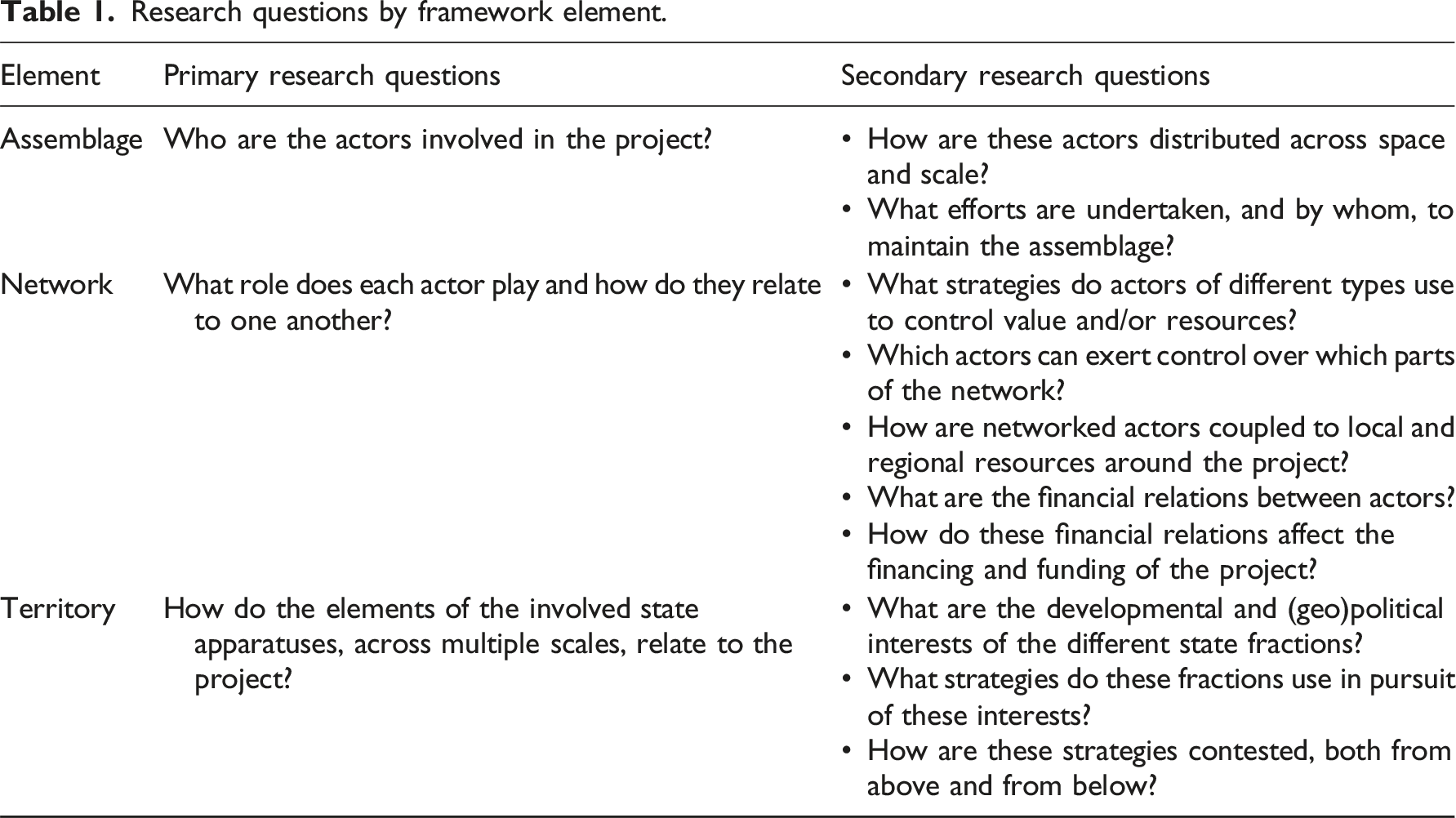
Once the primary and secondary research questions have been answered we need to analyse the interactions between the elements of the framework, as shown in Figure 2. Efforts to maintain the assembled actors influence the roles that different actors can play, while strategies used by actors in the network influence the coherence and directionality of the assemblage. The roles networked actors play and the amount of power they can exert affect how they are coupled into regional and local resources, while the multi-scalar actions of the involved state apparatuses, including attempts to rescale in pursuit of (geo)political aims, impact the distribution of resources and value across the network. Crucially, this involves an analysis of the financing and funding of the project. Lastly, the strategies used by state actors to include and exclude actors in line with political aims will directly impact the composition of the overall assemblage, while in turn this composition will create barriers and facilitators that affect the viability of such strategies. Interactions between assemblage, network, and territory.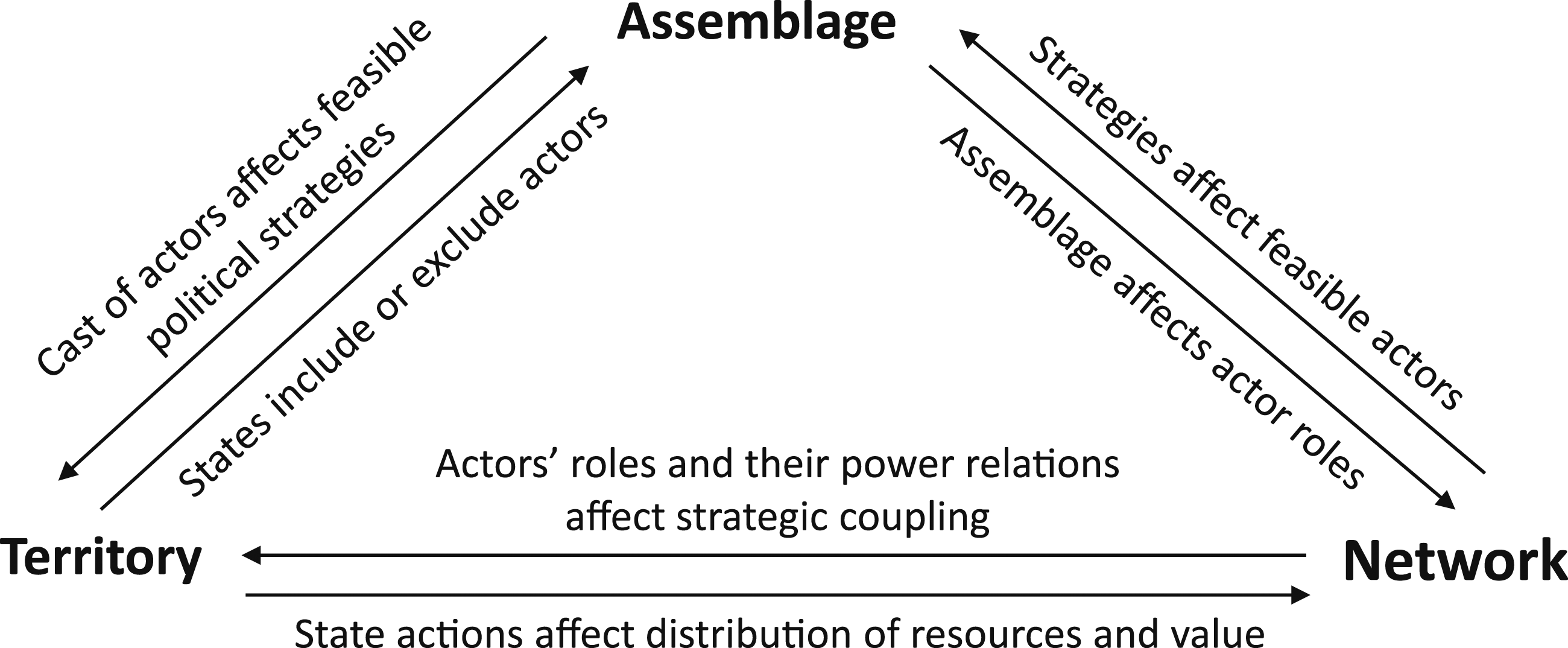
All three elements are likely to change over time as these interactions play out across the lifecycle of an infrastructure project. As the assemblage of actors shifts, new actors will take on new roles. Both new and existing actors try to develop, enact, and update strategies aimed at achieving their goals, be they economic, political, social, or environmental. State apparatuses across different scales will seek new modes of territorialisation and rescaling. And all actors are subject to geopolitical and geoeconomic developments they have no control over but that can substantially impact their scope for action. For this reason, we suggest our framework examining assemblage, network, and territory should be applied iteratively, with the different elements and their interactions revisited in order to capture new developments. This is of course demanding in terms of time and resources needed for data collection. In the following section, we lay out a methodological approach capable of generating the necessary data.
VI Researching Chinese transnational infrastructure projects
While our analytical framework is – in principle – methodologically agnostic, we feel that it lends itself particularly well to research designs that incorporate three broad principles: qualitative methods to produce detailed ‘thick’ descriptions of cases working upwards and outwards from particular infrastructure projects, comparison across cases to tease out variegation over multiple conjunctures and contexts, and tracking cases forwards and backwards in time to see how causal pathways unfold. We draw inspiration from three different but compatible approaches: the extended case method (Burawoy, 1998), incorporated comparisons across cases (Hart, 2018; McMichael, 1990), and comparative process tracing (Bengtsson and Ruonavaara, 2017). We will discuss each of these in turn.
First, the tendency we noted towards geopolitical hyperbole of a ‘new’ cold war sits in tension with the need for more place-based, actor-centred approaches to infrastructure (Oakes, 2021). We propose the use of in-depth ‘extended’ case studies. Gerring’s (2004: 342, emphasis in original) definition of the case study approach as ‘an intensive study of a single unit for the purpose of understanding a larger class of (similar) units’ is helpful to an extent though he argues that such units are ‘spatially bounded’, possibly reflecting his roots in political science. Investigating infrastructure projects as ‘units’ in this sense is difficult because they involve, as our framework establishes, both place-based processes as well as networked global connections. Qualitative methods, including ethnography, are well suited to studying such embedded and diffuse processes because they can work through actors and track the connections they make in place and across space. Here, then, we propose an ‘extended’ case methodology which instead of searching for commonalities across heterogenous cases ‘deploys a different comparative strategy, tracing the source of small difference to external forces….Here the purpose of the comparison is to causally connect the cases. Instead of reducing cases to instances of a general law, we make each case work in its connection to other cases’ (Burawoy, 1998: 19). This requires a focus on a locale, but also recognises that these ‘social forces are the effects of other social processes that for the most part lie outside the realm of investigation’ (Burawoy, 1998: 15). In our case, these ‘other social processes’ may be multi-scalar and geopolitical factors, intra-European inequalities, etc.
Second, by focussing on a given infrastructure project we do not assume that each one is a priori a manifestation of some universal ‘Chinese capitalist’ logic. Instead, in constructing comparisons across cases we draw on Hart (2018) and McMichael’s (1990) notion on ‘encompassing comparison’. We do not see cases as separate entities incapable of influencing one another, nor as instances of an assumed overarching structure which drives outcomes in each locality. Instead, to allow for greater complexity and contingency in comparisons (Lee, 2019) the focus is on uncovering processes and how they differ across contexts, different sets of actors, and differently structured networks. Any totality emerging from the analysis is not preconceived but arises from the mutual interaction of the constituent cases (Hart, 2018) such that ‘the whole’ emerges through the action of its ‘parts’ (McMichael, 1990), which is why we suggest moving from assemblage to network to territory and then to iteratively examine their interactions. For example, the Chinese shipping firm COSCO is active in shipping and increasingly in port investment and management as well as linked logistics (Koenig et al., 2023). Incorporated comparison would allow us to examine a range of COSCO’s port investments in Europe (e.g. Piraeus, Hamburg, and Valencia) as cases, to both understand how they interface with local political economies, but also to work outwards from these cases to discern whether there is a COSCO business model at work across Europe. From there one could see how far what COSCO is doing is different to non-Chinese port operators and/or whether COSCO’s business model reflects a broader ‘Chinese’ approach to state investment in overseas infrastructure. This is very different from starting at the other end and assuming there is a structurally driven Chinese approach to infrastructure that is manifested relatively unproblematically in multiple sites and projects.
Third, we suggest tracing these comparisons through time by using a form of process tracing. Process tracing seeks to establish causality between an action and an outcome by successively eliminating other possible causes (Mahoney, 2015). To be relevant to such an analysis, causal mechanisms have to transmit causal forces and need to have productive continuity (Beach, 2016). Process tracing methods are useful to force an active engagement with the strengths of the available evidence, often through a relatively bounded case study (e.g. the causes of a particular war). Building from the incorporated comparison approach we suggest using comparative process tracing, which traces multiple developments, across time in order to identify the reasons for variation among them. For example, returning to the COSCO example why did their investment in Piraeus in Greece proceed, albeit with a few setbacks, whereas the same company’s investment in Duisburg was pulled. As discussed by Bengtsson and Ruonavaara (2017), comparative process tracing proceeds through stylised periodisation, which functions like an ideal type which can then be explored within and then across cases, even if each one may be at a different stage within this ideal-typical timeline. This is useful because different infrastructure projects at the heart of each extended case may be at very different stages or indeed may fail and never materialise as tangible projects (Appel et al., 2018; Gupta, 2018). This allows for comparisons across diverse projects, such as greenfield investments that are yet to be built and operated, ‘upgrades’ of existing infrastructure, brownfield projects, and acquisitions with relatively little change to the operation of an infrastructure facility.
A typical infrastructure project will move through phases including conception, planning, construction, commissioning, operation, maintenance, and decommissioning. Some more engineering-based accounts (e.g. Willar et al., 2019) only see construction as the relevant cycle, whereas others stress the importance of good planning prior to construction as key to delivering successful completion of construction projects (Bisbey et al., 2020). Other studies focus more on operation and maintenance of infrastructure, particularly where investment is in existing infrastructure and investors are seeking assured revenue streams for recouping the initial investment and returning value to shareholders (Ashton et al., 2016). Given a wide variation in the types of infrastructure, spatial footprints, and temporalities, we use an extensive understanding of the infrastructure project cycle as our ideal type for comparison.
Using process tracing entails unpacking procedures and principles undertaken to reconstruct the timeline and course of action taken over the course of an infrastructure project (Bennett et al., 2019). This approach is time intensive and requires prolonged, systematic engagement with various stakeholders in collecting a large amount of mainly qualitative data on the case under reconstruction. Taken together, extended case studies examined through incorporated comparisons via comparative process tracing can operationalise our framework across a diversity of contexts and project types to provide analytical narratives that can explain how, why, and with what consequences Chinese transnational investment projects come together.
VII Conclusion
Transnational Chinese infrastructure projects have had, and will continue to have, profound political, economic, and social consequences in the countries they traverse. They are being developed and contested in an increasingly fraught geopolitical context. And yet, geographers are still in the process of developing the tools to conceptualise these new constellations. Our review of the rapidly expanding literature demonstrated that we have learnt a huge amount about Chinese transnational infrastructure projects but also identified five ways in which partial conceptions of such projects have limited our analyses. In particular, we found that much of the literature implicitly relied on an overly functional view of the Chinese state, combined with a reliance on structural economic factors to explain outcomes. Projects are often assumed to have singular motivations, and bilateral relations between actors are given analytical primacy. Methodologically, we have suggested that too few studies have undertaken in-depth comparative work.
In response, we have proposed a new framework for analysing transnational infrastructure projects that does not view them as instances of a singular Chinese capital logic. In light of the inherent complexity of such schemes, we have proposed a framework that combines different registers of geographic research. Assemblage thinking brings a focus on shifting sets of diverse actors. Global production network theory shows ways of systematising the relations between actors and the ways in which the resulting networks are coupled into local and regional geographies. Territorialisation across scales allows us to incorporate the roles of actors within the different involved state apparatuses. We have shown how the sequential interaction of these three elements can produce new analytical lenses and research questions. Lastly, we suggested a methodology for operationalising this framework through incorporated comparisons of comparative process tracing across multiple cases.
The literature we have reviewed here has focused largely on cases of investments in transnational infrastructure projects undertaken by Chinese firms and investors. However, the analytical lenses we have described and combined of course can – and should – be trained on other actors as well. Transnational infrastructure projects, whether led by private firms or governments, are likely to keep growing in many parts of the world. We hope that the combination of assemblage, network, and territory we have proposed will help us to understand them better.
Supplemental Material
Supplemental Material - Conceptualising Chinese transnational infrastructure projects in Europe and beyond
Supplemental Material for Conceptualising Chinese transnational infrastructure projects in Europe and beyond by Florian Schaefer and Giles Mohan in Progress in Human Geography.
Footnotes
Declaration of conflicting interests
The author(s) declared no potential conflicts of interest with respect to the research, authorship, and/or publication of this article.
Funding
The author(s) disclosed receipt of the following financial support for the research, authorship, and/or publication of this article: This work was supported by the H2020 European Research Council; Grant agreement ID: 885475.

Supplemental Material
Supplemental material for this article is available online.
Notes
Author biographies
References
Supplementary Material
Please find the following supplemental material available below.
For Open Access articles published under a Creative Commons License, all supplemental material carries the same license as the article it is associated with.
For non-Open Access articles published, all supplemental material carries a non-exclusive license, and permission requests for re-use of supplemental material or any part of supplemental material shall be sent directly to the copyright owner as specified in the copyright notice associated with the article.
