




Abstract
This study presents a novel perspective on the impact of market-intelligence channels on property markets and the subsequent effects on the formation of alliances among public- and private-sector actors in urban governance. I argue and demonstrate that property actors, especially investors, collaborate through knowledge coalitions by utilizing the market-intelligence channels they created, not only to navigate property markets but also to establish the mode of regulation in urban development. By using a strategic-relational perspective, it is possible to analyze the underlying institutional infrastructure of the property market as a dynamic system shaped by the relationships and interactions among various social and economic actors. In addition to forming various marketing or lobbying coalitions, property actors forge alliances by converting pertinent information—such as locational analysis, socioeconomic data, policy and land-use forecasts, permit conditions, and planning strategies—into advanced market intelligence. This process allows them to define the norms, rules, and principles to be negotiated with public policymakers and enhance their positions in knowledge-based governance networks. To obtain empirical evidence about Amsterdam’s property market, a comprehensive data set was created to identify the influential actors. Extensive deskwork was conducted to map the diverse channels and connections of market intelligence. Key players in the property market were also interviewed to provide a comprehensive view of the active market-intelligence channels in governance networks.
Keywords
Introduction
Property-market decisions are complex and involve doubt, uncertainty, and interpretation. Therefore, property-market actors collaborate to mitigate and manage these complexities by developing expertise, trust, authority, and strategic alliances (Das and Teng, 2001). These actors can indirectly influence regulations when assuming the role of gatekeepers (Raco and Brill, 2022). Through their professional expertise, lobbying strategies, and advisory or consultancy positions, they leverage their power to advance the market’s interests, thereby fostering new decision-making models (ibid.). In this article, the property market is approached from the angle of “knowledge infrastructure,” defined here as the conduits of “market intelligence.” While examining knowledge sources and categorizing their functions, it emerged that property-market actors utilize information channels to form alliances and establish interdependencies. Besides engaging in costly lobbying efforts and networking activities, and in addition to investing in expensive data sets and consultancy reports, it was found that diverse actors exploit these information channels as a means of achieving their goals in governance networks.
The main argument is that property-market-intelligence channels enable property actors to shape the market and connect with governance networks, which are regimes and patterns of engagement through formal and informal connections, negotiation, and coalitions. This article refers to the assemblage of knowledge, research, and data sources as “property-market intelligence,” which includes intricate networks and infrastructure beyond conventional sources of market expertise. The existence of close-knit, informal networks where access is controlled by influential companies or individuals has long been considered a common feature of property markets (Brill and Robin, 2020). However, the way in which market and public-sector actors form alliances is now changing. The impetus comes from the increasing professionalization of platform-based market-intelligence channels that use knowledge as a connector. Much remains unclear about the role that knowledge, data, and research play within these alliances (Colenutt, 2022; Raco and Savini, 2019; Robin, 2022; Rotta and Teixeira, 2019). I suggest examining these channels from a new perspective, placing the actors in governance networks within their knowledge context. This viewpoint offers a unique outlook on how cities are governed, where the line between public and private sectors is often indistinct.
The study underlying this article explored the knowledge infrastructure and information channels supporting property-market coalitions in order to clarify the entrepreneurial approach to urban governance. Entrepreneurial governance brings market actors closer to policymakers, which makes it difficult to understand the “motives, behavior and modus operandi” of the diversity of actors. In order to understand this diversity, some suggest investigating the “motives, behavior and modus operandi” of actors from a relational perspective by seeing the market as a social construct (Adams et al., 2012: 2578). Relational approaches help to build better representations of actors and their behavior; they also provide a useful set of analytical tools that enable economic and behavioral explanations of property development (Guy and Henneberry, 2000). From this perspective, markets are neither given nor transcendental but organized to favor the interests of powerful actors. Also, the property market is seen not as a fixed structure but as a dynamic process connecting to the institutional context. Jessop’s (2001, 2008) strategic-relational approach emphasizes that institutional reproduction and power relations among actors are key to understanding markets as social constructs that are produced through dynamic processes. This approach helps to elucidate how market-intelligence channels serve as a means to establish interdependencies and leverage positions in dynamic governance networks and play a role in shaping the norms, rules, and principles to be negotiated with public policymakers (McGuirk, 2000). These rules establish an institutional infrastructure to understand interactions between the actors involved in city building. Heeding the call to consider the multidimensional characteristics of property actors in establishing these connections (Del Giudice et al., 2019), my analysis illustrates how property actors, particularly investors, use these channels to establish strategic power relations in neutral environments.
Property-market-driven alliances foster regular interactions and connections between market actors. At another level, they facilitate engagement between municipalities and property-market parties. My research identifies and illustrates three pathways through which interdependencies emerge. First, investors establish and use the collective asset of knowledge through market-intelligence channels. Second, by accessing these channels, they establish new connections in the form of knowledge-based conventions, that is, customary behavior. Third, these channels function as platforms to build trust and confidence in the market. Diverse interconnections within governance networks emerge, leading to various outcomes. For example, knowledge-based alliances enable local governments to access market networks, while property-market actors find opportunities to collaborate and establish relationships with decision-makers in order to jointly establish norms and principles. Local governments are increasingly creating their own open data or digital platforms as civic initiatives and complementary welfare-provision mechanisms (Chiappini, 2020). However, market-intelligence channels help establish alliances among market actors, as well as between market actors and the public sector. These channels open up lobbying and networking opportunities on sectoral, locational, or policy choices. Within the competitive investment landscape, these alliances foster the exchange of expertise among market participants, mitigate risks through collective decision-making, and enable public actors to engage with market actors in neutral environments.
As my goal is to illustrate how reliance on the property market is shifting as market-intelligence channels infiltrate urban governance networks, the Amsterdam case offers an opportunity to observe this transformation and gain insights that can be applied more broadly. Amsterdam, known for its thoughtful urban planning, has shifted from plan-led toward a market-led system in recent years. Examining market-intelligence channels, we can gain valuable insight into how property investors have been able to navigate within regulated planning frameworks. This sheds light on entrepreneurial governance in cities, illustrating the shift away from plan-led systems of urban development. Moreover, Amsterdam’s unique mix of global investors and governance infrastructure makes it a prime location for studying the relationship between property markets and policy networks.
Uncovering market-intelligence channels was a challenge, requiring a combination of empirical data collection, participant observation, and in-depth interviews with property-market actors. The Dutch “polder tradition” is a consensus-based decision-making model that institutionalizes policy networks. The Dutch planning system has shifted from a centralized, plan-led development model to a market-led, opportunistic development model. Yet the tradition of direct communication and negotiation between local market parties and municipal decision-makers has remained influential. However, from the early 2000s onward, and especially after the global financial crisis, a more competitive and financialized investment landscape emerged. In that setting, existing knowledge and lobbying networks were insufficient for investors to navigate effectively. The Crisis and Recovery Act, issued right after the financial crisis in 2010, expressed the Dutch government’s desire for foreign investors to continue their projects and investments. This transformation illustrates how local and international market-intelligence channels enabled knowledge coalitions, lobbying opportunities, and connections beyond Amsterdam. Obviously, Amsterdam’s compact size makes it easier to understand sophisticated property-market-intelligence channels. However, the case also suggests how these channels allowed foreign investors to tap into local market dynamics and local investors to connect elsewhere. The city is not only an important property-investment destination but also home to property investors active internationally. This makes Amsterdam a very interesting vantage point from which to study and understand how property investors use market-intelligence channels to navigate local planning systems and governance networks. These relationships are institutionalized in Amsterdam through organizations like Holland Metropole, as can be seen in the sections below.
The article establishes a theoretical framework for interpreting the property industry through its position in market-intelligence channels. Then it presents the methodology as well as Amsterdam’s property-market context and property-intelligence channels. In the subsequent analysis, research findings depict market-intelligence channels as a collective asset to build knowledge as a connector and as a platform to build trust and confidence in governance networks. The article concludes by highlighting the value of these insights for urban and planning studies.
Role of market-intelligence channels in urban governance networks
According to Storper (1997), the collective behavioral characteristics displayed by economic groups and networks are expressed through interactions among their participants, which include connections, alliances, and coalitions. In the same vein, Fainstein’s (2001) work depicted property actors as “city builders” and displayed their collective behavior patterns in detail. Pursuing the idea that networks of actors—brokers, appraisers, developers, investors, and planners—channel capital through the built environment, more recent work underlines how these collective actions alter the course of investments (Weber, 2016). Investigating how economic self-interest links market actors through diverse coalitions, power networks, and lobbies is another way to understand how they shape property markets (Brill and Robin, 2020; Colenutt, 2020; Lizieri and Mekic, 2015; Raimbault, 2021).
A property market is a place of exchange but also a process (Slater and Tonkiss, 2013) through which actors establish alliances that reach beyond lobbying and networking. Many other power groups negotiate decisions in property markets: public political alliances, community groups, and platforms that mix private- and public-sector actors. Bonded by shared agreements, these coalitions produce general principles by which to understand value and risk, the behavior of other actors, and how to control market conditions (Gotham, 2006). Drawing inspiration from Polanyi’s work, this viewpoint regards market exchange as a complex framework of interactions that incorporate market components within specific historical and institutional contexts, which may include private-property systems, monetary systems, pricing mechanisms, as well as specific norms and knowledge (Slater and Tonkiss, 2013).
Moving away from the neoclassical economic understanding to conceive the market as a bounded, self-regulating system with an inherent tendency toward equilibrium, we can look at the property market as a social construct (Gemici, 2008; Maucourant and Plociniczak, 2013). Regulation theory enables the analysis of the state’s crucial role in capitalist reproduction processes. This angle, according to Adams and Tiesdell (2012), challenges the mainstream view that economic agents make individual choices based on rational choice. Seeing the property market as a social construct enables us to understand economic decisions within their relational institutional context, in which market transactions follow humanly devised rules, norms, and regulations (ibid.). From this vantage point, it is conceivable that informal rules and routines need to be formulated, discussed, and negotiated by market actors, as these go beyond the official legal context that regulates them.
According to Jessop (2001, 2008), it is important to use a strategic-relational approach to analyze institutional reproduction and the ability of actors to reflect on the institutional context. This approach emphasizes the significance of comprehending the interrelationships and interactions among social structures and institutions that are shaped by power relations and struggles among different social and economic actors (Jessop, 1998). Concretely, one can discern how a particular structure may favor certain actors, identities, strategies, spatial and temporal perspectives, and actions over others when choosing a course of action (Jessop, 2001). A relational perspective not only enables us to understand these actors and their behavior but also to examine the underlying institutional infrastructure linking them. Market-intelligence channels provide relatively transparent platforms to investigate strategic relations in an opaque context of power. Following this approach, the alliances between property-market actors can be explored through the constantly contested and negotiated power relations and regimes they establish among social structures and institutions (Jessop, 1998).
In this dynamic process of negotiation, market actors use their networks to strengthen their positions and secure their capital accumulation conditions. Various interdependencies arise through these processes, as McGuirk (2000) highlights. Cooperation among a multitude of actors allows access to various resources that are crucial in creating the capacity to govern. Understanding the mode of regulation in property markets helps us incorporate both economic and non-economic factors within the collective system of norms, institutions, organizational structures, social networks, and behavioral patterns (Jessop, 2003).
The role of knowledge, research, and data-based market alliances, especially in establishing rules, routines, norms, or principles that go beyond the official legal context, is not comprehensively explored, particularly in the field of urban studies and planning scholarship (Yigitcanlar and Bulu, 2015). Some scholars have acknowledged how local conditions and networks can shape the property industry (Haila, 2015; Rogers and Koh, 2017). Going beyond the concept of beneficial networking relations, Alexander (2014) expanded on the importance of interaction for uncovering, testing, and exchanging knowledge within property markets (see also Webster and Lai, 2003). Recent studies have linked this discourse to the regulation and governance of urban areas by asserting that the existence of professional bodies, specialists, advisors, lobbyists, or industry representatives allows the public sector to transfer its power and obligation to private-sector firms (Colenutt, 2020, 2022; Manganelli, 2015; Raco and Brill, 2022). Some others moved the discussion beyond regulation and showed the close relationship between expertise, real-estate activities, and the production of specific urban forms (Robin, 2022). However, to gain a strategic-relational understanding of the property market, it is necessary to investigate social structures and institutions, focusing particularly on the previously overlooked interrelationships and interactions in governance networks.
Property-market-intelligence channels enable us to understand the evolving nature of governance networks in city building. Governance networks are recognized within the context of a neoliberal urban political system, characterized by collaborations between economic and institutional elites (Swyngedouw, 2005, 2007). They are also seen as a reform mechanism to overcome the inflexibilities associated with traditional bureaucratic local governance, enabling them to function with greater autonomy and innovation (Aarsaether et al., 2011; Blanco, 2013; Rhodes, 1997). Robin (2022) not only discusses the importance of governance networks in city building but also highlights that few discussions relate them to the politics of expertise in urban settings (Oliver et al., 2017). The collaborative initiatives at the core of property-market-driven governance networks, known as market-intelligence channels, exhibit similarities to Granovetter’s (1992) analysis of institutions and their network linkages, whereby economic activities are coordinated by groups of people rather than carried out by isolated individuals. Granovetter (1985) noted that economic relationships are not purely based on economic relations but are also influenced by non-economic factors such as social relationships. Simply put, networks and institutions are mutually constitutive, creating the “conditions of possibility” for each other (Owen-Smith and Powell, 2008). At times, market-intelligence channels can have direct economic effects on urban development, as when providing data to identify investment locations. At other times, the effects are indirect, as when providing actors with the opportunity to form networks, lobby, negotiate, and eventually shape market dynamics. In addition, they have the capacity to set up norms or facilitate negotiations regarding regulations, rules, or principles of urban development. Either way, market-intelligence channels enable private-sector actors to navigate the market and connect to governance networks as reliable allies by establishing modes of market regulation.
Seeing the market as more than a place for the exchange of economic self-interest enables researchers to observe the collective system of norms, institutions, organizational structures, social networks, and behavioral patterns. The way property actors obtain and use market intelligence is context-specific. Echeverri-Gent and Sadiq (2020) recommend seeing these interactions from a relational view of actors and their context, as people make meaning from their context to create situated knowledge through the dynamics and context of interactions (Gherardi, 2008). From this point of view, urban governance networks increasingly involve market-intelligence channels, making urban development more dependent on forming alliances among public- and private-sector actors. Property actors, especially investors, collaborate with each other and with the public sector through knowledge coalitions by utilizing market-intelligence channels to navigate property markets and establish the mode of regulation in urban development. In return, the public-sector agencies, like municipalities or other local development organizations, engage with property actors through local policy networks that are instrumentalized by market-intelligence channels, which put the private sector in a position to influence urban regulation. Even though the public sector can generate and accumulate information and have its own knowledge platforms, it still seems to rely on external market-intelligence channels to establish impartial connections and networks with the property markets they rely on.
Against that backdrop and shining the spotlight on Amsterdam, the following sections will discuss how intelligence channels are operationalized in governance networks using their situated knowledge. However, first, I would like to elaborate on the methods underlying the research for this study.
Research context, methods, and data sources
The property industry contains a variety of actors (investors, developers, etc.) falling into sectors that are intertwined in multiple, overlapping, and contradictory ways (Özogul and Taşan-Kok, 2020; Taşan-Kok et al., 2023). The way they use data, research, and knowledge also varies. Without generalizing, I set out to define certain behavioral patterns of property actors in Amsterdam in relation to market intelligence. Instead of focusing on a single actor, I chose to conduct a comprehensive study of the industry and devote particular attention to investors, as they use market intelligence more systematically. To compensate for the lack of transparency, the privacy requirements of market parties, and the complexity of regulations, formal or informal rules, norms, and principles, I used the following four resources:
Self-constructed data set of market-intelligence channels
I created a data set of systematically collected information on data, research, and consultancy companies. The information was assembled through extensive desk research with the purpose of analyzing different channels in terms of their member profiles, connections, and fields of expertise. The data set contains 126 organizations (companies, networks, platforms, fairs, etc.) that have supported property investments in the Amsterdam Metropolitan Region Amsterdam (MRA). These are the most active companies and organizations within all sectoral categories (Figure 1). I created a typology of three main market-intelligence channels by grouping these companies and organizations based on their function: property-data providers; knowledge platforms; and professional and social networks. I double-checked the accuracy of my data set by showing it to interviewees, who confirmed the contents and filled in the gaps. With their input, the figure expanded, helping me contextualize what constitutes market intelligence. To my knowledge, such a comprehensive data set on market-intelligence channels does not exist elsewhere.
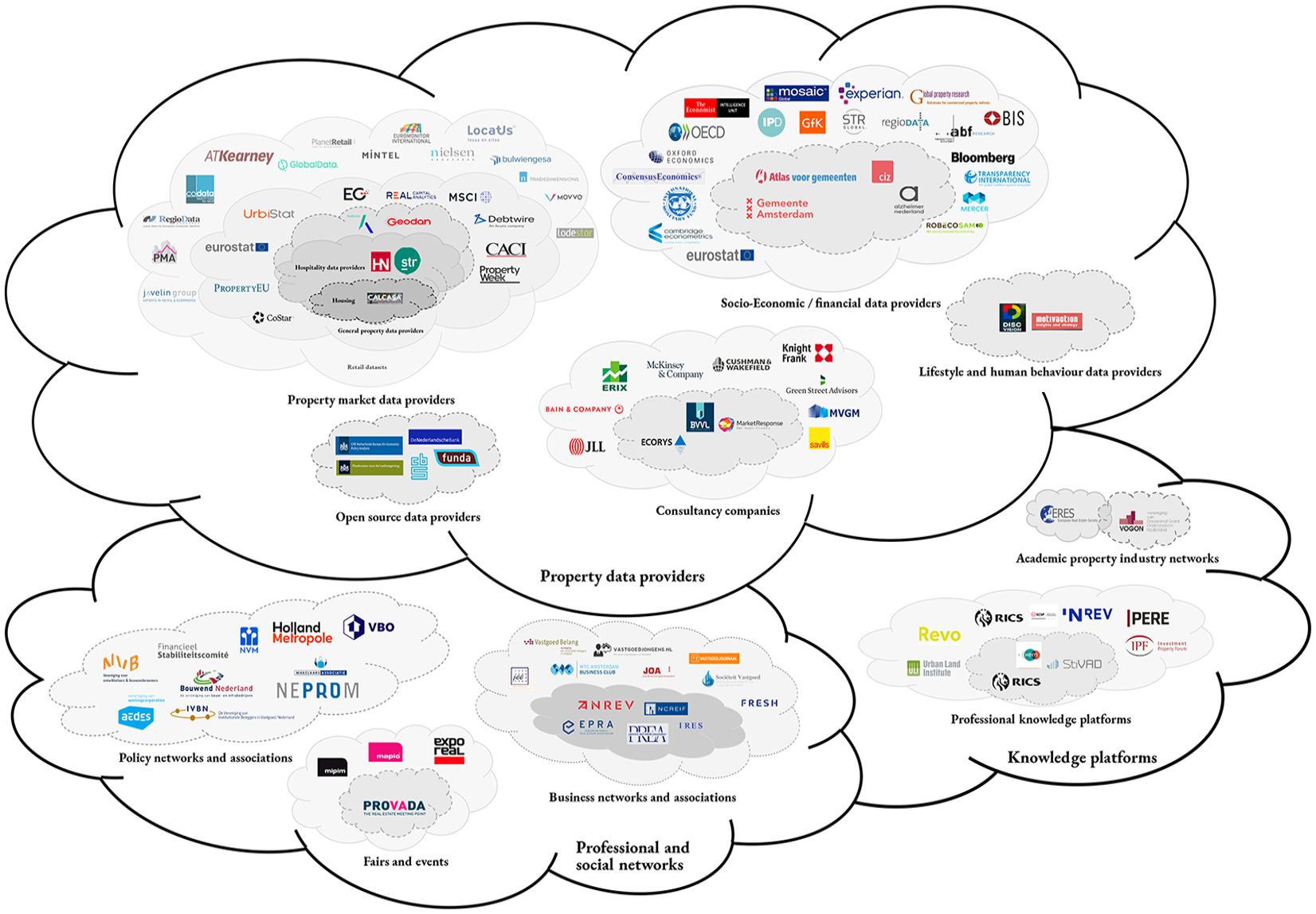
Market-intelligence channels active in Amsterdam’s property industry (2020).
Transaction database
A commercial real-estate database created by Real Capital Analytics (currently MSCI) tracks property transactions of 5 million Euros and above. From it, I compiled a list of all property investors who were actively investing in MRA over the last 15 years (2005–2020). Of these, I selected the dominant ones for the last 3 years based on their transaction volume. This selection allowed me to reach out to the 10 top actors, all of whom I managed to interview. We discussed the impact of market intelligence on their position in the property market. Assured that the names of the company and the interviewees would be anonymized in this article, they could speak freely. However, a list giving interviewees’ positions in the market is included in the Appendix (Table 2).
Participant observation
Once I had a clear picture of who the actors were and how they used market intelligence, I participated in several activities that enabled me to observe how investors engage with knowledge platforms and take part in professional and social networks. I participated in PROVADA (Professionele Vastgoed Dagen 1 ) (26–28 October 2020), a Dutch real-estate fair that falls into my category of professional and social networks. Due to the COVID-19 pandemic, the fair had to be held online. I also became a member of Urban Land Institute (ULI), “the oldest and largest network of cross-disciplinary real estate and land use experts in the world,” 2 which falls into my category of a knowledge platform (see Table 1 and Figure 2). As a member, I could take part in ULI webinars and a conference (ULI Virtual Europe Conference, 8–10 February 2021 3 ) and observe how market intelligence is used to form networks. Besides attending numerous property-market webinars passively, I also co-organized a webinar series with property-industry actors to more actively investigate the market-intelligence channels.
Characteristics of market-intelligence channels.
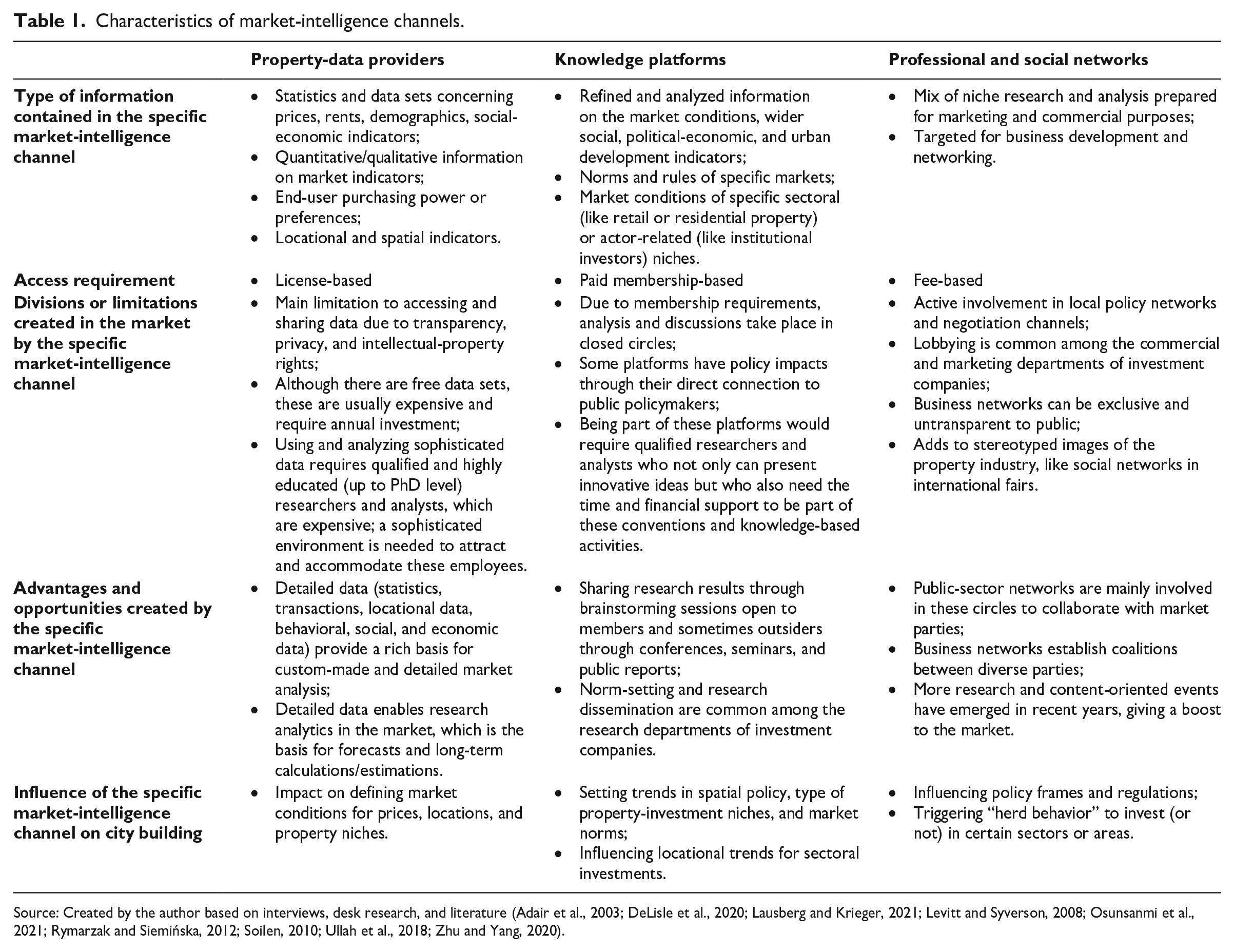
Source: Created by the author based on interviews, desk research, and literature (Adair et al., 2003; DeLisle et al., 2020; Lausberg and Krieger, 2021; Levitt and Syverson, 2008; Osunsanmi et al., 2021; Rymarzak and Siemińska, 2012; Soilen, 2010; Ullah et al., 2018; Zhu and Yang, 2020).
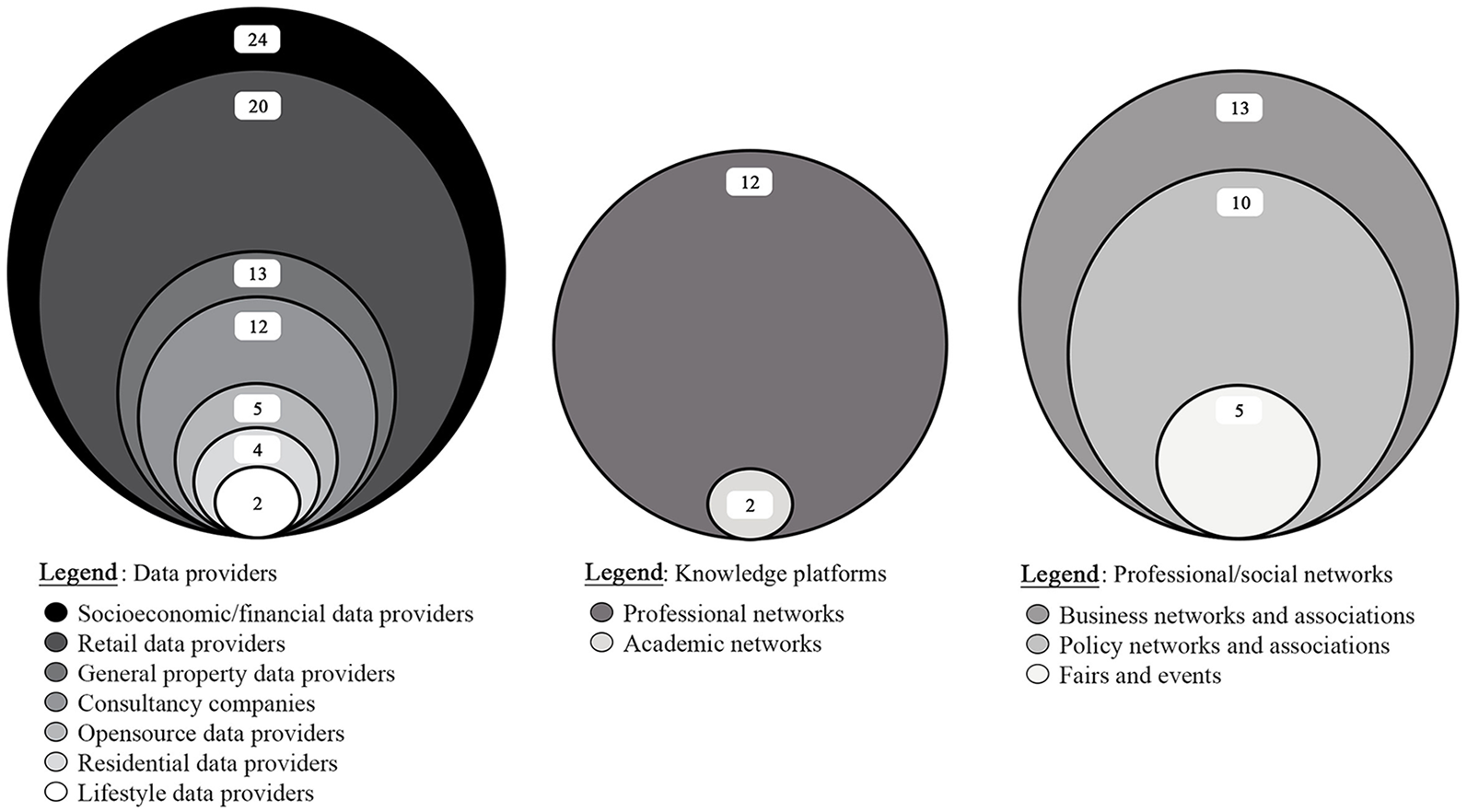
Distribution of market-intelligence channels in Amsterdam in 2020 (% of total companies in the data set).
Interviews
I conducted 39 interviews (Appendix Table 2) with market-intelligence actors, property investors, and the public sector, providing a comprehensive representation of viewpoints between 2019 and 2024 (see Appendix Table 1). For each actor category (market intelligence, property industry, public sector), I selected relevant representatives based on my typology of market-intelligence channels (data providers, knowledge platforms, professional and social networks). Then I interviewed actors in the market sector: both executives (CEO, manager, etc.) and research staff (analysts, researchers, head of research, etc.). In some cases, I drew upon actors within the same company, as they have different views on the role of research. Within the public sector, I interviewed experts (planners or other technocrats) as well as managers. Using snowballing sampling, I reached out to external providers such as data and research firms, platforms, and consultants. The interviews served two purposes: to understand the role and type of research and how investors use the information obtained and to establish a data set of market-intelligence channels. The interviews were supplemented by desk research that linked this information to my data set of dominant players in the market based on the MSCI data. All interviewees signed informed-consent forms.
Mapping market-intelligence channels in Amsterdam
I observed diverse channels through which sophisticated property-market knowledge is accumulated and shared. For instance, I consulted the journal of the Dutch Association of Real Estate Researchers (VOGON), which combines knowledge from theory and practice. And while participating in PROVADA, the largest real-estate fair in the Netherlands, I followed interactive sessions in which researchers, data analysts, planners, and public policymakers discussed their approaches and tools for collecting data and doing research. There are many international and local equivalents of VOGON and PROVADA where private- and public-sector actors share knowledge. However, it is difficult to categorize the market-intelligence channels involved, as they contain multiple geographical, thematic, and functional strands. The same information provider may have different rules and functions across continents, or the procedures in a domestic branch may differ from those at headquarters. Based on my findings, I divided market-intelligence channels into three broad categories: data providers; knowledge platforms; and professional/social networks.
Knowledge platforms disseminate a combination of raw and tailor-made data analysis to their membership, who can use the derived knowledge to create influential visions and set trends in the industry. Knowledge platforms create interactions and interdependencies among their members through institutionalized channels that produce norms or principles which enable or constrain the property markets, such as RICS 4 or ULI. 5 Professional networks circulate general market information, facilitate connections, and engage in lobbying activities. They afford mutual reliance in the form of informal and discreet connections. These are made through professional and social networks, allowing individuals to interact in a more relaxed manner, such as ExpoReal, MAPIC, 6 or MIPIM. 7 And, finally, interconnections may be created by data providers through commercial data and knowledge exchange mechanisms and consultancy. Data providers usually supply facts, figures, and quantitative information. Aligned with their sectoral specialties, data providers offer custom-made macro- and micro-scale analyses on which forecasts and long-term estimations of the market can be based.
Under these main market-intelligence channels lie many sub-categories, divided by sector, theme, or function (see Figure 2). Table 1 summarizes the main characteristics of these channels. They comprise local and international business and policy networks and associations, as well as fairs and events, ranging from the industry-wide popular MIPIM (International Market of Property Professionals, in French) to the more sophisticated and knowledge-oriented ExpoReal (Real Estate Trade Fair). They usually circulate commercially oriented market intelligence and offer scope for lobbying.
Over the past 15 years about 1,169 property companies invested predominantly in Amsterdam: about 36 percent in offices, 24 percent in industry, 18 percent in residential, 15 percent in retail, and 7 percent in hospitality sectors (MSCI Investors Data 8 ). Interestingly, 72 percent of the market is dominated by Dutch firms, while only 28 percent of the total investment volume was brought in by international companies (ibid.). Within this framework, market-intelligence channels in Amsterdam’s property investment have diversified, reflecting a three-fold typology, as illustrated in Figure 2 (see the companies in my data set in Figure 1) and confirmed by interviews and other data sources.
The landscape of market intelligence is complex and dynamic; as new companies emerge, new channels of data appear. By turning the spotlight on investors, rather than the many other actors at diverse positions in the property industry, some tendencies become clear.
The data providers are the most visible channel in Amsterdam in terms of number of companies that fall under this category (Figure 2). Investors are keen to acquire data sets, consultancy services, and new technologies. The buyers of data have the right to use it, which will enable them to invest in less risky and more productive locations (Teixeira and Rotta, 2012). As my research reveals, data providers help property investors in several ways: to map risky locations and opportunity areas; find the right investment location; find niche sectors to invest in; and understand the patterns of core established locations, gentrification, and revitalizing locations (Int.9,11,18,24,35).
The knowledge platforms help to set spatial policy trends, define spatial development and market norms, and select property-investment niches, especially those enabling discussions among market- and public-sector actors (Int.7,23). In Amsterdam, the impact of using these platforms in urban planning has been considerable. The active land-development tradition brings public- and private-sector parties together in the early stages of property development through a consensus-oriented planning approach (Heurkens et al., 2015). These platforms are criticized for allowing non-statutory bodies, such as the RICS, to have a say in urban development by setting rules. Especially where formalized procedures are lacking, these bodies consisting of a relatively small pool of consultants will be able “to establish the rules of the game” in a “closed-shop” (McAllister et al., 2016).
We can observe the impact of professional and social networks through their influence in “shaping policy frames and regulations” (Int.27), as well as in shaping actor behavior. In the Amsterdam context, as my consultant interviewees informed me (Int.11,32), the role of such networks is enormous in translating the “policy language to the market language, and vice versa” (Int.35). These networks also enable direct and indirect negotiations with the public sector, playing the role of a “sounding board” to see whether certain decisions would settle well in the market (Int.25). In light of Colenutt’s (2022) argument that property lobbies undertake political lobbying at different levels of governance, it is possible to observe the political influence of networks and associations in urban development decisions in the Dutch context, partly because of the traditionally direct connection between policymakers and property companies. For instance, the Association of Dutch Municipalities (VNG) and the Association of Dutch Project Developers (NEPROM) work together closely to influence planning legislation (Needham, 2014). This is demonstrated by the negotiations of the “40-40-20 Regulation,” which was issued by the municipality in 2018 to stimulate affordable housing production. Through networks like the Association of Dutch Institutional Investors (IVBN), investors influenced the amount, type, and volume of housing production in the city (Int.20). After long negotiations with IVBN, NEPROM, and the Association of Private Real Estate Investors (Vastgoed Belang), the City of Amsterdam signed a declaration of intent in 2017 to stimulate the production of more affordable rental properties in middle-income housing. Although this regulation still faces some challenges, the coalitions that were established to draft it have shaped how the city can experiment with new ideas.
It is also possible to see that knowledge platforms like ULI play diverse roles in sectoral and locational choices. They can have direct consultancy effects, as in the case of the Haven-Stad project in Amsterdam, where the ULI provided a consultancy-like service. In 2019, the City of Amsterdam invited ULI experts to a 3-day workshop to advise on how to speed up redevelopment. The experts recommended that the municipality share the risks, engage with investors, and accelerate the planning processes. 9 This complex project for the North of Amsterdam contains mixed landownership patterns, jurisdiction issues due to the involvement of the Port Authority of Amsterdam, and land availability as companies connected to the port will have to be relocated to free up space for development. An interview with one of the property developer/investors in the area confirms the “. . . ingrained mistrust between government and commercial organisations” (Int. 5). However, another interview reveals that the kind of initiatives that bring public and private stakeholders together played a role in displaying the importance and urgency of the project by creating “. . . built-in moments for the government to be able to negotiate with landowners on how, what, and at what cost to ensure that you really service the community” (Int. 38). Organizations like ULI can also have an indirect effect. We can observe this effect in mixed-use and multi-use projects, an emerging real-estate trend, which features as an important policy trend in strategies produced by the new Amsterdam Structure Vision 2040. 10 These emerging trends are discussed in conferences organized by ULI’s local branches. Experts from municipalities and the property industry participate in these conferences. 11
In the next section, keeping the landscape of market intelligence in mind, I will show how investors deploy data, research, and knowledge to shape the property market in Amsterdam.
The role of market-intelligence channels in shaping Amsterdam’s property-market-based networks
Once an investment decision is made, capital is spatially fixed to a location, at least for a while (French et al., 2011; Halbert et al., 2014). However, as noted, issues of transparency, competition, and privacy obscure what is behind these strategic decisions. At the same time, these investment decisions are crucial in fixing the capital to certain locations. Aiming to understand the role of market intelligence in property-driven governance networks, my research follows two tracks: mapping the market-intelligence channels to establish who is in there and discerning how these companies, networks, organizations, or platforms shape property markets through diverse modes of regulation.
The desk research and data collection enabled me to produce a map of market-intelligence channels in Amsterdam. The interviews and observations then provided me with the evidence to decipher the role of data providers, knowledge platforms, and professional and social networks in shaping the property markets. My research reveals that market-intelligence channels have a significant impact on property development. However, it also attests to their main importance: they assist property investors in shaping the market through explicit strategies formed by knowledge, research, and data by utilizing market intelligence as a collective asset, as a connector, and as a platform to produce knowledge as a means to build trust and confidence in the market. Table 2 gives an overview of the ways these channels enable investors to position themselves and navigate in the market.
Role of market intelligence in shaping the market.
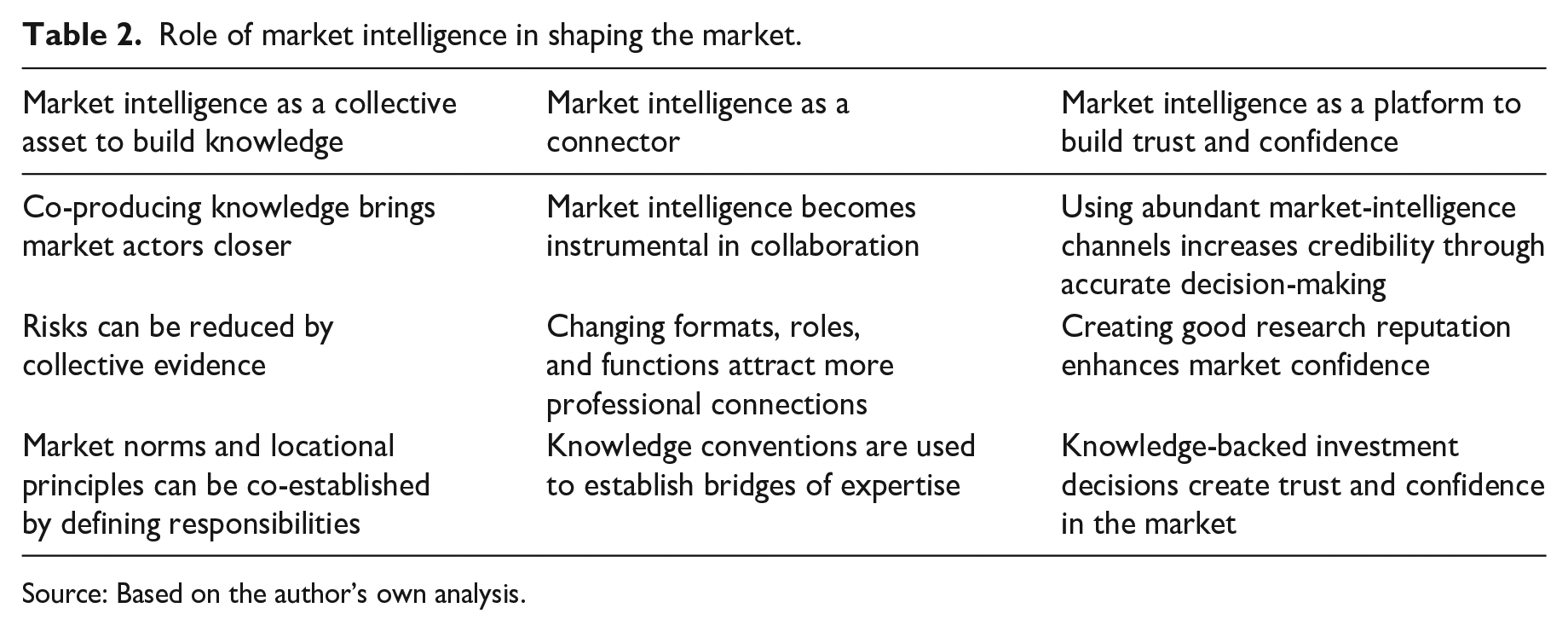
Source: Based on the author’s own analysis.
Market-intelligence channels help actors navigate the property markets and position themselves in governance networks in three ways. First of all, these channels help them co-produce knowledge as a collective asset, and using this process, they establish closer connections, reduce their risks, and establish market norms and locational principles. Second, they function as connecters to establish collaboration channels, professionalize existing interdependencies, and enable new expertise platforms. Finally, they help actors build trust and confidence, thereby enhancing their credibility and reputation, enabling accurate decision-making channels, and supporting knowledge-backed investment decisions. The following section delves into these pathways as found among prominent actors in Amsterdam’s property-investment market. This case material offers a closer vantage point from which to see how they navigate this complex landscape.
Market intelligence as a collective asset to build knowledge
Property-investment companies not only buy knowledge, research, and data; they also take part in creating the conditions under which market intelligence can be turned into a collective asset. In property-industry parlance, an asset refers to real-estate properties, shares, bonds, or other tools. In this article, a collective asset refers not only to shared market knowledge, data, and research but also to the benefits of being part of professional and social networks, alliances, and coalitions that produce, disseminate, share, and control market knowledge. My research suggests that market intelligence contributes to the shaping of property markets in diverse ways: by co-producing knowledge which brings market actors closer; by enabling them to co-establish market norms and locational principles; and by creating trust and confidence. Market intelligence has always been important for property investors. My interviewees agreed that increasing the range of intelligence channels brings market actors closer, providing a tool to collaborate (Int.3, 33, 34). However, they also agreed that being part of research platforms or professional networks helps them develop their business acumen further (Int.27, 24).
Shaw (2020) emphasizes the importance of understanding how such platforms operate since these are socially and technically crucial to urban real-estate markets. According to my interviewees, companies gain a competitive advantage by either purchasing or producing market intelligence. Access to custom-made data analysis is perceived as prestigious (Int.30). It is valuable to researchers and analysts working for institutional investors when making calculations, estimates, or scenario analyses (Int.2,13,24). Furthermore, information acquired through professional connections that are established by participation in these platforms is valued for supporting investment decisions (Int.1,6,11,19). Most of my interviewees, who are either researchers or analysts in property investment, highlighted the value of co-production and dissemination of knowledge through professional platforms despite their extremely competitive environment. One (Int. 11), who is head of research with an international institutional investor, expanded on the value of sharing, co-producing, and discussing market conditions under stressful circumstances in organized platforms or networks with like-minded people. Involvement in such knowledge co-production creates new relationships beyond market competition and a sense of safety during stressful times such as the COVID-19 pandemic.
Investors establish specialized research departments (Int.14), hire in-house researchers (Int.20), and create special research and data budgets (Int.17). Annual research budgets of between €50,000 and €500,000 cover various activities, from purchasing market intelligence to hiring in-house analysts and researchers (Int.13,18). According to the research director of a knowledge platform active in Amsterdam, members’ revenues range from €20 million to €1.5 billion a year, enabling a variety of possibilities to use market intelligence (Int.2). Larger firms have their own research departments, up to a team of 10, and even produce their own magazines (Int.22). As a director of a large company explained,
You have to have an opinion on general macro-economics, local economics, lifestyles, customer preferences, demography, sustainability, etc. . . . And you have to have all sorts of people in your organization that can oversee that. We have specialists on demographics. We have specialists on purely retail . . . we have a macro-economic view, and tax people too. (Int.5)
Expanding their expertise enables a company to respond to rapidly changing conditions by developing custom-made intelligence and by using it to access professional platforms.
As a second advantage, property investment companies see their market intelligence as a shared asset that serves to reduce market risks (Int.21). Unlike opportunistic property developers, investors typically analyze market conditions before looking into specific properties as a possible investment. The added value of market research lies in its capacity to not only identify risks but also convince less familiar parties why a location is risky (or not) by presenting evidence (Int.3). However, according to the managing director of an international investment management and development company, “. . . speed in many cases is more important than the best location. This is kind of sad and it contradicts everything that we know from: location . . . location . . . location” (Int.4). A market consultant (Int.8) underlined that even though intuition or gut feeling may play an important role in the speedy behavior of some investors, convincing analyses that are confirmed by reliable market parties would enable taking risky decisions as “. . . this is a question of numbers.” At several market events, 12 I observed open discussions about the warehouse and apartment-building sectors as the most promising investment choices. Following the COVID-19 pandemic, warehouse and apartment-building transactions became the largest sectors by total investment in European property markets. 13
Finally, market intelligence also provides grounds on which to set norms and establish principles for fair competition as well as to define responsibilities in a dynamic and uncertain decision-making environment. The impetus was explained by the owner of a property-investment platform and co-initiator of a professional platform. They aimed to establish norms in the Dutch property markets by:
acting together in a large group and trying to get it on a better level because previously, for instance, taxations and valuations were really low level. Like: ‘I am a real estate evaluator, and this building is 5 million because I’m saying so.’ No norms, no transparency . . . (Int.4).
Much interaction occurs on knowledge platforms (such as ULI and RICS). These are virtual spaces where experts get together to discuss and decide on norms and principles of the market or to penalize those who do not comply (Int.9). For instance, the advantages of spreading warehouses and last-mile logistics industries around the urban periphery were highlighted at several ULI events, as was the idea of accommodating datacenters in cities. 14 In the Metropolitan Region of Amsterdam, heated discussions have been taking place on the location and use of datacenters. The concerns range from exacerbating noise pollution and energy impact to increasing density in certain areas and creating new traffic circulation or mobility patterns. Interestingly, policymakers, especially at the local government level, tend to be part of these conversations. Actors in both the private-property market and the public sector are involved in these knowledge-building activities (Gaglione, 2018; ULI, 2019). As will be discussed next, these efforts contribute to gaining and strengthening positions in the market but also facilitate connections among actors participating in market-intelligence channels.
Market intelligence as a connector
Social networks, politics, and power relations are influential in the market but do not enable actors to make locational or strategic decisions (Colli and Adriaensen, 2020). In my research with property investors, market intelligence tended to connect companies and other actors (public sector, communities, etc.) who went on to collectively establish knowledge-oriented relations through diverse channels. Investors and lenders have become innovative in establishing connections through the knowledge platforms they are involved in (Adair et al., 2007). For opportunistic investors and lenders, personal relationships still play an important role in networks, and political lobbyists seek to influence certain decisions. Yet the connections between the market and public parties are taking on new forms. Research by Brill and Özogul (2021) shows that even overseas companies like Greystar Real Estate Partners, which is an international property developer and manager based in the United States, actively engage with policymakers at local events like PROVADA. As my interviews and observations reveal, knowledge platforms and professional and social networks offer new incentives to establish collaboration channels. First, knowledge becomes instrumental in replacing social and individual relations in market collaboration with prestigious expertise-based networks. Second, market-intelligence channels such as professional platforms and social networks change their formats, roles, and functions to attract more professional connections. Finally, professional and social networks are used to establish bridges of expertise between public- and private-sector actors.
Knowledge is instrumental for companies seeking to enter prestigious networks. In fact, using market intelligence, property investors collectively stimulate what Storper called “economically viable innovations” (Storper, 1997). Long-term players such as institutional investors see the added value of data, especially when it contains “shared views” (Int.2). Professional events (like MIPIM, MAPIC, ExpoReal, PROVADA, etc.) are not perceived “just as a channel to reach your public in a networking event” (Int. 3) but also as incentives to share knowledge and get feedback. In such meetings, fairs, or events market norms can be set jointly. Referring to the growing distinction between commercial and professional networks, several interviewees (Int. 12, 15, 20) noted the benefits of being involved in professional knowledge platforms (such as ULI, INREV, and ECSP) or expert events like ExpoReal. The latter was characterized by one interviewee (Int. 6) as an event that “. . . deals only with content.” These conventions enable experts to get together around the content. They are “. . . much better for learning something and actually creating some knowledge together . . . and more importantly, setting some ground rules and principles in the market” (Int. 4). All these responses point to new forms of closed expert-based networks in which rules of the game are set. Companies clearly see the value of establishing alliances: “Sharing knowledge is the thing. It’s teaming up together for specific goals. Not only knowing what’s going on, but also setting up together, for instance, new indices and thinking about structure for them” (Int.12).
Market intelligence works as a connector, linking diverse actors through various intelligence channels and establishing specialized network connections. During my research, I came across the same individuals that I had interviewed at events such as PROVADA, the ULI conference, and professional webinars. There, I observed a familiarity among the participants (despite distance and competitive positions). As one interviewee explained, they collaborate, discuss, and brainstorm in these settings “sometimes for decades” (Int.9). According to another interviewee, these are platforms where “. . . you can discuss new but risky ideas that you cannot even mention to your colleagues in your own company, and set some norms that will be widely acceptable sooner or later” (Int. 14). Trust networks, as will be discussed in the next section, are important new forms of connection in the market. The importance of these networks varies with the context. In response, investors may innovate and take risks or proceed with caution by emulating others.
While still competing with each other, professional platforms provide the incentive for discussing market conditions and setting norms concurrently (Adair et al., 2003). Moreover, by sharing data through neutral information platforms, investors can develop benchmarks without disturbing existing competitive conditions (StiVAD, 2020). The Dutch non-profit information platform StiVAD (2020) states in its vision that “. . . by sharing data, parties can further professionalize and work on more market transparency. The latter will lead to more confidence in the real estate markets.” These platforms can be exclusive when selecting their members. New-generation professional platforms, events, or networks tend to be more research-oriented than the purely commercial, social, and political networks of the past (Int.16,34,36). Including new-generation platforms in their program gives parties more prestige, enhances their reputation, and showcases their knowledge (Pyhrr et al., 2011). Even purely social networking platforms disseminate market intelligence through panel debates, scientific discussions, and market research, creating a format to establish connections based on good reputation. The Real Estate Society’s networks of continents (America, Europe, Africa, Latin America, etc.) not only boost market networking among companies but also produce journals, monograph series, annual conferences, doctoral dissertation seminars, and doctoral mentoring programs. That outreach offers prime training, research, and publication sources for individuals who work within the industry (Pyhrr et al., 2011).
Second, new forms, roles, and functions of market-intelligence channels offer new ways to establish collaboration. Lobbying is changing, as noted by an interviewee: “The lobby groups need data and research to underpin their point” (Int.9). In this data-oriented form, market intelligence is key to gaining recognition and respect. A junior analyst (Int.13) mentioned that lobby groups connect people to accelerate change. In addition, they help standardize market analysis by offering access to data and artificial intelligence. Several others underlined the important role of professional lobby groups after crisis periods in connecting and supporting companies through knowledge channels (Int.4,5,12,15, 37). As another interviewee noted, “sharing quantitative and qualitative intelligence is the only way for some property investors to take part in knowledge platforms, which are the most prestigious networks to establish and maintain market reputation” (Int.11). Knowledge platforms are perceived as crucial for developing strategies after periods of crisis (Int.15). They are also important for defining market principles and norms when collaborating with the public sector on issues such as affordable housing provision (Int.12).
In terms of the changing role of market intelligence, the imitation of group behavior (mimicry) is important in highly competitive property markets. Property scholars refer to its “herding effects” (Dieci et al., 2018). For instance, fee-based business and policy networks, as well as fairs and events, began to accentuate market intelligence. This entailed organizing discussion platforms, hosting knowledge-sharing sessions, or disseminating local knowledge among their participants, thereby imitating activities common among knowledge- and research-oriented platforms. This shift occurred in an Amsterdam-based professional network where local, mainly small property companies are linked through membership. There, a channel of knowledge exchange was created, disseminating information among the members through a research-based magazine and regular brainstorming sessions (Int.2). According to the research director of this network, the aim is to “make data more available and accessible to [members]” as it enables the members to learn from each other in innovative ways. Acting like knowledge platforms, these networks are shifting their emphasis from purely lobbying to supporting their members under competitive market conditions. Moreover, they also set up “investment coalitions” in order to bypass bureaucratic public-sector actors (Int.2). These coalitions are formed by investment companies around large-scale projects in an effort to secure a better position in the market, to integrate different sectors and areas, and to negotiate with the public sector.
Professional and social networks are particularly suited to establish bridges of expertise thanks to their flexible profile, making them accessible to public- and private-sector organizations. My interviews reveal that property fairs and events were transformed to connect companies through new channels. Knowledge platforms began to include public-sector actors. A hierarchy is emerging in the knowledge networks of international fairs and events such as MIPIM, MAPIC, or ExpoReal, as well as domestic events such as PROVADA. One interviewee (Int.8), who only attends PROVADA, said he participates mainly to follow market discussions. Others said their reason to participate in ExpoReal was that it is “for those with expert knowledge” (Int.4), explaining that “one can pick up serious market information provided by banks, mortgage banks, and investment managers and even by municipalities” (Int.7). Several interviewees (Int.3, 6, 9, 11) indicated that ExpoReal serves professional purposes, as opposed to the commercial MIPIM, considered to be the most social network and marketing-oriented event, which is “. . . more focused on wining and dining, and less on content” (Int.3). These events seem to be specializing in certain forms of knowledge exchange between public- and private-sector actors, especially since the 2008 economic crisis. One of my interviewees (Int.9) reflected on the changes MIPIM is going through, noting the increasing involvement of public-sector organizations such as municipalities and regional authorities. He said the main reason for his company to attend is to:
. . . explore relevant cities which are in our investments target, basically to learn what those municipalities are doing, where they have project opportunities, which direction do they grow, etc., to make a hypothesis on what for us are the hotspot areas we should consider.
Another interviewee (Int. 37), research director of a local knowledge platform active in Amsterdam and elsewhere in the country, mentioned the increasing membership of municipal policymakers, planners, and other public-sector experts, including some from the national government. Their participation eases collaboration on important points in the spatial policy agenda. An excellent example of such initiatives is KERN, 15 a knowledge platform established by real-estate companies operating in the commercial property and retail sector in 1986. It is the knowledge and network organization for all stakeholders involved in operating and revitalizing city-center areas. KERN acts as a formal network that facilitates collaboration among companies, municipalities, national government agencies, and non-governmental organizations (NGOs). It plays a vital role in negotiating targets and forming coalitions for the visionary development of concepts for planned shopping centers in the Netherlands. This platform effectively connects the public and private sectors by enabling them to take part in policy initiatives such as the Retail Agenda. The Ministry of Economic Affairs launched the Retail Agenda in 2015, bringing together various organizations and market participants to work collaboratively on creating policies for inner-city areas and commercial centers in the Netherlands. During an interview with a KERN member (Int. 39), it was disclosed that the organization has distinct committees designed to facilitate partnerships among various stakeholders, such as the Samenwerken Overheid en Markt (Government and Market Collaboration Committee). However, the member clarified that these committees are primarily focused on “. . . co-creating knowledge rather than strategy implementation.”
As the formats, roles, and functions of professional alliances change, more connections are made in the property industry. Guidelines for best practice in construction and property development arise within knowledge platforms and professional networks, and these guidelines have a direct impact on city building. Common practices established around market intelligence also help investors determine which niche sectors would be the most profitable to invest in (Adair et al., 2007). The new channels of market intelligence infiltrate traditional forms of market behavior, namely, social and political networking as well as lobbying based on personal connections and power coalitions. Moreover, long-term knowledge-based relations build trust among market parties and establish confidence to act collectively, as discussed in the following section.
Market intelligence as a platform to build trust and confidence
The perception of knowledge, research, and data in the property-investment market is especially upbeat after crises (Shah et al., 2018). The COVID-19 pandemic illustrates how large property investors tried to understand market trends through diverse research channels (Hasenmaile, 2020; Mattarocci and Roberti, 2020). They increasingly appreciated the role of market intelligence not only in supporting investment decisions but also in building confidence. In part, confidence grows because market intelligence creates a cache of credibility among market actors, and in part, it grows because knowledge-based platforms are seen by the public sector as indicators of accountability. My research highlights three ways that market intelligence builds trust and confidence: by increasing credibility through the availability of abundant market-intelligence channels; by creating a research reputation that facilitates establishing market confidence; and by enabling knowledge-backed investment decisions.
Transparency in property markets is an important factor in creating confidence to attract professional investors. In the 1990s, sources of property data were considered fragmented, incomplete, inaccessible, and not transparent (Ball and Tsolacos, 2002). Today, thanks to the abundance of market-intelligence channels, even small companies can access data sets, locational (GIS) or consumer data, and so on (see Figure 1). Moreover, new types of data, techniques, and advisory support are available, using new technologies and combining diverse methods. According to one interviewee (Int.3), data are not “two-dimensional anymore . . . and things change in time faster than ever, it seems,” notably consumer preferences and behavior. Property actors adopt new technologies such as machine-learning algorithms for big-data analysis, enabling them to predict prices and make forecasts (Ho et al., 2021). Similarly, new analytical tools and technologies help them estimate human behavior. Contemporary market research differs from traditional consumer analysis, which makes predictions by clustering people on their behavior, as explained by one of my interviewees (Int.16), who owns a consultancy firm specialized in behavioral economics. By creating psychological profiles of people, lifestyle, and behavior, consultants combine the choices of constructed personalities with statistics and translate the results into spatial data with GIS. Another interviewee, who is the CEO of a large Dutch residential investment and development company, explained that they apply new technologies to estimate the use of space by groups of people (classified by age, income, education, etc.) to design more effective products (Int.6). Their data collection and analysis methods “became their trademark” in the market. This kind of custom-made intelligence, which is also used in the public-policy sector, as another interviewee underlines (Int.25), increases the credibility of the company and the accuracy of socio-spatial decisions. The impact of these new technologies, as one of my interviewees (Int. 1) argued, is visible in the end-product, which “will be proudly presented to the platforms [they] are involved in” as a stellar project. They are proud not only because of the sustainability prize the company of the interviewee won but also because they believe in the social impact they had in the area.
New companies have emerged to organize, commercialize, and sell data. Yet the role of research distinguishes a respected company from firms who only make cyclical calculations, the latter being perceived as “opportunistic and selfish” (Int.6). Moreover, as I observed at PROVADA, it is not only data companies that represent and market themselves at this large domestic property fair, but also property investors put their researchers up front to showcase their reliability in the market. One of these (Int.9), who is head of research at an international investment management company, indicated how research “. . . created trust for attracting investors to [their] portfolio.” My interview with a senior public servant (Int. 27) underlines that the City of Amsterdam is very much aware of the increasing market-intelligence channels. Not only does the city utilize some of the data resources directly, but it also establishes alliances with the trusted market parties based on their long-term expertise-based relations, as in the case of Holland Metropole. In this domestic policy network, Amsterdam City, along with four other municipalities, collaborates with the largest Dutch institutional investors, developers, construction companies, consultants, and design agencies to develop policy solutions in the fields of housing, labor market, accessibility, and climate-related topics. This property-market-driven alliance works as a platform that connects municipalities with property-market actors to meet on a regular basis. As indicated by one of the interviewees (Int. 23) who is a high-level bureaucrat at the City of Amsterdam, the alliance also enables them to go together to International Fairs like Expo and MIPIM “with a combined stand.” The interviewee indicated that they “. . . are there together to expose the Dutch projects to the world but also to meet each other and try to find the good ways to continue collaborating.” He, and several other market parties who were involved in Holland Metropole (Int. 5, 11,15), expressed similar pride in being part of this platform, noting the confidence it gives them, especially in international markets.
A good research reputation encourages market confidence, as it enables individual companies to get involved in research networks. These function, according to an interviewee (Int. 13), as platforms of trust, not only among the property actors but also between them and public-policy networks. Indeed, public- and private-sector actors in urban development are more likely to cooperate in predictable environments (Eika, 2019). As highlighted by an interviewee (Int.12), head of research for one of the largest property investors in Amsterdam, “how people view research has to do with the output; if [the output] is bad, or if people actually don’t believe that output so much . . . then you will have a hard time to convince them next time,” confirming that reliability can only be communicated through actions (Sobel, 1985). Sobel argues that someone becomes credible by consistently providing accurate and valuable information or by performing useful services. As another interviewee (Int.20) indicated, a company’s credibility grows in the eyes of the municipality when it has research capacity. This is not only because it will be on the same platforms to lobby. It is also because, through involvement in knowledge platforms and professional networks, the company can more easily show its credibility “as a reliable partner” to the local authorities (ibid.). This argument was confirmed by public-sector interviewees, who are project managers for the City of Amsterdam (Int. 23, 25, 28).
Finally, the importance of knowledge-backed forms of investment decisions was highlighted with respect to creating trust and confidence. As a research manager of a large domestic investor explained, “. . . more and more data are coming into play in all the decisions” (Int.8). A researcher from a small local property-investment company emphasized that those who can combine their market intelligence with intuition about local market behavior have competitive advantages compared with “those large international corporations trying to enter the Dutch market” (Int.14). Another interviewee, working in the industry for more than 30 years in top executive positions and currently as an independent advisor (Int.10), argued that “. . . you have an awful lot of knowledge, probably unconscious, but all somewhere here [pointing at his head] . . . however, I would not have the reputation without having the hard-knowledge on the Dutch market.” For some large international property investors, decision-making is teamwork in which research must provide some support for the company’s vision (Int.7). Even though that vision may be shaped by people with long-running experience in the market, the combination of vision based on experience and evidence based on research increases the credibility of the company that accommodates it, according to another interviewee (Int.20). “Expert judgment” that combines market intelligence with intuition adds to the trust and reputation of the company and professionals in the market (Gallimore and McAllister, 2004).
Coming to the end of my analysis, which is based on information gathered from a selection of experts, commercial specialists, policymakers, and all kinds of other actors in Amsterdam’s property market, the next section will underline the importance of unveiling the market-intelligence channels in shaping property markets.
Conclusion
Property development and investment have direct consequences for urban development. They fuel construction activities that contribute to economic activity, employment, and urban design. The quality of the projects increases livability through improvements in the physical environment. And the market activities enhance the ability of cities to accommodate major changes (Henneberry and Roberts, 2008). Presenting the property market as more than a place of exchange, I demonstrated how actors use market-intelligence channels to strengthen their positions in governance networks. Stronger positions enable property companies to be part of the processes that shape cities.
This article turns the spotlight on the knowledge and expertise that accumulate and circulate in the property industry. I observed that market-intelligence channels have become sophisticated, contributing to new positions and hierarchies in the property market. Using market intelligence as a collective asset, property actors build knowledge, establish connections, and create the trust and reputation that enable their coalitions to survive. They use market intelligence in both innovative and conservative ways to take investment risks or simply mimic each other’s investment behavior. In any case, channels providing market intelligence are crucial in assisting investors as they navigate the city and establish their positions within urban governance networks. As several others (Adams and Tiesdell, 2012; Alvarez León et al., 2018) have suggested, I emphasize the importance of looking beyond the locational choices or other factors that influence market actors’ behavior.
Market intelligence plays a crucial role in shaping policy narratives and facilitating collaborations between investors and policymakers in urban development. Property companies have established in-house research units or engaged knowledge providers to conduct custom-made analysis, making market intelligence an industry in its own right. With increased access to private and public market data, shared investment products, performance standards, and changes in regulatory environments, market intelligence has had a significant impact on property markets (Schulte et al., 2005). Using these channels, municipalities are establishing political alliances and networks with private-sector actors. Although these do not directly impact decision-making, they shape urban governance networks, which in turn create dependence on market dynamics and contracts for regulating relationships between actors (Haveri and Anttiroiko, 2023). Self-directing policy and governance networks are increasingly important in delivering public services.
As market dependencies pervade the public sector, the need to understand the dynamics of the property industry is becoming urgent. To do so requires a fresh look at the property industry through the lens of market-intelligence channels, thereby opening new avenues to understand property-led urban planning and governance (Parker et al., 2020). While it is not easy to draw a picture of this complex and dynamic landscape, we must take steps to understand how particular dimensions play important roles in shaping markets. The underutilization of knowledge, research, and data is addressed in this article by describing the role that knowledge can play in property markets. Although the detailed discussions are revealing, many points remain for further research to understand the connections between planning and property-market dynamics. This requires challenging and dismantling disciplinary boundaries in the established literature (Özogul et al., 2024).
Following the COVID-19 pandemic, the property market of Amsterdam could be studied by confronting new policy narratives with the market intelligence that has accumulated in this period. In particular, I propose investigating to what extent market intelligence shapes patterns of investment and regulatory response within the city. New coalitions are emerging between public- and private-sector actors, especially around the norms, principles, and regulations of affordable housing. In addition to the ongoing problem of affordable housing, there are new issues, such as student housing and nitrogen emissions, which require the formation of new knowledge coalitions. To provide housing for students, it will be necessary for universities, national and local governments, and property investors set new goals for reducing the shortage of units more quickly, as international and non-local students are at risk of homelessness. 16 Nitrogen emissions led to a crisis 17 after new rules impacted sectors like the construction industry. The deposition of too much nitrogen in vulnerable nature areas in recent years is likely to promote alliances among the affected sectors.
New coalitions, lobby groups, power networks, and political platforms are being established to deal with these issues and many others. Such efforts are linked to knowledge- and expertise-based coalitions that are established through market-intelligence channels. These channels contribute to shaping the cities by creating new dependencies between the public and private sectors based on reliability and cooperation. More importantly, they provide a consistent and continuous formal and informal institutional basis for negotiating the “rules of the game.” These channels are shaped through exclusive networks, but they are also accessible by public-sector agencies, which see knowledge coalitions as reliable platforms to establish connections with the private sector. Research enables property actors to communicate with municipalities to clarify expectations and incorporate these into their projects. In this way, companies can demonstrate their reliability to the public actors, thereby ensuring a smooth development process from concept to completion. Similarly, public-sector agencies also use research to connect with market actors and discuss policy challenges in a neutral environment.
It is important to note some limitations of this study. Some property actors, such as speculative investors, opportunistic developers, and short-term individual investors, do not rely on market intelligence as much as other players in the market, like the established investment firms that were interviewed. However, this study provides a basis to delve deeper into the property market and gain a better understanding of its inner workings through more nuanced research approaches and interdisciplinary lenses. In my opinion, further research is needed to comprehend the impact of market-intelligence channels on property-investment decisions, particularly in terms of the social value and quality of the built environments they create in the city. Moreover, there is an urgent need to study market-intelligence channels to ascertain whether they facilitate opportunistic behavior. For example, ESG (Environmental, Social, and Governance) investments are voluntary contributions that companies make to sustainable development. As more companies seek to increase their ESG credentials by investing in green funds and sustainable property, professional knowledge platforms like ULI bring in experts to define ESG criteria in the property market. However, these forms of investment have recently faced increased scrutiny, becoming the target of criticism and allegations of greenwashing and fraud. 18 Professional platforms and business networks have already been working for decades, with increasing involvement of the public sector, to establish norms and rules for ESG investments in cities (Tantow, 2012). The intricate processes shaped by governance networks and negotiations, and influenced by market-intelligence channels, warrant thorough investigation.
Due to the enormous diversity of actors, property-investment companies will always have diverse forms of coalitions which influence their investment decisions and the development of the built environment. These coalitions now exert significant influence on the regulatory frameworks that govern the built environment. Alongside the sophisticated market-intelligence channels, there will always be commercial, social, and political alliances and lobbies. Characterizing property-market actors as “profit-maximizers,” Campbell et al. (2014) underline how market decisions involve doubt, uncertainty, and interpretation. Moreover, cultural and geographical differences in doing business also play a role. As for academics, we need a better understanding of the complex actor networks, relationships, and positions in city building, as each actor has dynamic, fluid, and complex identities. They may seem to spring from one source, yet they are diverse and complex.
Supplemental Material
sj-docx-1-eur-10.1177_09697764241266411 – Supplemental material for Navigating the city: Role of property-market intelligence channels in urban governance networks
Supplemental material, sj-docx-1-eur-10.1177_09697764241266411 for Navigating the city: Role of property-market intelligence channels in urban governance networks by Tuna Taşan-Kok in European Urban and Regional Studies
Supplemental Material
sj-docx-2-eur-10.1177_09697764241266411 – Supplemental material for Navigating the city: Role of property-market intelligence channels in urban governance networks
Supplemental material, sj-docx-2-eur-10.1177_09697764241266411 for Navigating the city: Role of property-market intelligence channels in urban governance networks by Tuna Taşan-Kok in European Urban and Regional Studies
Footnotes
Declaration of conflicting interests
The author(s) declared no potential conflicts of interest with respect to the research, authorship, and/or publication of this article.
Funding
The author(s) disclosed receipt of the following financial support for the research, authorship, and/or publication of this article: The paper was written within the framework of the WHIG Project (What is Governed in Cities: Residential Investment Landscapes and the Governance and Regulation of Housing Production), which examines the inter-relationships between contemporary investment flows into urban property markets, and the governance arrangements and public policy instruments that are designed to regulate them. The project has received funding from the Open Research Area for the Social Sciences (ORA) under grant agreement no. 464.18.113.

Supplemental material
Supplemental material for this article is available online.
Notes
References
Supplementary Material
Please find the following supplemental material available below.
For Open Access articles published under a Creative Commons License, all supplemental material carries the same license as the article it is associated with.
For non-Open Access articles published, all supplemental material carries a non-exclusive license, and permission requests for re-use of supplemental material or any part of supplemental material shall be sent directly to the copyright owner as specified in the copyright notice associated with the article.
