




Abstract
There is mounting evidence that the current model of economic development negatively affects many ecological processes and creates serious threats to the sustainability of economic processes and welfare. In response to those threats, policies have been introduced at supranational and national levels to alleviate the most burning environmental challenges and mitigate their consequences for humanity. At the same time, however, there is a growing understanding that economy–environment relations have to be analysed and approached from a geographical perspective, as this sheds more light on spatial differences and specificities, the unevenness of transition processes and their social consequences as well as the need to perform the transition towards sustainability in a spatially sensitive manner. This article seeks to reconstruct and analyse two processes – urban sprawl and the automobile revolution – that took place in the Polish urban regions during the systemic transformation period and to discuss their potential consequences for the transition to sustainability from a geographical perspective. We show that different places, due to their specificities and legacies, start sustainability transitions from different initial conditions that might affect the pace of this process as well as its environmental and social consequences.
Keywords
Introduction
There seems to be increasing doubt about the sustainability of the existing model of economic development in the long term, as it leads to numerous environmental challenges such as deforestation, soil erosion, loss of biodiversity and global warming (Arrow et al., 1995; Ekins, 2002; Neumayer, 2012). These challenges pose risks to ecological processes and jeopardise many human economic activities (Cardinale et al., 2012; Sumaila et al., 2011). In response to these negative consequences, policymakers have launched policies to redirect the current economic development model towards a more sustainable one (Meadowcroft, 2009). At the same time, there is a growing consensus that economy–environment relations should also be considered from a geographical perspective, as this sheds more light on spatial differences and specificities as well as the unevenness of transition processes and their social consequences (Gibbs and O’Neill, 2017; Hansen and Coenen, 2015; Murphy, 2015).
The transition towards sustainability seems even more challenging for countries that are simultaneously undergoing other types of systemic transformation, such as emerging economies (Anderson et al., 2016; Gouldson et al., 2016; Jupesta et al., 2011). Emerging economies have been experiencing significant economic growth that, on the one hand, generates wealth for their societies, and on the other, creates new challenges (e.g. environmental degradation). As a result, such countries have been put on a development path that is unsustainable in the long term but is difficult to turn away from. This article seeks to reconstruct and analyse two processes – urban sprawl and the automobile revolution – that took place in Poland during the systemic transformation period and to discuss their potential consequences for the transition towards sustainability from a geographical perspective. We aim to answer the following research questions: What is the nature of urban sprawl and the automobile revolution, and how intense have they been in Poland in recent years? Is there a relationship between urban sprawl and car ownership in Poland? What are the environmental consequences of these processes? To answer these research questions, we analyse urban sprawl and the automobile revolution in 45 Polish urban regions and examine a case study of the Poznań urban region. We show that Poland and its regions, like other Central and Eastern European (CEE) countries, have inherited many social challenges from the communist period, such as a severe shortage of affordable housing and insufficient mobility opportunities.
Combined with a relatively liberal model of economic transformation, this situation has led to many undesirable and uncontrolled processes, which are illustrated in this article through the case of intensive urban sprawl and the automobile revolution in the Polish urban regions. Both processes were, to a great extent, left without significant regulatory coordination, which has led, among other things, to the occupation of large areas of land, increasing preferences for means of individual mobility, the unfavourable structure of car fleets and growing environmental impacts. Interestingly, the automobile revolution was greatly intensified by Poland’s accession to membership of the European Union (EU) and the liberalisation of trade policies. In the article, we do not explore the sustainability transition as such but rather pay special attention to three specific geographical aspects relevant from the perspective of the emerging economy’s regions and their road towards sustainability: place specificity, coordination between places and policies and the normative aspect of the transition.
The rest of the article is structured as follows: first, we briefly shed light on the academic literature on the transition towards sustainability and specifically the selected geographical aspects of this process. We then describe the urban sprawl in Poland, its historical antecedents and the environmental consequences. We elaborate on the automobile revolution in Poland after 1990 and especially on the role of EU membership and its effect on the almost unrestricted importation of used cars from Western Europe. Finally, we combine the two processes and show how they reinforced each other and led urban regions along a path of development that is unfavourable from a sustainability perspective, but is also laden with certain inertia and thus difficult to change.
Environmental challenges, transition towards sustainability and why geography matters
The magnitude of the human intervention and impact on the natural environment has reached a level that raises concerns about the sustainability of the current model of economic development. Alarm has repeatedly been raised about ozone depletion, deforestation, disastrous droughts, loss of biodiversity and rising global temperatures. The latter leads to climate change, which is often perceived as one of the greatest contemporary threats to both the global ecological and socio-economic systems (IPCC, 2022; Sala et al., 2000). The consequences of climate change, although difficult to predict and verify empirically, are varied in character and have attracted researchers from numerous disciplines. For example, environmental scientists have shown that a changing climate might lead to disruptions at all levels of ecological organisation, including population decline and extinction, shifts in geographic range and changes in the species composition of communities (Smith, 2011), and, more generally, to a decrease in global biodiversity (Sala et al., 2000). Economists have tried to determine how much the GDP of each country and region would fall as a result of a global rise in temperature, as well as the effect of this phenomenon on agriculture and forestry, water resources, power use, air quality and human health (Hope, 2006; Maddison, 2003). Regardless of discipline, the existing empirical findings suggest that the negative consequences of environmental challenges will become increasingly serious and troublesome and that measures to mitigate their negative impacts are necessary.
In light of these environmental challenges, scholars and policymakers have started to develop and promote the idea of a transition towards sustainability (Markard et al., 2012; OECD, 2011; Smith et al., 2005). This transition can be understood as ‘a fundamental transformation towards more sustainable models of production and consumption’ (Markard et al., 2012: 955). This process covers many systems, including energy and water supply, transportation, agriculture and housing. Such transitions go beyond technological transformations, as they also include changes in the behaviour of individuals as well as regulatory regimes. For instance, the rise of automobiles as the main means of mobility was followed and complemented by a series of other developments, including the construction of road networks and fuel supply systems. Simultaneously, other domains, such as housing and spatial planning also changed (Markard et al., 2012). Now, to shift mobility from an individual, car-dominant model towards other, more sustainable means of transportation, not only requires changing combustion-driven vehicles to electric or hydrogen-powered ones, but also reconsidering various aspects of socio-economic reality and policymaking which are interlinked with the mobility system. In other words, the existing (un)sustainable socio-technical subsystems are maintained and reproduced by various actors (industry, policymakers, consumers, engineers, etc.), and the shift towards sustainability thus requires that all of them interact and change in a coevolutionary manner (Geels, 2012).
While much attention has been dedicated to the technological and temporal aspects of the transition towards sustainability, scholars are increasingly recognising the fundamentally geographical character of managing this process (Coenen and Truffer, 2012; Raven et al., 2012). This character requires exploration of the particular places in which this transition takes place and is embedded, as well as the relationship of this place with other places. The importance of geography unfolds in numerous ways. For instance, Hansen and Coenen (2015) offered a comprehensive overview of the spatial lenses through which the transitions towards sustainability are being investigated: the role of urban and regional visions and policies, informal localised institutions, local natural resource endowments and local technological and industrial specialisation. In this paper, we pay special attention to three specific geographical aspects that are relevant from the perspective of an emerging economy’s regions and their road towards sustainability: place specificity, coordination between places and policies and the normative aspect of the transition.
One geographical aspect of the discussed transition finds expression in spatial embeddedness and specificity (Bridge et al., 2013; Hansen and Coenen, 2015). Spatial embeddedness encompasses both the sunk cost of the existing built environment as well as place-specific cultures, values, consumption and production patterns. These aspects result, to some extent, from historically dependent events and processes that determine the present events and are difficult and costly to overturn. Moreover, these specificities and attributes of the built environment (e.g. the availability and distribution of housing, the type of heating system and infrastructure, the accessibility of public transportation) might drive the uneven pace of transition towards sustainability and increase the exposure of some places to environmental injustice (Bouzarovski and Simcock, 2017; Vaz et al., 2017). The existing literature is rich with examples of geographical specificities at different scales. At the EU level, Tirado-Herrero and Ürge-Vorsatz (2012), using the evidence from Hungary, showed that CEE post-communist countries are trapped in their district heating systems, which expose their inhabitants to disproportionately high heating costs and potentially a disproportionate burden in transition policies. In a similar vein, Cantarero (2020) reviewed and discussed the challenges that developing countries face on their road to a more sustainable economic model. These challenges include, among others, a prevalence of unprocessed biomass in the energy mix, growing demand for transport with a high reliance on imported fossil fuels, poor institutions, low level of knowledge concerning environmental challenges, lack of capital and technologies and a risk of the resumption of neo-colonial relations with corporations and their home countries. For infrastructural, institutional and economic reasons, these countries’ road to sustainability will be especially rough and costly.
At the regional and local levels, other specificities can be identified. Paterson (2007) argued that the locally specific culture and attachment to a certain type of consumption and mobility patterns might hamper the possibility of convincing people to change their behaviour. Specifically, he illustrated his argument with the presence and dominance of cars as a means of mobility. Over the last century, cars have become so deeply rooted in peoples’ values and identities, and so central to their everyday routines, that any efforts towards sustainability must recognise this conditioning and its geographical dimension. Bridge et al. (2013) scrutinised the geographical aspects of the transition to a low-carbon economy and claimed that in many places, the fossil fuels were ‘built into’ the urban landscape (i.e. in the spatial structure and functions of the urban areas, levels of car ownership, presence of alternative means of mobility), which might be an important barrier impeding shift towards sustainability. Using the case of three Finnish cities, Upham et al. (2015) showed that demographic and geographical differences between the investigated cities affected transport practices and environmental concerns, as well as the public perceptions of policy legitimacy concerning the transition towards sustainable transportation. For instance, the population of more secluded areas (characterised by more intensive car use and less concerned about environmental problems) was found to be less supportive concerning the sustainability transition compared to inhabitants of more central places. In sum, we followed Martin’s (2010) argument that ‘the combination of historical contingency and the emergence of self-reinforcing effects, steers a technology, industry or regional economy along one “path” rather than another’ (p. 3). This implies that current sustainability transitions depend on both the spatial and historical contexts of a given place and that policies and regulations mobilising these transitions need to be customised to the characteristics and capabilities of cities, regions and countries.
Another geographical aspect to which we want to turn is a matter of space and scale in governing the transition towards sustainability. Because of the complexity of this transition and the character of the environmental challenges, which go beyond national jurisdictions, we have observed a shift from state-dominated environmental policies to a multi-level environmental governance system consisting of supranational, national and subnational political arenas (Bulkeley et al., 2003; Jordan, 1999, 2000), and including various non-state actors such as inter-state institutions, scientists and NGOs (Paterson et al., 2003). In this type of governance system, the authority to allocate resources and coordinate actions to manage global commons has frequently been shifted to the international level. The academic literature is rich with examples of environmental governance solutions that have been developed and introduced at the supranational level and that have then cascaded down to national regulations and turned into specific local solutions. For instance, Paavola (2004) presented a detailed analysis of the EU’s Birds and Habitats directives, their implementation into national legislations and their final translation into local solutions. The launching of the Kyoto Protocol in 1997, which was a part of the United Nations Framework Convention on Climate Change, paved a path to other policy measures undertaken by the EU, national governments and subnational authorities to alleviate climate change and its consequences (Böhringer, 2003; Oberthür and Pallemaerts, 2010). Clearly, this extended model of environmental governance seems to be advantageous when dealing with some of the world’s most burning environmental challenges.
This approach to managing and coordinating efforts aimed at alleviating environmental problems does, however, come with certain challenges that restrict the efficiency of environmental governance and might cause unwanted social consequences. First, a hierarchical model of policymaking and the translation from top to bottom can neglect the interests of local inhabitants and thus be regarded as lacking sufficient public consultation. These problems were revealed, for instance, by Paavola (2004) with regard to the implementation of the Habitats Directive in the EU. Alphandéry and Fortier (2001) argued that decisions concerning the preservation of the natural environment cannot be undertaken based on science alone and in isolation from regional and local communities and biogeographical regions. Using the case of the establishment of the Natura 2000 Network in France, they showed that the mismatch between the scientific and social dimensions of environmental policy led to a ‘confrontation between various forms of legitimacy regarding nature’ (Alphandéry and Fortier, 2001: 312). Second, we also would like to draw attention to the insufficient coordination between policies that seemingly have very little in common but the consequences of which might be harmful to the natural environment. In this situation, the positive environmental consequences of dedicated policies (e.g. concerning the development and use of public transportation) can be reduced by the often unintended impacts of other policies (e.g. concerning housing and spatial planning). In sum, the complexity of environmental challenges needs to be targeted with the use of a multi-level governance system. This system, however, raises problems related to the geographical scale at which policymaking takes place and from which policies diffuse to other scales and places lower in the hierarchy of the governance system, as well as an issue of coordination between different policies.
Some scholars have expressed a more normative approach to transformation towards sustainability by asking which places (and which people) will benefit from this process and who (and which places) will carry the most burden. For instance, Lawhon and Murphy (2012), using the case of GMO and food production, showed that managing the transition towards sustainability requires an understanding of the power relations that might determine who is (and who is not) making the decisions concerning the direction and pace of the transition, the scale at which the decisions are made and the fairness of the transition process. Power is not evenly distributed across actors and places, and certain groups and places might be politically advantaged in the sense that they can steer the transition process towards the directions they prefer. Healy and Barry (2017) illustrated this with the energy system transition. They claimed that the non-environmental negative impacts of energy transition and distributional injustice related to divestment from fossil fuels are likely to be unevenly distributed across different populations, which might jeopardise the social legitimacy of the energy transition. Hence, the policies aimed at transforming the energy system should consider and compensate for sectors, regions and communities that might be adversely affected by low-carbon energy transitions. Sovacool et al. (2019) provided a comparative analysis of four different European low-carbon transitions (nuclear power in France, smart meters in Great Britain, electric vehicles in Norway and solar photovoltaic panels in Germany) and investigated the injustices that they might create across spatial scales. Their study revealed that decisions concerning transition towards sustainability undertaken in one place may lead to negative social and environmental impacts in other places. For instance, the French transition towards nuclear power might decrease the values of local properties next to the plant location (micro level impact), interfere with other low-carbon technologies in France (meso level) and also slow down or even block energy transition in other countries (e.g. in Italy, which is importing cheap nuclear energy from France – macro level impact). These negative effects might be even more geographically distant. Sovacool et al. (2019) reported that the shift towards electric vehicles in Norway might lead to the export of used combustion cars to CEE and African countries, which may make them more fossil fuel-dependent and adversely affect their transition towards sustainability. In short, scholars and policymakers seem to be overly concerned about the positive implications of the transition towards sustainability and the benefits that certain places can achieve (e.g. the growth of green jobs), while overlooking the injustices resulting from this transition and their geographical differentiation.
In this article, we do not investigate the process of transition towards sustainability per se. Rather, we add to the growing body of literature that views this process through geographical lenses, which allows for a more nuanced perspective on the determinants and impacts on sustainability efforts. We illustrate our arguments with the case of Polish urban regions, which, underwent a significant systemic transformation over the last two decades from a command and control to a market economy. During this process, they faced numerous political and economic processes that led them to the currently predominant model of individual mobility based on private cars and a dispersed housing system. Using the case of the selected regions, we seek to show that the efforts to redirect the existing model of economic development towards a more sustainable one need to be geographically sensitive as various places start their transition from different initial conditions; are embedded in different patterns of production, consumption and mobility; and likely carry different burdens in the transition. Following the claim of Hansen and Coenen (2015) that it is necessary for scholars to take a closer ‘look at the geographical unevenness of transition processes’ (p. 95), the present study takes up this line of argumentation and shows that historical and economic legacies, as well as a lack of coordination between different levels of the governance system, had an impact on intensive urban sprawl in Poland’s agglomerations and the automobile revolution in Poland.
Methodology
To illustrate the selected geographical dimensions related to the transformation of the current model of economic development towards a more sustainable one, we use the case of Polish urban regions composed of a city (or cities) and the related suburbs. There are significant internal interdependencies within a region so defined, including those concerning permanent migration (usually from the city to the suburbs) and the development of new housing and investment areas outside the city (Hesse, 2019; Kloosterman and Musterd, 2001). Urban regions are also characterised by multiple daily commutes to work, schools, kindergartens, hospitals, commercial buildings and service outlets, mostly from the suburbs into the city. In the present study, 45 urban regions in Poland were selected on the basis of the administrative division into counties (=poviats; former NUTS-4 units). The core of each of the selected regions is the city within their administrative borders, while the suburbs consist of the counties neighbouring these cities, which were delimitated based on the volume of permanent migration and work commutes to core cities. Cities and suburbs were assumed to have different trends in car ownership development as a result of the chaotic suburbanisation that increased in Poland after 1990 and was related to unsatisfied demand for housing and the deregulation of the spatial planning system. The selected urban regions cover nearly 30% of Poland’s area (Figure 1) and contain more than 56% of the country’s population. Up to 45% of all inter-municipal permanent migrations and 52% of work commutes take place within the analysed urban regions. This shows that despite its relatively small area, a significant proportion of inhabitants’ mobility is concentrated in the study areas. From among the selected urban regions, Poznań was chosen as a case study for in-depth analysis (Figure 1). This region, because of its size and current development processes, constitutes a representative example of car ownership development and urban sprawl on a local scale.
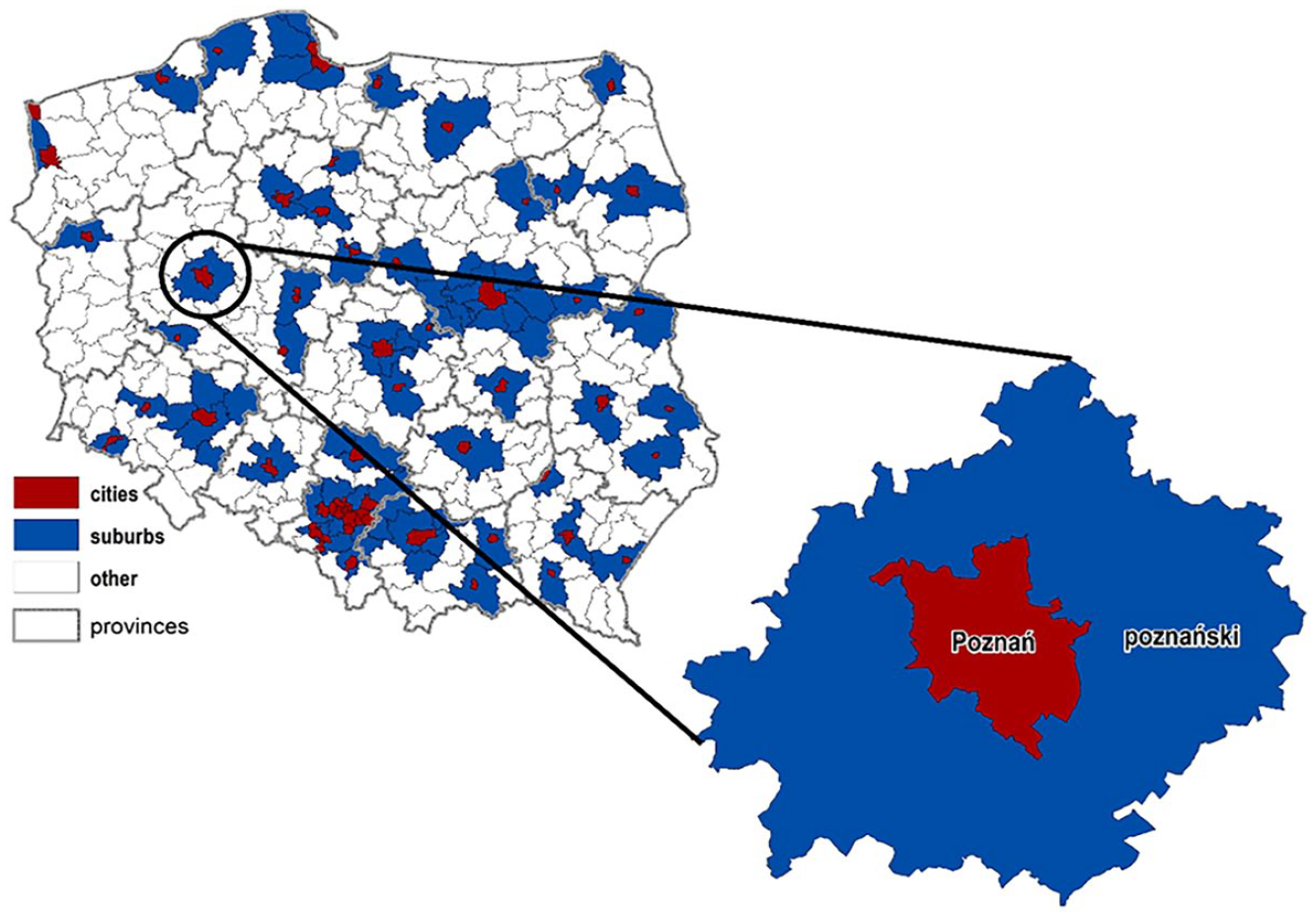
Location of the Polish urban regions and the case study of the Poznań urban region.
This research used data from the Polish Central Vehicle Register (CVR) and Statistics Poland (SP). The CVR data were obtained from the Ministry of Digital Affairs; they consist of detailed specifications of all of the registered vehicles in Poland. The data made it possible to determine the number and types of cars in particular counties. The CVR information on the age of the vehicle and the type of engine used helped to determine the structure of local markets, including the average age of the registered cars, the number of cars meeting specific Euro standards and the kind of fuel used. The SP data published in statistical yearbooks enabled the reconstruction of long-term changes in the housing market in Poland.
Urban sprawl and the dispersion of residential areas as a result of economic and historical legacies
Poland and other CEE countries have a specific history with respect to building development and spatial organisation. The communist period (1945–1989) was a time of centrally planned development that included housing and urban design. It was also the period in which Poland had to be rebuilt after the massive destruction of World War II. In Warsaw, the capital city, 84% of buildings had been utterly destroyed, over 75% in Szczecin, 66% in Gdańsk, 68% in Wrocław and 55% in Poznań (Musiaka et al., 2021; Racoń-Leja, 2018). Apart from rebuilding the destroyed housing resources, there was also an urgent need to ensure apartments for the increasing number of post-war ‘baby boomers’. This affected the growing number of dwellings to be delivered across a period that lasted to the end of the 1970s (Figure 2), but which (it must be mentioned at this point) was still not keeping up with demand: it was necessary to wait more than a decade from the time an apartment was ordered before it could be occupied. The number of dwellings per 1000 people remained significantly lower in Poland than in Western Europe; it was about 270 in 1980, while this figure was 410 in Germany, 450 in France and 435 in Denmark (Dol and Haffner, 2010). The situation in Poland was very difficult, even in comparison to that of other CEE countries; the number of dwellings in Hungary was 330 per 1000 people and in Czechoslovakia, 370.
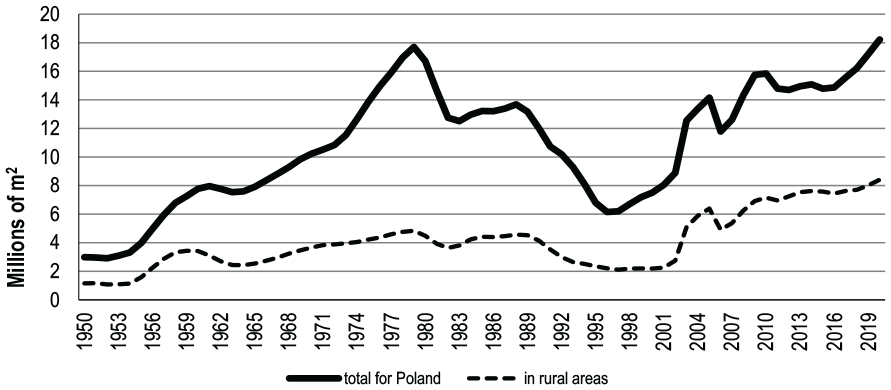
Changes in the floor area of apartments delivered in Poland in 1950–2020.
This very difficult housing situation was accompanied by the mounting economic crisis of a centrally planned economy. The crisis also affected construction, which still delivered 18.1 million m2 of floor area in 1979, but only 11.9 million m2 in 1981. In subsequent years, owing to state investments, a level of some 13 million m2 of new floor area per year was maintained. In 1989, however, the communist economic model fell apart completely, and this had a direct impact on the housing industry, because the major investor (the state), which was responsible for the vast majority of the annual supply of new dwellings, collapsed alongside the Iron Curtain. As it later turned out, this was a critical moment not only for housing, but also for urban development, land use planning and mobility as it was widely understood, which, like construction, were nationalised and subordinated to the centralised and hierarchical structure of decision-making.
The countries that emerged once the Iron Curtain was lifted adopted various economic transformation models. Poland followed a radical path, using ‘shock therapy’ as the model for the transition from a communist to a free market economy (Murrell, 1993). David Lipton (1990) and Jeffrey Sachs, whose concepts were behind the reforms of the Polish economy, stated that ‘The economic strategy must take cognizance of the political context, which in our view argues overwhelmingly for a very rapid, straightforward, and sharp program of economic reform’ (p. 87). The adoption of this transition model had inevitable consequences, because the role of the state as responsible for the majority of economic and social issues was completely marginalised. Alongside high unemployment and the decline of many industries, the transition led to the total collapse of the housing market. In 1996, only 5.7 million m2 of floor area were delivered, which is less than a third of the production in the late 1970s. There was a continual shortage of dwellings. Dol and Haffner’s (2010) report found that Poland had the lowest indicator for the number of dwellings per 1000 people among the 27 compared European countries in 1990. The situation was strengthened in the first decade of the systemic transformation.
Economic changes in Poland were accompanied by institutional reforms, whereby the organisational structures and procedures that had existed during communism were remodelled. In 1994, following the liberalisation of the rules and the departure from the idea of any state interference in market processes, the obligation for spatial planning was limited: local governments were not obliged to draw up new spatial development plans (Kowalewski and Nowak, 2018). These changes continued in 2003, and all of the spatial development plans adopted before 1995 were removed, which increased the supply of land for development, especially in rural areas. The construction market responded immediately. The lack of major restrictions on the location of residential buildings meant that they were increasingly erected in suburbs and peripheral regions. Whereas most (65%–75%) of the new floor area was delivered in cities in the 1970s and 1980s, there were many more buildings in the suburbs after the liberalisation of spatial planning. As early as 2003 and 2004, some 45% of new floor area was constructed in such spaces, and this situation was consolidated in subsequent years. Between 1995 and 2020, the number of inhabitants living in the suburbs of Polish cities increased by more than 1 million (+13%), while the populations of the largest cities dropped by 800,000 (−5%) (Figure 3).
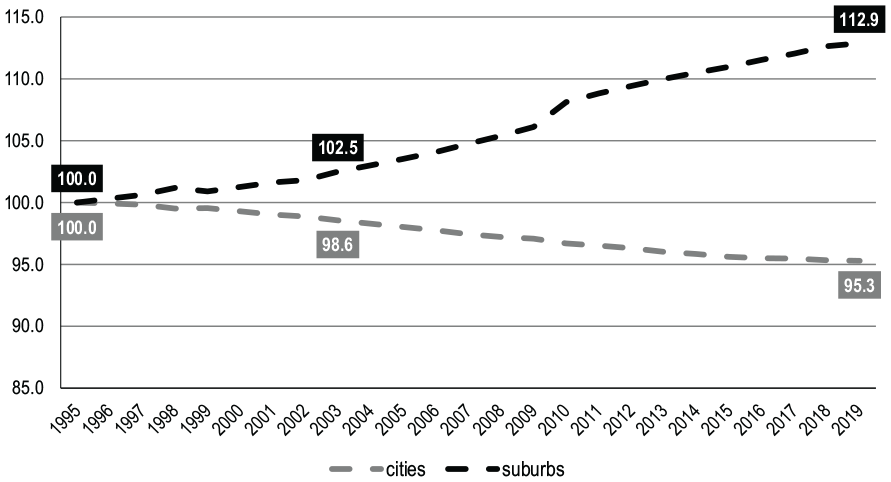
Changes in the population of cities and suburbs in Poland 1995–2019 (1995 = 100).
Although the suburbs were growing in many developed countries, their expansion in Poland was more dispersed and chaotic (Majewska et al., 2020; Śleszyński et al., 2020). Figure 4 shows satellite photos of the area around the city of Poznań (one of the largest cities in Poland) from 1997 and 2021, illustrating how residential buildings developed in Polish suburbs. Almost 300 new housing units were built within the 15 years between the two photographs, mostly in an uncoordinated, random pattern. The development also took place without the necessary transport infrastructure, or at a considerable distance from it (i.e. 2–3 km from the nearest train station or with at least a 20-minute walk to the nearest bus stop). The rapid and uncontrollable development of suburbs meant an increase in mobility needs that could not have been satisfied with public transport. As a result, suburban dwellers started to use private cars on a regular basis for individual mobility.
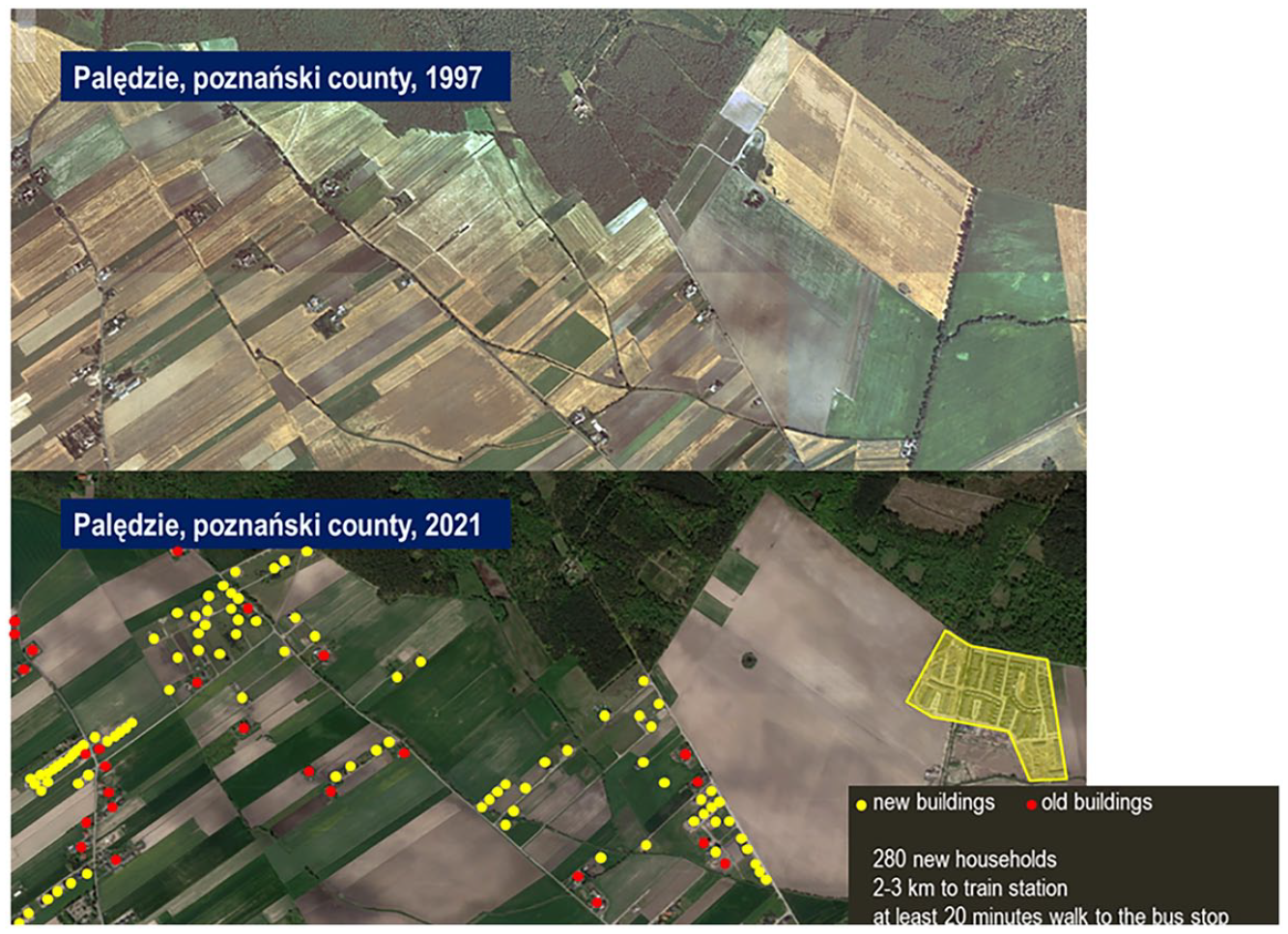
Changes in housing development in Palędzie (suburbs of Poznań).
The automobile revolution in Poland
The beginning of the systemic transformation in Poland in the early 1990s caused enormous changes in individual mobility. Until that time, subsequent communist governments had tried to control Poles in various ways and to limit their rights and civil liberties, including freedom of movement. As a consequence, public authorities clearly preferred and supported public transport, and simultaneously made it difficult to own a private car (Bater, 1980; Pucher, 1990). That situation led to the dominance of public vehicles as the basic means of mobility. According to Pucher (1990), up to 85% of all trips were made by public transport in the mid-1980s. In other CEE countries, the situation was similar; in Hungary, the proportion was 58%, 52% in Czechoslovakia and in the USSR, 88%. In comparison, this percentage was 19%, 11% and 3%, respectively in the United Kingdom, France and the United States (Pucher, 1990).
Owning a car in Poland was difficult and costly because of the economic and transport policy adopted, as well as the overall limited effectiveness and technological backwardness of the entire economy (Komornicki, 2003, 2011). The domestic car industry was relatively poorly developed, and even in 1980, a record year, it was only able to produce about 350,000 passenger cars (Lizak, 2009), which was far from sufficient to meet the needs of Polish citizens. During the economic crisis of the 1980s, car factories located in Poland manufactured some 230,000–290,000 cars annually. Closure to international trade meant that the import of cars was virtually impossible and de facto had no effect on car ownership in Poland (Kudłak et al., 2022). In effect, the car ownership rate in Poland was very low in the early 1990s, compared to both developed and eastern bloc countries. In 1990, there were 118 car owners per 1000 people, whereas in the United States, there were 717, 385 in Germany, 483 in Italy, 187 in Hungary and 211 in Czechoslovakia.
The fall of the centrally planned system and the launch of systemic transformation brought political, economic and institutional reforms, which changed this situation. First, the shock therapy adopted in Poland initially brought about a sharp decline in GDP (e.g. in 1990, it fell by more than 7%) and an increase in unemployment; as a result, state revenue fell. A significant reduction in expenditure on public transport followed. Consequently, in 1988–1992, the proportion of individual trips using public transport in cities fell from 79% in 1987 to 61% in 1992 (Pucher, 1995). The systemic transformation also led to the bankruptcy of many state-owned enterprises, which employed a large number of staff for whom separate transport links were established. The collapse of those entities and the development of the service sector further reduced the potential of collective transport and encouraged Poles to seek alternative solutions, such as passenger cars.
The privatisation and modernisation of the car industry was another important process affecting the automobile revolution in Poland. The existing manufacturing facilities were taken over by international corporations, such as FIAT, Volkswagen and Daewoo, and other multinationals (e.g. Opel and Volvo) made foreign direct investments of the greenfield type. This resulted in a gradual increase in the number of vehicles manufactured and sold on the Polish market. In 1992, new car sales reached 273,000 (Figure 5) and grew steadily in the subsequent years to achieve a maximum of about 621,000 in 1997 (Stryjakiewicz et al., 2017). In total, there were about four million new vehicles supplied in the first decade of the transformation, and they comprised 80% of all new registered cars (the remainder were imported from Western Europe). Finally, the partial removal of barriers in international trade was of some importance to the increase in car ownership. The effect of this factor, however, was limited, and changed according to customs policy, currency fluctuations and an attempt to protect the domestic car industry. Initially, 350,000 used cars were brought into Poland in 1991 after the almost complete elimination of customs and tax restrictions. This huge and uncontrolled car import evoked a response from the authorities, however, in the form of increases to the excise duty and the introduction of other customs barriers that limited imported vehicles to the level of 50,000–100,000 annually in the first decade of the transformation (Klimkowska and Klose, 2007; Stryjakiewicz et al., 2017). In summary, a reduction in the role of public transport, the modernisation and privatisation of the car industry, changes in the economic structure and the opening of the country to international trade led to an increase in car ownership in Poland in the 1990s.
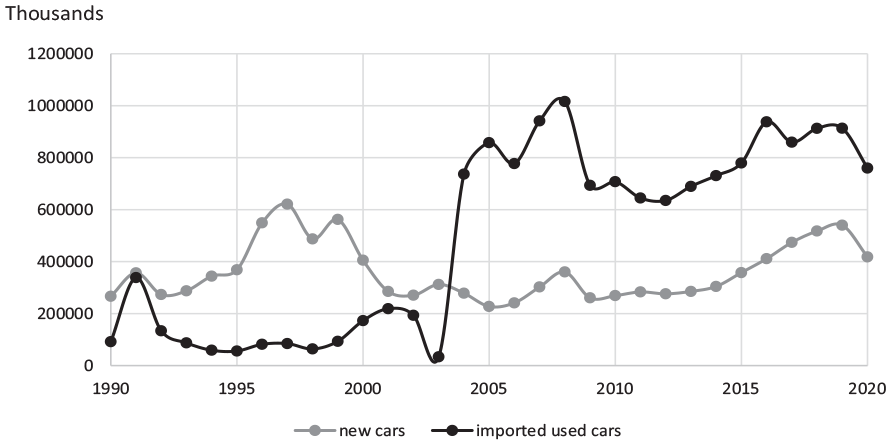
Registrations of new and imported used cars in Poland (in thousands), 1990–2020.
The real automobile revolution, however, was yet to come. In 2004, Poland joined the EU, preceded by a gradual adaptation of Polish law to the institutional EU system and by the removal of customs barriers. As a result, there was a significant increase in used car imports, up to 170,000–210,000 annually from 2000 (except in 2003 when for the first, and as yet, the last time, Poland banned the importation of cars that did not meet specific emissions standards). Full membership in the EU opened the country entirely for trade with other member states, which, following the problems of the domestic car industry (e.g. the collapse of Korean Daewoo, the main car manufacturer in Poland) and the continuing high, insatiable demand for vehicles, led to a massive inflow of used cars. In the first, incomplete year of membership, 740,000 vehicles were imported into Poland, and in 2008, this number exceeded one million. In 2014–2020, the importation of secondhand cars into Poland was more than 14 million (about 800,000 per year). In comparison, 5.8 million new cars were registered in the same period. Since Poland joined the EU, its car ownership rate has mainly risen due to the importation of used vehicles (Kołsut et al., 2022).
Owing to the limited availability and poor reliability of data, it is difficult to relate the volume of the Polish import of secondhand cars to imports in other countries; however, some partial information concerning selected world countries sheds light on the scale of this phenomenon. For example, about 600,000 cars from the United States were imported annually, on average, to Mexico following the reduction in customs restrictions in 2005–2008 (Davis and Kahn, 2010; Kołsut, 2020). According to the US Department of Commerce, Mexico imported approximately 8.3 million cars during the period 2005–2017. It is worth mentioning at this point that the Mexican population is over three times larger than that of Poland. In 2014–2015, New Zealand, the United Arab Emirates and Russia imported 220,000, 190,000 and 165,000 cars from Japan per year, respectively (Kołsut, 2020). In the record year of 2008, Russian imports amounted to some 500,000 vehicles, but even by 2009–2017, imports did not exceed 200,000 per year (Golunov, 2018). On the other hand, the United Nations Environment Programme (UNEP, 2020) report shows that, outside the EU, the largest secondhand car importers in 2018 included Serbia (approximately 260,000 cars), Nigeria (237,000), the United Arab Emirates (230,000), Ukraine (175,000) and Libya (161,000). These few examples demonstrate that the importation of used cars into Poland, which was maintained for more than 15 years at an average level of 800,000 vehicles annually, was the largest in the world.
The significant increase in car ownership and the shift in preferences towards individual mobility were not the only negative developments of the Polish economic transformation. They led to other consequences that were unfavourable from an environmental perspective. For instance, the proportion of diesel cars – which are recognised as the most detrimental to the global climate – increased considerably from 7% to 30%. Polish citizens perceived them as more economical (e.g. due to lower fuel consumption) and durable than petrol-fuelled cars. Diesel engines are especially preferred by drivers living in rural and suburban areas, who opt for large vehicles and typically travel longer distances. In addition, between 1990 and 2017, CO2 emissions increased from 200,000 to almost 900,000 kg (per year per inhabitant). Finally, cars in Poland are noticeably older than the European average (14 years vs the EU average of 11.5 years). This also means that a higher proportion of cars do not meet the restrictive standards for exhaust emissions, so they have higher emissions and a greater impact on the environment (Wojtyra and Kudłak, 2022).
Urban sprawl and car ownership
The development of the housing market and land use planning, as well as car ownership growth in Poland, illustrate the transition from a more centralised and collective system to a decentralised and individualised system of economic planning and coordination. In this section we show that the extensive urban sprawl and automobile revolution reinforced each other, with clear environmental and social consequences.
The automobile revolution spread unevenly. The regional differences in the development of car ownership were twofold in character. First, they reflected differences between urban regions and peripheral rural areas. In this pattern, a greater increase in cars (especially older and more emissions-intensive cars) was noted on the peripheries following the collapse of public transport as a consequence of its marketisation and the closure of state transport enterprises (Taylor, 2004; Taylor and Ciechański, 2008). From the perspective of this article, however, the other pattern inside urban regions, analysed on a city-suburbs scale, is more interesting. Data showing an increase in the number of vehicles after 2004 (i.e. after Poland’s integration into the European market and the intensification of urban sprawl) confirm a significant part of the results known from the literature. In 2004, car ownership rates in cities and suburbs were very similar and averaged about 200 cars per 1000 people, whereas in 2019, the disparities were much more visible (Figure 6) – there was a significantly lower car ownership rate in cities (372) compared to the suburbs (449). To confirm these differences, 64 urban and 80 suburbs counties were compared (Figure 6), to show what the relationship between the car ownership rate and the level of dispersed development (the average number of apartments per building) looked like in 2020. There is a statistically significant correlation (r = −0.773) between the dispersion of residential areas and the car ownership rate – the higher the proportion of single-family houses (the lower the value of the average number of apartments per building), the higher the car ownership rate (Figure 7). Apart from these differences in car ownership rates, the inhabitants of cities and suburbs also show different intensities of car use, which is decisive in terms of exhaust emissions and environmental impact. More detailed analyses revealed that city dwellers travel by car much less frequently than the inhabitants of suburbs. For example, 55% of urban residents of Poznań, one of the largest cities in Poland, cover less than 10,000 km by car, but this is true of only 43% of suburbanites (Dyba and Doszczeczko, 2022). Up to 35% of suburban residents declare that they spend more than 60 minutes in a car each day, compared to only 22% of city dwellers. This increased car usage has an effect on greater, spatially concentrated exhaust emissions.
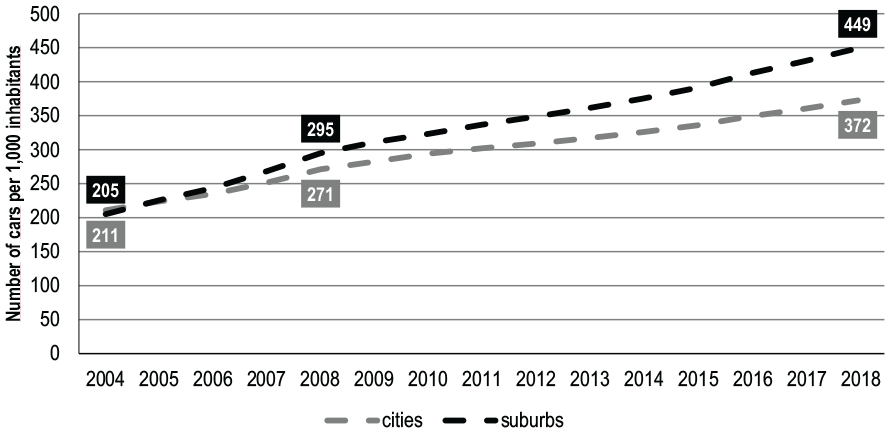
Car ownership rate in Polish cities and suburbs (2004–2019).
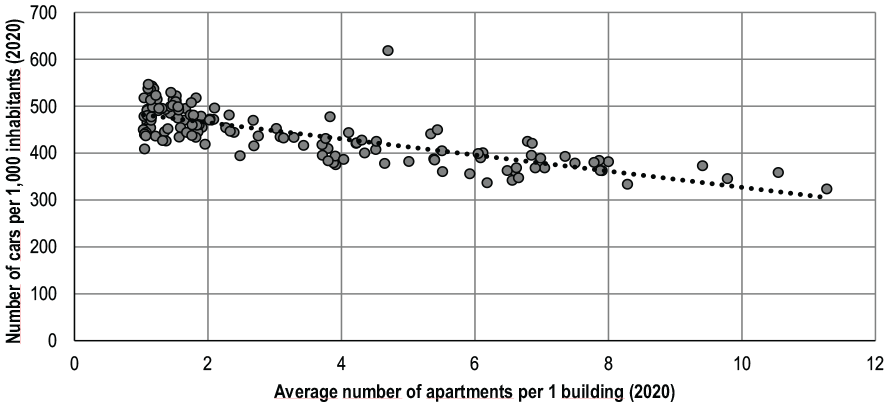
Relationship between urban sprawl and car ownership: Polish cities and suburbs, 2020 (n = 144).
The automobile revolution in Poland, particularly after its accession to the EU, has also affected the structure of the car fleet, which is reflected in urban regions. The proportion of more pollution-intensive diesel cars has increased faster in the suburbs than in cities (Figure 8). Cities noted an increase of about 18.5% during the period 2004–2019, whereas in the suburbs this was about 24%. The comparison of absolute figures provides an even clearer picture – the number of diesel cars in the suburbs went up nearly nine times, from 185,000 to 1.8 million, while in cities it grew six times, from 285,000 to 1.7 million. Correlation analysis also confirms that there is a statistically significant correlation (r = −0.546) between the dispersion of residential areas and the proportion of diesel cars (Figure 9) – the higher the proportion of single-family houses (i.e. the lower the value of the average number of apartments per building), the higher the proportion of diesel cars. This is especially important when considering that diesel engines significantly contribute to health (e.g. respiratory and lung cancer effects) and air pollution problems (Hesterberg et al., 2012; Jonson et al., 2017; Ristovski et al., 2012).
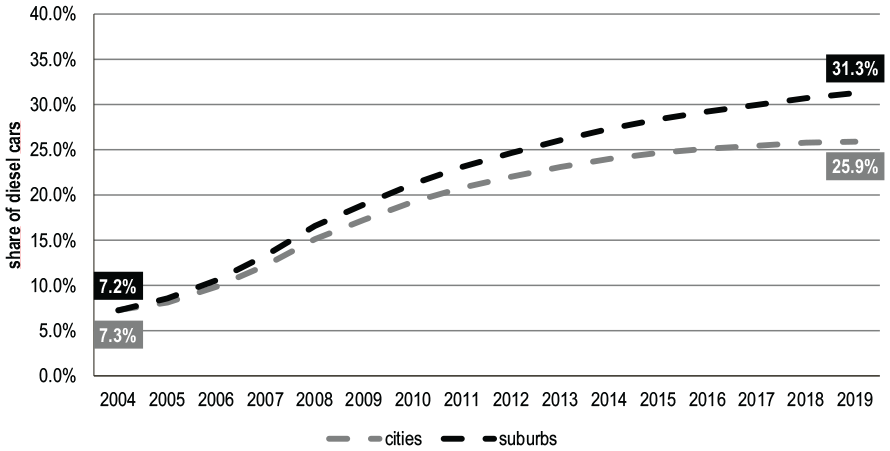
Diesel cars in Polish cities and suburbs (2004–2019).
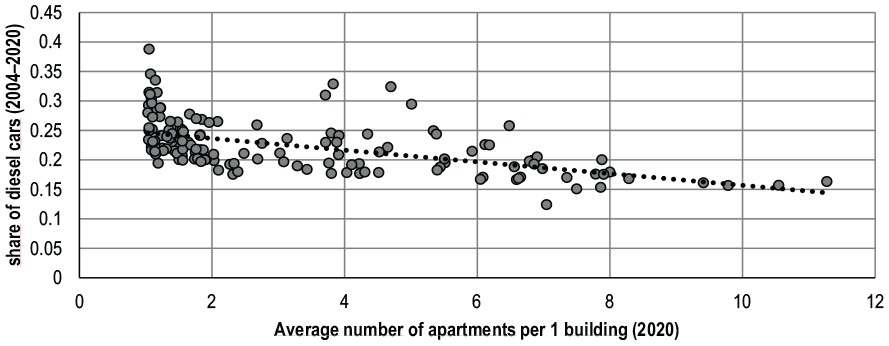
Relationship between urban sprawl and increased proportion of diesel cars (2004–2020): Polish cities and suburbs (n = 144).
Alongside the high proportion of diesel cars, the harmfulness of the emitted compounds is also important from the standpoint of the natural environment – and especially global warming. This, in turn, is related to the age of cars and the EURO exhaust emissions standards, which were introduced in 1993. As our analyses showed (Figure 10), over 60% of the cars in the suburbs are more than 16 years old (<Euro 4). In cities, the proportion is nearly 10% lower. The difference between the average age of cars in the suburbs and that in cities results from the fact that far more old used cars have been imported into the suburbs. This means that Poland’s urban regions are trapped in a vicious circle of environmental degradation. When they have problems buying a more expensive apartment in the city, people move to the suburbs, and the dispersion of residential areas and the considerable distance from service points and jobs means that they are then forced to have a car and use it more frequently. A relatively modest level of income and a large supply of secondhand vehicles from abroad means that they usually opt for cheaper used cars from Western Europe. They also tend to choose diesel cars, which are less expensive to operate, because they use them often. This all leads to a reduction in personal expenditure in the short term, but it has a negative impact on the natural environment. This phenomenon is also present in cities but, as shown above, its scale is much less intensive. As a result, the high availability and relatively low prices of imported secondhand cars strengthen urban sprawl and exacerbate congestion, air pollution and greenhouse gas emissions.
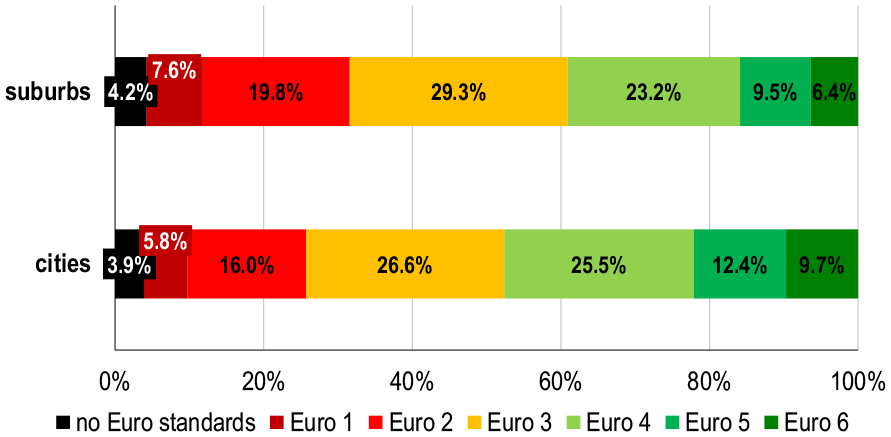
Car fleet structure by European emission standards in Polish cities and suburbs (2019).
Discussion and conclusion
There is little doubt that the current environmental crisis calls for policies and actions that would shift the dominant economic model towards sustainability. While a large body of research has explored various aspects of such a shift (Patterson, 2021; Steffen and Schmidt, 2021), scholars are increasingly interested in its spatial dimension (Hansen and Coenen, 2015; Martiskainen et al., 2021). Hence, this paper has sought to reconstruct and analyse two processes – urban sprawl and the automobile revolution – that took place in Poland during the systemic transformation period and to discuss their potential consequences for sustainability transition from a geographical perspective. We showed that the significant shortage of housing inherited from the communist period, together with an extremely liberalised spatial planning and housing policies, triggered many areas in Poland – especially urban regions – to enter their current environmentally unsustainable model of development. This was accompanied by other macro processes related to Polish EU membership, which spurred an uncontrolled and unprecedented level of importation of used cars from older EU members. This cemented the dominant mobility model based on individual car ownership and contributed to even more intensive urban sprawl and housing dispersion. These developments brought the Polish urban regions to their current spatial and functional structure, which is significantly unbalanced and unfavourable in terms of their mobility needs, transportation system and car ownership characteristics. This, subsequently, locked these regions in a development path that is harmful from an environmental perspective and, at the same time, that is very difficult and costly to overturn. While we did not analyse the process of sustainability transition as such, we add to the growing body of studies stressing the geographical character of this process and the necessity of implementing place-based policies.
The empirical evidence presented in this article illustrated that changing the current economic model towards sustainability is contingent on important geographical aspects. In line with the existing literature, we showed that different places are characterised by specific historical and economic legacies that led these places to their present development path (Cantarero, 2020; Hansen and Coenen, 2015; Tirado-Herrero and Ürge-Vorsatz, 2012). In the case of the Polish urban regions, the communist heritage (e.g. the drastic undersupply of housing) and political reforms undertaken during systemic transformation drove these regions to their current spatial structure, which is marked by urban sprawl and dispersed housing as well as heavy dependence on individual mobility for the inhabitants of suburbs. These developments are fairly recent and related to high sunk costs; hence, the investigated urban regions will face a substantial financial burden to reverse these housing and mobility trends. Apart from the attributes of the built environment, it can be argued that the inhabitants’ daily routines, mobility patterns and preferences centre around automobiles, which might undermine the legitimacy and pace of the transition towards other, more sustainable means of mobility (Paterson, 2007; Upham et al., 2015). These findings indicate that specific places (e.g. countries or regions) are often characterised by unique socio-technological systems that consist of different energy regimes (Van der Vleuten and Högselius, 2012), housing structures (Shearer et al., 2016), automobility dependencies (Sovacool and Axsen, 2018) and so on. This uniqueness results from long-historical processes leading to path dependence or lock-in on specific technological regimes, making the socio-technological systems rather persistent and resistant to external transformation stimuli. It further suggests that public interventions aimed at redirecting the current economic development model towards sustainability need to be spatially sensitive and consider the specific places’ economic, political and environmental endowments (Bridge et al., 2013; Hansen and Coenen, 2015). The ‘conservative’ character of places and their resistance to change might not be a consequence of strategic and calculated behaviour but rather stem from a structural characteristic and longevity of their socio-technological systems.
Second, looking at the multilevel environmental governance system through a geographical lens reveals certain deficiencies of this system. The current spatial and housing structure as well as mobility patterns and preferences of the inhabitants of the Polish urban regions are unequivocally adverse from the environmental perspective. These phenomena are on the one hand a consequence of various interventions undertaken at different spatial scales and, on the other hand, are rather inert and difficult to overturn. This suggests that certain places are often mere recipients of the political processes which can lead these places to environmentally unsustainable setting. The stickiness of the current environmental problems of the investigated regions and their relatively weak political position imply that their transition towards sustainability will be very costly and long-drawn. The development path of the urban regions presented in this study suggests that the environmental governance system may be insufficient in coordinating different policies at different spatial scales. Lack of coordination between trade, housing and spatial policies at the supranational, national and regional levels led to developments that undermined sustainability efforts or even, in some cases, exacerbated the existing environmental challenges (Markard et al., 2021). In addition, it can be argued that the environmental governance system is overly hierarchical and at times ignores the voice of lower levels in the system, as well as and the potential social and environmental consequences that might appear at these levels. For instance, the political decision taken in the 1990s at the EU level to promote diesel engines to reduce greenhouse gas emissions failed to reach its environmental purposes and also boosted the health-related problems resulting from noise, nitrogen oxide and particulate matter emissions. The subsequent political decisions to shift away from diesel cars triggered the migration of these cars to the eastern parts of the EU and other regions of the world (Cames and Helmers, 2013).
The empirical evidence presented in this article and the story of the Polish urban regions suggest that deregulation that is too far-reaching, combined with a lack of institutions effectively coordinating policymaking at the different spatial scales, might result in significant social and environmental externalities. This can be exemplified by the deregulated spatial planning policy in 2003, which led to a withdrawal of general land use plans and triggered urban sprawl. The departure of the state’s financial support for public transportation and privatisation of this sector left inhabitants of urban regions with almost no alternative to travelling by car. In addition, all of these problems were further strengthened by Poland’s urban governance system, which is a mosaic of various jurisdictions at different spatial scales. During the systemic transformation in Poland, the governance of the urban regions was based on the assumption that municipalities within these regions should have full autonomy and that any infrastructural, social or environmental problems should be solved through a voluntary collaboration between municipalities. Any attempts to create an additional layer of governance at the urban region level, which would be responsible for coordinating transport policy, land use and housing, schooling and the infrastructural system, failed. After 30 years of systemic transition, it can be argued that the political decisions protecting the autonomy of the municipalities often led to adverse economic, social and environmental impacts.
Finally, the story of the Polish urban regions also highlights the uneven power distribution and consequences of the sustainability transition (Lawhon and Murphy, 2012). As presented in earlier studies (Sovacool et al., 2019), every political decision concerning the sustainability transition causes unintended negative social impacts at different spatial scales, and these effects are unevenly geographically distributed. In addition, some places are politically advantaged and able to influence the pace and direction of the sustainability transition, while others are recipients of political interventions. The first group includes places (countries, regions, cities) that aggregate political elites, industrial centres and lobbying groups. The latter consists of less economically and technologically developed places, more distant from political centres and often more fossil-fuel dependent. Clearly, the Polish urban regions are facing environmental and social (e.g. health-related) consequences that result from political decisions undertaken at the EU (trade liberalisation) and national levels (reforms concerning spatial planning and housing).
In line with the existing literature (Coenen and Truffer, 2012; Hansen and Coenen, 2015; Raven et al., 2012), our study stresses the geographical character of sustainability transitions and adds an important lens through which such transitions should be governed and researched. This geographically sensitive approach is in contrast to many current or planned supranational environmental policies, which frequently remain blind to regional (and more generally territorial) differences and specificities. For instance, when it comes to the Emissions Trading System (ETS), CEE regions, which, often historically, rely on non-renewable sources of energy such as coal, are treated in the same manner as Western European regions. In addition, excessive reliance on market forces also makes the ETS system vulnerable to market speculation and leads to a situation in which the burden of divestment from fossil fuels is unevenly distributed across space. Similarly, scholars and policymakers should scrutinise in detail the consequences of introducing a ban on combustion engines and a complete switch to electric cars. It can be argued that incorrectly designed and implemented public interventions disregarding the geographical aspects of sustainability transition might actually lead to a relocation of the environmental problems instead of solving them. As presented earlier with the case of the EU policies promoting diesel cars, we suggest that due to economic, institutional and technological differences, electric cars will first take off in the developed economies and simultaneously spur the export of combustion engine cars to emerging and developing countries. Hence, the expected environmental effects might not be reached and additionally, the latter countries might get even more carbon dependent. This would not resolve any environmental problems but rather pass them on to other geographical locations and make their sustainability transition even more difficult and costly. While it goes beyond the scope of this article, it is worth mentioning that the promotion of electric cars will also induce additional environmental and social problems in various geographical locations. For instance, manufacturing of these cars requires the usage of rare metals such as cobalt which are often localised and extracted in developing countries with a ‘limited statehood’ (Rotberg, 2010). It is likely that this will lead to environmental degradation in these countries as their governments lack capabilities to protect the natural environment and the local communities. Hence, climate and, more generally, environmental policies should be designed and introduced in a manner that considers the specific legacies of the respective places (countries, regions, cities) and considers their capacities and capabilities (or lack thereof) to undergo the sustainability transition. Finally, another critical and exciting geographical aspect worth investigating could be the transmission of the negative social and environmental impacts to the Global South.
Footnotes
Declaration of conflicting interests
The author(s) declared no potential conflicts of interest with respect to the research, authorship and/or publication of this article.
Funding
The author(s) disclosed receipt of the following financial support for the research, authorship and/or publication of this article: The article was created as part of the research grant: Spatial dimension of car market (r)evolution in Poland, financed by the National Science Centre (grant number 2016/23/B/HS4/00710).
