




Abstract
The unpredictable impacts of sudden shocks such as the current COVID-19 pandemic or the current energy crisis accelerated by the Russia-Ukraine war have led to a renewed interest in regional economic resilience. Much of the literature focuses attention on how regional economies and industries could bounce back, that is, how they could return to their pre-shock conditions. Other scholars have proposed to construe resilience as bouncing forward to capture the mechanisms and processes that underpin positive adaptation and structural change in response to an acute crisis. In this article, we argue that both conceptualisations do not consider shocks and crises as a window of opportunity for regional economies to transform into a radically different and more desirable trajectory. We bring a new perspective into play, that is, transformative resilience which places shifts towards more sustainable pathways centre stage. This understanding of regional economic resilience acknowledges that a crisis may bring about permanent structural change and considers to what extent these transformations are to the benefit of society and the environment. This article seeks to identify in a conceptual way what factors and dynamics are vital for enhancing the transformative resilience of regions. To this end, we draw on recent insights from the debate on challenge-oriented regional innovation systems and elaborate on the role of pre-shock conditions and various core processes in building up regional transformative resilience.
Keywords
Introduction
Financial and economic crises at the end of the 2000s, the COVID-19 pandemic or the current energy crisis fuelled by Russia’s war on Ukraine have sparked an enormous interest in the resilience of regional economies in economic geography and related disciplines (Bailey et al., 2020; Bristow and Healy, 2020; Evenhuis, 2017; Martin and Sunley, 2020; Sutton and Arku, 2022).
The notion of regional economic resilience has been criticised for being a buzzword and fuzzy concept (Christopherson et al., 2010; Davoudi, 2012; Martin and Sunley, 2015; Pendall et al., 2010). Many scholars invoke the notion to assess how regional economies respond to and recover from major shocks, disruptions, disturbances and crises (Martin, 2012). There is, however, no universally agreed definition of regional resilience (Bristow and Healy, 2020; Martin and Sunley, 2015). Much of the literature focuses attention on how – and how fast – regional economies and industries could bounce back, that is, how they could return to their pre-shock conditions. Other scholars have proposed to construe resilience as bouncing forward to capture the mechanisms and processes that underpin positive adaptation, reorientation and structural change in response to a crisis (for a detailed discussion, see Martin et al., 2016). Recently, yet another understanding of regional resilience has been introduced in the Economic Geography literature, that is, resilience as system transformation (referred to as transformative resilience) (Martin and Sunley, 2020). Transformative resilience points to the capacity of regions to ‘transit to a new sustainable path characterized by a more productive and equitable use of its physical, human and environmental resources’ (Martin and Sunley, 2020: 15) in response to sudden shocks and acute crises.
This article takes up recent ideas about transformative resilience and seeks to bring a new perspective into play that complements prevailing bounce-back and bounce-forward conceptualisations and places shifts towards more sustainable pathways centre stage. This understanding of resilience acknowledges that a regional economy may leverage a shock or an acute crisis to initiate or accelerate transformation processes that help moving the region towards a more sustainable development path. In other words, it recognises that a crisis may bring about permanent structural change and it considers to what extent these transformations are to the benefit of society and the environment. Such a view is also gaining currency in the policy world (see, for instance, Giovannini et al., 2020).
We suggest interpreting transformative resilience as the capacity of regions to harness sudden shocks and crises to enhance the challenge-orientation of their innovation systems to tackle pressing place-based sustainability problems and needs. The article examines in a conceptual way what factors and dynamics are vital in this regard.
The remainder of the article is structured as follows. Section ‘Regional economic resilience: prevailing views’ provides a brief overview of established views of regional resilience in Economic Geography and cognate disciplines. Section ‘Reconceptualising regional economic resilience’ introduces the notion of transformative regional economic resilience. Section ‘Building up regional transformative resilience in response to shocks’ examines in a conceptual way how transformative resilience – interpreted as the capacity of regions to enhance the challenge-orientation of their innovation systems in response to a sudden shock or crisis – unfolds in regional contexts. In section ‘Empirical illustrations’, the article explores the articulated ideas with two examples from Norway and Austria. Section ‘Conclusion’ concludes and sketches out future research avenues and some first policy recommendations.
Regional economic resilience: prevailing views
Over the past few years, the idea of resilience has received growing attention in economic geography and regional studies (Bailey et al., 2020; Boschma, 2015; Bristow, 2010; Martin, 2012; Martin and Sunley, 2015, 2020) The notion echoes an old question in economic geography, namely why some regions succeed in coping with shocks and crises while others fail (Christopherson et al., 2010; Hassink, 2010; Simmie and Martin, 2010). Yet, there are still many unresolved issues around its definition, precise meaning, conceptualisation and measurement (Martin, 2018; Sweeney et al., 2020).
The resilience concept has roots in physical sciences, engineering and ecology and is now also widely used in other disciplines such as psychological studies, economics, geography and planning (Davoudi et al., 2013). Within economic geography, an evolutionary approach to resilience has gained prominence. This approach rejects equilibrist thinking that is prevalent in both engineering and ecological versions of resilience, points to the inevitability of structural change and argues for understanding resilience as reorganisation of existing industries or shifts to new economic activities (Evenhuis, 2017; Martin, 2018).
Martin and Sunley (2020: 10) understand regional economic resilience broadly as the capacity of actors within a region to cope with and recover from unfavourable shocks to its economy. They underline that the resilience of a region’s economy develops over time as ‘a historical evolutionary process’ (Martin and Sunley, 2020: 31). The state of a regional economy and its resilience are hence seen as the result of historical and region-specific processes. A region’s capacity to deal with shocks, its strategies and activities towards a shock are influenced by former experiences which are embedded in firms’ and organisations’ routines, in actor networks, in the structure of the regional innovation system and so on.
Prevailing ‘faces’ of regional economic resilience
Economic geography work on regional economic resilience has settled on a distinction between two main forms, that is, bouncing back and bouncing forward (Boschma, 2015; Martin and Sunley, 2020).
Conceptualising resilience as bouncing back emphasises the capacity of regions to expect and absorb shocks to its social, economic and technical systems, to the extent that it could maintain its preceding functions, industrial and institutional structures and identity (Christopherson et al., 2010). Hence, at its core is how regional economies could return to their pre-shock position and sustain their industrial paths. However, it is important to bear in mind that a region’s pre-shock structures may not be favourable ones (in the sense of providing full employment, decent incomes or ecological and social sustainability Martin and Sunley, 2015). Under such circumstances, embarking on a ‘bounce back route’ might be a questionable endeavour.
Conceptualising resilience as bouncing forward refers to a region’s ability to respond to shocks and crises by adapting its structures, reorienting existing industries and nurturing new (industrial) paths (Martin and Sunley, 2015). The notion thus highlights that shocks and crises could bring about innovation and structural transformation. This idea of resilience (often referred to as ‘evolutionary resilience’) thus acknowledges that new industrial paths may emerge from crises and the destruction of old ones (Boschma, 2015; Hu and Hassink, 2017; Simmie and Martin, 2010), thus moving structural change centre stage. Bouncing forward provides a ‘neutral’ view on crisis-induced transformation processes, remaining agnostic as to what kind of reorientation of existing industrial paths and what types of new economic activities emerging in regions would be favourable.
Reconceptualising regional economic resilience
In this section, we elaborate on a third type of regional economic resilience, namely, transformative resilience. This understanding privileges the idea that a shock or an acute crisis may not only lead to structural transformation but may also change the direction of transformation processes (Folke et al., 2010; Manca et al., 2017; Martin and Sunley, 2020), that is, it could be a window of opportunity for transforming to a more sustainable trajectory (Davoudi et al., 2013).
It is this focus on sudden shocks and crises that helps to distinguish transformative resilience from similar notions such as transformative capacity. While the latter refers to the ability of regional economies or societies to reconfigure their structures over time in the face of future challenges (Boyd and Folke, 2011; Castán Broto et al., 2019; Folke et al., 2021), transformative resilience is about the extent to which sudden shocks or crises could be leveraged to bring about fundamental changes that shift regional socio-economic systems closer towards more sustainable development paths. 1
Sustainability has become a comprehensive concept which includes environmental, social and economic aspects of sustainable development. Thus, the concept is difficult to define and measure empirically (United Nations (UN), 2014). Stiglitz et al. (2009) link sustainability to the question of whether the current level of well-being is at least maintained for further periods and generations, and they argue that future well-being will depend on what we leave to next generations of exhaustible resources, renewable natural resources, physical capital and quality of institutions. This is complex to measure and too broad to go into detail in this article.
Yet, our approach to transformative resilience – understood as the capacity of regions to respond to shocks and crises by pushing an alternative agenda for regional economic development, one that is less oriented towards short-term growth and more focused on environmental sustainability and inclusive development (Evenhuis, 2017; see also Cretney, 2014; Davoudi et al., 2013; Hudson, 2010; Jeannerat and Crevoisier, 2022; MacKinnon et al., 2022) – requires further clarification. Moving towards more sustainable development paths may take many different forms. It could entail the regionalisation of global supply chains, shifts towards more environmentally friendly forms of tourism, sustainability transitions of socio-technical systems such as energy, mobility, food or housing, post-growth initiatives, new institutional and behavioural practices and so on. The notion thus needs specification.
In this article, we interpret transformative resilience as the capacity of regions to leverage sudden shocks and acute crises to enhance the challenge orientation of their innovation systems to tackle pressing territorial sustainability problems and to create the conditions for the region to embark on a more sustainable development path. A special focus will be on challenge-oriented initiatives that aim at initiating or accelerating green path development as a desirable outcome. The notion of green path development covers the rise of new green economic activities (through path creation, diversification or importation), the green renewal of mature industries and the destabilisation and decline of old brown sectors (see, for instance, Grillitsch and Hansen, 2019; Trippl et al., 2020).
The concept of challenge-oriented innovation systems (CORIS) has recently been introduced to critically rethink the role of innovation systems in an era of environmental and societal challenges (Isaksen et al., 2022; Tödtling et al., 2022). Inspired by emerging debates on a new understanding of innovation (see, for instance, Coenen and Morgan, 2020; Schot and Steinmueller, 2018) and the ‘goal-orientation’ of innovation systems (Hekkert et al., 2020; Schlaile et al., 2017), the CORIS approach extends the conventional RIS concept in various ways. It propagates a broader view of the purpose of innovation and complements the traditional orientation on economic growth and international competitiveness by a focus on place-based problems and challenges. Tackling these problems/challenges requires attention on a greater diversity of innovation activities and innovative agents. Tödtling et al. (2022) advocate an extension of the traditional focus of RIS studies on technological innovation to other types of innovation (including, for example, social, user and institutional innovations) that are produced by actors operating in various domains. Next to established innovation actors (the so-called triple helix, which includes firms, research organisations and governmental bodies), new (hitherto neglected) innovation actors (such as civil society organisations, actors from the public sector, users and citizens) are said to play a significant role in the development, application and upscaling of innovative solutions to pressing (regional) problems and challenges (Trippl, 2023).
CORIS are defined as innovation systems that show the capacity to address various – and partly – interrelated regional problems by developing challenge-oriented initiatives (Tödtling et al., 2022). This capacity is not only conditioned by regional dynamics but also by non-local processes and the region’s embeddedness in national and supranational regulatory and policy structures, multi-scalar innovation and production systems, trans-local learning networks, etc. (Binz and Truffer, 2017; Loorbach et al., 2020; Tödtling et al., 2020).
A central presumption of scholarly work on CORIS is that historically grown real-world regional innovation systems are often unfit for tackling ecological and social challenges. The place-based structures, actor constellations, network practices, institutional configurations and dominant innovation and entrepreneurial activities inherited from the past are said to deliver barriers to green and inclusive innovation and to reinforce unsustainable pathways (Schot and Steinmueller, 2018; Trippl, 2023).
This has sparked an interest in the reconfiguration processes that RIS need to undergo to enhance their capacity to address the economic, ecological and social challenges the region is confronted with. Recent work suggests that shifts from conventional RIS towards CORIS – and the asset modification and reconfiguration processes of actor constellations, networks, institutions and practices that underpin them – may unfold in different ways. Isaksen et al. (2022) and Trippl (2023) identify two routes of CORIS development, that is, a reorientation route and a transformation route.
The reorientation route is characterised by the mobilisation of the assets, actors, networks and institutional structures of existing RIS to address regional challenges and to seize appropriate opportunities for green path development. In other words, this route is about enhancing the challenge orientation of existing RIS by redirecting established elements and functions to new goals and reusing (recombining) historically grown assets. Building on inherited industry specialisations, knowledge bases and other assets could be a sound sustainability strategy that helps to create economic value and jobs (Bugge et al., 2022). Innovation and transition activities that address place-specific challenges while increasing economic uncertainty could lead to fierce resistance from incumbents and suffer from a lack of political and societal legitimacy. Mobilising established RIS actors and assets and tackling regional challenges with innovative solutions that also provide economic opportunities might thus be a proper strategy in some places.
The transformation route is said to be more about the creation of new challenge-oriented structures and the dismantling of old, unsustainable ones. It involves the inclusion of new, hitherto neglected innovative actors, the break-up of old networks and the formation of new ones, and institutional change processes. The creation (and importation) of new assets (and to a lesser extent the repurposing of existing ones) plays a significant role. As indicated above, taking the transformation route could also involve the deliberative destabilisation of old RIS structures and practices and the strategic removal of assets inherited from the past. 2 Arguably, such endeavours are often hampered by powerful economic and political interests (Turnheim and Geels, 2013). Overcoming vested interests, breaking up resistance to change and cutting support for business-as-usual (Kivimaa and Kern, 2016) can thus be key features of the transformation route. The need for such activities is particularly urgent in places with a strong specialisation in polluting industries and unsustainable RIS.
The distinction between the two routes – reorientation and transformation – is an ideal-type one. Trippl (2023) notes that in real-world settings, CORIS development may show features of both routes. The two routes can be seen as the two ends of a continuum, along which various combinations of reorientation and transformation activities are likely to be observed.
Building up regional transformative resilience in response to shocks
As outlined in the previous section, regional transformative resilience – interpreted as the capacity of places to leverage a sudden shock or crisis to address pressing economic, ecological and social problems and to embark on a more sustainable development trajectory by nurturing green path development – demands a reorientation or transformation of historically grown RIS. Put differently, RIS reconfiguration is a means to a particular end, namely, more sustainable regional development, which is brought about by the rise of new green paths, the greening of mature paths and the decline of brown paths.
In this section, we seek to unravel how such changes may unfold in regional contexts. To this end, we propose a simple model (Figure 1) that accords attention to (1) the pre-shock conditions in a region, (2) various core processes and (3) outcomes of these processes.
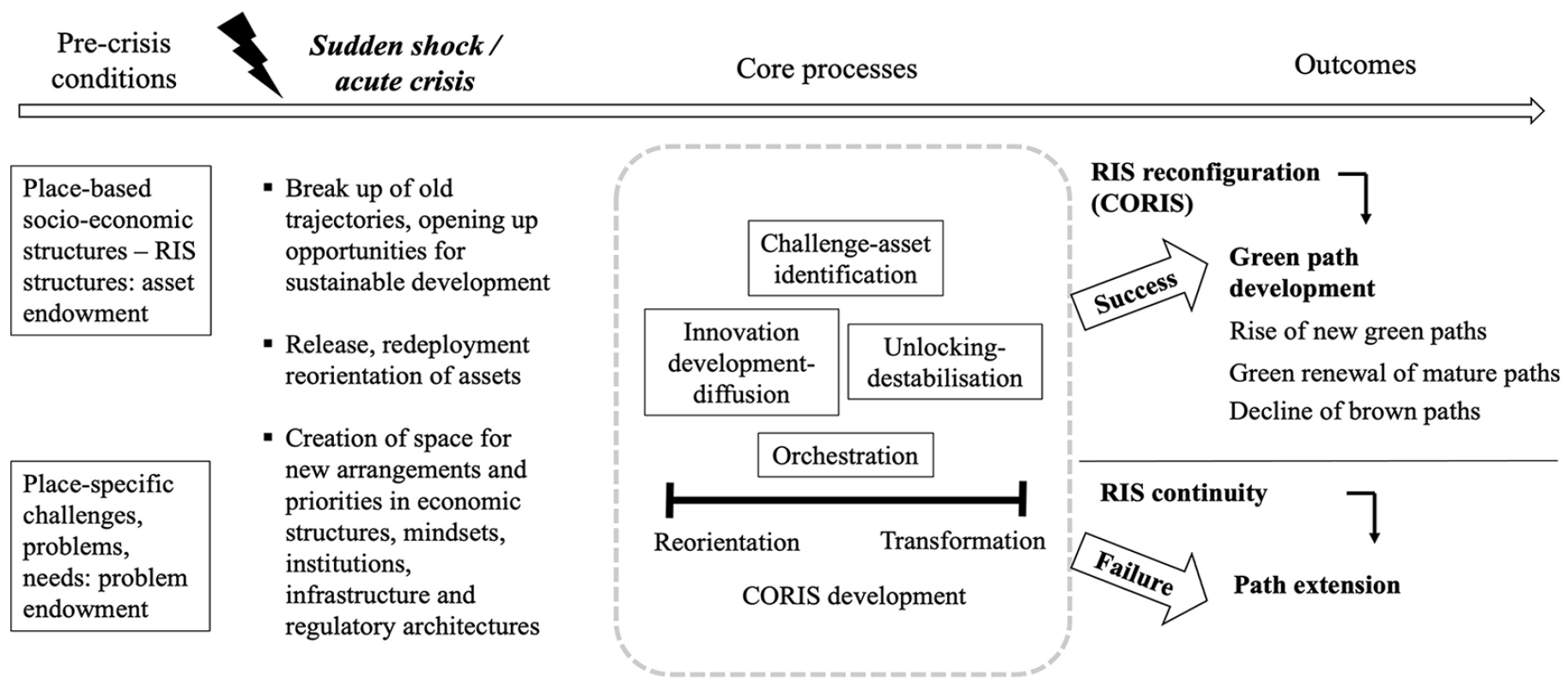
Transformative resilience: Building up CORIS for green path development in response to shocks and crises.
Pre-shock conditions
The first key dimension relates to the conditions found in the region prior to the shock. The focus is on historically grown place-based innovation system structures, that is, the region’s mix of industries and firms and their relationships, knowledge infrastructure, innovation support structures and institutional configurations. Furthermore, the region’s insertion into global production and innovation networks, international regulatory arrangements and multi-level governance settings require consideration.
Importantly, next to the production, institutional and support structures, economic, environmental and social challenges faced by the region should be factored into analyses of initial (pre-shock) conditions. Put differently, it is not only asset endowments but also problem endowments that matter. The latter are often linked to exogenously framed global ecological and social sustainability challenges (and goals). Yet, it is crucial to recognise that different regions have different exposures to environmental and societal problems (McCann and Soete, 2020), which demand contextualisation (see also section ‘Core processes’). For instance, places that host old heavy industries will face other decarbonisation challenges resulting from climate change and other environmental crises than peripheral regions specialised in tourism or agriculture, or urban areas characterised by industrial heterogeneity. Depending on the region under consideration, shifts towards more sustainable paths – and the associated need to remove, reorient and create RIS structures – will come in different forms. It is crucial to add that the potential to embark on greener paths is uneven and strongly shaped by the region’s asset base.
A core question is how a major shock or crisis affects the production, institutional and support structures of RIS. Arguably, much depends on the nature of sudden shocks or acute crises. Such events can take different forms, ranging, for instance, from economy-wide recessions to ecological disasters or the outbreak of a pandemic like COVID-19. Such events may well play different roles in different regional settings. Some regions may experience a massive decrease in their asset base. Firms and other stakeholders may have fewer resources during a crisis. Innovation networks might be disrupted. What is more, a sudden shock or crisis like COVID-19 could further aggravate place-specific problems and create new economic, social and political challenges (Bailey et al., 2020). However, a shock or crisis could also break up long-established development trajectories and unsustainable patterns in RIS and industries, opening up opportunities for green path development. These can indeed be difficult shifts, but the extremity of a shock can break down many past barriers. A major shock may ‘remove’ unproductive and unsustainable firms, economic activities and practices and release industrial, human, institutional and other assets that could be reemployed and reoriented to renew existing paths or nurture new ones. It may put the strategies of firms and those of other organisations under pressure and question established priorities. RIS actors may begin to take advantage of changed circumstances, promoting new arrangements and priorities in economic structures, mindsets, institutions, infrastructure and regulatory architectures.
In summary, a nuanced view on the regional structural conditions that existed before a major shock or crisis took place deems important. Depending on the nature of the shock or acute crisis, these conditions have an impact on how hard and in which ways a region is hit (Martin and Sunley, 2020). Furthermore, the place-specific asset and problem endowments after a shock can create very specific preconditions for building up transformative resilience.
Core processes
We contend that challenge-oriented initiatives that are developed in response to major shocks and crises and aim at initiating or accelerating shifts towards more sustainable paths are based on and can be analysed through four core processes (Hölscher et al., 2019; Trippl, 2023).
Challenge-asset identification: The first core process covers the identification and framing of challenges, vulnerabilities and opportunities. Arguably, sustainability challenges and goals (such as the SDGs adopted by the United Nations) articulated and set at higher spatial scales matter in this regard, providing a wide framework and orientation (or broad exogenous problem definition). Yet, crucial issues revolve around the questions of how those challenges and goals are ‘localised’ or contextualised in the region (Pontikakis et al., 2022), which ones are prioritised (and by whom), and what are the perceptions about their urgency, roots and effects (Flanagan et al., 2022). Different stakeholders (regional actors but also powerful actors from outside the region) may have very different views on these issues. Consequently, much depends on who is involved in this process, who has the power to shape the discourse on challenges and assets, and where priorities and directionalities for change are set (MacKinnon et al., 2022).
Innovation development-diffusion: The identification and framing of challenges and the available asset base will have a strong influence on the second core process, that is, the search for contextual solutions. This process encompasses innovation and diffusion activities, that is, the development, testing and upscaling of novel solutions in the region (and beyond). This might include the development (or importation) of technologies or non-technological solutions (or a combination of both, since many sustainability challenges require an integration of a range of technological and non-technological innovations).
Unlocking-destabilisation: As noted above, innovation and diffusion processes might not suffice. Depending on the case under consideration, a third core process, namely unlocking and deliberate destabilisation of old paths and unsustainable RIS structures could be vital. It involves the revelation and unlocking of unsustainable path dependencies in the RIS, the destabilisation and phasing out of unsustainable activities, practices, products, technologies, networks, institutional structures, and might come with undermining vested interests and ‘picking the losers’ (Braams et al., 2021; Hölscher et al., 2019; Kivimaa and Kern, 2016). Some scholars argue that sudden shocks and deep crises – like the current pandemic – provide a window of opportunity for deliberate destabilisation (Heyen et al., 2017; Rosenbloom and Markard, 2020).
Orchestration: ‘Challenge-asset identification’, ‘innovation development-diffusion’ and ‘unlocking-destabilisation’ processes are linked to a fourth core process, that is, orchestration. This includes the coordination of multiple actors who might have very different interests and motivations, which calls for mediation, formulation of shared visions and setting collective priorities as well as the minimisation of tradeoffs and conflicts. Furthermore, navigating complex multi-level governance systems, coordinating with and mobilising support from national and EU policies is crucial to meet place-specific needs and address broader societal challenges in the region.
The four core processes play out differently, depending on whether a reorientation or transformation route (see section ‘Reconceptualising regional economic resilience’) is taken (or to what extent and in which ways elements of both routes are combined). When reorientation is the main strategy for transformative resilience, established RIS actors will play a powerful role in identifying and framing regional challenges and influencing the search for solutions. In such situations, technological innovation, a dominant focus on economic value creation or issues that do not otherwise threaten their position and destabilise RIS structures are likely to be observed. With transformation as the main strategy and new actors being given more prominence, regional challenges and solutions will be identified as more pervasive, requiring destabilisation of unsustainable RIS structure and development of entirely new regional assets. This makes the orchestration of the change process far more demanding in the transformation than in the reorientation route.
Outcomes
As discussed above, leveraging a sudden shock or acute crisis for reorienting or transforming RIS and developing a set of challenge-oriented initiatives to address economic, environmental and social problems are demanding and complex endeavours. Such processes could eventually culminate in the development of a CORIS, which is seen as a means to a desired outcome, that is, green path development. Arguably, there could be many hurdles along the way which may inhibit the initiation or consolidation of such processes, resulting in RIS continuity, which in turn would promote the extension of old, unsustainable paths.
Empirical illustrations
This section provides two illustrative regional examples, both of which face not only the challenges of the COVID-19 crisis, but also the long-lasting challenges of decarbonising their key industries. Both regions, Stavanger in Norway and Lower Austria in Austria, are examples of the challenges related to the development of CORIS and building regional transformative resilience to support the development of green regional industrial pathways. This section provides preliminary findings that help assess the relevance of and explain some important elements of our model. A central question is to what extent and in what ways the COVID-19 crises has affected longer-term work with green path development of the regional economies.
Stavanger: the legacy of the petroleum sector – opportunities and barriers to green industrial diversification
Pre-crisis conditions: With about 350,000 inhabitants in 2022, the Stavanger region is the third largest city region in Norway. The region is the main agglomeration of the petroleum industry in Norway. Since the late 1960s, a specialisation in offshore petroleum activity has developed through supportive national and regional policy and an interplay between oil firms, suppliers, R&D institutes and universities (Deegan et al., 2022). The specialisation in the petroleum sector represents an opportunity for diversification into new green industrial activities as this can build on the skills and technologies accumulated over 50 years of petroleum activity. Then, a complete destabilisation and phasing out of the petroleum sector is not seen as a viable solution by the majority of regional stakeholders, as the skill base and other assets should not be destructed but rather reused for new industrial activity.
CORIS development: Diversifying the industrial base and moving into more ecologically sustainable industries are two core pillars of the region’s industrial strategy (Industrial strategy 2021–2030, Stavanger municipality 3 ). The diversification efforts are facilitated by the development of a CORIS, relying heavily on reorientation activities. The past few years have witnessed various challenge-oriented initiatives, with innovation and path development activities orchestrated through formal industrial cluster initiatives that aim to develop (1) renewable and low-emission energy solutions (with leading actors in the petroleum sector as cluster participants), (2) smart care solutions for the health sector, (3) smart-city solutions, (4) secure, smart and sustainable transport infrastructure and (5) new technology for the aquaculture industry. 4
Unlocking: Despite CORIS initiatives such as new cluster projects, key formal and informal institutions need to be unlocked. A dominant narrative among industrial actors in Stavanger is that the petroleum sector will continue to dominate for a long time ahead, albeit with updated technology that results in a greener industry (Deegan et al., 2022). The narrative plays a part in hindering new industry development, in addition to financial organisations prioritising safe investment in the dominant industry where they ‘. . . possess “insider” knowledge about the industry and its managers, network connections, and social ties to many of its actors’ (Gjelsvik and Trippl, 2019: 120).
Diversification activities are also hampered by the fact that the petroleum sector pays higher wages than other industries due to resource rents (Fitjar and Timmermans, 2019). In particular, in times when the petroleum sector is booming due to rising oil prices, it attracts highly qualified workers from other skill-related industries and hampers their development through competitive inter-path relations.
Effects of COVID-19: The COVID-19 pandemic strengthened the development of digital products and digital business models in the Norwegian industry in general (Jakobsen et al., 2022). Industries such as tourism and aquaculture moved in sustainable directions, largely as unintended market adaptations following COVID-19 (Jakobsen et al., 2022). The development in the petroleum sector during and after the COVID-19 period shows the opposite effect. The national government launched comprehensive measures in May 2020 (lasting until January 2023) to uphold the activity in the petroleum sector and its supply industry. 5 Those measures were also rationalised by the need to keep important competence residing within the petroleum sector that is deemed important for a green industrial transformation. However, activity in the Norwegian petroleum sector is expected to further increase in the next years as a result of the government’s ‘COVID-19 package’ (and the Ukraine war) (Jakobsen et al., 2022) This keeps suppliers in the petroleum sector instead of these going into other industries such as renewable energy sectors. Thus, even though the Corona support for the petroleum industry was given a ‘green stamp’, the national government together with regional lobbyists have rather protected the status quo through ‘bouncing back measures’, presumably slowing down CORIS reconfiguration for green path development activities in the Stavanger region. An alternative policy strategy could be to support green innovation activities in companies that hire unemployed oil workers, instead of retaining them in the petroleum industry, which needs to be downsized over time. This could have contributed to building up transformative resilience in Stavanger.
Lower Austria: drivers and pitfalls of green path development in the plastics and building materials industry
Pre-crisis conditions: Lower Austria is the largest of Austria’s nine federal states in terms of surface area, and with 1.65 million inhabitants, the second largest in terms of population. Over the past 20 years, the region has developed into an important economic location, benefitting from its proximity to the city state of Vienna, connections to metropolitan areas such as Munich, Bratislava, Budapest and Prague and, more generally, the markets in Central and Eastern Europe. Apart from the growing tourism and visitor industry, the regional economy shows a strong export orientation with a focus on specialised materials and technologies. With companies of global significance in the region, two industries are particularly important: the building materials sector and the plastics industry. While these industries are continuing to grow, they face the challenges of decarbonisation and reducing the overall environmental impact of their production.
The plastics industry is confronted with concerns about the impact of plastics on the environment and human health (e.g. Lim, 2021). The building materials sector also faces increasing pressures for transformation. Cement, brick and roof tile manufacturing accounts for more than eight per cent of the global carbon dioxide emissions (Monteiro et al., 2017), which is what the aviation and shipping sectors are accounting for combined. The European Commission is driving solutions through funding schemes and legislation to reduce plastic waste and introduce low-carbon building materials and circular economies for both industries through the Green Deal. Therefore, producers are increasingly forced to find solutions by developing new products and/or efficient circular arrangements.
CORIS development: For more than a decade, innovation activities in the context of green plastics and low-carbon building materials are widely seen as an opportunity and necessity for future-proofing the region’s economy. Both industries have started challenge-oriented initiatives to reduce their environmental impact by developing and introducing new alternative products and circular solutions (e.g. bioplastics, green cement and bricks, wood as a building material), but so far these represent only small niches in their product portfolios or have not yet achieved market entry. Both plastics and building material industry build on well-established regional skills and other assets formed over many decades. Therefore, a transformation of the RIS is not the desired strategy in this case as the established asset base is seen to provide valuable entry points for challenge-oriented industrial initiatives.
Orchestration: The willingness and regional support for green path development have been clearly articulated by regional policy actors. The Lower Austrian regional economic strategy identifies cleaner production, building up circular economies, as well as sustainable energy systems as important drivers for future innovation activities (Ecoplus, 2021). The regional economic development agency ‘Ecoplus’ seeks to orchestrate reorientation activities to enhance the challenge orientation of Lower Austria’s RIS. Ecoplus is an established semi-public organisational platform for knowledge generation and sharing by connecting regional companies, investors, policy-making and research.
Many of those activities take place in eight thematic clusters and platforms (food, plastics, green building, mechatronics, e-mobility, aerospace, green transformation and bioeconomy and health). 6 The green building, e-mobility and green transformation and bioeconomy clusters show a high degree of challenge orientation. They recognise the urgency of climate change, and biodiversity crises as important drivers for change. Founded in 2004, the green building cluster consists of more than 200 partner firms and organisations focusing on resource-efficient construction and building materials, climate-adaptive technologies and digitalisation.
Unlocking: Often the larger incumbent companies are taking on ideas for driving greener industrial pathways by drawing on their own or regional and national R&D to test and develop alternative products. At the same time, incumbents must be seen as a retarding force. Even though the building and construction sector has been identified as a key contributing sector to climate change (e.g. United Nations Environmental Programme (UNEP), 2020) and the plastics industry is responsible for mass pollution, both industries have been characterised as slow innovators due to often place-specific industrial and political path dependencies (e.g. Fastenrath and Braun, 2018 for building and construction). Powerful lobby work can result in ‘regime resistance’ (Geels, 2014). Similarly, this can also be observed in Lower Austria’s producers of building materials and the plastics industry. Therefore, new CORIS initiatives are needed to further support the unlocking of path dependencies and the dominant role of incumbents leading the way.
Effects of COVID-19: The impact of the COVID-19 crisis on CORIS development is not entirely clear yet. However, the results of a regional business survey indicate that COVID-19 was not a catalyst to accelerate the ambitions of reorienting the RIS with the aim to foster greener activities (Lemke and Fastenrath, 2022). Nevertheless, the crisis has exposed general structural weaknesses in the building material and plastics industry that could lead to greener paths. The shortage of labour and an interrupted supply chain led to a rethinking in some cases. To what extent companies will engage in a re-regionalisation of their supply chains remains unclear. However, this could have a direct positive impact on the environment due to shorter transport distances and also indirectly mean new potential collaborations for a CORIS. Furthermore, the crisis is widely seen as an accelerator for digitalisation processes in production and management. One example is the increased policy support for digital platforms in construction such as Building Information Modelling (BIM), which has been more strongly supported by Ecoplus and other stakeholders at different levels since the crisis. BIM, is seen as a key digital innovation for decarbonisation of the construction sector and building up circular approaches. The digitalisation of the life cycle from planning to construction and operation to demolition holds valuable potential for the future reuse of materials in the building. On the other hand, the crisis has also clearly shown that green paths already taken can be weakened by the effects of crises. For example, the significant upswing of timber construction in the building sector has been offset by the disrupted supply chains and associated costs, which may even have had a negative impact on challenge-oriented initiatives. Thus, the described cases in Lower Austria are likely to be examples of ‘bouncing back’ rather than of building up transformative resilience.
Conclusion
Disruptions have increasingly become prevalent in many parts of the world. The unpredictable impacts of sudden shocks such as the COVID-19 crisis have led to a renewed interest in regional economic resilience. Despite the appeal of the resilience concept and ‘build back better’ approaches in economic geography and neighbouring disciplines, we argue in this article that a third understanding of regional economic resilience is needed that takes into account the context of persistent ecological and societal challenges. We complement the prevailing analytical dichotomy of bouncing back and bouncing forward, by elaborating on the notion of transformative resilience. This conceptualisation of regional resilience is linked to the current debates about transformative systemic change which is gaining momentum in the policy world. This new perspective puts sustainable pathways centre stage and goes beyond purely economic logic. Instead of returning to economic ‘normality’, regions may respond to sudden shocks and use times of crisis for driving lasting structural change to tackle urgent societal and environment challenges. Theoretically we argue that transformative resilience means that established RIS structures can be reoriented or transformed towards new structures that are more challenge-oriented and might lead to more sustainable regional path development. Concrete challenge-oriented initiatives rest on four core processes: challenge-asset identification, innovation development-diffusion, unlocking-destabilisation and orchestration. We argue that these processes are playing out differently depending on which route is taken or in which way elements of both routes are combined.
The two illustrative examples of Stavanger and Lower Austria demonstrate that the analytical framework (Figure 1) is relevant for identifying and examining key regional preconditions and initiatives for green industrial path development. Historically grown assets such as competence and technology in key regional industries represent both opportunities and barriers in this process. Both regions move towards a more challenge orientation of their RISs, where the reuse of existing assets is seen as important for green transitions by regional stakeholders. Thus, stakeholders like regional policy actors or administrative bodies and cluster organisations orchestrate a kind of CORIS reorientation strategy. However, the examples also unveil that the COVID-19 pandemic has thus far not been leveraged to accelerate and further expand green path development activities. Resistance to change by powerful incumbents and narratives hamper transformative resilience and CORIS development. This emphasises the importance of destabilising parts of the institutional infrastructure and building new institutional and other assets.
This article provides initial contours for a theoretical understanding of transformative regional resilience. Future research should take a closer theoretical and empirical look at how crises affect regional innovation systems and how crises might catalyse the reorientation or transformation of established RIS into more challenge-oriented innovation systems (CORIS). We propose three research directions building on this. First, a better understanding is needed regarding the agency in building CORIS in the context of a regional shock. Here, future work could tie in with recent debates in regional studies on change, replicative and maintenance agency (Bækkelund, 2021; Gong et al., 2022; Grillitsch and Sotarauta, 2020; Henderson, 2020; Isaksen et al., 2018; Sotarauta et al., 2021) to unravel the complex agency dynamics that underpin transitions towards CORIS for green path development in times of crises. Second, empirical analyses of regions that have experienced a more radical transformation of their RIS are needed so that we can learn from the rarer cases. Advancing our understanding of strategic destabilisation and exnovation processes is particularly important in this regard. These processes have long been overlooked in scholarly debates on RIS development. While this theme is now becoming a more central focus in discussions, scholarly work should delve deeper into how such processes unfold. And third, a closer look at regional initiatives and anchor organisations that provide directionality for transformative change is needed. The research directions outlined and other ‘fresh’ questions could help to substantively advance our understanding of the uneven geography of transformative resilience, that is, why regions differ in their capacity to leverage shocks and crises to (further) enhance the challenge orientation of their innovations systems and what factors condition ‘regional choices’ of reorientation versus transformation routes (or where to position along the reorientation-transformation continuum) (Trippl, 2023).
Our proposed conceptualisation of transformative resilience has implications for policy making. If we assume that crises can bring about important structural changes in regional innovation systems towards better societal and environmental outcomes, policymakers should include this in recovery policies and initiatives, but more importantly, proactively look for opportunities to reorient or transform RIS before the next crisis hits. Crises often bring new and innovative ideas and constellations to the surface – driven by new agents of change, new coalitions of actors, and initiatives. Policies should foster these dynamics by supporting platforms and organisational structures that help facilitate challenge-oriented innovation.
Footnotes
Acknowledgements
The authors thank the editor and two anonymous reviewers for the valuable comments and recommendations.
Declaration of conflicting interests
The author(s) declared no potential conflicts of interest with respect to the research, authorship and/or publication of this article.
Funding
The author(s) disclosed receipt of the following financial support for the research, authorship, and/or publication of this article: Arne Isaksen received funding from the Research Council of Norway, grant number 316539.
