




Abstract
The rapidly expanding stream of path development studies recognises that translating observations from past paths to conscious path creation requires conceptually linking agency to path development frameworks. Actors frame issues about and for the future, coordinate their actions in the present and make sense of what may have transpired in the past. The main objective of the paper is to explore the roles that actors play in green path development by answering the following main research questions: (a) Who are the core actors in green path development in the Nordic regions, ie. in industrial development around products, solutions or technologies that make regional economies more sustainable? (b) What are their main roles in relation to other actors? (c) What are the differences and similarities between the regions in terms of agency? The paper explores whether similar actors take on different roles in different regions and whether different actors may assume similar roles. For the empirical analysis, we identified seven roles in change agency. The empirical results showed that institutional entrepreneurship was the core of change agency in conjunction with innovative entrepreneurship and place-based leadership. The other four roles supported path development efforts. The results also show that institutional entrepreneurship is not a solo activity but a collective form of agency and that well-functioning shared institutional entrepreneurship may have a chance to change institutions for green path development.
Keywords
Introduction
In this article, we aim to shed light on agency by identifying and exploring the roles various actors play in green path development.
The rapidly expanding stream of path development studies recognises that translating the observations from past paths to conscious path creation requires conceptually linking agency to path development frameworks. MacKinnon et al. (2019) crystallise the link between agency and path development by maintaining that knowledgeable actors take pains to create paths via the strategic coupling of regional and extra-regional assets to the mechanisms of path development and the related markets. Change agents, by necessity, operate in the jungle of multi-scalar institutional arrangements, and hence they more often than not struggle to initiate and direct regional path development (MacKinnon et al., 2019). Scholars more and more approach agency as distributed but nonetheless as a strategic and foresighted driver for change (Dawley, 2014).
Even though market-related entrepreneurial agency is generally emphasised in the studies focusing on industrial path development, it needs to be scrutinised from both the institutional and entrepreneurial agency perspectives (Holmen and Fosse, 2017). Institutional agency shapes the rules of the game and the playing field for industry-oriented efforts and thus paves the way for future developments (Sotarauta and Suvinen, 2018). In our understanding, to study the different types of agency is to study the roles they play in relation to each other. Graen (1976) defines a role as an expected set of behaviours by people occupying an organisational position (cited in Van de Ven et al., 1999). In line with Van de Ven et al. (1999: 121), we see a study of roles as appealing because ‘it articulates a way in which people can gain intelligence during their innovation journey by reducing uncertainties in relationships between actions and outcomes’. We are interested in the distribution of activities and influence – patterns of agency – rather than the qualities and activities of a single actor.
We also use the metaphor of the game to highlight the roles that actors play. Green path development is a game where conditions for new creations of economic, ecological and/or social significance are consciously sought for and constructed. In a policy context, ‘a game’ is easily seen as a negative concept, but here it simply illustrates the various dimensions of actors in the context of path development. The game of path development refers to all those actions and decisions by the many actors who have an effect on an unfolding path. There is not one single game but many sub-games unfolding all the time, and thus there are numerous players in several fields who monitor each other’s moves when deciding about moves of their own. The game of green path development contains two distinct but highly interlinked games: (a) the competition between regions for who is to succeed in the future, and (b) the competition between internal actors for who is to be best placed to shape path development to support their own intentions (Sotarauta, 1999).
Green path development refers to industrial development around products, solutions or technologies that ‘reduce carbon emissions and pollution, enhance energy and resource efficiency, and prevent the loss of biodiversity and ecosystem services’ (UNEP, 2011: 16). While the opportunities for green path development vary significantly between regions (Grillitsch and Hansen, 2019), the imperative of sustainability is now taken up by multiple types of actors operating at different scales, and it often manifests itself in an ambition to stimulate green industries (Coenen et al., 2015; Hansen and Coenen, 2015). Thus, local, regional and national authorities, as well as transnational authorities, higher education institutions and businesses may be important supporters of green path development. However, their assumed roles have been highlighted but not specified further in the existing literature. We argue that there is a need to reach beyond the generic definitions; consequently, the main objective of the paper is to explore the roles actors play in green path development by answering the following main research questions: (a) Who are the core actors in green path development in the Nordic regions? (b) What are their main roles in relation to other actors? (c) What are the differences and similarities between the regions in terms of agency?
Green path development and agency
Drawing on Binz et al. (2016), Steen and Hansen (2018: 191) define a new industrial development path as a ‘set of functionally related firms and supportive actors and institutions that are established and legitimised beyond emergence and are facing early stages of growth and developing new processes and products’. Grillitsch and Asheim (2018) identify three broad categories for shedding light on its nature: upgrading, diversification and emergence of new regional industrial paths.
Applying this categorisation to the greening of paths, Grillitsch and Hansen (2019) conceptualise upgrading as referring to existing industrial paths that change qualitatively, which in turn may be about (a) wanting to climb the hierarchy of global production networks by introducing green services and products, or about (b) major changes in the existing industry due to the adoption of new green technologies and/or the introduction of new environmentally friendly business models (renewal). Diversification refers to moving into new green industries by applying existing knowledge and competencies. Finally, emergence refers to the creation of new green industries which do not draw on the knowledge bases of existing regional industries. These de novo industries may depend on the inflow of actors and resources from outside the region or on regional research activities. (Grillitsch and Hansen, 2019).
Path development studies are inspired by Karnøe and Garud’s (2012) study on the windmill industry in Denmark and their view that path creation is constituted by the sociotechnical arrangements that shape the temporal dynamics of projects. Actors frame issues about the future, coordinate their actions in the present and make sense of what may have transpired in the past (Karnøe and Garud, 2012: 375). Especially in the context of path development, ‘actors mobilize the past . . . to generate new options’ (Garud et al., 2010: 770). It is crucial to keep in mind that agency is ‘a temporally embedded process of social engagement’, which requires ‘a strong capacity to interpret past habits and future prospects’ (Emirbayer and Mische, 1998: 963). We do not predefine actors in focus; they may be individuals, groups of individuals, organisations or groups of organisations.
A search for actor roles
Innovative Schumpeterian entrepreneurship is central in path development; it is the nexus of the present opportunities and the presence of individuals that perceive and strive to realise them (Garud and Karnøe, 2001; Shane and Venkataraman, 2000). As Schumpeterian entrepreneurship is a specific form of entrepreneurship, we use a broader concept of innovative entrepreneurship and acknowledge its role in green path development as a driving force for change (Grillitsch and Sotarauta, 2020); innovative entrepreneurs are transforming regional economies and shaping new growth paths (Feldman et al., 2005; Lawton Smith, 2003). Innovative entrepreneurs are actors who actively seek for new economic opportunities, and are willing to take financial and personal risks in doing so. They exploit the existing and emerging opportunities. Entrepreneurs have the will to realise something new to ‘map unknown terrain, to move where no-one dared venture before’ (Weik, 2011: 470–471).
Entrepreneurship calls for sound tangible playground to succeed including, for example, sound legal arrangements, well-functioning capital markets, high quality labour, and so forth. According to Venkataraman (2004), these are necessary prerequisites for entrepreneurship. Additionally, to have sufficient conditions for entrepreneurship, intangible assets are also required including, for example, access to novel ideas and new knowledge, collaborative spaces, region-specific opportunities, access to large markets, and futures-oriented leadership (Venkataraman, 2004). Consequently, for entrepreneurship to thrive in a region, it calls for actors who work to change both formal and informal institutions to better support entrepreneurship and, therefore, path development also needs institutional entrepreneurship to pave the way for future action (Sotarauta and Pulkkinen, 2011). Institutional entrepreneurs initiate divergent institutional changes and actively participate in their implementation (Battilana, 2006), and work explicitly to bring about major changes to make green path development possible. They work to improve the conditions for green entrepreneurship. By definition, institutional entrepreneurs work to change the rules of the game.
In addition to the two forms of entrepreneurship, the literature on path development highlights the importance of support actors. As Isaksen and Jakobsen (2016: 356) summarise: ‘Innovation systems provide firms with access to relevant competence and other resources and include institutional frameworks that support their innovation activities . . . a new growth path demands more than just entrepreneurship and innovation activity; it demands the emergence of several related firms linked to supportive actors and institutions.’ Reversely, the most vulnerable of regions, trapped by declining industrial paths often suffer, among other things, from a lack of critical mass of support actors (Blažek et al., 2019). They show a limited capacity for any type of path development. In path development, supportive actions are often indirect by nature (Trippl et al., 2018), and support actors encourage change by loosening up facilitation, coordination and/or providing change efforts with financial and other resources. They may also make substantial investments in the support of specific industries. Support actors do not play the game themselves but work to provide other actors with a supportive playground through both material and non-material assistance. Support actors may play many roles and can be regional or external to a region (Hassink et al., 2019).
Learning from corporate innovation journeys, we acknowledge the importance of mentors who coach and advise other actors. Applying Van de Ven et al. (1999), mentors are involved in activities related to procuring, representing and championing innovation processes that are external to specific organisations. They counsel, coach and advise. They may also serve as role models. Typically, mentors are not actively engaged in a change process by themselves, and thus mentorship is a form of change agency from a distance, and thus different from support agency. Using the game metaphor, we could say that they teach others to play better or to change the rules more effectively.
Again, applying Van de Ven et al. (1999), we recognise the importance of critics, who do not take path development or all the activities enhancing it for granted but assess a specific path development and the many activities revolving around it from the outside. Critics ask questions that other actors do not, also using criteria that other actors are not using. As Van de Ven et al. (1999) observe, critics play the role of the devil’s advocate by asking cunning questions that force the other actors to re-examine their assumptions and hold them against other criteria. Critics are often fringe actors (Jolly et al., 2020) but not all fringe actors are critics. Fringe actors may adopt more affirmative influence tactics too. In any event, critics do not work for the game or improve the ways it is played but indirectly help the players to improve their game.
Hassink et al. (2019) underline the importance of integrating visions in analyses of path development to add the future more explicitly into research on path development. Normann (2013) shows the importance of a shared vision for the development efforts that took place in Agder, Norway, by saying: ‘The leadership behind these processes (transformation in a region) was not rooted in one political party, neither was there a single person or institution behind it. It was rather a collection of people from different institutions who worked together based on a shared vision of how the region should develop.’ Drori and Landau (2011) show, based on an in-depth analysis of science policy in Israel, vision is not only an instrument for engineering change processes but a multi-dimensional arena to discuss developmental directions. In any event, aiming to break from cognitive, structural and political path dependencies (Grabher, 1993) and thus being future-oriented by nature, path development benefits from the contributions of visionaries, whoever and wherever they are. Visionaries have the imagination and the ability to see the big picture and are not bogged down by details (Nanus, 1992). Visionaries keep an open mind for everything that implies novel horizons for the future, and they also ponder what kinds of completely new games might emerge.
The recent literature highlights also the importance of place leadership (e.g. Beer et al., 2019). As Bailey et al. (2010) show, different types of regional development trajectories, and related local production systems, exemplify different forms of leadership when aiming to boost both incremental and structural changes. In addition to showing that place leadership matters, empirical studies on it also reveal that different types of actors may take the lead in a proactive construction of a new development trajectory (e.g. Blažek et al., 2013; Hidle and Normann, 2013). Place leaders mobilise powers, resources and competencies for path development (e.g. Rossiter and Smith, 2017; Sotarauta and Suvinen, 2019).
Hambleton (2015) contrasts place leadership with placeless leadership, which is indifferent to the impact their action may have on particular places. Placeless leadership may, in principle, be either a positive or negative force in path development, and therefore, instead of referring to placeless leadership, we use the concept of institutional leadership, which refers to actors capable of leading processes potentially shaping path development in a specific place but without an explicit objective to do so. Institutional leaders are working for their own corporations, industries, and so forth. Conceptually, institutional leadership overlaps somewhat with institutional entrepreneurship, but the latter underlines the direct involvement in institutional change processes and the risk-taking related to it, while institutional leadership is about pooling the resources, competences and powers across organisational and institutional divides to support the interests of a power holder. The concept of institutional leadership may also overlap, in specific situations, with that of place leadership (Beer and Clower, 2014), depending on the form it takes, Importantly, institutional leadership is not by definition as tightly tied to place-based developments as place leadership is. Place leadership aims specifically to make sure that place-based ambitions are not pushed aside but instead achieved. Place leadership operates across institutional and organisational boundaries with the ambition to enable collective action for the greater good (Sotarauta and Beer, 2017).
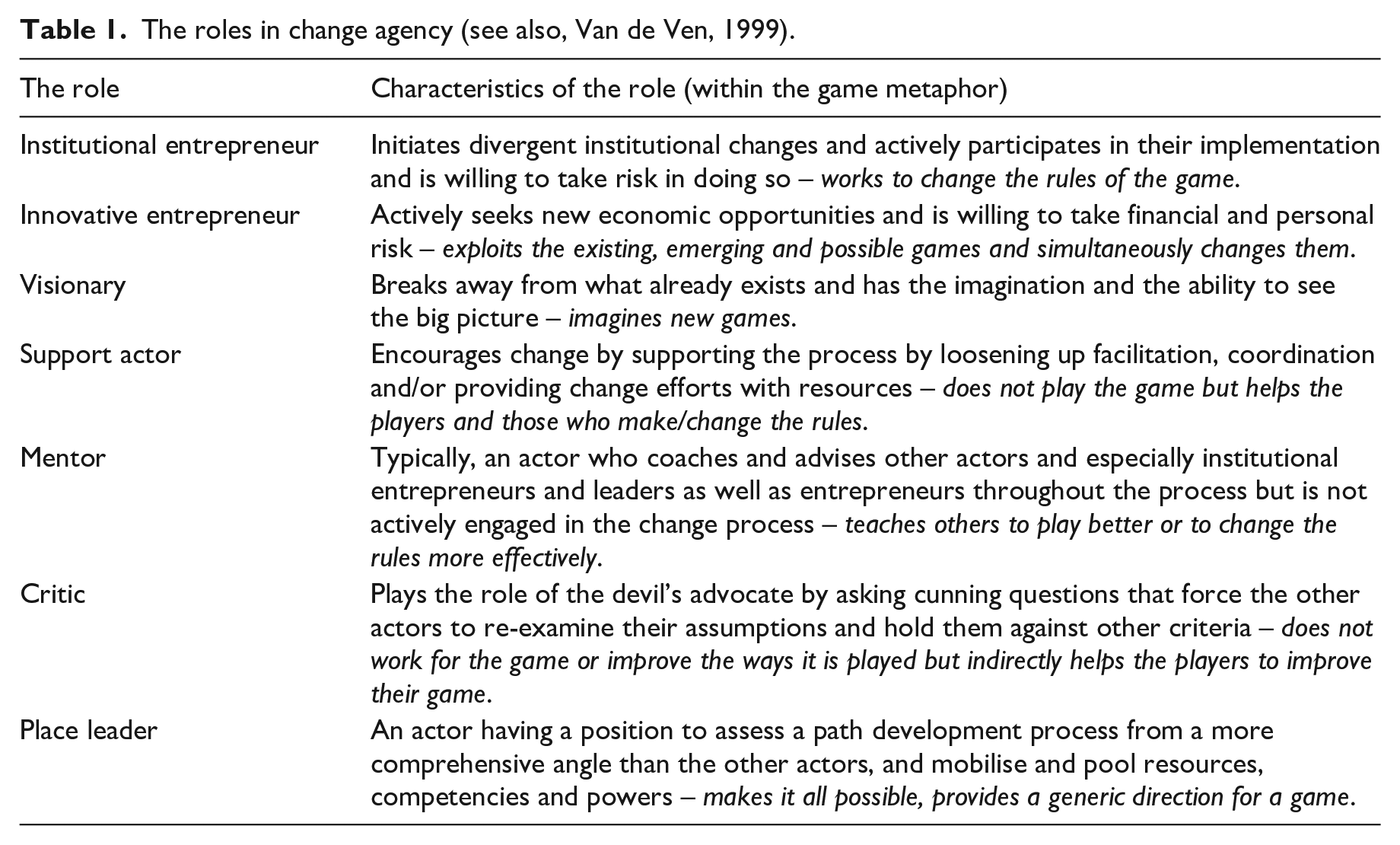
The roles presented in Table 1 overlap, and, in practice, one actor may, and often does, play several roles. For example, a successful innovative entrepreneur may end up changing the markets and thus also assume, involuntarily or knowingly, the role of an institutional entrepreneur. The roles were used (a) to highlight the ways actors contribute to multi-actor path development, and thus also (b) to pave the way for more detailed role-based studies on agency.
The roles in change agency (see also, Van de Ven, 1999).
Methodology, data and the cases
Methodology and data
We explored role-based agency in six regional case studies from three countries: Denmark, Finland and Sweden. Our case studies were in-depth analyses of local- and regional-level development activities, accompanied by extra-regional efforts and targeted at greening the economy. As the roles of agency in green path development as well as in regional innovation systems and related policies have not been studied before, and as the patterns of agency cannot be fully understood or explained by the established regional development theories, we selected an exploratory and qualitative case-based research design. The main aim was to flesh out patterns of agency that were typical in the Nordic green path development. However, the study did not follow a comparative case study design; rather, it drew on parallel single cases to explore role-based agency. It is too early, when studying role-based agency, to follow the comparative case study approach exactly in terms of comparing and contrasting the cases systematically for the purpose of building new theory.
First, we studied each case independently, drawing upon relevant secondary material such as journals, related newspaper articles and respective policy documents. We constructed the overall understanding of the main actors and their means of influence by drawing on the said material. Second, we carried out 87 semi-structured interviews in the case regions but also with national-level policy makers. The interviewees represented local and regional authorities, firms, research institutions, universities and national funding bodies and authorities (see Table 2). Third, we compared the regions using the actor role framework presented above.
The number of interviews by regions.
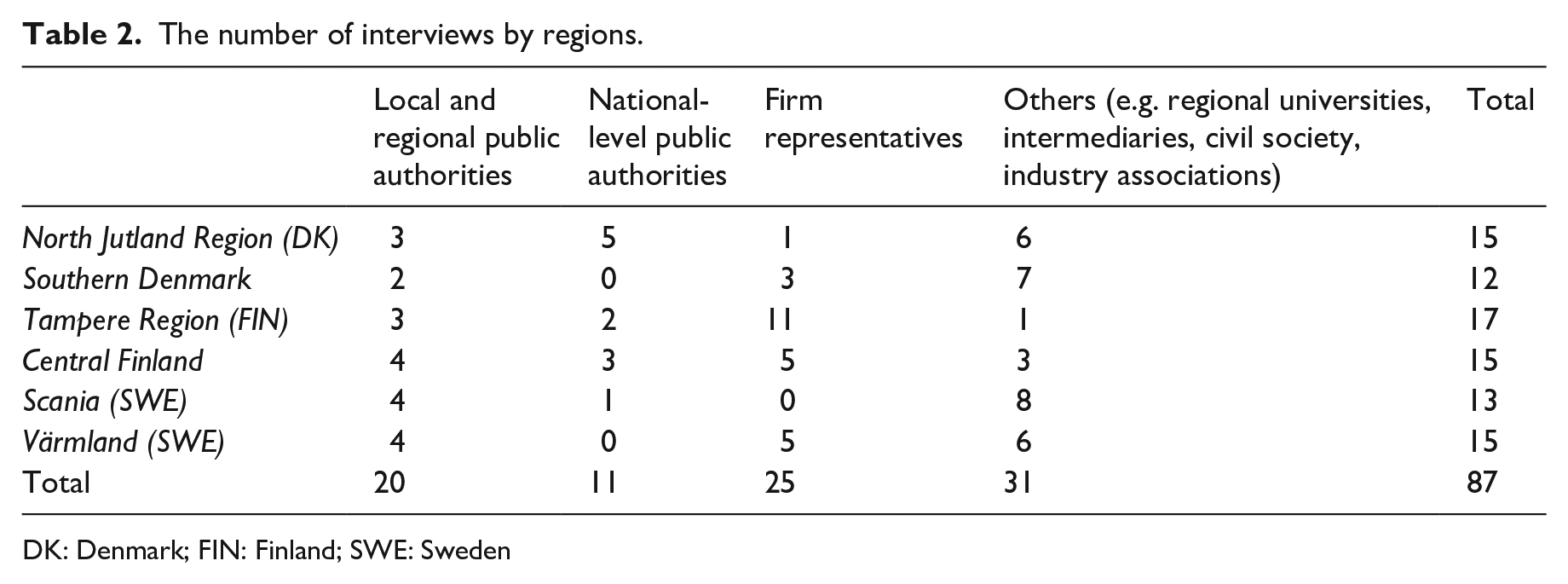
DK: Denmark; FIN: Finland; SWE: Sweden
Throughout the three phases of data collection, the explorative approach led us to search for patterns of agency according to schematic similarities and differences between the key actors and their relationships. The cases in this paper served as a means to illustrate, in a stylised manner, the different types of agency in regional path development.
The cases: their characters and governance arrangements
What are the cases about?
The case selection was done by the criteria established for the ‘Where Does the Green Economy Grow? The Geography of Nordic Sustainability Transitions’ (Gonst) project (Andersen et al., 2019). Three cases (North Jutland, Tampere Region and Scania) were chosen because they have a reputation in their own country as pioneers of green growth and innovation. The other three cases (Southern Denmark, Central Finland and Värmland) were selected drawing upon a quantitative analysis of green skills and occupations as well as green technologies (see for more in detail, Østergaard et al., 2019; Tanner et al., 2019). The cases reflect the key development trajectories present in respective regions (see for details Table 3, and for the location of the case-regions, Appendix 1). The Regional Council of Tampere Region and the City Council of Tampere have adopted several green path development-related concepts to frame local and regional development work. These include circular economy, cleantech and bioeconomy. The core theme in Tampere is to improve cleantech, but the concept of circular economy is also used as a guiding metaphor. In Tampere, both local and regional development actors have constructed policy platforms to mobilise new kinds of ecosystems and hence to support upgrading the local industries to take up the opportunities provided by the increasing demand for environmentally friendly products and services. The case of Tampere Region is about path upgrading and potentially also about diversification.
The case-study regions in a nutshell.
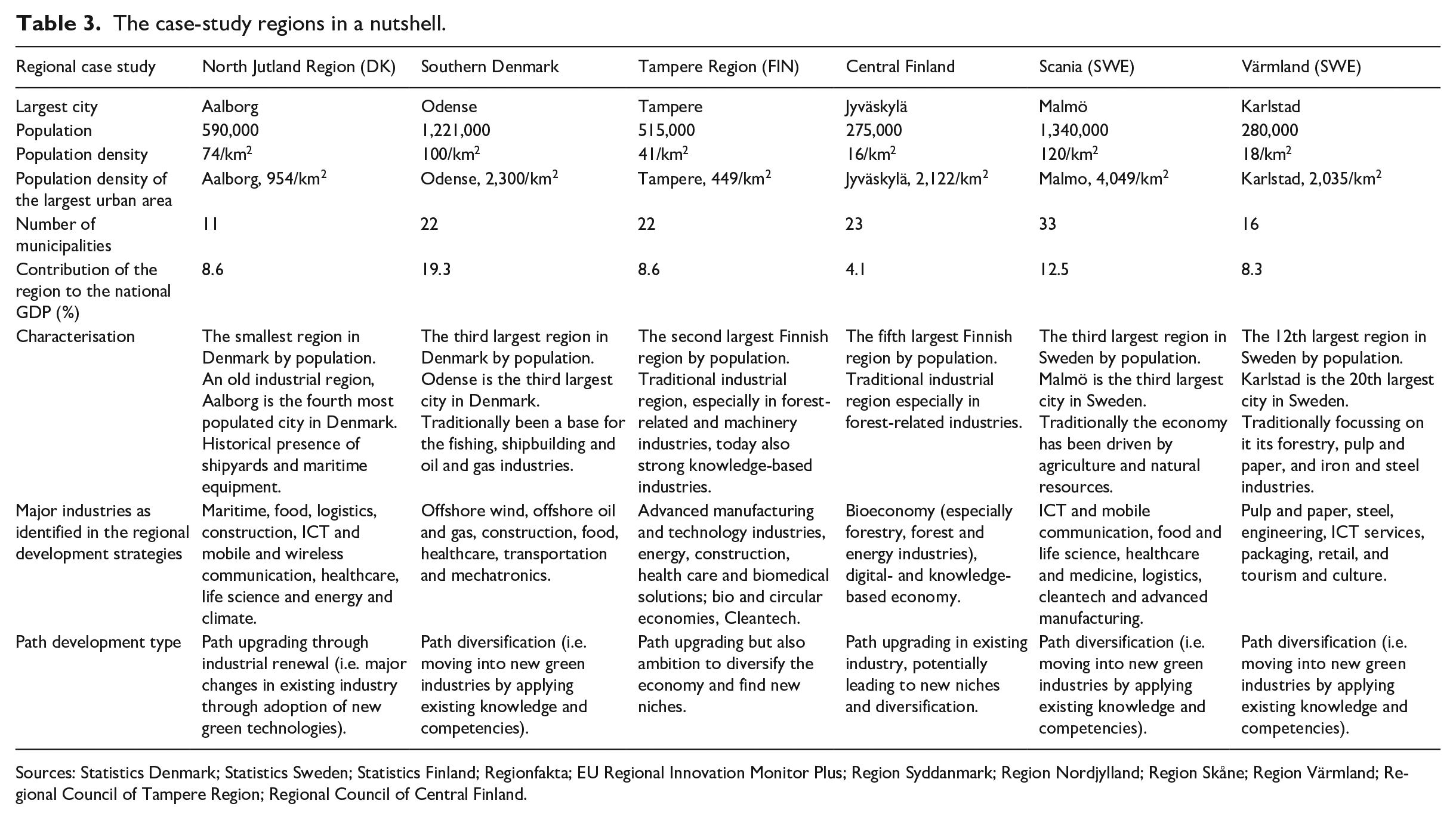
Sources: Statistics Denmark; Statistics Sweden; Statistics Finland; Regionfakta; EU Regional Innovation Monitor Plus; Region Syddanmark; Region Nordjylland; Region Skåne; Region Värmland; Regional Council of Tampere Region; Regional Council of Central Finland.
As Central Finland is one of the traditional Finnish forest regions, with approximately 80% of its territory covered by forest, bioeconomy has quite naturally emerged as the core organising concept in policy-making. In Central Finland, a specific ecosystem including several firms is being constructed around the new bioproduct mill of the Metsä Group. The mill produces not only high-quality softwood and hardwood pulp but also a range of other bioproducts (tall oil, turpentine, bioelectricity, product gas and sulphuric acid). In a way, the new bioproduct mill, and the ecosystem around it, is simultaneously about path upgrading and diversification as well as, potentially, about the emergence of something new.
The case of North Jutland is about greening the maritime industry. The North Jutland region has the advantage of a favourable geographic location in terms of closeness to the North Sea, Kattegat and Limfjord, which provides the necessary support in terms of different ports for the development of a viable maritime industry in the region. The region has benefitted from a traditional shipbuilding industry, which over the years has transformed into a well-functioning hub for several small- and medium-scale maritime equipment manufacturers and service providers. In a way, the North Jutland case is about path upgrading from the traditional shipbuilding industry to the development of a specialised cluster focused on maritime equipment manufacturing and services.
Southern Denmark lies by the North Sea. The case study focused on the offshore wind industry in the region. The region has transformed itself from a leading centre for fisheries to a major centre for oil and gas activities, with its more recent activities being centred around a prominent offshore wind industry. The region has several geographical and infrastructure advantages for the development of an offshore wind energy industry: these include excellent port facilities and the sharing of infrastructure with the offshore oil and gas industry and the presence of major national and international offshore supplier firms in the region. The Southern Denmark case is about path diversification from the existing offshore oil and gas industry in the region and the onshore wind energy industry to an emerging offshore wind energy industry.
Värmland has a strong concentration of forest-related industries due to the significant geographical advantages of a large forest cover in close proximity to the lake Vänern which provides access for the easy transportation of wooden logs and cheap hydroelectricity for running pulp and paper mills during the earlier phases of the industry. Furthermore, the region has prominent paper mills and packaging firms. As the industry grew, the region attracted a number of equipment manufacturers geared towards supplying the regional pulp and paper firms. Over the years, the region of Värmland has gradually transformed towards a forest-based bioeconomy. The Värmland case study is about path diversification from a traditional pulp and paper industry in the region toward a forest-based bioeconomy.
Scania is a frontrunner in biogas production in Sweden. The region has geographical advantages for biogas production, with access to good natural conditions such as a high amount of biomass, access to a good waste management sector for the treatment of household and industrial waste, proximity to agricultural and food industries and a well-developed natural gas grid in the western part of the Scania region. Furthermore, the region has prioritised the development of biogas in the region for meeting regional transportation needs and the further development of a circular bioeconomy in the region. The Scania case study is about path diversification from the agricultural, food processing and waste management industries in the region to the development of a new biogas industry.
The governance systems in a nutshell
Finland is a unitary state with a two-tier government system: central government is strong, with ministries playing a significant role in their respective fields. Importantly, significant responsibilities and powers have been devolved to 330 self-governing municipalities enjoying a constitutionally guaranteed local autonomy and fiscal powers. Especially, city councils have invested significantly both financial and human resources in the promotion of economic development in their respective localities. At a regional level (18 regions), regional councils (statutory joint municipal authorities) are responsible for the coordination of regional development, the management of development funds being shared between several public organisations, including state development agencies at a regional level (Haveri, 2015). Since the 1990s, the Finnish regional development legislation has treated regions and localities as the authors of their own development, in collaboration with the State (Vartiainen, 1998).
Sweden has a three-tier government system at the national, regional (21 counties) and the local level (290 municipalities) with a centralised administrative and political system. At the regional level, political tasks are performed by the regional councils which are directly appointed by people in the county along with the county administrative bodies, which are government bodies in the counties. At the local level, the municipalities are responsible for local affairs such as educational and vocational training, healthcare, environmental protection, planning and public transport. In Sweden, the national government has significant power over the regional and local level in the multi-level governance arrangement (Government of Sweden, 2020). In the Swedish context, the state level through the county governor has an upper hand in the regional innovation strategy, being engaged in a dialogue with the central government and the municipalities. In Sweden, the degrees of freedom for regions to operate are often limited by the national government and national initiatives with the regions often following mandates from the national government (Normann et al., 2017).
Denmark has a three-tier government system at the national, regional (five regions) and local level (98 municipalities) organised on a decentralised basis. The regional level is mainly responsible for healthcare and hospitals, but has responsibilities also within areas such as transport and environment and so forth. The municipalities have their specific citizen representation and look after specific issues such as education at the primary and secondary level, social welfare, sports and culture, spatial planning, unemployment services, integration of immigrants, development of local roads and eldercare (Division of Powers Denmark, 2020; Normann et al., 2017). Denmark has a relatively decentralised governance system where municipalities have increasingly gained responsibilities, most recently when business support policy was moved from the regional to the municipal level (Ministry of Industry, Business and Financial Affairs, 2019).
Change agency in the North
The core: leadership, institutional entrepreneurship and innovative entrepreneurship
Drawing on our empirical analysis, we argue that place leadership, institutional entrepreneurship and innovative entrepreneurship are at the core of change agency in path development and that all the other roles, in their own ways, support the core.
DiMaggio (1988) introduced the concept of institutional entrepreneurship to shift the focus more on disruptive actions of key actors instead of seeing institutions mainly as constraining forces and actors as being constrained by them. A significant part of the promise of the concept of institutional entrepreneurship as a research focus is to establish a broader vision of agency that would avoid depicting actors either as ‘cultural dopes’ trapped by institutional arrangements or as ‘hyper muscular institutional entrepreneurs’ (Lawrence et al., 2009: 1). Our analysis showed that institutional entrepreneurship was neither about cultural foolishness nor heroic actions of individual super organisations or superior human beings. In green path development among the Nordic case regions, risk was shared among the many rather than the few (though not equally). In all our cases, we were able to identify several actors who worked, one way or another, to change institutional arrangements for green path development and related innovations. The actors involved ranged from national-, regional- and local-level public authorities to leading corporations as well as other firms and research organisations. Consequently, we suggest that institutional entrepreneurship is a form of shared agency, instead of a solo activity. As such, it may be best understood through the combined influence of the actor roles, in particular place and institutional leaders as well as innovative entrepreneurs.
In Tampere, the collective effort to mould institutions to better support green growth is most notably led by the City of Tampere in collaboration with other public development agencies (specifically, Regional Council and Business Tampere). The City Council has explicitly acknowledged the need to change local institutions and find new ways to frame and enhance greening the economy (Cotton, 2018; Raunio et al., 2016). It has also acknowledged its limited capacity to push for major changes alone. Our data did not allow us to assess the risks the city is taking, but it is clearly in a position to assess the institutional change process from a more comprehensive angle than most other actors. By identifying and facilitating specific policy platforms, the city has taken the lead by providing other actors with generic directions and organised ways to look for new ways of collaboration (see Sotarauta and Suvinen, 2019). In Central Finland, the efforts to change the local and regional institutional landscape are organised around platforms. If in Tampere the leadership is assumed by the City Council, in Central Finland the institutional leader is one of the Finnish forest industry giants, the Metsä Group, which searches not only for new products but also for a novel ecosystem around its new bioproduct plant. With its partners, the Metsä Group has initiated divergent changes, which in time are expected to modify not only the regional conditions for the forest industry but also for the industry more broadly.
In Värmland (Sweden), the change strategy is based on a broad collective action with the aim of generating new businesses by a novel use of side streams of the main industrial players. The main aim is similar to that in Central Finland. While in Central Finland the core institutional leader is a corporation, in Värmland place leadership is shared between the region Värmland and the leading firms (such as Stora Enso, Billerud Korsnäs, Nordic Paper, etc.). More or less all the main corporate players of the region have been mobilised to contribute to diversification from the existing forestry industry: they share the ambition of the public agencies to push the industry toward a bioeconomy. The collective effort has been managed and brokered by Paper Province, a dedicated cluster organisation with the aim of becoming the leading competence node for a forest-based bio-economy. The Paper Province cluster has been instrumental in developing a new platform for forest-based bioeconomy in the region by strengthening cooperation between the various regional stakeholders. In Scania, the local and regional public authorities have assumed place leadership roles. The region Skåne and the County Administrative Board of Scania have engaged in the development of biogas by formulating distinct regional strategies and mobilising political support for biogas.
Similarly, in the North Jutland Region and in the region of Southern Denmark, the respective regional authorities have assumed the role of place leaders, while the many private and public-private actors are the central entrepreneurial actors. The region North Jutland has played an instrumental role in prioritising the maritime industry as a focus area and has consequently developed a regional strategy for its promotion. In Southern Denmark, the regional authority has strategically supported the offshore wind energy industry in the region, enhanced collaboration between small-scale regional firms and international offshore wind firms and supported a national industry with a regional base in Southern Denmark. The regional authority also established collaboration with the wind energy lobbying organisations that are operating at the national level in representing the interests of the industry.
Indeed, in five cases out of six, based on their strong roles in the respective governance systems, the local and regional public actors are by definition in a position to launch and assess institutional change processes from a more comprehensive angle than the other actors and are thus assuming leading roles. In Central Finland too, the national, regional and local public actors have played central roles, but more in support and mentoring positions. When aiming to lead processes, local/regional development authorities work to pool resources, powers and competences to direct the emergence of green paths. They arrange sense-making sessions and networking events, set up projects involving the regional stakeholders and engage in ‘development diplomacy’ with the aim to convince regional-, national- and international-level actors – placeless institutional leaders – to support green path development. Place leaders need to reach beyond organisational boundaries and to construct collaborative spaces for increasing their leverage (Liddle, 2012: 37).
Each and every case involved several private firms. However, our data did not allow us to assess how ‘Schumpeterianly innovative’ the engaged firms were and what kind of opportunities they were pursuing and how, and what was the level of risk they were actually taking. Importantly, they have been involved in enhancing, in different capacities and in different ways, their own local/regional operational environments for the future. In the North Jutland Region, for example, the entrepreneurs include such firms as Alfa Laval, Man Diesel and Turbo but also DESMI Ocean Guard. The region has also been involved in shaping maritime cluster policies and setting up collaboration with local suppliers. In Southern Denmark, the respective list for offshore wind power is as impressive, including firms like Siemens Gamesa, MHI Vestas and Ørsted. In Värmland, start-up firms such as Modvion, Drinor, Renew Cell and Cellcomb are engaged in developing innovative products and services. Furthermore, leading corporations, such as Valmet, are focusing on technology provision and services for the paper and pulp firms, such as Stora Enso and Billerud Korsnäs. In Scania, important entrepreneurial firms include Purac Läckeby, Norups Gård and Malmberg Water, which are the key firms representing the biogas value chain in the region. The list of engaged firms is similarly long in other case regions. Of course, the level of engagement and contribution varies from firm to firm, varying over time as well.
The Props 1
Our cases show how place leaders provide the change processes with directions to better support the greening of regional economies and the related entrepreneurial activities, while innovative entrepreneurs perceive and strive to realise new opportunities commercially. Place leaders and innovative entrepreneurs are central in the game of green path development, taking together the role of institutional entrepreneurship, but they need other forms of agency to support their change efforts either directly or indirectly – we label such forms of supportive agency as the ‘Props’ (see Figure 1).
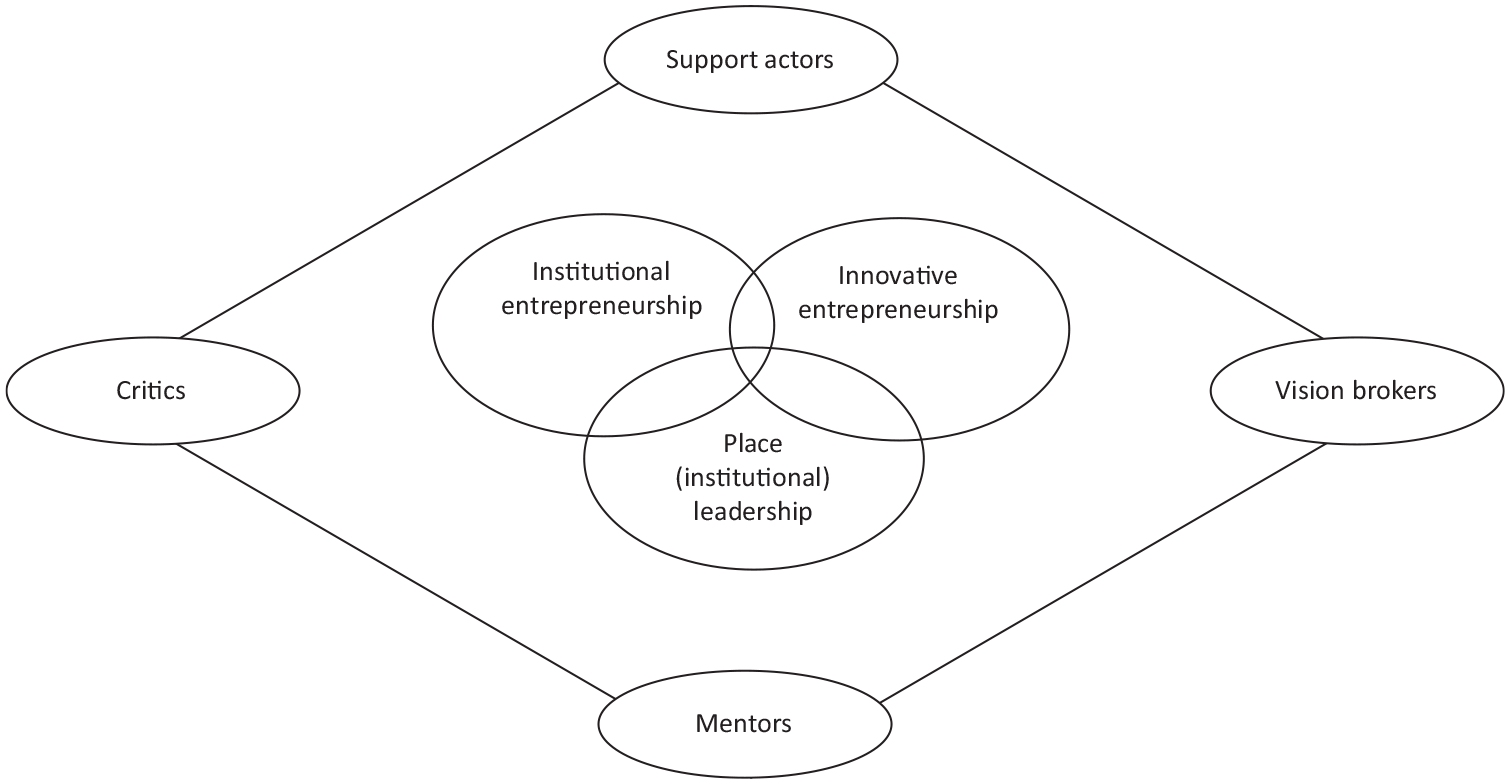
The roles in change agency.
Individual entrepreneurs or any other actor may break away from what already exists: they may have the imagination and the ability to see the big picture. Our interview data, however, suggests that visions for green path development (not for individual products or services) are not unique as such but reflect the general understanding of the need for green economies. In regional path development, instead of imagining totally new games, more important are the ways that generic visions in global/national circulation are being made sense of and translated into collective contemplation and action. In our case regions, future directions are not based on foresighted visions by exceptional individuals or dominant organisations. Instead, it is possible to identify the actors who influence the thinking of others with appealing future imaginaries, or who bring ideas and visions from elsewhere to a region, or who organise collective strategy and/or envisioning processes. Generic visions are translated into collective awareness through complex communicative processes lasting years. Our analysis suggests that visionaries in the case regions are more brokers of generic visions from wider circulation than actual visionaries; they are localisers of generic visions to fit in the economic and social fabric of a place in question. Visions, indeed, are crucial as they create a tension between what is now and what could be, and thus they are food for thought in many debates on greening the economy. From this perspective, at a regional level, vision brokers may even be more important in path development than the actual visionaries.
In North Jutland, the role of a vision broker has been played by the Port of Aalborg. In Southern Denmark too, the Port Authority has been central in introducing novel thinking to the region. For its part, the Finnish Innovation Fund (Sitra) is an example of an organisation that has influenced the thinking in Tampere Region through its many reports, training sessions, conferences, demonstrations and pilot projects. As Sitra is an organisation operating under the auspices of the Finnish Parliament, its influence is national and visible also in Central Finland, at least indirectly through the many national strategies. From a local perspective, the Metsä Group has introduced a new vision into Central Finland but perhaps not into the world.
In Värmland, the vision brokers are the cluster initiative (Paper Province) and Karlstad University. The cluster initiative has played an important role in transforming Värmland into a large-scale demonstrator of bioeconomy by setting up a new vision of change for a traditional pulp and paper industry by focusing on reutilising waste streams and developing new services and products in collaboration with regional stakeholders. The vision is more or less the same as in Central Finland. In Skåne, the vision revolving around biogas has been promoted by the transportation company (Skånetrafiken) and the regional authority (Region Skåne). The regional authority together with Skånetrafiken envisioned the use of biogas in the regional transportation and set the goal for making Scania the leading biogas production region in Europe by 2030. The regional authorities have translated this vision into practice by procuring biogas at higher costs through specific criteria.
We were able to identify actors playing the role of a mentor in every case region. The regional universities have all played the roles of the mentor in the Danish cases by collaborating with the maritime and offshore wind industries and providing R&D facilities for the development of new knowledge around new products and services. In North Jutland, the regional cluster organisation – the Maritime Center for Optimization and Operation (MARCOD) – was enlisted to help small and large firms in developing strong regional networks for sharing knowledge and thus strengthen the regional cluster. It has organised seminars, advised firms to enter the maritime market and facilitated the development of new demonstration projects. Another actor, the Frederikshavn Business Council, is involved in supporting and coaching the local firms, performing a brokering function by involving different stakeholders in demonstration projects and negotiating the role of different partners in the projects.
In Värmland, the regional university and research institute have played the mentoring role by providing other actors with research-based knowledge and promoted engagement in collective policy contemplations. For instance, Karlstad University has been strategically involved in advising the regional industry and the regional authorities on different regional development strategies, including the establishment of the Academy for Smart Specialization. Karlstad University has also mentored new spinoff firms and facilitated collaboration between regional firms and researchers on test beds for bioeconomy development in the region. Furthermore, initiatives like Lignocity have been helping and providing mentorship to regional entrepreneurs to use the infrastructure present in the region to develop novel applications and value chains using lignin and to turn them into new business models with the potential of scaling them up to a substantial level.
Meanwhile, in Scania, the mentor roles have been played by Energiforsk and the Swedish Environmental Research Institute. These actors have played an important role in performing laboratory studies for biogas, acting as consultants and performing various studies for the regional authorities regarding biogas development as well as working together with the regional industry in providing evidence-based objective information regarding biogas development in Scania. Energigas Sverige, which has played an essential role in preparing reports and suggestions for the national government with respect to incentive schemes for biogas, has been developing a national biogas strategy and working together with other regional biogas associations to lobby for suitable policy mechanisms for biogas at the Swedish national and the EU level.
In Finland, related to its vision broker role, Sitra has also mentored developments. Sitra is an example of an actor that has influenced the thinking in the Finnish case regions through its many reports, training sessions, conferences, demonstrations and pilot projects. In Central Finland, in addition to Sitra, the Ministry of Agriculture and Forestry, local and regional development agencies and consulting companies in varying capacities have also mentored developments, often in an indirect manner, by encouraging the emergence of a new ecosystem around the Metsä Group’s bio product plant. In line with other cases, in the Finnish cases the universities have facilitated the path development efforts.
In addition to the roles briefly discussed above, each case has received support from a variety of public agencies in terms of funding, building new infrastructure and navigating through regulations. In all case regions, there are local/regional actors promoting new investment opportunities, navigating the constraints that hamper business developments and providing business development services for firms. As the public support functions are fairly well known, we will not discuss them in this article, but use some of the Danish industry and function-specific interest groups as example of support actors. Overall, the support actors are the usual public organisations (see Table 4 for a general-level summary). The Port of Aalborg has played an essential role in attracting maritime companies to the North Jutland region. Actors like Danish Maritime and the Danish Shipowners Association serve a different role from regional cluster organisations (e.g. MARCOD) as they do not just address business activities but represent the industry at a political level and help regional cluster organisations to represent their concerns at the national level. The Danish Maritime association focuses more on supporting the interests of the Danish maritime equipment manufacturers and suppliers for the development of new green technologies, while the shipowners’ association works to protect the interests of the large shipowners by lobbying for more attractive regulations at the national-, the EU- and the IMO-level through the Danish representation. These actors have been supported by public–private partnerships, such as the Green Ship of the Future, to facilitate collaboration between shipowners and maritime suppliers.
Various actors and roles played in the game of green path development: illustrative and exemplary summary. (Only some of the actors are mentioned). (Public policy actor refers to national-level actors).
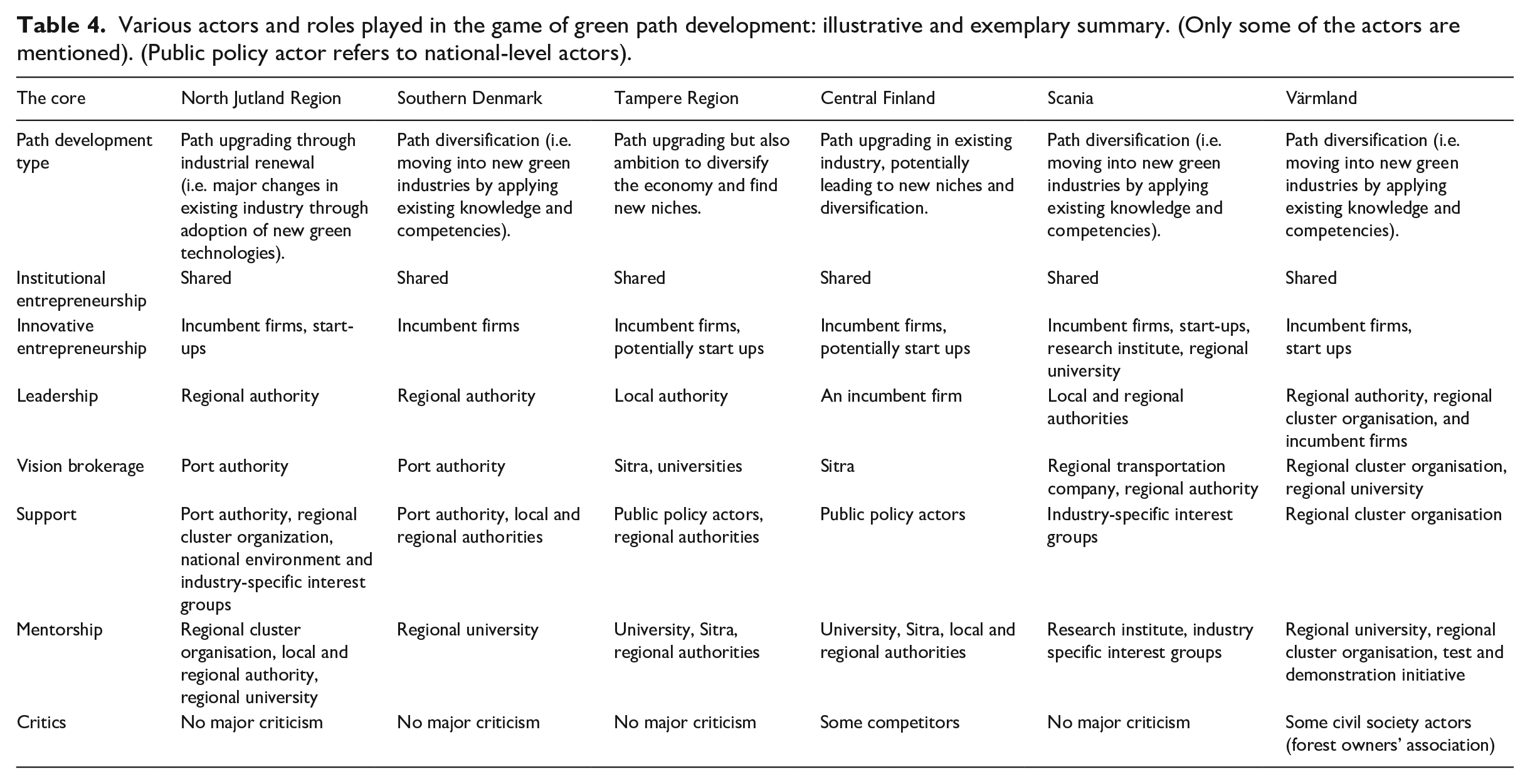
Furthermore, organisations such as the Danish Environmental Protection Agency (EPA) have focused on regulatory issues related to environmental issues in the maritime sector. The Danish Maritime Agency has focused on supporting Blue Denmark, which is helping to promote the greening of the maritime sector in Denmark. The Danish Maritime Authority is also involved in founding and supporting the Green Ship of the Future initiative with other stakeholders, such as A.P. Moller-Maersk, Aalborg Industries, MAN Diesel and Odense Steel Shipyard. In Southern Denmark, the port of Esbjerg has become a front runner in offering flexible infrastructure for offshore wind firms, providing continuous operational and service support and adopting a flexible approach to business development by listening to their customers’ needs.
Critics challenge the advocates of a specific path development to learn about potential negative consequences by questioning the assumptions behind specific actions. In the two Finnish cases, we were not able to identify how critics might have influenced collective learning in the context of green path development. In Central Finland, the critical voices argue that the new bio-product plant is not as innovative as has been claimed and that it is more about branding than innovation. In any event, the plant is in operation and the ecosystem around it is growing; in other words, the path is being upgraded and diversified – the critics’ influence has been minor in the actual course of events.
In Värmland, representatives of civil society, especially female forest associations such as Skogskvinnorna (forest women), have acted as critics by raising issues related to gender inequality in traditionally male-dominated forest-based industries with the ambition to increase the attractiveness of the industry for female engineers. Furthermore, civil society actors in Värmland have advocated also for defining the value of forests in the region for nature and ecosystem services, tourism, recreation and wildlife protection rather than exclusively focusing on forest-based industrial development and transition towards a bioeconomy.
Grillitsch and Sotarauta (2020) argue path developments call for three types of potentially overlapping forms of agents: innovative entrepreneurs capable of perceiving emerging opportunities and willing to take risks; risk-taking and opportunity savvy institutional entrepreneurs working to change the institutional arrangements; and place leadership for pooling competencies, powers and resources to boost collective action. In sum, our analysis endorses their view but argues further that also the roles of the many Props, who are engaged both directly and indirectly in green path development, are to be acknowledged (see Figure 1 and Table 1).
Discussion
In every case region, for the initiation of divergent institutional changes in support of green path development, a shared action has been mobilised, and, in some cases, designated organisations to support this by managing boundary spanning and coordination functions have been established. Our observations, first, confirm the findings of previous studies that institutional entrepreneurship is not an individualised heroic activity, as it is sometimes criticised, but a shared and processual form of agency (see Benneworth et al., 2017; Drori and Landau, 2011; Jolly et al., 2020; Ritvala and Kleymann, 2012; Sotarauta and Mustikkamäki, 2015). Institutional entrepreneurship is shared (involving both regional and extra-regional actors) to control the risk, to better understand the multi-dimensional issues from several perspectives and to shape as early as possible the notoriously complex multi-actor decision-making processes. Shared institutional entrepreneurship is defined by the roles that various actors play to pave the way for green path development in their regions for selected industries, products or other commercial entities. Institutional entrepreneurship does not determine the unfolding of a new path but frames the actions of influential actors in multiple ways.
Second, we suggest that institutional entrepreneurship in the promotion of Nordic green path development is shared for at least four reasons: (a) the Nordic tradition and governance system supports the idea of sharing the risk and mobilising for collective action; (b) even the strongest of actors are dependent on the resources and capabilities of the others, with none being in a position to mould the institutions alone; (c) the key actors manage risks (political, reputational, financial) by drawing on each other’s assets, powers and capabilities; and (d) as the countries and regions under scrutiny are fairly small, the resources of actors are finite and the capabilities to tackle complex issues are limited, a built-in conception that collective action is not a choice, but a necessity is widely shared. We also see multiple actors having, to some extent, overlapping roles but in some cases also differentiating themselves from other actors. The roles are based on the positions of the actors in the wider governance and/or innovation systems as well as on their resources, competences and capabilities.
We are not suggesting that the Nordic version of a shared institutional entrepreneurship would be a harmonious and clearly defined process; rather, it is a continuous discussion – sometimes heated, sometimes less so – regarding both the possible development strategies and the roles of actors. The roles are a constantly evolving feature of shared agency; they are not necessarily clearly defined but emerge from continuous communication and negotiation among the key actors.
Change agents consciously reach beyond their familiar fields of activity toward such spheres and spaces where they do not have direct authorisation or formal power. This is why the Props, third, side-by-side with the core actors, play an important role in shared institutional entrepreneurship. In this study, we were not able to assess how well the actors fulfilled the roles they had assumed or had been provided with by the other actors. We were able to show what kinds of roles are visible as elemental parts of the shared development work and how they complement each other. Fourth, in a fairly typical Nordic tradition, all six cases demonstrate strong local- and regional-level formal place leadership, in concert with national actors and policies, assumed by public authorities. As the Central Finland case suggests, other actors may also assume a leading role. In the cases under scrutiny, public actors that have assumed a leadership position consciously aim to work to construct new collaborative spaces (policy clusters, platforms) with state, non-state, business and research organisations. Interestingly, as Collinge and Gibney (2010) also observed in their study of the Øresund Science Region, the local/regional development efforts in the North may function well, not in spite of the lack of centralised power and clear divisions of labour in a region, but because each and every actor has a limited formal power base to mobilise sets of actors. Continuously evolving emergent forms of action necessitate finding such roles for collaboration that benefit both the members of the collective effort and the region in question.
Fifth, a shared vision is generally seen as one of the preconditions for mobilisation of a shared action, but the role of a vision is more complex than is often assumed. Shared institutional entrepreneurship is ‘surrounded’ by generic green visions pressurising actors. Instead of having a shared vision introduced by visionaries, shared institutional entrepreneurship operates in the nexus of existing visions that push for continuity and new visions that cry out for institutional changes in support of green path development. Consequently, instead of having a grand vision providing a direction for collective action and its members or some visionaries leading the thinking, the case regions benefit from vision brokers transmitting future-oriented ideas and boosting related thinking. It is not the visions that differentiate the regions from each other but the capacity to mobilise and coordinate collective action to execute them.
Conclusion
This study adds to the literature on path development and related agency by specifically focusing on the roles that various actors play in enhancing green growth. By seeing beyond their formal positions, we show how different actors contribute to path development. The paper introduces a first take of a stylised conceptual framework to study role-based agency in path development and related fields of interest. Our view differs from the usual approach in policy-related studies, which focuses on policy contents, contexts and processes, as well as on the impacts of a selected policy or a mix of them. Our aim is to see beyond public policies and corporate strategies in order to flesh out the ways that various actors are connected to path development and to each other’s activities – what roles each of them plays in the game of green development.
We acknowledge the importance of policy actors but suggest that they may take differing roles from place to place, from country to country and in different industrial paths; however, there also are similarities in their roles. For the empirical analysis, we identified seven roles in change agency. Based on our analysis, we argue that institutional entrepreneurship was the core of change agency in conjunction with innovative entrepreneurship and place-based leadership. The other four roles together support the path development efforts. We suggest that institutional entrepreneurship is not a solo activity but a collective form of agency.
Footnotes
Appendix
Acknowledgements
We are thankful for comments of the ‘Where Does the Green Economy Grow? The Geography of Nordic Sustainability Transitions’ (Gonst) project team.
Declaration of conflicting interests
The author(s) declared no potential conflicts of interest with respect to the research, authorship, and/or publication of this article.
Funding
The author(s) disclosed receipt of the following financial support for the research, authorship, and/or publication of this article: This research was funded by the Nordic Green Growth Research and Innovation Programme in cooperation with NordForsk, Nordic Innovation and Nordic Energy Research [grant number 83130]
