




Abstract
While the role of cities and regions is increasingly acknowledged for climate action and discussed in the literature on sustainability transitions, the specific condition of peripheral regions has received less attention. This article develops a bibliometric review to shed light and discuss how the (multi-dimensional) notion of periphery has been conceived and implicitly declinate in different literature streams studying low-carbon sustainability transitions at the sub-national level. While the studies explicitly addressing the issues of peripherality are still scarce, the article identifies four critical dimensions that contribute to frame structural bottlenecks and opportunities: socio-spatial unevenness, asset fragility, network positionality and agency and the multi-scalar embeddedness of transition policies. At the interface of urban and regional studies and sustainability transitions’ research, these dimensions open up new research challenges and trading zones ahead for peripheral regions on navigating troubled waters of sustainability transitions.
Keywords
Introduction
To accomplish current international climate targets – such as the ones in the Paris Agreement and the European Green Deal – countries need to accelerate low-carbon transitions while facing the macroeconomic turmoil resulting from COVID-19 pandemic and the effects of the Russian–Ukraine war. It is commonly accepted that while environmental issues are a global societal challenge, policy action should be conceived and delivered also at lower spatial scales, including the national, regional and local levels (Fenton and Gustafsson, 2017; Reed and Bruyneel, 2010). Hence, virtually all around the world, climate action has sprung up in many cities and regions – ranging from greening energy systems and introducing cleaner technologies to seeking wider transitions towards more sustainable production and consumption modes (Gibbs and O’Neill, 2017; Traill and Cumbers, 2023; United Nations, 2017).
At the same time, it has been argued that such transition pathways are variegated and so are the resulting environmental outcomes (e.g. Bina, 2013; Gibbs and Jensen, 2022; Moallemi et al., 2020). While large metropolises and core urban regions have been at the forefront of those efforts (C40 Cities, 2016), sustainability transitions raise several issues for so-called peripheral regions. In such places, weak economic structures and innovation dynamics have been described as constraining environments for new green path development (Grillitsch and Hansen, 2019), due to multiple lock-ins, economic dependence on industrial (polluting) incumbents and institutional thinness (e.g. Tödtling and Trippl, 2018). In Europe, many such regions have been caught in economic development traps (Diemer et al., 2022) and political turmoil (Rodríguez-Pose, 2018), making transition efforts even more challenging. Also, in peripheral settings, clean technologies (in a broad sense) are often imported, with green pathways as much a matter of technology absorption as of endogenous technological development and new industry formation, raising issues of connectedness and the role of agency in the process (Binz et al., 2016; Nilsen and Njøs, 2022).
Overall, this line of reasoning suggests that peripheral regions face troubled waters ahead in their transition to more sustainable production and consumption modes. However, and although the regional and geographical aspects of sustainability transitions have started to be addressed with considerable depth over the last decade (e.g. Coenen et al., 2021; Gibbs and O’Neill, 2017; Hansen and Coenen, 2015; Truffer and Coenen, 2012; Truffer et al., 2015) – seeing regions not as normative concepts or fixed realities but taking on-board issues of scale, connectedness and power – the specific issues of the periphery within this debate have received less attention. While a growing number of studies focus on rural areas (e.g. Galliano et al., 2022) and are concerned with non-western realities (e.g. Truffer et al., 2022), a discussion on how peripherality is conceived and declinate in studies linking sustainability transitions, regions and space is still lacking. Also, while the literature on the geography of sustainability transitions has been drawing inspiration from institutional, relational and evolutionary paradigms in Economic Geography (Hansen and Coenen, 2015), a deeper understanding of the conditions and ‘fluidity’ of the periphery may benefit from also considering other contributions in wider streams of literature.
In this article, we address these challenges in three ways. First, we run a bibliometric analysis to systematically expose the extant literature discussing climate-related sustainability transitions at the regional level; by doing so, we reveal knowledge relationships, including conceptual differences, similarities and complementarities in this research spectrum (Boyack and Klavans, 2010; Zhu et al., 2019). Second, we apply a qualitative analysis to pinpoint and identify how the periphery is conceived and implicitly discussed in such studies. Third, and based on the preceding discussion, we inductively identify four aspects that emerge from these studies to frame critical issues behind sustainability transitions in peripheral regions: socio-spatial unevenness, asset fragility, network positionality and the multi-scalar embeddedness of transition policies.
The remainder of this article is structured as follows. The following section briefly reviews three ways in which the periphery is conceived in urban and regional studies. The following section introduces the bibliometric methodology, detailing data collection procedures and article selection criteria. The bibliometric analysis section presents the results of the analysis based on a co-occurrence network of keywords and a bibliographic coupling network, analysing the declination of the periphery in the identified cluster, while the ‘Sustainability transitions in the periphery: what do we know about it?’ section reviews and highlights critical issues underlying sustainability transitions in peripheral regions. The ‘Concluding reflections and research challenges’ section concludes by discussing implications, challenges ahead for peripheral regions and future research directions.
The periphery in urban and regional studies
The notion of periphery (and of peripheral regions) has received considerable attention in Economic Geography, Urban and Regional Studies and Development Studies (e.g. Eder, 2019; Massey, 1979; Smith et al., 2002; Willis, 2011). Underlying the notion of periphery is a sense of unevenness and difference in relation to a certain core; however, the way such a notion is applied and conceived varies widely and depends on specific research traditions. In this section, which does not claim to be comprehensive, we identify three major perspectives that can be observed in recent research.
First, the dichotomy between ‘Global North’ and ‘Global South’ has become widely used, in many studies, as a shortcut to identify specific core-periphery relations (e.g. Horner and Carmody, 2019; Pike et al., 2017). These studies implicitly mobilize notions of political (e.g. representation, access to decision-making, international dependence) and cultural peripherality (outside ‘western’ and ‘core’ cultural norms and practices), but also suggest an overall sense of ‘Southern’ economic backwardness. This type of block-based dichotomy is widely used in Development and Urban and Regional Studies but hides enormous differences across sub-national realities and conflates highly variegated territorial contexts – notably in assessing transition potentials and possible pathways (e.g. in the dynamic cores of urbanized mega-cities versus rural areas under a subsistence economy).
Second, and notably within Europe, peripherality and the identification of peripheral regions are most frequently conceived at the sub-national level, taking a more place-based perspective (e.g. Iammarino et al., 2019). From this angle, the notion of spatial–economic peripherality is the most common, equating peripherality with rurality and remoteness in relation to major economic centres and metropolitan labour markets. Peripherality comes associated with physical distance and accessibility, but essentially with a structural condition of lower economic density and industrial diversification bottlenecks. Recent studies have argued for a more fine-grained view on peripheral regions and their resilience capacities, according to different actor constellations and power relations within (Nilsen et al., 2023). Yet, from this angle, peripherality is still a regional condition, associated with a relatively structural if not permanent state of disadvantage in relation to metropolitan centres, which may lack ‘assets’ for sustainability transitions – notwithstanding a growing number of studies highlighting the innovation advantages of peripheries (e.g. Eder and Trippl, 2019; Shearmur, 2017).
Third, another influential way to conceive peripherality takes a relational approach, in which core and periphery are ‘relationally constituted and functionally interdependent’ (Grabher, 2018: 1785). Thus, peripherality depends on (regional) actors and their positions in wider networks, of multiple kinds. This view has been influential in Economic Geography (e.g. Bathelt and Glückler, 2011; Yeung, 2021) and in geographical studies of Sustainability Transitions (e.g. Hansen and Coenen, 2015). For example, Glückler et al. (2023: 231) recently argued that peripherality relates to a
distant, dispersed, and disconnected position relative to a core within a field (. . .); [here], a key distinction is made between the position of an actor in geographical space (location) and the position of an actor in a social network of relations.
According to this perspective, periphery is not a fixed, objectively geographical or economic condition: it is shaped by social, political and economic relations between different regions and actors, and depends on the specific functions at stake. By highlighting connectedness and interdependence, this approach opens a more fluid view of peripherality, depending not only on regionally situated assets, but also seen as a condition that can change overtime and be (de-) constructed – for example, by actively forging new connections and relations.
Research methodology
To analyse how these views declinate in the literature simultaneously addressing sustainability transitions and regions – and what this reveals about the challenges for peripheral and less-developed places – we applied an integrated twofold methodology, consisting of a bibliometric analysis and a thematic meta-analysis, based on bibliographic data extracted from the Web of Science (WoS) database. Initially, we used a broader query, aiming to investigate roadmaps, strategies, action plans and pathways towards green transitions and lower global carbon emissions, as follows:
((((TS=((pathway* OR transition* OR strateg* OR scenario* OR roadmap* OR plan* OR goal* OR outlook* OR narrative* OR mitigation adapt*) AND region* AND (climate OR (energy AND (suppl* OR demand* OR global)) OR carbon OR warming OR emission* OR sustain*))) AND LA=(English)) AND DT=(Article)) AND DOP=(2011-01-01/2021-12-30))
The output dataset was filtered using a list of specialized journals in regional and economic sciences, considering articles aiming on investigate green and energy transitions’ impact in regional economies (see Supplemental Table A1), ultimately leading to 440 articles. An additional query was introduced, focusing on regional sustainable transitions related to climate change, including all journals in the field of Geography (as categorized by WoS). We did so to avoid the biases that could emerge from the first query alone, to assure that articles from other relevant journals were included.
1
A total of 42 new documents were thus added through the second query, as follows:
(((((TS=(transition* AND region* AND sustain* AND climate change)) AND PY=(2011-2021)) AND LA=(English)) AND DT=(Article)))
The next step was to apply specific bibliographic data selection criteria to obtain the final dataset. We deleted articles with no citations during the first 5 years since publication and removed duplicates and documents with incomplete bibliographic information, such as abstract, keywords and references. Subsequently, we reduced the number of relevant articles based on a reading of the title and abstract. The final bibliographic dataset comprised 263 articles. It was marked as a WoS list and exported to Tab-delimited format to be used in VOSviewer to create distance-based maps (networks), where the relatedness or similarity of any pair of items increases when the distance between them decreases, using a similarity matrix as an input calculated by the association strength (equation (1) in Van Eck and Waltman (2007)) that normalizes the strength of the links between pairs of items.
We used VOSviewer to conduct the bibliometric analysis, namely by constructing and visualizing different networks of items. Specifically, we built a co-occurrence network of keywords and a bibliographic coupling network of articles (Figure 1). By default, VOSviewer uses the clustering technique to assign the items in a network to specific clusters (Waltman et al., 2010), with an item belonging to one cluster only. 2 In conducting the bibliometric cluster analysis and obtaining cluster information, only items with high total link strength have been explored, considered as representative of the cluster that they belong to and the overall network.
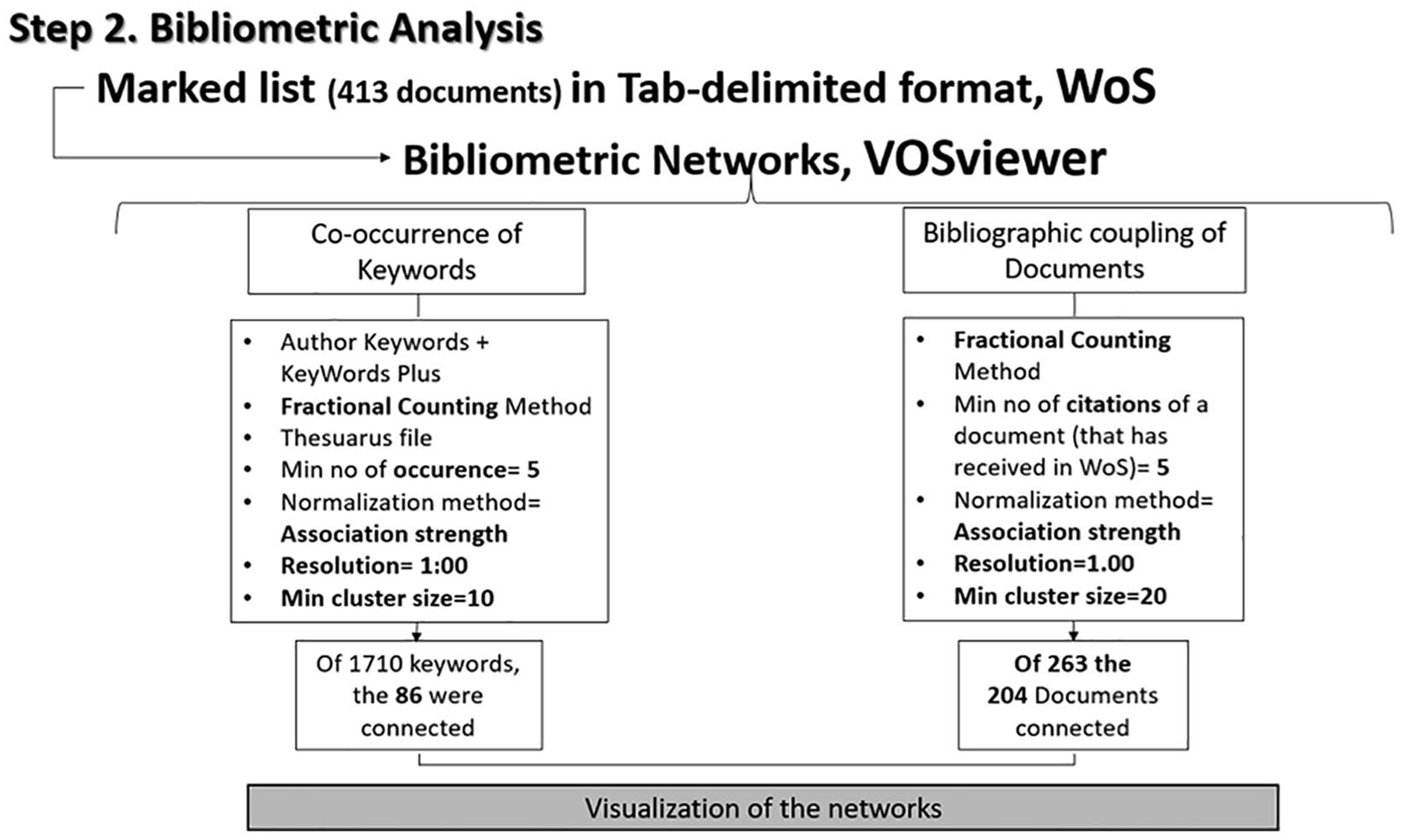
Bibliometric analysis (authors’ own elaboration).
Having completed the bibliometric analysis, we selected 41 articles based on their total link strength and therefore relevance in the overall dataset, to proceed with a deeper qualitative assessment. That focused on identifying, on the one hand, the (implicit and explicit) declination of the concept(s) of periphery at stake (explored in the ‘Bibliometric analysis: how is the notion of periphery conceived?’ section) and, on the other hand, on the identification of what constrains/enables sustainability transitions and green shifts in those settings (explored in the ‘Sustainability transitions in the periphery: what do we know about it?’ section). Taking the network of the bibliographic coupling of articles as reference, we selected for qualitative analysis the articles with a total link strength value of 30 or more in larger clusters (Clusters 1, 2 and 4 – see Figure 3) and 20 or more in smaller clusters (Clusters 3 and 5 – see Figure 3). A high total link strength value means that these articles share a high number of references with other articles and are thus more likely to reflect the findings of the remaining articles that form each cluster (e.g. Moher et al., 2009).
Bibliometric analysis: how is the notion of periphery conceived?
Keywords’ network
Figure 2 depicts the article keywords’ co-occurrence network. Of the 1710 keywords in the dataset, 86 met the threshold (i.e. minimum number of occurrences equals to five), and we set the minimum cluster size to 10 keywords (see Supplemental Table A2). The size of each node denotes the total number of times each keyword is referred to in the analysis, and the lines connecting them represent a keyword’s co-occurrence in the articles under analysis. The keywords’ co-occurrence network reveals the (knowledge) structure of the links between the articles included in the dataset. By studying the strength of the links between keywords, its patterns and the cluster information, general trends from the research on sustainability transitions at a regional level are indicated (Radhakrishnan et al., 2017).
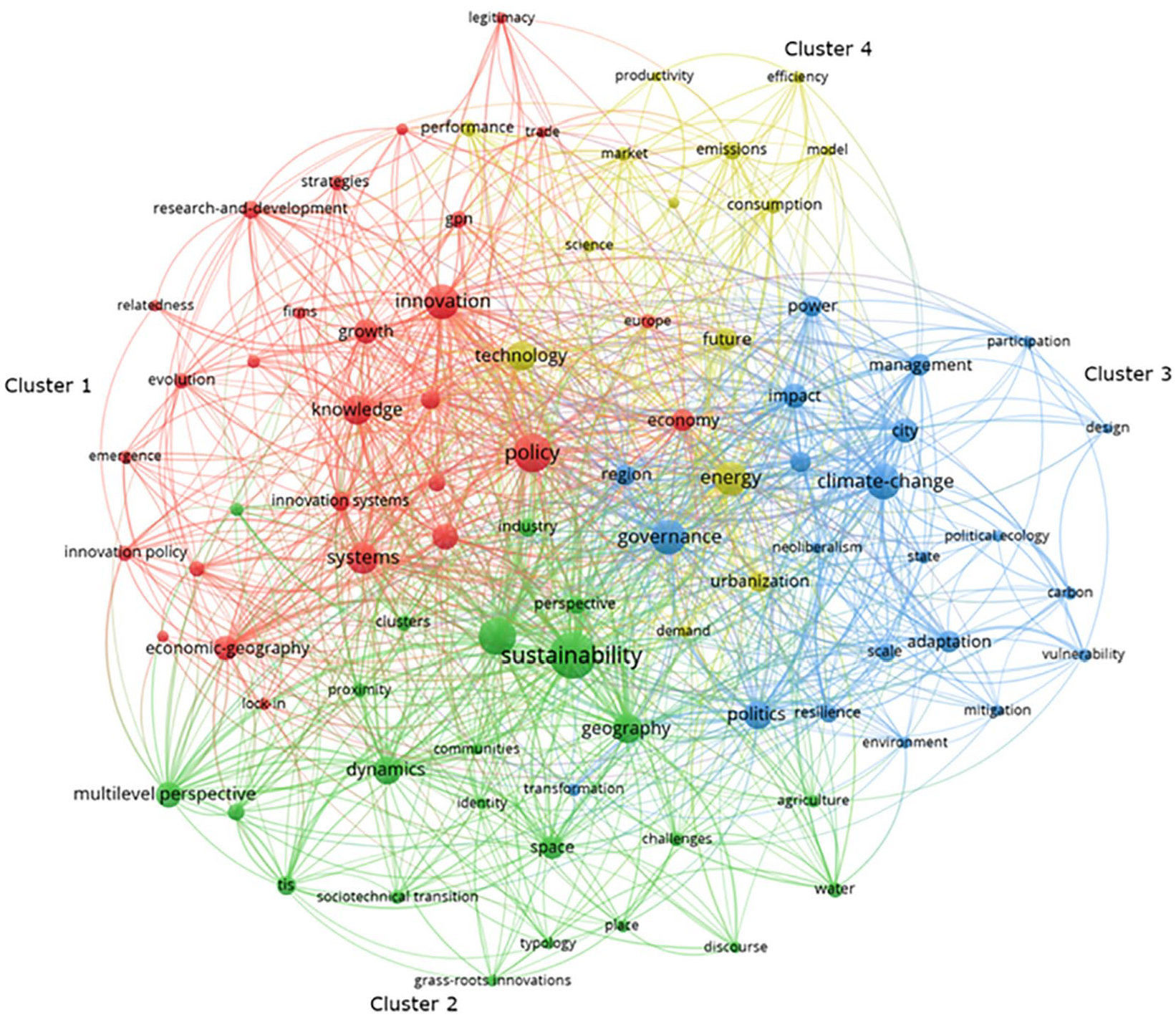
Keywords’ co-occurrence network (authors’ own elaboration).
As observed, the resulting network is tight and well connected, suggesting a shared interest by different research communities on the key issues at stake – notwithstanding also a clear split into four major clusters. To be sure, few of the surveyed studies have an explicit focus on peripherality and peripheral regions, as suggested by the absence of those concepts as keywords; yet a closer reading of this literature (based on the aforementioned article selection – see the ‘Research methodology’ section) allows us to distil the implicit understanding of periphery in relation their conceptualization of regions, place and space.
Cluster 1 (red; 27 keywords) is mostly composed of studies on innovation (and innovation system) dynamics, interested in the emergence of green industrial paths and regional economic transformation, being largely associated with research in the field of Economic Geography. Keyword analysis indicates a view on sustainability transitions involving knowledge and technology, and those being closely dependent on industrial structure composition and system-level policy. The foci of analysis are often sub-national entities, notably regions, implying that a condition of periphery is associated with weaknesses in the aforementioned resources. Cluster 2 (green; 23 keywords) is populated by research drawing on the foundational concepts and frameworks from Sustainability Transition’s research, such as the Multi-level Perspective (e.g. Geels, 2002) and the Technological Innovation System’s framework (Bergek et al., 2008). A distinctive characteristic of this cluster – as suggested by the keyword analysis and the qualitative assessment of the literature – is that it tends to consider a more varied set of agents (e.g. grassroots communities), processes and resources (e.g. identity, discourse formation) as determinant in regional sustainability transitions; also, the interest in notions of scale and place suggests a view on peripherality that is defined not only by place-based resources but also by connectedness and power relations (Coenen and Hansen, 2015).
One salient feature of Cluster 3 (blue; 22 keywords) is the consideration of regional aspects shaping – and being shaped by – the politics and the governance of climate change. In analysing sustainability transition processes, these studies highlight the failures of capitalism, the dominance of policy agendas by specific actors, the role of community participation and the possibilities for (urban) management to deal with climate mitigation and resilience affairs drawing from critical geography studies and political ecology approaches (e.g. Lawhon and Murphy, 2012). While ‘region’ is an important keyword in this cluster, the actual spatial settings under analysis are more frequently the city (and urbanization phenomena) or, instead, rural areas facing climate vulnerabilities (often in latecomer countries of the ‘Global South’). In these studies, peripherality is mostly associated with power imbalances, (lack of) political representation and voice, which is juxtaposed with the condition of specific communities, both urban and rural. From another angle, while Cluster 4 (yellow; 14 keywords) shares an interest in energy and urbanization affairs with Cluster 3 (and in technology-specific aspects with Cluster 1), its focus is on the economic efficiency of energy systems, and on the market incentives that could nudge production and consumption behaviour towards climate acceptable targets; from this lens, regions are not sub-national entities but are often large country blocks; periphery is seen as a dichotomous condition (e.g. advanced versus latecomer countries), and the systemic approach taken by the studies in the previous clusters is less relevant.
Bibliographic coupling network
The bibliographic coupling network of articles complements and provides more detailed insight on the literature under analysis. In this network, the links between pairs of articles are built based on the number of references to other articles that they share. We set a minimum common number of references to an article to be equal to five, and the minimum cluster size comprised by 20 articles. In the bibliographic coupling network, 204 out of the initial 263 articles met the proposed criteria, exposing five new clusters (see Supplemental Table A3).
In Figure 3, a very tightly connected space can be observed at the bottom of the diagram (formed by new Clusters 1, 2 and 4), suggesting that their knowledge foundations closely relate to each other. What connects this ‘cluster of clusters’ is a strong socio-spatial sensitivity to sustainability transitions – notwithstanding considerable differences in relation to the most frequent geographies under analysis and declinations of peripherality.
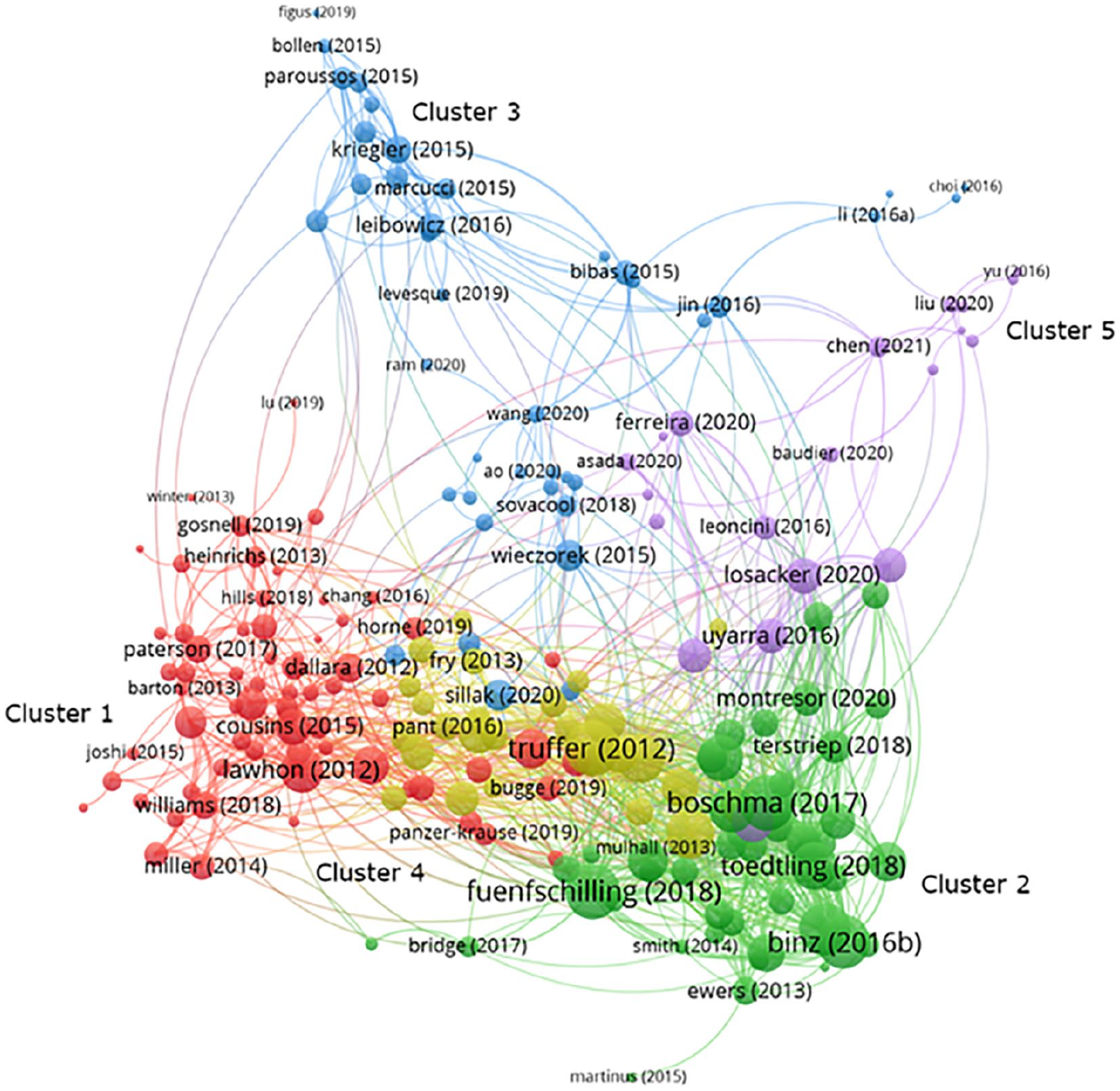
Bibliographic coupling of documents network (authors’ own elaboration).
For instance, Cluster 1 (red; 70 articles) groups several studies previously identified under Cluster 3 (blue, ‘Keywords’ network’ section, Figure 2), focusing on the spatial unevenness of sustainability transitions and their political, social and cultural underpinnings, addressing socio-spatial phenomena of climate resilience, vulnerability and justice, both in rural areas and within large cities of the ‘Global North’ and ‘Global South’. Peripherality is primarily conceived as socially constructed, resulting from cultural, political and power imbalances between actors and communities, seen from a theoretical lens of political ecology, and assessed in a wide range of empirical domains – for example, energy, water, irrigation, agriculture (Birkenholtz, 2012; Chandrashekeran, 2016; Cousins and Newell, 2015; Lawhon and Murphy, 2012). Peripherality (and being a peripheral place) is seen as a relatively structural condition, namely as the fortunes of places are embedded in multi-scalar relations, involving state actors at the national and international level (Kama, 2014).
In Cluster 2 (green; 46 articles), the prevalence of a research stream sitting at the interface of Economic Geography, Regional Studies and Sustainability Transitions research is clear, highlighting the spatial interrelatedness of technology, industrial actors, market formation, institutions and policy in transition endeavours (Binz and Anadon, 2018; Binz et al., 2014, 2016; Boschma et al., 2017; Fuenfschilling and Binz, 2018; Tödtling and Trippl, 2018). Studies in this cluster investigate the links between sustainability transitions and the formation of new industrial paths in concrete regions (sub-national level; e.g. Coenen et al., 2015b; Grillitsch and Hansen, 2019; Njøs et al., 2020; Rohe, 2020). Therefore, while regional pre-conditions and endowments (industrial composition, actors, knowledge, institutions) are of major importance in defining peripherality, the ability of regional actors to forge distant connections to access complementary resources (e.g. markets, finance, legitimacy) challenges such a notion (Binz et al., 2016; Hassink et al., 2019). Hence, in this cluster, the periphery tends to be defined as both socio-spatial (linked to regional assets) and relational (associated with an actor’s connections), and less dependent on rigid scalar boundaries. Also, the condition of peripherality is seen as fluid: regions – notably in the ‘Global South’ – can leapfrog and become frontrunners if they are able to anchor external resources and build innovation-supportive conditions (e.g. Binz and Anadon, 2018).
Cluster 4 (yellow; 27 articles) sits between the previous two clusters: it shares an interest in power relations with Cluster 1, and a regional-relational focus of analysis with Cluster 2. Hence, the conceptions of space and peripherality – rather than focusing on an actor’s agency and networks – are often seen from the vantage point of nested multi-scalarity (e.g. global–national–regional), highlighting the sometimes conflicting roles of the state (Johnstone and Newell, 2018) and the enduring relevance of multi-scalar and socio-political relations in the process (Chlebna and Mattes, 2020; De Laurentis et al., 2017; Gibbs and O’Neill, 2017). While multi-scalarity and power imbalances may create regional peripheries, some studies in this cluster also argue that peripherality may come with advantages for sustainability transitions, for example, when associated with natural resource endowments (e.g. Hansen and Coenen, 2015), less locked-in systems and the existence of a growing demand for clean energy solutions (notably in the ‘Global South’) (Yu and Gibbs, 2018).
Clusters 3 and 5 are more fragmented and heterogeneous, but still allow for an inference on how the periphery is dealt with in each case. Cluster 3 (blue; 40 articles) takes a more globalist stance to sustainability transitions and climate action; key challenges involve experimentation of new solutions and technology diffusion across borders, thus requiring transnational linkages and global–local interplays. This group of articles is heterogenous on how they see peripheries, ranging from interconnected experimentation sites (Wieczorek et al., 2015) to wider blocks of countries that passively benefit from international technology diffusion (Kriegler et al., 2015). Cluster 5 (purple; 21 articles) shares the focus on the role of policy to accomplish sustainability transitions – for example, through the creation of lead markets, technology transfer and political support to green agendas – but also the heterogeneity in how these studies see regions and peripheries, here ranging from sub-national entities (Losacker and Liefner, 2020; Santoalha and Boschma, 2021; Uyarra et al., 2016) to aggregated country blocks (e.g. Ferreira et al., 2020).
To sum up, what the previous analyses reveal is a rather nuanced declination of periphery and peripheral regions among the literature under scrutiny. Those notions cut across the three broad traditions delimited in ‘The periphery in urban and regional studies’ section (North–South; spatial–economic and relational) and tend to be juxtaposed in different clusters of literature, yet with different degrees of salience and relevance. However, it is noteworthy that most studies under analysis do not focus on peripheral regions or peripherality per se, limiting our knowledge on how to understand and address sustainability transition challenges in peripheral settings. In the next section, we proceed to analyse more closely what is explicitly discussed about sustainability transitions in these contexts, and what the implications are.
Sustainability transitions in the periphery: what do we know about it?
Having identified the previous knowledge structures and taking the bibliographic coupling network as reference (‘Bibliographic coupling network’ section), we now deepen the qualitative analysis (based on a limited set articles with high total link strength, thus considered as more relevant within the overall dataset – see the ‘Research methodology’ section) to inductively categorize, synthetize and exemplify what is known from the literature that explicitly deals with peripheral regions in the context of sustainability transitions. As a result, we distilled four dimensions that frame the specificities, underlying propositions and key issues addressed in the literature: power unevenness (‘Power relations and unevenness’ section), asset fragility (‘Asset fragility’ section), network positionality (‘Network positionality’ section) and the multi-scalar embeddedness of transition policy (‘Place-sensitivity and the multi-scalar embeddedness of transition policy’ section).
Power relations and unevenness
A key transversal topic in the analysed studies is the unevenness of sustainability transitions, alluding to the multiple imbalances and power relations leading to variegated outcomes across nations, regions and cities. As Birkenholtz (2012) shows for the case of groundwater-dependent irrigating farmers in Rajasthan (India), political-economic constraints to adaptation and social power relations shaped transition outcomes. This line of reasoning, as in Lawhon and Murphy (2012), emphasizes that power relations in transition processes are not only an important empirical object but also a causal driver of uneven transition outcomes, most often unfavourable to peripheral places. From the lens of another research tradition and focusing on energy transitions in particular, Coenen et al. (2021) acknowledge that peripheral regions face significant obstacles to position upstream in energy value chains, acting mostly as resource peripheries – therefore, the risk is that these regions mostly position as exporters of renewable energy, thus failing to keep a fair slice of the value pie, or even to mitigate the negative environmental and social outcomes associated with raw material extractivism. All in all, these contributions coalesce to argue that broader causal structures (economic, social, political) and power relations shape and hinder the adaptative potential of peripheral regions.
Asset fragility
Another domain which appears to condition sustainability transitions in peripheral regions is the relative scarcity or fragility of existing knowledge endowments and place-based assets, hindering new ‘green paths’. For example, Montresor and Quatraro (2020) and Santoalha and Boschma (2021) find that pre-existing knowledge in a region facilitates diversification into green industries and suggest that such industrial specialization (e.g. in the production of related goods and technologies) is a more powerful explanation for green industrial shifts than environmental advocacy and political will at the regional level.
Yet, from another perspective, it has also been argued that green path development (i.e. the emergence of green industries in non-core regions) has multiple foundations and relates to prevailing place-based conditions that go beyond knowledge attributes; understanding these processes should consider multiple elements such as firm strategy, demand characteristics, technological advantages, regulation and policy dimensions (Coenen et al., 2015b; Losacker and Liefner, 2020). Therefore, while green industrial diversification can occur in peripheral regions (e.g. Boschma et al., 2017), the lack of quality of endogenous assets (or the failure to attract and maintain them) may condition new path development (Coenen et al., 2015a; Tödtling and Trippl, 2018). Moreover, also the adoption of new green technologies in peripheral regions may face market diffusion problems, notably if the institutions to support their development and commercialization are inappropriate (Leibowicz et al., 2016).
Network positionality
A more optimist view on the potential for sustainability transitions in peripheral regions relates it to wider multi-scalar processes – even if that creates both hurdles and opportunities. A key insight is that understanding sustainability transitions in peripheral regions implies looking beyond a particular region to embrace multi-scalar logics (e.g. Truffer and Coenen, 2012), and to consider the role of agency in creating, transforming and regionally anchoring the necessary assets for green path development (Binz and Anadon, 2018; Binz et al., 2014; Grillitsch and Hansen, 2019). Connectedness is thus a fundamental attribute to challenge peripherality, but also to enable latent regional assets resources. As argued by Binz et al. (2016: 174), ‘endogenous development factors – like pre-existing capabilities and technological relatedness – induce new paths only if they get integrated in a broader resource formation and alignment process in the global innovation system emerging around a new technology’, thus stressing the importance of linkage formation across regions.
The literature also indicates that balancing inward and outward relationships is particularly challenging for non-metropolitan regions. Coenen et al. (2015b), studying path renewal processes in an old industrial region of Northern Sweden, show that actors bonded by strong regional identities may over-rely on intra-local networks and disregard connections beyond the region, causing lock-in and obstructing green industrial reorientation; in this sense, Strambach and Pflitsch (2020) suggest that regions must go through de-institutionalization and institutionalization sequences to foster sustainability transitions at the regional level. Other contributions have identified that less locked-in actors (vis-à-vis existing technological regimes), in less developed economies, are important agents behind sustainability transitions (Yu and Gibbs, 2018), influencing the search, adoption and development of cleantech industries in latecomer economies (e.g. Binz and Anadon, 2018).
From this angle, actors and agency can ameliorate the constraints of green regional diversification in peripheral regions, and the literature demonstrates that actors in peripheral regions are not necessarily condemned to a powerless role. Yet, this requires that regional actors are strongly connected to the outside world (Boschma et al., 2017) and can simultaneously play the role of institutional entrepreneurs, actively shaping their regional institutional environment (Fuenfschilling and Binz, 2018).
Place-sensitivity and the multi-scalar embeddedness of transition policy
Policy intervention capacities are often mentioned as a key regional asset, fostering (or hindering) regional transitions. However, beyond stressing the need to deploy place-sensitive approaches and a holistic policy-mix, little is discussed about which concrete types of policies and interventions are to be favoured to help the navigation of peripheral regions in the turbulent waters of sustainability transitions. As an illustration, Tödtling and Trippl (2018: 1789) argue that ‘little is known about how green path development unfolds in different types of regions and which policy instruments and mixes work best in different spatial contexts’. Also, Uyarra et al. (2016) claim that as the transition to a low-carbon economy is a complex challenge, the policy-mix approach is particularly relevant, although many gaps and tensions are likely to emerge if a place-based approach is not followed. The challenge is heightened as non-core regions are also increasingly seen as heterogeneous among each other in terms of industrial ‘greenness’, calling for different policy responses to supporting decarbonization at the regional level (Grillitsch and Hansen, 2019).
Another key policy aspect refers to the multi-scalar embeddedness of regional decarbonization processes, making the introduction of new institutions, standards, regulations and technologies particularly challenging for peripheral regions. Because of that, some authors argue that more disruptive policies might be needed to drive sustainability transitions, as illustrated by Sillak and Kanger (2020) in a study of the disembedding of the oil shale industry from its socio-spatial networks. Thus, a challenge lies in adopting a multi-scalar perspective in transition policies, since political jurisdictions and policy actions tend to intervene in a limited and bounded space. As Uyarra et al. (2019) point out, it is of paramount relevance to articulate actors, policy levers and processes of sustainability-oriented change with the wider goals of regional communities, to achieve social and spatially just outcomes (Coenen et al., 2021).
Concluding reflections and research challenges
While the role of cities and regions addressing (climate-related) sustainability transitions has been raising considerable scientific and policy interest, the urgency and magnitude of the challenge require widening the discussion arena and taking into closer consideration the specific challenges and opportunities associated with peripheral regions. The bibliometric analysis in this article has contributed to highlight the ways in which the periphery and peripheral regions have been conceived and discussed – implicitly and explicitly – in the extant literature concerned with the regional and spatial dimensions of sustainability transitions.
Although bibliometric analyses of this kind have intrinsic limitations – for example, associated with the formulation of search queries, selection thresholds and cut off-decisions, which may introduce biases by excluding important articles – they also constitute an objective way to identify and visualize hidden knowledge structures and coalescing research fields, providing direction for subsequent deeper and qualitative assessments of the relevant literature (Linnenluecke et al., 2020). Hence, through these methods, this study identified different research interests, conceptual roots and vantage points, but also showed that different notions of periphery (cultural–political, socio-spatial and relational) cut across the identified streams of the literature, thus providing complementary views on how to define the condition of peripherality in relation to sustainability transitions. Based on this, it could be argued that a multi-dimensional and pluralistic view on peripherality seems to be an appropriate route to further research, discuss, understand and intervene in relation to the challenges at stake, instead of crystallizing a priori a single and dualistic notion of periphery and peripheral regions.
However, a noticeable limitation is that studies explicitly addressing the condition of peripheral regions (either theoretically or empirically) and the implications of different types of peripherality for sustainability transitions are still rare. As seen, studies that explicitly address it tend to suggest that peripheral regions face troubled waters, associated with four major factors: power relations and unevenness in transitions, regional asset fragility, network positionality and connectedness and the multi-scalar embeddedness of transition policies. However, due to the paucity of studies, each of these four dimensions – alone or in articulation – would still require further research and closer scrutiny so that a more encompassing framework on how to deal with sustainability transitions in peripheral regions can be devised.
Considering the current state of the literature, we can think of four related research directions. First, while most studies stress the fragility of peripheral regions and look at the periphery as a condition of inferiority – associated with power unevenness, lack of assets and multiple lock-ins – relational approaches suggest a more optimist stance or, at least, a more nuanced and less deterministic view on the fates, consequences and potentials of peripheral regions addressing sustainability transitions. In line with recent approaches in Economic Geography and Regional Studies (e.g. Eder and Trippl, 2019; Glückler et al., 2023), more engagement is needed with the idea that peripheral regions, of different kinds (see, for example, Nilsen et al., 2023), can also be generative contexts for innovation and climate-related transitions. Such a direction would promise to open new trading zones between Economic Geography, Regional Studies and Sustainability Transition research towards strengthening a framework to understand sustainability transitions in peripheral regions.
Second, it can be observed that a major cluster of the surveyed literature coalesces into a meso-level systemic view, in which industries and technology co-evolve with much wider social, cultural, political and institutional elements to pave the ground to sustainability transitions (Hansen and Coenen, 2015). While this study focused on climate-related sustainability transitions, other types of long-term systemic shifts could be conceived, for example, in sectors and societal provisions such as health or food (e.g. Truffer et al., 2022). It is still very unclear whether the situation of peripherality and the associated fragility (or lack thereof) would vary according with the types of transition at stake. While the analysed literature has been looking into empirical objects that go beyond the most conventional energy and mobility-related domains, there is still ample room in urban and regional scholarship to widen the types of sectors and transitions under analysis.
Third, little attention has been devoted to analysing the relations (and eventual tensions) between the introduction of green technology, industrial path development and outcomes in terms of greening and decarbonization, notably for the case of peripheral regions. In fact, recent studies argue that green technology may have ambiguous environmental outcomes (e.g. Blažek et al., 2020; Gibbs and Jensen, 2022; Gudmundsdóttir et al., 2018), which raise the more general question about how to assess the success and failure of regional sustainability transition efforts, and in peripheral regions in particular. This would call for a reinvigorated agenda to analyse with more granularity the nexus and the relations between regional industrial path development, ecological outcomes and sustainability transitions (see also Chlebna et al., 2023).
Finally, there is still a dearth of research on how to devise, coordinate and implement sustainability-related policy in peripheral regions. Transitions are enacted at various inter-related spatial scales and levels, calling for multi-level governance (Binz et al., 2016; Coenen et al., 2021; Trippl et al., 2020). As seen, the interests of powerful incumbents and global actors are not necessarily aligned with local and regional development strategies pertaining to sustainability transition goals, with power relations being asymmetrical and usually benefitting actors based in developed countries and core regions. Hence, besides suggesting the need for policy mixes and place-based approaches, research should delve into the specificities and policy learning dynamics associated with transition policies in peripheral contexts. This research effort would also gain from acknowledging unevenness as an enduring characteristic of capitalist economies and the multi-scalar dimension of sustainability transitions, as interventions in one scale may contradict others or simply be insufficient by ignoring broader political and spatial contexts.
Supplemental Material
sj-docx-1-eur-10.1177_09697764231194316 – Supplemental material for Are peripheral regions in troubled waters for sustainability transitions? A systematic analysis of the literature
Supplemental material, sj-docx-1-eur-10.1177_09697764231194316 for Are peripheral regions in troubled waters for sustainability transitions? A systematic analysis of the literature by Mário Vale, Angeliki Peponi, Luís Carvalho, Ana Patrícia Veloso, Margarida Queirós and Paulo Morgado in European Urban and Regional Studies
Supplemental Material
sj-docx-2-eur-10.1177_09697764231194316 – Supplemental material for Are peripheral regions in troubled waters for sustainability transitions? A systematic analysis of the literature
Supplemental material, sj-docx-2-eur-10.1177_09697764231194316 for Are peripheral regions in troubled waters for sustainability transitions? A systematic analysis of the literature by Mário Vale, Angeliki Peponi, Luís Carvalho, Ana Patrícia Veloso, Margarida Queirós and Paulo Morgado in European Urban and Regional Studies
Supplemental Material
sj-docx-3-eur-10.1177_09697764231194316 – Supplemental material for Are peripheral regions in troubled waters for sustainability transitions? A systematic analysis of the literature
Supplemental material, sj-docx-3-eur-10.1177_09697764231194316 for Are peripheral regions in troubled waters for sustainability transitions? A systematic analysis of the literature by Mário Vale, Angeliki Peponi, Luís Carvalho, Ana Patrícia Veloso, Margarida Queirós and Paulo Morgado in European Urban and Regional Studies
Footnotes
Acknowledgements
The research in this paper was conducted under the SUS2TRANS project, coordinated by Nuno Bento and Margarida Fontes, and we are grateful for support of the research team. It grew out of constructive comments received by Bernhard Truffer in a project seminar held in Lisbon, as well as by being presented and discussed at the 2022 Global Conference on Economic Geography (Dublin), in a gateway organised by Adrian Smith and Nick Henry on ‘Ecology, Economy and Climate Crisis in European Regional Development’. We are particularly grateful to European Urban and Regional Studies for the quality of the review process, as well as to the handling editor and the two anonymous reviewers who provided thorough, insightful, and constructive comments on previous versions of the paper.
Declaration of conflicting interests
The author(s) declared no potential conflicts of interest with respect to the research, authorship and/or publication of this article.
Funding
The author(s) disclosed receipt of the following financial support for the research, authorship, and/or publication of this article: This research has been supported by Portuguese public funds through FCT - Fundação para a Ciência e a Tecnologia, I.P., in the framework of the project SUS2TRANS (PTDC/GES-AMB/0934/2020) and the project UID/ECO/04105/2020.

Supplemental material
Supplemental material for this article is available online.
Notes
References
Supplementary Material
Please find the following supplemental material available below.
For Open Access articles published under a Creative Commons License, all supplemental material carries the same license as the article it is associated with.
For non-Open Access articles published, all supplemental material carries a non-exclusive license, and permission requests for re-use of supplemental material or any part of supplemental material shall be sent directly to the copyright owner as specified in the copyright notice associated with the article.
