




Abstract
The temporality of agency plays a fundamental role in regional development but has received little attention in economic geography and regional studies. This paper zooms in on two aspects of temporality: the temporality of intentions and the temporality of consequences. The former refers to actors’ perception and valuation of opportunities in the near and distant future, whereas the latter refers to the short- and long-term consequences of actions. This paper studies the temporality of agency in the context of regional development. It investigates how short- and long-term intentions motivate different types of agency, how different types of agency affect short- and long-term regional development outcomes and which conditions enable or constrain different types of agency. We illustrate our arguments with an in-depth case study covering the regional development of a labour market in Norway over the last 20 years.
Keywords
Introduction
There can be little doubt that the temporality of agency has substantial implications. This paper elaborates on two aspects of the temporality of agency: the temporality of intentions and the temporality of consequences. The former refers to actors’ perception and valuation of opportunities in the near and distant future, whereas the latter refers to the short- and long-term consequences of actions. The investment in five years of higher education, for instance, will provide for other opportunities than accepting the immediate pay check of a low-skilled job; and maximising a firm’s profit in the short-term may be a cost cutting exercise, while in the long-term investments may provide for larger payoffs. Given the rather obvious importance of the temporality of agency, it has received surprisingly little attention in economic geography and regional studies.
The aim of this paper is to conceptualise and empirically investigate the temporality of agency in the context of regional development. More specifically, the research questions are (a) how short- and long-term intentions motivate different types of agency, (b) how different types of agency affect regional development in the short- and long-term and (c) which conditions enable or constrain different types of agency.
This contributes to a burgeoning literature on the role of agency for regional development (e.g. Dawley, 2014; Isaksen et al., 2019; Sotarauta et al., 2020; Steen, 2016). This literature aims to address a black box in economic geography, namely the micro-level processes that push for, work against or react to changes, and how such micro-level processes connect to structural factors at multiple spatial scales affecting regional development (Asheim et al., 2016; Boschma, 2017; Uyarra et al., 2017). In other words, this literature goes beyond and adds to the structural perspective of evolutionary economic geography to achieve a more comprehensive and complementary understanding of regional development and new path development.
The role of agency is particularly important when a change to historically developed economic, social or institutional structures is needed. The need for change becomes obvious in the wake of crises, which may be of an economic, financial, ecological or social nature. Crises are often critical junctures when new paths may emerge (Pierson, 2004). While outcomes are uncertain in critical junctures, and therefore often seen as random, a focus on agency helps one to understand why certain actions were taken during critical junctures with what effects and how this explains, at least partially, why certain paths emerged and not others during a critical juncture.
In this paper, we study the role of agency in a labour market region in Sunnmøre, Western Norway, going through a turbulent development: from 1999 to 2004, the globally leading maritime industry in the region exhibited substantial job losses. An extraordinary growth phase started thereafter related to the increased demand for offshore vessels for the oil and gas industry. The boom lasted until the drop in oil prices in 2014, leading to a massive crisis. We empirically focused on the agency exercised by leaders of firms, local and regional government, support organisations and higher education institutions.
Our main argument is that the temporality of intentions is a fundamental condition differentiating change agency from reproductive agency. Change agency is transformative and requires a long-term perspective, which is not normally the case for reproductive agency. In the long-term many of the regional structures, such as capabilities, networks or institutions, can be moulded, while they are quasi fixed in the short-run. Put differently, in the long-term structural factors are less rigid than in the short-term.
Such temporal perspective resonates with a trade-off between the exploitation of existing industrial specialisations and the exploration of new ones. In our case, exploitation was characterised by reproductive agency aimed at grasping the immediate opportunities of the offshore vessel boom. Firms and support structures adapted to this niche, allowing for high profits in the short-term but causing severe problems when the crisis hit. Reproductive agency is also related to rationalisation (e.g. cutting costs) and maintenance work (e.g. keeping competences in the region) as response to the crisis.
In contrast, exploration was driven by change agency with a long-term perspective. In our analysis we differentiate between three types of change agency with distinct theoretical roots, namely innovative entrepreneurship, institutional entrepreneurship and place-based leadership (Grillitsch and Sotarauta, 2020). Innovative entrepreneurship and place-based leadership led to the capabilities, resources and triggering actions that made it possible to ride the offshore vessel boom. Institutional entrepreneurship, in our case, contributed to enhancing research capacities at universities and firms, through new forms of collaboration. Investments in new technologies, related and unrelated to diversification during the boom, became important for reducing the negative effects of the crisis in 2014. During the crisis, leading business actors emphasised that they followed a strategy of cutting costs in the short-run while investing in new markets for the long-run. Furthermore, we find that immediate opportunities and pressures as well as policy cycles favoured reproductive agency with a short-term perspective over change agency with a long-term perspective.
Theoretical discussion
The temporality of intentions and the temporality of consequences
Temporality is a key concept in theories on structure and agency. Temporality is necessary to explain how structural conditions and agency play together to change or maintain social structures over time (Archer, 1982, 1995; Elder-Vass, 2007). Following the writings of Archer (1982: 468), “structure and action operate over different time periods [. . .] based on two simple propositions: - that structure logically predates the action(s) which transform it, - that structural elaboration logically postdates those actions”.
Building on this crucial insight about the importance of temporality to theorise and empirically study the interplay between agency and structure, this paper zooms in on two specific aspects of temporality: the temporality of intentions and the temporality of consequences. We define the former as the actors’ perception and valuation of opportunities in the near and distant future. The temporality of intentions captures whether actors aim to realise short-term or long-term benefits. Paying attention to how actors perceive the future addresses a fundamental aspect of human agency, as intentions are future oriented (Steen, 2016). While structural preconditions enable and constrain agency, perceived future opportunities motivate actions. This thought is essential in the definition of human agency by Emirbayer and Mische (1998: 963) as “temporally embedded process of social engagement, calling for a strong capacity to interpret past habits and future prospects”. In the same vein, Garud et al. (2010: 770) explain that “[a]ctors mobilize the past not necessarily to repeat or avoid what happened, but, instead, to generate new options. Likewise, people imagine new initiatives for the future which then lead them to mobilize the past in support”.
The temporality of intentions must not be confused with the temporality of consequences of actions. Actions aimed at realising short-term benefits may have long-term consequences; and actions aimed at realising long-term benefits may have short-term consequences. What is more, these consequences may be unintended and unwanted (Sayer, 1992: 1984). For instance, the decision to accept a low-skilled job after finishing the primary or secondary level of education over taking a college or university education is typically motivated by an immediate income stream. The long-term unintended and unwanted consequences are, among others, a higher likelihood of becoming unemployed and lower chances for career and income advancement. Conversely, by taking a higher education, actors may intend to realise long-term benefits, such as having access to a variety of high-skilled and well-paid jobs and opportunities for career advancements. Yet, there may also be short-term and long-term unintended and unwanted consequences. For instance, due to unforeseen events, such as the financial crisis in 2008 or the Covid-19 crisis, young university graduates may still end up in long-term unemployment.
Temporality at the individual, organisational and regional levels
The previous section introduced temporality by referring to the perspective of individual actors. Yet, the issue of temporality extends from the level of the individual to the organisational and system levels, with important interactions between these levels (see also Virkkala and Mariussen, 2019). This paper aims to contribute to the literature on regional development, the focus as regards systems is on regions, and more specifically regional industrial pathways, while we appreciate that the system level can also refer to the national or global scale.
Furthermore, we discuss the temporality of intentions in relation to micro-level processes, that is, referring to why actors choose certain actions and when they perceive the benefits of their action are realised. In contrast, we do not picture organisations or regions having intentions (Hassink and Klaerding, 2012; Paasi and Metzger, 2017). Organisations or regions may have strategies, but their leaders – that is, those who have the power to mobilise resources in organisations or regions – have intentions, which brings us back to the micro-perspective when studying the temporality of intentions. In contrast, the temporality of consequences is relevant at the individual, organisational and system levels.
At the organisational level, the temporality of consequences relates to a trade-off between the short-term benefits of exploiting existing markets or technologies and the long-term benefits of exploring new opportunities (Nguyen and Mariussen, 2019). March (1991: 73) elegantly phrased this as follows: Compared to returns from exploitation, returns from exploration are systematically less certain, more remote in time, and organizationally more distant from the locus of action and adaption. What is good in the long run is not always good in the short run. What is good at a particular historical moment is not always good at another time. What is good for one part of an organization is not always good for another part. What is good for an organization is not always good for a larger social system of which it is a part.
March also hints at the interaction between organisations and social systems – in our case regional industrial pathways – and that the interactions might be of a kind where unintended and unwanted consequences result from processes at the organisational or individual level (see also Sayer, 1992: 1984). For instance, if all firms in a region focus on exploiting one specific market opportunity, the firms may build up overcapacities and become collectively less profitable. In addition, as result of the many firm-level decisions, the region will become highly specialised but also vulnerable to market changes.
At the regional level, Virkkala and Mariussen (2019) also note that the trade off between exploitation and exploration has a temporal dimension. The consequences of exploitation and exploration are systemic in character, as they manifest in the relationships between actors regionally through traded and untraded interdependencies (Storper, 1995) and extra-regionally through the embedding in global production networks (MacKinnon et al., 2019).
In regional development, exploitation refers to the adaptation of firms and regional support structures to the requirements of specific markets, industries or technological opportunities, which leads to regional specialisation and positive lock-ins. A variety of positive local externalities arises, such as the provision of relevant skills in a thick labour market, access to inputs from specialised suppliers, knowledge spillovers and sharing of infrastructure and resources (Duranton and Puga, 2004; Marshall, 1920). The social and institutional embeddedness of firms create untraded interdependencies that facilitate knowledge exchange and innovation (Gertler, 2004; Storper, 1995).
Martin and Sunley (2006) explain path-dependency in regional development with such externalities based on increasing interdependencies and embeddedness and refer to them as lock-ins. Lock-ins are positive in the short-run when they stimulate economic performance. However, in the long-run, they argue that positive lock-ins can turn negative because the interdependencies and embeddedness may result in rigidities when markets or institutions change (see also Hassink, 2010a). In his seminal piece, Grabher (1993) showed that lock-ins can exist in hierarchical production networks, in a common worldview shared among regional actors and in powerful elites who resist institutional change. The persistence of negative lock-ins is reinforced by the sunk cost effect, which “is manifested in a greater tendency to continue an endeavour once an investment in money, effort, or time has been made” and explained psychologically by “the desire not to appear wasteful” (Arkes and Blumer, 1985: 124f).
Garud and Karnøe (2001) complement this view on path-dependence and argue that entrepreneurs mindfully deviate from existing paths, which – if successful – is a main driver for path creation. The current literature has increasingly focused on structural change in regions and the development of new industrial paths as a response to various economic, environmental and public health crises (e.g. Bathelt et al., 2013; Boschma et al., 2017; Grillitsch et al., 2018; Isaksen and Trippl, 2016; Martin and Sunley, 2006; Morgan, 2016; Tanner, 2014). This literature distinguishes between different types of new industrial path development. Path upgrading in the form of climbing global value chains rests on knowledge from the existing specialisation, but typically requires appropriating advanced knowledge from extra-regional sources. Path upgrading can also be achieved if new technologies or organisational forms are introduced in an existing sector, or if firms specialise in market niches (Grillitsch et al., 2018). Related variety (Frenken and Boschma, 2007; Frenken et al., 2007) offers opportunities for structural change through product diversification into other industries where existing knowledge and resources create higher value, which is typically called regional (or path) branching. More transformative forms of structural change rest on unrelated knowledge combinations, which offer opportunities for variegated forms of new path developments. The most radical form is the creation of industries that are new to the world, often based on new scientific knowledge. New-to-the-world industries are rare events. More frequently, unrelated knowledge combinations, often by the use of key enabling technologies, lead to unrelated diversification (Grillitsch et al., 2018).
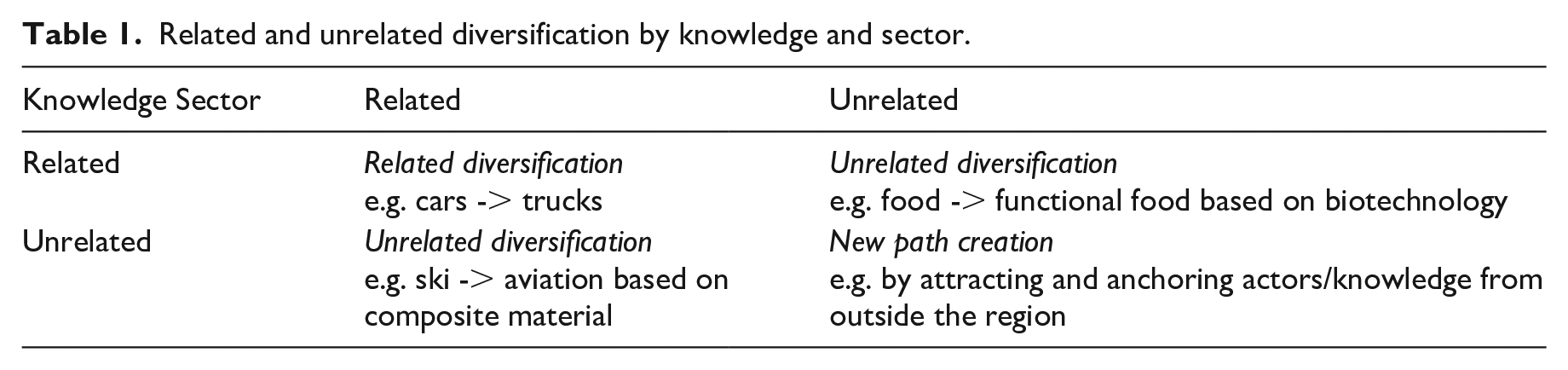
As path upgrading operates within the same sector and similar knowledge, the benefits associated with it are more certain and less distant in time as compared with diversification and new path creation. As regards diversification processes, we argue that benefits tend to become increasingly uncertain and distant in time with the integration of unrelated components, as conceptualised in Table 1 (Asheim, 2019). Related diversification requires both the knowledge and sector to be related, which is the most common form of industrial development according to many studies in evolutionary economic geography (Hidalgo et al., 2018). An example would be a car manufacturer diversifying into the production of trucks. Unrelated diversification signifies cases where either the knowledge or sector is unrelated. A case of related knowledge but unrelated sectors is the diversification of the ski manufacturer Fischer (Austria) to the aviation industry using its cutting-edge knowledge of composite materials (Grillitsch et al., 2018). A case of a related sector but unrelated knowledge is the diversification of the food industry into functional foods by introducing science-based knowledge from biotechnology (Asheim and Coenen, 2005). When both the knowledge and sector are unrelated to existing industries in the region, this is not diversification but new path creation. This typically requires the acquisition and anchoring of actors and knowledge from extra-regional scales (Binz et al., 2016; Isaksen and Trippl, 2017).
Related and unrelated diversification by knowledge and sector.
Temporality and different types of agency
As discussed above, the temporality of consequences is of relevance at the individual, organisational and regional levels. In contrast, intentions relate to the plan, purpose or aim motivating actions at the level of individuals. We propose that the distinction between change and reproductive agency is useful to link the temporality of intentions and consequences at different levels.
As a general definition, Grillitsch and Sotarauta (2020: 707) suggest that “[h]uman agency refers to intentional, purposive and meaningful actions, and the intended and unintended consequences of such actions” and that change agency captures actions that are intended at realising change. Grillitsch and Sotarauta (2020) argue further that three types of change agency, namely innovative entrepreneurship, institutional entrepreneurship and place-based leadership, are particularly important in shaping regional development paths, and call them the Trinity of Change Agency (TCA).
Innovative entrepreneurship is concerned with new products, processes, services or business models that break with traditional industrial paths, and is therefore a major driver of change in the economy (Schumpeter, 1911; Shane and Venkataraman, 2000). Institutional entrepreneurship characterises efforts to introduce new or change existing organisations or institutions, the latter referring to formal or informal rules (Battilana et al., 2009; Sotarauta and Mustikkamäki, 2015). Place-based leadership is about identifying common interests and transforming regions through the coordination and mobilisation of multiple actors for these common interests (Gibney et al., 2009; Sotarauta and Beer, 2017).
Even though the TCA does not necessarily capture all relevant types of agency, it matches the empirical evidence of case studies in economic geography. Saxenian and Sabel (2008) illustrate how institutional change has created new opportunities for innovative entrepreneurship in the semiconductor industry in Taiwan. MacKinnon et al. (2019) find that innovative entrepreneurship led the way in new path creation in the metropolitan region of Berlin, whereas institutional entrepreneurship triggered the other two types of agency in the specialised industrial region of Pittsburgh. Jolly et al. (2020) show that over time different actors play a role in shaping regional trajectories and that actors may engage in various types of agency. Accordingly, not only are firms agents of change in regional development, but also other actors, such as universities, regional governments and municipalities, play an important role, too.
The mentioned empirical cases illustrate that regional change is realised over a longer period. This resonates with the finding of Fritsch and Mueller (2004) that entrepreneurial activities need 8–10 years to translate into changes at the regional level. The consequences of change agency thus materialise in the long-term. The temporality of consequences, however, does not necessarily align with the temporality of intentions. Our assumption, which we investigate in our empirical study, is that actors engaging in change agency typically recognise that it will take time until the benefits of their actions will be realised, and that they therefore engage in such actions with a long-term horizon. We assume this to hold even though actors may have incorrect expectations about how long the change process takes, their actions may have unintended consequences and intentions may change over time in the interplay between many actors and emerging outcomes.
Reproductive agency, in contrast, maintains existing structures and often relates to the exploitation of existing markets and technologies. Reproductive agency also refers to actions intending to sustain current institutional arrangements or hinder change, which has been termed “institutional maintenance” (Lawrence and Suddaby, 2006). Institutional maintenance sometimes includes accepting minor compromises to ensure continuation of existing practices (Zietsma et al., 2018). Institutional work aimed at maintaining existing structures is often conducted by current elites, creating a political lock-in (Grabher, 1993).
While reproductive agency does not normally require a long-term perspective, in some circumstances it includes entrepreneurship and investments with a longer-term perspective. For instance, an entrepreneur may open a new hotel in a tourist resort following the observation that existing hotels are overbooked. This is an entrepreneurial act without introducing change to existing regional pathways. Many actions that are needed and fruitful in the growth phase of a regional specialisation, such as specific investments in infrastructure or human capital, are reproducing and reinforcing existing structures. The unintended consequence of such actions may be lock-ins, positive in the growth phase but problematic if the tide turns.
Analytical framework
In summary, a long-term perspective of intentions is a necessary condition for change agency but not for reproductive agency. In other words, change agency will not exist without a perception and valuation of benefits in the longer term. We also expect that reproductive agency often (but not necessarily) has a short-term perspective of intentions. Change and reproductive agency have short-term and long-term consequences for individuals, organisations and regions. The regional outcomes are conceptualised as different forms of industrial path development. The focus in this paper is on regional-level outcomes, which implies a translation from individual-level intentions to regional-level consequences through agency as the causal mechanism. We analyse human agency in context, appreciating both regional structural preconditions as well as extra-regional factors, such as changes in markets, institutions or technologies (Gong and Hassink, 2020).
Figure 1 illustrates the analytical framework of this paper. The temporality of intentions captures whether actors foreground a short- or long-term perspective as motivation for their actions. The first research question investigates how short- or long-term intentions motivate different types of agency. The analysis of types of agency relies on the distinction between reproductive agency and the TCA, elaborated on in the Temporality and different types of agency section. The second research question investigates the link between the identified types of agency and regional outcomes in the short- and long-term, doing justice to the temporality of consequences. The regional outcomes are analysed using the different types of path development discussed in the Temporality at the individual, organisational and regional levels section. Certainly, agency also has consequences at the individual or organisational level. However, this is not the focus of this paper. Finally, agency is not operating in isolation and this is why the third research question investigates the enabling and constraining conditions for the identified types of agency. We consider regional context conditions and extra-regional factors as well as the capabilities that individuals or organisations have developed in the past. In short, the three research questions are as follows.
How do short- and long-term intentions motivate different types of agency?
How do different types of agency affect regional development in the short- and long-term?
Which conditions enable or constrain different types of agency?
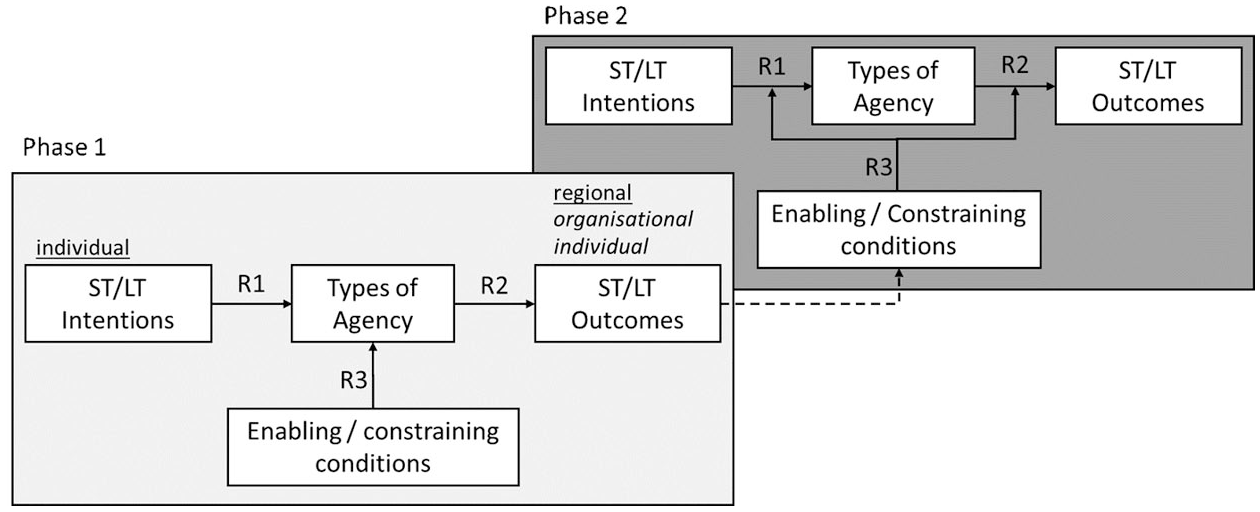
Analytical framework. ST: short-term; LT: long-term.
Case study, methodology and data
The maritime industry in Sunnmøre
The case study concerns a region in the coastal islands of the Sunnmøre district (Ulsteinvik labour market region), comprised of five municipalities (Ulstein, Hareid, Herøy, Sande and Vanylven) located in Møre and Romsdal County in the western part of Norway (Figure 2). It is home to around 28,000 inhabitants and close to Ålesund, the main city and knowledge centre in Sunnmøre, including the Ålesund Campus of NTNU (Norwegian University of Science and Technology in Trondheim) and an elaborated support structure for innovation and entrepreneurship under the umbrella of the ÅKP (Ålesund Knowledge Park). Two university colleges in Volda, located in an adjacent region on the mainland to the east, and in Molde to the north-east of Ålesund, play an important role in building regional human capital.
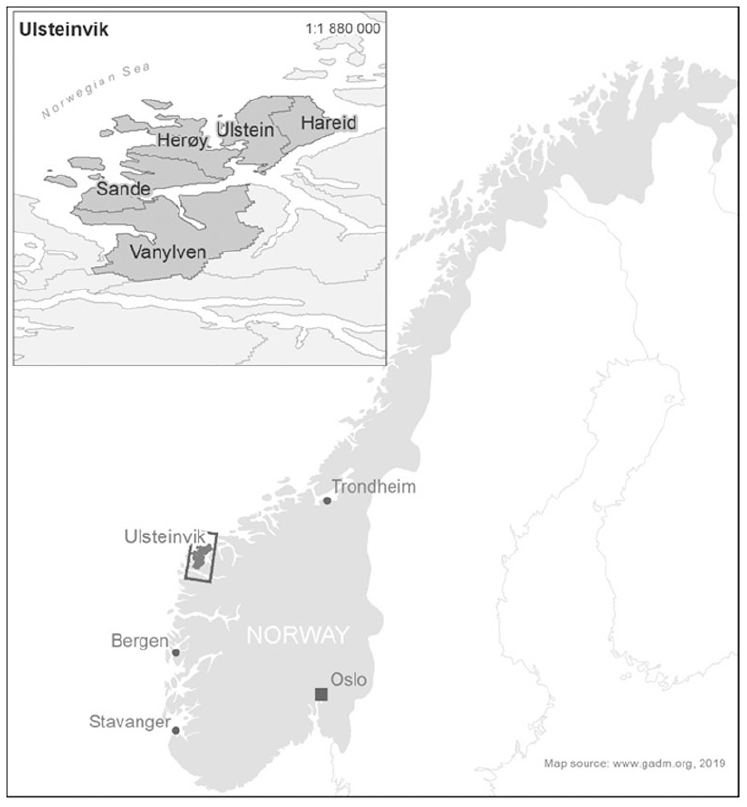
Geographic location of the study area.
The region has a tradition in shipbuilding, originating from a strong fishing industry. Operations in rough seas created a sophisticated demand for innovative shipbuilding relying on close user–producer interactions. The main yards were founded in the first half of the 20th century: Myklebust Verft in 1915, Ulstein Verft in 1917 and Kleven Verft in 1944. Since then, the region has become a globally leading cluster in the maritime industry comprising all parts of the value chain (shipbuilders, ship owners, specialised suppliers, etc.).
Local ship owners and shipbuilders saw opportunities in the offshore service vessel industry in the 1970s and started to design ships based on local expertise. From then on, the maritime industry increasingly focused on the highly volatile oil and gas market. The case study focuses on the last 20 years. As shown in Figure 3, the case study region contracted between 2000 and 2004, followed by a boom from 2005 to 2008 and continued growth until 2014, and faced a deep crisis in 2015 and 2016 with a small recovery thereafter. The empirical analysis focuses on the growth phase (2005–2014) and consequent crisis (2015–2019), but also traces the emergence of regional paths back in time.
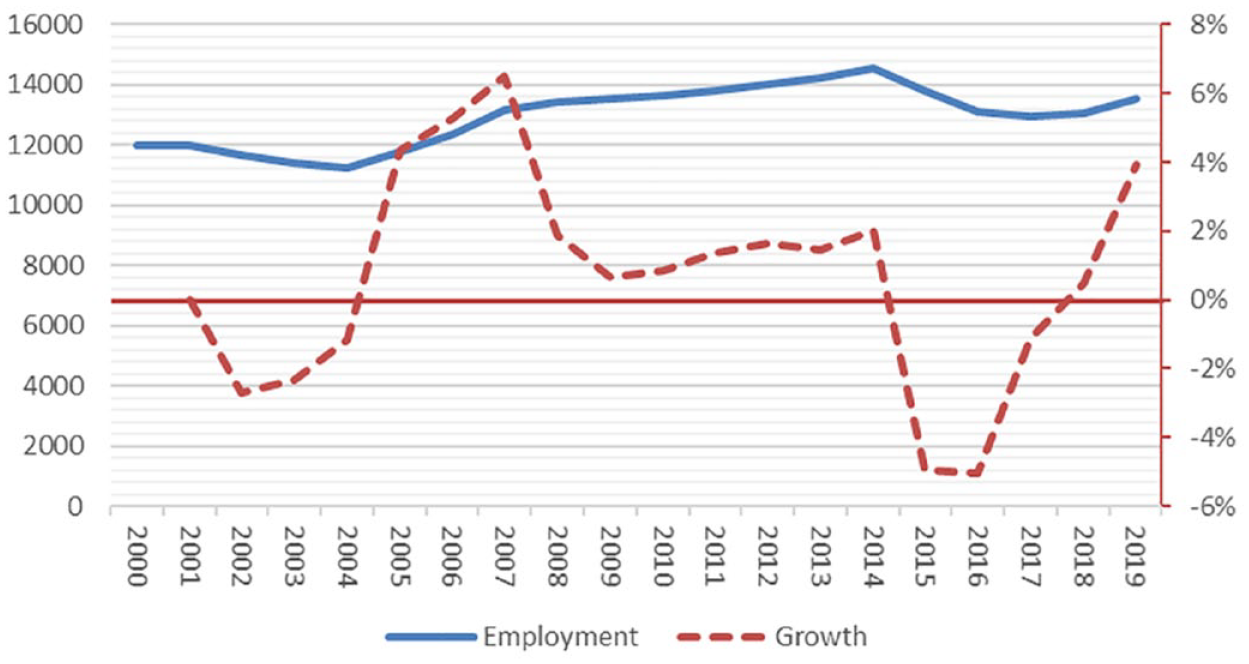
Employment in coastal Sunnmøre from 2000 to 2019.
Methodology
The empirical analysis focuses on differences in the temporality of intentions and consequences of change agency and reproductive agency. We expect that change agency is always associated with a long-term perspective of intentions, while this is not the case with reproductive agency. In order to identify differences in the temporality of agency, which are not due to differences in regional structural preconditions but due to the different types of agency, a single case study is the most suitable approach. A single case study principally allows for a variety of observations on different types of agency in the same regional context. Due to the apparent changes in regional development over the last 20 years, Sunnmøre expectedly exhibits plenty of cases of change agency and reproductive agency, which can be compared as regards their temporality. Hence, Sunnmøre is a case with high potential to create theoretical insights (Eisenhardt and Graebner, 2007). As discussed in the findings, our case study provides rich evidence of innovative entrepreneurship and place-based leadership, whereas we observed fewer instances of institutional entrepreneurship. Furthermore, we have collected extensive evidence on reproductive agency.
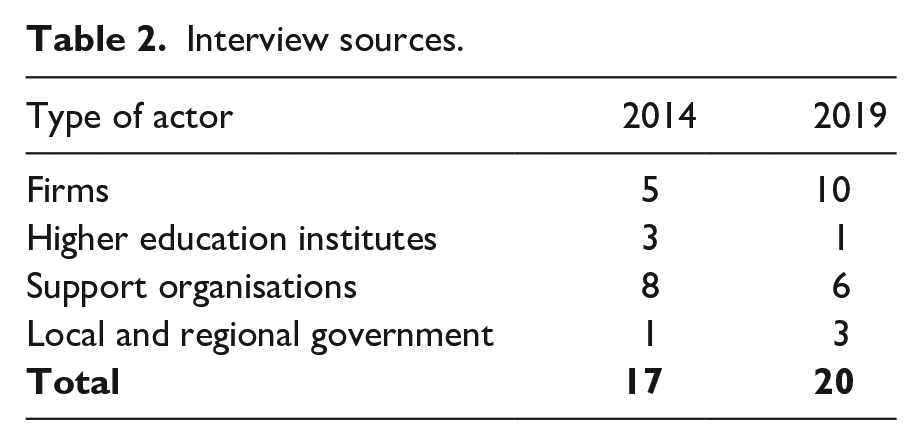
The data include secondary sources and in-depth interviews, as well as verification of the empirical material through a focus group and a factual check by an independent expert with in-depth insights about the development of Sunnmøre. Reports, regional development documents and newspaper articles were used to identify key events in the growth phase from 2005 to 2014, and the crisis thereafter. Key people or organisations linked to these events were identified. In a preparatory interview with a key informant from the region, the events were validated and additional key actors identified and contacted. We conducted 37 interviews (17 interviews just at the end of the growth phase in 2014 and 20 interviews in 2019) and a focus group meeting in 2014. Seven individuals participated both in the 2014 and 2019 interviews, allowing us to compare their perceptions and actions over time. We interviewed business leaders, local and regional government, support organisations and higher education institutes in our case study region, Ålesund, and the Møre and Romsdal County capital Molde. Table 2 lists the number of interviews per type of actor.
Interview sources.
With one exception, the interviews were recorded and most of them held face-to-face. Asking about individuals’ intentions and perceptions, which motivated actions, has turned out to be highly personal. This engaged our interview partners but also meant that the interviews were of a rather open nature. Yet, we used an interview guide covering questions about (a) important events related to observed employment changes during the last 20 years and how these have influenced the region or the organisation the informant was working for, (b) strategies or actions to develop or grasp opportunities or to deal with the challenges the region faced and (c) detailed information about these actions, including who was involved and why, what triggered the action, why the action was conducted, what the main enablers and constraints were and how these were overcome and what the outcomes of these actions were in the short- and long-term.
In order to analyse the interviews against the theoretical framework, we prepared interview protocols, which included a table identifying and describing actions according to the model in the Appendix. This allowed us to categorise actions according to the type of agency (three types of change agency and reproductive agency). Then, the analysis focused on the temporality of intentions and consequences of the actions identified in our interviews, as well as the enabling and constraining conditions. The temporality could be unveiled by investigating when the intended benefits of the actions were expected and consequences occurred – in the short- or long-term.
Findings
Phase 1: Period of rapid growth (2005–2014)
After a period of low demand and great uncertainty, the maritime industry experienced a rapid expansion from 2005 to 2008 followed by a more moderate growth until 2014 (see employment growth in Figure 3). This relates to a rapid increase in oil price, which started in 2003 and peaked in 2008, followed by a drop and another peak in 2012 (OECD, 2019). The high oil price led the search for oil and gas further and deeper into the sea, which demanded sophisticated offshore vessels able to deal with rough seas and intense situations on deep ocean floors. This presented a unique opportunity for the maritime industry in the region.
Local competences in building ships for rough sea operations and the presence of a local supply chain, in combination with a strong collaborative and innovative culture (Amdam et al., 2020b), acted as an important precursor for the abilities of local actors to capitalise on this wave of rapid increase in demand for new offshore vessels and compete in international markets. In other words, previous actions played an important role in the period of 2005–2014, forming favourable regional preconditions for this opportunity emerging from the oil and gas sector.
In order to understand the role of agency in the extraordinary growth of the maritime industry, we zoom in on key events in this period, trace their origin and place them in context. These key events include the early investments in offshore service vessels, followed by the exploitation of the growing market, the X-Bow ship design, the National and Global Centre of Expertise Awards, the Eiksundsamband bridge and tunnel system and the award of a Centre of Research Driven Innovation.
Early investments in offshore service vessels
During the early 2000s, firms within the maritime industry were not willing to take big risks and did not order many new ships from the shipyards. In spite of high levels of uncertainty, two local shipowners, Island Offshore in Ulsteinvik municipality and Olympic Shipping in Herøy municipality, placed orders for new offshore vessels from Ulstein and Kleven yards. An important factor in these transactions was that shipbuilders were willing to co-fund the building of new ships, which was not common in their line of business. Our findings suggest that a key facilitating factor was “patriotic capital”, that is, the will of local capital owners to invest locally instead of investing capital outside the region.
These early orders by Island Offshore and Olympic Shipping did not go unnoticed by other local actors within the maritime industry, and their action stimulated them to follow their lead, scale-up their business and put in new orders themselves. After the initialisation through the early investments, most firms were riding the offshore market boom, keeping busy with fulfilling orders. Firms adapted their processes and resources to the offshore market, making them highly efficient and profitable in the boom period. These actions were less visible or linked to key events, but were performed at scale and by most actors. Hence, the growth in employment relates to the exploitation of the market opportunity for offshore vessels.
The reproductive actions focusing on exploiting the market boom were clearly short-term oriented, focused on profits even though actors recognised that the boom would not continue indefinitely. In the short-run, they were driving the growth in employment and profits. As an unintended consequence, the dependence on one market segment and cost base increased, leading to problems in phase 2, as discussed in the Phase 2: Period of crisis (2015–2019) section. The early investments in the offshore service vessel markets, however, were based on an anticipation of market growth, which the involved actors wanted to take a large share in. Thus, these actions of innovative entrepreneurship had a longer-term intentionality than the actions that followed during the boom.
X-Bow ship design
In 1999, Vickers bought Ulstein Group and shortly after sold it to Rolls-Royce Marines. Vickers was not interested in the yard, which remained in the ownership of the Ulstein family. Despite slow demand and a negative outlook for the shipbuilding industry, strategic investments in innovation were made in the new Ulstein Group, leading to the launch of the X-Bow design in 2005. The X-Bow ship design became a symbol for innovation in Norway and has received numerous national and international innovation awards for its radicalised new designs and ways to operate in a more stabilised manner in rough seas. Overall, the Ulstein Group delivered more than 100 vessels with this design.
The rationale of the decision makers in the new Ulstein Group was that they needed to differentiate themselves from the competition through innovation. They could build on experience and capabilities because the old Ulstein Group became a world leader by challenging US-produced oil vessels with a new ship design (UT design) in the 1970s and 1980s. Furthermore, they had financial resources from the sales to Vickers, which the owners decided to invest locally instead of outside the region, for example, in the Oslo stock market. This is another example of patriotic capital.
The innovation processes started in the early 2000s but the sales of ships with the X-Bow design took off only in 2008 for several reasons: firstly, the Ulstein Group could only introduce the new design after a 5-year clause in the contract with Vickers expired. Secondly, ship owners had a conservative attitude and needed to be convinced that the new design worked. Thirdly, ship design companies were increasingly reluctant to place orders with the new Ulstein Group because they increasingly perceived it as a competitor. Hence, intentionality and intended consequences were long-term, while unintended consequences of sales occurred in the short-term.
National and Global Centre of Expertise – Blue Maritime Cluster
The ÅKP was founded in 1999 and developed over 15–20 years a comprehensive and integrated support system. The local business community was highly engaged in pushing this initiative forward. In 2005, this led to a successful application for a National Centre of Expertise, part of the Norwegian Innovation Clusters programme run by Innovation Norway. Around this time, a new leadership of ÅKP emerged that proactively stimulated university–industry interactions and the creation of a strong and complete local value chain in the maritime industry. This place-based leadership of a set of firm and non-firm actors resulted in a successful application for a Global Centre of Expertise (GCE) in the Norwegian Innovation Clusters programme in 2014. The GCE Blue Maritime Cluster was one of the first two that was awarded this status. Leading up to the award in 2014, the GCE Blue Maritime Cluster led a strategic discussion about a time after “oil and gas” and placed a strong emphasis on local firms as early adapters of new technologies. This was an important precursor when it came to coping with severe challenges and developing new business strategies following the crisis. The development of a strong support structure had historic roots. In 1968, local business leaders founded a local organisation called MAFOSS in order to promote competence development and lobbying for the maritime industry nationally. The business leaders saw an opportunity in collaborating and building a regional environment, supporting the industry. Hence, both the intentionality and intended consequences were long-term and oriented towards path upgrading and to some extent diversification, whereas the short-term consequences were limited.
Eiksundsamband bridge and tunnel system
A long-term concern for local leaders was the scattered physical landscape. Lobbying for connecting the various islands with the mainland to the east started in the 1960s. Leading business representatives and local mayors intensified efforts in the 1990s. In 2002, massive investments in the Eiksundsamband bridge and tunnel system were approved by the Norwegian parliament, and the system opened for traffic in 2008. This greatly increased the mobility of local people and businesses within and beyond the region. The labour market became larger and more diverse, access to important services such as the University College in Volda improved and commuting within different parts of the region four-folded in the first 10 years after the system opened.
Centre of Research Driven Innovation
Ålesund University College, which was integrated into NTNU in 2016, played an important role in anchoring science-based knowledge in the engineering-based maritime industry. Traditionally, the university college was conducting applied activities in close collaboration with industry. A new professor with a strong research profile, recruited from NTNU, joined Ålesund University College, and advocated for the absorption and development of more science-based knowledge. The long-term intentions were to enhance research capabilities in the higher education and business sectors. These efforts led to the award of a Centre of Research Driven Innovation in 2014 from the Research Council of Norway, with a focus on demanding maritime operations, such as subsea operations. Even though the nowadays-called Ålesund Campus of NTNU strengthened the research base, it still connects tightly to industry. Collaborative PhD and Master’s theses, and collaborative research and development (R&D) projects, contributed to the innovation activities of firms.
Furthermore, we identified that some decision makers in the leading firms had a PhD education and played an important role in transforming the regional knowledge base. For instance, the investments in R&D of Rolls-Royce Marines in collaboration with NTNU and SINTEF started in 2005 with a focus on long-term product development. SINTEF is one of Northern Europe’s largest applied research organisations, located in Trondheim. This included a change in mind-set where firms increasingly realised the value of science-based knowledge, which may be partly reflected in an increased share of employees with university education from 17% in 2000 to 28% in 2019, according to the employment register of Statistic Norway (own calculation). The intentions and consequences of these actions of mainly institutional entrepreneurship were long-term, directed at both path upgrading and diversification.
Phase 2: Period of crisis (2015–2019)
The region struggled substantially in this period due to a sharp decline in oil prices and a total stop in demand for offshore service vessels, leading to an existential challenge for the local maritime industry, evidenced by a sharp drop in employment (see Figure 3) and high operating losses in firms (Jakobsen et al., 2020). As the opportunities in the oil and gas market vanished, firms were looking for other opportunities in markets for cruise ships, ships for aquaculture and renewable energy.
At the height of the crisis, the region was characterised by a functional lock-in, which is a legacy from phase 1. Firms had built up high fixed costs in terms of physical infrastructure and wage levels, while few had a strong foothold in other markets. However, regional actors had gradually built a stronger knowledge base, complementing traditional engineering knowledge with scientific knowledge, an integrated support system with a united voice and innovation capabilities and financial capital, and the region exhibited a strong entrepreneurial and collaborative culture.
In this phase, agency focused on dealing with the crisis. This includes diversification of firms, provision of restructuring support, combined efforts to retain capabilities and a change of focus in support organisations for entrepreneurship.
Diversification of firms
The global performance benchmark report for the GCE Blue Maritime Cluster performed by Menon Economics (Jakobsen et al., 2020) suggests that the large yards are more diversified now than in 2014, when over 80% of their order books was captured by the offshore service sector. In 2020, this share was down to 7%, while cruise ships accounted for 56%. Other important markets that had grown were aquaculture, offshore wind and fisheries. In 2018, the ferries and fisheries markets were substantial in the order book. Vessels increasingly used hybrid/battery engines. In the medium-sized yards, aquaculture had become increasingly important, even capturing 100% of the order books in 2020. Service and equipment manufacturers also diversified into new markets. Our interviews in 2019 corroborate that the regional industry was more diversified. Firms were driving diversification through long-term, costly investments in future markets and technologies, while simultaneously cutting the costs of current operations.
We identified a couple of enabling factors for the heavy investments in innovation, as evidenced in the doubling of R&D expenditures in the crisis years of 2015 and 2016 as compared to 2014 (Research Council of Norway, 2018). Firstly, the preparedness to invest own capital and take risks was important, which also implies that the financial resources built in the past were important too. This was in particular the case for locally rooted family firms, as found also by Amdam et al. (2020a). Secondly, local actors had experience in innovating and the confidence that they could compete in world markets. Thirdly, even though the main story in phase 1 was one of exploiting the offshore vessel boom, several firms diversified during the growth phase, making them and the region more resilient. Fourthly, there was an alliance of public and private actors to facilitate restructuring (see further below). Fifthly, the local culture was described not only as entrepreneurial and collaborative, but also as resilient in terms of fighting downturns and hardship rooted in a culture of fisheries in rough seas (Amdam et al., 2020b).
As regards the third point, innovative entrepreneurship into new markets or technologies in phase 1 was not foregrounded in our interviews in 2014, but surfaced as important when we conducted interviews in 2019 after the crisis hit. For instance, Olympic Shipping, which had successfully built up a fleet of offshore service vessels early in the period of steep growth, started to focus on new technological possibilities, such as deep-sea drilling services, and a stronger focus on renewables, such as offshore wind services, already in 2011. The maritime technology firm Ulmatec developed ship efficiency systems, which were applicable not only for offshore service vessels. Smaller and medium-sized yards grew with boats and yachts, and smaller vessels for aquaculture. The company Jets started by selling an improved, patented design for vacuum pump toilets in the maritime industry, but quickly moved into new, land-based markets (e.g. cabin houses). Nowadays, only 50% of Jets sales are in the maritime sector. Jets also developed a closed, nature-based sewage system, based on a long-term project starting in the 1990s involving various universities and partners abroad, launched it under the label Ecomotive in 2006, and engaged in changing regulations at the national and European levels in order to create a market for their novel sewage system.
The firms thus diversified but the change process was painful, in particular for the large firms. Even though aggregate earnings in the region grew for the first time again in 2019 since 2014, large firms were still struggling to become profitable (Jakobsen et al., 2020). In particular, the large yards had enormous difficulties making the cruise ship segment profitable, which led, for instance, to a takeover of Kleven Yard by Hurtigruten in 2018, and by Green Yard in 2020 (now named Green Yard Kleven). The main difficulties for the large yards were, firstly, large fixed costs and a high cost base as a consequence of the boom. Secondly, there was a need to learn/acquire new competences quickly because cruise ships needed more logistics and the emphasis on interior work was completely new. Thirdly, there were institutional/cultural differences between the offshore and cruise industry: the latter was perceived to operate with more rigid contracts with less flexibility for changes in the process of production, and to be more conservative.
Restructuring support
We find a broad coalition of private and public actors providing support to firms for restructuring. For instance, a joint initiative of a mayor and a business leader was to lobby nationally for receiving support from the Norwegian export bank (GIEK) for diversification efforts into new market segments, such as offshore wind, cruise ships, ferries and more environmentally friendly solutions, such as electric and hybrid engines. Furthermore, when Rolls-Royce Marines indicated a plan to exit the region, regional stakeholders mobilised support for a takeover by the national Kongsberg group, which was believed to play a more proactive role in the regional cluster than a foreign firm. In one case, we found that a mayor actively mobilised political networks at the national level to support the financial restructuring of an important local firm. These activities built on the strong collaborative networks between public and private actors in the region, as well as the networks and voice regional actors had built nationally in the previous phase.
Retain capabilities
MAFOSS together with ÅKP started a competence-building project in 2014. This included a joint venture with larger firms to keep internship programmes running with financial support. In addition, there were direct and partly successful negotiations at the national level to exceptionally grant unemployment benefits and local training for engineers without requiring them to seek jobs nationwide as the system otherwise demands by design. The identified actions are reproductive in nature and target the maintenance of existing structures. The aim of the actions is not institutional change but rather short-term adaptions of rules. Considering also that these exceptions hold little risk for regional actors, the respective agency constitutes institutional work rather than institutional entrepreneurship. However, there is little doubt that these actions were important in the immediate aftermath of the crisis to keep firms afloat and keep competences in the region.
Change of focus in support organisations for entrepreneurship
It was surprising, however, to observe a sharp change in rhetoric and focus of the support organisations for innovation and entrepreneurship. During our fieldwork in 2014, related and unrelated diversification was emphasised based on knowledge exchange between clusters and generic technologies. Several areas related and unrelated to the offshore market were identified in the regional development strategy. The award of the Centre for Research driven Innovation in 2014 held promise to support realising such a strategy. Conversely, during our fieldwork in 2019, quick wins were emphasised. ÅKP set up a programme to support entrepreneurship and scale-up following the “regional entrepreneurship accelerator programme” (REAP) model developed at MIT. Mostly, the programme focused on supporting laid-off engineers in identifying and exploiting current market opportunities, while limited support was provided to existing firms in their diversification efforts.
This phase was dominated by change agency with heavy investments in innovative entrepreneurship and place-based leadership supporting this process. The intentions of these actions were long-term, as actors clearly pointed out that diversification was costly and that it remained uncertain whether the new market segments would be profitable in the future, which was particularly problematic for larger firms. The regional maritime industry diversified, and overall earnings and employment rose again in 2019. Yet, the long-term consequences are not foreseeable yet – in particular as the cruise market, in which the large yards have invested heavily, is in crisis due to Covid-19. Reproductive agency concerns downscaling and the retention of resources. The latter included retraining activities as well as the support of entrepreneurial ventures of laid-off engineers. Reproductive agency was important in the short-run to deal with the direct aftermaths of the crisis.
Discussion
The results show that reproductive agency and change agency differ markedly in the temporality of intentions and consequences. As regards reproductive agency, we identified actions aimed at exploiting the boom in the offshore market, as well as downscaling actions to reduce costs and retention actions to keep competences in the region during the crisis. The intended consequences of exploitation actions were high profits and growth in the short-run, while actors recognised that the boom would end at some point. In the long-term this led to a functional lock-in where many firms were highly dependent on one market, had high fixed costs and had processes highly adapted to building offshore service vessels. The downscaling and retention actions were also short-term in nature, addressing the immediate effects of the crisis. Reproductive agency promoted the extension of existing regional industrial paths.
Considering change agency, intentions and consequences aligned in the long-term. The case study provided ample evidence of innovative entrepreneurship, place-based leadership and some cases of institutional entrepreneurship. Innovative entrepreneurship was the key process promoting related and unrelated diversification. Innovative entrepreneurship materialised as investment (costs in the short-term) for uncertain benefits in terms of market leadership, profits and growth in the more distant future. This included the mobilisation of related knowledge to develop new ship designs (e.g. the X-Bow concept) and the use of existing knowledge to move into related market segments, such as cruise ships. Moreover, many cases of innovative entrepreneurship included the combination of either unrelated knowledge or unrelated sectors. Most often, this referred to the use of unrelated knowledge emerging in fields, such as IT (e.g. ship intelligence, sensor technology, digitalisation, automatisation) or clean technology (e.g. hybrid and electric engines, batteries, offshore wind). However, it also included the move to unrelated sectors, such as vacuum toilets for cabin houses. While in all cases there is a connection to the past in terms of reusing existing competences or the direction of research, the empirical material indicates a wide opportunity space for combining related and unrelated knowledge in processes of innovative entrepreneurship.
The importance of place-based leadership was particularly apparent in the upgrading of the maritime industry from 2005 to 2014 in terms of strengthening the knowledge base, university–industry linkages and national and global positioning. Furthermore, as result of the long-term efforts of a set of actors, a large investment in tunnels and bridges significantly enlarged the labour market. During the crisis, place-based leadership played a role in securing resources for the restructuring and diversification efforts. The intentions and consequences of place-based leadership thus aligned in the long-term. Yet, the long-term consequences of upgrading are to some extent ambiguous. On the one hand, an enhanced competence base and improved university–firm interactions enabled innovation and diversification, and the strong voice helped in securing resources for diversification during the crisis. On the other hand, and even though there was a strategic discussion about the time after oil and gas in 2014, the upgrading with focus on the offshore market might have marginalised diversification efforts.
Institutional entrepreneurship concerned mainly the anchoring of academic knowledge in firms, and promoting research-driven innovation. As with the other types of change agency, intended benefits are realised in the long-term. The broadening of the knowledge bases and the path-breaking nature of the research activities hold potential for unrelated diversification, or even the creation of new paths. Even though this potential is still to be realised, some firms benefited from explorative activities in new technology in their efforts to restructure, refinance and diversify during the crisis.
Overall, the key issue for firms and regions is to balance long-term oriented explorative activities with the exploitation of current opportunities. This is essential for the renewal of industrial pathways (Grillitsch et al., 2018; Hassink et al., 2019; MacKinnon et al., 2019) as well as the resilience of regions to external shocks (Boschma, 2014; Bristow and Healy, 2014; Hassink, 2010b). In our case, regional actors struggled to find such a balance. Immediate opportunities and economic pressures incentivised agency with a short-term horizon reproducing existing structures. Considering that change agency drives new industry path development and the success of regions in the long-run, whereas market pressures and policy cycles incentivise short-term agency, there is a rationale for policy to promote change agency with a long-term perspective in firms and in the regional support system.
Certainly, this does not imply that reproductive agency has no role to play in regional development. Reproductive agency in the form of adaptations to a specific market niche leads to increases in efficiency and competitiveness in the respective niche, which is supported both theoretically and empirically in various streams of literature on clusters, innovative milieus, industrial districts, etc. Furthermore, solid returns in one market can potentially subsidise long-term and uncertain explorative activities. Also, institutional maintenance, for instance of good governance principles (Rodríguez-Pose and Di Cataldo, 2015), is clearly important for regional development.
Our study foregrounds the importance of considering the temporality of intentions and consequences in actions targeting regional development, and pays attention to the conditions that promote or constrain change agency. In our case the following conditions supported change agency: (a) the presence of financial resources and the willingness to invest them locally; (b) a widely shared awareness that investments in innovation are necessary to succeed in the long-term, paired with the experience that market leadership through innovation was possible; (c) exposure in national and global networks as well as experience and capabilities gained in the past, which facilitated the identification of opportunities; and (d) the preparedness to take risks and invest before the market was ripe. In addition, we found that small- and medium-sized firms targeted different market segments, and turned profitable faster after the crisis hit. Yet, large and mainly family-owned firms were essential not only in terms of employment and as a source of demand, but also as innovators and taking a leadership role in building the regional environment (see also Amdam et al., 2020a). In our case, the main factor promoting reproductive agency over change agency was the extraordinary market boom. During the crisis, the support structures put more focus on dealing with short-term consequences of the crisis, while firm actors pursued the double strategy of cutting costs for short-term survival and investing in innovation for long-term success.
Conclusions
The aim of this study was to shed light on the temporality of agency in regional development. The first contribution of the paper is to discuss the temporality of agency theoretically. We made a distinction between the temporality of intentions and the temporality of consequences. The former refers to actors’ perception and valuation of opportunities in the near and distant future, whereas the latter refers to the short- and long-term consequences of actions. We discuss these two types of temporality at the level of individuals, organisations and systems. In addition, we further develop conceptually how short- and long-term regional outcomes can be analysed, building on the recent literature about economic diversification and new path development. Then, we elaborate how the distinction between change and reproductive agency links the temporality of intentions and consequences at different levels.
The second contribution of the article is that we illustrate the theoretical argument by an in-depth case study about coastal Sunnmøre, a semi-peripheral labour market region in western Norway known for its maritime industry. The study illustrates the theoretical arguments by zooming in on an extraordinary growth phase from 2005 to 2014 and a deep crisis from 2015 to 2019. The case study not only illustrates how the time-perspective of intentions motivates different types of agency, which in turn influence regional development in the short-and long-term, but it also sheds light on the enabling and constraining conditions for more long-term oriented change agency. The case study foregrounds that market incentives and policy cycles may promote short-term oriented, reproductive agency, while long-term oriented change agency is important for the renewal of industrial pathways and the resilience of regions to external shocks. Hence, the paper points to a potential system failure, which may require active policy intervention.
The empirical study in this paper is limited to a single case with relatively favourable conditions to promote change agency for being a semi-peripheral region. In the future, we would welcome research that provides insights on the conditions and interventions that promote long-term oriented change agency for related and unrelated diversification in different types of regions, as well as on how to orchestrate the interplay with reproductive agency, which plays a role in the short-term.
Footnotes
Appendix
Declaration of conflicting interests
The authors have no conflicts of interest to declare.
Funding
The authors disclosed receipt of the following financial support for the research, authorship and/or publication of this article: This work was supported by the Länsförsäkringar Alliance Research Foundation, Sweden (grant number: 2017/01/011).
