




Abstract
Social networks are vital to the start-up and development of new businesses. In immigrant entrepreneurship research, the key role of co-ethnic networks has been particularly highlighted. However, there is a lack of knowledge about the networking practices of immigrants who start businesses in a rural context where co-ethnic communities do not exist. In order to address this gap, this article highlights the experiences of female Russian immigrant entrepreneurs living in Finnmark in northernmost Norway. Finnmark in fact represents a particularly interesting geographical context for such an empirical focus. The article considers how social, economic and cultural contexts configure network relationships and reveals the important role of the family, and in particular the male spouse, representing a network of resources that may alleviate migrant disadvantage through affective ties. Moreover, it shows that the family of the immigrant entrepreneurs may be located both locally in the new context of settlement and transnationally in the country of origin, and in addition may be of both co-ethnic and cross-ethnic character.
Keywords
Introduction
A growing body of literature has considered the importance of networks for starting and developing new businesses (Hite, 2005; Partanen et al., 2014; Rasmussen et al., in press; Sullivan and Ford, 2014). Networks refer to the relationship between an entrepreneur and his or her many links with other individuals and organisations in the wider environment (Bagwell, 2008). Network studies are based on the idea that entrepreneurs use private and business contacts to acquire information and resources they would not necessarily have the capability to obtain in the market (Granovetter, 1973). Research has shown that entrepreneurs can improve their performance by establishing networks to overcome liabilities of newness (De Carolis et al., 2009). Networks are also important to the way entrepreneurs understand and enact their context (Jack et al., 2008). Also in the immigrant entrepreneurship literature, network approaches are increasingly used to make sense of entrepreneurial experiences (Bagwell, 2008; Collins and Low, 2010; Ensign and Robinson, 2011; Kariv et al., 2009; Phizacklea and Ram, 1996; Zarrugh, 2007). This research particularly indicates the key role of local co-ethnic relations in the initiation and development of immigrant businesses.
Previous research on co-ethnic networking among immigrant entrepreneurs has typically been conducted in megacity contexts (Jones et al., 2010; Light, 1972; Miera, 2008; Portes and Jensen, 1989; Wong and Ng, 2002). In this literature, co-ethnic networks are commonly perceived as something that alleviate migrant disadvantage in the entrepreneurial start-up phase through providing, for example, co-ethnic trust, co-ethnic solidarity, rotating credit associations and a pool of unemployed and disadvantaged co-ethnic workers, as argued already several decades ago by Ivan Light (1972). However, there is a lack of knowledge about the networking practices of immigrants who start businesses in a rural context where co-ethnic communities do not exist. In order to address this gap, this article highlights the experiences of immigrant entrepreneurs living in Finnmark in northernmost Norway. Finnmark represents a particularly interesting geographical context for such an empirical study for two reasons; firstly, because it is a peripheral and sparsely populated region and, secondly, because it borders Russia to the east and thus has a small and scattered, but increasing (mostly female), Russian minority population. This minority population may, in view of the short geographical distance to the country of origin, be assumed to engage in different types of social networking practices, not only locally but also transnationally, across the border.
Despite the growing body of literature that studies entrepreneurial networks, it has only recently been argued that there may be gender differences in both the types of networks in which entrepreneurs engage and in their use of networks (Neergaard et al., 2005: 339). The research on gender differences in networking among entrepreneurs, however, is at an early stage, and the findings are still preliminary (Neergaard et al., 2005). Hence, to respond to the need for more gender-specific knowledge in this field, this article highlights the networking practices of female immigrant entrepreneurs. In particular, I ask the following questions: What are the stories of female immigrant entrepreneurs in the rural, peripheral border zone of Finnmark in northernmost Norway? What characterises their networking practices in terms of spatial and ethnic embeddedness? And how do their family, and especially their (Norwegian) male partners, support their business plans and activities?
Hence, by analysing the networking practices of female Russian immigrant entrepreneurs in Finnmark, this article aims to enhance our understanding of immigrant entrepreneurship in a rural context. The article considers how social, economic and cultural contexts configure network relationships, and reveals the important role of the family, and in particular the male spouse, representing a network of resources that may alleviate migrant disadvantage through affective ties. Moreover, it shows that the family of the immigrant entrepreneurs may be located both locally in the new context of settlement and transnationally in the country of origin, and may be of both co-ethnic and cross-ethnic character. In addition, the article highlights how different social networks support immigrant businesses in various ways and discusses the findings in light of the research literature.
In the following sections, I will begin by introducing the conceptual, geographical and methodological framework adopted before presenting the analysis of the empirical data. The article ends with conclusions, a discussion of limitations and suggestions for future research.
Analytical framework
Geographical embeddedness of social networks
Studies have long suggested that immigrant entrepreneurs’ business networks are based primarily on relationships with co-ethnic relatives and acquaintances who live in close proximity within the host context (Aldrich and Waldinger, 1990; Waldinger, 1994). Although people’s networks used to exist mainly within strict geographic limits, recent technological developments and increased mobility have allowed social relations to become more geographically dispersed (Bærenholdt and Aarsæther, 2002; Massey, 1994). Hence, as Light and Gold (2000) note, the transnational ties of immigrant families can be of great significance in shaping economic opportunities, for instance by providing ideas and financial resources for importing or exporting goods or by identifying workers who have the necessary skills and who are willing to accept the severe working conditions of many immigrants’ small businesses, as also argued by, for example, Katila (2010), Morawska (2004) and Wahlbeck (2007).
To analytically unite immigrant entrepreneurs’ local and transnational networks, Tan and Chen (2009: 1083) suggest the term glocalisation, which they define as ‘the geographic configuration of networks’. They argue that glocalisation (Robertson, 1994) refers to a combination of local and global networking and can be viewed as facilitating immigrants’ process of discovering and acting on opportunities in the market (Tan and Chen, 2009: 1083). Whereas local networking entails networking with people settled in the same host context as oneself, global or transnational networking (which is the term I prefer) relates to the different types of sustained relations and activities conducted across national borders (Glick-Schiller et al., 1995; Vertovec, 2004; Williams et al., 2004). Importantly, transnational networking represents a spatially enlarged source of social networks and can, according to recent research, sometimes be perceived as a ‘comparative advantage’ for immigrant entrepreneurs (Jones et al., 2010: 566).
The strength of ties: on bonding or bridging networks
Furthermore, local and transnational networks may be of different kinds, and entail various resources for the immigrant entrepreneur. The distinction between bonding and bridging networks is often cited in the literature (Putnam, 2000). Bonding networks thus often denote resources that flow within groups that know each other well, such as family networks or ethnic minorities, and may be linked to Granovetter’s term ‘strong ties’ (Granovetter, 1973). Bonding networks may entail access to resources such as financial, practical and emotional support from family members, and they are considered particularly important in the start-up phase of a business (Katila and Wahlbeck, 2011; Sanders and Nee, 1996). Whereas bonding networks are shaped by multiplex relations, bridging networks are shaped by uniplex relations (Gullestad, 1989), such as relations with people in various professional contexts (Putnam, 2000). Bridging networks, hence, are based on ‘weak ties’ (Granovetter, 1973) supposed to provide the entrepreneur with a wider range of business-related information, knowledge and ideas and, potentially, financing and other material assets (Kalantaridis and Bika, 2006; Katila and Wahlbeck, 2011; Wahlbeck, 2007).
Linking spatial embeddedness and the strength of ties
If we link the terms bonding and bridging networks to the spatial embeddedness of networks in Chen and Tan’s (2009) conceptualisation referenced above, we obtain four types of networks that immigrant entrepreneurs may utilise: (a) local bonding networks; (b) local bridging networks; (c) transnational bonding networks; and (d) transnational bridging networks. Traditional studies of immigrant entrepreneurship indicate that immigrant entrepreneurs primarily make use of local bonding networks within their own ethnic group members who live in the host context, whereas they lack local bonding and bridging networks with the majority population in their new country of settlement (Fernandez and Kim, 1998; Phizacklea and Ram, 1996; Portes, 1987). Transnationally oriented entrepreneurship research, in contrast, suggests that many immigrants have access not only to local co-ethnic networks but also to transnational co-ethnic relations of various kinds that may contribute to their business development (Bagwell, 2008; Morawska, 2004; Portes et al., 2002).
Mixed embeddedness, and the importance of family as a resource in entrepreneurship
While it has been claimed that immigrant entrepreneurs depend heavily on their own ethnic communities (Basu and Altinay, 2002; Bauder, 2008; Borooah and Hart, 1999; Light, 1972), the mixed embeddedness perspective, rather, argues that immigrant businesses are rooted not only in ethnic minority networks but also in the wider social, economic and political environment of the country of settlement (Kloosterman and Rath, 2001). This insight is well incorporated in Welters’ (2011) context approach. Welter claims that context simultaneously provides opportunities and sets boundaries for (immigrant) entrepreneurial activities in multiple and situational ways (Welter, 2011). Welter distinguishes between social, spatial and institutional contexts. Firstly, the social context refers to micro dimensions such as, in this study, entrepreneurs’ family and their biography in terms of migration background and their different types of human and social capital. Secondly, the spatial context, in our case, not only describes Finnmark as a peripheral and sparsely populated border context but also points to the more specific effects of location on the perceptions of entrepreneurship opportunities, a topic also elaborated by Xheneti et al. (2013). Thirdly, the institutional context refers to formal and informal institutions as ‘rules of the game’ (North, 1990), such as policy measures and laws and regulations related to market entry in the host and home contexts. It also refers to migration policies in the host context.
Despite the relevance of all these contexts, for many entrepreneurs, immigrant or not, the micro context, and in particular their family, may play a decisive role in terms of getting access to resources such as financial, practical and emotional support. Also, in entrepreneurship research, the family has been characterised as ‘the oxygen that feeds the fire of entrepreneurship’ (Rogoff and Heck, 2003: 559). Despite this recognition, the literature on how the family may influence the entrepreneurial start-up phase is still quite limited, and typically highlights ‘firm survival, change, and performance - as the critical (if not only) outcome variables of interest’ (James et al., 2012: 94). Other studies with an interest in how family affects entrepreneurship processes have commonly used a negative lens exploring how the family intrudes on the entrepreneurial experience, hence focusing on different aspects of work–family conflict (Wu et al., 2010). In the immigrant entrepreneurship literature, however, family as a resource has been somewhat more in focus (Bagwell, 2008; Dhaliwal, 1998; Katila, 2010; Sanders and Nee, 1996). Moreover, recent scholarship does indicate that many entrepreneurial decisions, processes and outcomes are influenced by, and can influence, the family (Jennings and Brush, 2013). In terms of the launch decision, for example, several studies indicate that women are particularly motivated to start their own business in order to attain a better balance between work and family (Jennings and Brush, 2013: 688). The literature has also shown that male entrepreneurs often receive more emotional and practical support from their partner for their business activities and a greater relief from domestic responsibilities as compared to female entrepreneurs (Eddleston and Powell, 2012: 514). However, what are the experiences of female immigrant entrepreneurs in the rural, peripheral border zone of Finnmark in northernmost Norway? What characterises their networking practices, and how do their family and, in particular, their (Norwegian) male partner support their business plans and activities?
Transnational entrepreneurs or immigrant entrepreneurs engaging in transnational networks?
When immigrant entrepreneurs are widely engaged in cross-border networks and practices, some studies call them transnational entrepreneurs (Drori et al., 2009; Morawska, 2004; Urbano et al., 2011), whereas other studies refer to them as immigrant entrepreneurs and discuss their involvement in transnational networks, strategies or practices (Bagwell, 2008; Kariv et al., 2009; Katila and Wahlbeck, 2011; Miera, 2008). However, transnational entrepreneurship is increasingly outlined as a distinct type of immigrant entrepreneurship and is defined as ‘self-employed immigrants whose business activities require frequent travel abroad and who depend for the success of their businesses on their contacts and associates in another country, primarily their country of origin’ (Portes et al., 2002: 287). Moreover, recent research states that transnational entrepreneurship is a process in which immigrant entrepreneurs discover and enact business opportunities across national borders (Chen and Tan, 2009) and in which business activity in itself is deeply embedded in at least two geographical locations (Urbano et al., 2011). The participants in this study cannot be termed transnational entrepreneurs; they are Russian immigrants who do business in northern Norway and are involved in different types of local and transnational practices and networks, as will be highlighted in the following.
Contextualising Russian migration to Finnmark, Norway and methodological framework
The dissolution of the Iron Curtain and the subsequent softening of the political relations between Russia and Norway in the 1990s led to a gradual increase in the flow of goods, knowledge and people across the border. Despite being a minor phenomenon before the 1990s, the number of Russian immigrants in Norway rose to 16,412 in 2014 (Statistics Norway, 2014). 1 In the beginning of the 1990s, Russian migration was motivated mainly by economic reasons, given that the situation in post-Soviet Russia was quite harsh (Aure, 2008). However, over time, the reasons have become more varied, including education and lifestyle (Johanson and Olsen, 2012) as well as marriage (Flemmen, 2008; Flemmen and Lotherington, 2008). Flemmen (2008) notes that although this phenomenon was rare prior to 1990, the number of marriages between Russians (women) and Norwegians (men) has increased since the opening of the border and has presently stabilised at an annual level of 300–400 marriages (Flemmen, 2008: 114). Some of the Russian immigrants, the majority of whom are women, have chosen to settle in the border region of Finnmark in northernmost Norway. Due to its close proximity to Russia, this geographical location allows for a mobile lifestyle in which social relations on both sides of the border can be maintained.
Finnmark is a vast region of 48,637 square kilometres. Despite the dimensions, however, only 75,000 people 2 live there, of whom 6773 are immigrants. The immigrants originate primarily from Russia (1096, of whom 767 are women) and Finland (908) and secondarily from Poland (510), Lithuania (471) and Sweden (389). Whereas new immigrants who arrive in the USA, Canada, Australia or the UK can often choose to become part of fairly large ethnic communities, this is not the case in the thin and scattered population of Finnmark.
The region is located very far north, between 70 and 71 degrees north. The majority of people live along the coast in small towns and fishing villages. Fisheries have long played a crucial role (Gerrard, 2005, 2013) along with small-scale peasant farming. However, skilled employment in the public welfare sector and in industrial mega-projects based on the extraction of natural resources, such as gas, oil and minerals, have become increasingly important (Aure, 2015). The self-employment rates in Finnmark are at average levels for Norway as a whole (approximately 4%). Among immigrants, the rates are somewhat lower: according to Statistics Norway, there were around 170 immigrant entrepreneurs in Finnmark in 2010, representing approximately 3.2% of the immigrant population aged 18–65.
Research methodology and presentation of participants
Given the scarcity of knowledge about immigrant entrepreneurs’ networking in a rural context, and to obtain a thick description of the interviewees’ own understanding of their multiple social relations, a qualitative, interpretative approach was considered most appropriate (Bagwell, 2008; Haavind, 1999; Shaw, 2006; Søndergaard, 1999, 2002). Narratives are often used within interpretative methodology to explore how individuals comprehend their everyday life situation, because telling their stories enables individuals to draw on memory and current experience and hence to bridge the past and the present (Cullum, 2003; Terjesen and Elam, 2009).
The fieldwork was conducted in 2012 in Finnmark, Northern Norway, including business visits and semi-structured in-depth interviews with nine Russian women who had started their own businesses and hence were self-employed. I used personal contacts and the snowball method to identify potential informants, who were purposefully selected on the basis of their education, family situation and business sector. All participants gave their informed consent. 3 The nine interviewees were running eight businesses; six were female-led, one was couple-led (a woman and her Norwegian husband) and one was team-led (mother and daughter, both interviewed). There was some variation between the businesses in terms of their size and income provision and the hours that the entrepreneurs worked. Two of the businesses were run from home, whereas six had a separate workplace. The businesses were varied, including a café, shops that sold clothes and lingerie, a business that produced cultural events and concerts, a business that organised leisure activities for children, a business that sold specialised leisure products for adults and a business that provided beauty treatments and massage therapy.
Most of the interviews took place at the participants’ workplaces, whereas some of the participants preferred to be interviewed in a café. All interviews were conducted in Norwegian as all participants were fluent in the Norwegian language. The interviews highlighted the main aspects of the biography of each migrant, concentrating on the start-up phase and the further development of the business, as well as identifying who had contributed support, information and other resources. A check-list was used to ensure that key data were collected about each entrepreneur, including her migration story, family situation, motivation for creating a start-up, networking practices and relations, and employees and employment strategies. The interviews were tape recorded, and transcripts were thematically analysed using a constructivist grounded theory (CGT) approach (Charmaz, 2005, 2006, 2009). The CGT approach requires the researcher to take a reflexive stance; (s)he must search for multiple perspectives by analysing the empirical data by means of general rather than very specific concepts, and (s)he must aim for understanding through interpretation (Charmaz, 2005: 509). The thematic analysis was assisted by the use of NVIVO-10 software to manage and code the material and to support the transparency of the analysis. Quotes have been translated into English for the purpose of this article. All names in this article are fictitious for the sake of confidentiality.
Background information about the participants
Seven of the interviewees in this study can be categorised as marriage migrants. Their main motivation for moving to Finnmark was that they had met their future spouse, who lived there. Rather than moving to the peripheral north as a place of particular attraction, the female marriage migrants moved there to settle down with a man. Most of them became pregnant upon arrival and spent some years focusing on domestic and caretaking tasks and duties before they began the process of entering the labour market. All of them obtained paid employment when they began to apply for jobs, but their work was not always as stimulating as they had expected or was not in accordance with their formal and informal qualifications from their country of origin. Two of the participants can be defined as dependent migrants. These participants arrived with their mothers in their late teens and later decided to stay in Finnmark and to start businesses there, one of them in partnership with her mother.
The participants were, to a large extent, highly skilled. In fact, three of them had university degrees from Russia, two of them had university degrees from Norway and the others (with only one exception) had craftsman’s certificate(s) or had completed high school and taken some courses at the college level. Two of the participants had degrees in economics, whereas the others received education in fields related to their current business. None of the participants started their business immediately upon arrival in Finnmark as part of their relocation plan. Six of the participants obtained satisfying paid employment shortly after they first attempted to integrate into the local labour market, whereas three of them were underemployed in the sense that they had jobs, but they were considered ‘boring’ jobs, such as assistant work in shops or hotel cleaning. Three of the participants experienced difficulties related to qualification recognition, which may occur when education and work experience are obtained in a foreign country (Aure, 2012; Collins and Low, 2010). The three underemployed participants decided to start businesses mainly to escape their unsatisfying employment situation (see Pio, 2007, for similar findings). The other six participants started businesses as their preferred choice; they stated, for instance, that they wanted to create something on their own, be their own boss or learn new skills.
Regarding the participants’ family situations, two of the entrepreneurs were single at the time of the interviews (Mariam and Anastasiya). Whereas Mariam had recently become single and had no children, Anastasiya had divorced her Norwegian husband some years earlier and was living with her daughter. The rest of the participants co-habited with a partner: the five marriage migrants lived with an ethnic Norwegian man, one of the dependent migrants lived with her Norwegian husband and the other dependent migrant lived with her Russian husband. Five of the participants had young children in kindergarten or school at the time of the business start-up, whereas two of them had children who were grown when they launched their businesses. One participant, Olga, had two children shortly after starting her business. Thus, at the time of the interview, six participants had young children living at home. Table 1 presents an overview of the participants in terms of the themes discussed above.
Overview of informants.
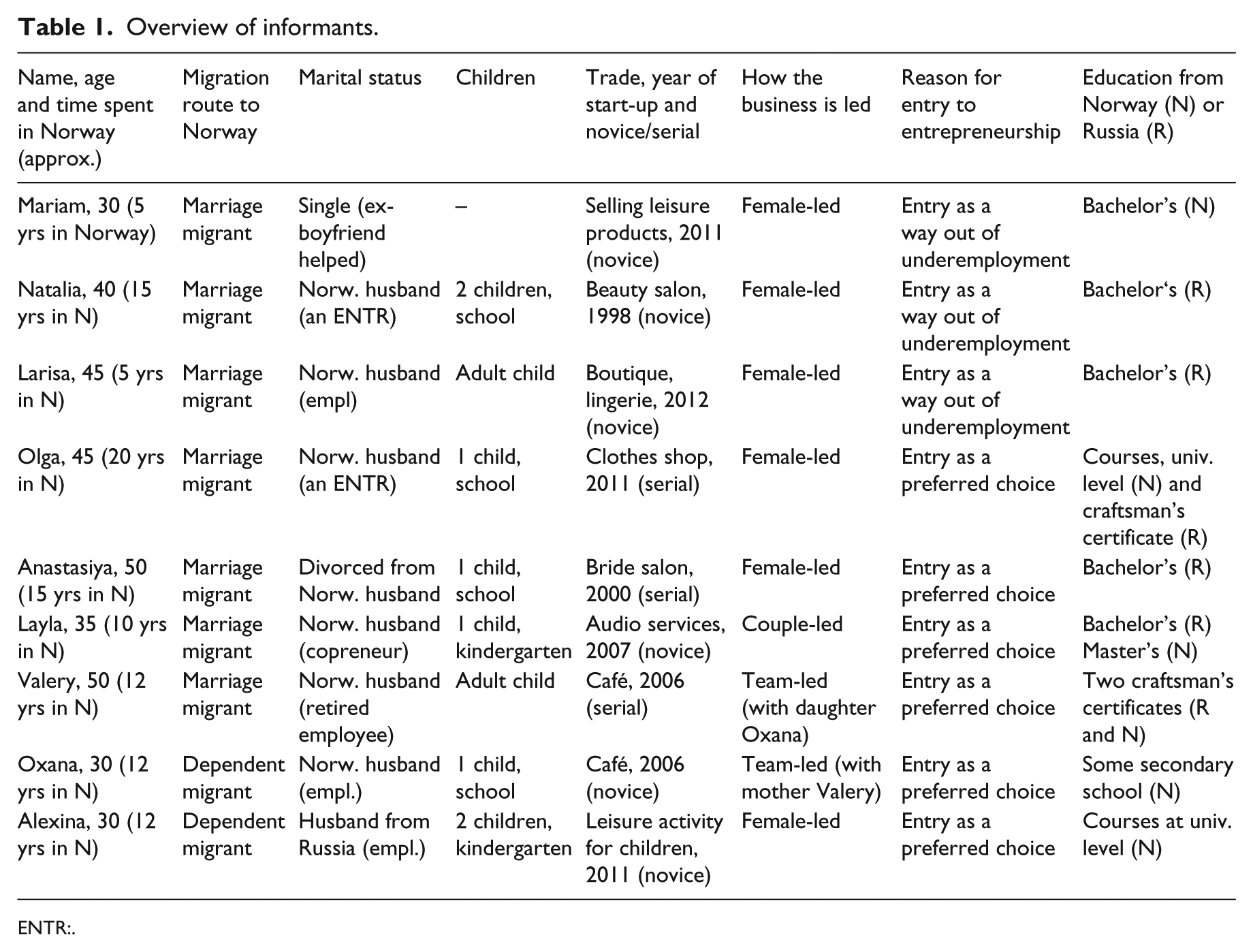
ENTR:.
Networking among female Russian migrants in Finnmark
On the importance of the male partner
Entrepreneurs hold unique resources in terms of education, former work experience and business motivation. To start and run their business, however, they need access to complementary resources, such as information, advice, emotional support, practical support and funding capital (Neergaard et al., 2005; Shaw, 2006). These complementary resources can be obtained in different ways. In megacity contexts in, for example, the USA, the UK and Canada, immigrant entrepreneurs have often used their local co-ethnic network in the host context (Light and Gold, 2000; Portes, 1987; Portes and Jensen, 1989). In Finnmark, however, because the region is vast and minority populations are small and geographically scattered, co-ethnic communities do not exist. Rather, the Norwegian (in two cases the non-Norwegian) male partner clearly represented the most important relation and resource during the start-up phase for all of the participants in this study in terms of providing emotional support, business advice and practical help in finding and renovating appropriate business premises. Valery, who was running a café with her daughter Oxana, said: Although I started the business together with my daughter, my husband was there all the time to help us. He was like a painter, janitor and maintenance guy and even did the dishes in the beginning to help us out. Now, we have two employees, so he does not need to help us with daily tasks anymore, but he stills assists us if we have technical problems.
Two of the spouses, the husbands of Olga and Natalia, were entrepreneurs themselves and were therefore able to provide not only emotional and practical support but also concrete advice related to the paperwork necessary for starting a business, accounting and other business-related information. One husband not only supported his wife in her business concept but also decided to engage in the business as a ‘copreneur’ (Smith, 2000). This was the case in the business of Layla and her spouse. Although all of the participants spoke fluent Norwegian at the time of the interview, several of the marriage migrants said that they did not speak Norwegian very well at the time of their business start-up. Hence, the role of their husbands became even more important in terms of translating public forms that needed to be completed.
The two non-Norwegian male partners were also very supportive of their wives during the start-up and the subsequent business development. Mariam stated that her European boyfriend assisted her in many ways, and Alexina reported that her Russian husband, who decided to settle in Finnmark after meeting her when she visited her father in Russia, had contributed during her start-up phase by decorating her business premises, providing emotional support and taking care of the children so that she could fully attend to her work. Alexina elaborated: If I have a problem, or if I’m a little down, my husband always comforts me, telling me, ‘You’re the best! You can do it!’ He never says, ‘This is your problem’. He supports me no matter what. If I have to work, he looks after our children. No problem. He feeds them, takes care of them, cleans the house and washes the clothes. If I have to work during the weekends, he brings our children to our mountain cabin. In the winter, they go skiing, or they drive with the snow mobile.
The Norwegian male partner as a mediator to the majority community
Through their Norwegian husbands, the female migrant entrepreneurs not only had access to a variety of resources in the wider Norwegian society. Anastasiya, who ran a bridal salon that made and sold wedding dresses and other outfits for celebrations and parties, said that through her husband, she gained access to a lawyer and to an accountant. This was the case for the other participants as well, who stated that they gained access through their Norwegian spouses to different resources, including start-up capital, as will be discussed below. Hence, the analysis reveals that the seven participants who were married to a Norwegian partner had particularly good access to different types of resources in the majority community, both during the start-up phase and during the further development of their business. This situation is different from the situation of other recently arrived immigrant entrepreneurs who, through marriage to a co-ethnic partner, would normally have more difficulty accessing resources in the majority society (see Katila and Wahlbeck, 2009, for similar findings).
A theme that has been frequently explored in research concerns the relationship between the entrepreneurs’ personal networks and their ability to create and maintain relationships with ‘transacting parties’, such as customers and financing sources (Shaw, 2006: 14). With regard to financing, there is often a need to borrow money when starting a business. Hence, to obtain the necessary funding for the business start-up, all of the entrepreneurs in this study (except Mariam) were able to obtain loans from a local bank. For most of them, their Norwegian partner played a significant role in this process because he already owned a house and was willing to guarantee the loan. Mariam, who had an immigrant boyfriend at the time of her business start-up and was single at the time of the interview, however, had not been able to obtain much bank assistance. As a consequence, her internet-based business was developing quite slowly because she was not able to buy all of the goods and supplies she needed. In contrast, Alexina, who was married to a Russian man, said that she had eventually obtained the start-up loan she needed, but only after a ‘long fight’ with the bank and after obtaining financial help from her mother. None of the participants in this study received financial help for the business from relatives in Russia.
Transnational family networks
Although their male partners, rather than co-ethnic relations, constituted the most significant dimension in the participants’ local networks in Finnmark, transnational family relations were also identified as a significant resource for business start-up and development in this study. In fact, all of the entrepreneurs with children who lived at home talked about the importance of the emotional and practical support received from mobile family members. They explained that their mothers, and in some cases also other relatives, regularly travelled across the Norwegian–Russian border to help them with childcare and other tasks during periods of especially high workloads. Oxana, for instance, had a small child when she started the café together with her mother Valery six years earlier: Oxana: When we started the business, we needed to work really long days. So we invited family from Russia to come and look after my little girl. My grandmother used to come here very often to look after her. And other relatives came to look after her, too. Everybody likes it here, you know. Both my mother and I have a big house now, so we have lots of space. And we have a big family in Russia. Valery: Yes, you know, I have five siblings in Russia. They all like to be here. So we still work long days, we earn good money, and we have lots of visits from Russia.
Another key theme that emerged from the analysis of the interview data was the important role of the participants’ personal mobility across the border to maintain relations with their extended family in Russia. In fact, all of the participants visited their families, who, in several cases, lived only a few hours away by car. However, the regularity of the visits varied from one to two times a month (Larisa) to less than once every other year (Valery). Valery explained that she did not feel that she needed to go to Russia to meet her family because her house was ‘constantly full of family from Russia’. In addition, none of the participants talked about sending remittances, which is common among immigrant entrepreneurs and is often viewed as a caring obligation (e.g., Katila, 2010: 300).
Serving the mainstream market from day one
Research has typically shown that so-called ethnic businesses start by serving a co-ethnic market and that they ‘only in the course of further integration break-out’ and enter the mainstream market in terms of majority and other minority customers, as argued by Miera (2008: 754; see also Waldinger et al., 1990). There is no evidence of such a pattern among the female Russian immigrant entrepreneurs in Finnmark. Rather, the participants served the mainstream market from day one, primarily because, in a context such as Finnmark, there is no such thing as a co-ethnic market since there are so few immigrants from each country. However, this study shows that, in the case of some businesses located close to the border, Russian customers sometimes travelled across the border to purchase goods and services while visiting the Norwegian side. This was the situation in Valery and Oxana’s café: Valery: During Russian holidays, Russian customers abound. I mean, it’s full of them here. But even generally, after the border opened, I would say that around half of our customers are Russians, and the rest are Norwegians. But we only serve Norwegian dishes. That’s what all the clients ask for.
Employment strategies: employing the most reliable workers
The businesses in this study were micro-enterprises. The families of the participants did not tend to be used for staffing, except in the case of the male spouses, who formally worked in one business (Layla’s husband) and who, in five cases, worked informally by helping with different tasks and duties without pay. Moreover, five of the businesses had between one and three employees in addition to the entrepreneur and her assistant husband. These employees were Russian in approximately half of the cases and Norwegian in the other half, with a few exceptions. The participants were quite eager to discuss their employment strategies. The most important aspect for them was reliability, or trustworthiness. In the literature, entrepreneurs generally consider people from their own ethnic group, and preferably from their own extended family, the most reliable (Bagwell, 2008; Katila, 2010). In this study, this was the case for only two of the participants, Olga and Natalia. They said that although they had experience employing Norwegian assistants in their shop and spa, they were most satisfied when they were able to hire Russian employees. Olga, implicitly comparing her Russian employees with Norwegian workers, expressed this in the following way: Russians have another work ethic. When my employees are Russian, I know I can trust them. I can take a week off and let them take care of the shop and not have to worry about them getting sick or anything. When they’re in charge, they don’t get sick. Their conscience doesn’t allow that.
Oxana and Valery, in contrast, said that they preferred Norwegian employees. This preference was not necessarily because they considered Norwegians to be more reliable or to have a better employee attitude but because, as they expressed, they wanted to be a ‘Norwegian café for both Norwegian and Russian customers’ and to be ‘totally integrated in the Norwegian society’. Therefore, they felt that employing Norwegian assistants in the café was the best solution. In one case, the entrepreneur (Alexina) chose to employ two refugees who had recently arrived from the Global South. Her employees worked in the cafeteria, attended to the children on the playground, cleaned and performed other tasks in the business. Alexina explained that her employees were part of a public employment scheme, so their wages were paid by the municipality for one year. After that year, Alexina had agreed to hire them on a regular basis.
Finally, two of the businesses, Anastasiya’s sewing business and Mariam’s adult leisure company, had no employees. Anastasiya shared that she was very happy with being her own boss, deciding her own working days and not having to manage any employees. In contrast, Mariam, who had only recently started her business, had plans to recruit workers when her activities and budget would allow it.
Conclusions
This article challenges the assumption of the fundamental importance of co-ethnic networks for immigrant entrepreneurial business start-up and development. Rather, it highlights the networking practices and experiences of Russian female immigrant entrepreneurs in peripheral Norway, and reveals the significance of the family, and in particular the male spouse in the start-up and development of rural immigrant businesses. This study, moreover, finds that Russian female migrants, mainly through their Norwegian husbands, have access to various resources in the host context, such as business advisors, accountants and bank loans. Hence, being a marriage migrant provides extraordinary access to social networks in the majority culture in the country of settlement, as was also found by Katila and Wahlbeck (2011: 304). This phenomenon certainly represents an advantage in the start-up phase of the businesses, particularly for immigrant entrepreneurs in a peripheral and sparsely populated context who, due to the lack of co-ethnic communities, aim to reach the majority market from day one. The female Russian immigrants also made use of their transnational family relations through personal travel to Russia to their relatives in Russia and by hosting Russian family members who came to provide emotional and practical support. Research on immigrant entrepreneurship has indicated the important role of local and transnational family members in providing cheap labour to the business or by sending remittances to support business start-ups (Bagwell, 2008; Katila, 2010; Leung, 2002; Light and Gold, 2000; Portes, 1987; Sanders and Nee, 1996; Waldinger, 1994). This study, however, highlights another important aspect of this phenomenon in terms of mobile family members who regularly cross the national border to visit and to look after children (and the house) while the immigrant entrepreneur is occupied with developing her business. Hence, this article reveals the important role of the family as a network of resources that may alleviate migrant disadvantage through affective ties. In addition, the study shows that the family of the immigrant entrepreneurs may be located both locally in the new place of settlement and transnationally in the country of origin, and may be of both co-ethnic and cross-ethnic character.
Recent research suggests the likelihood of high levels of transnational networking among immigrant entrepreneurs in contexts where there is close proximity between the host and home countries coupled with considerable differences in economic power across the border (Miera, 2008). This situation is the case in Miera’s (2008) study on Polish immigrant entrepreneurs in Berlin. These Poles are labour immigrants whose families are located in one geographical setting (Poland) and whose businesses are located in another (Berlin); hence, they commute between the two contexts for both personal and business purposes. However, although they are situated in a similar politico-spatial context, the participants in this study are much less involved in transnational networks and transnational travelling than the participants in Miera’s (2008) study. We may, therefore, conclude that although they are geographically located in a border zone with a considerable difference in economic power and have strong transnational family relations to relatives living across the border, the immigrant entrepreneurs in this study do not necessarily have a transnational mind-set or a transnational orientation for their business. This finding can partly be explained by the mode of migration of the participants in this study. The female Russian immigrant entrepreneurs in this study were mainly marriage migrants (and two of them were independent migrants who later settled in Finnmark) who primarily focused on integration into their new Norwegian family, which, as noted above, paved the way for cross-ethnic relations of various kinds in the Norwegian host context. Another explanation may be related to Finnmark as a remote and sparsely populated context which, one might expect, may represent a quite different business environment than Berlin, representing larger possibilities for business growth both locally and transnationally.
To conclude, this study finds that the participants’ engagement in different types of local and transnational networks varies not only with regard to human capital and family networks, as suggested by Kariv et al. (2009), but also with regard to their mode of migration and to their new spatial context of settlement. Hence, if the goal is a better and more nuanced understanding of variations in different entrepreneurs’ engagement in and use of different social networks and the various resources they represent, biographical aspects related to mode of migration and family situation, as well as spatial aspects related to demography and geographical location, should be included in the analysis.
Limitations and policy implications
The interpretative methodology has proven useful to identify networking practices among Russian female immigrant entrepreneurs and, in particular, to examine how the host context and the entrepreneurs’ modes of migration influence their engagement in various networks. The results are congruent with findings from a similar context (Katila and Wahlbeck, 2011). However, this study has limitations, such as the restricted number of participants. Certainly, the entrepreneurial experience of female immigrants may be shaped in different ways in other contexts. It is important, therefore, to be careful about generalising the findings to immigrant entrepreneurship in general. Further research is needed to examine other cases, larger samples and other contexts. In particular, whereas this article focuses on the interactional and contextual aspects of social networks as well as their family embeddedness, future research should use mixed methods to also include structural dimensions of entrepreneurs’ social networking to obtain a better understanding of how variations in social networking affect entrepreneurial experiences and business outcomes for male and female entrepreneurs, immigrant and native alike.
Despite its limitations, this study raises some important issues that should be considered by policy and enterprise support programmes designed to help immigrant entrepreneurs. In particular, it is important to understand the importance of local and transnational as well as co- and cross-ethnic networks and to consider how they may be intertwined in different ways in different contexts, as well as their consequences in terms of access to resources.