




Abstract
Although social capital is a relational concept, existing studies have focused less on measuring social relations. This article fills the gap by reviewing recent studies that used network measures grouped into three types according to the measurement level. The first group defined social capital as an individual asset and used node-level measures to explain personal benefits. The second group defined social capital as a collective asset and used graph-level measures to describe collective properties. The third group used subgraph-level measures to explain the development of social capital. This article offers a link between the concepts and measures of social capital.
Introduction
Humans are social animals who engage in social relations to achieve individual or collective goals (Tomasello 2014). Through such social relations, humans can access social resources (e.g., information, trust, and support) possessed by others. Some scholars stress that resources embedded in social relations are valuable because they can generate benefits; the amalgam of social resources, networks, and trust has been called “social capital” by researchers (Bourdieu 1986; Burt 1992; Coleman 1998; Flap 2004; Lin 1999; Putnam 2000; Van der Gaag 2005). The concept of social capital has gained significant attention from scholars and practitioners in many fields of social sciences (Adler and Kwon 2002), including in the planning discipline (Gualini 2002; Healey 1997; Innes et al. 1994; Osborne, Baldwin, and Thomsen 2016; Mandarano 2009; Wilson 1997).
One cause for this increased attention is the emergence of new forms of communicative planning. Since the 1980s, planning scholars have observed the transformation from a top-down to a bottom-up planning model through which multiple stakeholders take part in horizontal and inclusive forms of governance (F. Fischer and Forester 1993; Healey 1997; Innes 1995; Innes and Booher 1999). However, empirical studies soon found the dark side of communicative planning in a small, elite group of actors who still controlled the planning process (Brand and Gaffikin 2007; Geddes 2006; Healey et al. 2003; Swyngedouw 2005). In response, scholars have employed the concept of social capital to assess how a given community develops it throughout planning processes that connect a wide range of stakeholders (Gualini 2002; Healey 1998; Innes et al. 1994; Olsson 2009). Social capital is regarded as a public good that needs to be developed and maintained to provide the essential conditions for collective action (Gualini 2002; Healey et al. 2003).
However, social capital is hard to measure because it resides in social relations that are intangible and ever-changing (Lin 1999). Partly due to the analytical challenge, many empirical studies have observed the level of social involvement (e.g., membership) and cognition (e.g., trust) that were aggregated to generate proximal indicators of social capital at the local or national level (DeFilippis 2001; Stone 2001). In this article, I argue that methodological individualism is problematic, particularly in the planning context in which social relations play “double-sided roles” in nurturing or hampering social cohesion (Sabatini 2009). That is, social capital does not result from the aggregation of resources possessed by individuals but from the complex social interactions that require relational data and measures to account for the multidimensional empirical phenomena. Thanks to the recent advancement of computational power and statistical models, social capital research increasingly employs network measures based on online/off-line relational data, which will be explored in this article.
Against this backdrop, this article aims to explore network measures of social capital with two questions: (1) how is social capital conceptualized in the planning literature? and (2) what measures have been used to study the associated concepts of social capital? To answer the first question, there is a review of the theoretical debates in the planning literature to identify the concept of social capital in use and why it matters in the planning context. In particular, this article focuses on the communicative planning theory, which embraces the concept of social capital as a core element of planning outcomes. For the second question, there is a review of the various measures developed in the broader social sciences to link the concept and measures.
The two research questions construct a stepwise procedure for the review. The first section reviews the concept of social capital and network measures that will provide a framework for the review. The second section presents the retrieving process in detail, and the third section extracts various information from the retrieved publications, focusing on measures of social capital. The fourth section concludes with a discussion of the limitations of network measures and implications for future research.
The Concept of Social Capital and Measurement Problems
Social Capital in the Planning Literature
Social capital is a popular yet slippery concept that consists of “goodwill”: sympathy, trust, and forgiveness offered by friends and acquaintances (Adler and Kwon 2002, 18). While goodwill is the substance of social capital, it comes from social relations built through everyday sociality (Coleman 1998; Lin 1999, 2008; Putnam 2000). Social capital has also emerged online throughout the digital era, which might influence civic engagement (Mandarano, Meenar, and Steins 2010) and health conditions (Pan, Shen, and Feng 2017; Shen and Chen 2015). Likewise, scholars from many disciplines have focused on different aspects of social capital, such as physical and perceived resources, social networks, institutions, and determinants and outcomes at the individual and collective levels (Adler and Kwon 2002; Lin, Fu, and Hsung 2001; Lowndes and Wilson 2001; Portes 1998; Van der Gaag 2005; Woolcock and Narayan 2000).
The concept’s popularity does not come without problems. As many scholars have noted (Adler and Kwon 2002; Bhandari and Yasunobu 2009; Osborne, Baldwin, and Thomsen 2016; Paldam 2000; Stone 2001), social capital research suffers from a lack of common definition and measurement. In this article, my aim is not to provide an exhaustive list of definitions but to link social capital concepts and measures in the planning literature. This section will focus on the theoretical debates in the communicative planning theory that employ social capital as a critical element.
Lin (1999) distinguished the social capital concept under two frameworks. One group of scholars views it as a form of capital in conjunction with economic and political capital in which individuals invest in social relations and take advantage (Burt 1992; Lin 1999): “Better connected people enjoy higher returns” (Burt 2001, 3). Another group of scholars agrees that individuals develop social capital for their benefit, but it also brings externalities in the form of social trust, values, and norms that facilitate collective action (Coleman 1998; Portes 1998; Putnam 1993; Woolcock 1998). Putnam defined social capital as “the norms and networks of civil society that lubricate co-operative action among both citizens and their institutions” (Putnam 1998, V), which can be rephrased as “the norms and networks facilitating collective action for mutual benefit” (Woolcock 1998, 155). While both individual and collective views share the idea that social capital is developed in social relations, the former focuses on personal benefit and the latter on collective benefit.
Communicative planning scholars focus more on the collective perspective based on Coleman (1998) and Putnam (1993, 2000). Here, communicative planning theory refers to the studies of network governance in planning processes, in which multiple stakeholders manage collective affairs through deliberation and negotiation (Allmendinger 2002; Harris 2002; Hartmann and Geertman 2016; Innes and Booher 2015). Influenced by the notion of communicative rationality (Habermas 1984), communicative planning is based on the assumption that planning problems are not fixed but socially constructed and are solved through intersubjective communications (Allmendinger 2002). The main interest of communicative planning is to facilitate the condition of an ideal speech situation in which all affected parties are allowed free access to deliberation, and power inequality among them is neutralized so that all participants can equally exchange ideas in order to reach a certain level of consensus (Innes 2004, 7; Purcell 2009, 149). Particularly in its earliest debates, proponents focused on the role of planners, arguing that they have the power to “influence the conditions which make citizens able (or unable) to participate, act, and organize effectively regarding issues affecting their collective lives” (Forester 1982, 67; see also, Albrechts 1991; Forester 1987; Healey 1992; Innes 1995). The planners’ primary role was no longer to engineer but to mediate who facilitates a consensus among different stakeholders.
However, there has been significant criticism of the neglect of power inequality in communicative planning. Critical scholars argue that planning is the product of power relations rather than of communicative rationality (Brand and Gaffikin 2007; Bratt and Reardon 2013; Fainstein 2000; Fischler 2000; Flyvbjerg 1996; Huxley and Yiftachel 2000; Neuman 2000; Purcell 2009). In particular, economic power is a crucial factor that determines who decides on and who benefits from the planning outcome (Fainstein 2000). Communicative planning often takes place in formal institutional arenas combined with “horizontal” and “inclusive” technologies, yet the invited process is likely staged in favor of elite groups while political conflicts are repudiated (Swyngedouw 2005). Besides, social movements operating outside the formal arena cannot be overlooked because they bring pluralism in planning (Bratt and Reardon 2013; Davidoff 1965; Neuman 2000). In this regard, Fainstein (2000) criticized the communicative planning theory for being too idealistic and neglecting substantial inequality, democracy, and diversity which influence communicative processes. Following Mouffe (2005), Purcell argued that power in discourse should be mobilized, not neutralized (Purcell 2009, 150).
In response to the criticism (Forester 2000; Healey 1999, 2003; Innes 2004), communicative planning scholars have shifted their attention from the planners to the mobilization of collective capacity since the late 1990s. This means that stakeholders’ involvement, institutional capacity-building, and the transformation of urban governance have become crucial research agendas (Calderon and Westin 2019; Cars et al. 2002; Goodspeed 2016; Hajer and Wagenaar 2003; Harris 2002; Healey 1997; Ziafati Bafarasat 2014). Booher and Innes (2002, 225) stressed the importance of network power, arguing that consensus-building creates “a shared ability of linked agents to alter their environment in ways advantageous to these agents individually and collectively.” The notion of collective capacity to facilitate network power is called “institutional capacity” (Healey 1998).
Institutional capacity is developed by the coordination of institutional capital (Healey 1997, 1998; Healey et al. 2003). The term “capital” highlights the fact that institutional capacity continuously “lives on among participants even after the group disbands, and it facilitates future coordination” (Innes et al. 1994, 47) in order to institutionalize (Healey 1998, 1999; Healey et al. 2003). Scholars identified three dimensions of institutional capital (Healey 1998; Healey et al. 2003; Innes et al. 1994; De Magalhães, Healey, and Madanipour 2002). Intellectual capital refers to knowledge resources (e.g., problem framing and technical information) that provide a shared agenda and knowledge for discussion. Social capital refers to relational resources built through face-to-face encounters that create a favorable environment for collective action. Political capital refers to the capacity to mobilize collective actions for a common goal and to translate these results into policy action. Likewise, social capital is treated as one of the outcomes of communicative planning (Agger and Löfgren 2008).
Social capital plays a specific role in providing “channels” or “webs” that enable other social resources (including intellectual and political capital) to flow through them (Healey 1997, 1998; Innes et al. 1994). The concept of social webs is crucial because its morphology “may define how accessible networks are, who are insiders and outsiders, as well as the nature of power relations within and beyond a specific network” (de Magalhães, Healey, and Madanipour 2002, 56). This relational perspective aligns with scholars who argue the importance of studying structural components of social capital (Borgatti, Jones, and Everett 1998; Burt 1992; Coleman 1998; Granovetter 1973; Lin 1999; Portes 1998), whose key elements could be the range of stakeholders, the morphology of their social networks, the extent of integration, and their network power (de Magalhães, Healey, and Madanipour 2002; Healey et al. 2003). In contrast, another group of scholars focuses on the stock (or volume) of social capital (Bourdieu 1986; Fukuyama 2001; Putnam 2000). For Bourdieu (1986, 21), social capital is the aggregate of social resources possessed by agents interconnected through memberships (e.g., of a family, a class, a tribe, and a party). Members supposedly accumulate or maintain social capital for individual and collective benefits. Lin (1999, 2008) and Van der Gaag (2005) called the former approach “mobilized social capital” because it focuses on mobilizing linkages of resources that are unequally distributed across actors. The latter approach is called “accessed social capital” because it focuses on the accessibility of accumulated social resources. Moore and Kawachi (2017) called the two approaches the “network approach” and the “cohesion approach,” respectively. Lin’s (2008, 51) definition succinctly captures the core elements of social capital as “resources that can be accessed or mobilized through ties in the networks.”
Overall, we have identified social capital as the manifestation of social networks in the communicative planning theory. In the individual/collective dimension, the main focus is on stakeholders’ social networks as a whole. In the mobilization/accessibility dimension, the main focus is on the flow (mobilization) rather than on the stock (access) of resources. Following Healey (1997, 57–59), a prominent communicative planning scholar, I call this approach to social capital the “network approach” (Dempwolf and Lyles 2012).
Bonding and Bridging Social Capital
From the network approach, social capital is inherently neither good nor bad but functional, as it connects actors who have different interests and resources (Coleman 1998). Since actors have free will to develop personal networks, their micro-social interactions produce a range of collective outcomes (Woolcock and Narayan 2000). Based on the work of Granovetter (1973, 1985) and Putnam (2000), scholars have offered two types of social capital that account for different outcomes: bonding and bridging social capital (Rydin and Holman 2004; Szreter and Woolcock 2004; Woolcock 2001). In short, the former refers to closely connected networks with similar backgrounds, whereas the latter refers to loosely connected networks across multiple boundaries.
Bonding social capital denotes the connections between people within groups. It promotes norms of social cohesion, homogeneity, reciprocity, and cooperation within social groups or geographically defined communities. The inward-looking norms create a “glue” that makes people work together and a social support that benefits the membership, but they also create negative consequences, such as the “exclusion of outsiders, excess claims on group members, restrictions on individual freedoms, and downward-leveling norms” (Portes 1998, 15). The nature of bonding social capital is likely to require a high level of trust within groups. However, it will depend on how actors define “us” in the cognitive boundary (Fukuyama 2001). In the planning context, competitive and adversarial relationships are prevalent (Brand and Gaffikin 2007), and bonding social capital is likely to create a few tightly clustered and reciprocated subgroups within a network. It requires an appropriate institutional design to “bridge” these groups (Healey 1997, 1998).
Bridging social capital denotes the connections across groups. It promotes norms of openness, diversity, popularity, respect, and cross-communication between different social groups. The outward-looking norms create benefits for the development of intellectual capital and mobilizing political power (Szreter and Woolcock 2004). Bridging social capital might generate a weaker connection than bonding it because they are influenced by various institutional settings (Kusakabe 2012). However, studies have found that while bonding social capital affects the access of information, bridging affects the flow of information across different groups (Burt 2000; Granovetter 1985; Lin 1999). In this situation, actors are likely to contact someone who has many connections between different groups or who possesses plentiful resources. Bridging social capital is likely to create bridging structures that connect different groups.
Woolcock (2001) argued that the concept of bonding and bridging is not a binary opposition, rather they work simultaneously to provide competing mechanisms for the development of social capital (also, Burt 2000; Patulny and Svendsen 2007; Rydin and Holman 2004; Woolcock and Narayan 2000). If bonding social capital is excessive, a community develops hierarchical and exclusive networks; if bridging social capital is excessive, a community may have difficulty building trust and norms of reciprocity across diverse groups (A. P. Fischer et al. 2014; Kusakabe 2012).
Szreter and Woolcock (2004, 655) pointed out that bonding and bridging concepts do not account for vertical relationships across different scales and levels (e.g., national–local governments), so they proposed a third type of social capital: linking capital (Osborne, Baldwin, and Thomsen 2016; Szreter and Woolcock 2004; Woolcock 2001). Linking capital is similar to bridging capital in that they refer to relationships among dissimilar people. However, while bridging capital focuses on horizontal linkages within a scale, linking capital focuses on linkages between those within a hierarchy of power and authority, especially in a multilevel governance context (Kusakabe 2012; Lang and Novy 2014; Rydin and Holman 2004). As Osborne, Baldwin, and Thomsen (2016) observed, existing studies tend to define, a priori, a set of criteria (e.g., the level of government) to determine social strata and concentrate on the content (e.g., trust relationship) of linking capital rather than on developing network measures (Aldrich 2011; Hawkins and Maurer 2010; Healey et al. 2003; Lang and Novy 2014; Kawamoto and Kim 2019; Nogueira 2009). These methods fall outside the scope of this review. Nevertheless, linking capital between residents and key decision makers from different government levels have been a central focus in communicative planning research (Healey et al. 2003; Healey 2006; Hillier 2000; Phelps and Tewdwr-Jones 2000). Therefore, this article will revisit the measurement of linking capital in the Discussion section.
Measurement Problems
Based on the communicative planning theory review, two measurement problems are found. First, the field uses mainly qualitative research methods, that is, explorative, inductive, and interpretive methods “designed to uncover deeper meanings in social processes” (Silverman 2014, 140). They are often based on data collected through a combination of observations, interviews, and documents that are useful for understanding the content of social capital (Moody and Paxton 2009). Born from the rejection of a positivist understanding of planning, communicative planning scholars have developed qualitative methods for understanding planning practices characterized by context specificity, plurality, and subjectivity (Allmendinger 2002; Yanow 2003). However, Dempwolf and Lyles (2012, 4) argued that social network analysis could be useful for analyzing structural components of social capital because it provides well-established tools for “visualizing, analyzing, understanding, and remembering complex networks of actors.” Although social network analysis has received increasing attention in the planning literature—for instance, as a tool for analyzing collaboration (Holman 2008; Provan et al. 2005), stakeholder mapping (Lienert, Schnetzer, and Ingold 2013; Prell, Hubacek, and Reed 2009), community development (Ennis and West 2010), and transportation (El-Adaway, Abotaleb, and Vechan 2017)—applications of social capital are still rare (except, for instance, in Ernstson, Sörlin, and Elmqvist 2008; Gilchrist 2008; Mandarano 2009; Mandarano, Meenar, and Steins 2010). Network scholars suggest using social network analysis as a complement to qualitative methods, which will be discussed later (Crossley 2010; Hollstein 2011, 2014; Moody and Paxton 2009; Yousefi Nooraie et al. 2018).
Second, social capital research tends to measure the volume of social capital. Influenced by Putnam (1993, 2000, 2001), many studies have developed proximal indicators (e.g., social involvement, reciprocal acts, trust, network size, and perception) or distal indicators (e.g., crime rates, health status, and life expectancy) to count the presence of specific elements associated with social capital (DeFilippis 2001; Stone 2001). These indicators are often based on large-scale social survey data observed at the individual level and then aggregated up to the local or national level to answer the following, for instance: “How can we increase the stock of social capital (Fukuyama 2001) or the decline of social capital in America?” (Putnam 2000). However, these measures are not useful for analyzing the range of stakeholders and the morphology of their social networks due to the absence of relational data. In the following section, I will explain the concept of network measures to address these problems.
The Concept of Network Measures
Bonding and bridging have been a long-standing subject of social network analysis (Borgatti, Jones, and Everett 1998; Burt 1992; Granovetter 1973; Lin 1999), and in this article, the focus is on network measures developed in the field. Social network analysis is the study of the structures of social relations that originated in the 1930s (Wasserman and Faust 1994), but that only recently has been introduced in the planning literature (Dempwolf and Lyles 2012). Network data are stored in a different format that makes them conductive for analysis. Therefore, I will clarify the concept of network measures by using a simple fictitious example (for detail, see Borgatti et al. 2009; Borgatti, Everett, and Johnson 2018; Hanneman and Riddle 2005; Newman 2010; Robins 2015).
Assume that we investigate the social capital of a bowling club consisting of five members (actors A through E). Conventionally, the data of the members are stored in a rectangular array of measurements where rows represent cases (or observations) and columns store individual-level attributes (Figure 1A). For example, we may ask, “how many bowling friends do you have in the club?” Then, we store the collected data in the frnd column. In contrast, a network data structure is a square array of measurements (e.g., one-mode network) in which rows and columns consist of the same set of actors (nodes or vertices). Each cell represents a relationship between actors (1 if yes, 0 otherwise), for example, those obtained by asking “with whom do you frequently go bowling?”
The two questions ask about social relations among the members but collect qualitatively different types of data: while the former asks an individual-level attribute, the latter asks about a relationship between individuals. Network data can be represented in several ways, such as in an adjacency matrix (Figure 1B) and graph (Figure 1C).
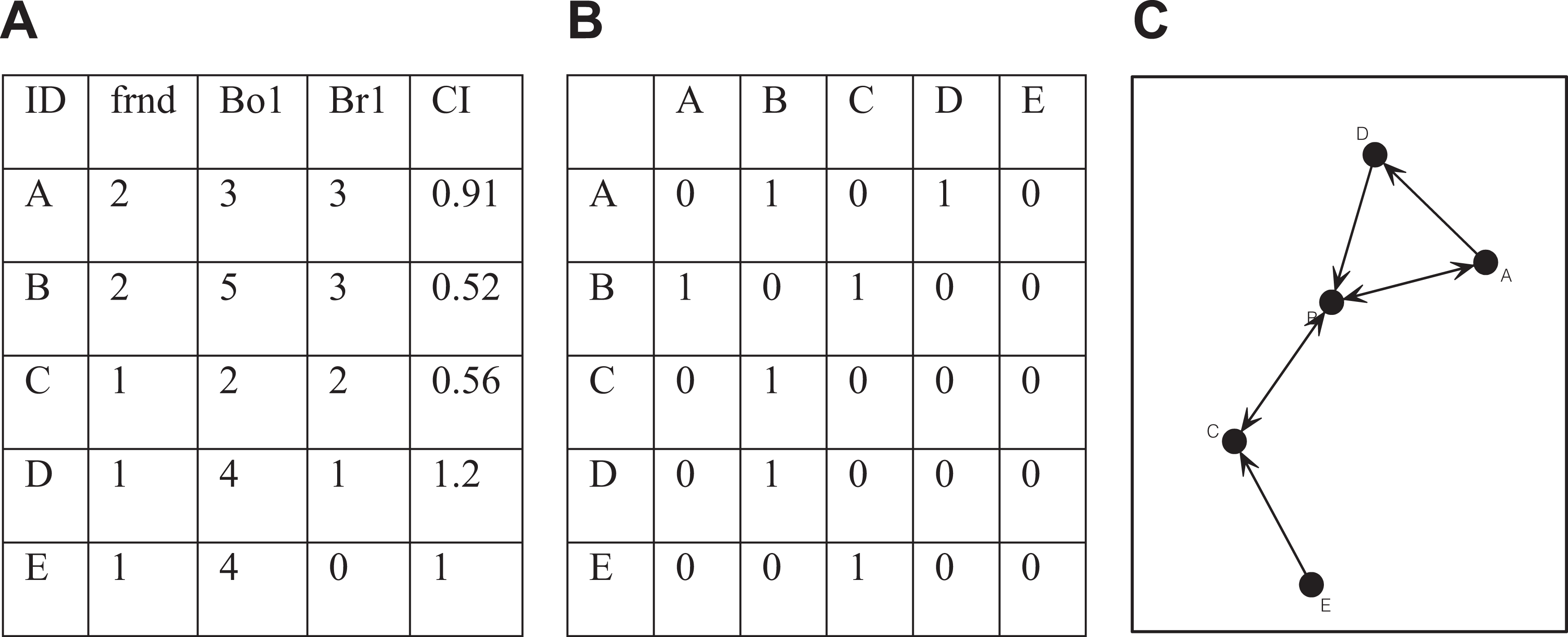
An example of different data structures. (A) Standard data. (B) Network data. (C) Network graph.
In short, both data structures can be used to analyze social capital. Williams’s (2006) Internet Social Capital Scale is perhaps the most widely used measurement of perceived social capital that serves as a useful example of the standard data. The social capital index consists of ten bonding and bridging psychometric subscales (off-line and online). For instance, the first item of the bonding questions is, “There are several people I trust to help solve my problems.” The first item of the bridging questions is, “Based on the people I interact with, it is easy for me to hear about new job opportunities.” These items can be measured on a five-point Likert-type scale and stored in column Bo1 and Br1, respectively (Figure 1A). Several articles have reviewed how these types of individual-level measures can be aggregated to provide an indication of the level of social capital at the community, city, and national levels (Islam et al. 2006; D. Liu, Ainsworth, and Baumeister 2016; Lochner, Kawachi, and Kennedy 1999; Mazumdar et al. 2018; Van der Gaag 2005). However, the data miss some information on relationships between specific actors that allow planning research to examine the structural component of social capital.
Therefore, the current article reviews studies that used network measures of social capital. Literature reviews on network measures are rare in the planning literature. According to Marsden (2002), there are two distinct approaches in social network analysis (also, Borgatti, Everett, and Johnson 2018, 33–34; Robins 2015, 51–54): an egocentric approach and a sociocentric approach. On the one hand, an egocentric approach focuses on a network(s) of me; a focal node (ego) and the surrounding nodes (alters) are related to the ego. From this approach, social capital is possessed by me in relation to others. The main aim of an egocentric approach is to infer “the properties of individuals’ local networks” (Butts 2008, 18). One example measure of the egocentric approach is the Network Constraint Index developed by Burt (2005). The index measures the concentration of the ties of node i within a single cluster, so this position constrains i's ability to bridge across different groups. In the example of the bowling club, the measure yields that actor B got the lowest value (0.52), indicating that he enjoyed the most benefit from his brokerage position (see Table 1). Since the egocentric approach focuses on node-level measures, it does not require “a priori enumeration of a population of nodes” (Marsden 2002, 408); thus, network data can be collected (e.g., name generators) within a large-scale sampled survey and combined into the standard data structure (Robins 2015). For instance, the values of the Network Constraint Index are based on the network data (Figure 1B) and stored within the standard data as column CI (Figure 1A).
Examples of Different Levels of Network Measures.
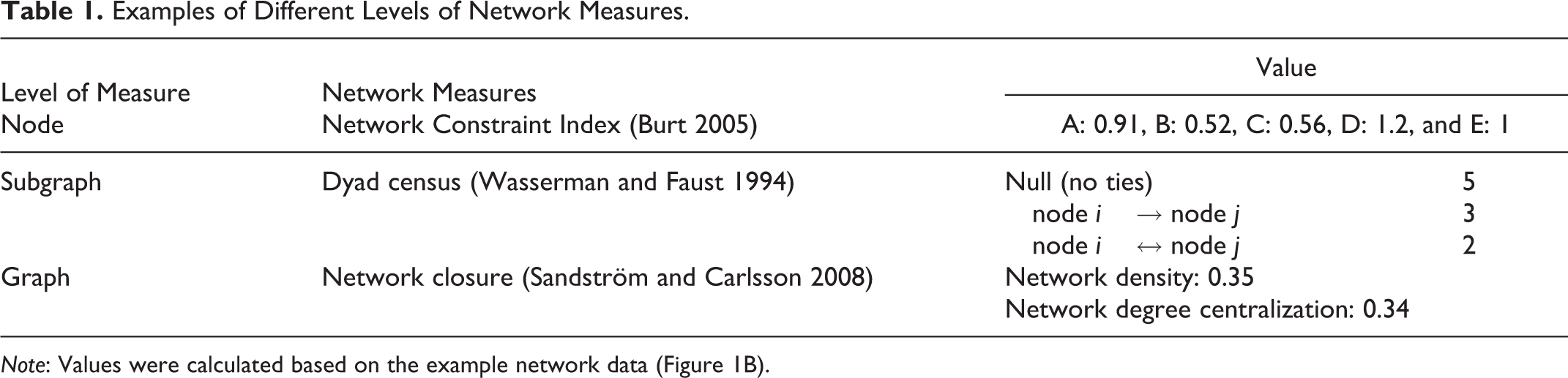
Note: Values were calculated based on the example network data (Figure 1B).
A sociocentric approach focuses on a group network(s) from a bird’s-eye view: relations between all nodes within a defined group. For the bowling club, the question is not about the social capital of each individual member but about the property of the bowling club as a whole. Therefore, it requires a researcher to specify a network boundary, which is five in this case. Sandström and Carlsson (2008) suggested network density and degree centralization, which can be used to examine the bonding social capital of the bowling club. According to the measures, network density and degree centralization are 0.35 and 0.34 (values ranging from 0 to 1), respectively, indicating that the bowling club shows a moderate level of bonding social capital.
Network density and centralization are descriptive statistics of the given network data. More recently, there has been an emerging body of statistical network analysis that allows for inferring how social networks form and evolve (Cranmer and Desmarais 2011; Kolaczyk 2009; Lubell et al. 2012). Statistical network analysis refers to a statistical analysis of network data, which uses network models to handle interdependence among observations (network observations are relations). According to Van Duijn and Huisman (2011), network models are classified into actor-level and tie-level models. On the one hand, actor-level models aim to explain or predict actor attributes using network data (e.g., general linear models) or to categorize groups within a given network (e.g., stochastic block models); on the other hand, tie-level models aim to explain the correlation between networks (e.g., quadratic assignment procedure), network formation (e.g., exponential random graph models [ERGMs]), and evolution (e.g., stochastic actor–oriented models [SAOMs]). SAOMs can infer changes in both attributes and relations over time (Snijders, van de Bunt, and Steglich 2010). Several network models allow for incorporating both subgraph patterns (configurations) and individual-level attributes as a model’s parameters. For instance, we might want to test whether the number of friends (frnd) and reciprocal relations (see Table 1) explain the observed social network formation. By incorporating these two parameters together in a single ERGM, a researcher can test these effects against one another (Lusher, Koskinen, and Robins 2013). Statistical network analysis mostly uses sociocentric network data, but the egocentrically sampled data are also possible with limitations (Krivitsky and Morris 2017).
Overall, Table 1 shows that node, graph, and subgraph measurement levels produce different types of values. Node-level measures are useful for analyzing who is better connected or isolated; graph-level measures are useful for analyzing whether a whole network is cohesive or centralized; subgraph-level measures can be included in network models to infer social processes that have formed or changed the observed network. Although these measures are often combined in practice, the three levels of network measures will provide a framework for the literature review.
Method
Thus far, this article has reviewed the concept of social capital and network measures. In the planning literature, social capital is conceptualized as social networks for which social network analysis provides useful measures and methods. However, the concepts of social capital and social network analysis have been developed in isolation from each other in the field. The rest of this article explores the network measures of social capital by retrieving relevant studies through the Web of Science under two conditions (see Figure 2). First, this review extends the investigation scope to the broader social sciences due to a relatively small number of empirical studies that used network measures in the planning literature (Dempwolf and Lyles 2012). Second, because of the large number of social capital research publications (25,076 publications mentioned “social capital” in their titles, abstracts, or key words), this article limits the time range from 2010 to 2019. The search key word “social capital” (topics) within the time range yielded 14,412 results, showing that half the publications have been produced since the 2010s.
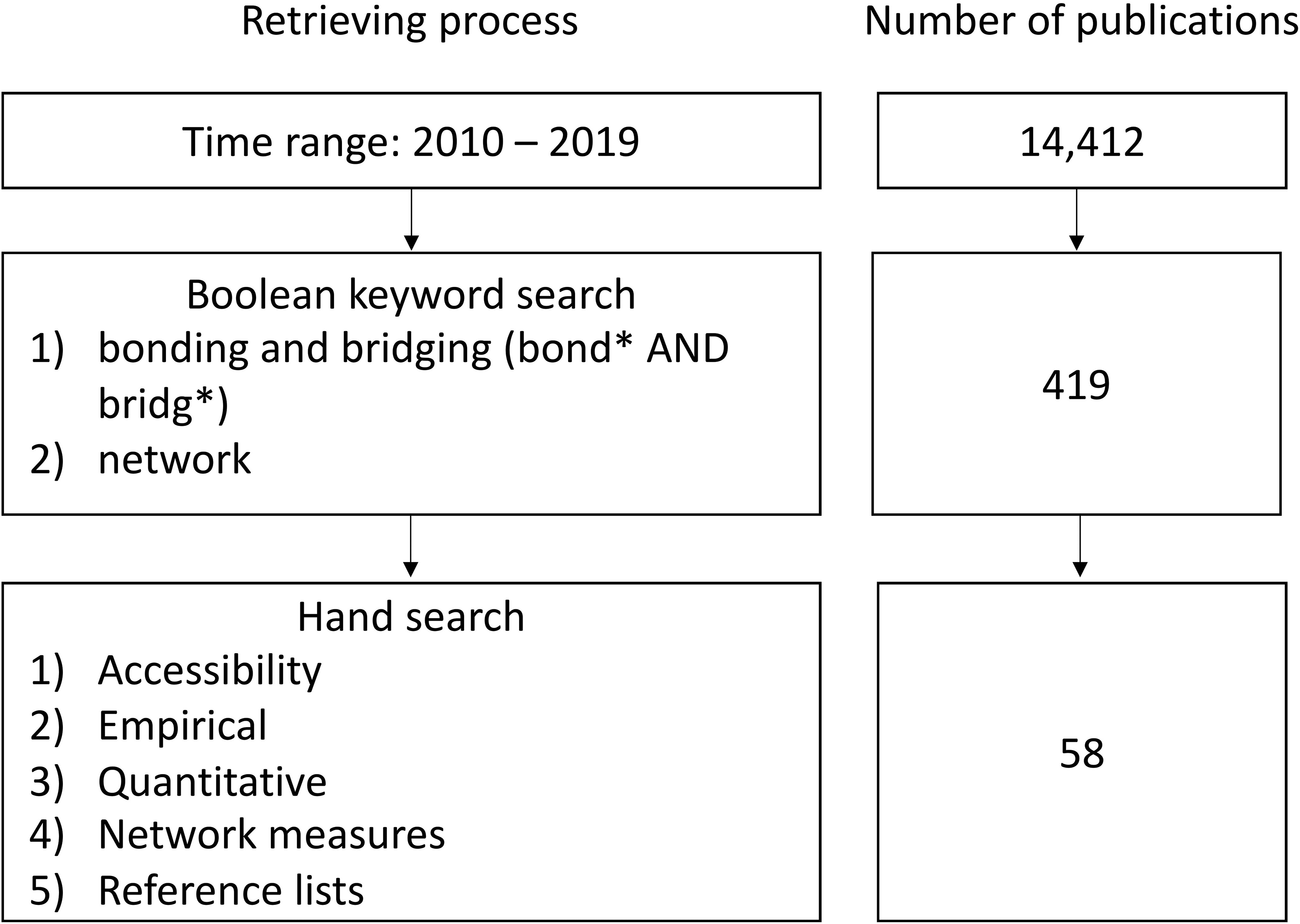
Flowchart of the search process.
Next, I conducted a key word search by using the key words “bonding,” “bridging,” and “network.” Since the network approach assumes that different combinations of bonding and bridging account for the range of outcomes associated with social capital (Woolcock and Narayan 2000, 231), the search query “AND” instead of “OR” was used to ensure that the retrieved publications considered both bonding and bridging social capital in a single analysis. I also added a key word network to include publications that might use network measures. The final search query was TS=(“social capital”) AND TS=(bond* AND bridg*) AND TS=(network) AND PY=(2010–2019), which yielded 419 results.
Screening abstracts was not useful because measurement information was not included in most titles and abstracts. Therefore, I retrieved the relevant articles by reading their full contents. To be included in the review, the study had to (1) be written in English and accessible (e.g., articles written in Portuguese were excluded), (2) be empirical (e.g., theoretical and review articles were excluded), (3) have used quantified network measures (e.g., qualitative studies were excluded), and (4) include detailed technical explanations (e.g., studies using measures without explanation were excluded). I also searched the reference lists of the publications and included relevant studies. The hand search identified fifty-eight records. Online Appendix A provides detailed information on the publications that include author, title, year, data collection, network type, bonding and bridging measures, level of analysis, and method.
Descriptive Summary of the Publications Collected
Table 2 provides a descriptive summary of the fifty-eight publications collected. These studies are distinctive from the large body of social capital research in terms of using network measures for bonding and bridging social capital. Regarding the data collection method, twenty-seven publications (nearly half) used a paper-based or online survey, followed by eleven studies that used online data such as Facebook “friends.” Eighteen studies combined interviews with surveys or online data to analyze the content of social capital from the insiders’ viewpoints.
Descriptive Summary of Fifty-eight Publications.
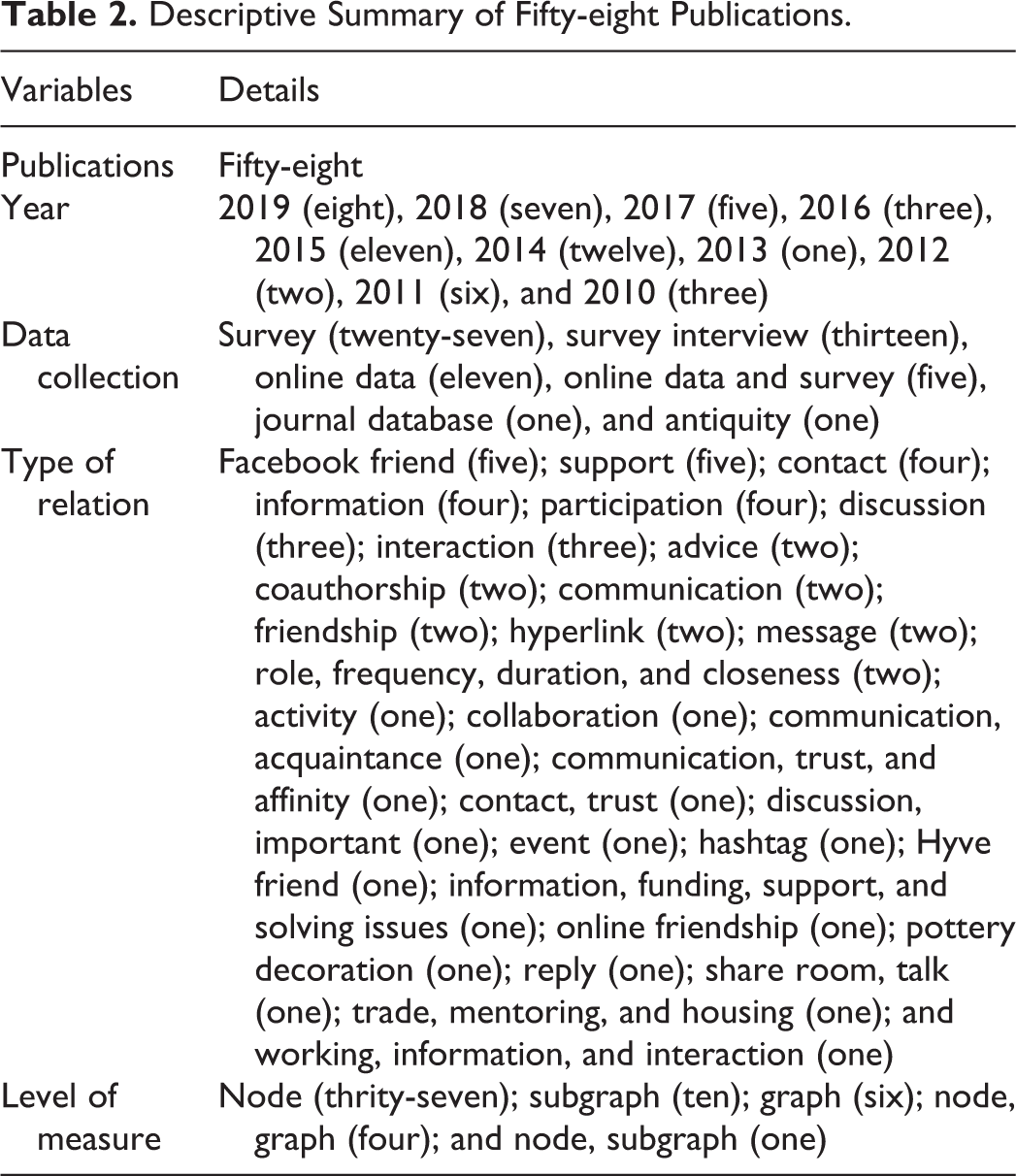
As for the relational type, the studies used diverse types of relations as a proxy network(s) for social capital. Adler and Kwon (2002, 18) distinguished three types of relations: market relations (exchange based on bargaining), hierarchical relations (command-and-control based on authority), and social relations (exchange based on favors and trust). They argued that the third type constitutes social capital. The publications showed a fragmented landscape of the third relational type: Facebook friend (five); support (five); contact (four); information (four); participation (four); discussion (three); interaction (three); advice (two); coauthorship (two); communication (two); friendship (two); hyperlink (two); message (two); role, frequency, duration, and closeness (two); and others according to different contexts.
In terms of the measurement level, thirty-seven studies used node-level measures, ten used graph-level measures, and six used subgraph-level measures to empirically study social capital. The remaining five studies used multiple levels of measurement.
Network Measures of Social Capital
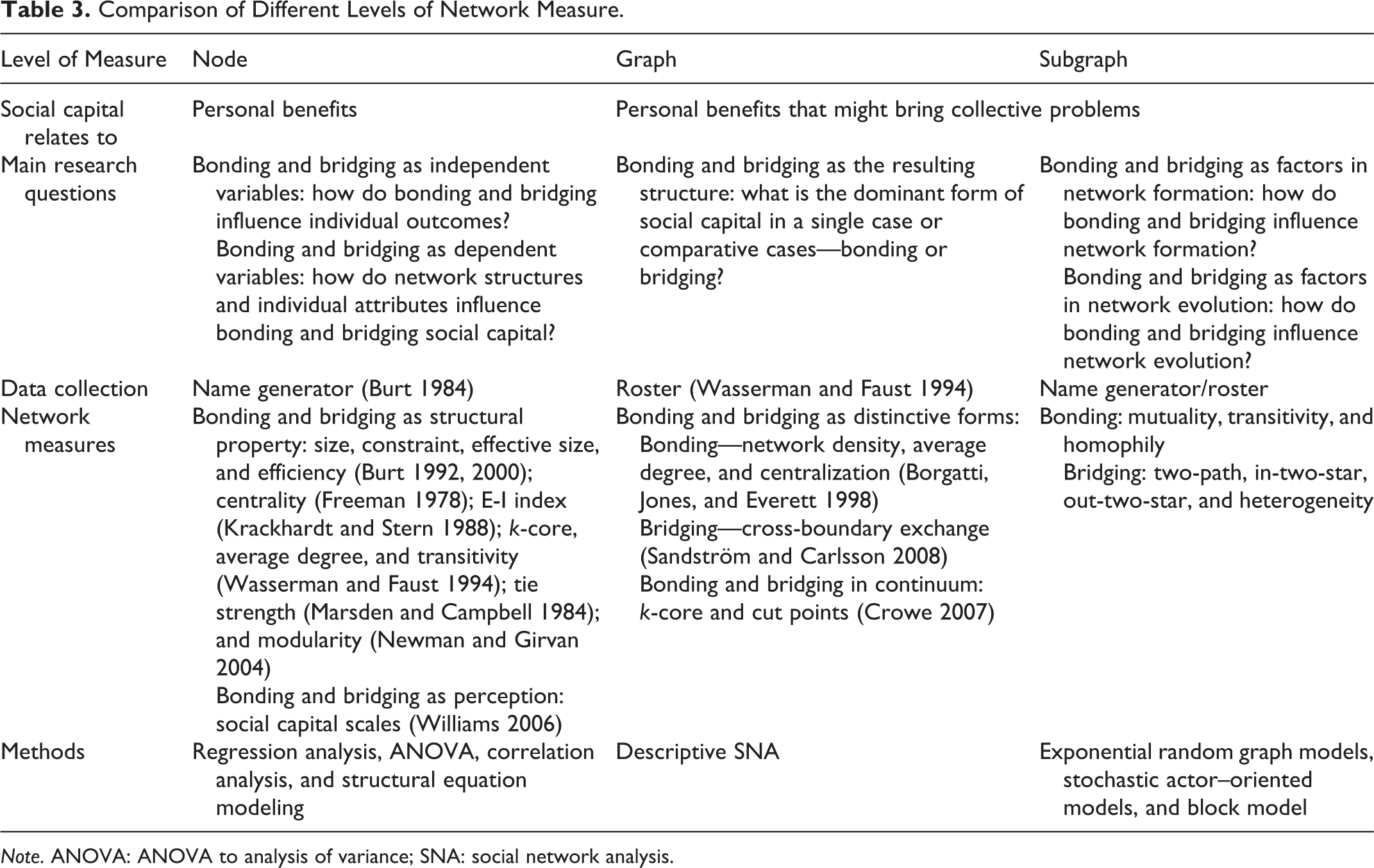
This section summarizes how previous studies have measured social capital. As previously discussed, this article groups the retrieved studies into node-level, graph-level, and subgraph-level groups as shown in Table 3. Citations attached to each measure and concept provide theoretical definitions and technical details of measurements.
Comparison of Different Levels of Network Measure.
Note. ANOVA: ANOVA to analysis of variance; SNA: social network analysis.
Node-level Network Measures
Node-level measures are useful for studying social capital as an individual asset. On the one hand, bonding and bridging social capital were conceived as factors in explaining political participation (Achbari 2015), use of employment services (Barman-Adhikari and Rice 2014), entrepreneurial orientation (Cao, Simsek, and Jansen 2015), loan repayment performance (Dufhues et al. 2011), job searches (Gayen, Raeside, and McQuaid 2019), and health disruption (Shen and Chen 2015). These studies generally refer to bonding and bridging as effects and then analyze how the two explain the individual-level dependent variables. A common type of research question was, “How do bonding and bridging influence individual outcomes?”
On the other hand, other studies used bonding and bridging social capital as dependent variables. Most studies in this group used the Internet Social Capital Scale (Williams 2006) with some modifications to measure perceived bonding and bridging social capital. The scale itself is not a network measure out of the scope of this review, but some studies were included in the review because they used network measures as independent variables (Appel et al. 2014; Brooks et al. 2014; Y. Liu et al. 2014; Venkatanathan et al. 2012, 2013). For instance, Y. Liu et al. (2014) used degree centrality (for bonding) and betweenness centrality (for bridging) as factors in explaining the Internet Social Capital Scale. A common type of research question for this was, “How do network structures and individual attributes influence perceived bonding and bridging social capital?”
Name generators (Burt 1984) were almost the default data collection method within the category. For instance, based on Marsden (1987), Hampton (2011) collected network data with the following survey question: “Looking back over the last six months, who are the people with whom you discussed matters that are important to you?” Then, respondents were asked to list up to five people.
After the data collection was completed, several measures were chosen within the following toolset of SNA: size, constraint, effective size, and efficiency (Burt 1992, 2000) 1 ; centrality (Freeman 1978) 2 ; E-I index (Krackhardt and Stern 1988) 3 ; k-core, average degree, and transitivity (Wasserman and Faust 1994) 4 ; tie strength (Marsden and Campbell 1984) 5 ; and modularity (Newman and Girvan 2004). 6 In Figure 1, these measures produced values assigned to individual-level attributes; they were treated as either independent or dependent variables in different types of regression analysis, ANOVA to analysis of variance (ANOVA), correlation analysis, and structural equation modeling. Notably, these analyses assume independent observations, thus using network measures (interdependency of social relations) that require special treatment (e.g., nonparametric methods) to avoid violating the independent assumption.
Graph-level Network Measures
Graph-level measures are based on the sociocentric approach, which conceptualizes social capital as a collective asset. Most studies within the category used graph-level measures to examine social capital in sports teams (Bergesen Dalen and Seippel 2019), regional innovation networks (Eklinder-Frick, Eriksson, and Hallén 2014; Muscio, Lopolito, and Nardone 2019), resource management (A. P. Fischer et al. 2014; Rova and Sandström 2010), tourism (Birendra et al. 2018), biodiversity conservation (Tuda and Machumu 2019), and agri-food (Ramirez et al. 2018).
All publications within the category used roster instruments to collect network data. “Roster” refers to a list of the actors’ names, and roster instruments typically involve a two-step process (Butts 2008; Wasserman and Faust 1994). The first step is to create a roster that is defined exogenously (e.g., formal membership or expert knowledge) or methodologically (e.g., snowball sampling). The second step is to show the roster to respondents and ask them to check the listed names to see if they have specified relations. For instance, Bergesen Dalen and Seippel (2019) created a roster for thirty teams of athletes through a snowball sampling technique, in which the data collection started with the main author’s network of coaches and then expanded to other coaches who provided lists of their team members.
Despite the small numbers of publications within the category, two approaches were noticeable. One group of studies viewed bonding and bridging as two distinct forms of connection (A. P. Fischer et al. 2014; Rova and Sandström 2010; Yamaki 2015). Bonding social capital is characterized by cohesive networks in which homogenous actors are densely connected around a few central actors. To measure network cohesion, the following were used: network density, average degree, and (degree) centralization (Borgatti, Jones, and Everett 1998; Bodin, Crona, and Ernstson 2006; Sandström and Carlsson 2008). 7 Bridging social capital is characterized as loosely connected networks across groups assessed by cross-boundary exchange (Sandström and Carlsson 2008). Likewise, bonding and bridging were regarded as mutually exclusive. In contrast, another group of studies viewed bonding and bridging as differing in degree, and they situated them at the opposite end of the dense/loose continuum (Birch and Hart 2018; Birendra et al. 2018), which used k-core and cut points based on Crowe (2007). 8
Subgraph-level Network Measures
Graph-level network measures are useful descriptive statistics for the collective property of social capital. The recent development of statistical network analysis allows us to incorporate both individual attributes (Figure 1A) and network measures (Figure 1B) into a single model and test their relative explanatory strength in network formation and evolution (Cranmer and Desmarais 2011; Kolaczyk 2009; Lubell et al. 2012; Robins, Lewis, and Wang 2012).
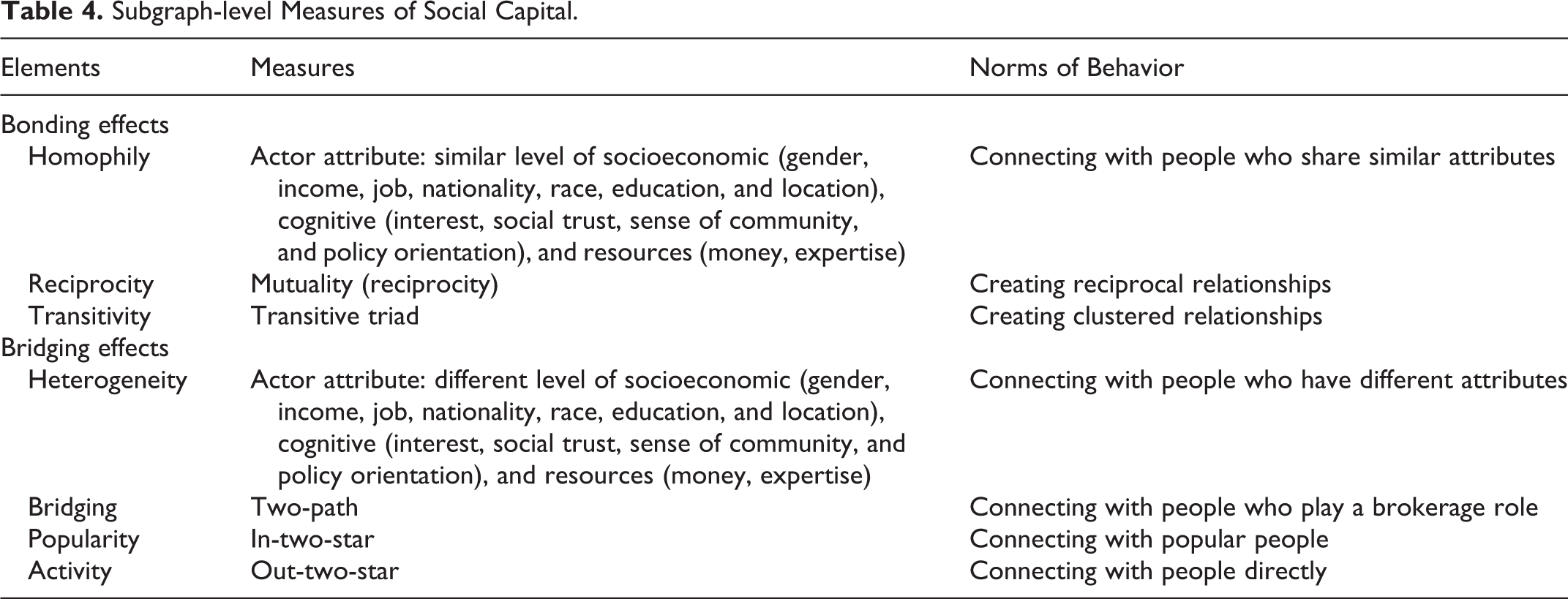
The current review identified nine studies that examined bonding and bridging effects in the analysis of network formation (Alcañiz and Berardo 2016; Berardo 2014; Feiock et al. 2010; Lee 2011; Leung, Chin, and Petrescu-Prahova 2016; McAllister, Taylor, and Harman 2015; McAllister et al. 2017; Musso and Weare 2015) and network evolution (Berardo and Scholz 2010). In contrast to the standard statistical models that assume independent observations, these studies assume interdependent observations and treat subgraph-level measures as a basic unit. Table 4 summarizes the measures of bonding and bridging social capital found in the reviewed articles.
Subgraph-level Measures of Social Capital.
Bonding social capital
Bonding social capital involves inward-looking norms of behavior, including homophily, reciprocity, transitivity, and cohesiveness. Homophily, or “birds of a feather flock together,” refers to “contact between similar people [that] occurs at a high[er] rate than among dissimilar people” (McPherson, Smith-Lovin, and Cook 2001, 416). The reviewed articles measured homophily by investigating the interaction tendencies between people who have a similar socioeconomic status (gender, income, job, nationality, race, education, and location), cognition (interest, social trust, sense of community, and policy orientation), and resources (money and expertise; e.g., Berardo and Scholz 2010; Lee 2011; Leung, Chin, and Petrescu-Prahova 2016; Musso and Weare 2015). These are all individual-attribute variables (recall Figure 1A).
Reciprocity, or “give and take,” can be measured by counting a reciprocation of ties. For instance, if person A helps person B with homework, and vice versa, we call this kind of relationship a “reciprocity” (mutuality or symmetry).
Transitivity, or “a friend of a friend is a friend,” refers to a transitive triad. If person A chooses person B as a friend, B chooses person C as a friend, and A chooses C, we call this type of structure a transitive triad. Both reciprocity and transitivity are argued to be fundamental measures of strongly cohesive relationships (Berardo and Scholz 2010; Lee 2011; Musso and Weare 2015).
Most studies within this category used individual or combined mutuality, transitivity, and homophily to indicate bonding capital (Berardo and Scholz 2010; Feiock et al. 2010; Lee 2011; Musso and Weare 2015).
Bridging social capital
Bridging social capital involves outward-looking norms of behavior, including heterogeneity, bridging, popularity, and activity. Heterogeneity refers to connecting with people who have different socioeconomic status, cognition, and resources. Actors in the process of communicative planning seek not only those who are similar to them (homophily) but also those who have dissimilar backgrounds (heterogeneity). In statistical network models, one can use the same variables as those used for homophily, albeit measuring different levels or categories.
Bridge refers to weaker connections between otherwise disconnected clustered groups (Burt 2001). Several studies within the category used a two-path configuration to measure bridge effects (Berardo and Scholz 2010; Feiock et al. 2010; Lee 2011; Musso and Weare 2015). If person A shares information with person B and B shares information with person C, we describe this pattern as a two-path pattern. A two-path pattern creates an indirect connection between A and C through B.
Popularity refers to a tendency toward centralization in the in-degree distribution. In bridging situations, stakeholders tend to form social connections with a few popular actors to get benefits. Therefore, it is more likely that central actors become more central over time (preferential attachment; Barabási and Albert 1999).
In contrast to popularity, actors might also want to create direct relationships without relying on brokers or popular actors to acquire resources directly. The tendency toward expansiveness is called “activity” (Lusher, Koskinen, and Robins 2013). Lee (2011) points out that creating direct connections becomes burdensome when there is a little marginal benefit coming from new connections. While popularity can be measured by ingoing ties to the central node, activity can be measured by two outgoing ties.
Articles reviewed within this category mostly used ERGMs or SAOMs, which are currently the most popular statistical network models in policy and political science (Lubell et al. 2012). The ERGM is used to study the formation of networks based on cross-sectional data (Robins et al. 2007); SAOM is for studying the evolution of networks based on longitudinal network data (Snijders, van de Bunt, and Steglich 2010).
Discussion
Social capital is a relational concept because people access and mobilize social resources through relationships with others. However, previous studies tend to measure it by creating proximal or distal indicators while focusing less on relational data and associated methods. Dempwolf and Lyles (2012) made a critical contribution to the planning literature published in this journal, arguing the usefulness of social network analysis as a method for investigating structural components of social capital. This article advances the debate by providing a platform for more informed network measures of social capital with two research questions.
The first question was how social capital is conceptualized in the planning literature, particularly the communicative planning theory that employs social capital for assessing planning outcomes. This article recognizes that communicative planning scholars are more interested in the unequal distribution of social capital and mobilizing social resources than in the volume of social capital and its accessibility. Therefore, they have employed a network approach to identify the range of stakeholders, their morphology, integration, and network power using mostly qualitative methods. The network approach assumes that different combinations of bonding, bridging, and linking social capital are responsible for the range of collective outcomes, for which social network analysis provides a set of well-established measures.
Based on the results of the first question, the second question was how existing studies have used network measures to examine bonding and bridging social capital. Linking social capital was excluded from the review due to there being few relevant cases. The scope of the literature review thus focused on empirical studies that used network measures to investigate both types of social capital in a single analysis, distinctive from earlier literature reviews (Islam et al. 2006; D. Liu, Ainsworth, and Baumeister 2016; Lochner, Kawachi, and Kennedy 1999; Mazumdar et al. 2018; Van der Gaag 2005). Although the search query covered broader social sciences (published between 2010 and 2019), fifty-eight publications were finally retrieved; this implied that most studies employ qualitative methods or nonnetwork–oriented methods and focus on either bonding or bridging social capital.
Depending on the level of measurement, the retrieved studies were grouped into three types. (1) node-level measure, used to analyze the association between social capital and personal benefit (e.g., health), and bonding and bridging were considered as either independent or dependent variables. It includes size, constraint, effective size, efficiency, centrality, E-I index, k-core, transitivity, tie strength, and modularity. (2) Graph-level measure is used to describe an observed community(s) either as bonding or bridging social capital. It includes network density, average degree, (degree) centralization, cross-boundary exchange, k-core, and cut points. (3) Subgraph-level measure is used for statistically testing bonding and bridging effects on the formation and evolution of social capital. It includes reciprocity, transitivity, homophily, bridge, popularity, activity, and heterogeneity. These three sets of network measures guide the design and analysis of planning research that focuses on how bonding and bridging developed through planning processes are associated with individual and collective benefits.
This article ends by discussing the limitations of network measures and implications for future research. As several studies noted (Mandarano 2009; Moody and Paxton 2009; Woolcock and Narayan 2000), network measures are based on relational data; thus, they are not useful for analyzing the content of social capital. Social capital is highly context-dependent because people develop social capital differently in families, schools, and online communities. It is the reason scholars have stressed the role of social contexts and institutional design in shaping social capital (Healey 1997; Lowndes and Wilson 2001). Therefore, it is recommended that future research employs a mixed research design to account for both the content and structure of social capital (Crossley 2010; Hollstein 2011, 2014; Moody and Paxton 2009; Yousefi Nooraie et al. 2018). Among several mixed research design strategies (Hollstein 2014), “sequential” designs can be well suited for planning research. Sequential designs involve the consecutive use of qualitative and quantitative network analysis (Hollstein 2014). A sequential exploratory design starts with qualitative investigations, which provide the content of social capital. Based on the results, a researcher can develop hypotheses or questions for the following quantitative network analysis. A sequential explanatory design starts with the collection and analysis of quantitative data, which generates quantitative results. In the second phase, a researcher could develop in-depth questions based on quantitative findings for qualitative investigations.
Future research may also develop a type of social capital other than bonding and bridging. For example, Woolcock (2001; Szreter and Woolcock 2004) proposed a third type, “linking” capital, to consider the vertical linkage between those in the hierarchy of power and resources. The following question, then, is how to discern horizontal and vertical linkages within a given society. Future research could employ a position generator method to analyze linking capital (Lin 2008; Van der Gaag 2005). Position generators ask respondents to report a list of positions in a social hierarchy (e.g., occupations and authorities), which allows measuring the range and extensity of accessibility to different hierarchical positions and upper reachability of accessed social capital (Lin, Fu, and Hsung 2001, 63). Linking social capital can also lead to unilateral interactions (mostly top-down) between those in a social hierarchy. Network measures, such as the factor attribute effect for in-edges and factor attribute effect for out-edges, could be used to test these asymmetrical relationships in ERGMs (see Handcock et al. 2020). In this case, both network data (e.g., advice ties) and individual-level attribute data (e.g., position) must be collected and fed into a model. Future research should consider these limitations of network measures.
Supplemental Material
Supplemental Material, sj-docx-1-jpl-10.1177_0885412221999415 - Exploring Network Measures of Social Capital: Toward More Relational Measurement
Supplemental Material, sj-docx-1-jpl-10.1177_0885412221999415 for Exploring Network Measures of Social Capital: Toward More Relational Measurement by Bokyong Shin in Journal of Planning Literature
Footnotes
Declaration of Conflicting Interests
The author(s) declared no potential conflicts of interest with respect to the research, authorship, and/or publication of this article.
Funding
The author(s) received no financial support for the research, authorship, and/or publication of this article.

Supplemental Material
Supplemental material for this article is available online.
Notes
References
Supplementary Material
Please find the following supplemental material available below.
For Open Access articles published under a Creative Commons License, all supplemental material carries the same license as the article it is associated with.
For non-Open Access articles published, all supplemental material carries a non-exclusive license, and permission requests for re-use of supplemental material or any part of supplemental material shall be sent directly to the copyright owner as specified in the copyright notice associated with the article.
