




Abstract
Objectives
Hemoglobinopathies are the commonest inherited blood disorders and form a serious burden worldwide, affecting communities, patient quality of life and healthcare resources. The Kingdom of Bahrain has issued a law obligating couples to undergo premarital screening to detect those at risk of having children affected with these disorders. The aim of this study was to analyze the marital decisions of couples at risk for hemoglobinopathies and follow up the outcomes.
Methods
A retrospective study was conducted on couples at risk for hemoglobinopathies identified during the premarital screening program at local health centers in the Kingdom of Bahrain and referred to the genetics department in the Salmaniya Medical Complex for genetic counselling in 2018–2020.
Results
A total of 189 couples were found to be at risk for hemoglobinopathies, of whom 159 completed the survey. Of these, 107 (67%) decided to proceed with their marriage and 26 couples achieved pregnancy. Out of 24 at-risk pregnancies with known outcome, 83.3% were spontaneous whereas only 16.7% underwent in-vitro fertilization (IVF) with preimplantation genetic diagnosis (PGD). Eight out of 20 infants born to couples after spontaneous conception were affected. A positive attitude toward IVF with PGD was held by 60% of at-risk couples.
Conclusions
Despite undergoing premarital screening and genetic counselling, a large percentage of at-risk couples proceeded with their marriage. Most of them justified their decision due to the availability of advanced methods that aid in the prevention of having an affected child. However, the cost of such intervention was a major barrier for the majority of couples.
Keywords
Introduction
The hemoglobinopathies, thalassemia and sickle cell disease (SCD), are common hematological disorders that impose a serious burden on wide geographical areas in the Mediterranean countries, Africa and the Middle East. 1 SCD is an autosomal recessive blood disorder with a mutation of the 6th amino acid on the beta chain that causes sickling of the red blood cells under deoxygenated conditions resulting in chronic anemia, painful vaso-occlusive crisis and multiple end-organ damage. 2 Beta-Thalassemia is caused by a defect in beta globin chain synthesis resulting in moderate to severe anemia requiring regular blood transfusion. 3
In the Kingdom of Bahrain, SCD is the commonest hemoglobinopathy, requiring hospitalization and frequent admissions. This chronic disease has debilitating consequences and can cause extensive organ damage in the long run. The commonest complications are acute chest syndrome, thromboembolism, stroke, and necrosis of the head of the femur. These can have a further somatic and psychological impact, such as depressive symptoms, among SCD patients. 4 A study of adults with SCD in the Kingdom of Bahrain in 2017 reported serious impairment of health-related quality of life due to frequent admissions to medical care facilities which affected their life function, schooling of children, and employment because of restriction imposed by recruiting organizations. 5 Furthermore, thalassemia is the second commonest hematological disorder in Bahrain. 6
Due to the burden inflicted by these hemoglobinopathies, Bahrain established the first genetic clinic in 1984 for augmenting local awareness and screening methods. 7 Through this initiative several educational campaigns and programs were launched. In 1993, an optional premarital screening program was launched in all Primary Care Health Centers across the country and this became compulsory in 2004. 7 Bahrain national screening policy for hemoglobinopathy is in fact implemented through three different programs: neonatal screening for all newborns (Bahraini and non-Bahraini), screening of high school students in governmental schools, and finally the compulsory premarital counselling for Bahrain residents. However, no routine or official screening is offered to already married couples or during pregnancy if they are at risk for hemoglobinopathies, taking into consideration the national law and legislation regarding abortion. The couple at risk can seek antenatal screening through the private sector to be ready psychologically if the offspring will affected.
Advances in medicine have led to the development of prenatal diagnosis (PND) and preimplantation genetic diagnosis (PGD), which are important reproductive choices that have lessened the burden of having a child with genetic abnormalities in general and specifically for hemoglobinopathies. PGD has superiority over PND in that it is done before conception, eliminating the need for assisted termination. 8 Additionally, according to a study done in the United Kingdom by Vali et al., on the cumulative outcome of pre-implantation genetic diagnoses for sickle cell disease, 63% of the partners involved in the study achieved unaffected live births. 9 This shows that PGD has promising odds of preventing the birth of offspring affected by SCD. In regard to the cost-effectiveness of PGD, a study found that conceiving a healthy child with IVF and PGD reduced the cost by $22,881–$30,000 compared to that SCD-related care. 10
In the premarital screening program in the Kingdom of Bahrain, couples at risk are usually counseled first by family physicians in the primary health care services, primarily by giving them information about hemoglobinopathies, their risk, and their choices. Then as per the premarital law in Bahrain they are obliged to be referred to the genetics department at the secondary level for further genetic counselling and discussion of future options if they decide to proceed with marriage. The couple at risk are counseled by a specialist geneticist about their chances of having future affected offspring/carriers, the antenatal care that is provided for them in governmental hospitals, and that some of the screening services are available in the private sector only, such as chorionic villus sampling, amniocentesis and PGD. In addition, they are informed about the law and legislation in Bahrain regarding termination of pregnancy. However, the law does not prevent couples at risk from proceeding with marriage, and nor does it make antenatal screening tests compulsory. If the couple at risk decide to go for any antenatal screening test, IVF or PGD, this is entirely up to them and the cost should be covered by them.
This study was planned due to the significant impact of these diseases on the couples themselves and the society around them. The aim was to address the purpose and the importance of genetic counseling in educating and raising the couples’ awareness regarding their final decision of marriage and/or conception of potential affected offspring.
Methods
Study population
This was a retrospective descriptive study. The study population included all couples at risk for hemoglobinopathies who had undergone a premarital screening program at local health centers all over Bahrain, and were referred to the genetics department in the main governmental secondary care hospital (Salmaniya Medical Complex, SMC) for genetic counselling during the years 2018–2020. There was a total of 189 at-risk couples.
Questionnaire
The data for this research were acquired through a self-administered questionnaire that included three parts: the demographics, decision about marriage, and outcome of the marriage. The original questionnaire was developed by Alswaidi et al. in 2012 11 and modified by the primary researchers after permission had been obtained and piloting was done. Thereafter, an electronic message that contained a brief explanation of the research and the questionnaire was only sent after contact with the participant via a phone call to obtain verbal consent to participate in the research. It was emphasized that only one partner of each couple should fill in the questionnaire to avoid having the same response twice.
Data collection
The participant data were collected from lists of couples at risk for hemoglobinopathies referred from local health centers all over the Kingdom of Bahrain to the genetics department at the SMC in the 3 years covered (2018–2020). Out of 189 eligible candidates 159 agreed to take part in the study, a response rate of 84%.
Data management and statistical analysis
Data collected from the questionnaires were entered on an Excel sheet, then copied to the statistical package for the social sciences 26 (SPSS 26.0). To test for association, chi square test was applied, and P-value of less than 0.05 was considered as significant. Each section of the questionnaire was subjected to a descriptive analysis. The mean and standard deviation were used to express continuous variables while frequency and proportions were used for categorical variables. The proportions of categorical and ordinal variables were reported with a 95% confidence interval. Chi-square test was used to assess the correlation between the demographic characteristics and decision of marriage and decision of having a child.
Ethical considerations
Before commencing the study, approval from the Primary Care Research Committee was obtained. Then, permission from the head of the premarital counselling clinic at SMC was obtained to gain access to the lists of patients referred to the clinic in the period 2018–2020. In addition, permission to send out the questionnaire as an electronic message to the participants was acquired from the appropriate authorities. Informed consents were obtained before sending out the questionnaire and the participant's autonomy was preserved by giving them the freedom to decide upon participation without coercion. All collected participant's data were confidential, shared only between researchers, and no potential harmful outcomes were anticipated.
Results
A total of 159 individuals were identified to be at risk of hemoglobinopathies and enrolled in the study. Table 1 presents the demographic characteristics of the study participants. Most of the participants were the male partner with a mean age of 27.3 (SD = 6.0 years). The majority of at-risk couples after receiving premarital genetic counseling decided to proceed to marriage and continued the marriage until the time of this study.
Demographic characteristics of the study participants.
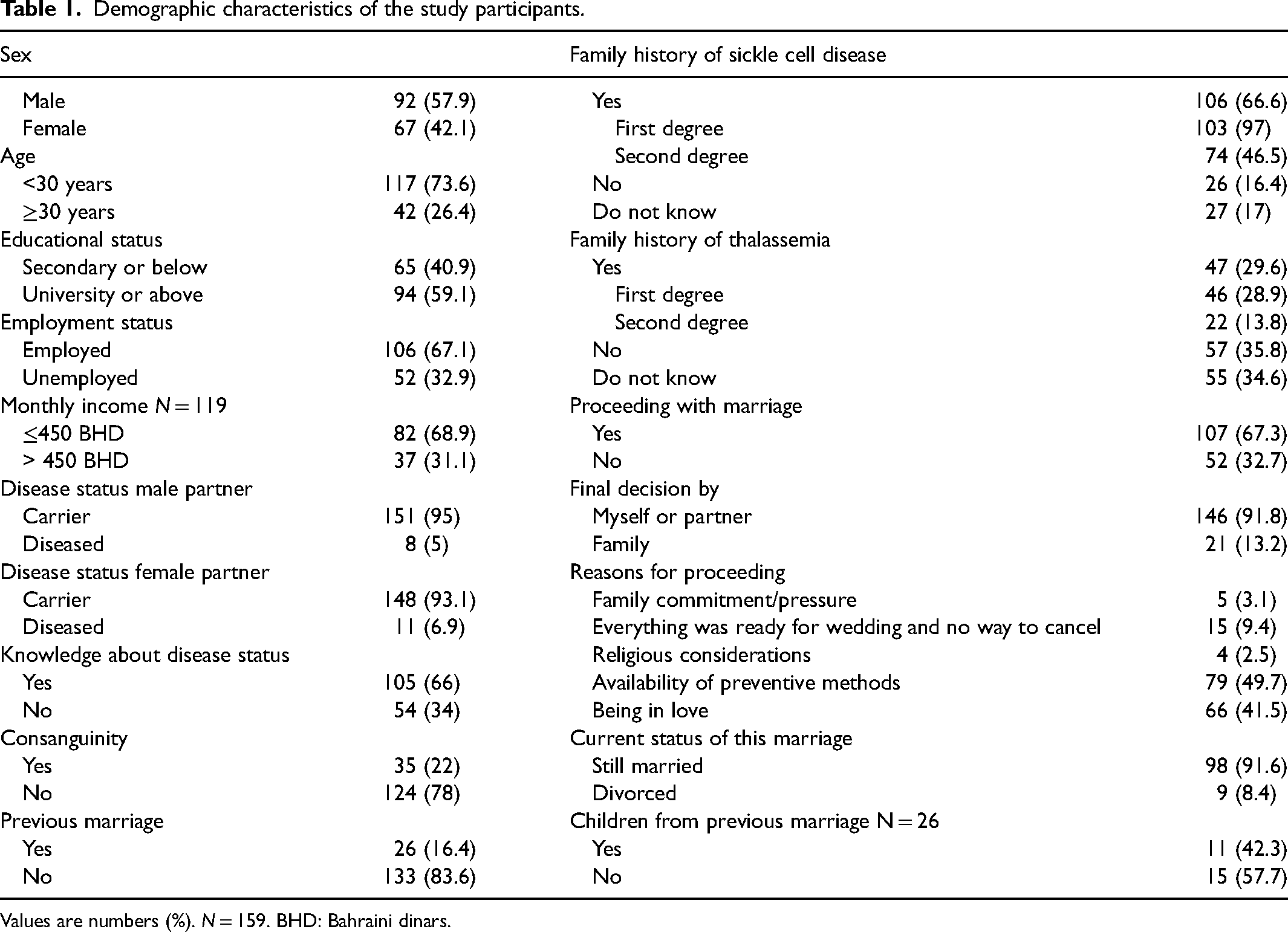
Values are numbers (%). N = 159. BHD: Bahraini dinars.
Table 2 shows the results of a Chi-square test for independence (with Yates continuity correction) for the relationship between demographic characteristics and decision to marry, indicating that sex, age, educational level, and employment status had no significant association with proceeding with marriage at risk. However, the level of monthly income had a significant impact on the decision to proceed with marriage, with 74.4% (95% CI = 63.6–83.4%) of candidates with monthly income of ≤450,000 BHD (≤1200 USD) proceeding with marriage, compared to 45.9% (95% CI = 29.5–63.1%) of candidates with income of >450,000 BHD (>1200 USD), p = 0.01. Although non-significant, partners who were previously married were more likely to proceed with at-risk marriage, at 77% (95% CI = 56.4–91.0%), p = 0.3. Significantly, all individuals who had children from a previous marriage proceeded with at-risk marriage, p = 0.02. Respondents with a family history of thalassemia, 53.2% (95% CI = 38.1–67.9%), p = 0.05, were less likely to proceed with at-risk marriage.
Relationship between demographic characteristics and decision to proceed with marriage.
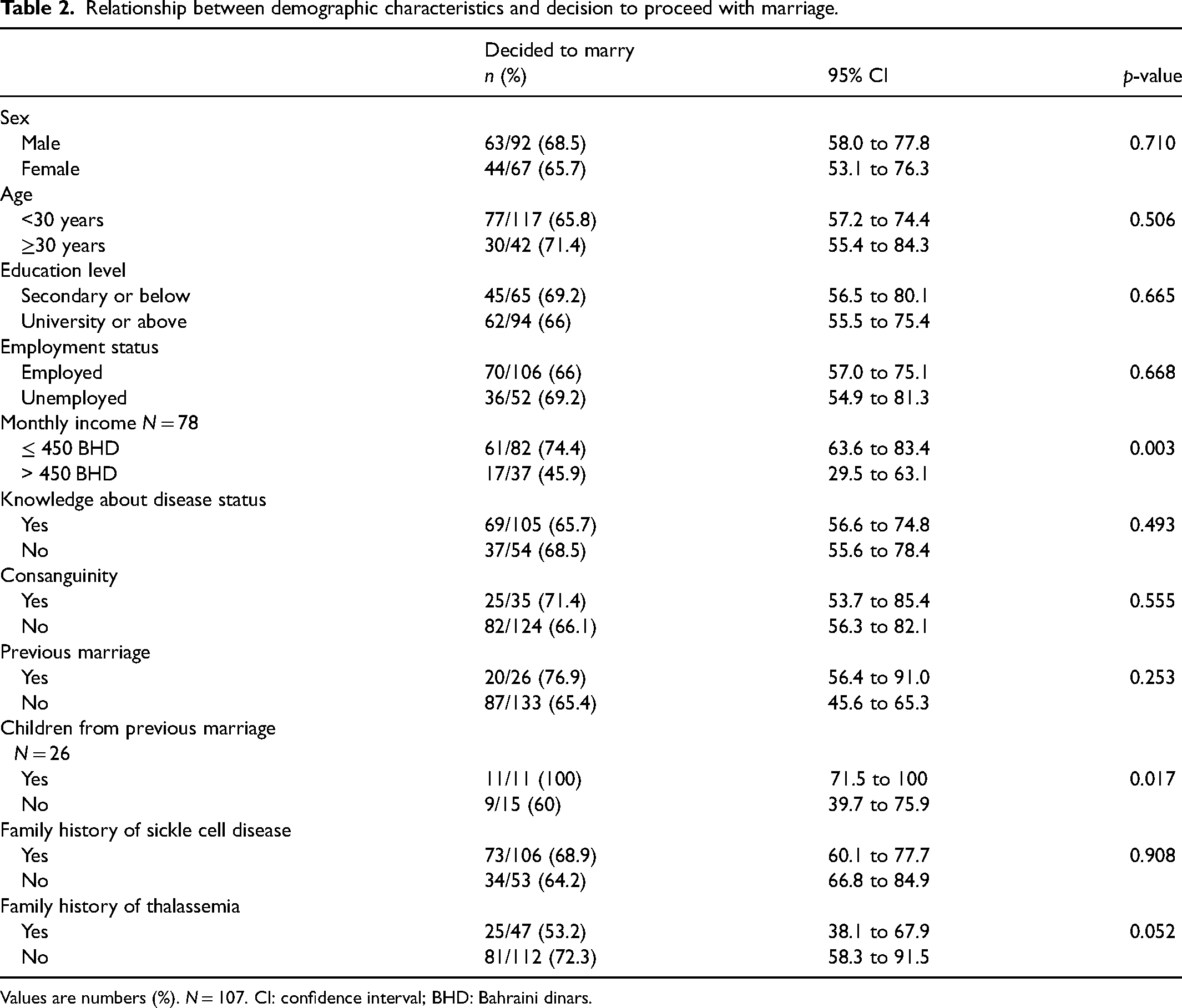
Values are numbers (%). N = 107. CI: confidence interval; BHD: Bahraini dinars.
Of the 107 couples who proceeded with marriage, 100 completed the survey with regard to decision to have children. The majority of these, 80% (95% CI = 71–87%), initially decided to try for conception. The question about whether pregnancy was in fact achieved was answered by 94 couples, of whom 26 (27.7%, 95% CI = 19–38%) did conceive (see Supplementary Table 1). Of the 24 at-risk pregnancies with known outcome, 20 (83.3%) were spontaneous and 4 (16.7%) were the result of IVF with PGD (Figure 1). Furthermore, 60% of the pregnancies at risk were assessed by prenatal diagnostic testing, which identified 4 out of 12 fetuses (33.3%) to be diseased. However, 80% proceeded with the pregnancy and 75% would have refused elective abortion if it had been available. Of the 20 spontaneous conceptions, 8 (40%) of the infants were affected, while the total of infants born to couples who had an IVF with PGD conception was not affected by hemoglobinopathies. In addition, most of the at-risk couples (60%) were thinking of using IVF with PGD, but in fact only 4 couples underwent IVF. Among spontaneous conceptions, only 5 (25%) would have opted for elected termination.
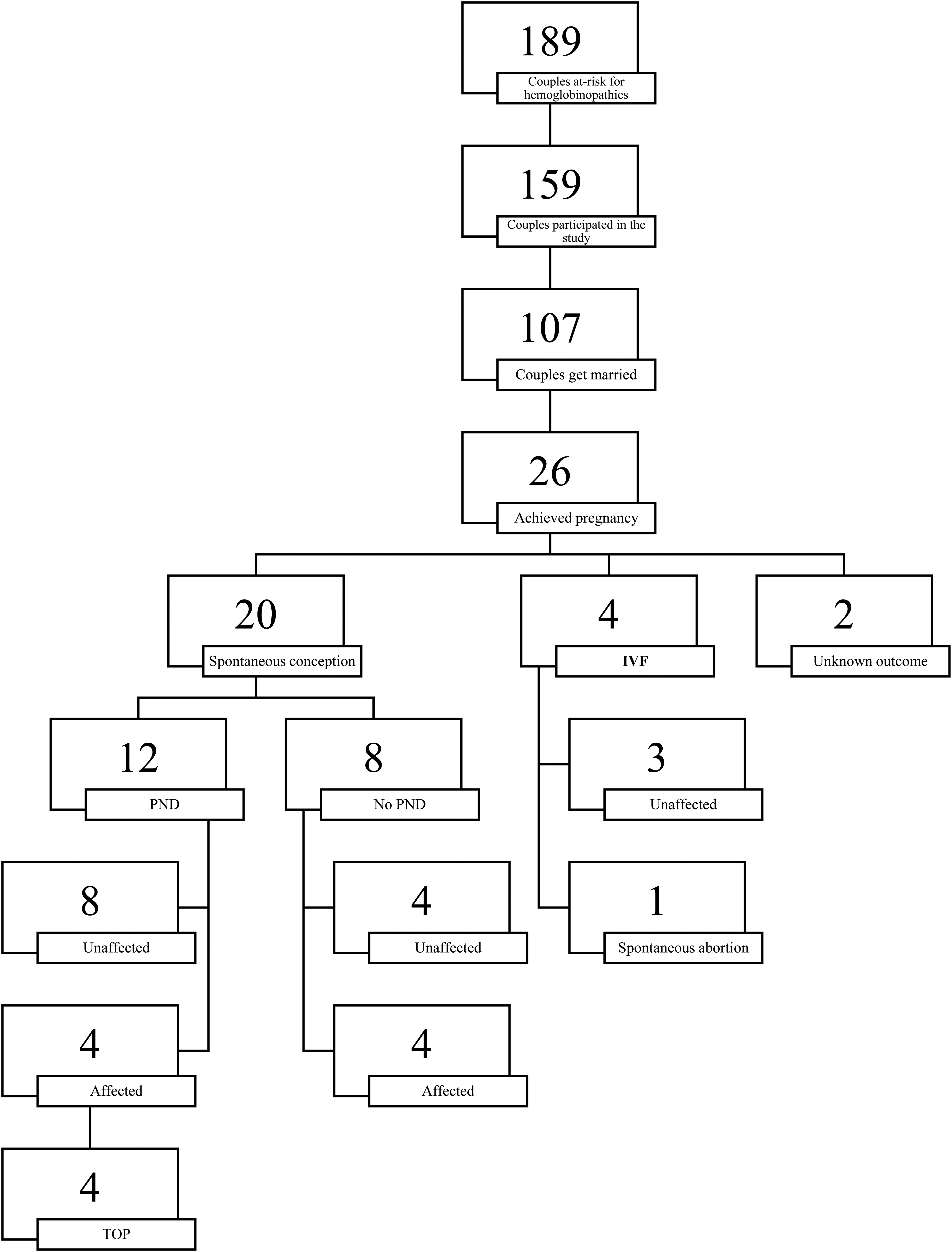
Conception outcome of couples at risk of hemoglobinopathies. TOP: termination of pregnancy.
Furthermore, Chi-square analysis for relationship between demographic characteristics and decision to have children showed that age, sex, education, income, knowledge of disease, previous marriage, and history of SCD or thalassemia were not significant in the decision (see Supplementary Table 2). Employment status did have a significant effect on the decision to have a child: 92% (95% CI = 83.0–97.5%) of employed subjects decided to have children versus 56% of unemployed subjects, p = 0.001. In addition, a significant association was found between consanguinity and decision to have a child, as 60% (95% CI = 38.7–78.9%) of consanguineous couples were willing to have children from this at-risk marriage, p = 0.01.
Discussion
This study targeted couples at risk for hemoglobinopathies in the Kingdom of Bahrain who received detailed premarital genetic counseling by a professional geneticist at SMC to assess their future marital outcomes. Worryingly, 67.3% of couples at risk decided to proceed with their marriage after receiving this counseling. This is in comparison to previous studies done in Bahrain, where Al Mutawa et al. (2009) and Bubshait et al. (2021) reported that 56.7% and 51.1% of at-risk couples planned to marry, respectively.12,13 However, a study done in Saudi Arabia by Alswaidi et al. (2012) reported that 88.2% of at-risk marriages proceeded after compulsory premarital testing and counseling. 11 Similarly, in a study done in Iraq that assessed the premarital screening for hemoglobinopathies program in Kurdistan, Al-Allawi et al. (2015) showed that 90.4% of couples proceeded with their at-risk marriage. 14 The authors concluded that premarital screening and genetic counseling had limited success due to the influence of several factors such as the timing of the screening and lack of education in the population about its importance.
The individuals included in the current study appeared to be representative of the general population. 5 The analysis of demographic data showed that a higher level of education or a low income did not deter at-risk couples from proceeding with marriage, in spite of knowing and understanding the risk of having an affected child, and the possible consequences. Perhaps educated couples were aware about the availability and effectiveness of methods to prevent having an affected child. However, our study showed that income was significantly inversely related to the marital decision whereas the opposite was reported by Alswaidi et al. (2012): couples in their study with low incomes avoided such marriages because of financial burden. 11 Our result could be explained by the socio-economic status of the individuals, for whom the marital decision was affected by finding a partner willing to live at the same standard and accepting the level of income rather than by disease status.
In this study, two-thirds of the participating couples knew about their disease status, of whom 65.7% continued with the marriage. This is in contrast to Alswaidi et al., who reported that 74% of the couples who had knowledge about their disease status chose not to marry. 11 Being in love was one of the reasons given by 41.0% of couples to justify their intention to marry, and who underwent the premarital screening only to receive a certificate for the court. On the other hand, 78% of couples were non-consanguineous, which is similar to the result reported by Al Arrayed et al. (1997). Their study covered the first years of the voluntary premarital screening program and found that 74.1% of partners were non-consanguineous. 15 This highlights the fact that consanguinity is not affecting the marital decision in the Kingdom of Bahrain.
Of the 107 couples who agreed to proceed with the marriage, the majority wanted to try for conception due to the availability of methods to prevent having an affected child, and 26 eventually achieved pregnancy. Additionally, our results show that 60% went through prenatal diagnostic tests and only 16.7% underwent IVF with PGD, similar to the report from Turkey by Tosun et al. (2006) that 59.7% of at-risk couples underwent prenatal diagnostic tests. 16 However, 41% of at-risk couples didn’t seek prenatal diagnosis due to financial problems or not being covered by health insurance, the same reason mentioned in the study by Ali-Allawi et al. where only 15% of married couples at risk chose to go for prenatal diagnosis. 14
Out of 20 at-risk pregnancies, 40% resulted in the birth of affected babies regardless of prenatal diagnostic test results. Furthermore, 75% of at-risk couples rejected the idea of elective abortion even if it was legal, and this decision could be coming from a religious point of view. However, in Tosun et al., of 80 pregnancies with prenatal diagnosis 17.5% were ended by elective abortion and only one affected baby was born. 16 Additionally, in Ali-Allawi et al., 8 out of 30 affected fetuses were identified through prenatal diagnostic tests and were terminated due to parental preference. 14
Although 59.6% of our study population were thinking of undergoing IVF with PGD, only 16.7% of couples at risk actually did so. These results might contribute to making these procedures more affordable for the general population as they are very costly. Of note, a study done in Kuwait by Rouh Al Deen et al. (2021) to assess the outcome of a premarital screening program resulted in the launch of a PGD program funded by the Ministry of Health in Kuwait. 17
Conclusions
In conclusion, the prevalence of at-risk couples proceeding with their marriage will not reduce significantly in the coming years even with the premarital screening and genetic counselling program, as the vast majority of such couples were educated about and aware of the disease's nature. A carefully designed program to support couples at risk of having affected children should be put in place to divert costs spent on complications of the disease itself to instead be invested in preventing it. This could augment autonomy of selection when partners are at risk of having a child affected by a hemoglobinopathy. Additionally, campaigns should be rolled out to increase public awareness regarding the successfulness of PGD in lowering the risk of having affected children.
Supplemental Material
sj-docx-1-msc-10.1177_09691413231169820 - Supplemental material for Outcome of premarital genetic counseling for couples at risk of hemoglobinopathies in Kingdom of Bahrain
Supplemental material, sj-docx-1-msc-10.1177_09691413231169820 for Outcome of premarital genetic counseling for couples at risk of hemoglobinopathies in Kingdom of Bahrain by Samya Bahram, Aalaa Haji, Hawra Abdulwahab, Hanan Mohsen, Tahera Alnashaba, Zainab Al-Aradi and Mohamed Mandeel in Journal of Medical Screening
Footnotes
Declaration of conflicting interests
The author(s) declared no potential conflicts of interest with respect to the research, authorship, and/or publication of this article.
Funding
The author(s) received no financial support for the research, authorship, and/or publication of this article

Supplemental material
Supplemental material for this article is available online.
References
Supplementary Material
Please find the following supplemental material available below.
For Open Access articles published under a Creative Commons License, all supplemental material carries the same license as the article it is associated with.
For non-Open Access articles published, all supplemental material carries a non-exclusive license, and permission requests for re-use of supplemental material or any part of supplemental material shall be sent directly to the copyright owner as specified in the copyright notice associated with the article.
