




Abstract
Objective
To establish the birth prevalence of sickle cell disease in Grenada, with a view to assess the requirement for a population-based neonatal screening programme.
Methods
A two-year pilot neonatal screening programme, involving the Ministry of Health of Grenada, the Sickle Cell Association of Grenada, and the diagnostic laboratory of hemoglobinopathies of the University Hospital of Guadeloupe, was implemented in 2014–2015 under the auspices of the Caribbean Network of Researchers on Sickle Cell Disease and Thalassemia.
Results
Analysis of 1914 samples processed identified the following abnormal phenotypes: 10 FS, 2 FSC, 183 FAS, 63 FAC. These data indicate βs and βc allele frequencies of 0.054 and 0.018, respectively.
Conclusion
Neonatal screening conducted in the framework of this Caribbean cooperation can allow rapid detection and earlier management of affected children.
Sickle cell disease (SCD) is a significant problem in the Caribbean, where many individuals have African and Asian ancestors. The first case of SCD, reported by James Herrick, 1 was a patient from Grenada. Data on the epidemiology and prevalence of SCD are unavailable in many Caribbean countries, including Grenada. To overcome this, closer collaboration between Caribbean territories initiated in 2006 led to the formation of the Caribbean Network of Researchers on Sickle Cell Disease and Thalassemia (CAREST). SCD newborn screening forms part of the priority programmes developed by CAREST. 2 There is definitive evidence from Caribbean countries with experience in SCD management, such as Jamaica and Guadeloupe, that newborn screening and relatively inexpensive interventions in early life decrease mortality and morbidity in infants with SCD.3,4
SCD patients in Grenada, currently diagnosed when presenting with crisis, are managed through collaboration with the Pediatric Department of the General Hospital Grenada, the Sickle Cell Association of Grenada (SCAG) and Community Health Services. All identified cases of SCD are reported to SCAG, and referred to the monthly sickle cell clinic at the St. George's Health Center in the capital, St. George's. The Clinic, run by a member of the pediatric team, a representative from SCAG, and a community health nurse, is supported by the Hospital Laboratory Services and the Government of Grenada Pharmacy Services.
To establish the local SCD birth prevalence and to foster newborn screening in Grenada, CAREST offered subsidized newborn screening for a two-year period. A partnership coordinated by CAREST was established with the SCAG, the Ministry of Health of Grenada, and the diagnostic laboratory of haemoglobinopathies of the University Hospital of Guadeloupe. In Guadeloupe, there is solid experience in newborn screening with a universal screening programme for SCD and other abnormal haemoglobins in place since 1984. 5 The laboratory has also provided neonatal screening services for another Caribbean country, Tobago. 2
The pilot study was undertaken at the principal delivery site of Grenada, the General Hospital, from 1 March 2014 to 15 November 2015. Mothers gave verbal consent for the blood tests, which were collected on Guthrie test cards and sent to the Guadeloupe Laboratory. During this period, 1923 blood specimens, representing 79% of the births, were collected and sent for analysis. A brief decrease in vigilance in the collection of the blood specimens at the mid-point of the programme was corrected, but had an impact on the birth coverage rate. Initial haemoglobin screening was carried out using high performance liquid chromatography (Variant™nbs Newborn Hemoglobin system-Bio Rad), with isoelectric focusing (PerkinElmer) as a confirmatory test.
SCD birth prevalence in Grenada: comparison with other Caribbean countries.
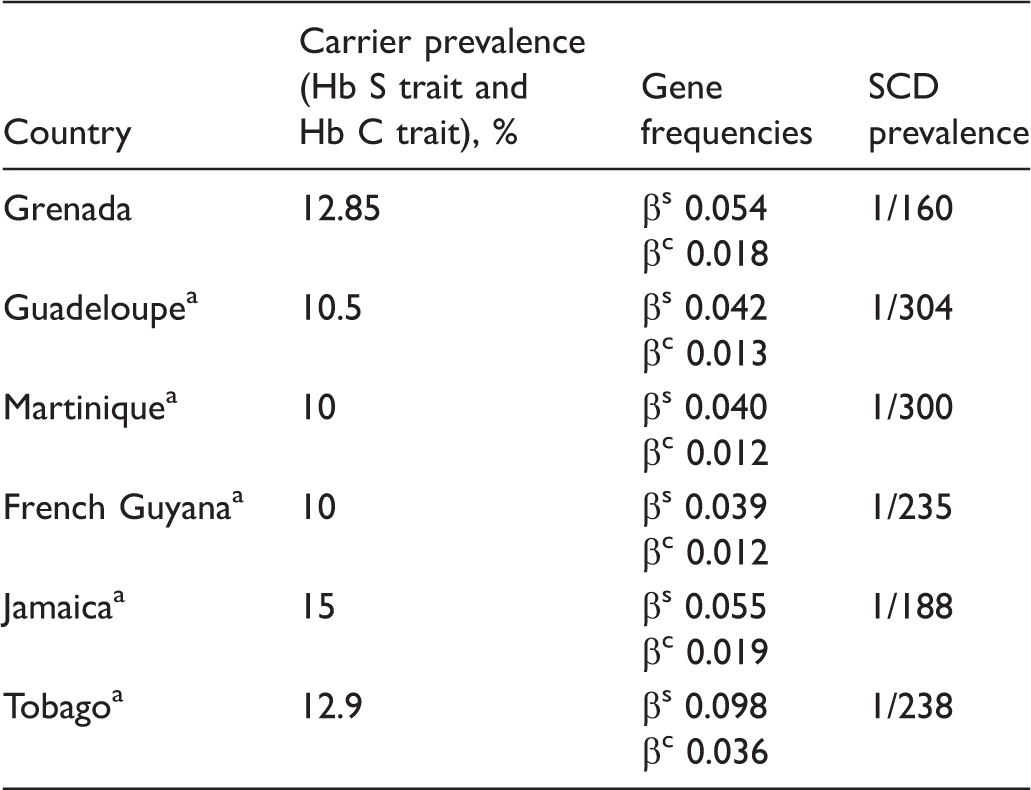
SCD: sickle cell disease.
From Jennifer Knight-Madden et al. 2
The families of the babies diagnosed with SCD are educated on the disease and its clinical management. The babies are started on folic acid and pen VK prophylaxis and receive immunization under the Grenada Expanded Program on Immunization, with an additional pneumococcal 23 at age two. Follow-up is carried out at the Sickle Cell Clinic on a three monthly basis, and also as the need arises depending on the clinical picture. The 12 children diagnosed with SCD through the pilot screening programme were all called into clinical care according to this protocol.
This pilot study demonstrated the feasibility of neonatal screening for SCD and subsequent follow-up of the diagnosed babies. On the basis of the information regarding the birth prevalence of SCD in Grenada provided by this study, the Health Ministry of Grenada is committed to engage this strategy, focusing on early diagnosis and access to care, in order to successfully reduce the burden of SCD in Grenada. SCD is currently perceived as a significant problem in the Grenadian healthcare system, and the Government is firmly resolved to continue the screening programme and to ensure its funding. A formal agreement between the parties is under development to define the screening and medical follow up conditions.
Footnotes
Acknowledgement
This report is dedicated in memory of Jean Griffith, Past President of the Sickle Cell Association of Grenada, who initiated the project. The authors thank the team of the diagnostic laboratory of haemoglobinopathies of the University Hospital of Guadeloupe for its involvement in each step of this project and for ensuring the quality of the result, Christian Saint-Martin for helpful discussions, and Catherine Chicate-Moibert for assistance with the coordination of CAREST.
Declaration of conflicting interests
The author(s) declared no potential conflicts of interest with respect to the research, authorship, and/or publication of this article.
Funding
The author(s) disclosed receipt of the following financial support for the research, authorship, and/or publication of this article: This study was funded by the regional councils of Guadeloupe (grant CR/12-1682) and Martinique (grant CR/13-1146-1), the general council of Guadeloupe (grant CG/13-2405), le Fond de Cooperation Régionale Guadeloupe (grant FCR 2014-22), the Guadeloupe Association for Screening and Prevention of Genetic and Metabolic Disorders (AGDPM).