




Abstract
Introduction
Henry Bracken M.D. (1697–1764) was born in the Horse and Farrier inn, Lancaster, England. He completed his apprenticeship in Wigan and studied at St Thomas’ Hospital (London), the Hôtel Dieu (Paris) and Leiden (Holland). Bracken published books on farriery, urological stones and midwifery.
Aims
To examine Bracken's 1737 controlled trial of two treatments for rabies in hounds
Method
Historical literature review
Results
Bracken's ‘strict enquiry’ compared treatments in two groups of ‘an equal number' of hounds ‘equally affected as far as could be judged’ [i.e. at risk of developing rabies]. One received a herbal ‘decoction' and the other a ‘secret’ powder sold by Mr Hill of Ormskirk. Bracken offers quantitative outcomes: ‘Five out of Nine of Mr. Hill's died, and those under the [herbal treatment] all recover'd’.
Conclusion
We speculate that Mr Hill's powder contained mercury, causing salivation which was mistaken for clinical signs of rabies. Finally, we also examine Bracken's notion of vocation that ‘a Man is born a Physician as well as a Poet’. We conclude that it is harder in modern societies for young people to recognise an early inkling towards a career in medicine. Unlike Bracken's ‘inborn' calling, vocation today is more likely to be perceived in terms of a ‘transaction', e.g. a ‘career move' or ‘lifestyle choice'.
Keywords
Introduction
Henry Bracken, M.D. (1697–1764) was a surgeon from Lancashire, England, who published books on farriery,
1
equine medicine,
1
midwifery
2
and urological stones in humans.
3
His biography is outlined in the 1891 book (the title of which draws upon Shakespeare's play Richard the Second) ‘Time honoured Lancaster’. Therein the author bequeaths the following: ‘Henry Bracken, M.D. was born, according to the parish register, in 1697 … This remarkable man was born at the Horse and Farrier [inn] in Church Street. He died in Lancaster, on the 13th November, 1764, and was buried in St. Mary's church …’.
4
‘After a grammar-school education at Lancaster he was apprenticed to Dr Thomas Worthington, a Wigan physician. At the end of his apprenticeship about 1717, Bracken went to London and spent a few months as a pupil of St Thomas's Hospital but was disappointed with the lack of cadavers. He next went to Paris to the Hôtel Dieu where he found plenty of opportunity for dissection and was able to attend midwifery cases through the intercession of the English ambassador, the Earl of Stair. On 29 August 1730 he matriculated at the University of Leiden’.
5
‘when I was a Student Abroad, I thought it an easy Matter to pass the Catheter into a Man's Bladder, for this Operation was the first we were trying to perform every Morning upon dead Bodies, of which there was sometimes fifteen, sometimes twenty, and seldom less than ten, sent up into the Amphitheatre for Dissection at the Hotel de Dieu at Paris, during the cold Months; but being at the Amphitheatre of St Cosme in that City, where I usually attended their Anatomical Lectures and Courses of [sic] Operations in Surgery, and standing by the Elbow of that justly celebrated surgeon Mons. [i.e., Mr] Petit, when he was performing the Operation of Lythotomy upon a dead Subject, I observed he was sadly puzzl'd in introducing the Sounde or channel'd Catheter, insomuch, that through the Solemnity of the Audience, his Hand begun [sic] to tremble, and he was going to desist, for he thought to have performed the Thing with an Air of Dexterity, as I observed, but missing his first Flourish [i.e., attempt], he was sorely abash'd; however, as I was known to be one of Mons. Petit's Pupils, I took hold of the Catheter, and happened to hit upon the right Road without Difficulty’.
3
, p44–5 ‘the River Seyne [sic] which runs thro’ Paris, I have often observed to fur up the Pipes or Conduits to such a Degree that they have become useless [i.e., blocked], and new ones been obliged to be put down in their room; and from hence, no Doubt, the Inhabitants who drink those Waters are more liable to the Stone and Gravel as well as other anomalous Concretions, such as the Gout’.
3
, p14 ‘If I may be allowed to speak it without Arrogancy, I have been conversant with as able Men as any the Faculty has produced, more particularly the late Learned, ingenious, as well as ingenious Professor Boerhaave, with whom I have often reasoned upon this subject [bladder stones]; and have been Witness to repeated Experiments in order to discover a proper Dissolvent for the Stone in the Bladder, yet all his Tryals were vain [sic] and ineffectual, for whatever would dissove the Stone out of the Body was not safe to be used inwardly; yet I must own he did, with his usual Candour and good Will towards his Fellow Creatures, strongly recommend our pursuit after such a Dissolvent … The late Learned and indefatigable Industrious Professor Boerhaave, hath in my Opinion wrote accurately upon the Stone and Gravel, in his Book entitled Aphorismi de Cognoscendis et curandis Morbis …’
3
, p31 ‘nor do I remember any Person to have come nearer Truth than the Noble Van Helmont, in his Treatise call'd Lithiasis’.
3
, p26 ‘During the Jacobite rising of 1745 Bracken sent information on Stuart sympathizers to General Wade …, but in January 1746 was himself imprisoned in Lancaster Castle, probably by tories angered by his apparent support for the Stuarts following the Jacobites’ arrival in the town. His imprisonment was short-lived. He was discharged without trial, and it appears there were no grounds for his arrest’.
5
‘The doctor must have been somewhat eccentric, for it is said that he would frequently get up in the summer, about two or three o'clock in the morning, and in his night-gown and slippers, and with a telescope in his hand, go into the churchyard to look at his horses exercising on the Marsh, and then he would return to bed again’.
4
‘Bracken, who had already lost three infant daughters, now lost his only son to fever—contracted when he had visited his father in prison’.
5
‘Henricus Brackin, M.D., obiit 13 die Novembris anno domini 1764, Aetatis suae 64 [sic]’.
4
Bracken on hydrophobia in hounds
Throughout the Eighteenth century, rabies was a constant dread in England (see Figures 1 to 2). Bracken includes a chapter within his book on farriery entitled: “Of Venomous Bites, as of the Mad Dog, &c. in Horses”. He may have become interested in dogs with rabies because it was more common in hounds than in horses. He probably also recognised that dogs were an important conduit for horses to become infected. That he was very familiar with the natural history of the disease is evident from his vivid description of rabid dogs: ‘The first Symptom of Madness in most Animals, is an unusual Trepidation or Trembling. The Diagnostic Signs of a Dog truly mad, are Hunger and Thirst, yet he will not eat or drink, except when the Distemper is in its first Stage. His Eyes are fierce and flaming; he hangs down his Ears, thrusts out his Tongue, froths much at the Mouth, barks at his Shadow, runs along sad and anxious, often breathes as if tired with running, carries his Tail bent inwards without any Difference; he runs against all he meets with Force, and bites running in a hasty and uncertain Course’.
1
‘No pack when hunting can be said to be entirely safe, as frequently parts of it are out of sight in woods and coverts; some of the hounds are occasionally lost and absent for two or three days, and who can tell what may happen to them? Besides, how much mischief may happen at night from travelling mad dogs which … will go to the distance of 50 miles from home’.
6
Whether the Creature that is bitten be Man or Beast, it is absolutely necessary to immerse them in Salt-Water; but if that cannot conveniently be come at, any cold Spring may do, ‘till you can arrive at the Sea-Water. The deeper the Creature is plunged over Head the more effectual will it prove; for it is not altogether the Coldness, but the Weight of the Fluid which presses upon the Body in Immersion, that does the Business. And it is therefore, that Salt Water in many Cases is more beneficial than cold bathing, by reason it is much heavier’.
1
‘tho’ I can't say it was ever pretended to cure any one when the Symptoms of Madness had really seized them’.
1
‘whomsoever such innocent Cur [i.e., dog] happens to bite in his own Defence [i.e., not as a result of rabies] must be deem'd forsooth bit by a Mag-dog [sic, presumably Mad-dog]’.
1
‘travels Scores of Miles with his wise Head to apply for Relief to some ignorant Fellow as silly as himself, only ‘tis rumour'd he has got a Nostrum or never failing Secret for the Cure of these venomous Bites. And upon taking such Pill, Powder, Bolus, or Draught, the deluded Traveller returns with Mens Sana in Corpore Sano, altho’ ‘tis ten, nay I may say, a hundred to one, that such Dog was not really mad, or that if he were so, the Saliva or Slaver did not get into the Blood of the Person, who fancied himself bit, and if it did not, I am sure no evil Accident would follow upon such Bite. Yet such People say that if it do no Good, it can do no Harm true, but then why should a Pack of ignorant Fellows have the Credit of curing these venomous Bites with their Nostrums and Nonsense …’
1
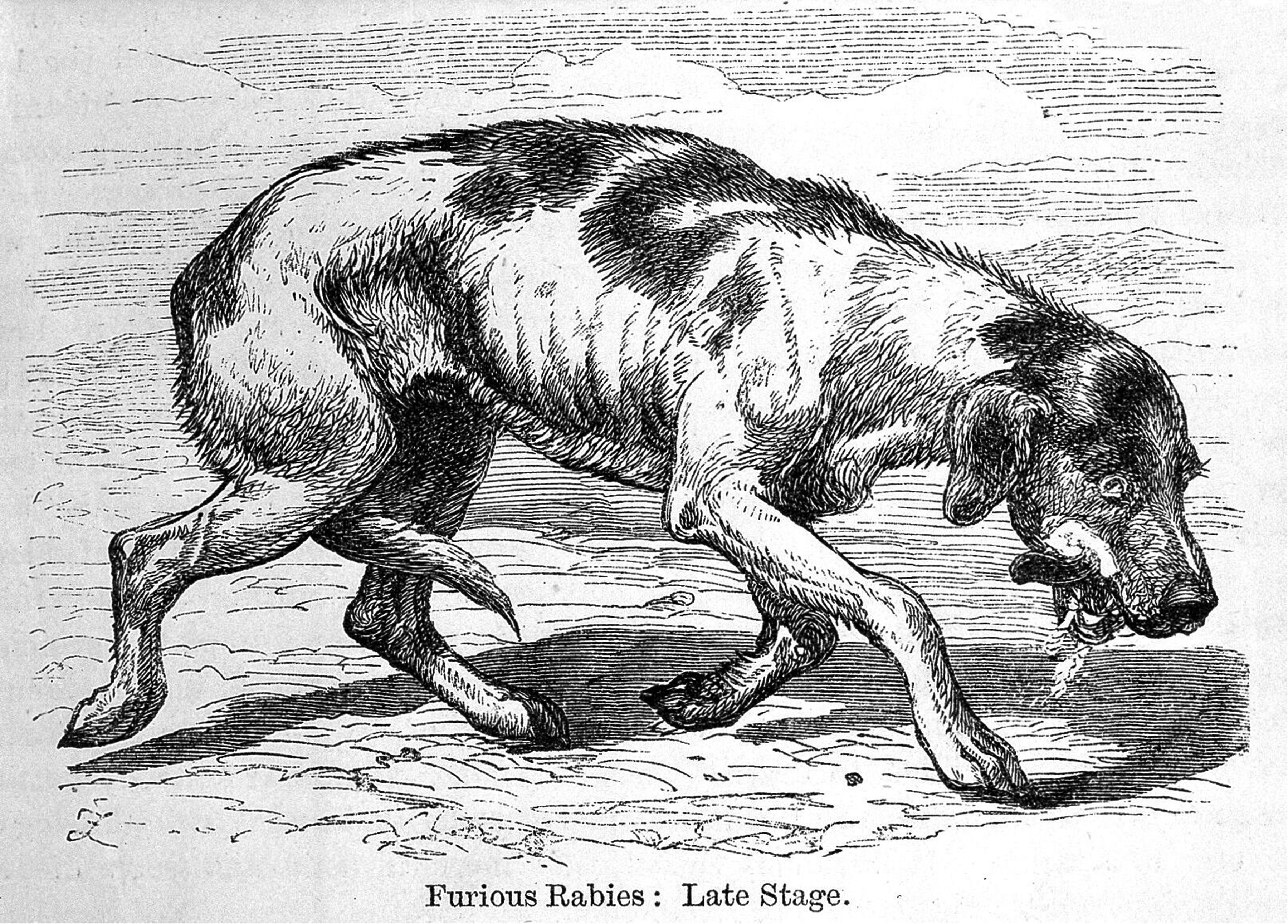
Furious rabies (1872). Rabies and hydrophobia: their history, nature, causes, symptoms, and prevention / by George Fleming (1833–1901). Image courtesy of the Wellcome Collection.
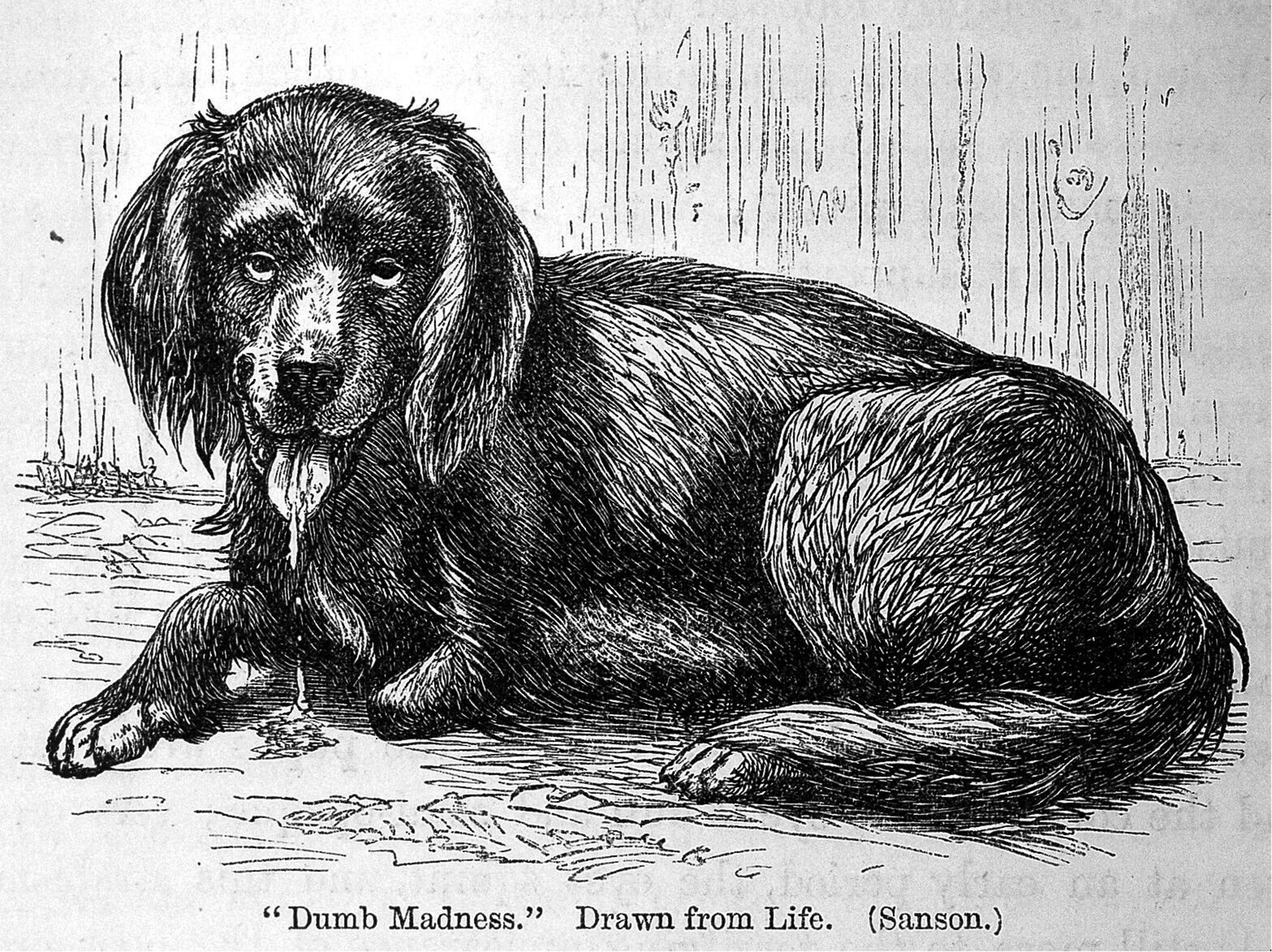
Dumb rabies (1872). Rabies and hydrophobia: their history, nature, causes, symptoms, and prevention / by George Fleming (1833–1901). Image courtesy of the Wellcome Collection.
Bracken's ‘strict enquiry’: ‘Decoctum ad Morsum Canis Rabidi’ versus Mr Hill's ‘powder’
One aspect of Bracken's legacy that appears to have been overlooked is an interest in comparing medical treatments. Bracken's most celebrated work was his ‘Farriery Improved’ that was first published in 1737 and ran through twelve editions. 4 Therein Bracken describes a controlled comparison of two treatments for rabies (hydrophobia) in dogs.
The first treatment is a herbal ‘decoction’ originally published in Bate's Dispensatory under the title ‘Decoctum ad Morsum Canis Rabidi’ (treatment for the bite of a rabid dog).
1
It is of relevance to the quotations presented below that Bracken refers to this description as ‘an Account’ of the decoction: ‘A great deal of Stir has been made in the News several Times, with an Account of a pretended secret for the Cure of the Bite of a mad Dog. And I knew some Gentlemen who esteem'd the Thing (before it came in the News) as a grand Orvietan [a panacea for poisoning] or Counter-Poison; whereas the Composition is in Bates's Dispensatory, under the Title of Decoctum ad Morsum Canis Rabidi. However, to save the Reader the Trouble of looking into that Book, I shall here write the Thing down that those who judge fit may try its Efficacy; and I must own the same is well enough calculated for the intended Purposes’
1
‘A Decoction for the Bite of a mad Dog Take Tops of Rue, six Ounces; Filings of Tin, London Treacle, and Garlick, of each four Ounces; clear Ale, four Pounds or two Quarts: Boil to the Consumption of one Half, and digest or let it stand warm a While, then strain it. Dose to a Man, six Spoonfuls twice a Day for nine Days together, and apply the Magma (or Herbs after they are squeezed out of the Liquor) to the Wound’.
1
‘There is one Mr. Hill of Ormeskirk [sic] in Lancashire, who pretends to a rare secret for the Cure of venomous Bites, particularly those of a mad Dog, mad Cat, &c. and I am told, his Medicine is in Form of a Powder [see wrapper in Figure 3 that is probably from the nineteenth century] …’
1
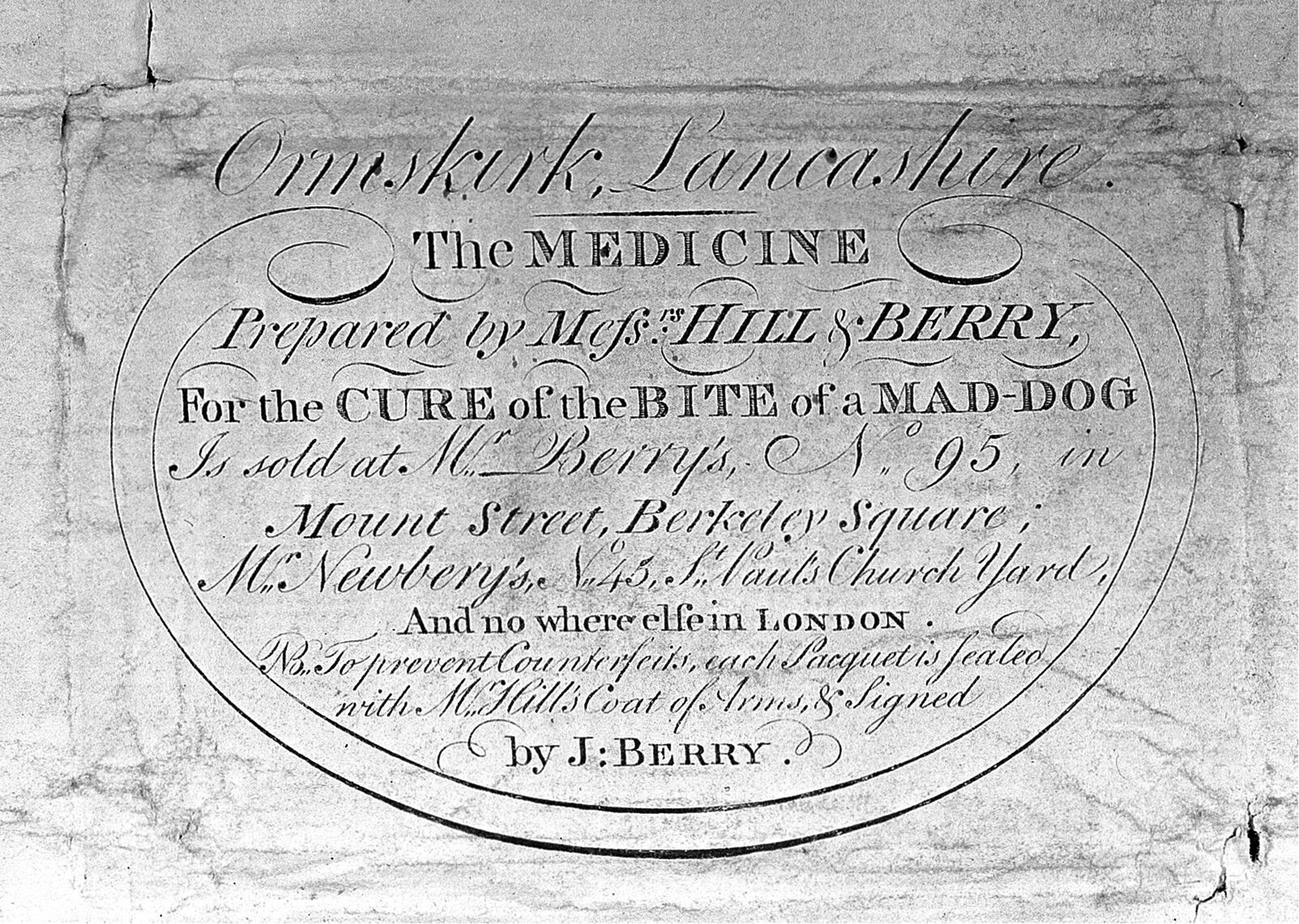
Hill and Berry's medicine for cure of rabies. This appears to be a later version of Mr Hill's medication. Image courtesy of the Wellcome Collection.
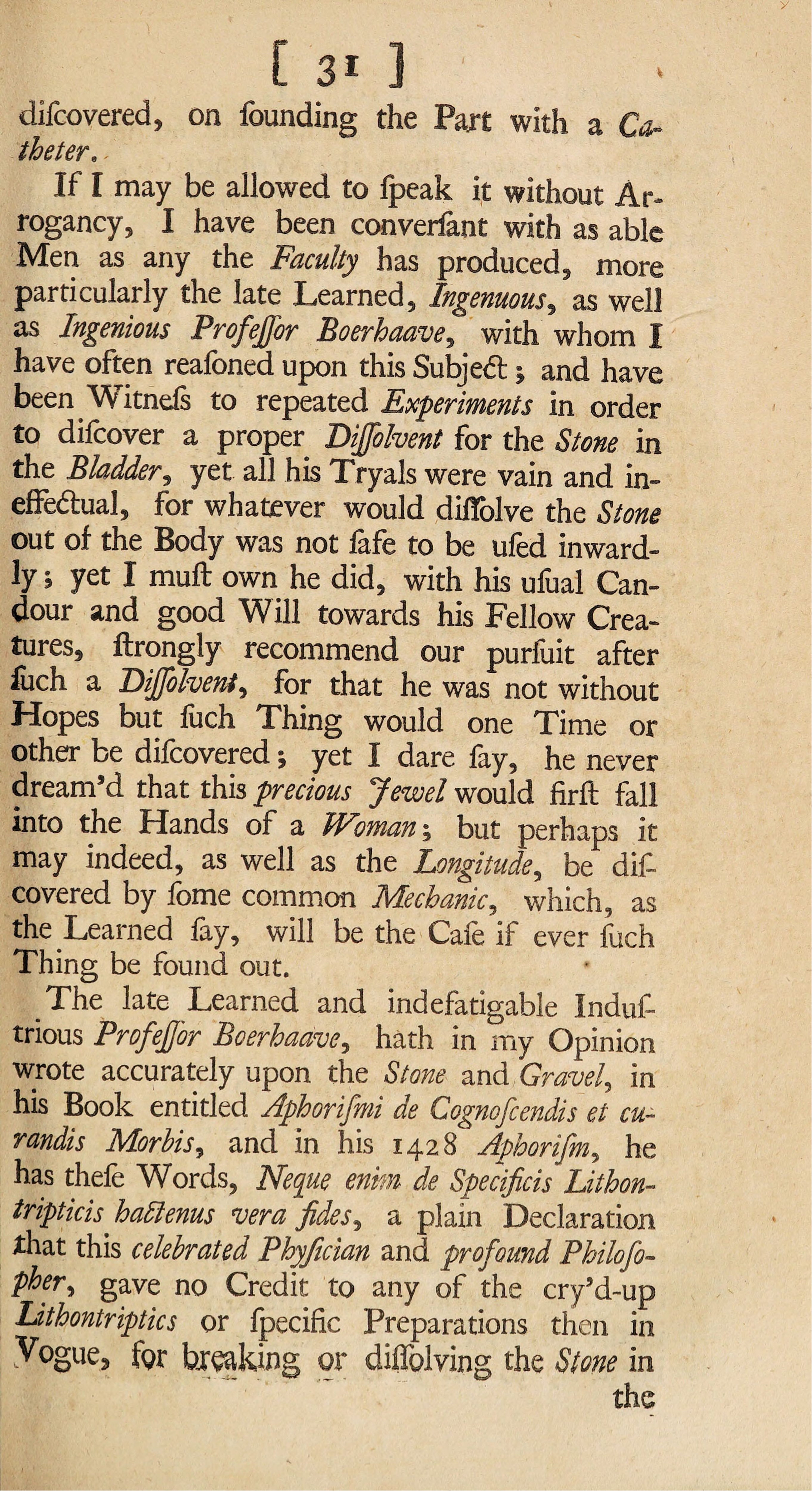
In his 1739 book ‘Lithiasis anglicana’, Bracken cites Boehaave as an inspiration for experimental enquiries into the gravel and stone. Overleaf, he also mentions Van Helmont. The image is reproduced here courtesy of the Wellcome Trust and is entitled: Lithiasis anglicana, or, A philosophical enquiry into the nature and origin of the stone and gravel, in human bodies, & c.: Wherein is considered, the possibility of dissolving such animal tartar or calculous concretion. In a letter to David Hartley, author of the cases in behalf of Mrs. Stephen's medicines. To which is added, an account of a new and safe method of cure for the ischury, or total suppression of urine.
It is then made clear that Bracken's personal ‘curiosity' was behind the idea for a controlled trial. He also outlines how the circumstances for proposing his comparison arose: ‘notwithstanding I had the Curiosity to make a strict Enquiry of its Success. But I was told that the Late Earl of Derby had most of his Hounds bit by a mad Dog : and As Knowsley, the present Seat of that Ancient and Noble Family, is in the Neighbourhood of Ormeskirk, his Lordship thought fit to try Mr Hill's secret’.
1
‘An equal Number of them [hounds] took the Powder, and as many more, equally affected as far as could be judged, took the Decoction of Rue, Garlick, &c. as aforesaid, by the Management and Direction of Mr. Serjeant the then Cook at Knowsley, from whom I had the Account. In fine, Five out of Nine of Mr. Hill's died, and those under the Cook's Care all recover'd’.
1
‘But then it may be objected, that Mr. Hill's secret does not operate upon Men and Dogs in the same Manner; but such Objection would, to any Man of Sense, look very absurd and ridiculous, seeing, as I have often hinted, nothing is more sure than that the Operation of Medicine is mechanical, and that therefore it will act by the same known Powers, let the Subject be human or brute creature ….’
1
Interpreting Bracken's ‘strict enquiry’
Bracken is guarded about the implications of his finding, just possibly because he recognised that it could impact Mr Hill's livelihood from selling his secret powder. This anxiety may also account for the limited information recorded by Bracken about the enquiry. For example, it is unclear exactly to what extent hounds were already presenting with suspected early clinical signs or whether they were being treated preventively. This is important because assessing rabies exposure may be difficult. Even tiny scratches can lead to the disease because dog claws easily become contaminated from drops of highly infectious saliva. Nevertheless, Bracken was aware that death was inevitable after the onset of symptoms and recognises that infection did not always require a bite: ‘I believe by Experience, and our own Observation, that the Saliva or Slaver of the Dog is chiefly vitiated [affected], and that the poison is only in that, for it is that which usually infects Wounds. Yet we have some authentic Accounts that the Mischief (i.e., rabies) may be contaminated without a Wound …’.
1
‘It often happens that the Poison shows itself two or six Months, nay sometimes a whole Year or longer after the Bite; and I have been well inform'd from very credible People, that a Carrier between Bernard [sic] Castle and Kirkly [sic] Lonsdale in Westmoreland, went mad three Years after the Bite without any new Aggravation, and died howling and barking, with all the Symptoms of this so direful Malady upon him. So that really we cannot tell when we are quite safe’.
1
Under these circumstances, it is even possible that Bracken was not treating rabies at all. If so, the greater mortality in the group treated with Mr Hill's secret powder might best be explained by its contents. It is of note that the components of Mr Hill's powder are known, albeit probably from a later date. This unreferenced source offers the following composition: ‘Powder of chalk – half an ounce, possibly for bonding the powder Armenian bole – three drachms, this gave the powder its red colour Potassium Alum – ten grains Powder of elecampane root – one drachm Oil of Anise – six drops’.
7
Other historical trials on rabies treatment
It is of note that Bracken did not include in his ‘strict enquiry’ any hounds that received no treatment at all. Although Bracken clearly read the Philosophical Transactions of the Royal Society, he makes no reference to a broadly similar enquiry conducted just sixty years earlier that included one untreated dog. This 1671 comparison appears to have been instigated by the Duke of York, later King James the Second (1633–1701) and may have been a topic of discussion at the time of Bracken's trial. Circumstantial evidence for this deduction lies in a subsequent brief mention of the comparison in the Transactions in 1738: ‘[Sir Robert Moray] exhibited a certain Plant (which was by Mr Ray called Lichen cinereus terrestris) said by Sir R[obert] M[oray] to be very good to cure Dogs bitten by Mad-Dogs; His Royal Highness having caused it to be given to a whole Kennel of Dogs, bitten by a Mad one, which were all cured, except one of them, to whom none of it was given’.
8
‘And if Dr. Shaw be concern'd in it upon the present Proposals [to test treatments without first confirming the presence of a bladder stone], I should be sorry to hear it, for I look upon him to be an ingenious worthy Man’.
3
, p3 ‘For we take cocks – not those that live with us under the same roof, but rather wild ones, and with a rather dry constitution – and we put poisonous beasts among them, and those who have not drunk theriac die immediately, but those who have drunk it are strong and stay alive after being bitten …’.
11
Bracken and the history of controlled trials
Until recently, little had been published about comparative trials of medical treatment from the first half of the Eighteenth century. It is now known that at least three proposals for controlled trials were published at the beginning of the century: Sir John Floyer's 1702 trial of coldwater on athleticism, 12 Peter Shaw's 1723 proposed antidote trial described above 9 and Thomas Short's 1730 proposed comparison of alcohol on speed of digestion. 13 The middle of the Eighteenth century appears to have been a pivotal moment in the development of the controlled trial. That is evident in the proposed ‘experimentum crucis’ of Hauksbee the Younger in 1743, 14 Thomas Reeve's proposed ‘fair experiment’ of tar-water in 1744 15 and James Lind's landmark comparison of scurvy treatments in 1747 in sailors of the Royal Navy. 16
Certain parallels exist between the trials of Bracken and Lind. By highlighting the importance of (canine) participants ‘equally affected [i.e., at similar risk of developing rabies or, perhaps, with what were perceived to be very early clinical signs] as far as could be judged’, 1 Bracken anticipates Lind's attempt at a fair comparison. 16 Similarly Bracken publishes his outcomes using precise numbers and offers a denominator (nine hounds). Like Lind's trial, Bracken's ‘strict enquiry’ is buried inside his book without any dedicated subtitle. Unlike Lind, Bracken fails to report certain important facts, especially treatment duration. What is more, his study may have been implemented somewhat at arms’ length, i.e., through Mr Serjeant (the cook) and the Earl's huntsmen. Such steps would be unsurprising given the danger of a bite from a rabid dog. Although not a contagious condition it also seems likely that Royal Navy sailors were actively involved in implementing Lind's scurvy trial aboard HMS Salisbury. 16
Bracken's experiment appears to have been overlooked in the history of comparisons of treatments. 17 This is surprising as it comes less than a decade before Hauksbee the Younger, 14 Thomas Reeve 15 and James Lind. 16 It begs the question of whether Bracken could have served as an inspiration for these more detailed descriptions of methods for comparing treatments? Although there is no direct evidence to support such a deduction , Hauksbee may have been aware of Bracken's study through his personal links with Peter Shaw.9 It also remains possible that Lind came across Bracken's writing during his extensive literature review for his Treatise of the Scurvy (1753). Lind, however, makes no mention of Bracken therein but he does consider ‘garlic pills’ as a treatment for scurvy. 16 What is more, as a medical officer in the British military services, Lind must frequently have had reason to encounter veterinary surgeons, farriers and horses.
Discussion
Henry Bracken was an English physician who studied in Wigan, London, Paris and Holland. A neglected figure in the history of medicine, Bracken emerges as a judicious physician, a courageous surgeon, a medical polymath, a passionate horseman, a practical experimentalist, a prolific author, a gifted linguist, a colourful eccentric and an early voice for what today would be called ‘one health’ (integrating human and animal medicine). The biography of Henry Bracken serves as a reminder of the value of studying comparative medicine (i.e., humans alongside animals). Learning from comparative anatomy and pathology flourished into the Eighteenth and Nineteenth centuries through the great medical museums and inspirational teachers like the surgeons John Hunter (1728–1793) and Sir Astley Paston Cooper (1768–1841). This ‘spirit’ has sadly been lost from today's undergraduate medical curricula where it has been reduced to key zoonotic infections in humans. 18
Bracken was clearly an experienced physician who both read and published widely. Bracken spent time incarcerated in Lancaster castle and, as such, joins a historic list of prisoners – most notably, George Fox (1624–1691) and Margaret Fell (1614–1702) who founded the Quakers. The tide of Bracken's professional fortunes turned and he twice was appointed Mayor of Lancaster. Bracken's affection for animals may have its origins in his own childhood and the tragic loss of all his children.
The present article adds to Bracken's biography by highlighting one overlooked aspect of his life, namely his ‘strict enquiry’ in the first half of the Eighteenth century. Bracken bequeaths an account of a basic comparison of two treatments for rabies in hounds. Unlike many contemporary experimentalists, his trial went further than a written proposal and was not the product of profiteering or bitter disputes with opponents. To modern eyes, there are clear methodological imperfections but Bracken considered the evidence convincing. His documentation and promotion of his findings may have been constrained from a fear of undermining Mr Hill's livelihood.
Bracken deserves recognition for this noteworthy and laudable attempt at accumulating evidence of treatment efficacy by comparing two treatments. We speculate that his results might best be explained by causes other than rabies, specifically the contents of Mr Hill's ‘secret’ powder. If this had contained mercury, it may well have caused salivation and death that were then attributed to rabies. Counter to this theory stands Bracken's extensive knowledge and experience of rabies as well as his recognition that it was eminently possible for others to diagnose the disease when ‘the dog was not really mad’. 1
An historical role model: Bracken on the importance of vocation in medicine
This article cannot cover every aspect of Bracken's fascinating biography. What is clear, however, is that he bequeaths an historical role model for modern students of medicine.
19
This assessment arises from his spirit of enquiry, passion for medicine, breadth of interest, compassion for his patients and desire to publish. His books reveal a physician who was confident practising inside patients’ homes, undertaking physical examination, practising surgery and ‘thinking on his feet’. By drawing upon his own enquiries, observations and experience he sought to share whatever he learned. His transparency was not typical of the day: ‘I beg leave … to declare, that I have not (to my Knowledge) kept any thing from my Readers as Secrets or Nostrums, but on the contrary, I have put every Thought down (as it occur'd to me) in open Day-light …’.
2
, p320 ‘the Secret does not consist in the Composition of a Medicine, but the Method of Application. And I am fully persuaded that a Man is born a Physician as well as a Poet’.
2
, p320
Vocation in medicine is just as important today 20 as it was in the Eighteenth century. One further deduction from Bracken's biography is that in modern urban, technological and consumerist societies, it may be harder to recognise an early inner calling for medicine. Future research should explore if this is true. If correct, it may be due to a lack of meaningful opportunities to observe doctors in action or a false impression gleaned from the media. Instead of recognising a deep ‘inborn' calling as exemplified by Bracken, we suggest that modernity encourages youngsters to perceive vocation as a ‘transactional act': a ‘career move', ‘lifestyle choice'20 or ‘opportunity' to develop a new skillset, earn more, find work in new geographical areas or to pursue private practice. A ‘transactional act' may also lie in early positive affirmation from family, friends or teachers for pursuing a career in medicine.
Alongside helping young people to recognise this early inkling for medicine, vocational guidance should nurture key practical skills essential for a career in medicine. These comprise ‘dealing with people, problem-solving, decision-making, communication and teamwork’.
20
With such qualities in mind, Bracken stands out as an historical role model for what we call being the ‘medical detective’.
21
To convey this notion to medical students, we offer the following entreaty of Sir William Osler (1849–1919): ‘Use your five senses. The art of the practice of medicine is to be learned only by experience … Learn to see, learn to hear, learn to feel, learn to smell, and know that by practice alone can you become expert. Medicine is learned by the bedside and not in the class-room’.
22
Conclusion
Bracken's enquiry represents a structured, controlled experiment deserving acknowledgement in the history of clinical trials. It is of particular note as it pre-dates the landmark scurvy trial of James Lind (1747). Unpicking Bracken's trial is not straightforward and risks being judged by modern standards of controlled trials. Behind this lie the enormous challenges of practising physic ‘in the dark’ i.e. before the advent of modern medical evidence, investigations and treatments.
25
The predicaments of doctors practising in the long years of the Eighteenth century are summed up eloquently by one contemporary doctor, David Irish of Surrey, England. He starts by drawing upon Hippocrates’ famous aphorism, recognises the challenges of interpreting ‘experiments’ and lays the blame for ‘errour’ upon the physician, the disease, the patient and carer. ‘Life is short, Art long, Occasion sudden, Experience dangerous, Judgment difficult: Hence we may conclude, there are but few good Physicians… The Physician ought to be faithful and cautious in Practice; for Life hangs as it were but by a slender Thread, and it is at best but short, yet is apt to be made much shorter by many Accidents, and those very small ones too. Art is long, if Theory and Practice are consider'd. Diseases are sudden, and if not suddenly removed, may quickly ruine. Past experiments, if not well understood, may lead the Physician into Errour [sic]; besides, Judgment is very difficult, through the Variety of Diseases and their Causes, which, by the Fault of the Sick and his Attendance, are many times not perceived even by Physicians of greatest Abilities’
26
Footnotes
Contributions
MC identified source, drafted and submitted paper. SC read and commented upon multiple drafts.
Funding
The authors received no financial support for the research, authorship, and/or publication of this article.
Declaration of conflicting interests
The authors declared no potential conflicts of interest with respect to the research, authorship, and/or publication of this article.
