




Abstract
Introduction
Peter Shaw (1694–1763) was an English physician who practised in London and Scarborough, Yorkshire. He was appointed physician to Kings George II and III. Shaw published many medical texts as well as translations of Lord Francis Bacon and Robert Boyle.
Method
Historical examination of Shaw's text A Treatise of Incurable Diseases (1723).
Results
Shaw states that ‘incurable’ conditions offer an opportunity to examine the cause of disease and its treatment. He proposes a model for a comparative trial of ‘antidote’ for hydrophobia (rabies) in one of two dogs and – if successful – in humans.
Conclusion
Shaw's proposal is an early model for translational medical research from animals to humans to ensure effectiveness and safety. The evidence suggests that Shaw's was an inspiration for Hauksbee the Younger's 1743 proposed ‘experimentum crucis’ of venereal disease treatments. That is because in 1731 they co-authored ‘An Essay for Introducing a Portable Laboratory’. Furthermore, Hauksbee reveals that Shaw was actively involved in early enquiries into the efficacy of his venereal medication. Due to shared roots in Lichfield and an interest in spa water treatment, the authors conjecture that Shaw's comparative approach might have roots in Sir John Floyer's 1702 controlled trial of cold-water on athleticism.
Peter Shaw (1694–1763) FRS MD LRCP (1740) FRCP (1754) was an English physician who practised in London and Scarborough, Yorkshire.1,2 He was born in Lichfield, Staffordshire, where his father was Master of the Grammar school. It is unknown where Shaw studied medicine and his name is not included in the records of English-speaking medical graduates in continental Europe collated by the Royal College of Physicians of Edinburgh.
3
By the mid-1720s Shaw was practising in London.
2
In 1733, Shaw moved from London to Scarborough in the north-east of England. The Oxford Dictionary of National Biography describes this period of his life thus: Shaw's popularity among the fashionable nobility and gentry in Scarborough enabled him to develop a successful career in medical practice, which displaced authorship as his primary occupation. He benefited from a growing reputation as a doctor, and his connections with prominent society figures and physicians proved valuable when he moved back to London in 1738. The same year, he defended the controversial claims of Joanna Stephens to have discovered an effective medicine for dissolving urinary calculi
1
In 1753 he was appointed physician-extraordinary and later physician-in-ordinary to George II, and regularly accompanied the king on his visits to Hanover. He also attended the duke of Newcastle and his family, and the duke of Grafton. On the accession of George III, in 1760, he was confirmed as physician-in-ordinary to the new monarch
1
To the Memory of Peter Shaw, M.D. Physician in Ordinary to their Majesties George the 2nd and George the 3d who died March 15th, 1763. Aged 69 Years
2
Shaw's roots in Baconian science
Shaw published extensively
2
and edited or translated the works of many notable scientists, for example Lord Francis Bacon (1561–1626), Robert Boyle (1627–1691), Herman Boerhaave (1668–1738), Georg Ernst Stahl (1659–1734) and Friedrich Hofmann (1660–1742). Amongst all these, the influence of Bacon was foremost in shaping Shaw's approach to advancing the field of medicine. Shaw reveals his scientific roots in Baconian science by proposing an experiment that clearly recapitulates the latter's proposal in Sylva Sylvarum4,5 to study the impact of air on ‘raw flesh’. Shaw's own experiment on flesh
6
likewise demonstrates an approach of controlled comparisons to reveal causation: If equal, or unequal, quantities of Nitre, Sea-Salt, Epsom Salt, and Borax, be dissolv'd in distill'd Water, and a piece of raw flesh be steeped in the Solution for some hours, and then taken out and examine'd, or compared with a piece of the same raw Flesh, which has not undergone the same Operation, the former will be found redder than the latter; or than another piece of the same Flesh, set to steep, for the same time, in a solution of the several Salts above ment'd, except the Nitre: whence it follows, that Nitre, according to its known property, was the Cause of the additional Redness
6
The cure of an ascites remains hitherto unknown; for more patients die than recover after the operation.
7
The Prolongation of Life. The Restitution of Youth in some Degree. The Retardation of Age. The Curing of Diseases counted Incurable. The Mitigation of Paine. More Easie and less Loathsome Purgings… (
4
, p. 83) Lastly, it will Cure a Beast, as well as a Man; which I like best of all the rest, because it subjecteth the Matter, to an Easie Triall (
4
, p. 259)
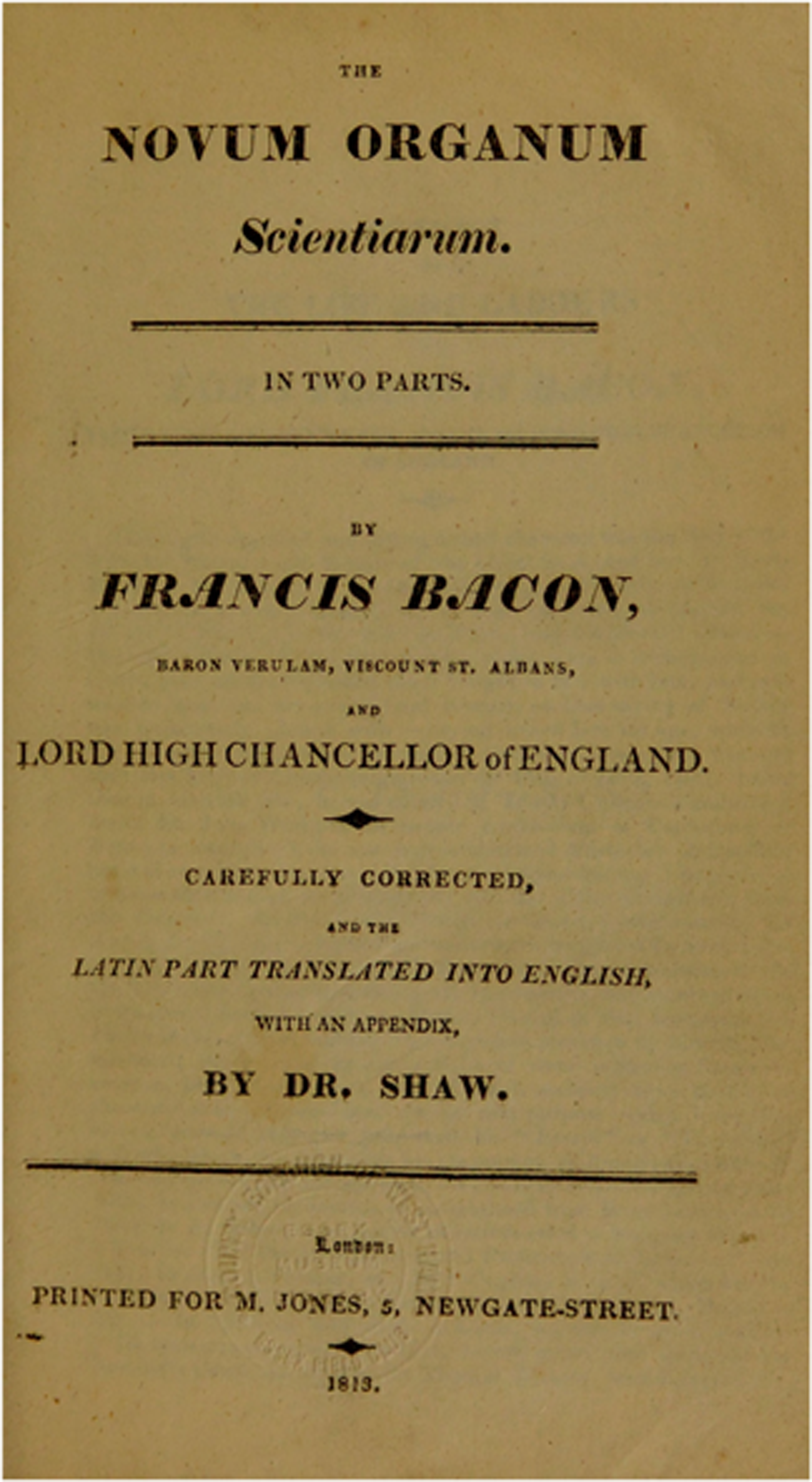
The Novum Organum Scientiarum: in two parts (by Francis Bacon) carefully corrected, and the Latin part translated into English, with an appendix, by Dr. Shaw (1813, a posthumous reprint). Shaw's experimental ideas are clearly rooted in the works of Bacon. Page two states that ‘Physicians pronounce many diseases incurable, and frequently mistake and fail in the cure of the rest'. Image courtesy of the Wellcome Collection.
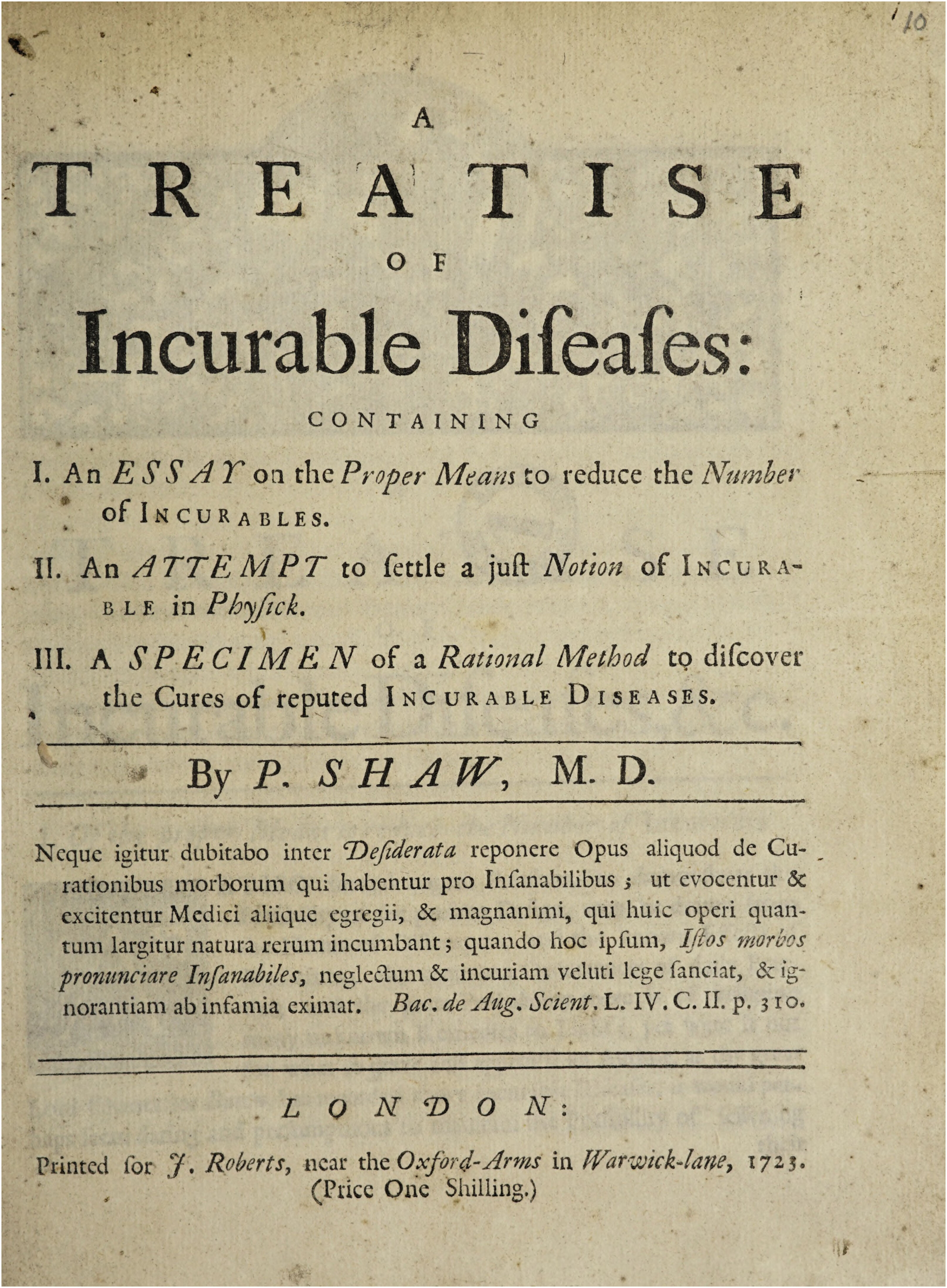
A treatise of incurable diseases: containing, I. An essay on the proper means to reduce the number of incurables. II. An attempt to settle a just notion of incurable in physick. III. A specimen of a rational method to discover the cures of reputed incurable diseases (1723). The footnote in Latin quotes Bacon's book ‘De Augmentis Scientiarum' (1623) and is an entreaty for physicians to dedicate themselves to solving diseases considered incurable. Image courtesy of the Wellcome Collection.
A Treatise of Incurable Diseases (1723)
The book 9 contains just 38 pages of text within the following Chapters: ‘An Attempt to settle a just Notion of Incurable in Physic’ (p. 18) ‘A specimen of a rational Method, to discover the Cures of reputed Incurable Diseases Of Madness’ (p. 24), ‘Of the Rabies Canina, or Hydrophobia, consequent upon the Bite of a mad-Dog’ (p. 27), ‘Of the Palsy’ (p. 29), ‘Of the Lues Venerea’ (p. 31), ‘Of the Gout’ (p. 35).
In order to advance his lofty notion of a ‘noble method in physic’, Shaw makes it clear that his aim is to ‘discover whether a reputed incurable be also a real incurable Distemper [i.e. disease]...’ (
9
, p. 23). He recognises that ‘in chronic [i.e. long term incurable] Diseases… no Opportunities are wanting to make the necessary Inquiries to find out the Cause, and to apply the proper Remedies’ (
9
, p. 21). He then advocates a foundation upon which to pursue the cause of such cases: I apprehend the best Course to be taken, is first to set down the several Properties of every Case distinctly; next, to draw as many Consequences from these Properties, as may give Light into the Nature of the Case, and assist in discovering its immediate Cause: And when this is obtain'd, we are naturally directed to search for the Remedy (
9
, p. 23). We daily observe so many unexpected and surprizing [sic] Turns in the Disorders of a human Body; Nature here acts by so many secret Springs, and makes so many unforeseen Sallies and Excursions, as if she took Delight to mock our Toil, baffle our best concerted Measures, and reverse our best form'd Judgments (
9
, p. 22)
Shaw's proposed hydrophobia antidote trial
Little has been published on proposals for controlled trials in the early eighteenth century before the 1740s. Shaw, however, offers what he calls: ‘a most desirable and rational way of procuring Specificks or grand Remedies’ (
9
, p. 12). Shaw's proposed trial states: Supposing the case of an Hydrophobia [rabies] occasion'd by the Bite of a mad Dog, where we know the Fluids are contaminated by an actual Poyson, which being contagious by a Communication of any of those Fluids, a way may very easily be contriv'd to obtain a quantity of the infected Saliva, or any other of the animal Juices [i.e. from a rabid dog], in order to make the proper Experiments upon it, till an Antidote for the Venom were by that means discover'd. This Antidote might thus be known to be found (
9
, p.12) Supposing two equal Portions of the contaminated Fluid to be procured, and the presumed Antidote to be mix'd in one of them, let both be communicated by Injection, or otherwise to two sound [i.e. healthy] Dogs; and if that wherein the presum'd Antidote was contain'd, proves harmless, and the other noxious [i.e. that the dog die from rabies], and the same Consequence attends the same Experiment in two or three Repetitions; it would be reasonable to expect that the Cure of this cruel Disease was discover'd, and the Medicine might therefore be try'd occasionally upon Hydrophobous [i.e. rabid] Patients, or rather administred soon after the Bite was receiv'd (
9
, p.12)
Shaw's entreaty for improved research in medicine (1723)
Elsewhere in his book, 9 Shaw reveals insight into other aspects of a scientific approach to medical research. Firstly, drawing upon the physical sciences, he hints at the need for medicine to make deductions from evidence. Thus, he calls for: ‘Reasoning from Data [i.e. facts] to Quaesita [i.e. what is being sought to be known], which has done Wonders in Philosophy, Astronomy, and Mechanicks’ ( 9 , p. 6). Secondly, he recognises that deductions should not be drawn from observing the effects of treatments in individual patients: ‘The success or failure of a single Experiment, is not sufficient to establish or abolish the use of a Remedy’ ( 9 , p.15). This observation is likely to be related to his observation that incurable patients can recover through ‘meer [sic] chance’ ( 9 , p.8).
Thirdly, Shaw affirms that positive clinical outcomes must be weighed up with negative ones: ‘If any undesirable Method of Cure shall, upon repeated trials, either prove intirely unsuccessful, or suffer more to die than recover, it ought not to be acquiesc'd in…. ( 9 , p. 15)’. Fourthly, in a similar vein, he proposes that successful treatment outcomes must not be judged only by complete cure. Thus, clinical improvement constitutes a positive outcome: ‘If any Disease can be transmuted into another, attended with less Danger, and less Pain, every such Transmutation is a Degree of Cure’ ( 9 , p. 15). It is of note that the term disease here conveys the more general notion of ‘dis-ease’ rather than the modern notion of a diagnosis.
Finally, Shaw advocates simplicity in explaining the cause of a disease, i.e. without resort to multiple diagnoses: ‘No more causes of a Disease need be inquired after, than will fairly and naturally account for its Phaenomena [symptoms and clinical signs]’ (
9
, p.15). This suggests that doctors of the day were prone to attributing illness to multiple causes at the same time, for example an imbalance of humours inside the body. Instead of ad-hoc use of medicine, Shaw appears to be calling for a more systematic approach to medicine starting with understanding the ‘nature of the disease’. Again, this appears to emulate Bacon's approach: For in these Cases [incurable diseases], our present stock of Experience is confessedly of no Service, and new random trials might be justly deem'd rash and Presumptuous: An attempt therefore to form a method of Cure, by arguing from the nature of the Disease, to the discovery of more powerful Remedies, is here the only rational and promising means we have left (
9
, pp. 9–10) the present practice of Physick is improveable, if it be consider'd that the several Branches of which this Art [i.e. medicine] is compos’d, are daily improving: whilst new discoveries are made in Anatomy, and Chirurgery grows more compleat; whilst Chymistry and Pharmacy furnish us with new Preparations, and Mechanicks is more successfully applied to the animal structure; it cannot be doubted but some use may be made of these Things to the advantage of Physic, and the cure of reputed incurable Diseases (
9
, p.10) the way to discover such a Cure, is not to stop short where the common Medicines fail, lazily term the Case Incurable, and then sit down contented, and applaud our selves for having got to the extent of our tether (
9
, p.6) I have, for a considerable time, and with attention, applied my self to collect and compare together the several methods which the most eminent physicians had fall'n upon of treating various diseases; and from a series of Observations made in this manner, the following Treatise gradually grew up; till at length it appeared in the form of one general standard practice (
10
, p.2)
Shaw's place in the timeline of the historical development of controlled trials
In Europe, the comparative approach to assessing medical treatments has its earliest origin in the book De Theriac ad Piso from the period 203 to 211 (
11
, pp.18, 12). This work has been attributed to Galen of Pergamon (or one of his disciples)
11
and considers the medicinal product theriac, in modern times known as ‘Venetian treacle’ (see Figure 3). This thick paste could contain ingredients as diverse as opium, viper's flesh and spices. Galen's own theriac comprised over 70 ingredients
12
and became the archetypal ‘antidote’ or preventative for envenomation from snake bite. Indeed, theriac was a staple of the Roman legionnaire on campaign for whom snakebite represented an occupational hazard and whose sandals yielded little protection.
12
Galen bequeaths a description of a comparative trial of its effect in the prevention of snake bite envenomation in wildfowl: Indeed, it is truly most famous among all men both because of the infallibility of its stated properties and the power of its stated properties and the power of its effect. For there is no record either of anyone dying from the bite of one of the wild beasts whose bite is usually fatal, if he immediately drinks the antidote [theriac] after being bitten, or of anyone dying who drinks it in advance and then not long afterwards is bitten and gets a strong enough dose to kill… ….For we take cocks - not those that live with us under the same roof, but rather wild ones, and with a rather dry constitution - and we put poisonous beasts among them, and those who have not drunk theriac die immediately, but those who have drunk it are strong and stay alive after being bitten… (
11
, pp. 69–71)
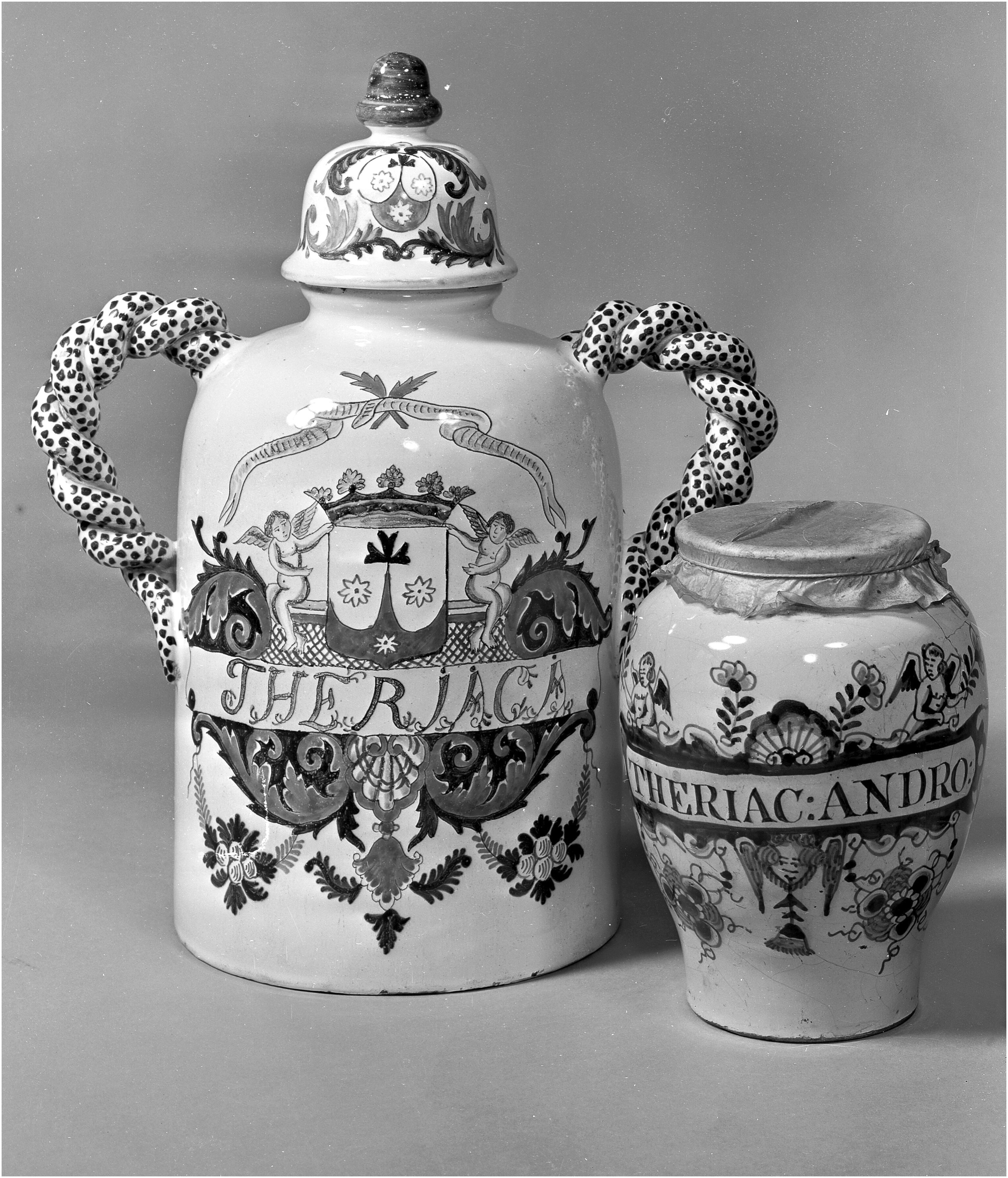
Two drug jars for storing theriac (Venetian treacle). Image courtesy of the Wellcome collection.
Subsequent proposals for controlled trials of medical treatments in Europe arose from the pen of Petrarca (1364) and Fioravanti (1573).13,14 Further proposals came in the Seventeenth century, most notably van Helmont (1648),13,14 Starkey (1658)13,14 and Mainwaring (1668). 15 In 1702, Sir John Floyer described comparing the effect of cold-water on athleticism in one of two boys. 16 Floyer is also of note as he may be the first to heed Bacon's call for data from experiments to be compiled within (simple) tables for ease of interpretation. 16
Despite this flurry of proposals for controlled enquiries, little was published on the comparative method in medicine during the early Eighteenth century. Shaw's 1723 proposed trial is, therefore, of note by appearing in print during this chronological gap. That notwithstanding, there is no evidence that Shaw stimulated a resurgence in calls for controlled trials of treatment. Afterwards, however, comparisons do emerge in parallel areas where the scientific method could be applied. Most notable, perhaps, is the English agriculturist Jethro Tull's (1674–1741) comparative approach to assessing the effectiveness of seed planting published in 1732: Let some of the Ridges have double Rows, others treble; and let some have treble Rows Half-Way, and leave out the middle Row in the other Half, to shew [sic] whether the double Row or the treble Row produce the better Crop
17
An inspiration for Hauksbee the Younger?
In 1731, Shaw published with Hauksbee the Younger a pamphlet entitled Proposals for a course of chemical experiments: with a view to practical philosophy, arts, trades, and business ( 20 , see Figure 4). In the same year An Essay for Introducing a Portable Laboratory by Shaw and Hauksbee was read at the Royal Society. 21 These documents about experimental enquiry suggest that Shaw was an early influence on Hauksbee – along with James Jurin (1684–1750) of the Royal Society. 15 Hauksbee and Shaw must have discussed experiments extensively, perhaps in the company of Jurin. This is consistent with evidence that Shaw had returned to London from Yorkshire by 1738. 1 Before this, however, Hauksbee must have already read Shaw's 1723 book containing his proposed comparative trial of rabies ‘antidote’.
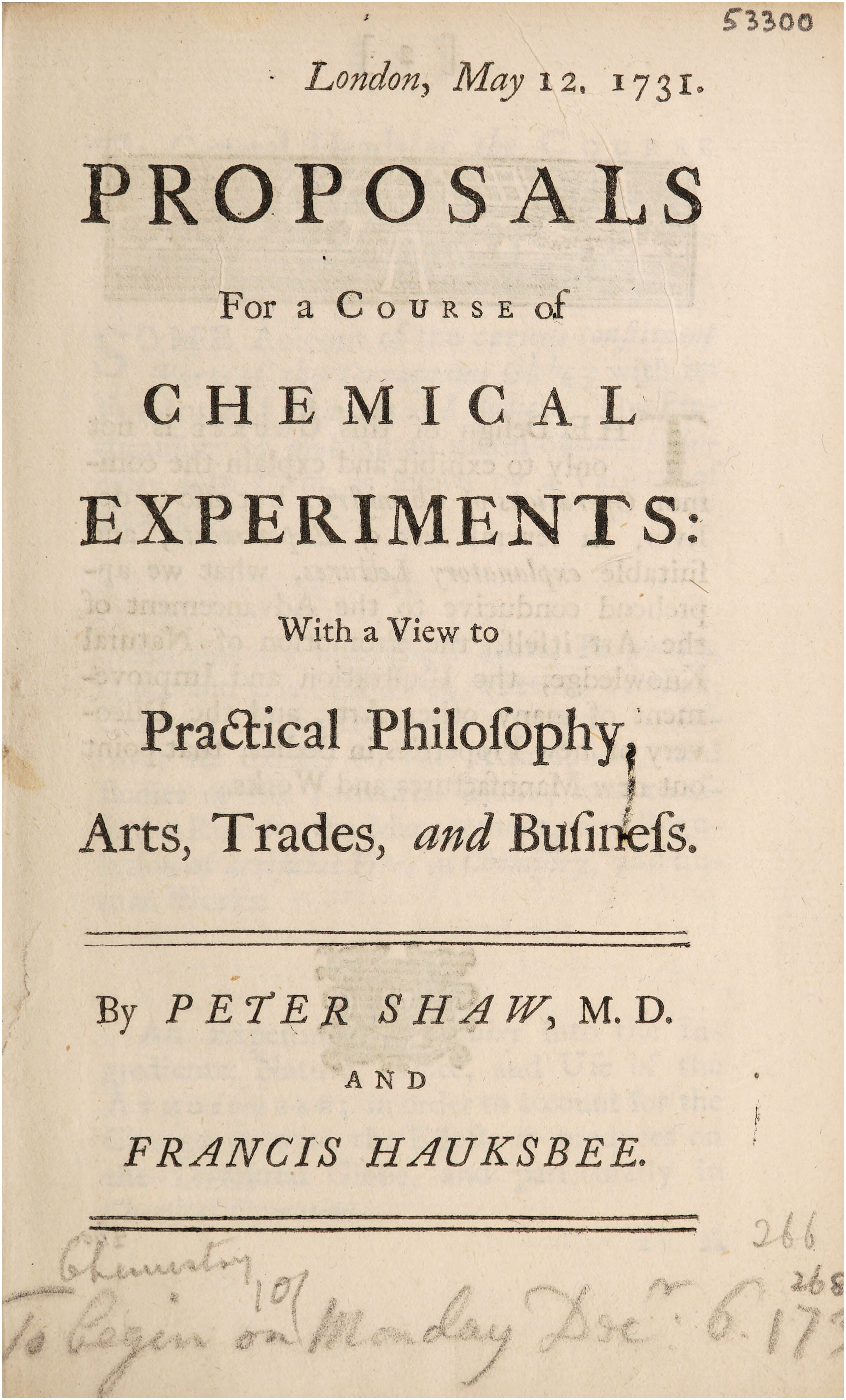
Proposals for a course of chemical experiments: with a view to practical philosophy, arts, trades, and business (1731). This highlights collaboration between Shaw and Hauksbee the Younger in the early 1730s. Image courtesy of the Wellcome Collection.
This claim is further supported by evidence from the 1743 pamphlet A Further Account of the Effects of Mr. Hauksbee's Alterative Medicine, As applied in the Cure of the Venereal Disease.
22
Herein, Hauksbee reveals both his personal affinity with Shaw and the fact that the latter was involved in early attempts at assessing the effects of the venereal treatment in question. What is more, Shaw is the only physician that Hauksbee is comfortable naming in response to accusations of failure to reveal the identity of his backers: Others objected, That the Persons of high Rank, and of the Faculty of Physick, alluded to in… my first Pamphlet, was an Assembly in the Clouds; for if it was real, Why was not their Titles, Names, &c. incerted [sic] for the support of such extraordinary Facts? &c. To this last Objection I can only say, That I then was, and still am very tender of mentioning the Titles, Names, &c. of this Company, because I have not Leave to do it; and as Three of them are now abroad in the Army, a Fourth is since dead, and a Fifth is a Physician at the Bath [presumably, the English city of Bath], I can only (to any purpose) mention a Sixth, who is the only one now in London that was present in that Company… and that is my old Friend and Quondam [i.e. in the past] Fellow-Student in Physick, Peter Shaw, M.D. of Pall-mall; and who was one of the Gentlemen that was deputed by that Company, in a more particular manner, to inspect and examine the several infected Persons before they began to take this [i.e. Hauksbee's venereal] Medicine, and during the Course of the Cures; and who did many times see this Medicine adminster'd to the several infected Persons by Mr. Watson [the apothecary working with Hauksbee], and did diligently remark, and with Candor report its Effects; and to this Gentleman, whoever shall be pleased to apply, may be fully satisfied, that the said Noble Company was not an Assembly in the Clouds, unless the Objectors should mean Clouds of Smoak [sic]; for we were both us (the Doctor [Shaw] and myself) at that time engaged in a Course of Chemistry with those Noble and Honourable Persons at St James's
22
The hand of Sir John Floyer?
Unlike the proposed trials of van Helmont (1648), Starkey (1658) and Blackrie (1763), 23 Shaw's calls for healthy cases to be studied (i.e. dogs without rabies) but omits a place for randomisation in participant selection (i.e. humans with rabies) or treatment intervention. His model for a controlled trial, therefore, appears to have arisen independently from the seminal proposal of van Helmont.
This begs the intriguing question of who else might have influenced Shaw? In a vacuum of uncertainty, one faint thread could offer a surprising origin for Shaw's comparative approach: Sir John Floyer. Shaw was from Lichfield, the town where Sir John Floyer was practising at the time. 16 Both these physicians were fascinated by and published upon mineral water treatment.6,16 Furthermore, Floyer and Shaw each proposed the most simple experimental comparison: two participants, of whom just one receives treatment. A shared origin, thus, might just be found in Floyer's controlled comparison of cold-water treatment upon athleticism published in 1702 and perhaps implemented at St Chad's bath, Lichfield. 16 One might even imagine Shaw as a young observer of – or active participant in – Floyer's running trial. Of course, the answer more likely rests with Shaw reading the Floyer's 1702 book which describes his cold-water trial.
Discussion
Peter Shaw was a prosperous physician and prolific writer with an interest in experimental chemistry. His 1723 A Treatise of Incurable Diseases stands out for its insight into and desire to understand disease causation and treatment. 9 Although the brief extracts considered above do not reflect the overarching substance of Shaw's many books, they offer glimpses of an enlightened approach to fair tests of medical treatments. This is most evident in his proposal for a systematic ‘translation’ of research from animals into humans, all with patient safety in mind. Shaw's proposal was published in what amounts to a historical ‘gap’ in the development of comparative methods for comparing treatments, i.e. the early Eighteenth century. His translational approach broadly anticipates Louis Pasteur's (1822–1895) groundbreaking research and testing of the first ever rabies vaccination in the 1880s. 24
Shaw was deeply swayed by the scientific approach of Bacon's entreaty for ‘new learning’. Shaw expounds upon this by highlighting the ‘grand purposes’ behind an experimental approach. Again like Bacon, Shaw's own appeal calls for improved ‘design’ (i.e. methodology) of experiments: And here I cannot but take notice, how apt we are to plume our selves upon living in an Age when experimental Philosophy flourishes. Experiments, its [sic] true, are daily made, but I wou'd fain know to what grand Purposes they serve? Several indeed there are, whose design is highly Commendable; but are there any now on foot, or that can possibly be contriv'd, of greater Moment, than the sort above mentioned; any more Beneficial to Mankind, or Ornamental to a Nation; any so well deserving the Encouragement of the Wealthy, and the Countenance of the Learned? (
9
, p.13) Tis a fatal mistake to suppose that the Sciences have gradually arrived at a state of perfection, and then been recorded by some one Writer or other, and that as nothing better can afterwards be invented… whereas, in reality, this registring [sic, i.e. documenting] of the Sciences proceeds only from the assurance of a few, and the sloth and ignorance of many (
25
, Sect I. p 5) [Shaw] wrote largely, and in some instances hastily, as he was wont in his later years to confess, and as is admitted by his son-in-law and eulogist, Dr. Richard Warren
2
Sir Edward Hulse, bart., one of the court physicians … writing in 1748 to Dr Heberden, said that Dr Shaw had even then too much business, and more than he could possibly do.
2
Conclusion
The present article, we trust, goes some way to recognising the achievements of Dr Peter Shaw and to stimulate interest in his life and works. Shaw's 1723 book A Treatise of Incurable Diseases bequeaths an early entreaty for physicians to undertake more extensive and better experiments. This message has obvious roots in Bacon and broadly anticipates the famous advice offered by John Hunter (1728–1793) in 1775 to his pupil Edward Jenner (1749–1823): ‘but why think? Why not try the experiment?'.
12
Like many of his contemporaries, Shaw struggled to make the transition from elegant study proposal to meaningful comparison of medical treatments in patients. This may be one reason – in stark contrast with the enduring legacies of Hunter and Jenner – why Shaw's life and experimental ideas have been largely forgotten. Perhaps his most notable contribution to have escaped notice is an early model for a comparative trial of rabies antidote in dogs and humans. From this obscurity, however, Shaw re-emerges as an esteemed physician, a loyal subject, an indefatigable wordsmith, a gifted linguist, a seeker of facts and a dedicated experimentalist. The lattermost point, it should be noted, finds its clearest expression in his writing on chemistry. This overarching conclusion echoes that of William Munk penned in the mid-Nineteenth century: Of this eminent physician and voluminous writer but few records remain…. Dr Shaw, who is now but little known, except by his editions of Bacon and Boyle, was one of the most active, industrious and favoured physicians of his time
2
Footnotes
Contributions
MC identified source, drafted and submitted paper. SC read and commented upon drafts.
Funding
The authors received no financial support for the research, authorship, and/or publication of this article.
Declaration of conflicting interests
The authors declared no potential conflicts of interest with respect to the research, authorship and/or publication of this article
