Zitterbewegungen des Fusses bei Dorsalflexion (shaking movements of the foot upon dorsal flexion) were observed independently from each other and described in the same issue of a German peer reviewed journal by Carl Westphal (1833–1890) at the Charité in Berlin and by Wilhelm Erb (1840–1921) in Heidelberg. While Westphal used the term Fussphaenomen, Erb is credited with coining the term clonus for the phenomenon. Both scientists are immortalized by various eponyms acknowledging their respective contributions to science. Little is known however about Julius Sander (1840–1909), in those days resident at Charité, who noticed the phenomenon and presented it to his superiors, Wilhelm Griesinger (1817 −1868) and Westphal. In addition to such observations, Sander made original contributions in resuscitation physiology while working with Hugo Kronecker (1839–1914). With Kronecker, Sander published observations on life saving transfusions with inorganic salt solutions in dogs “Bemerkung über lebensrettende Transfusion mit anorganischer Salzlösung bei Hunden” a very early work on isovolemic fluid resuscitation. The purpose of this communication is to highlight Sander's scientific contributions and to shed some light on his life, of which a German Lexicon stated that after 1870 no information on him can be ascertained anymore.
The English (and Latin) word clonus is derived from the Greek klónos, used by physicians of the Antiquity to describe involuntary muscle contractions during confused motion, i.e. during seizures. Centuries later, the 1811 American Medical Lexicon of John Quincy defines clonos as any tumultory, interrupted or inordinate motion…. applied to epileptic and convulsive motion.
French neurologist Charles-Édouard Brown-Sequard (1817–1894) understood clonus as spinal epilepsy while Jean-Marie Charcot (1825–1893) and Alfred Vulpian (1826 −1887) described ankle clonus (clonus de cheville) under the name trépidation épileptoïde du pied.1 Sharp dorsiflexion of the foot producing clonus is known as Charcot-Vulpian sign.
In the German medical literature Zitterbewegungen des Fusses bei Dorsalflexion (shaking movements of the foot upon dorsal flexion) were described independently in the same issue of a peer reviewed journal by Carl Westphal (1833–1890) at the Charité in Berlin and by Wilhelm Heinrich Erb (1840–1921) in Heidelberg.2,3 Both terminology-wise and etiology-wise there is clear distancing from the association with epilepsy.
In his paper Westphal writes “I became aware of shacking movements of the foot upon dorsal flexion when I took over the neurology clinic in 1869, as Dr Julius Sander, the resident physician at the time, presented those to me as a curiosity” [“Ich lernte letztere Zitterbewegungen des Fusses bei Dorsalflexion bei meiner Uebernahme der Nervenklinik im Jahre 1869 kennen, indem mir die Zitterbewegungen des Fusses bei Dorsalfiexion desselben vou dem damaligen Assistenten, Herrn Dr Julius Sander, als ein Curiosum gezeigt wurden”].
Erb is additionally credited with introducing in the German medical literature the term clonus to replace the previous ones (spinal epilepsy and trépidation épileptoïde du pied). He writes: “In all examined cases….. upon dorsiflexion of the foot a clonic twitch was noted” [In allen den bisher untersuchten Erkrankungsfaellen fand sich aber auch weiterhin eine Erscheinung, namlich das bekannte klonische Zucken des Fusses welches bei ploetzlicher passiver Dorsalflexion desselben eintritt].
While Erb, Westphal, Charcot, Vulpian and Brown-Sequard are immortalized by various eponyms acknowledging their respective contributions to science, little is known about Julius Sander (1840–1909), in those days resident at Charité, who noticed the phenomenon and demonstrated it to his superiors, Wilhelm Griesinger (1817 −1868) and Westphal. In addition to such observations, Sander made original contributions in resuscitation physiology while working with Hugo Kronecker (1839–1914). In 1878, Kronecker moved to Berlin to become department director in the Physiological Institute; his stay was however rather short as in 1885, he accepted the Chair of the Physiology Department at the University of Bern, Switzerland. With Kronecker, Sander published observations on life saving transfusions with inorganic salt solutions in dogs “Bemerkung über lebensrettende Transfusion mit anorganischer Salzlösung bei Hunden” one of the very early works on fluid resuscitation. Also with Kronecker he described the excitatory effect of strychnine, to the effect that minor excitations suffice to trigger major reactions (so dass kleine Reize genuegen, um einen Grossen Effect auszuueben).
The purpose of this communication is not to reignite the controversy on the primate of the clonus description and or its explanation but to highlight Sander's contributions and to shed some light on his life, of which a German Lexicon stated that after 1870 no information on him can be ascertained anymore.4,5
Origin & family
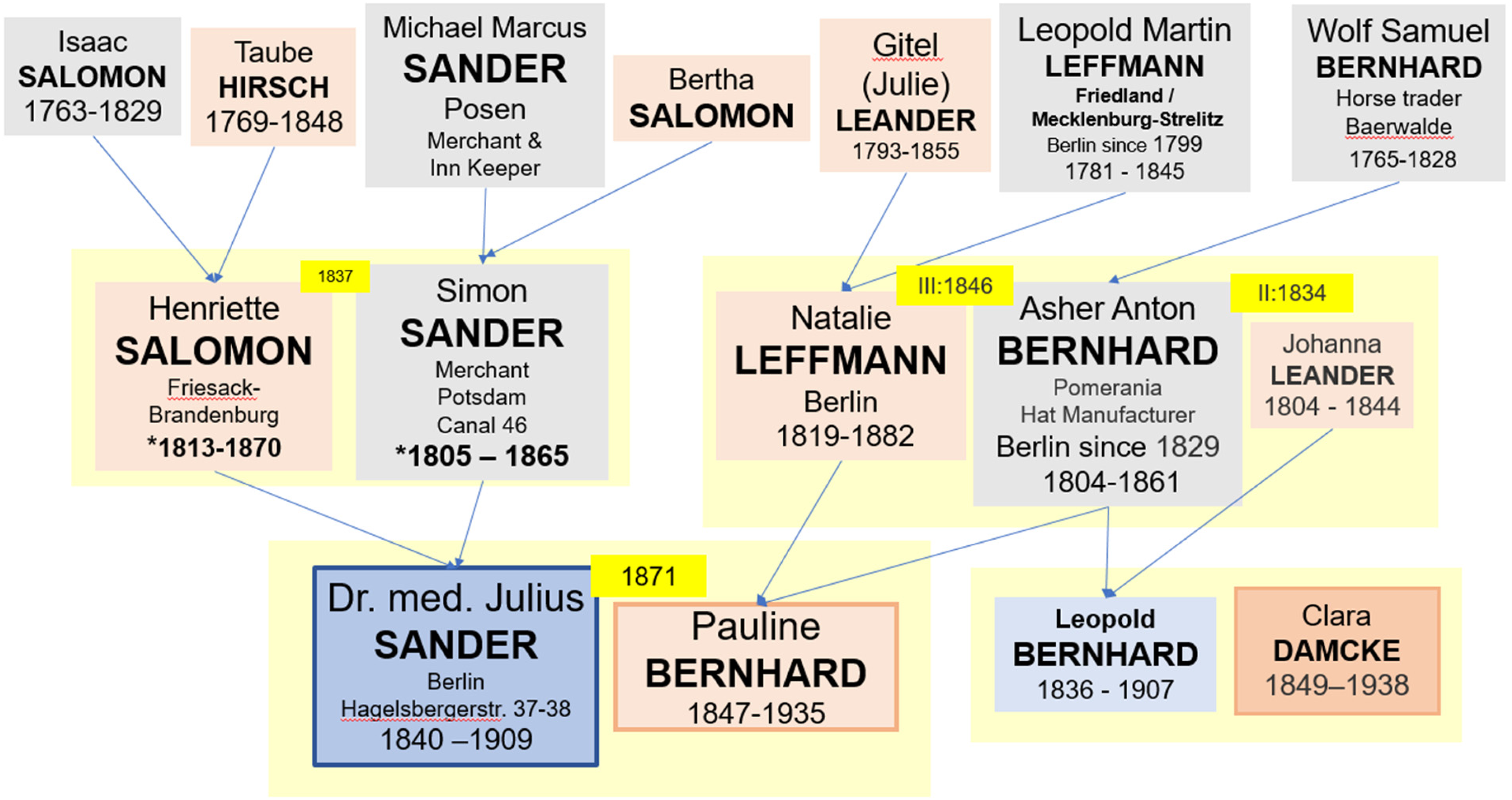
Born 1840 in Potsdam, in a moderately affluent household, Julius was the son of Simon Sander (1805 −1865), a merchant, and Henriette born Salomon (1813–1870) of Friesack in Brandenburg (Figure 1).6
Family tree of Julius Sander (1840-1909) and his wife Pauline Bernhard (1847-1935).
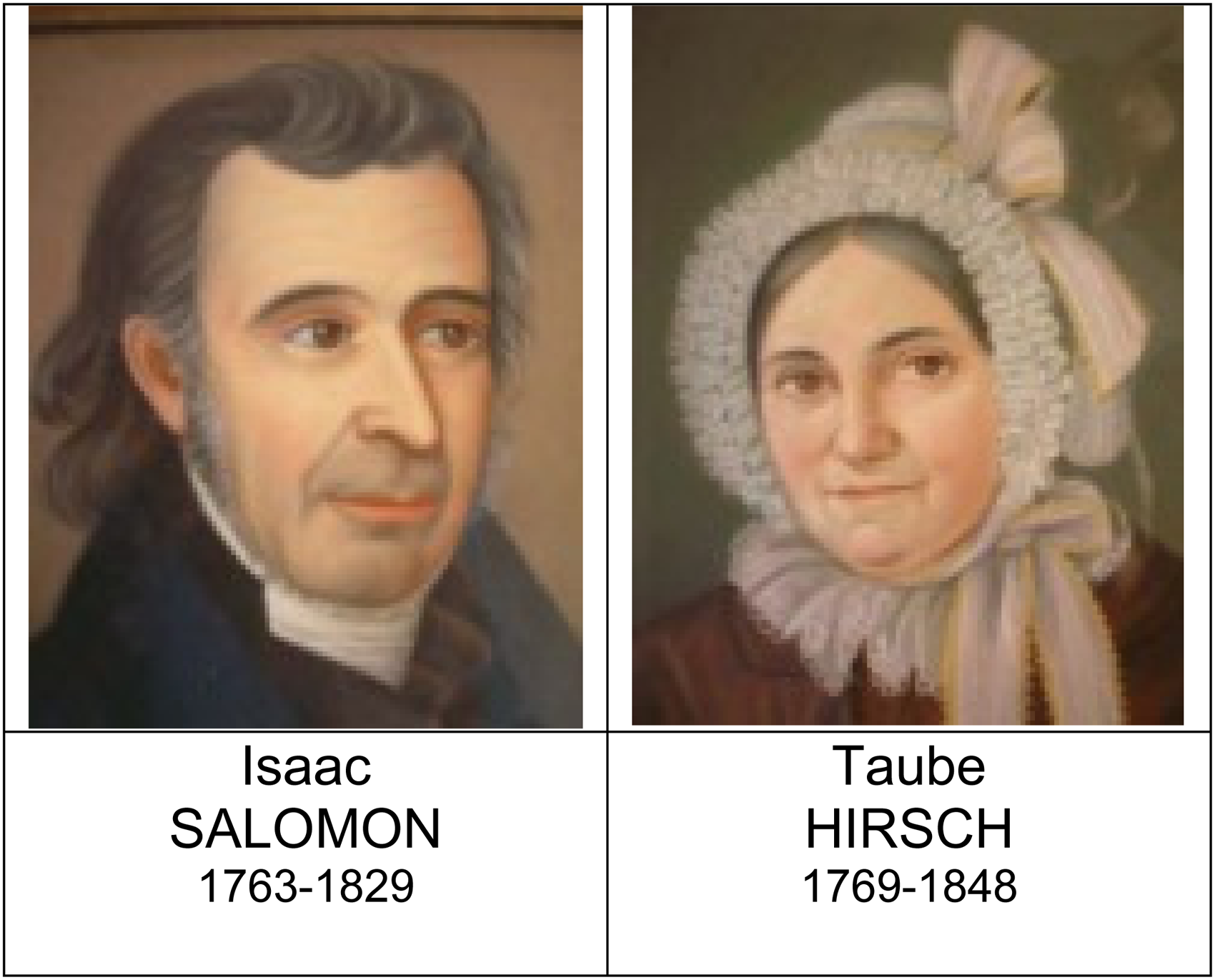
The origins of the solid financial basis of the family were the maternal grandparents (Isaac Solomon and his wife Taube born Hirsch) (Figure 2) and the connections established by the marriage of Simon's sisters Johanna and Pauline into the affluent Lubosher banker family [Efraim Joseph Luboscher (1812–1885), merchant in Potsdam, Canal 46].6
Dr Sander's maternal grandparents Isaac Solomon and his wife Taube born Hirsch.
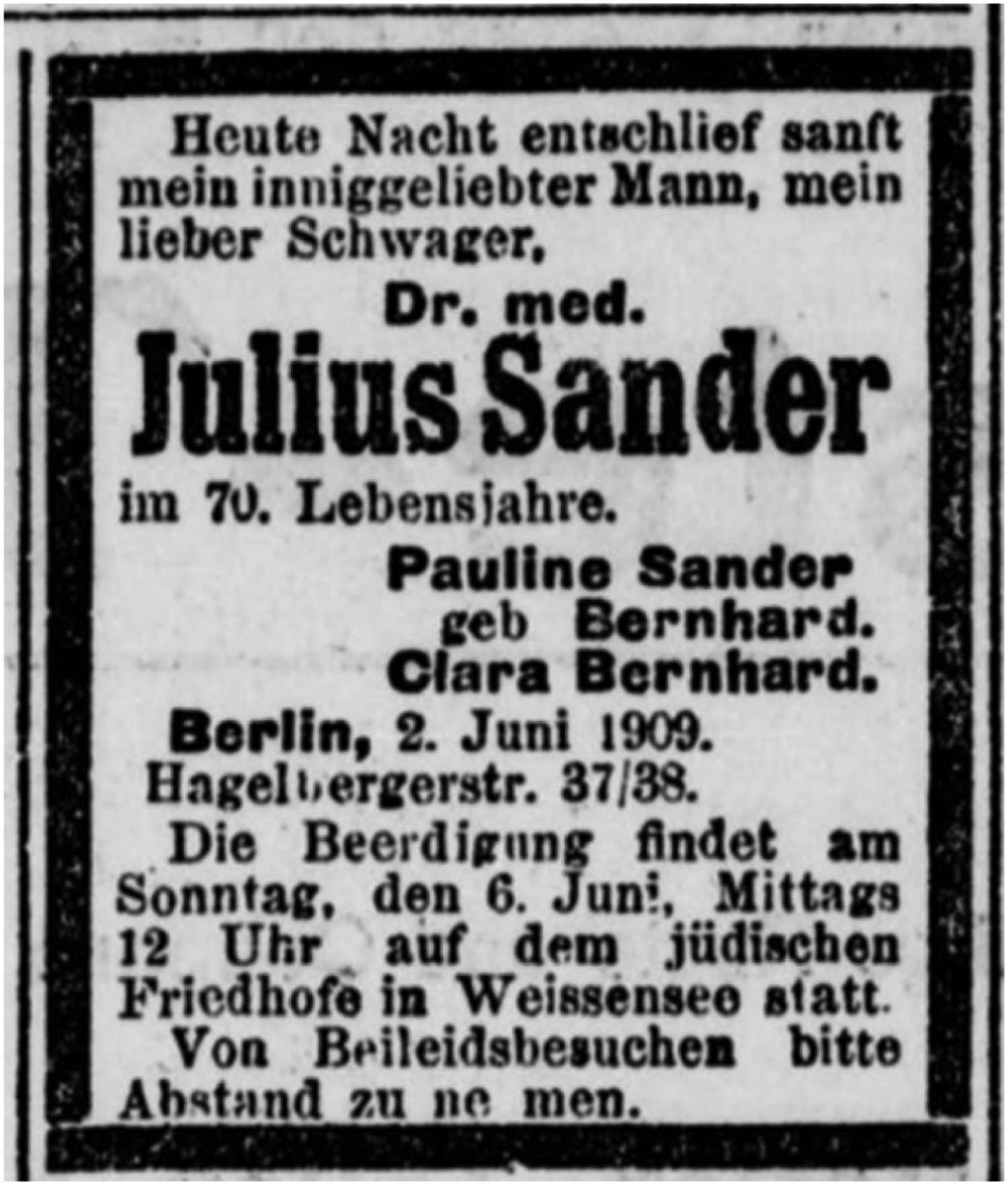
Julius and Pauline married in 1871, the couple had no children. Julius wife Pauline, was the daughter Asher (Anton) Bernhard (1804–1861), a hat manufacturer (Hut-Fabrikant) in Berlin and of his (third) wife Natalie Leffmann (1819–1882). After Julius death 1909, his wife Pauline resideed at the Hagelsberger street 37/38 address (where Julius consultory was also located) until her death 1935 (Figure 3).
Berliner Tageblatt from June 3rd, 1909 (kindly provided by Alexandra Inama-Knaeblein; Universitätsbibliothek Heidelberg).
Pauline was listed in a lexicon of German women writers of the epoch, with the comment that she published feuilleton, anecdotes and humoristic pieces.7 It turns out however that the listing was in error; the real author was a relative, Clara Bernhard born Damcke (see death announce for Julius). Clara (the spouse of Pauline's half-brother Leopold) authored such material.8,9
Sander the physician
At the age of ten he entered the Royal Potsdam Gymnasium (Koenigliches Gymansium zu Potsdam) where he graduated eight years later (1858). The same year (Michaelis1 1858 to Easter 1859; winter half year) he was matriculated as a medical student at the University in Berlin (Berolina), the following half-year at the University of Würzburg (Herbipolis). He returned to Berlin Michaelis 1859 where he continued until graduation 1862.
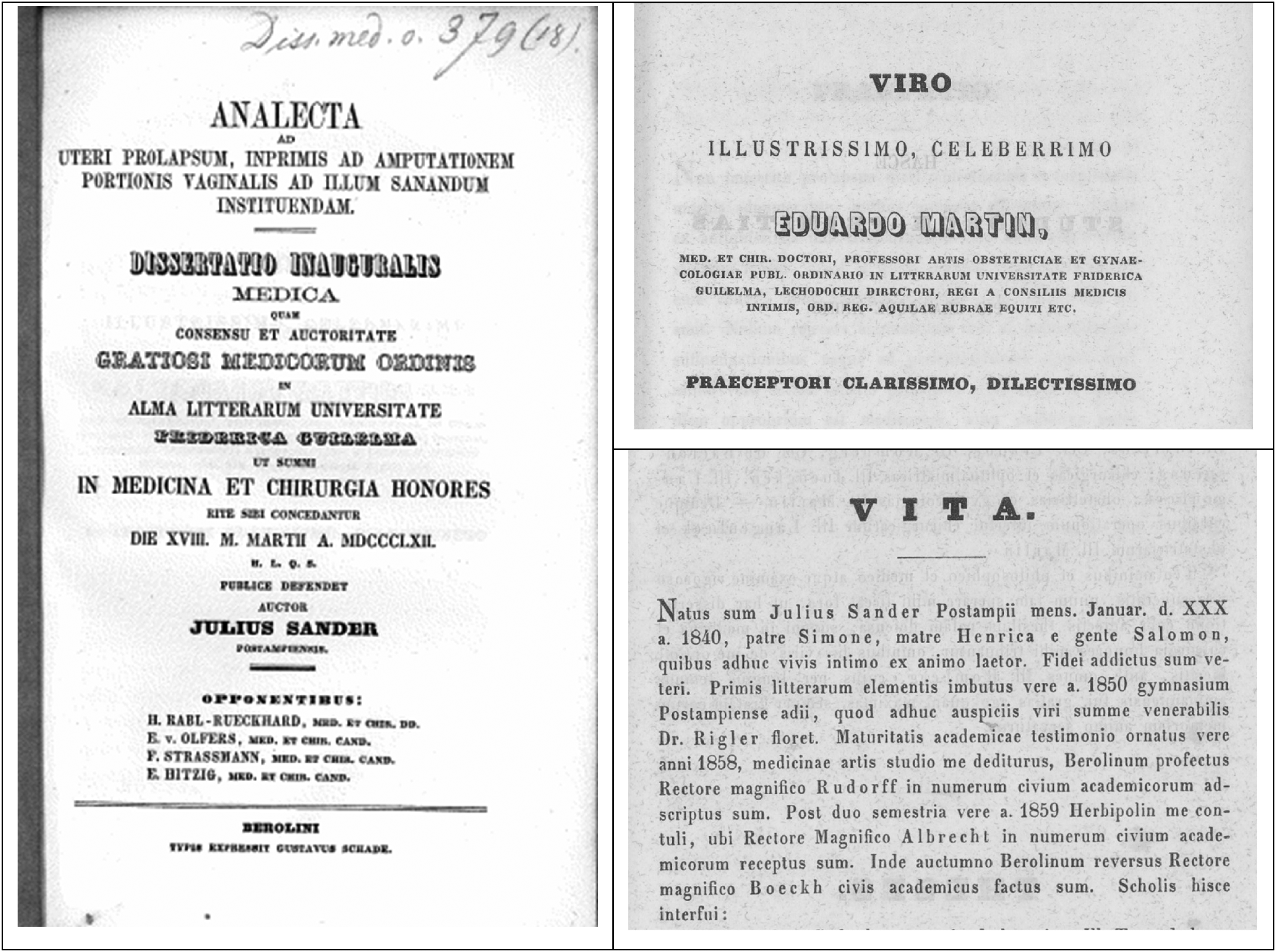
The same year he defended his Doctoral Thesis titled Excerpts on the Prolapse of the Uterus prepared under the supervision of his Doktorvater, Professor Eduard Arnold Martin (1809–1875) and with the support of Martin's assistant, (later professor) Dr Adolf Gusserow (1836–1906) (Figure 4). The list of his opponents at his doctoral exam in March is equally impressive: Ernst von Offers (1840–1915), Hermann Rabl-Rückhard (1839–1905), later military physician and anatomist and member of the Leopoldina Academy of Sciences, Ferdinand Straßmann (1838–1931), later Director of the Health Authority of the City of Berlin, and Eduard Hitzig (1838 −1907), later neurologist and psychiatrist
Cover page of his Doctoral Thesis, dedication to his supervisor (Doktorvater) Professor Eduard Arnold Martin (1809–1875) and Sander's vita.
The Amtsblatt der Regierung (Official Monitor) in Potsdam: 1863 - Page 151 announced that the Doctor of Medicine and Surgery Julius Sander in Berlin was licensed (aprobiert) and sworn in as a General Practitioner, Wound Physician and Obstetrician in his Majesties Countries.
From 1862 to 1889 Dr Sander was affiliated (in various functions) with the Charité, where, as a young resident (Assistenz Arzt) he lived at Unterbaumstraße Nr. 7, which was (and still is) the adress of the Charité.
Starting with the early 1870ies he spent a number of years in Malaga, in those days a city of some 120 thousand inhabitants, popular for extended stays mainly among well-off foreigners afflicted by lung disease. As stated in the Handbook for Travelers in Spain (1878): “…the invalid who can secure south rooms will be able to sit with open windows till evening in the mid-winter”. The same source lists among the resident English-speaking physicians -that year three altogether- Dr Julius Sander on Calle Mendez Nunez 2, at the corner with Calle Granada.10
It is unclear what motivated Sander to interrupt a promising career at the Charité for the sun of Andalusia, but one can speculate that his own health was a factor. He participated both in the Danish-Prussian War of 1864 and the Franco-Prussian War (1870–1871).11
Upon return to Berlin, he continued his academic activities until the end of the 1890ies when he turned entirely to private practice, first at locations on the Belle Alliance street (Belle Alliance is the name Germans prefer for the site of the famous battle the English call Waterloo) and then, for the rest of his life, in the Hagelsberger street 37/38, where he also resideed.
Sander the researcher
Sander's scientific contributions can be roughly assigned to three time periods: work at Charité mainly under Griesinger (before 1868) and then for a brief period (before the French-Prussian War) under Westphal, then the Malaga period, and finally the collaboration with Kronecker in the Physiological Institute before 1885.
At Charité he published anatomical and pathological contributions, mainly in the journal Archiv für Psychiatrie und Nervenkrankheiten established by Griesinger. A complete listing of his works from this time is provided by [Kreuter 1996], the most comprehensive one dealing with aphasia.12
In Malaga he conducted over a three-year period, continuous meteorological observations, which he published under the title Berichte aus Kurorten.13 In the introductory note the Editor states that “all observations were made 3times a day…..unfortunately always in the same room at an open window” which seems to indicate that the observer (Dr Sander) might have been limited in his mobility/convalescent.
With Hugo Kronecker, in Berlin from 1878 to 1885, Sander published a very short but possibly-paradigm shifting contribution related to fluid resuscitation using alkaline saline.14 They bled two dogs via the carotid artery until a significant reduction in cardiac activity (Herztaetigkeit) stopped the blood flow; the volume lost was approximately 50–60% of the total blood volume. Subsequently a volume of alkaline saline (Gaul'sche Fluessigkeit; 0.6% NaCl + 0.005% NaOH) corresponding to the induced blood loss was infused via the external jugular vein. Cardiac activity resumed and the animals recovered quickly.
This widely cited but limited animal (n = 2) experimental work, was a forerunner of modern fluid resuscitation in humans, initiated in Germany 1881 by Albert Sigmund Landerer (1854–1901).15 Of course, such ideas and therapies were developed and implemented in other countries as well: Thomas Latta (1796–1833) in Scotland is considered by many to be the father of saline infusion (to a cholera patient in 1831).16,17
Also from this period are Sander publications on syntonin solubility, various attempts at determination of circulating blood volume in vivo, and a neuro-anatomical contribution.18–20
Muscle fibrin, a protein-like substance identified 1850 by Justus von Liebig (1803 −1873) and named 1854 syntonin by Carl Gotthelf Lehmann (1812–1863), was viewed as an important constituent of muscular tissue, formed from myosin (a native protein) by the action of dilute acids. Eduard Grimaux's (1835–1900) Chimie Organique Elmentaire recognized that “syntonine seems to be the first product of gastric juice on albuminous substances”.21–24
Stedman's Practical Dictionary from 1914 defined syntonin (acid albumin) “as a derived albumin formed by the action of a dilute acid on a native albumin”. Later publications only rarely mention the term. A 1929 protein chemistry book defined syntonines (plural) as products obtained by the action of acids….on proteins.25 Sander's work in this area did not fundamentally alter our understanding (or misunderstanding) of syntonin.
Conclusion
Dr Julius Sander, a curious mind, contributed to various fields of science. While the fog of time hinders objective assessment of his contribution, it is certain that he was an early observer of the clonus phenomenon in neurological patients at the Charité and that his work with Kronecker provided the animal experimental foundation for the introduction of saline volume replacement therapy. Participation in both Danish- and Franco-Prussian wars most likely affected his health and possibly cut short his life. Details of his life after 1870 are presented and contextualized.
Thanks
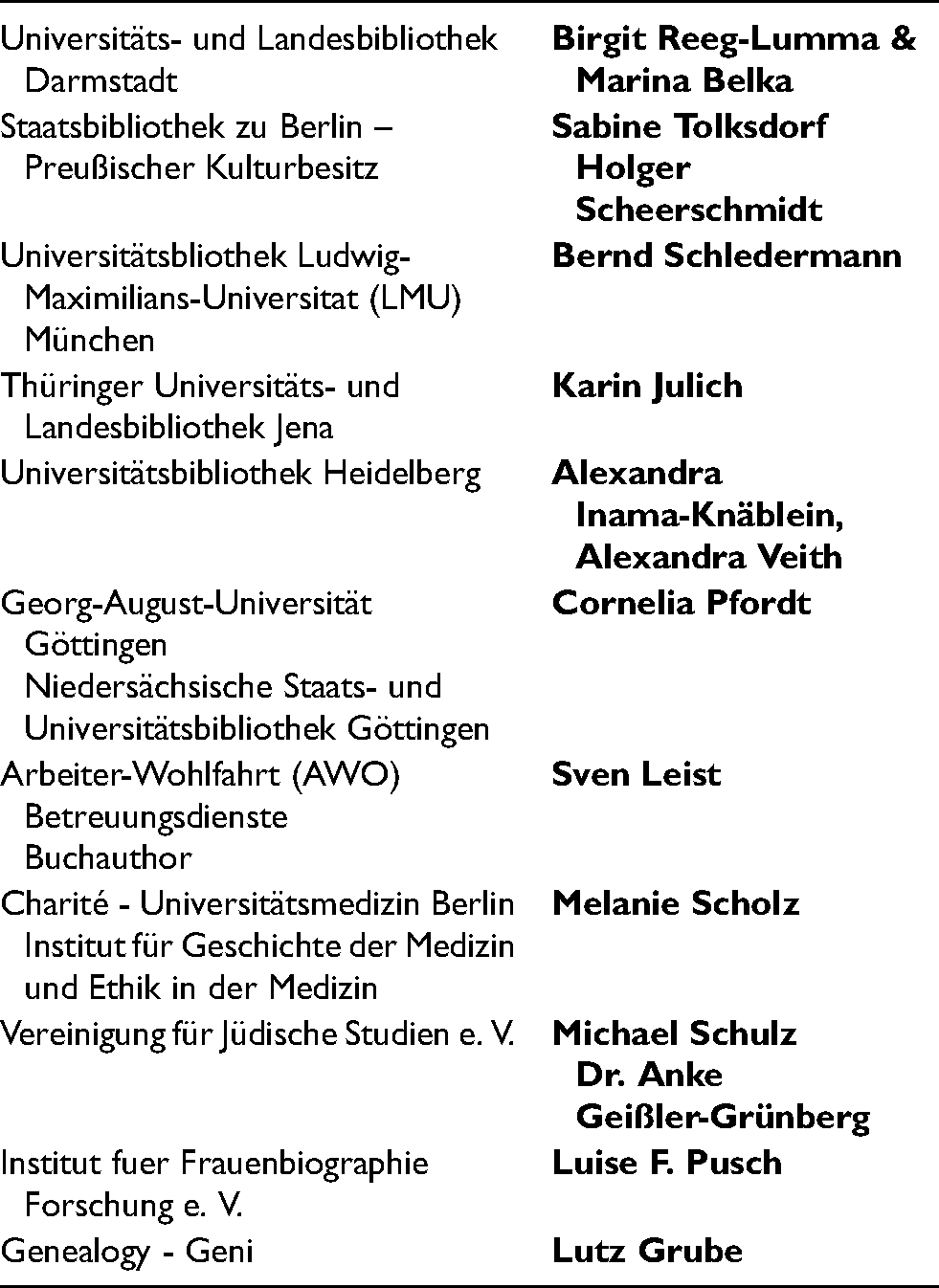
This contribution would not have been possible without the help and support of many generous people and organizations. My gratitude to
Universitäts- und Landesbibliothek Darmstadt
Birgit Reeg-Lumma & Marina Belka
Staatsbibliothek zu Berlin – Preußischer Kulturbesitz
Sabine Tolksdorf Holger Scheerschmidt
Universitätsbliothek Ludwig-Maximilians-Universitat (LMU) München
Bernd Schledermann
Thüringer Universitäts- und Landesbibliothek Jena
Karin Julich
Universitätsbibliothek Heidelberg
Alexandra Inama-Knäblein, Alexandra Veith
Georg-August-Universität Göttingen Niedersächsische Staats- und Universitätsbibliothek Göttingen
Charité - Universitätsmedizin Berlin Institut für Geschichte der Medizin und Ethik in der Medizin
Melanie Scholz
Vereinigung für Jüdische Studien e. V.
Michael Schulz Dr. Anke Geißler-Grünberg
Institut fuer Frauenbiographie Forschung e. V.
Luise F. Pusch
Genealogy - Geni
Lutz Grube
Footnotes
Declaration of conflicting interests
The author(s) declared no potential conflicts of interest with respect to the research, authorship, and/or publication of this article.
Funding
The author(s) received no financial support for the research, authorship and/or publication of this article.
ORCID iD
Georg A Petroianu
Supplemental material
Supplemental material for this article is available online.
Notes
Author biography
George A Petroianu received his medical degree from the University of Heidelberg at Mannheim (Germany), followed by a PhD in Pharmacology from the same University. He is board certified in Pharmacology (Germany), Clinical Pharmacology (US) and Prehospital Emergency Medicine (Germany). He was appointed Professor at the University of Heidelberg, than (2002) Professor and Chair (Pharmacology and Therapeutics) at the UAE University, Faculty of Medicine and Health Sciences, and in 2008 Tenured Professor and Chairman of the Department of Cellular Biology and Pharmacology at the FIU College of Medicine, Miami. He received numerous teaching awards, was an invited speaker at over eighty national and international symposia and conferences, has authored over 200 peer reviewed research papers, six books and 15 book chapters and he is an Honorary Member of numerous professional societies. Dr. Petroianu served for many years on the United States Medical Licensing Examination (USMLE) Pharmacology and Biochemistry Test Material Development Committee and is a Fellow of the Academy of Pharmacology Educators (FAPA; USA). He recently joined Khalifa University as Associate Dean for Research at the College of Medicine and Chair of the Department of Pharmacology and Therapeutics.
References
1.
VulpianACharcotJ-M.
Mémoire sur la sclérose en plaques de la moelle épinière. Bulletins et Mémoires de la Société Médicale Des Hôpitaux de Paris1867;
3:
87–
100. Paris, P Asselin, Gendre et Successeurs de Labe.
2.
WestphalC.
Ueber einige Bewegungs-Erscheinungen an gelaehmten Gliedern. Archiv für Psychiatrie und Nervenkrankheiten1875;
5:
803–
834.
3.
ErbW.
Ueber Sehnenreflexe bei gesunden und bei Rueckenmarkskranken. Archiv für Psychiatrie und Nervenkrankheiten1875;
5:
792–
802.
4.
HoldorffB.
Carl Westphal (1833–1890). Journal of Neurology2005;
252:
1288–
1289.
5.
KreuterA.
Sander, Julius. In: HippiusHHoffP (eds) Deutschsprachige Neurologen und Psychiater. Ein biographisch-bibliographisches Lexikon von den Vorläufern bis zur Mitte des 20. Jahrhunderts.
Muenschen:
De Gruyter Verlag KG Sauer,
2013, p. 1230.
FordR. Handbook for travelers in Spain. Fifth.
London:
John Murray,
1878.
11.
WredeR.
Sander, julius. In: Das geistige Berlin. Eine Encyklopädie des geistigen Lebens Berlins. Band 3.
Berlin:
Verlag von Hugo Storm,
1898.
12.
SanderJ.
Ueber Aphasie. Archiv für Psychiatrie und Nervenkrankheiten1870;
2:
38–
63.
13.
SanderJ.
Berrichte aus Kurorten. Vierteljahrschrift fuer Klimatologie1876;
1:
219–
220.
14.
KroneckerHSanderJ.
Bemerkung über lebensrettende Transfusion mit anorganischer Salzlösung bei Hunden. Berliner klinische Wochenschrift1879;
16:
767.
15.
EbsteinE.
: Zur Entwicklung der intravenoesen injektionstherapie. Therapeutische Monatshefte XXIX: Aprilheft1915:
211–
215.
16.
GoerigM.
The beginnings of volume therapy. Anästhesiol Intensivmed Notfallmed Schmerzther2001;
36:
71–
75.
17.
JanakanGEllisH.
Dr Thomas Aitchison Latta (c 1796–1833): pioneer of intravenous fluid replacement in the treatment of cholera. Journal of Medical Biography2013;
21:
70–
74.
18.
SanderJ. Ueber die Loeslichkeit des Syntonins. Verhandlungen der physiologiscen Gesellschaft zu Berlin 1880-1881. Sitzung am 25. Februar 1881. p 198.
1881.
19.
SanderJKroneckerH. Ueber die Bestimmung der cirkulierender Blutmenge im lebenden Tiere. Verhandlungen der physiologiscen Gesellschaft zu Berlin 1880–1881. Sitzung am 29. Juli 1881. p 471.
1881.
20.
SanderJKroneckerH.
Ueber die Verbreitung der Gefaessnervencentren. Archiv fuer Physiologie Sitzung am 5. Mai
1882:
422–
423.
21.
LiebigJv.
Ueber das Fibrin der Muskelfaser. Annalen der Chemie und Pharmazie1850;
LXXIII:
125–
128.
22.
LehmannCG. Handbuch der physiologischen Chemie: mit besonderer Berücksichtigung der zoochemischen Dokimastik.
Leipzig:
Verlag von Wilhelm Engelman,
1854.
Hoppe-SeylerF. Handbuch der physiologisch- und pathologisch-chemischen Analyse fuer Aerzte und Studierende) Paragraph 184.
Berlin:
Verlag von August Hirschwald,
1883.
25.
RothmannSSchaafF.
Chemie der Haut. Page 189. In: FreyNAHoepkeNAReinNAJuliusB (eds) Physiologie der Haut. Berlin:
Springer,
1929, p. 189.